
AP Comparative Government Part One Vocabulary to Know
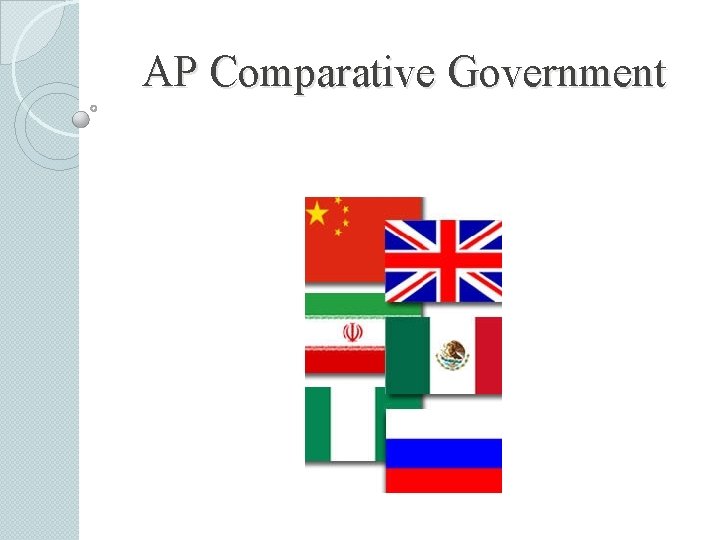
AP Comparative Government
Part One: Vocabulary to Know
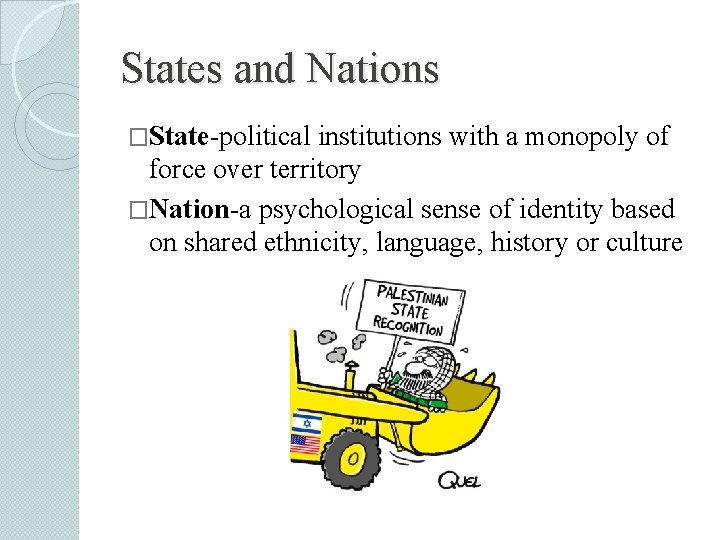
States and Nations �State-political institutions with a monopoly of force over territory �Nation-a psychological sense of identity based on shared ethnicity, language, history or culture

Institutions �Formal policymakers within the government, including the executive, legislature, judiciary and bureaucracy
Regimes and Hybrid Regimes �Regime-a long-lasting government in which the system has not changed even though there have been different leaders. �Hybrid regime-a government with both authoritarian and democratic elements. �Also known as illiberal regime, structure of democracy but does not protect civil liberties. i. e. Apartheid regime in S. Africa (1948 -’ 94)

Legitimacy �Legitimacy is the people’s belief that the government has the right to rule �Rational/legal-based on a fair and understandable system of laws that are followed and apply to everyone �Traditional-because it has always been that way �Charismatic-based on a ruler’s engaging personality
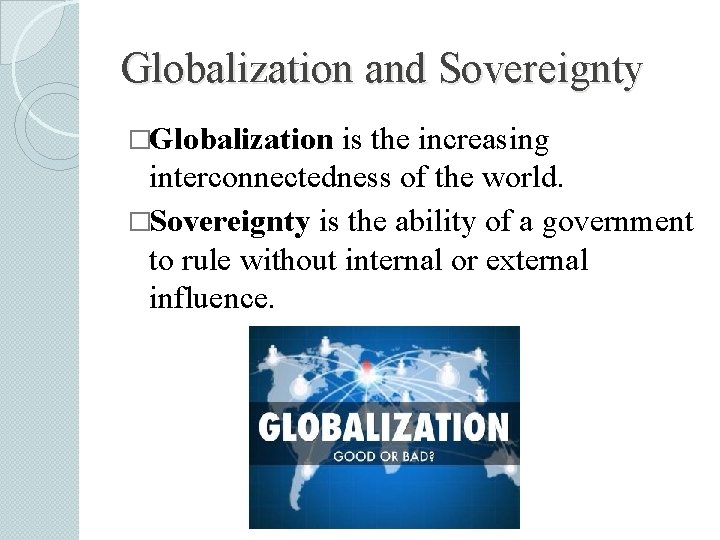
Globalization and Sovereignty �Globalization is the increasing interconnectedness of the world. �Sovereignty is the ability of a government to rule without internal or external influence.
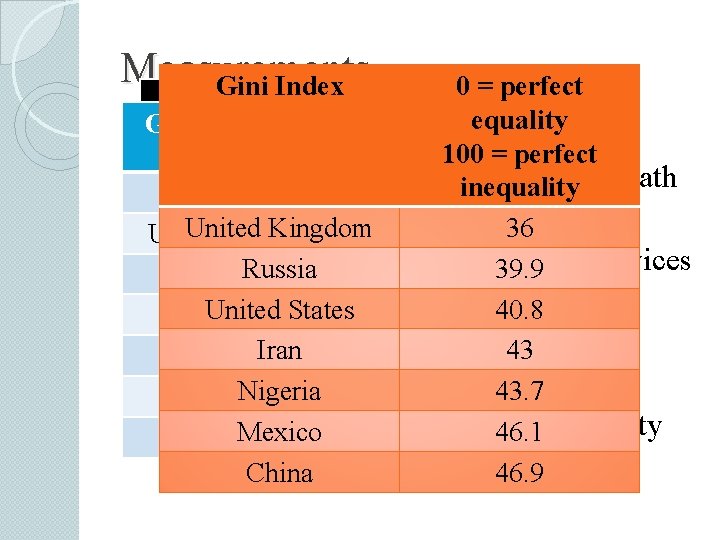
Measurements Gini Index 0 = perfect HDI equality Total GDP Per Capita �HDI-Human Index United States. Development Goods/Population 100. 937 = perfect measures life expectancy, birth and death United Kingdom. 875 inequality United States $49, 965 rates, education, quality of. 775 life. Mexico United Kingdom 36 United Kingdom $36, 600 �GDP-the total value of goods and services Iran. 742 Russia 39. 9 Russia $17, 500 produced in. States a country. 690 China United 40. 8 Mexico $15, 400 �GDP Russia per. Iran capita-GDP$13, 000 divided. 550 43 by the Iran population Nigeria. 153 Nigeria 43. 7 China $9, 000 �Gini. Nigeria Index-measures income Mexico 46. 1 inequality $2, 600 China 46. 9
Development �Developed countries have high GDP per capita and HDI rankings; service-based economies. �Developing countries are emerging economies; based on production. �Underdeveloped countries have low GDP per capita and HDI rankings; agricultural. �Least Developed-the poorest of the poor
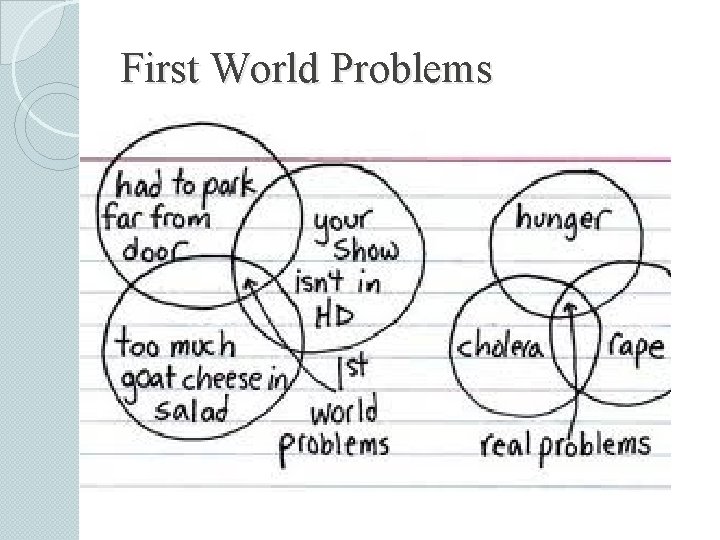
First World Problems
Economics �Political Economy is the relationship between government policies and the economy. �Economic liberalization is the move to a free market by reducing tariffs, trade barriers, and government control over the economy.
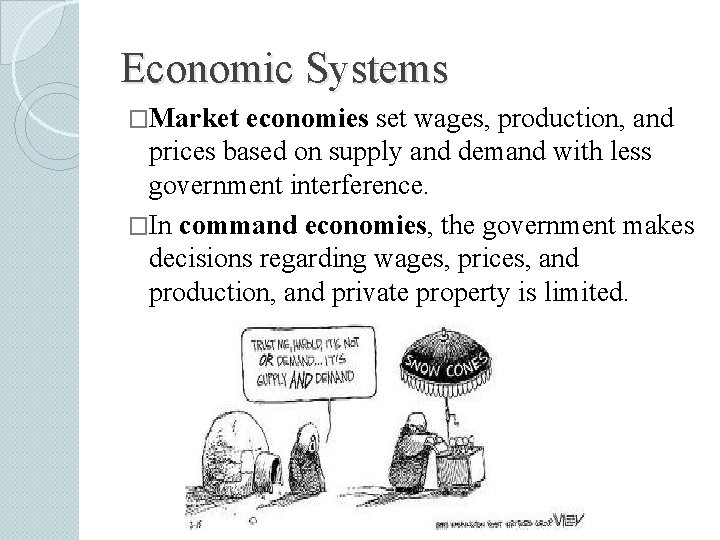
Economic Systems �Market economies set wages, production, and prices based on supply and demand with less government interference. �In command economies, the government makes decisions regarding wages, prices, and production, and private property is limited.
Communism and Welfare States �Communism is a system of government based on the writings of Karl Marx in which the stated goal is economic equality. �In a welfare state, the government provides support to citizens, such as unemployment benefits and health care.
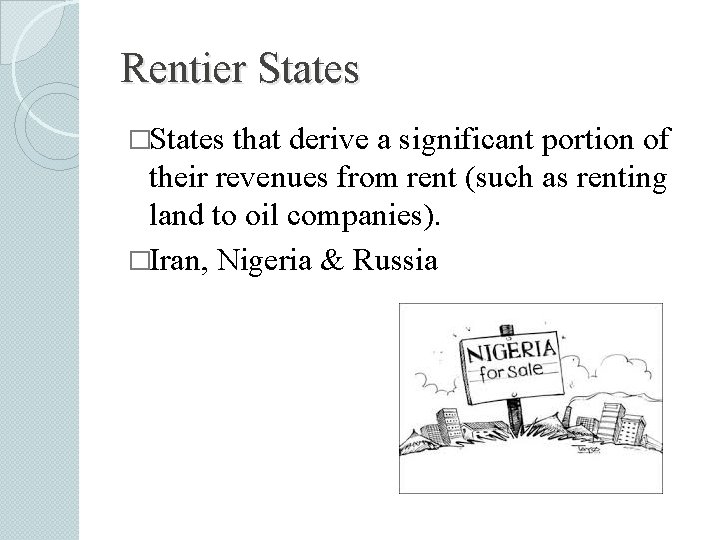
Rentier States �States that derive a significant portion of their revenues from rent (such as renting land to oil companies). �Iran, Nigeria & Russia
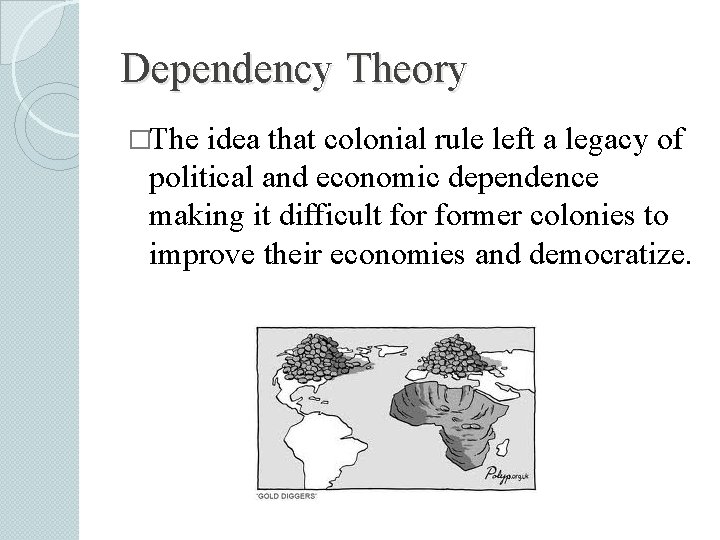
Dependency Theory �The idea that colonial rule left a legacy of political and economic dependence making it difficult former colonies to improve their economies and democratize.
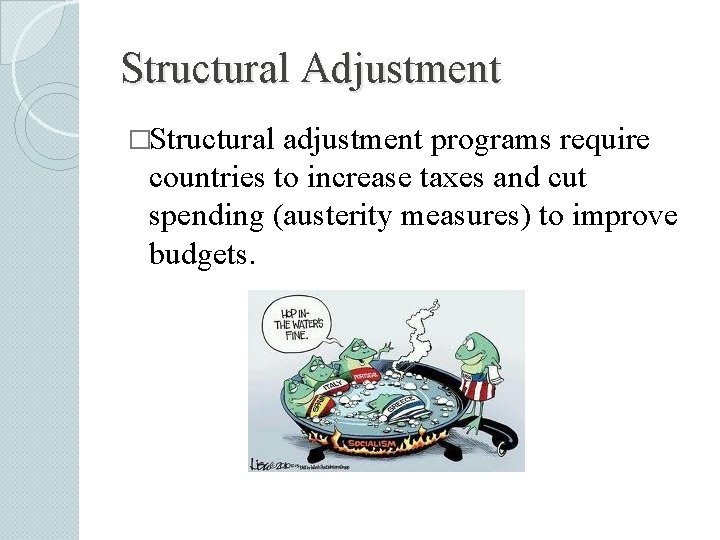
Structural Adjustment �Structural adjustment programs require countries to increase taxes and cut spending (austerity measures) to improve budgets.
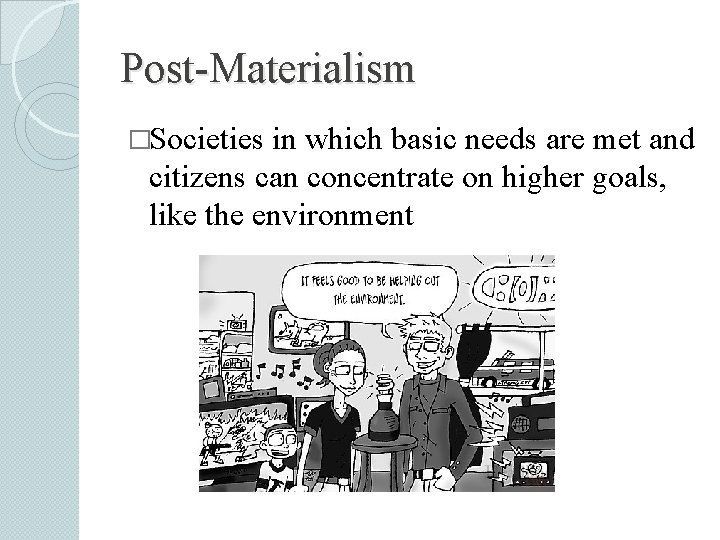
Post-Materialism �Societies in which basic needs are met and citizens can concentrate on higher goals, like the environment
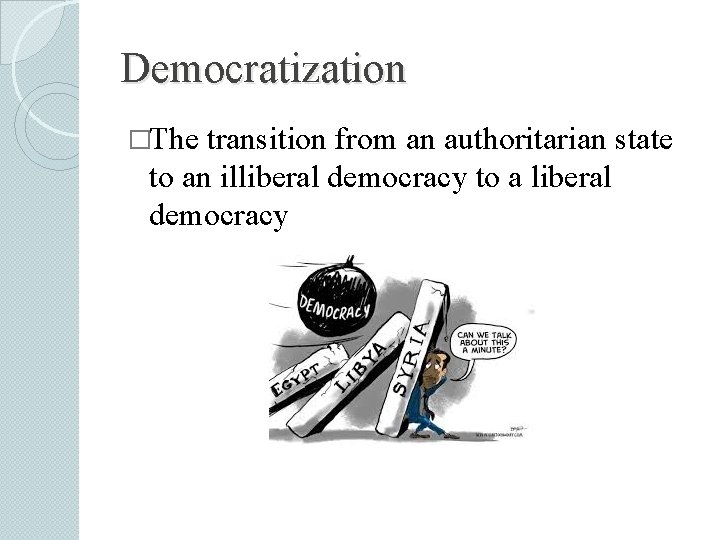
Democratization �The transition from an authoritarian state to an illiberal democracy to a liberal democracy
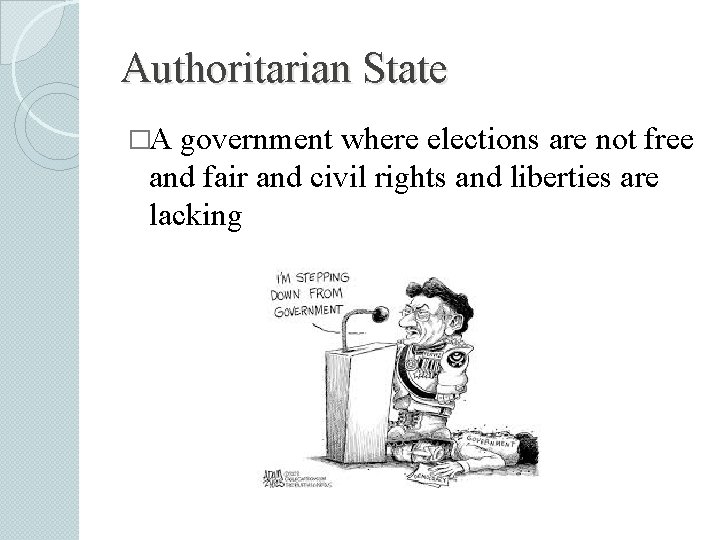
Authoritarian State �A government where elections are not free and fair and civil rights and liberties are lacking
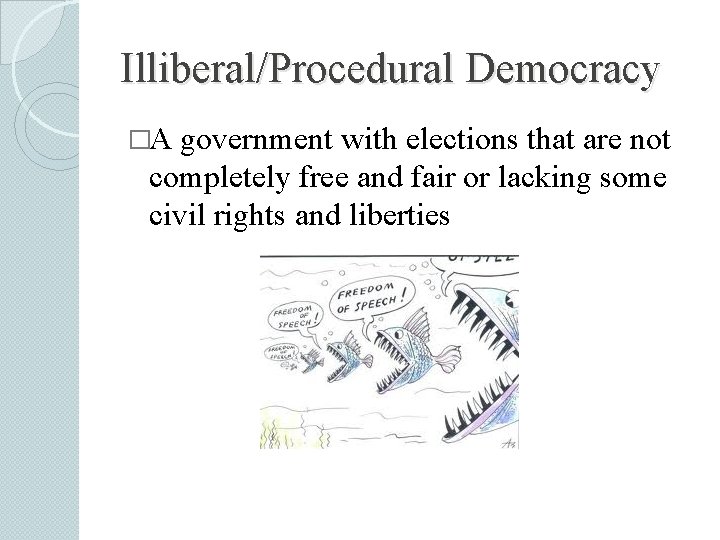
Illiberal/Procedural Democracy �A government with elections that are not completely free and fair or lacking some civil rights and liberties
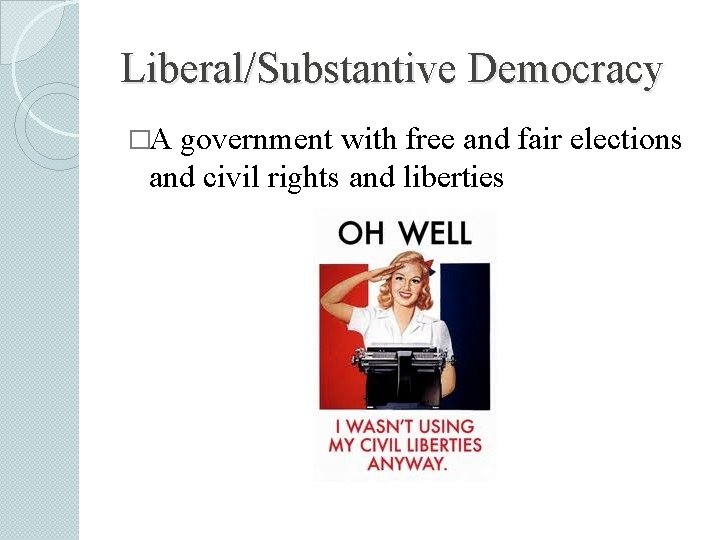
Liberal/Substantive Democracy �A government with free and fair elections and civil rights and liberties
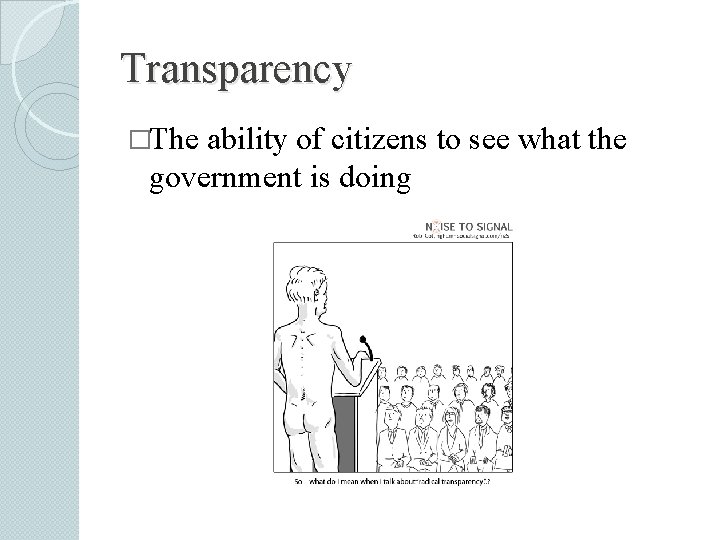
Transparency �The ability of citizens to see what the government is doing
Civil Rights and Liberties �Civil rights are protections granted by the government to prevent discrimination against groups, like ethnic or religious minorities and women. �Civil liberties protect individuals from government infringement, like free speech.
Systems of Government �In a Unitary System, all power is held by the central government and state power is not protected. �In a Federal System, power is shared between the national and state government and some state power is protected. �Devolution occurs when the national government grants more power to states.
Legislatures �A bicameral legislature has two chambers or houses, and a unicameral legislature has one. �FPTP/SMD awards one seat to the candidate with the most votes in a district. �Proportional Representation awards sets to political parties based on the percentage of votes received; there may be a threshold for getting seats.
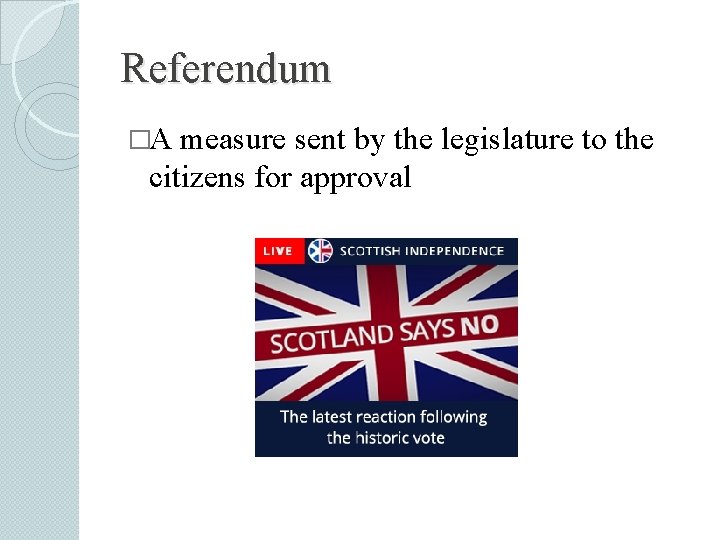
Referendum �A measure sent by the legislature to the citizens for approval
The Judiciary �In common law systems, court decisions are written down and serve as precedent for future cases. �Code law systems are based on rules written by the legislature. �Judicial review is the ability of a Supreme Court to overturn a law or executive action as unconstitutional.
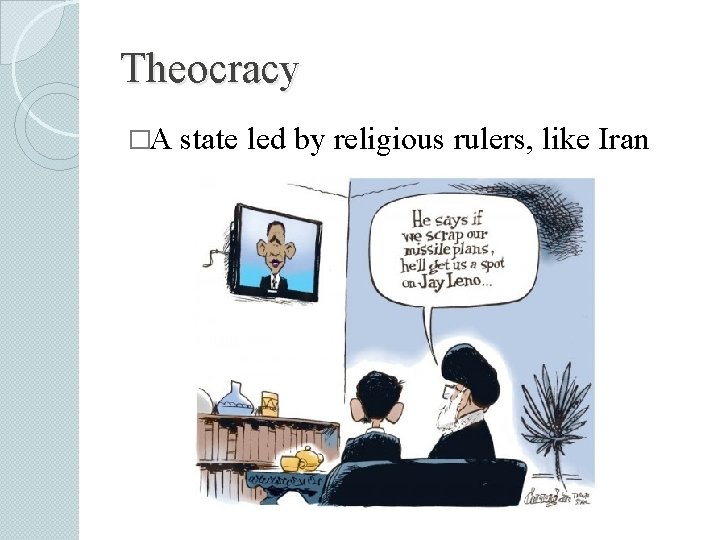
Theocracy �A state led by religious rulers, like Iran
Revolutions and Coups �A revolution is an overthrow of the government based on broad popular support. �A coup is a change in the leader brought about by a small group, often a military leader.
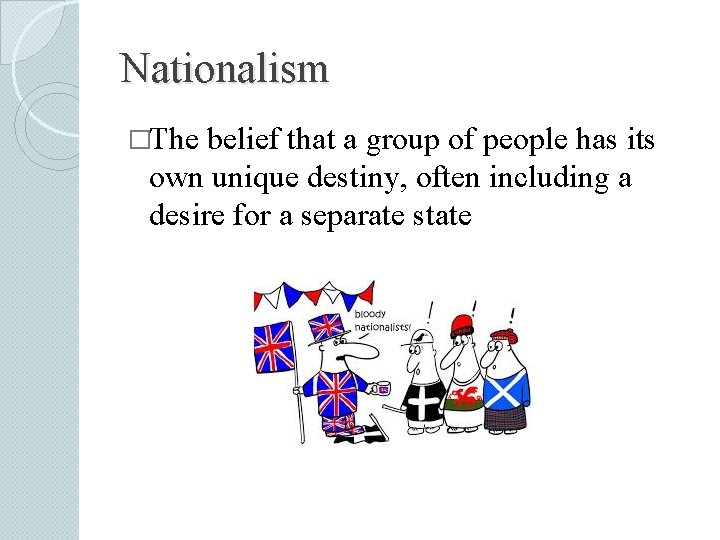
Nationalism �The belief that a group of people has its own unique destiny, often including a desire for a separate state
Ideology and Socialization �Political ideology is an individual’s belief system about the role of government. �Political socialization is the process through which an individual acquires his or her political beliefs and behaviors. �Political culture is the shared beliefs of a group of people.
Political Ideologies �Political Right favors the status quo/conservative view. �Political Left favors change. They usually favor social programs. �Reactionaries are extreme and want to go back to the past. �Liberalism-favor freedom in the economy and in civil rights and liberties
Corporatism �Cooptation is when the government buys off its critics, as seen in communist states �Corporatism is when large businesses and labor unions are brought into the policymaking process, as seen in illiberal democracies. This limits pluralism because small actors are left out. �Pluralism is when many groups compete in policymaking, as seen in consolidated democracies.
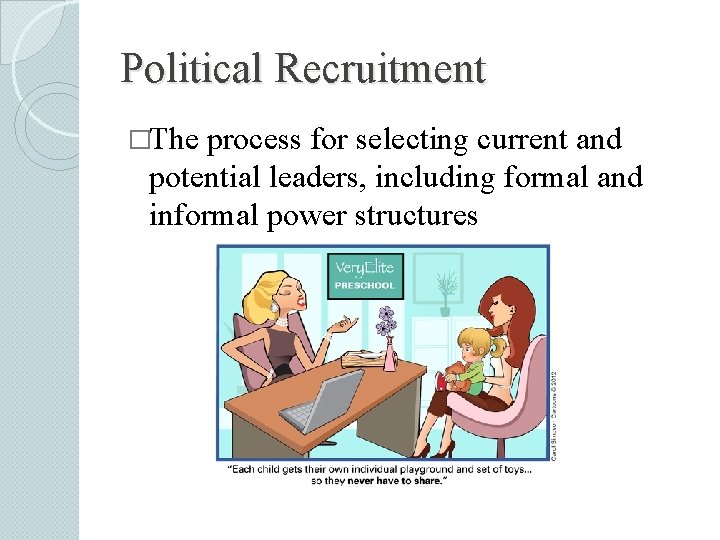
Political Recruitment �The process for selecting current and potential leaders, including formal and informal power structures
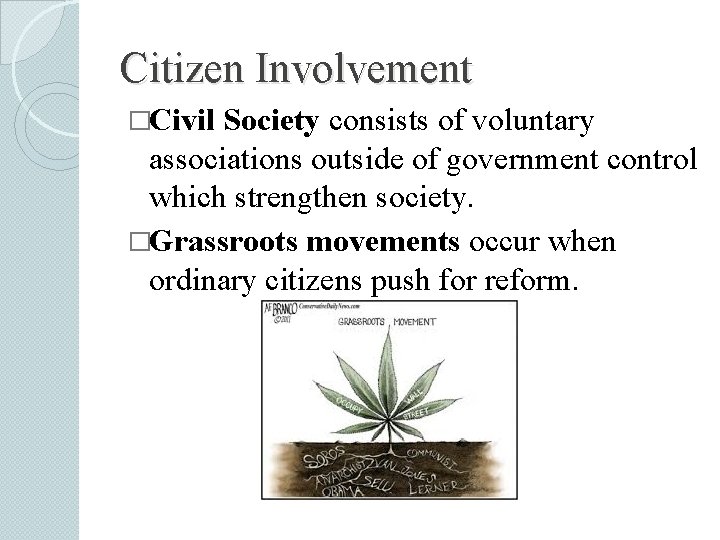
Citizen Involvement �Civil Society consists of voluntary associations outside of government control which strengthen society. �Grassroots movements occur when ordinary citizens push for reform.
Cleavages �A political cleavage is a division over a policy issue. �Cross cutting cleavages bring different kinds of groups together, strengthening society. �Coinciding cleavages exacerbate feeling of difference, weakening society.
Causation and Correlation �Causation is when a change in one variable precipitates a change in another variable. �Correlation is an apparent connection between variables. �Causation and correlation may be positive (in the same direction) or negative (in opposite directions).
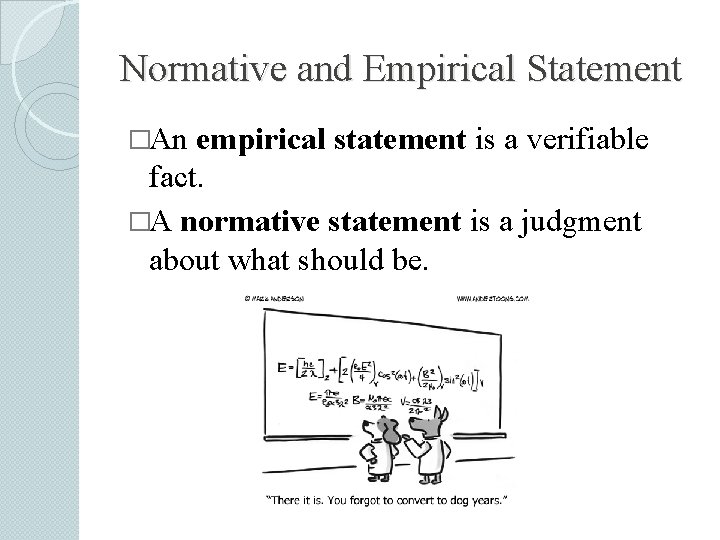
Normative and Empirical Statement �An empirical statement is a verifiable fact. �A normative statement is a judgment about what should be.
Part Two: Big Picture Country Comparisons
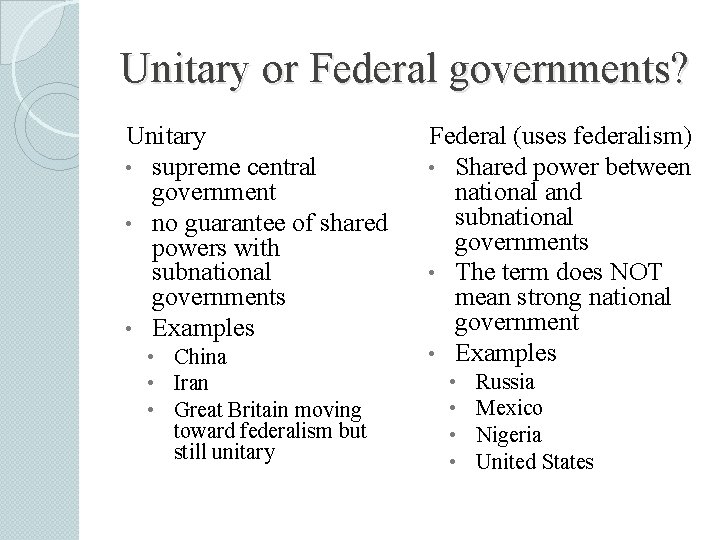
Unitary or Federal governments? Unitary • supreme central government • no guarantee of shared powers with subnational governments • Examples • China • Iran • Great Britain moving toward federalism but still unitary Federal (uses federalism) • Shared power between national and subnational governments • The term does NOT mean strong national government • Examples • • Russia Mexico Nigeria United States
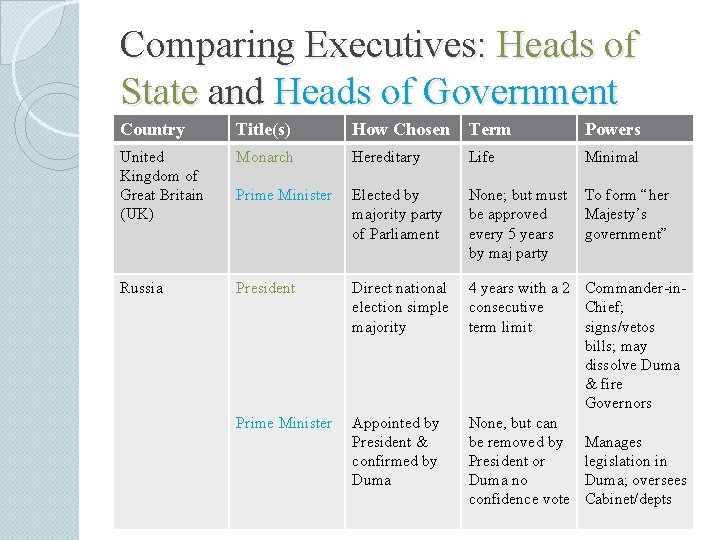
Comparing Executives: Heads of State and Heads of Government Country Title(s) How Chosen Term Powers United Kingdom of Great Britain (UK) Monarch Hereditary Life Minimal Prime Minister Elected by majority party of Parliament None; but must be approved every 5 years by maj party To form “her Majesty’s government” Russia President Direct national election simple majority Prime Minister Appointed by President & confirmed by Duma 4 years with a 2 Commander-inconsecutive Chief; term limit signs/vetos bills; may dissolve Duma & fire Governors None, but can be removed by Manages President or legislation in Duma no Duma; oversees confidence vote Cabinet/depts
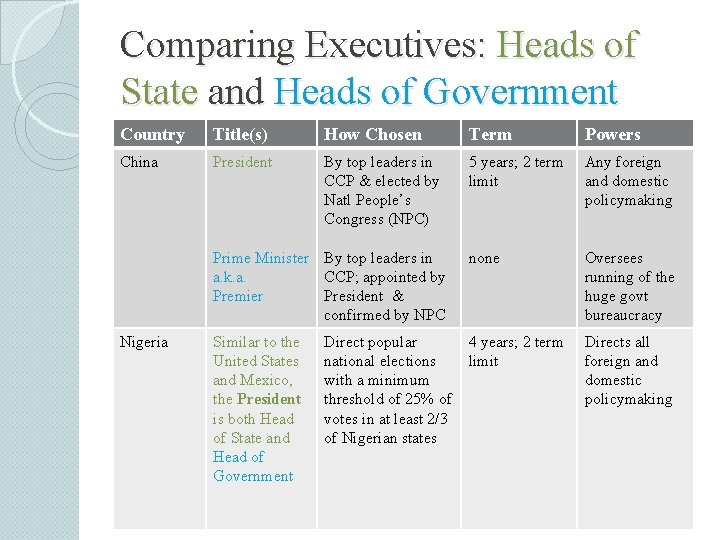
Comparing Executives: Heads of State and Heads of Government Country Title(s) How Chosen Term Powers China President By top leaders in CCP & elected by Natl People’s Congress (NPC) 5 years; 2 term limit Any foreign and domestic policymaking Prime Minister By top leaders in a. k. a. CCP; appointed by Premier President & confirmed by NPC none Oversees running of the huge govt bureaucracy Similar to the United States and Mexico, the President is both Head of State and Head of Government 4 years; 2 term limit Directs all foreign and domestic policymaking Nigeria Direct popular national elections with a minimum threshold of 25% of votes in at least 2/3 of Nigerian states
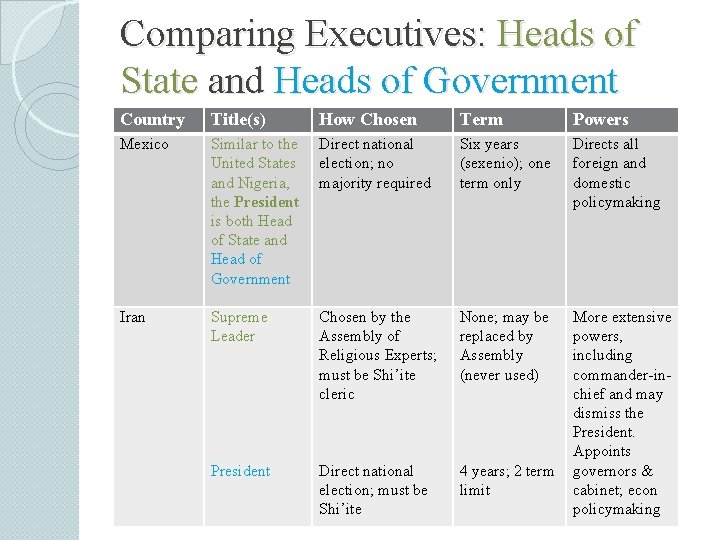
Comparing Executives: Heads of State and Heads of Government Country Title(s) How Chosen Term Powers Mexico Similar to the United States and Nigeria, the President is both Head of State and Head of Government Direct national election; no majority required Six years (sexenio); one term only Directs all foreign and domestic policymaking Iran Supreme Leader Chosen by the Assembly of Religious Experts; must be Shi’ite cleric None; may be replaced by Assembly (never used) President Direct national election; must be Shi’ite 4 years; 2 term limit More extensive powers, including commander-inchief and may dismiss the President. Appoints governors & cabinet; econ policymaking
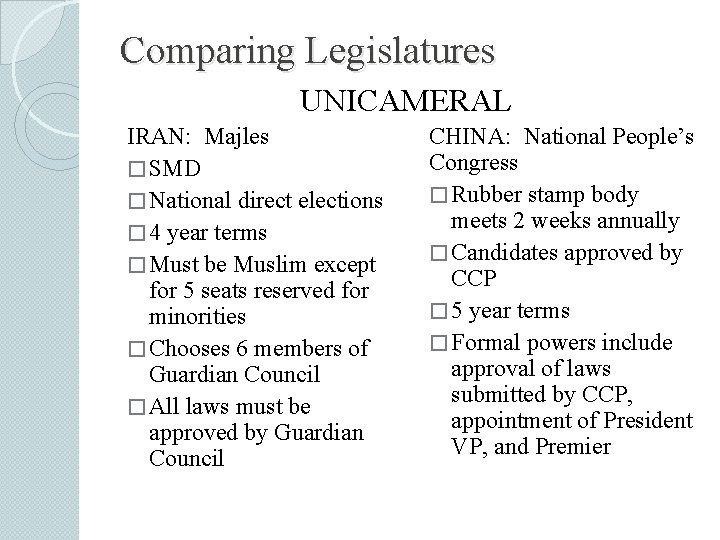
Comparing Legislatures UNICAMERAL IRAN: Majles � SMD � National direct elections � 4 year terms � Must be Muslim except for 5 seats reserved for minorities � Chooses 6 members of Guardian Council � All laws must be approved by Guardian Council CHINA: National People’s Congress � Rubber stamp body meets 2 weeks annually � Candidates approved by CCP � 5 year terms � Formal powers include approval of laws submitted by CCP, appointment of President VP, and Premier
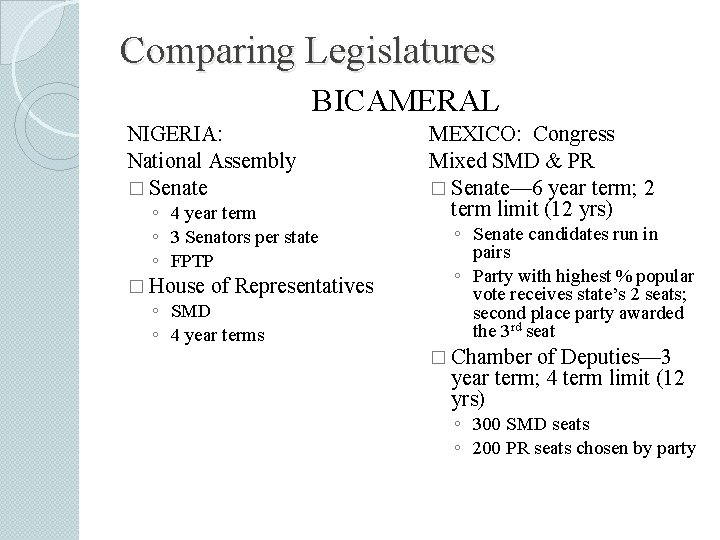
Comparing Legislatures BICAMERAL NIGERIA: National Assembly � Senate ◦ 4 year term ◦ 3 Senators per state ◦ FPTP � House of Representatives ◦ SMD ◦ 4 year terms MEXICO: Congress Mixed SMD & PR � Senate— 6 year term; 2 term limit (12 yrs) ◦ Senate candidates run in pairs ◦ Party with highest % popular vote receives state’s 2 seats; second place party awarded the 3 rd seat � Chamber of Deputies— 3 year term; 4 term limit (12 yrs) ◦ 300 SMD seats ◦ 200 PR seats chosen by party
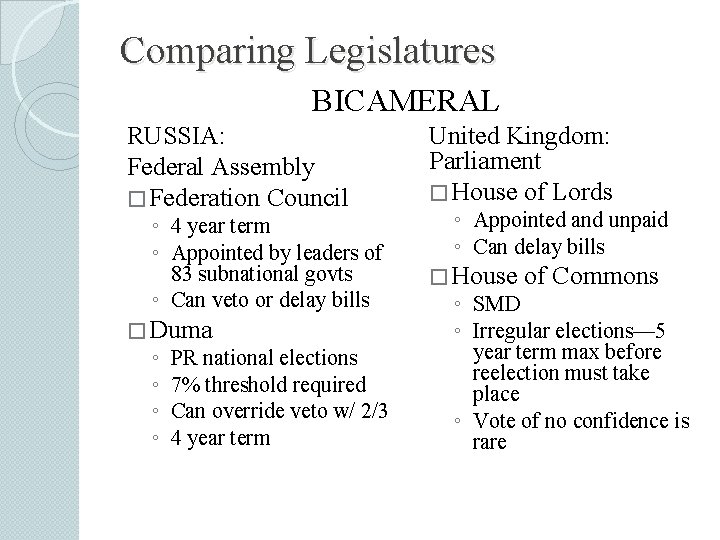
Comparing Legislatures BICAMERAL RUSSIA: Federal Assembly � Federation Council United Kingdom: Parliament � House of Lords � Duma ◦ PR national elections ◦ 7% threshold required ◦ Can override veto w/ 2/3 ◦ 4 year term � House of Commons ◦ SMD ◦ Irregular elections— 5 year term max before reelection must take place ◦ Vote of no confidence is rare ◦ 4 year term ◦ Appointed by leaders of 83 subnational govts ◦ Can veto or delay bills ◦ Appointed and unpaid ◦ Can delay bills
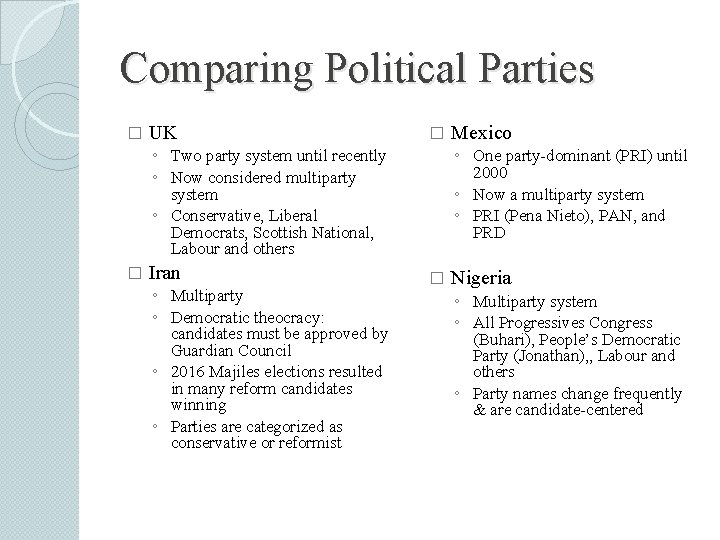
Comparing Political Parties � UK � ◦ Two party system until recently ◦ Now considered multiparty system ◦ Conservative, Liberal Democrats, Scottish National, Labour and others � Iran ◦ Multiparty ◦ Democratic theocracy: candidates must be approved by Guardian Council ◦ 2016 Majiles elections resulted in many reform candidates winning ◦ Parties are categorized as conservative or reformist Mexico ◦ One party-dominant (PRI) until 2000 ◦ Now a multiparty system ◦ PRI (Pena Nieto), PAN, and PRD � Nigeria ◦ Multiparty system ◦ All Progressives Congress (Buhari), People’s Democratic Party (Jonathan), , Labour and others ◦ Party names change frequently & are candidate-centered
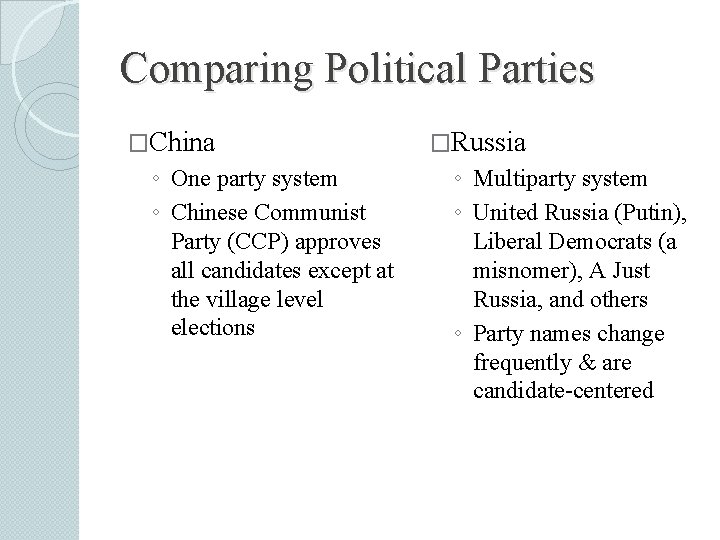
Comparing Political Parties �China ◦ One party system ◦ Chinese Communist Party (CCP) approves all candidates except at the village level elections �Russia ◦ Multiparty system ◦ United Russia (Putin), Liberal Democrats (a misnomer), A Just Russia, and others ◦ Party names change frequently & are candidate-centered
Part Three: AP Comparative Exam Tips
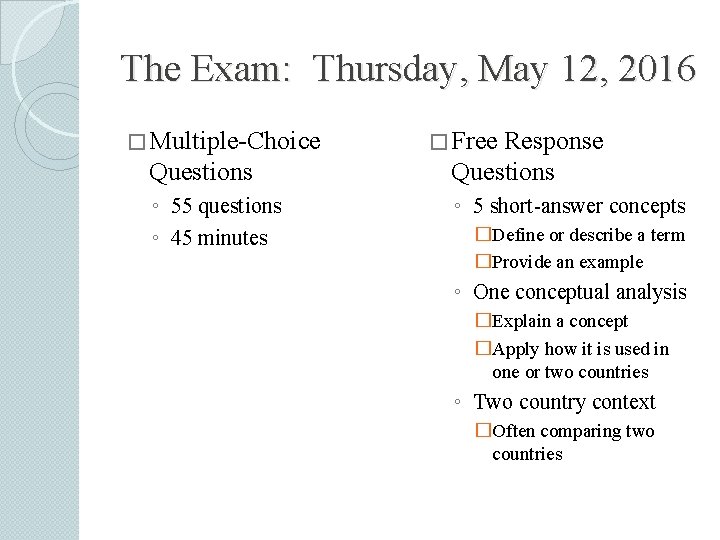
The Exam: Thursday, May 12, 2016 � Multiple-Choice Questions ◦ 55 questions ◦ 45 minutes � Free Response Questions ◦ 5 short-answer concepts �Define or describe a term �Provide an example ◦ One conceptual analysis �Explain a concept �Apply how it is used in one or two countries ◦ Two country context �Often comparing two countries
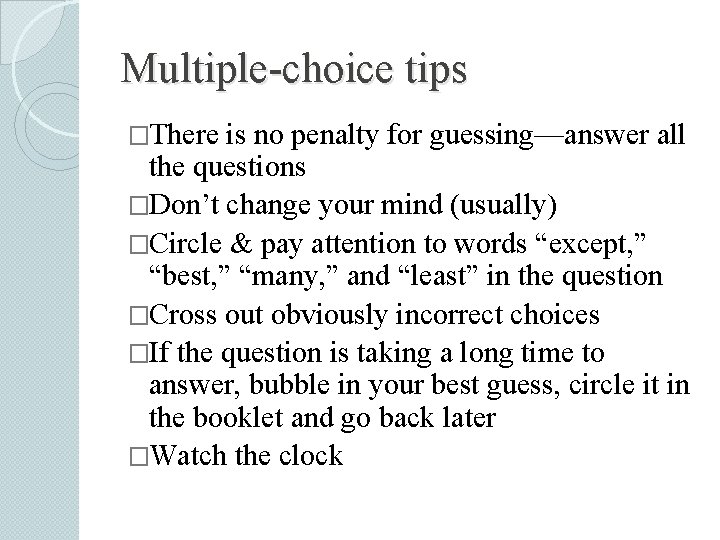
Multiple-choice tips �There is no penalty for guessing—answer all the questions �Don’t change your mind (usually) �Circle & pay attention to words “except, ” “best, ” “many, ” and “least” in the question �Cross out obviously incorrect choices �If the question is taking a long time to answer, bubble in your best guess, circle it in the booklet and go back later �Watch the clock
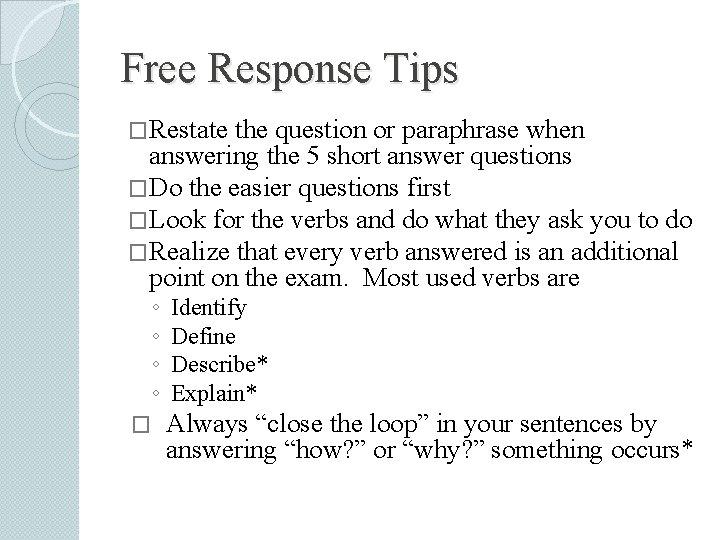
Free Response Tips �Restate the question or paraphrase when answering the 5 short answer questions �Do the easier questions first �Look for the verbs and do what they ask you to do �Realize that every verb answered is an additional point on the exam. Most used verbs are ◦ ◦ � Identify Define Describe* Explain* Always “close the loop” in your sentences by answering “how? ” or “why? ” something occurs*
- Slides: 52