
AP Chemistry Unit 2 Review Choose your destiny
- Slides: 23
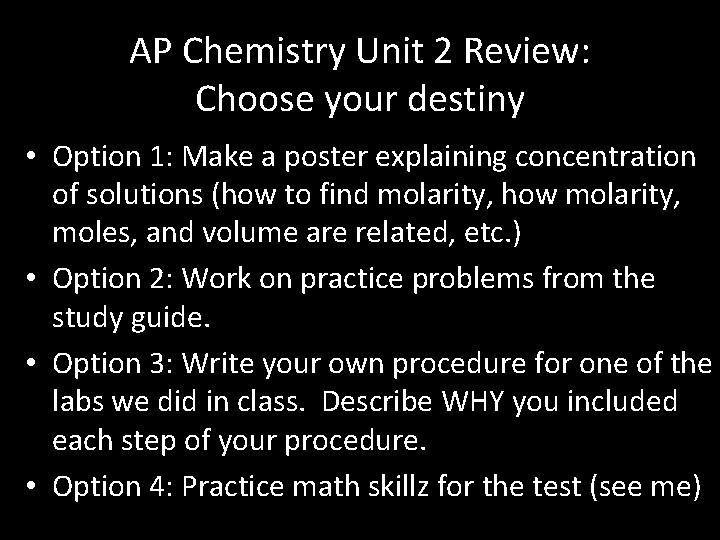
AP Chemistry Unit 2 Review: Choose your destiny • Option 1: Make a poster explaining concentration of solutions (how to find molarity, how molarity, moles, and volume are related, etc. ) • Option 2: Work on practice problems from the study guide. • Option 3: Write your own procedure for one of the labs we did in class. Describe WHY you included each step of your procedure. • Option 4: Practice math skillz for the test (see me)
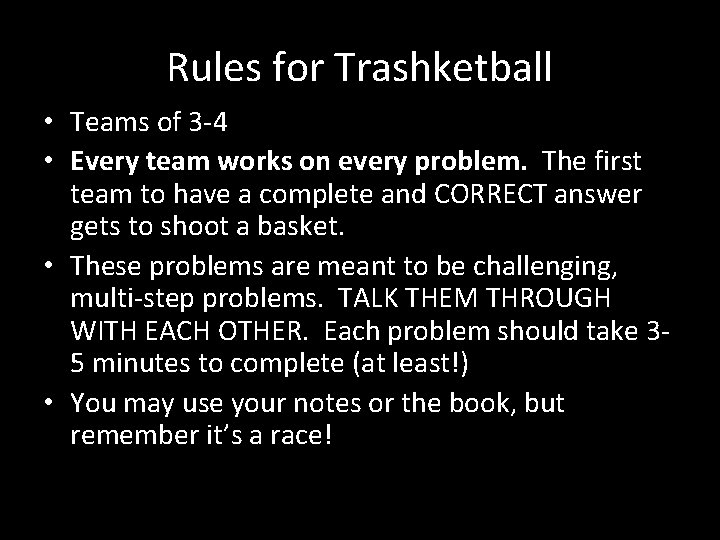
Rules for Trashketball • Teams of 3 -4 • Every team works on every problem. The first team to have a complete and CORRECT answer gets to shoot a basket. • These problems are meant to be challenging, multi-step problems. TALK THEM THROUGH WITH EACH OTHER. Each problem should take 35 minutes to complete (at least!) • You may use your notes or the book, but remember it’s a race!
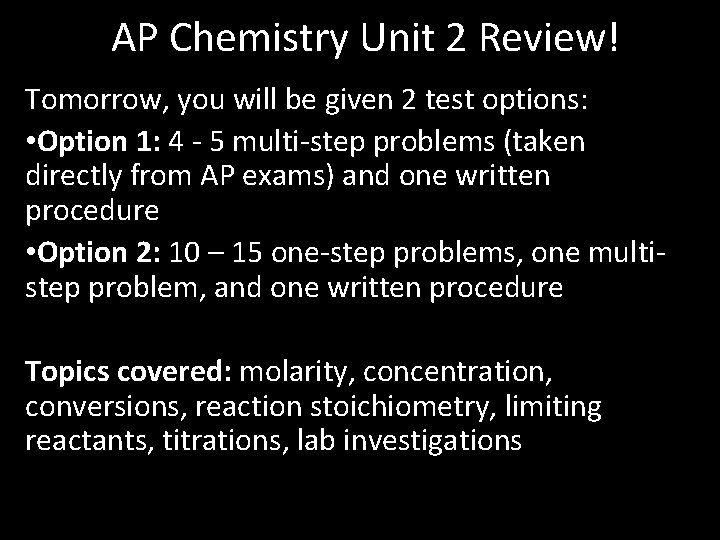
AP Chemistry Unit 2 Review! Tomorrow, you will be given 2 test options: • Option 1: 4 - 5 multi-step problems (taken directly from AP exams) and one written procedure • Option 2: 10 – 15 one-step problems, one multistep problem, and one written procedure Topics covered: molarity, concentration, conversions, reaction stoichiometry, limiting reactants, titrations, lab investigations
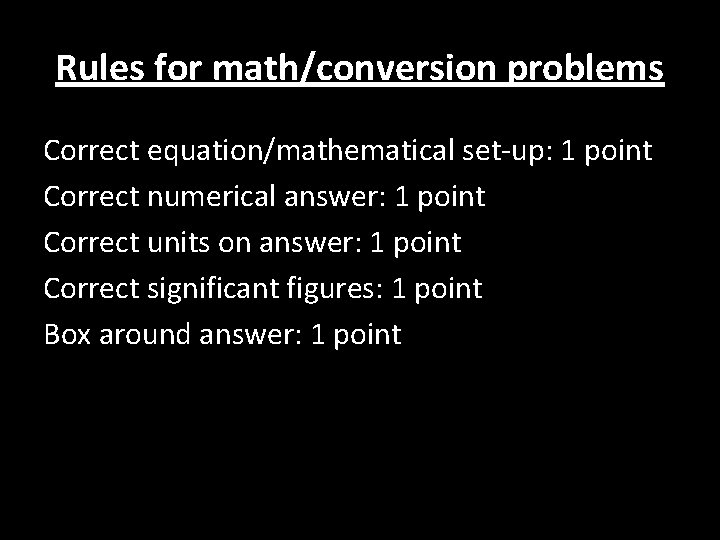
Rules for math/conversion problems Correct equation/mathematical set-up: 1 point Correct numerical answer: 1 point Correct units on answer: 1 point Correct significant figures: 1 point Box around answer: 1 point
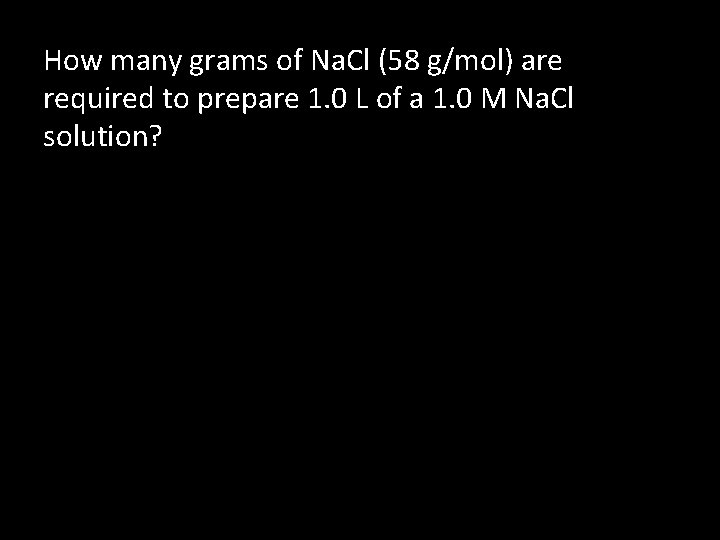
How many grams of Na. Cl (58 g/mol) are required to prepare 1. 0 L of a 1. 0 M Na. Cl solution?
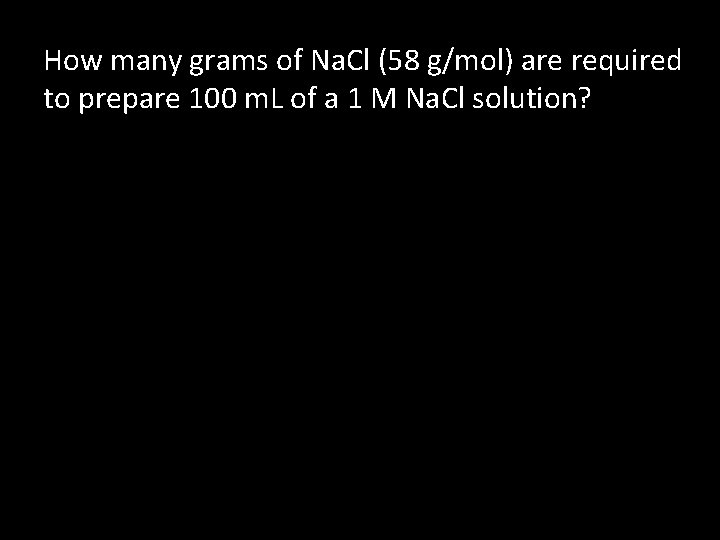
How many grams of Na. Cl (58 g/mol) are required to prepare 100 m. L of a 1 M Na. Cl solution?
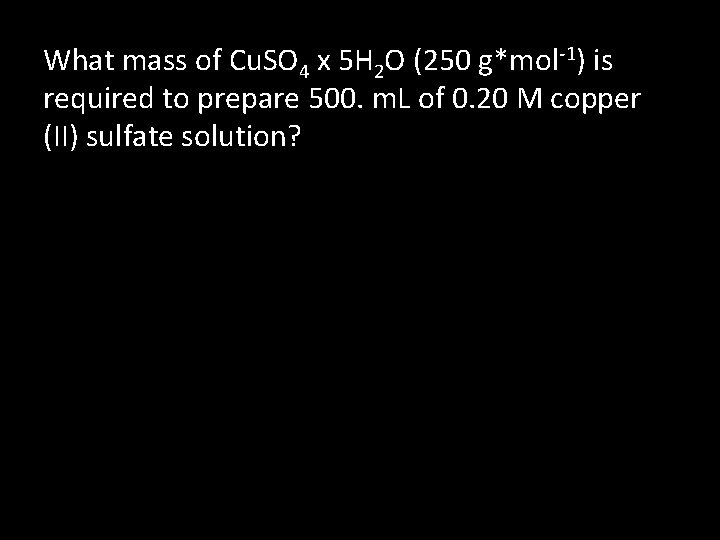
What mass of Cu. SO 4 x 5 H 2 O (250 g*mol-1) is required to prepare 500. m. L of 0. 20 M copper (II) sulfate solution?
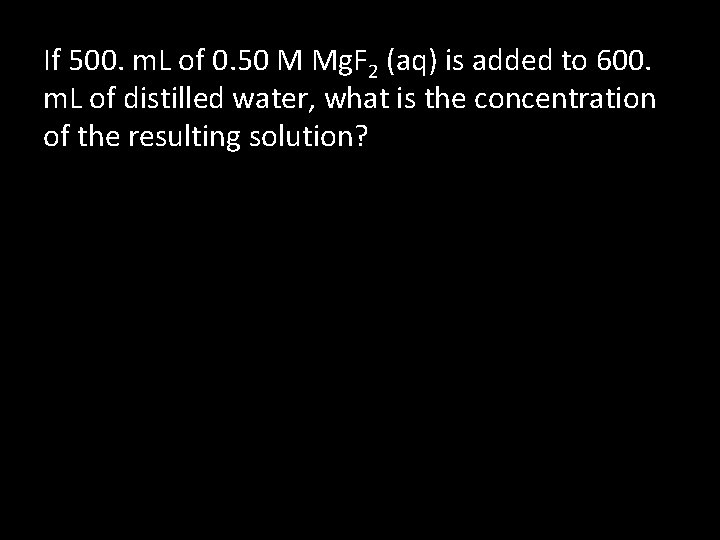
If 500. m. L of 0. 50 M Mg. F 2 (aq) is added to 600. m. L of distilled water, what is the concentration of the resulting solution?
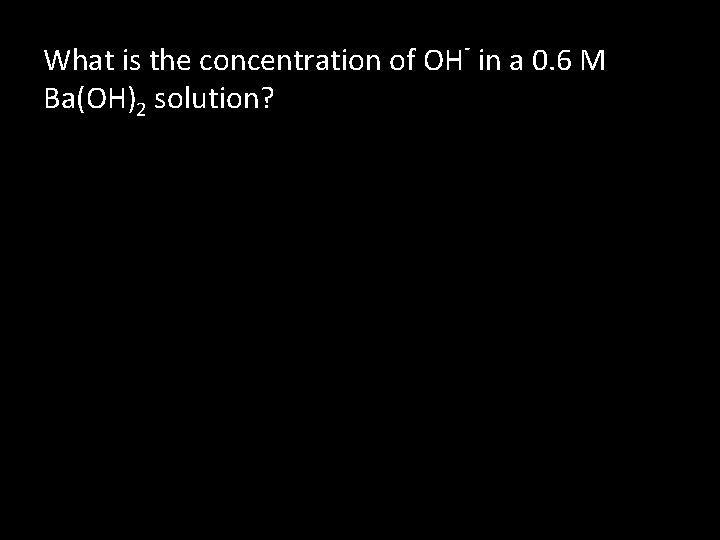
- What is the concentration of OH in a 0. 6 M Ba(OH)2 solution?
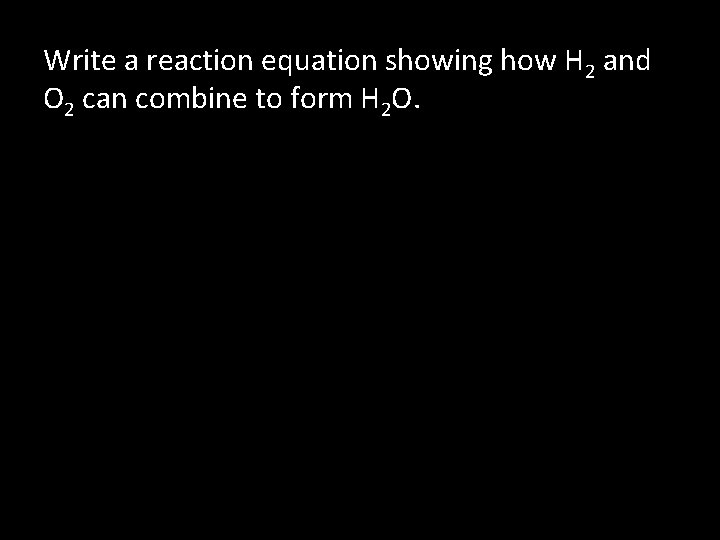
Write a reaction equation showing how H 2 and O 2 can combine to form H 2 O.
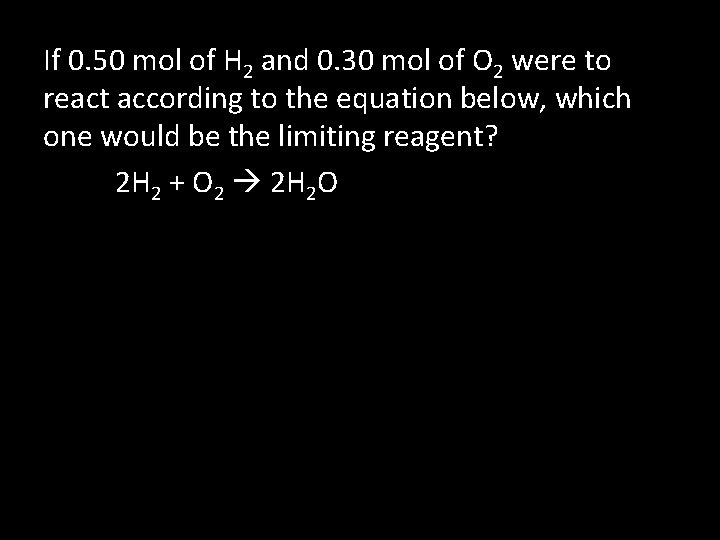
If 0. 50 mol of H 2 and 0. 30 mol of O 2 were to react according to the equation below, which one would be the limiting reagent? 2 H 2 + O 2 2 H 2 O
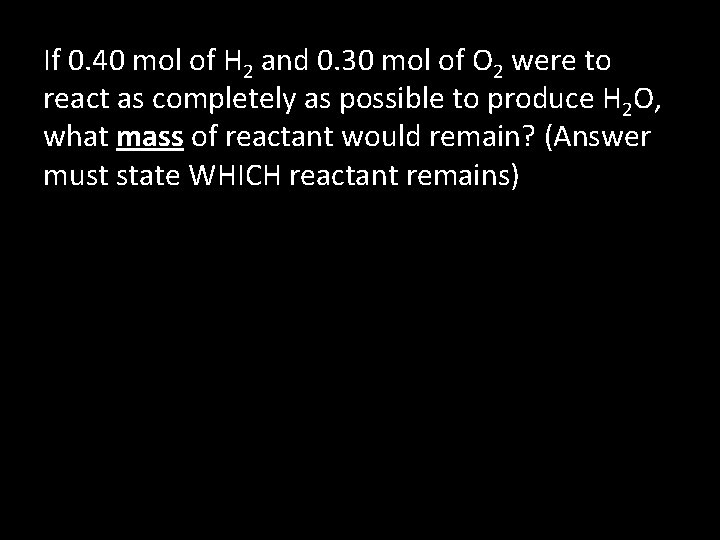
If 0. 40 mol of H 2 and 0. 30 mol of O 2 were to react as completely as possible to produce H 2 O, what mass of reactant would remain? (Answer must state WHICH reactant remains)
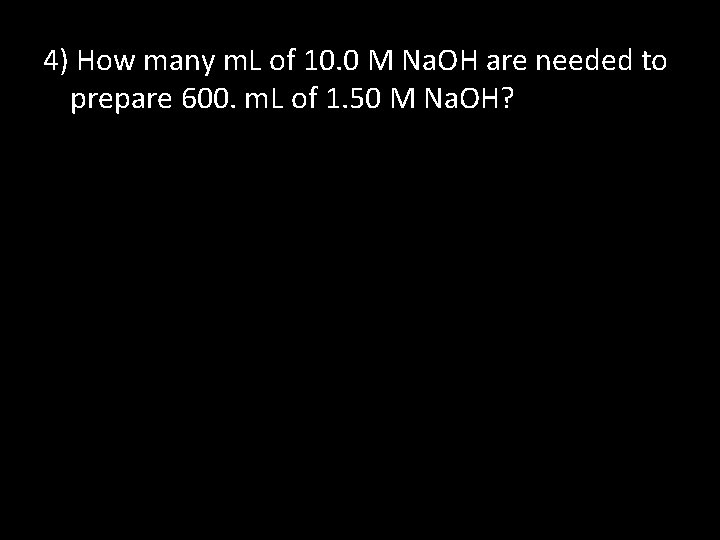
4) How many m. L of 10. 0 M Na. OH are needed to prepare 600. m. L of 1. 50 M Na. OH?
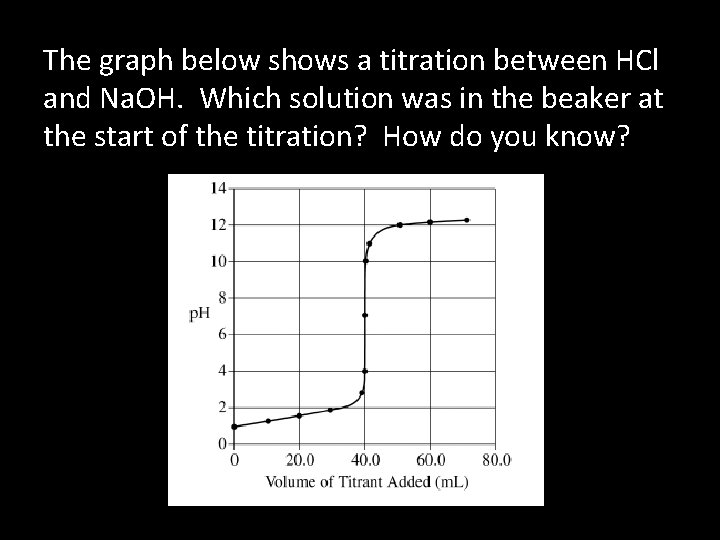
The graph below shows a titration between HCl and Na. OH. Which solution was in the beaker at the start of the titration? How do you know?
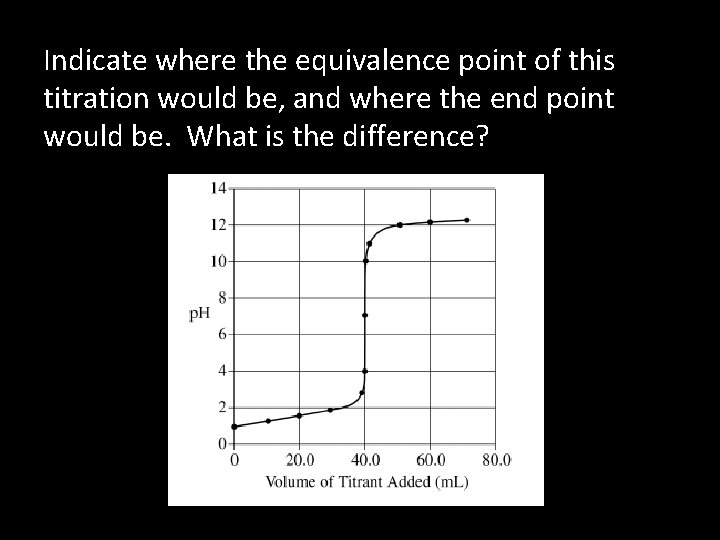
Indicate where the equivalence point of this titration would be, and where the end point would be. What is the difference?
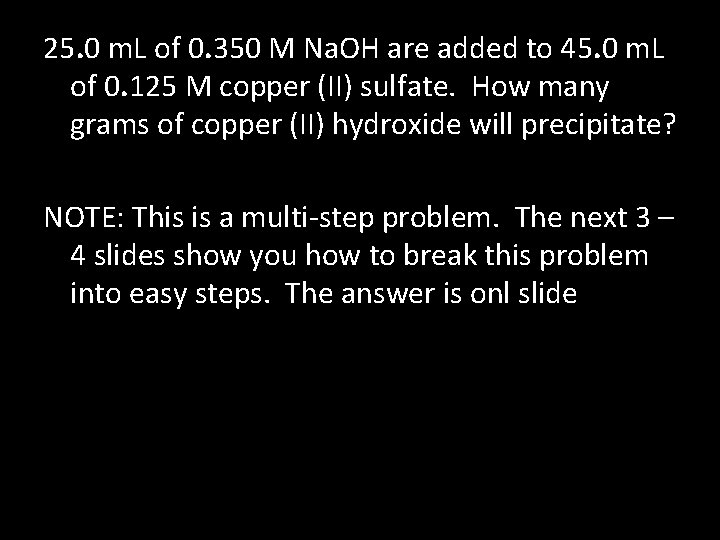
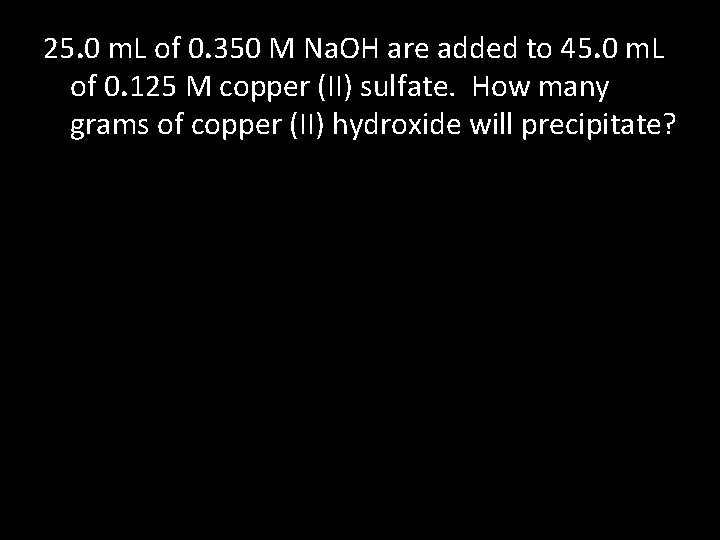
25. 0 m. L of 0. 350 M Na. OH are added to 45. 0 m. L of 0. 125 M copper (II) sulfate. How many grams of copper (II) hydroxide will precipitate? NOTE: This is a multi-step problem. The next 3 – 4 slides show you how to break this problem into easy steps. The answer is onl slide
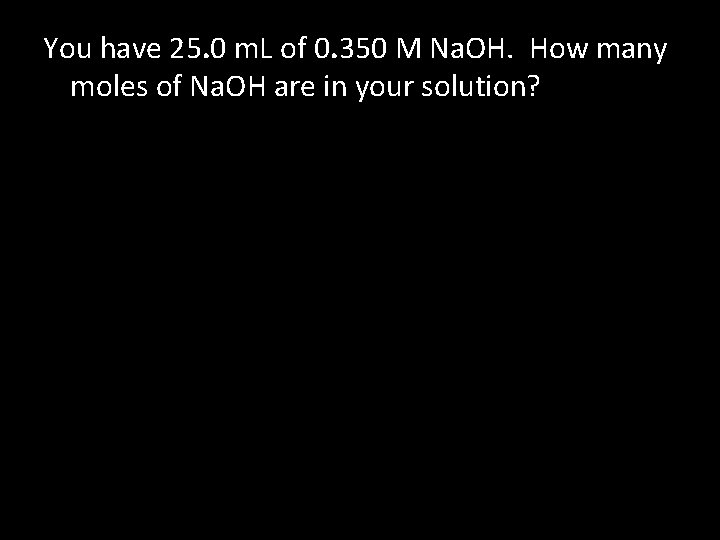
You have 25. 0 m. L of 0. 350 M Na. OH. How many moles of Na. OH are in your solution?
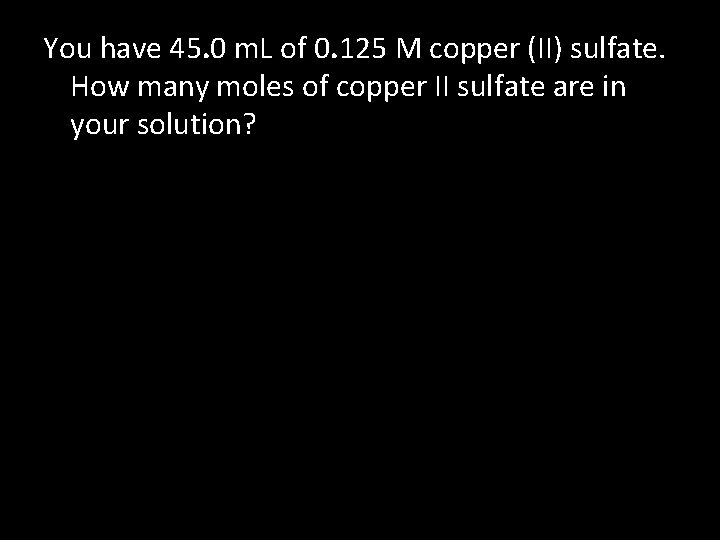
You have 45. 0 m. L of 0. 125 M copper (II) sulfate. How many moles of copper II sulfate are in your solution?
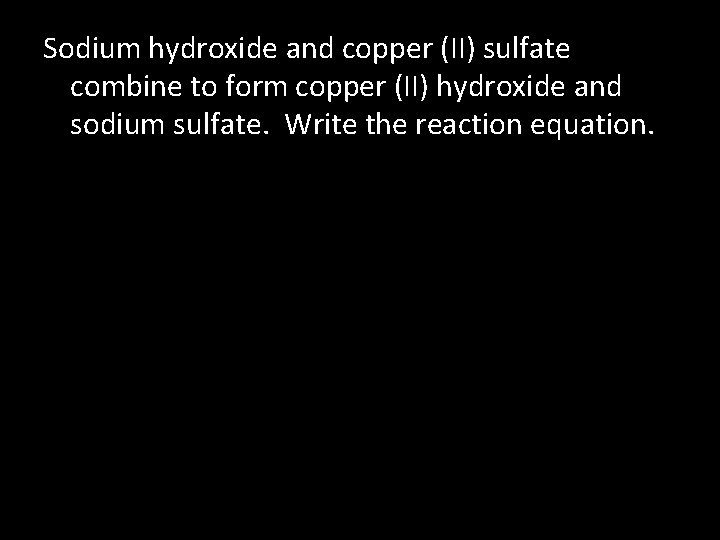
Sodium hydroxide and copper (II) sulfate combine to form copper (II) hydroxide and sodium sulfate. Write the reaction equation.
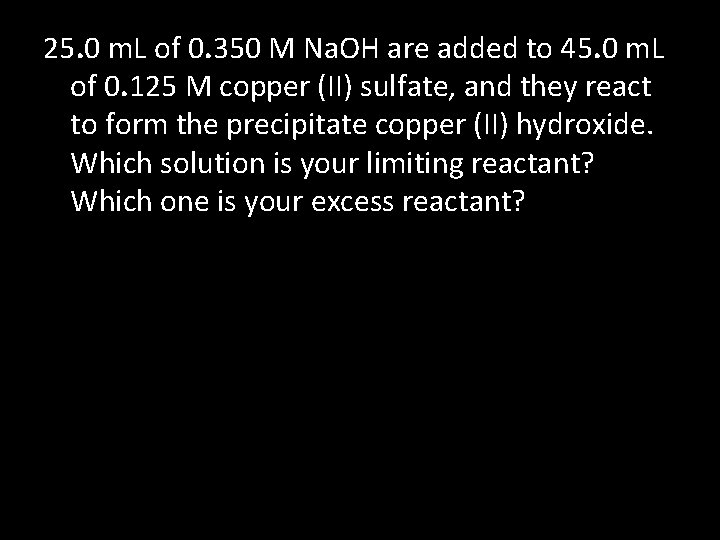
25. 0 m. L of 0. 350 M Na. OH are added to 45. 0 m. L of 0. 125 M copper (II) sulfate, and they react to form the precipitate copper (II) hydroxide. Which solution is your limiting reactant? Which one is your excess reactant?
25. 0 m. L of 0. 350 M Na. OH are added to 45. 0 m. L of 0. 125 M copper (II) sulfate. How many grams of copper (II) hydroxide will precipitate?
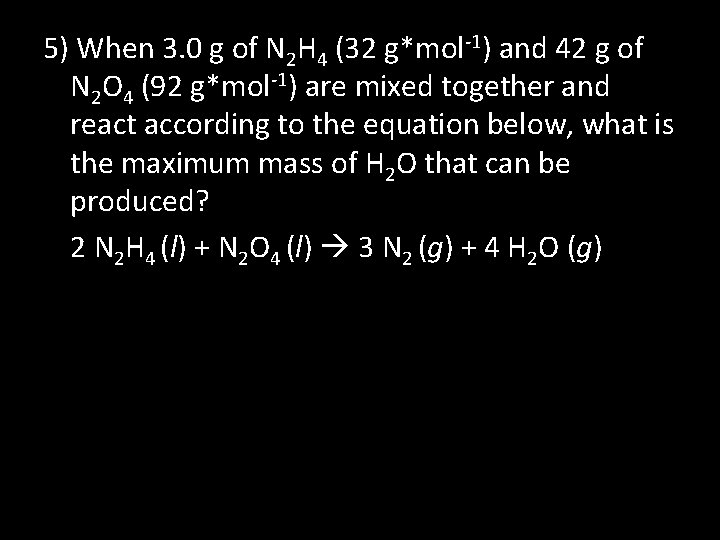
5) When 3. 0 g of N 2 H 4 (32 g*mol-1) and 42 g of N 2 O 4 (92 g*mol-1) are mixed together and react according to the equation below, what is the maximum mass of H 2 O that can be produced? 2 N 2 H 4 (l) + N 2 O 4 (l) 3 N 2 (g) + 4 H 2 O (g)
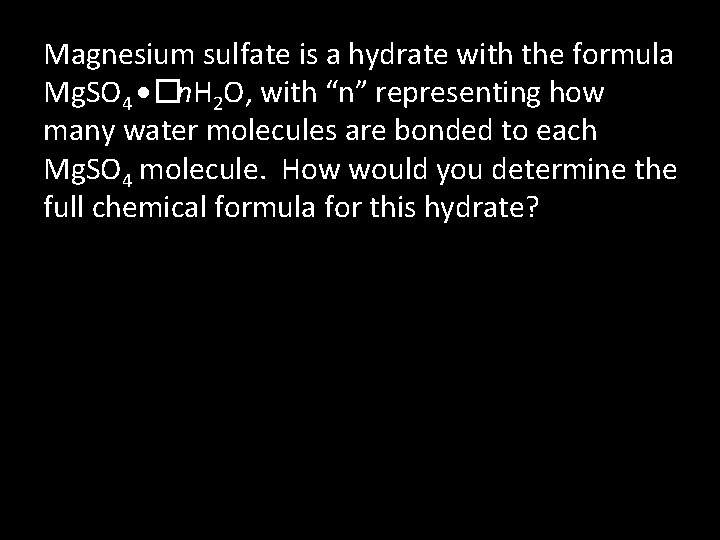
Magnesium sulfate is a hydrate with the formula Mg. SO 4 �n. H 2 O, with “n” representing how many water molecules are bonded to each Mg. SO 4 molecule. How would you determine the full chemical formula for this hydrate?