
AP Chemistry Thermochemistry Chapter 6 Thermodynamics the study
- Slides: 58
AP Chemistry Thermochemistry Chapter 6
Thermodynamics: the study of energy and its transformations Thermochemistry: the sub discipline involving chemical reactions and energy changes
Energy • Energy is defined as the capacity to do work or to produce heat. • The 1 st Law of Thermodynamics …. Energy is conserved as it is converted between one form and another, it will be neither created or destroyed, but simply change form…thus making the energy of the universe constant! • Energy can be classified as either Kinetic or Potential
RECALL……. Kinetic energy: energy associated with the motion of atoms and molecules in a system. KE = ½ mv 2 Temperature is a measure of the average KE of a collection of particles in a system.
Heat vs Energy • Thermal energy is the energy of the object and is not in the process of being transferred or moved. • Heat is kinetic energy being transferred –It moves from a hotter object towards cooler object until the temperatures are the same. –At this point the KE’s are at equilibrium. –It is not a property of the substance.
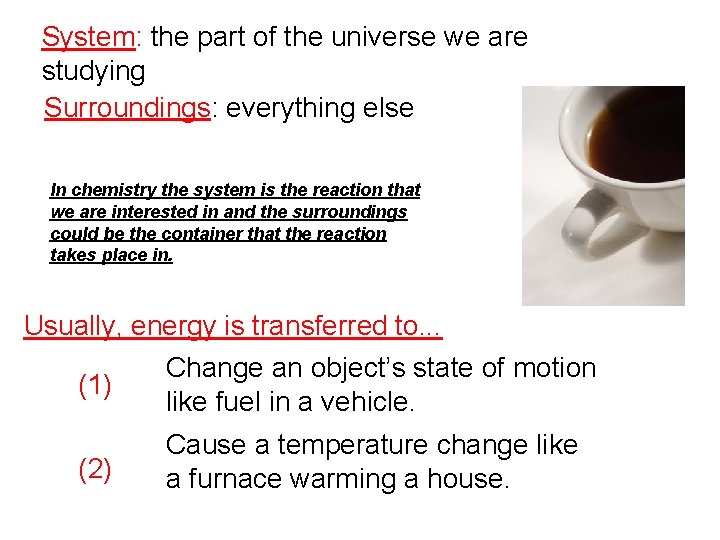
System: the part of the universe we are studying Surroundings: everything else In chemistry the system is the reaction that we are interested in and the surroundings could be the container that the reaction takes place in. Usually, energy is transferred to. . . Change an object’s state of motion (1) like fuel in a vehicle. (2) Cause a temperature change like a furnace warming a house.
Units of energy are either joules (J) kilojoules (k. J) CONVERSIONS: Divide by 1000 to convert from J to KJ Multiply by 1000 to convert from KJ to J 4184 J = 4. 184 k. J James Prescott Joule (1818 -1889)
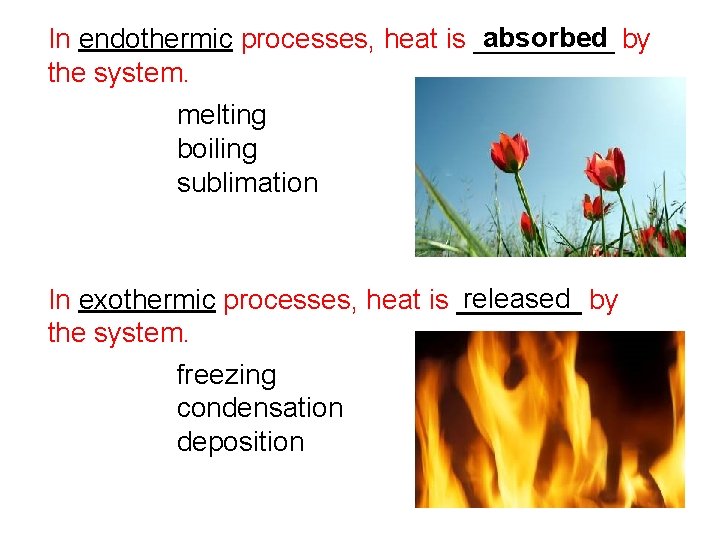
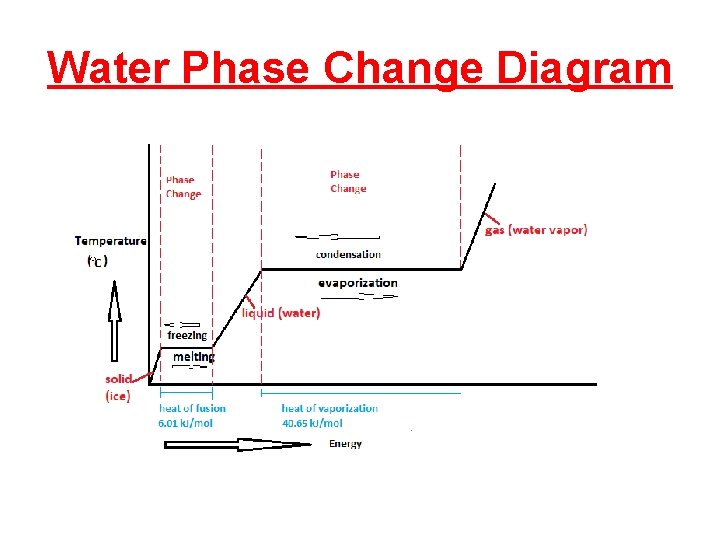
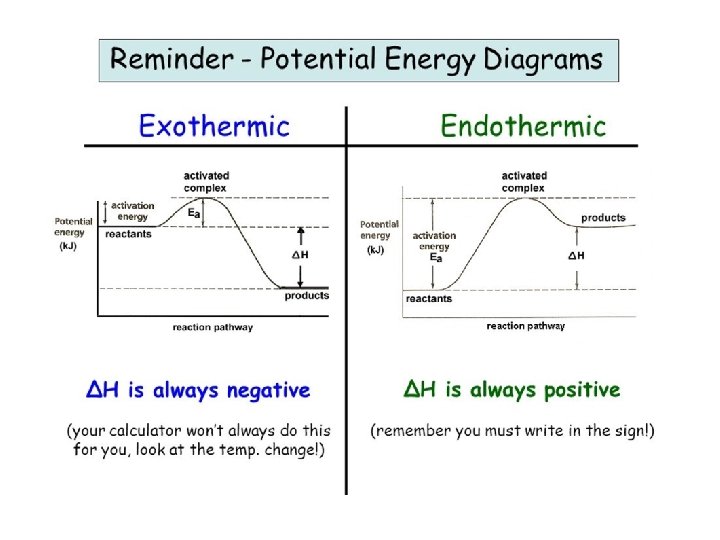
absorbed by In endothermic processes, heat is _____ the system. melting boiling sublimation released by In exothermic processes, heat is ____ the system. freezing condensation deposition
Water Phase Change Diagram
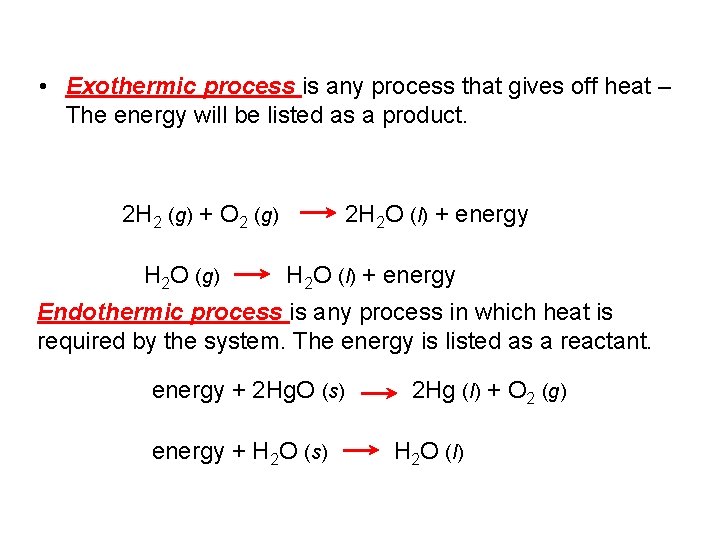
• Exothermic process is any process that gives off heat – The energy will be listed as a product. 2 H 2 (g) + O 2 (g) H 2 O (g) 2 H 2 O (l) + energy Endothermic process is any process in which heat is required by the system. The energy is listed as a reactant. energy + 2 Hg. O (s) energy + H 2 O (s) 2 Hg (l) + O 2 (g) H 2 O (l)
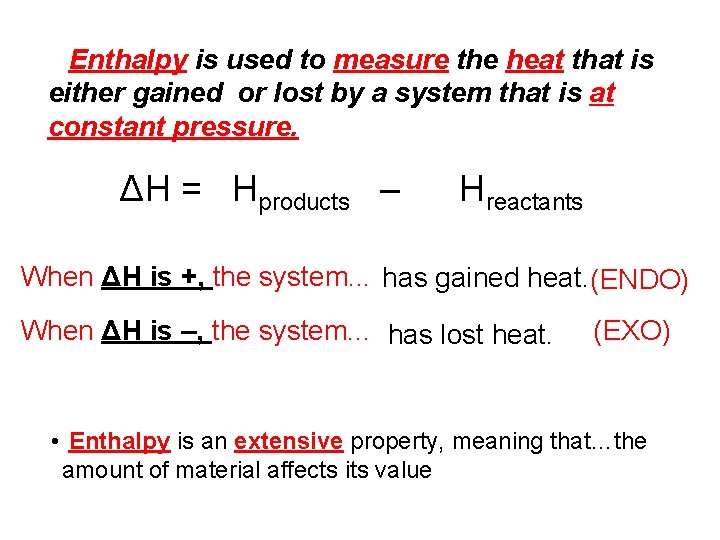
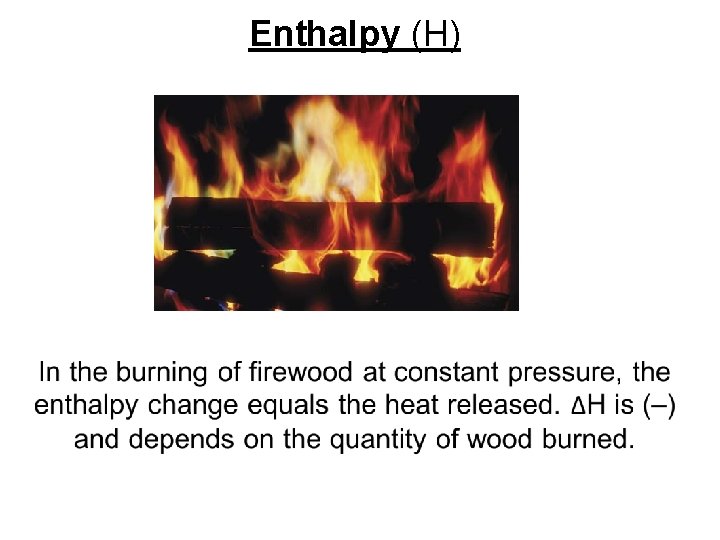
Enthalpy is used to measure the heat that is either gained or lost by a system that is at constant pressure. ΔH = Hproducts – Hreactants When ΔH is +, the system. . . has gained heat. (ENDO) When ΔH is –, the system. . . has lost heat. (EXO) • Enthalpy is an extensive property, meaning that…the amount of material affects its value
Enthalpy (H)
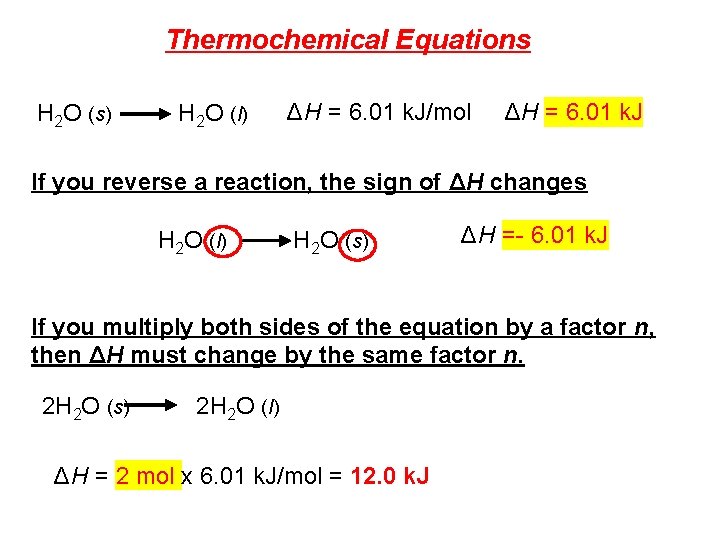
Thermochemical Equations H 2 O (s) H 2 O (l) ΔH = 6. 01 k. J/mol ΔH = 6. 01 k. J If you reverse a reaction, the sign of ΔH changes H 2 O (l) H 2 O (s) ΔH =- 6. 01 k. J If you multiply both sides of the equation by a factor n, then ΔH must change by the same factor n. 2 H 2 O (s) 2 H 2 O (l) ΔH = 2 mol x 6. 01 k. J/mol = 12. 0 k. J
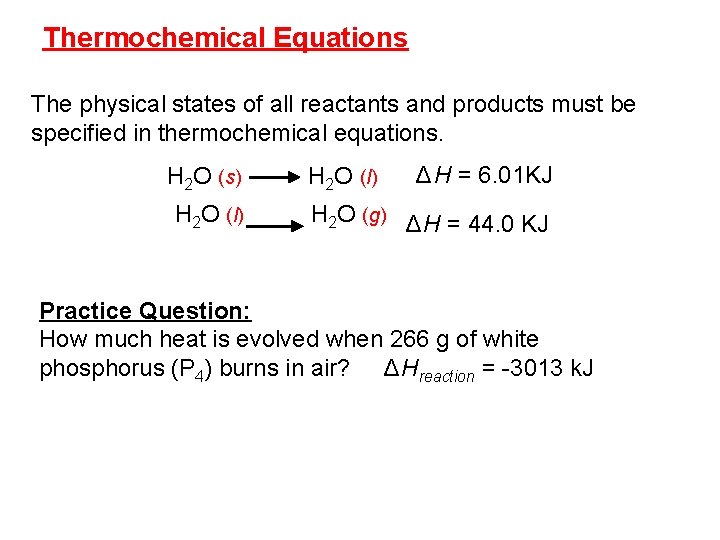
Thermochemical Equations The physical states of all reactants and products must be specified in thermochemical equations. H 2 O (s) H 2 O (l) ΔH = 6. 01 KJ H 2 O (g) ΔH = 44. 0 KJ Practice Question: How much heat is evolved when 266 g of white phosphorus (P 4) burns in air? ΔHreaction = -3013 k. J
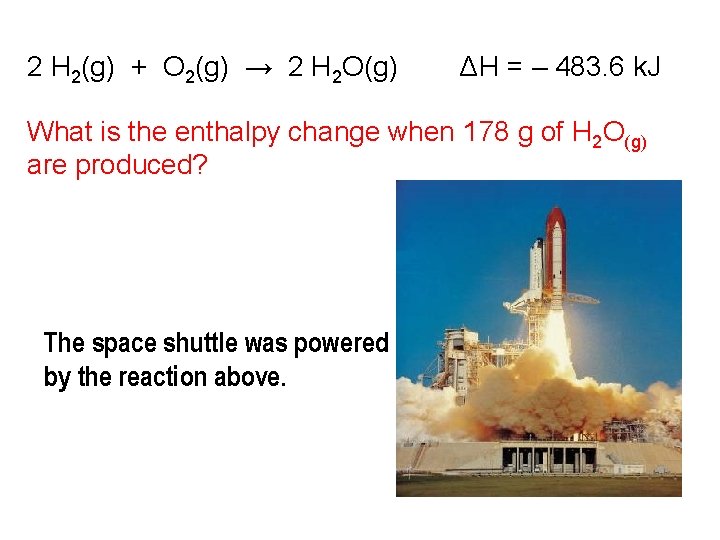
2 H 2(g) + O 2(g) → 2 H 2 O(g) ΔH = – 483. 6 k. J What is the enthalpy change when 178 g of H 2 O(g) are produced? The space shuttle was powered by the reaction above.
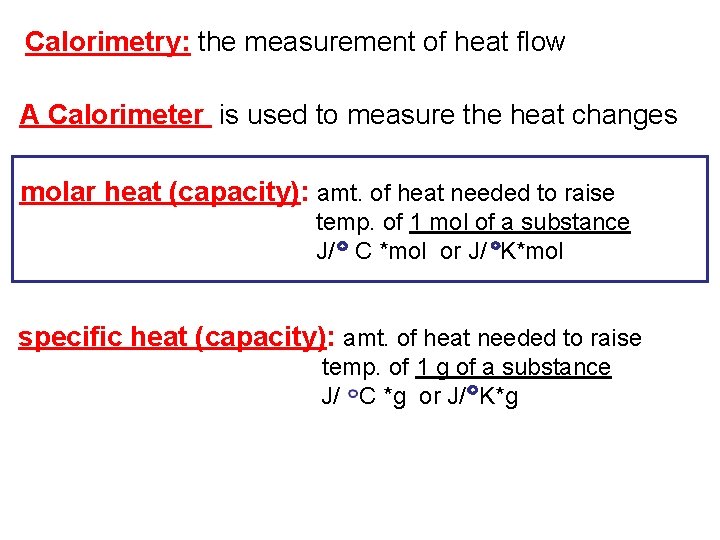
Calorimetry: the measurement of heat flow A Calorimeter is used to measure the heat changes molar heat (capacity): amt. of heat needed to raise temp. of 1 mol of a substance J/ C *mol or J/ K*mol specific heat (capacity): amt. of heat needed to raise temp. of 1 g of a substance J/ C *g or J/ K*g
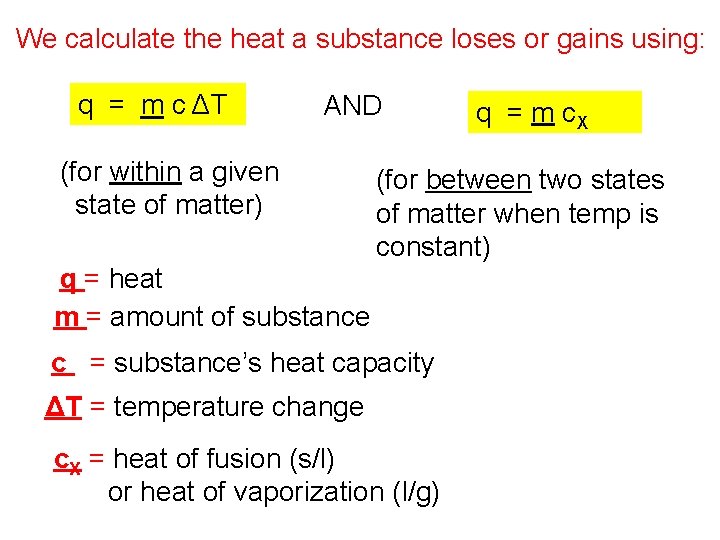
We calculate the heat a substance loses or gains using: q = m c ΔT AND (for within a given state of matter) q = heat m = amount of substance q = m c. X (for between two states of matter when temp is constant) c = substance’s heat capacity ΔT = temperature change c. X = heat of fusion (s/l) or heat of vaporization (l/g)
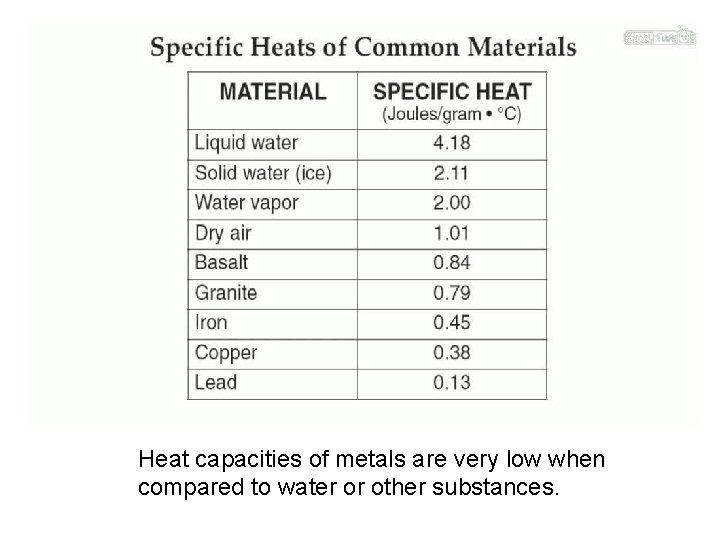
Heat capacities of metals are very low when compared to water or other substances.
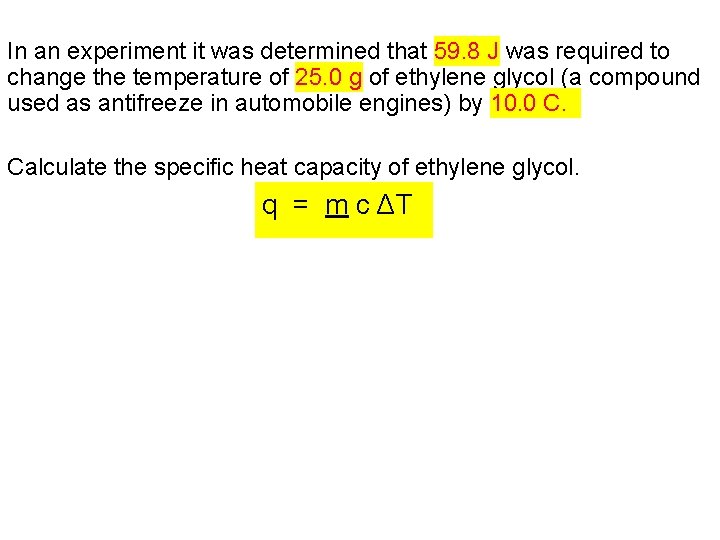
In an experiment it was determined that 59. 8 J was required to change the temperature of 25. 0 g of ethylene glycol (a compound used as antifreeze in automobile engines) by 10. 0 C. Calculate the specific heat capacity of ethylene glycol. q = m c ΔT
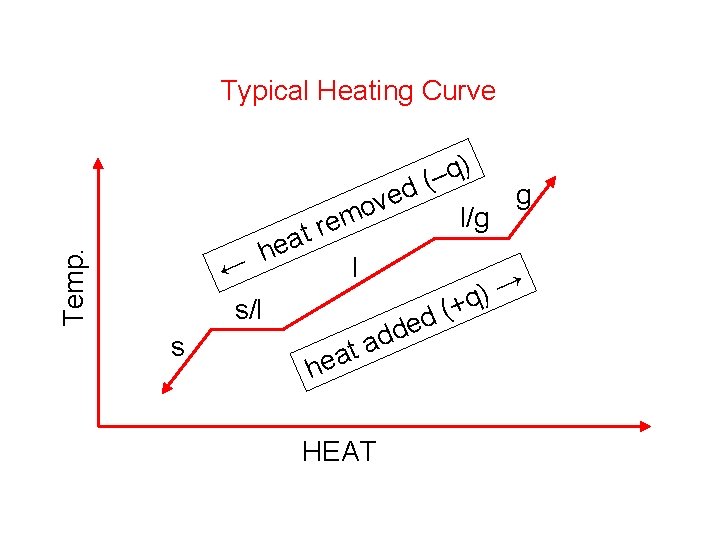
Temp. Typical Heating Curve ← s/l s t a e h ) q – ( d g ve o l/g rem l ( d e d d a t a he HEAT → ) +q
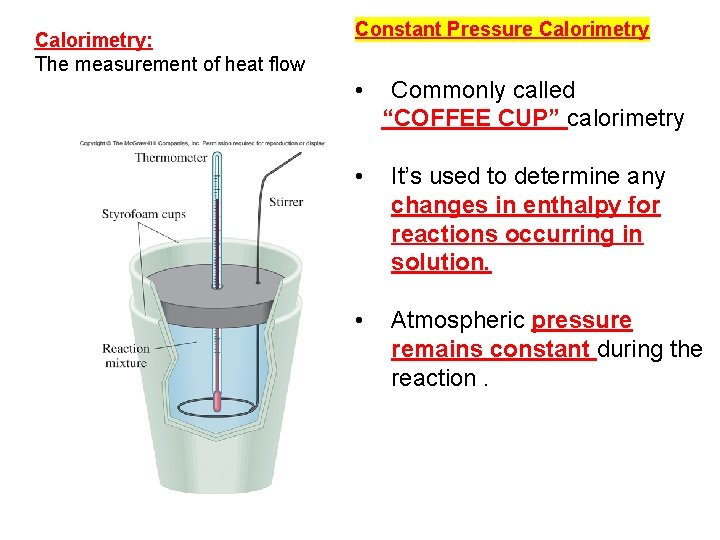
Calorimetry: The measurement of heat flow Constant Pressure Calorimetry • Commonly called “COFFEE CUP” calorimetry • It’s used to determine any changes in enthalpy for reactions occurring in solution. • Atmospheric pressure remains constant during the reaction.
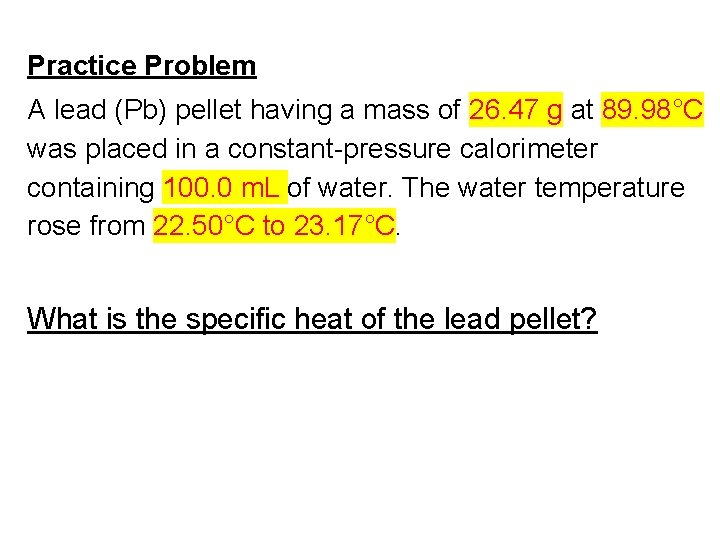
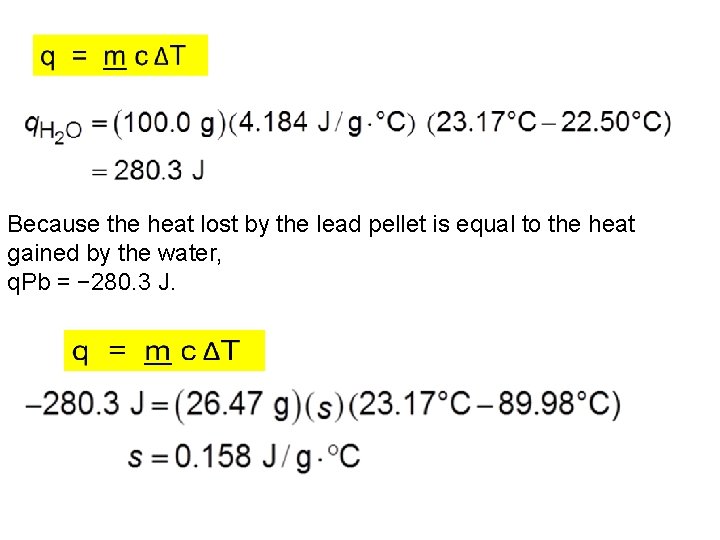
Practice Problem A lead (Pb) pellet having a mass of 26. 47 g at 89. 98°C was placed in a constant-pressure calorimeter containing 100. 0 m. L of water. The water temperature rose from 22. 50°C to 23. 17°C. What is the specific heat of the lead pellet?
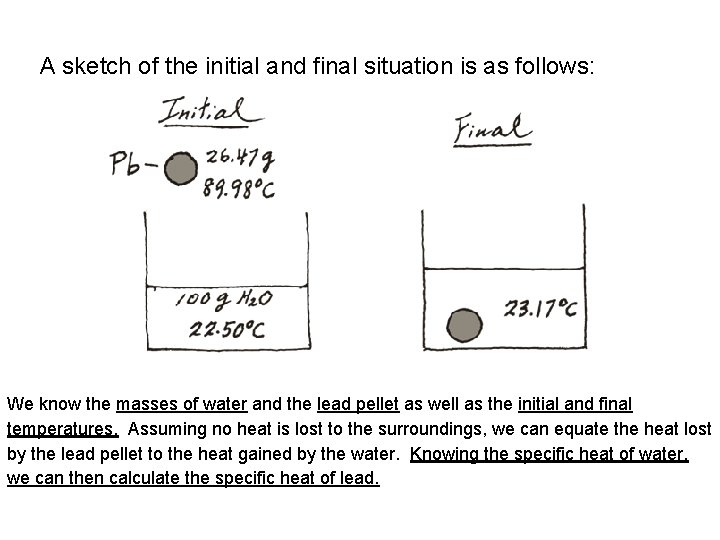
A sketch of the initial and final situation is as follows: We know the masses of water and the lead pellet as well as the initial and final temperatures. Assuming no heat is lost to the surroundings, we can equate the heat lost by the lead pellet to the heat gained by the water. Knowing the specific heat of water, we can then calculate the specific heat of lead.
Because the heat lost by the lead pellet is equal to the heat gained by the water, q. Pb = − 280. 3 J.
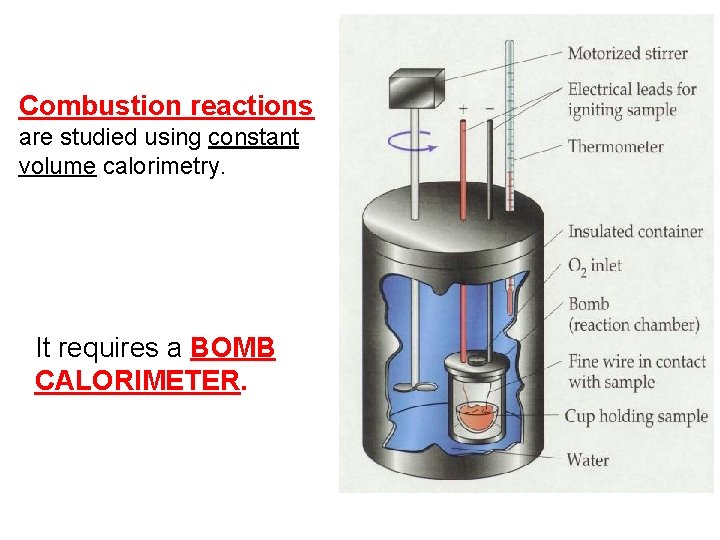
Combustion reactions are studied using constant volume calorimetry. It requires a BOMB CALORIMETER.
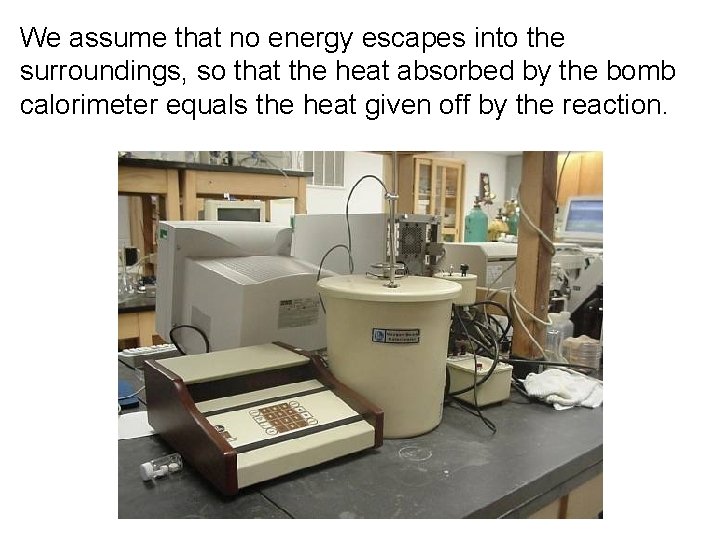
We assume that no energy escapes into the surroundings, so that the heat absorbed by the bomb calorimeter equals the heat given off by the reaction.
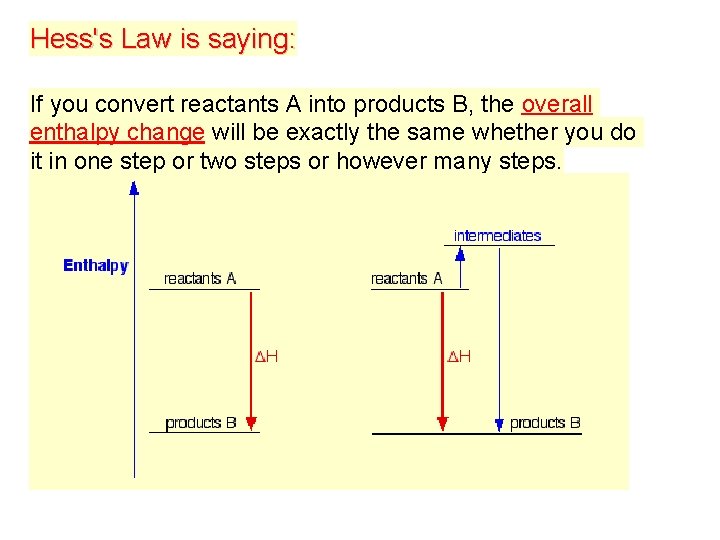
Hess’ Law 1840 • The change of enthalpy in a chemical reaction is independent of the route by which the chemical change occurs. • This is true because enthalpy is a state function , which is a value that does not depend on the path taken
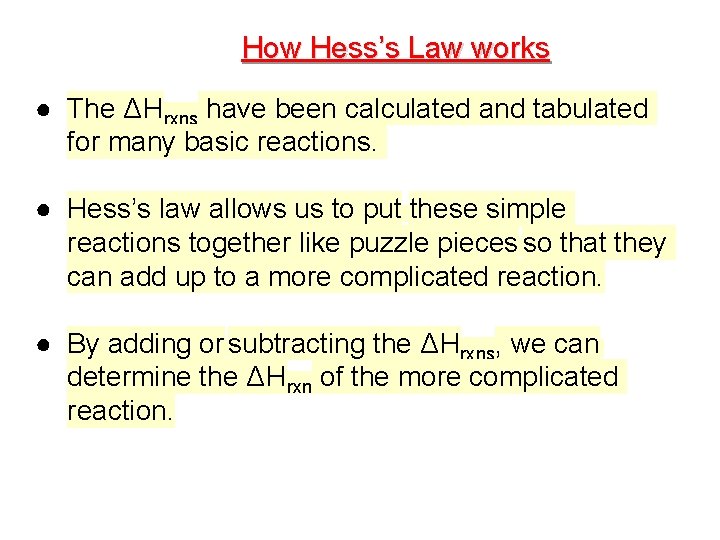
How Hess’s Law works ● The ΔHrxns have been calculated and tabulated for many basic reactions. ● Hess’s law allows us to put these simple reactions together like puzzle pieces so that they can add up to a more complicated reaction. ● By adding or subtracting the ΔHrxns, we can determine the ΔHrxn of the more complicated reaction.
Hess's Law is saying: If you convert reactants A into products B, the overall enthalpy change will be exactly the same whether you do it in one step or two steps or however many steps.
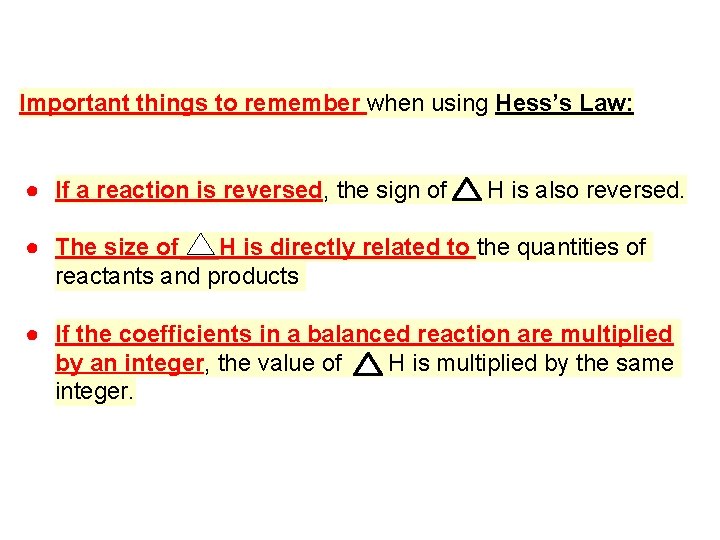
Important things to remember when using Hess’s Law: ● If a reaction is reversed, the sign of H is also reversed. ● The size of H is directly related to the quantities of reactants and products ● If the coefficients in a balanced reaction are multiplied by an integer, the value of H is multiplied by the same integer.
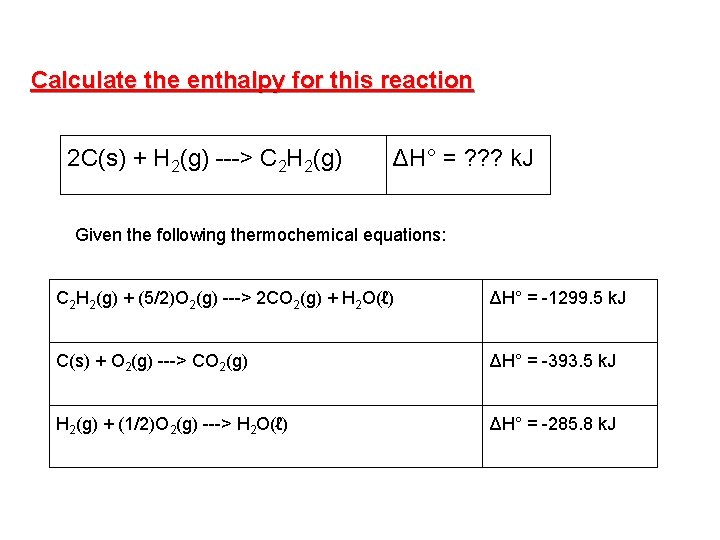
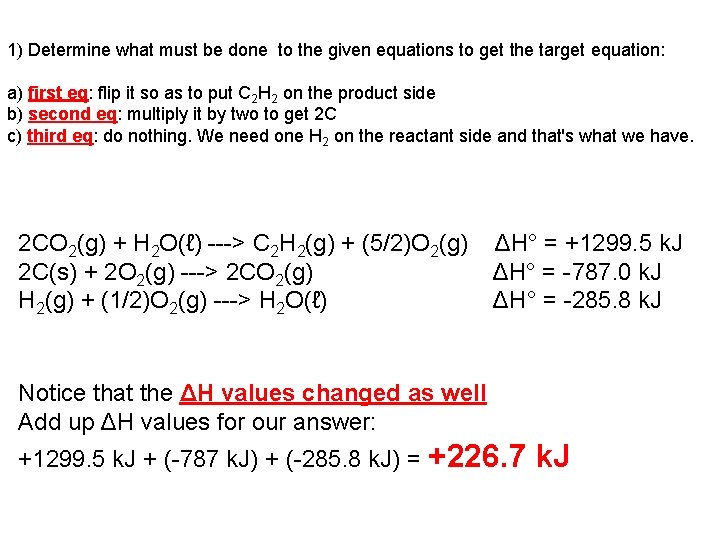
Calculate the enthalpy for this reaction 2 C(s) + H 2(g) ---> C 2 H 2(g) ΔH° = ? ? ? k. J Given the following thermochemical equations: C 2 H 2(g) + (5/2)O 2(g) ---> 2 CO 2(g) + H 2 O(ℓ) ΔH° = -1299. 5 k. J C(s) + O 2(g) ---> CO 2(g) ΔH° = -393. 5 k. J H 2(g) + (1/2)O 2(g) ---> H 2 O(ℓ) ΔH° = -285. 8 k. J
1) Determine what must be done to the given equations to get the target equation: a) first eq: flip it so as to put C 2 H 2 on the product side b) second eq: multiply it by two to get 2 C c) third eq: do nothing. We need one H 2 on the reactant side and that's what we have. 2 CO 2(g) + H 2 O(ℓ) ---> C 2 H 2(g) + (5/2)O 2(g) 2 C(s) + 2 O 2(g) ---> 2 CO 2(g) H 2(g) + (1/2)O 2(g) ---> H 2 O(ℓ) ΔH° = +1299. 5 k. J ΔH° = -787. 0 k. J ΔH° = -285. 8 k. J Notice that the ΔH values changed as well Add up ΔH values for our answer: +1299. 5 k. J + (-787 k. J) + (-285. 8 k. J) = +226. 7 k. J
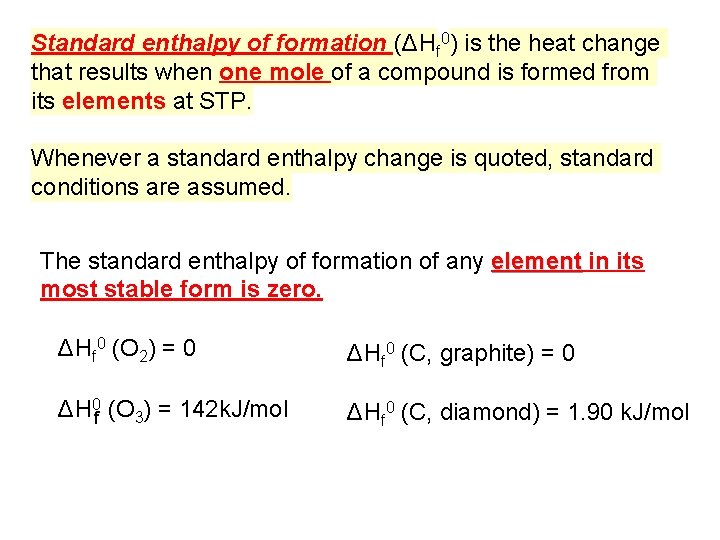
Standard enthalpy of formation (ΔHf 0) is the heat change that results when one mole of a compound is formed from its elements at STP. Whenever a standard enthalpy change is quoted, standard conditions are assumed. The standard enthalpy of formation of any element in its most stable form is zero. ΔHf 0 (O 2) = 0 ΔHf 0 (C, graphite) = 0 ΔH 0 f (O 3) = 142 k. J/mol ΔHf 0 (C, diamond) = 1. 90 k. J/mol
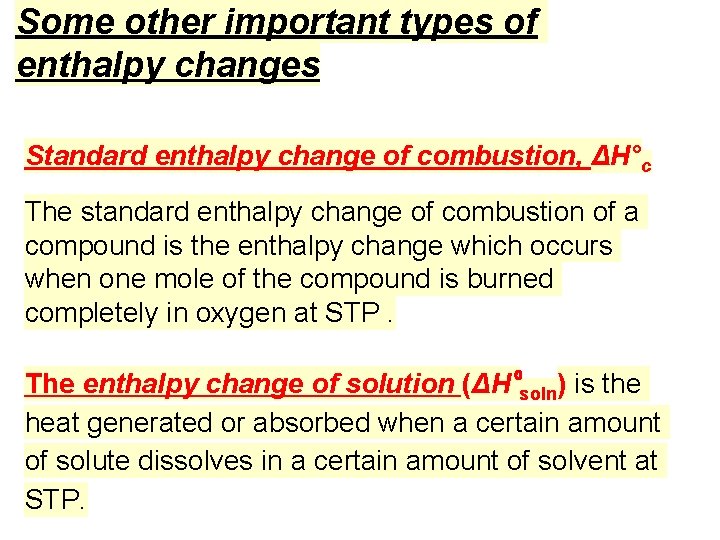
Some other important types of enthalpy changes Standard enthalpy change of combustion, ΔH°c The standard enthalpy change of combustion of a compound is the enthalpy change which occurs when one mole of the compound is burned completely in oxygen at STP. The enthalpy change of solution (ΔH soln) is the heat generated or absorbed when a certain amount of solute dissolves in a certain amount of solvent at STP.
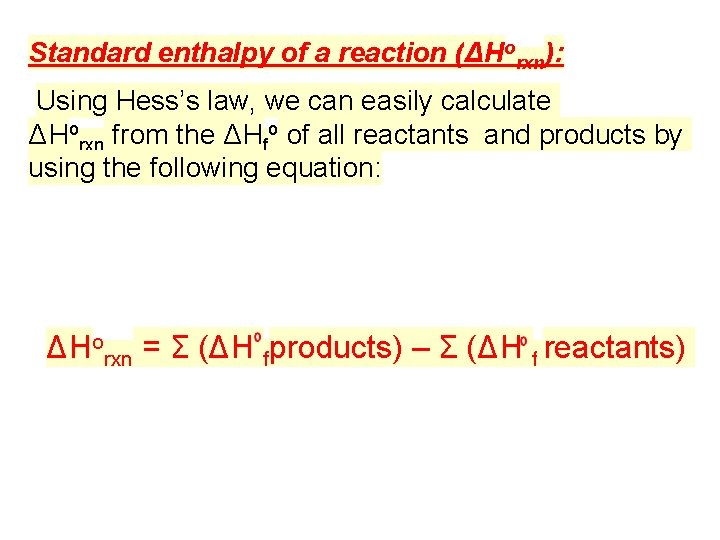
Standard enthalpy of a reaction (ΔHorxn): Using Hess’s law, we can easily calculate ΔHorxn from the ΔHfo of all reactants and products by using the following equation: ΔHorxn = Σ (ΔH fproducts) – Σ (ΔH f reactants)
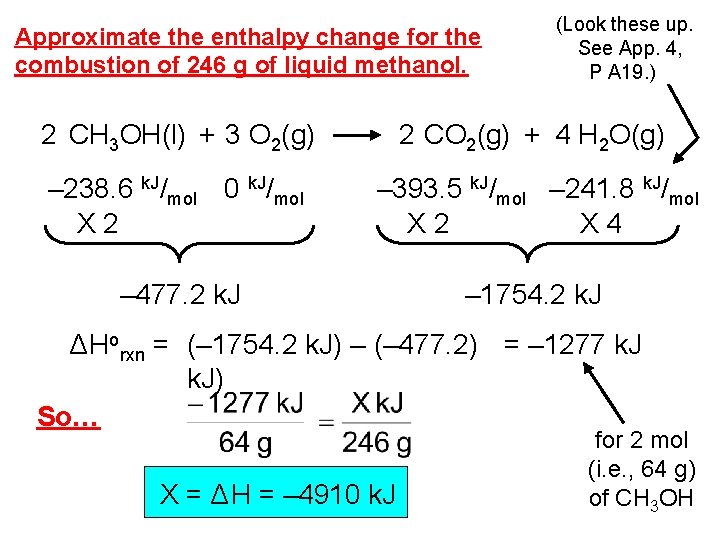
Approximate the enthalpy change for the combustion of 246 g of liquid methanol. (Look these up. See App. 4, P A 19. ) 2 CH 3 OH(l) + 3 O 2(g) 2 CO 2(g) + 4 H 2 O(g) – 238. 6 k. J/mol 0 k. J/mol X 2 – 393. 5 k. J/mol – 241. 8 k. J/mol X 2 X 4 – 477. 2 k. J – 1754. 2 k. J ΔHorxn = (– 1754. 2 k. J) – (– 477. 2) = – 1277 k. J) So… X = ΔH = – 4910 k. J for 2 mol (i. e. , 64 g) of CH 3 OH
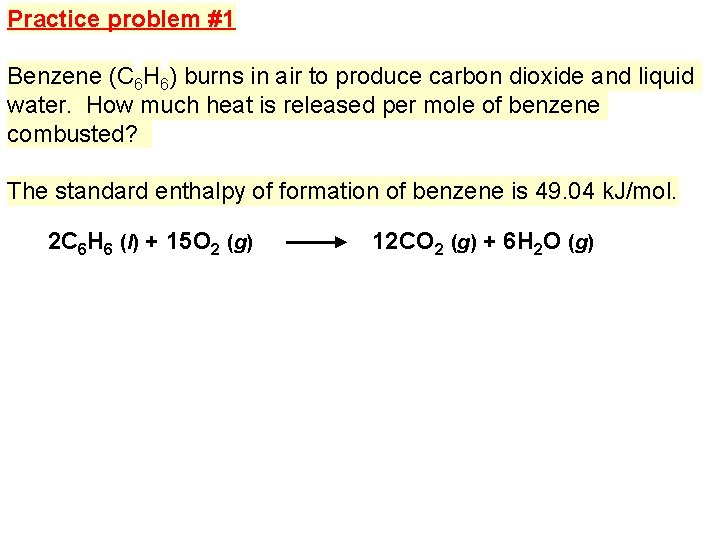
Practice problem #1 Benzene (C 6 H 6) burns in air to produce carbon dioxide and liquid water. How much heat is released per mole of benzene combusted? The standard enthalpy of formation of benzene is 49. 04 k. J/mol. 2 C 6 H 6 (l) + 15 O 2 (g) 12 CO 2 (g) + 6 H 2 O (g)
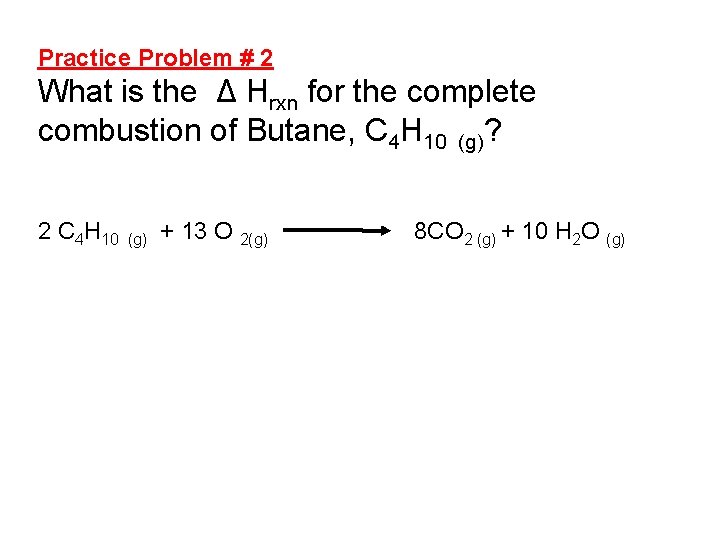
Practice Problem # 2 What is the Δ Hrxn for the complete combustion of Butane, C 4 H 10 (g)? 2 C 4 H 10 (g) + 13 O 2(g) 8 CO 2 (g) + 10 H 2 O (g)
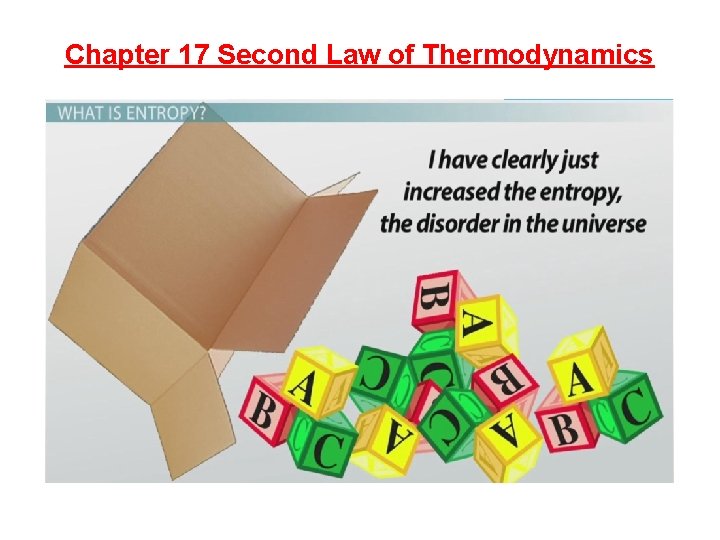
Chapter 17 Second Law of Thermodynamics
Think of these commonplace experiences: ● A Hot frying pans cool down when taken off the stove. ● Air in a high-pressure tire shoots out from even a small hole in its side to the lower pressure atmosphere. ● Ice cubes melt in a warm room. ● Iron exposed to oxygen and water will form rust.
What’s happening in each of those processes? ● Energy of some kind is changing from being localized, concentrated, and contained to becoming more spread out and dispersed. ● Entropy is the measurement of disorder of a system and it is given the letter S, and it is temperature dependent.
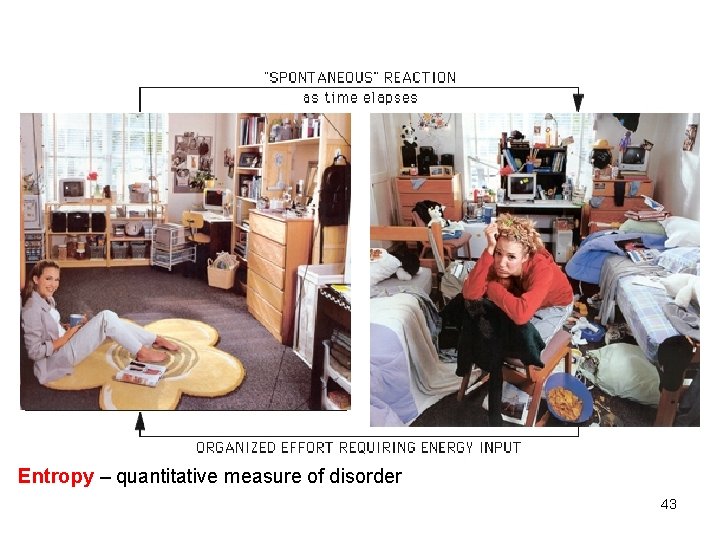
Entropy – quantitative measure of disorder 43
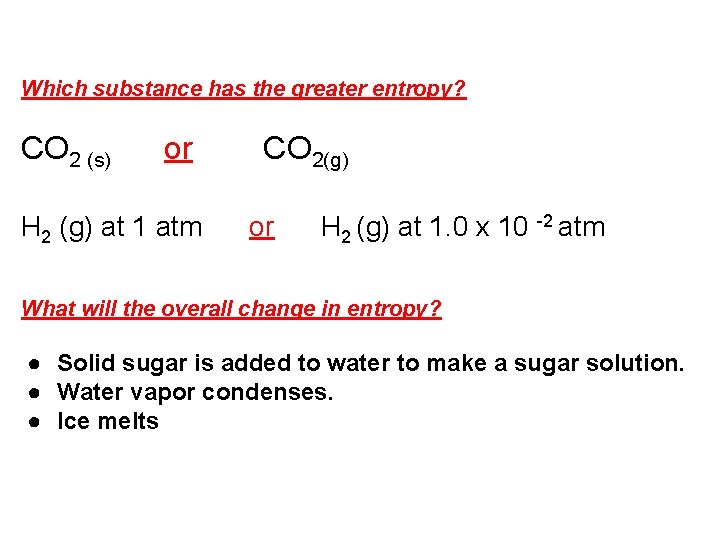
• Entropy increases with dispersal of particles so, entropies of gases are larger than liquids and liquid entropies are larger than solids. Ssolid < Sliquid < Sgas Entropies are greater for : - more complex molecules - Increased temperatures (KE) - When volume increases for gases +ΔS ………. Entropy increases - ΔS ………. Entropy decreases
Which substance has the greater entropy? CO 2 (s) or H 2 (g) at 1 atm CO 2(g) or H 2 (g) at 1. 0 x 10 -2 atm What will the overall change in entropy? ● Solid sugar is added to water to make a sugar solution. ● Water vapor condenses. ● Ice melts
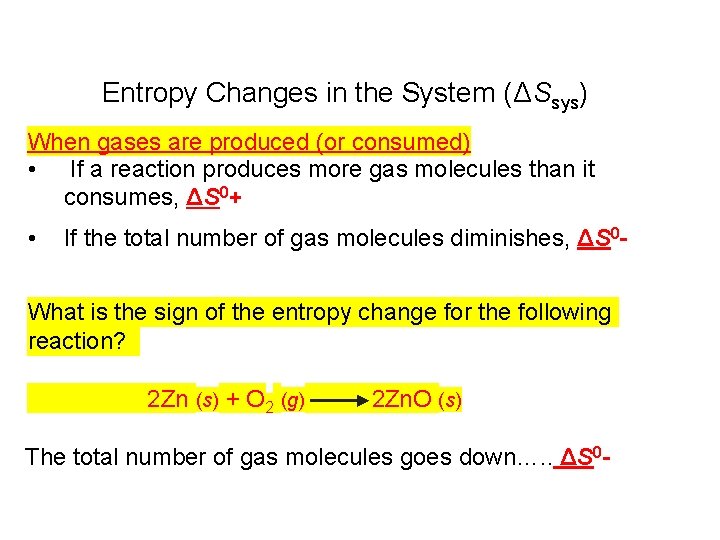
Entropy Changes in the System (ΔSsys) When gases are produced (or consumed) • If a reaction produces more gas molecules than it consumes, ΔS 0+ • If the total number of gas molecules diminishes, ΔS 0 - What is the sign of the entropy change for the following reaction? 2 Zn (s) + O 2 (g) 2 Zn. O (s) The total number of gas molecules goes down…. . ΔS 0 -
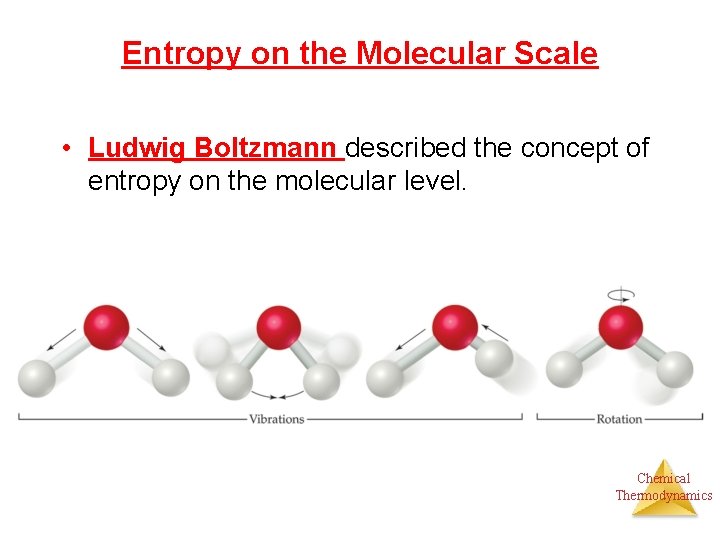
Entropy on the Molecular Scale • Ludwig Boltzmann described the concept of entropy on the molecular level. Chemical Thermodynamics
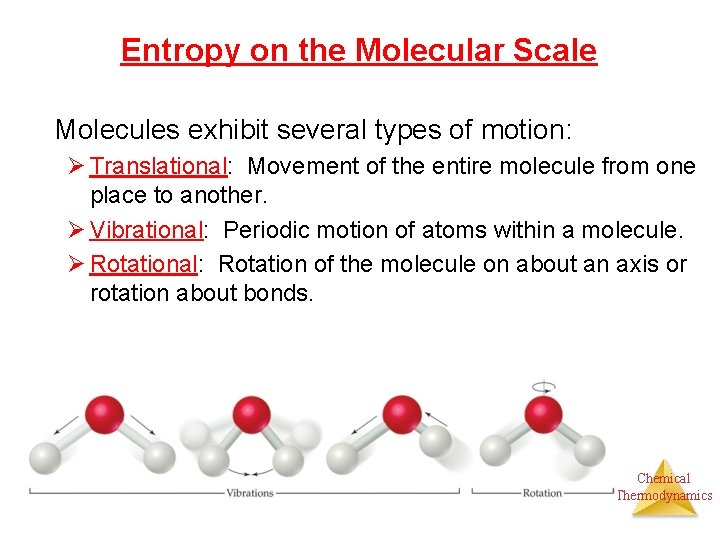
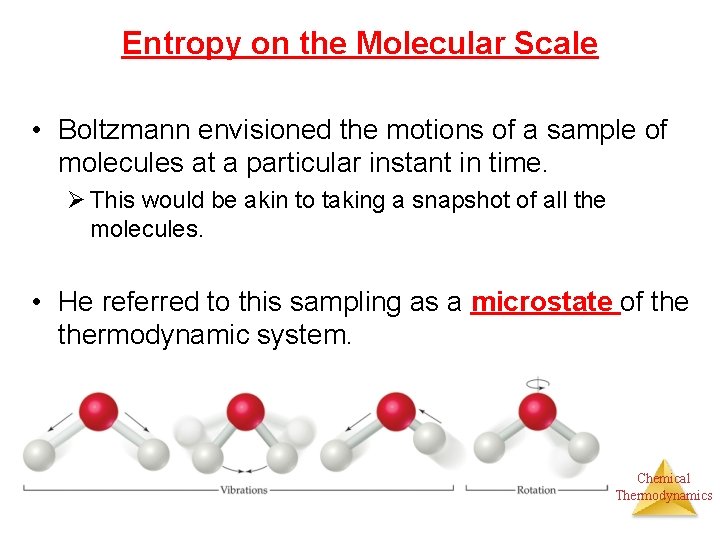
Entropy on the Molecular Scale Molecules exhibit several types of motion: Ø Translational: Movement of the entire molecule from one place to another. Ø Vibrational: Periodic motion of atoms within a molecule. Ø Rotational: Rotation of the molecule on about an axis or rotation about bonds. Chemical Thermodynamics
Entropy on the Molecular Scale • Boltzmann envisioned the motions of a sample of molecules at a particular instant in time. Ø This would be akin to taking a snapshot of all the molecules. • He referred to this sampling as a microstate of thermodynamic system. Chemical Thermodynamics
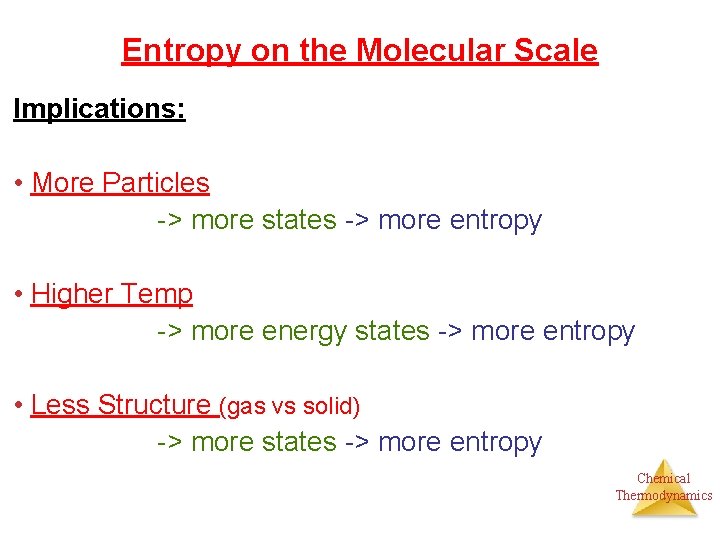
Entropy on the Molecular Scale Implications: • More Particles -> more states -> more entropy • Higher Temp -> more energy states -> more entropy • Less Structure (gas vs solid) -> more states -> more entropy Chemical Thermodynamics
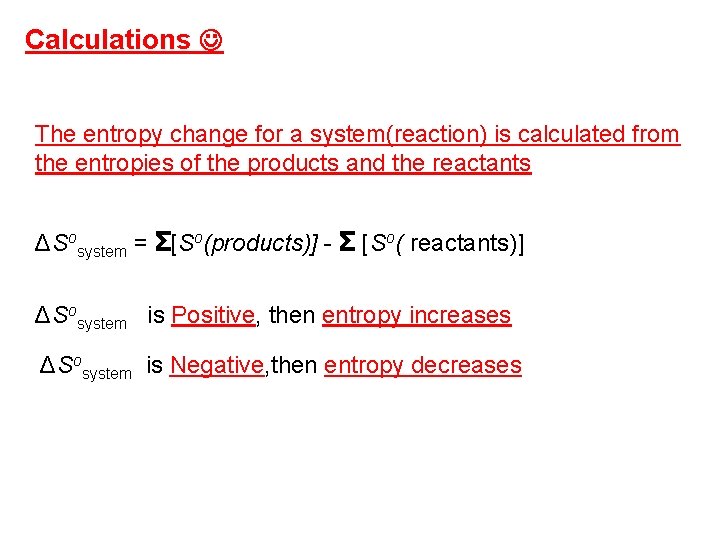
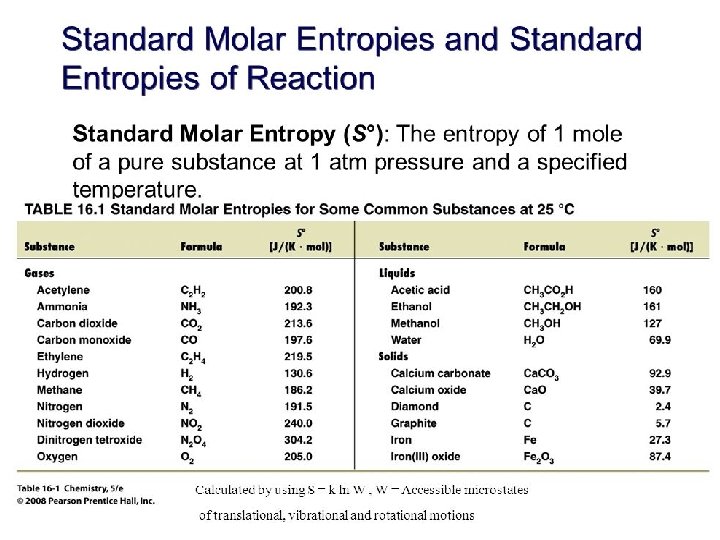
Calculations The entropy change for a system(reaction) is calculated from the entropies of the products and the reactants ΔSosystem = Σ[So(products)] - Σ [So( reactants)] ΔSosystem is Positive, then entropy increases ΔSosystem is Negative, then entropy decreases
Chemical Thermodynamics
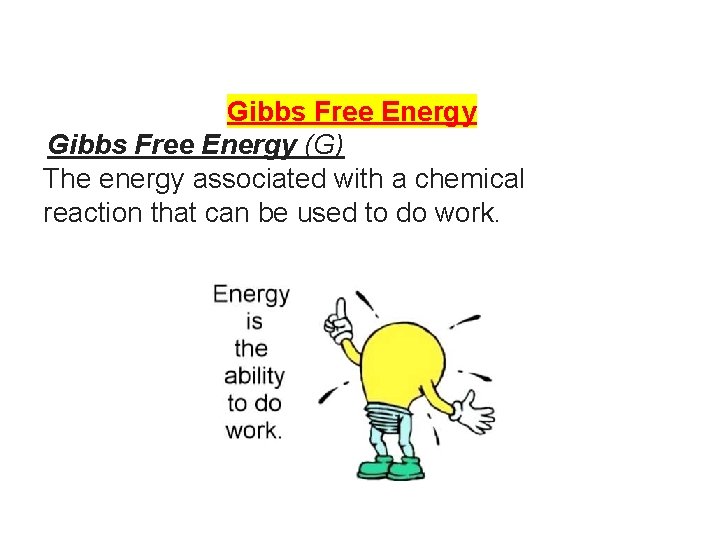
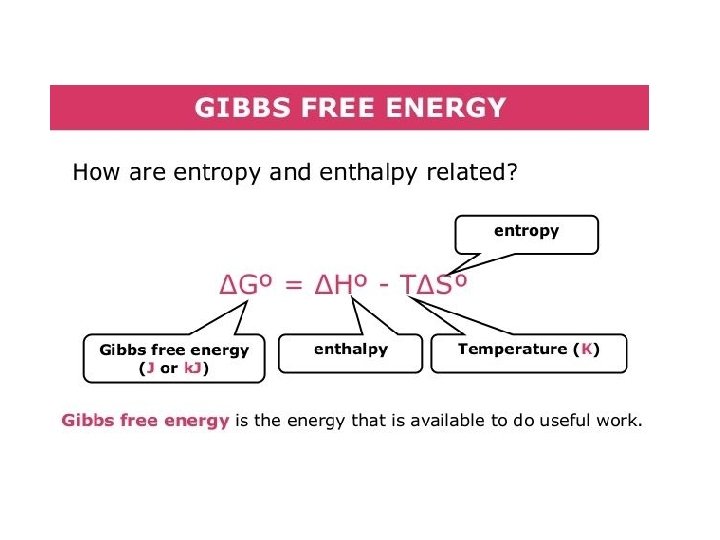
Gibbs Free Energy (G) The energy associated with a chemical reaction that can be used to do work.
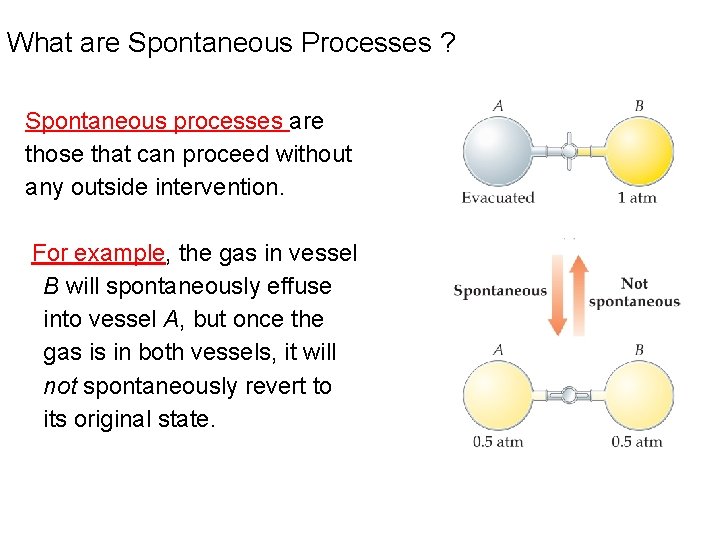
What are Spontaneous Processes ? Spontaneous processes are those that can proceed without any outside intervention. For example, the gas in vessel B will spontaneously effuse into vessel A, but once the gas is in both vessels, it will not spontaneously revert to its original state.
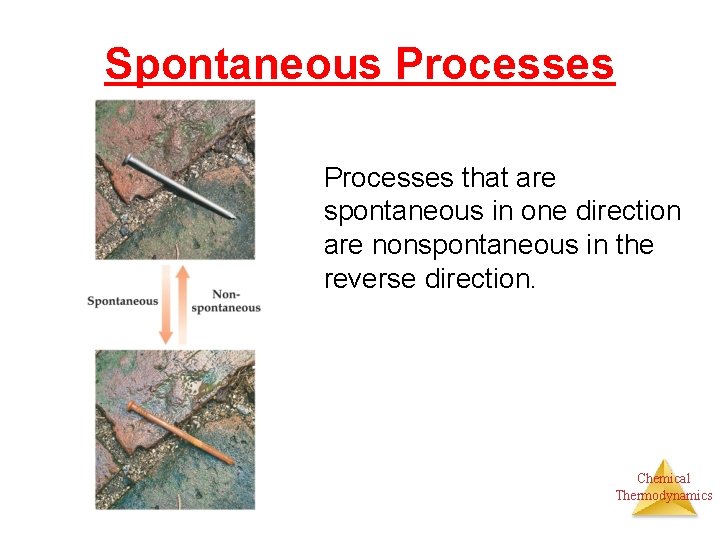
Spontaneous Processes that are spontaneous in one direction are nonspontaneous in the reverse direction. Chemical Thermodynamics
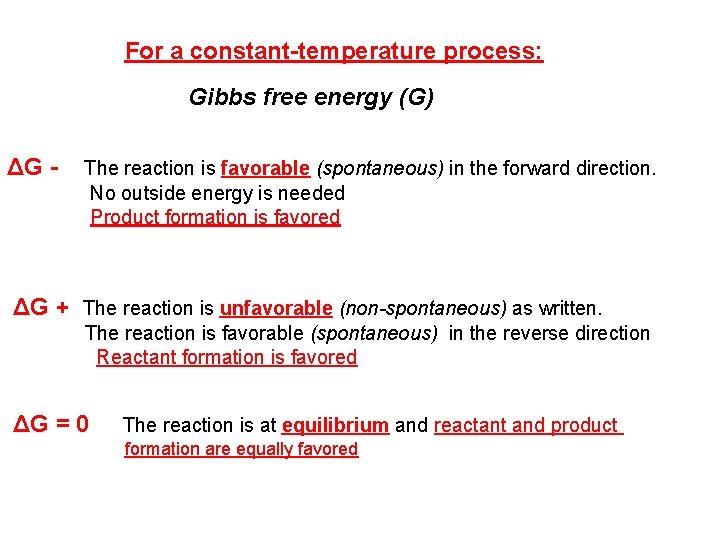
For a constant-temperature process: Gibbs free energy (G) ΔG - The reaction is favorable (spontaneous) in the forward direction. No outside energy is needed Product formation is favored ΔG + The reaction is unfavorable (non-spontaneous) as written. The reaction is favorable (spontaneous) in the reverse direction Reactant formation is favored ΔG = 0 The reaction is at equilibrium and reactant and product formation are equally favored
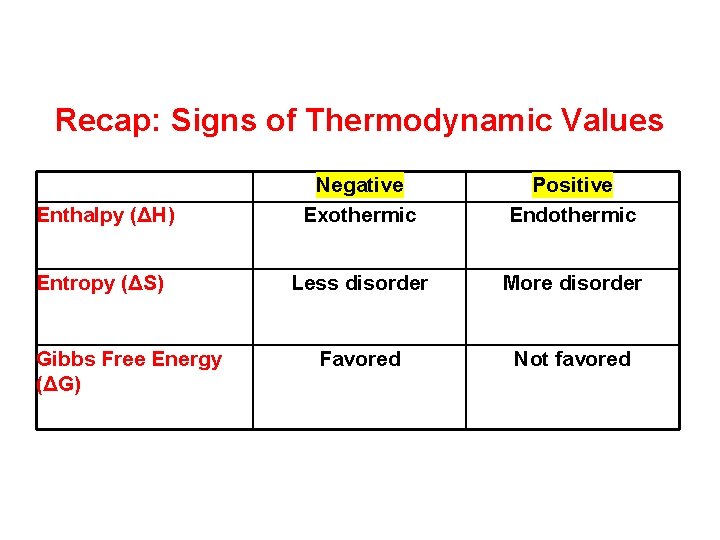
Recap: Signs of Thermodynamic Values Enthalpy (ΔH) Negative Exothermic Positive Endothermic Entropy (ΔS) Less disorder More disorder Favored Not favored Gibbs Free Energy (ΔG)