
AP Chemistry Quiz Bowl 0 The temperature of
AP Chemistry Quiz Bowl
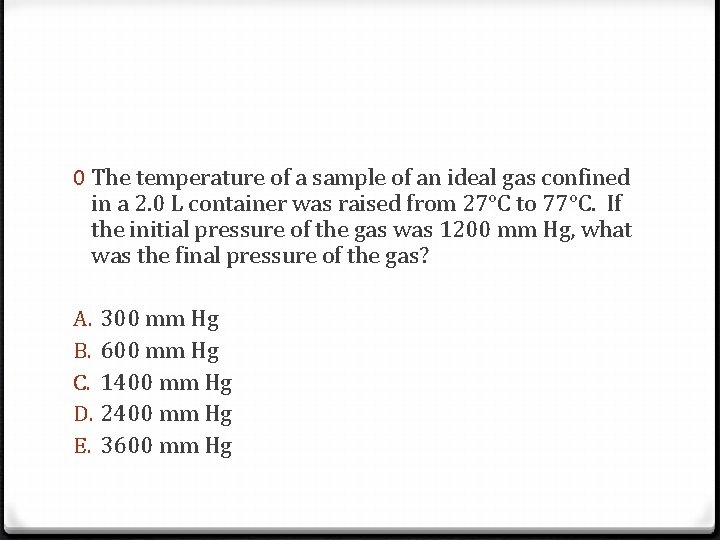
0 The temperature of a sample of an ideal gas confined in a 2. 0 L container was raised from 27°C to 77°C. If the initial pressure of the gas was 1200 mm Hg, what was the final pressure of the gas? A. 300 mm Hg B. 600 mm Hg C. 1400 mm Hg D. 2400 mm Hg E. 3600 mm Hg
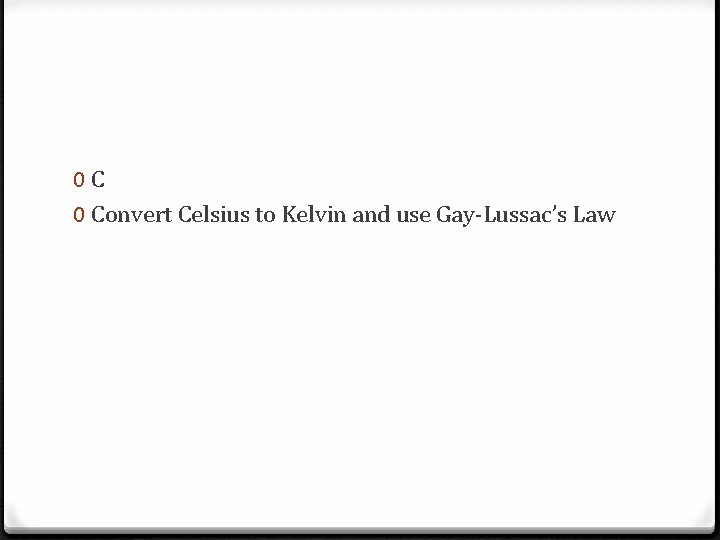
0 C 0 Convert Celsius to Kelvin and use Gay-Lussac’s Law
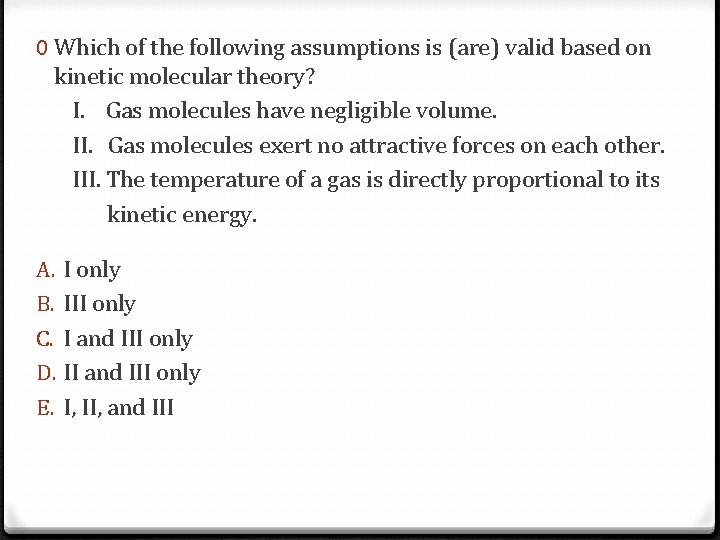
0 Which of the following assumptions is (are) valid based on kinetic molecular theory? I. Gas molecules have negligible volume. II. Gas molecules exert no attractive forces on each other. III. The temperature of a gas is directly proportional to its kinetic energy. A. I only B. III only C. I and III only D. II and III only E. I, II, and III
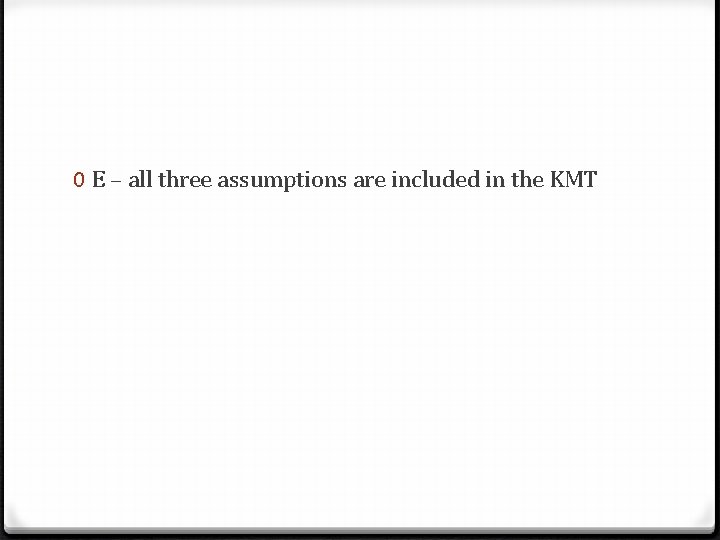
0 E – all three assumptions are included in the KMT
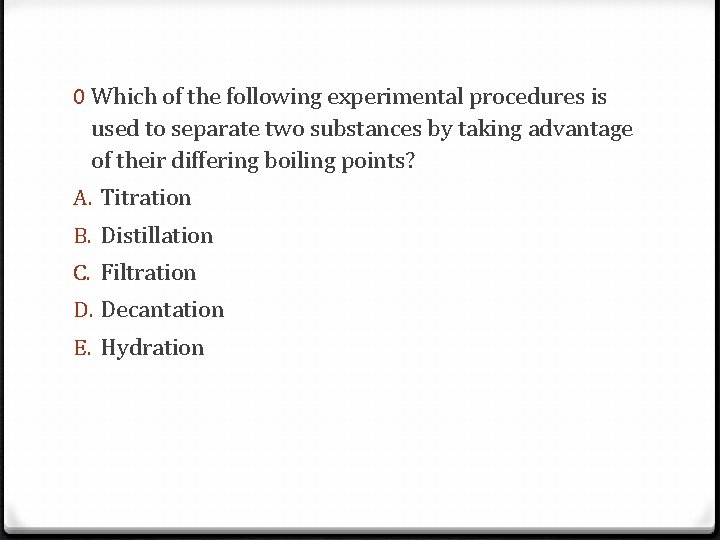
0 Which of the following experimental procedures is used to separate two substances by taking advantage of their differing boiling points? A. Titration B. Distillation C. Filtration D. Decantation E. Hydration
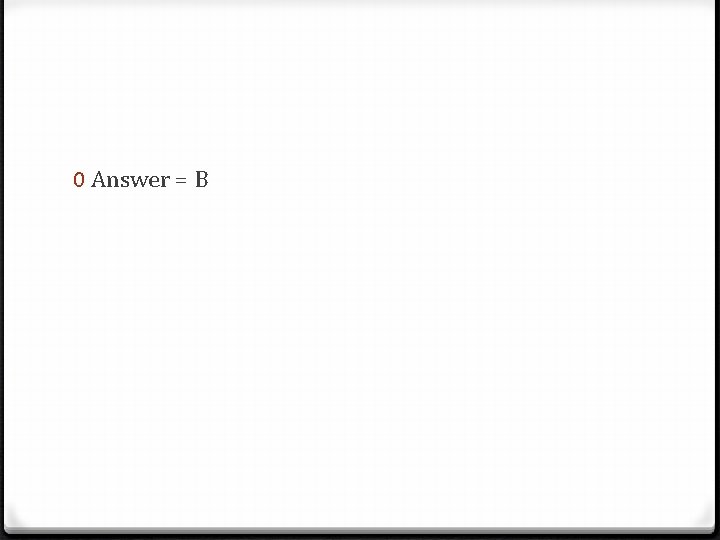
0 Answer = B
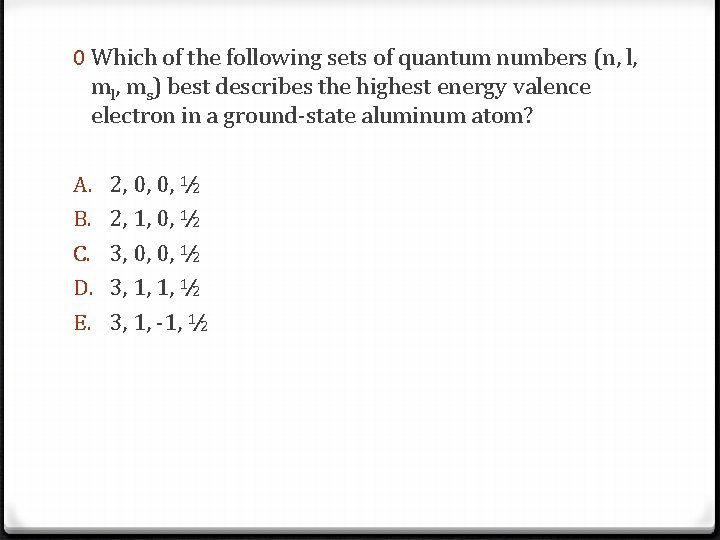
0 Which of the following sets of quantum numbers (n, l, ms) best describes the highest energy valence electron in a ground-state aluminum atom? A. B. C. D. E. 2, 0, 0, ½ 2, 1, 0, ½ 3, 0, 0, ½ 3, 1, 1, ½ 3, 1, -1, ½
0 Answer = E
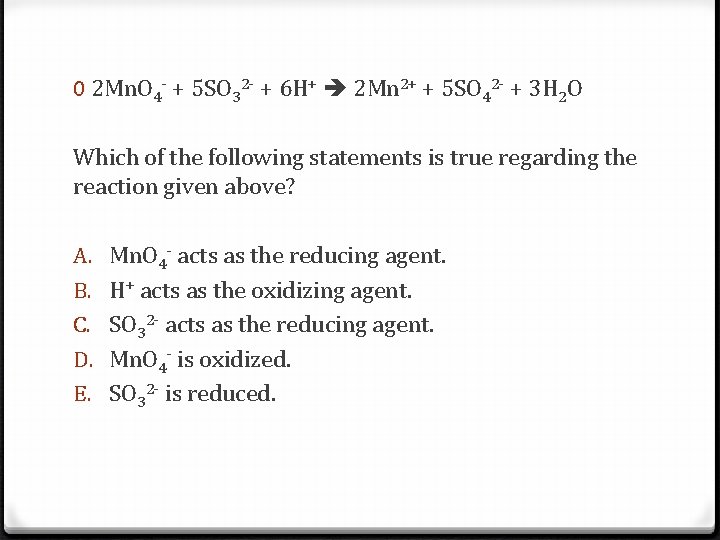
0 2 Mn. O 4 - + 5 SO 32 - + 6 H+ 2 Mn 2+ + 5 SO 42 - + 3 H 2 O Which of the following statements is true regarding the reaction given above? A. B. C. D. E. Mn. O 4 - acts as the reducing agent. H+ acts as the oxidizing agent. SO 32 - acts as the reducing agent. Mn. O 4 - is oxidized. SO 32 - is reduced.
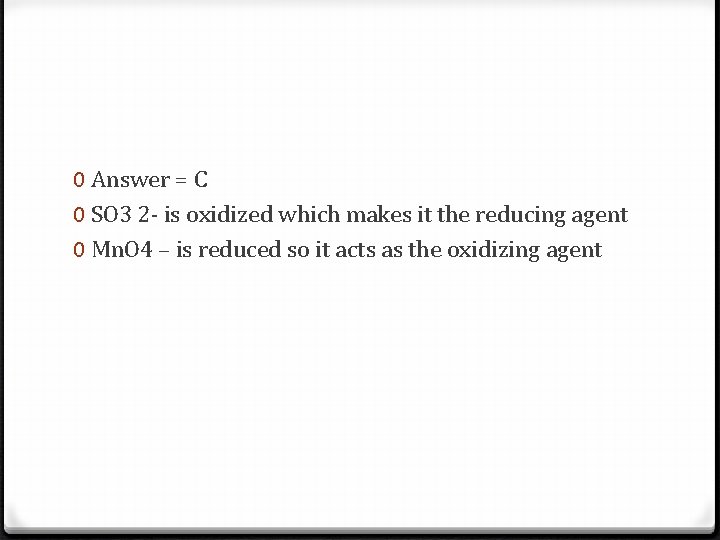
0 Answer = C 0 SO 3 2 - is oxidized which makes it the reducing agent 0 Mn. O 4 – is reduced so it acts as the oxidizing agent
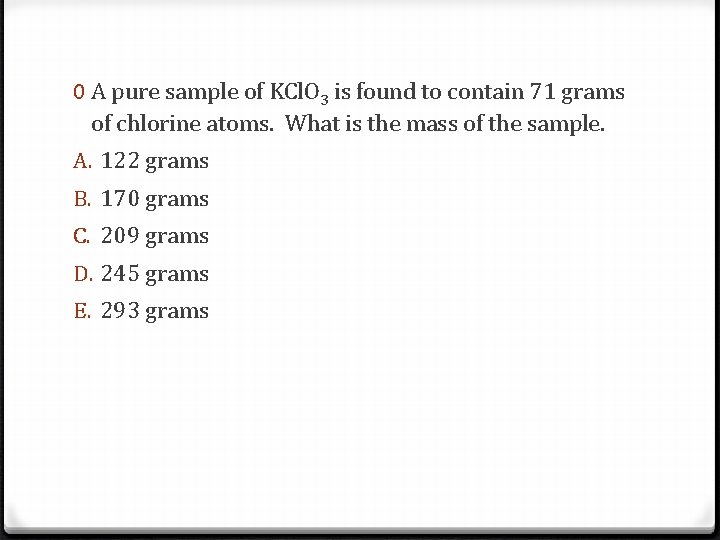
0 A pure sample of KCl. O 3 is found to contain 71 grams of chlorine atoms. What is the mass of the sample. A. 122 grams B. 170 grams C. 209 grams D. 245 grams E. 293 grams
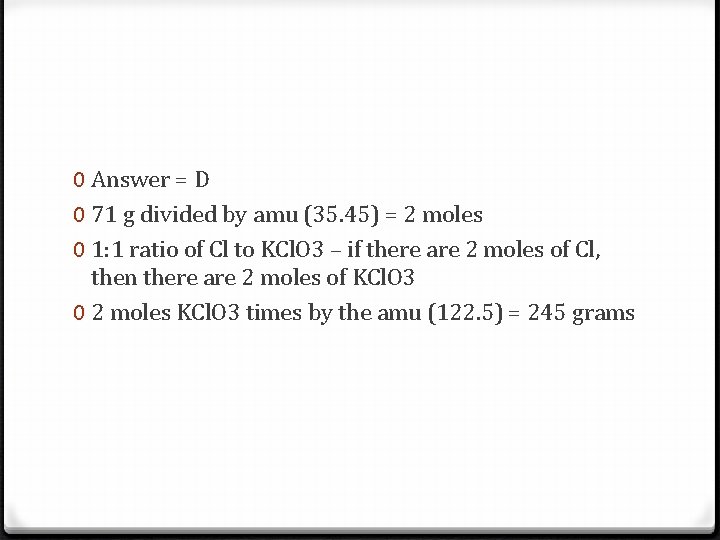
0 Answer = D 0 71 g divided by amu (35. 45) = 2 moles 0 1: 1 ratio of Cl to KCl. O 3 – if there are 2 moles of Cl, then there are 2 moles of KCl. O 3 0 2 moles KCl. O 3 times by the amu (122. 5) = 245 grams
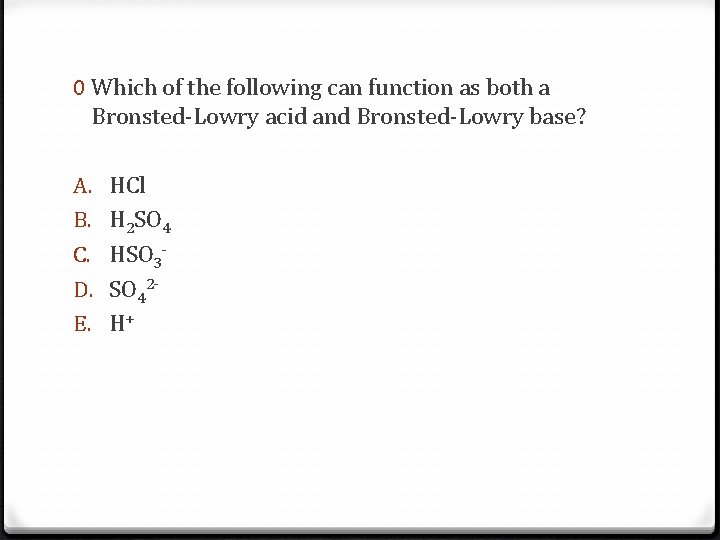
0 Which of the following can function as both a Bronsted-Lowry acid and Bronsted-Lowry base? A. B. C. D. E. HCl H 2 SO 4 HSO 3 SO 42 H+
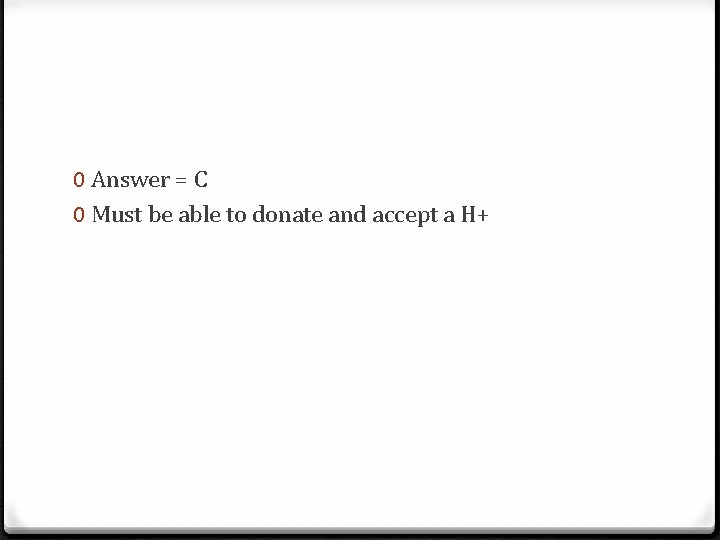
0 Answer = C 0 Must be able to donate and accept a H+
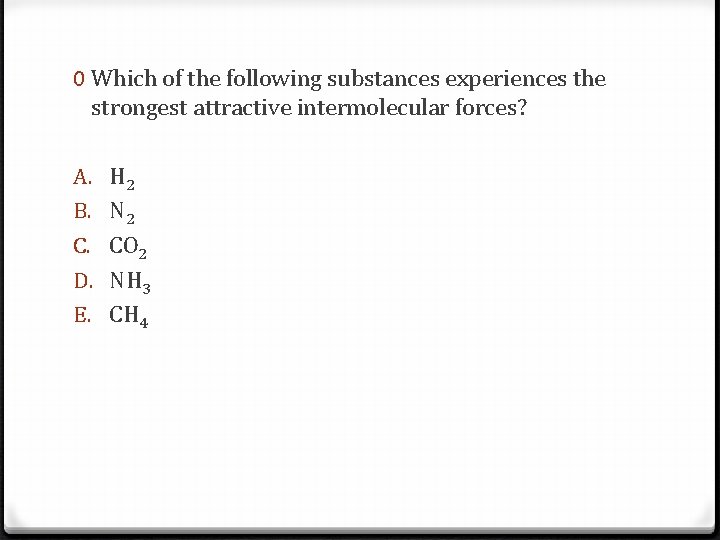
0 Which of the following substances experiences the strongest attractive intermolecular forces? A. B. C. D. E. H 2 N 2 CO 2 NH 3 CH 4
0 Answer = D 0 NH 3 has hydrogen bonding 0 A & B have LDF 0 E has LDF and DP-DP
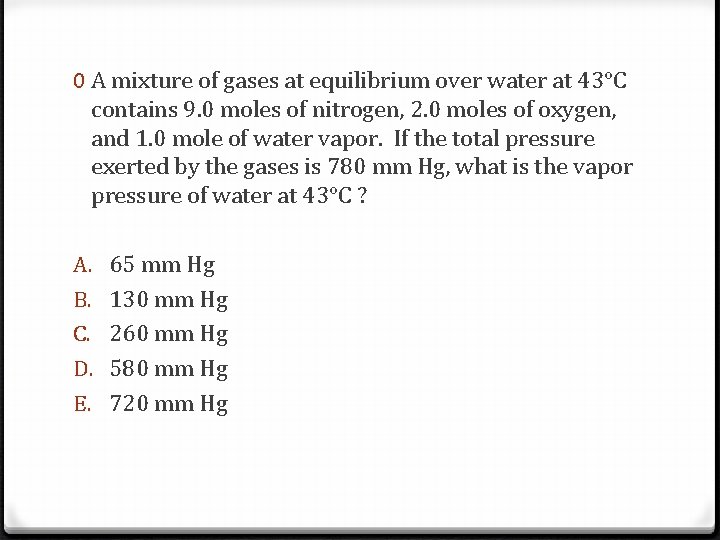
0 A mixture of gases at equilibrium over water at 43°C contains 9. 0 moles of nitrogen, 2. 0 moles of oxygen, and 1. 0 mole of water vapor. If the total pressure exerted by the gases is 780 mm Hg, what is the vapor pressure of water at 43°C ? A. B. C. D. E. 65 mm Hg 130 mm Hg 260 mm Hg 580 mm Hg 720 mm Hg
0 Answer = A 0 Dalton’s Law of PP 0 The gases are at equilibrium so the partial pressure of the water vapor will be the same as the vapor pressure of water
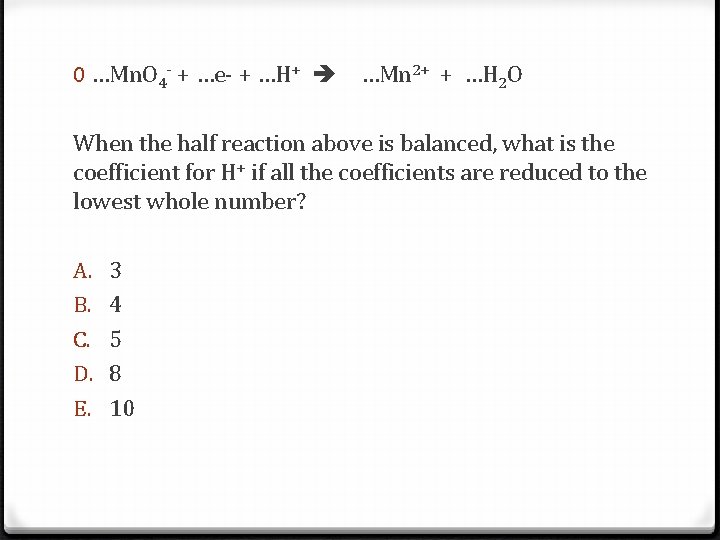
0 …Mn. O 4 - + …e- + …H+ …Mn 2+ + …H 2 O When the half reaction above is balanced, what is the coefficient for H+ if all the coefficients are reduced to the lowest whole number? A. B. C. D. E. 3 4 5 8 10
0 Answer = D
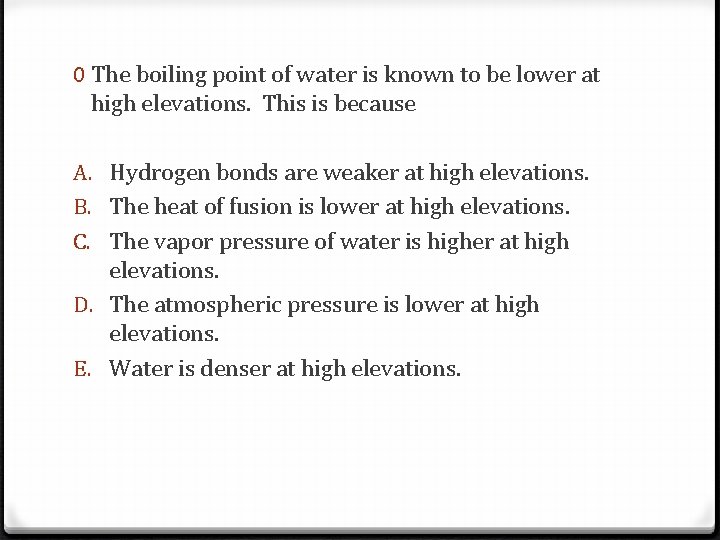
0 The boiling point of water is known to be lower at high elevations. This is because A. Hydrogen bonds are weaker at high elevations. B. The heat of fusion is lower at high elevations. C. The vapor pressure of water is higher at high elevations. D. The atmospheric pressure is lower at high elevations. E. Water is denser at high elevations.
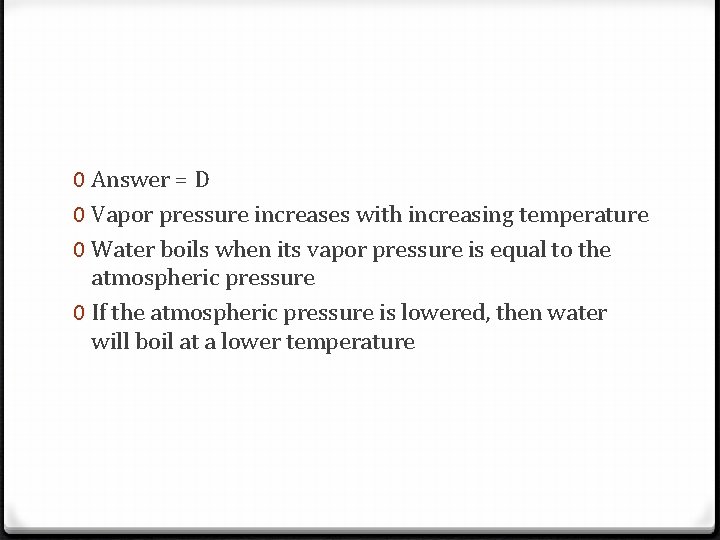
0 Answer = D 0 Vapor pressure increases with increasing temperature 0 Water boils when its vapor pressure is equal to the atmospheric pressure 0 If the atmospheric pressure is lowered, then water will boil at a lower temperature
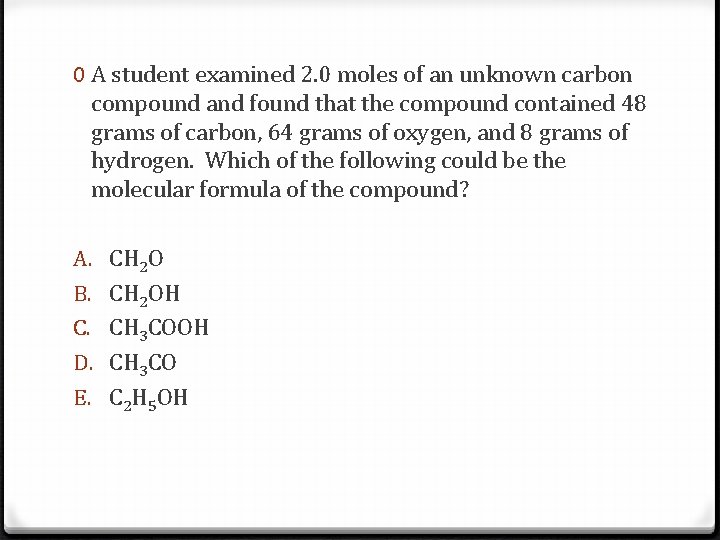
0 A student examined 2. 0 moles of an unknown carbon compound and found that the compound contained 48 grams of carbon, 64 grams of oxygen, and 8 grams of hydrogen. Which of the following could be the molecular formula of the compound? A. B. C. D. E. CH 2 OH CH 3 COOH CH 3 CO C 2 H 5 OH
0 Answer = C 0 Find the EF 0 Divide by the amu of each, divide by the lowest 0 Be careful – the student has 2 moles of the carbon compound
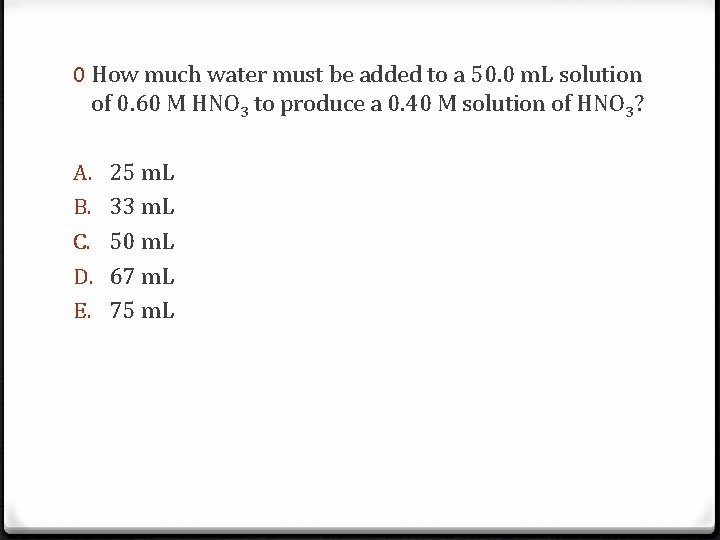
0 How much water must be added to a 50. 0 m. L solution of 0. 60 M HNO 3 to produce a 0. 40 M solution of HNO 3? A. B. C. D. E. 25 m. L 33 m. L 50 m. L 67 m. L 75 m. L
0 Answer = A 0 This is a dilution problem = M 1 V 1 = M 2 V 2 0 Subtract from the total for the amount of the water
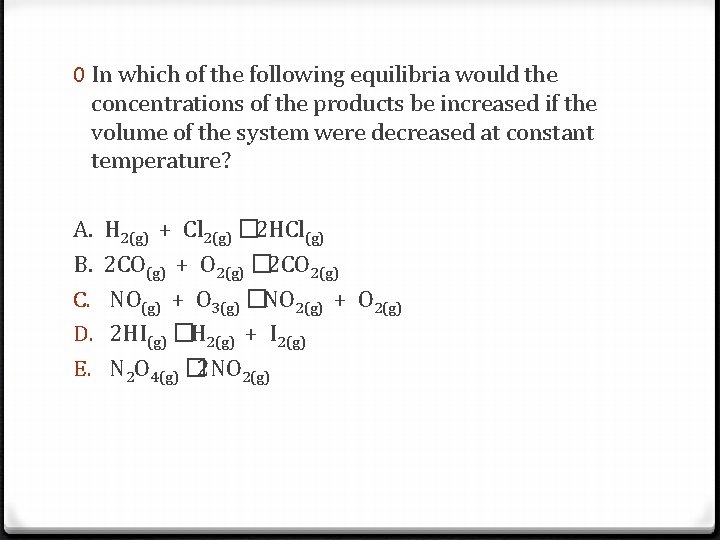
0 In which of the following equilibria would the concentrations of the products be increased if the volume of the system were decreased at constant temperature? A. B. C. D. E. H 2(g) + Cl 2(g) � 2 HCl(g) 2 CO(g) + O 2(g) � 2 CO 2(g) NO(g) + O 3(g) �NO 2(g) + O 2(g) 2 HI(g) �H 2(g) + I 2(g) N 2 O 4(g) � 2 NO 2(g)
0 Answer = B 0 Equilibrium shift to relieve the stress 0 Decrease volume, increase pressure 0 Pressure increase goes to the side with the least number of moles
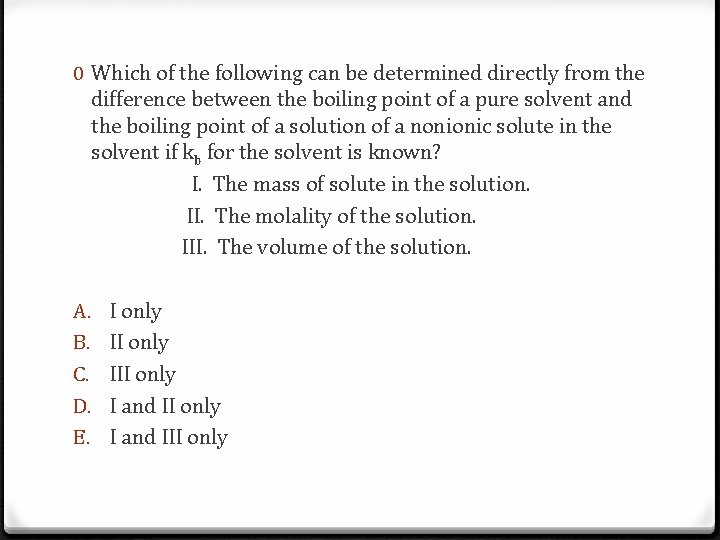
0 Which of the following can be determined directly from the difference between the boiling point of a pure solvent and the boiling point of a solution of a nonionic solute in the solvent if kb for the solvent is known? I. The mass of solute in the solution. II. The molality of the solution. III. The volume of the solution. A. B. C. D. E. I only III only I and III only
0 Answer = B 0 You do not know the amount of solution so you cannot find the mass or the volume (I and III) 0 You can get II from the BP elevation – you know kb and you know it’s i factor (nonionic solute)
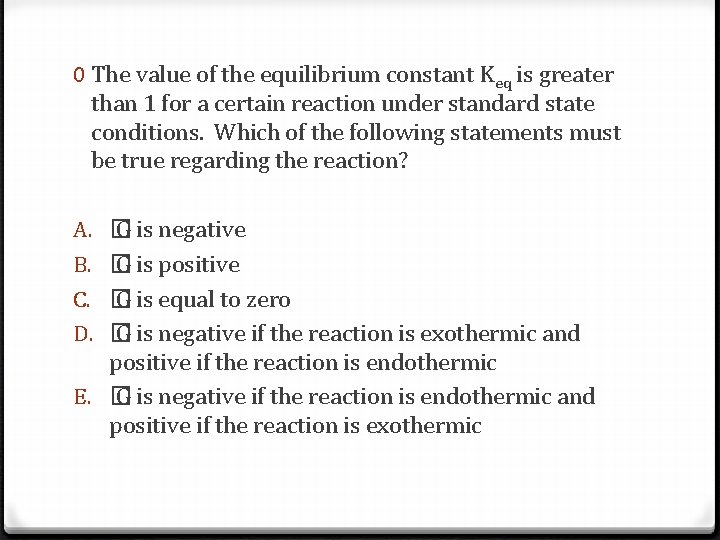
0 The value of the equilibrium constant Keq is greater than 1 for a certain reaction under standard state conditions. Which of the following statements must be true regarding the reaction? � G is negative � G is positive � G is equal to zero � G is negative if the reaction is exothermic and positive if the reaction is endothermic E. � G is negative if the reaction is endothermic and positive if the reaction is exothermic A. B. C. D.
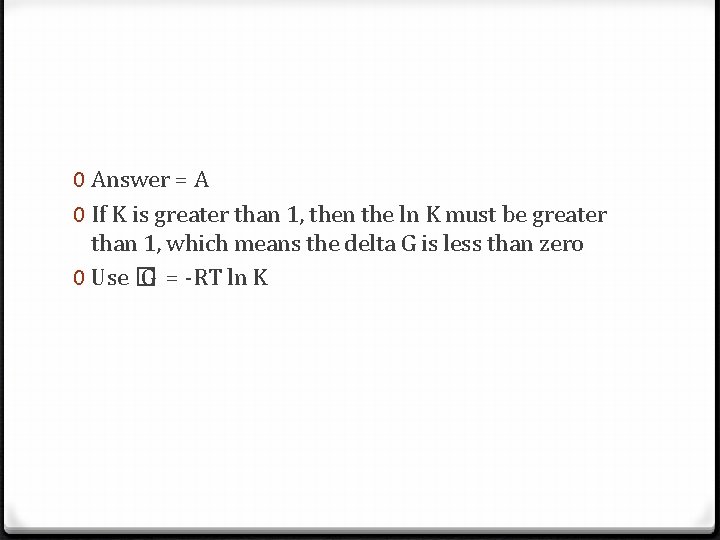
0 Answer = A 0 If K is greater than 1, then the ln K must be greater than 1, which means the delta G is less than zero 0 Use � G = -RT ln K
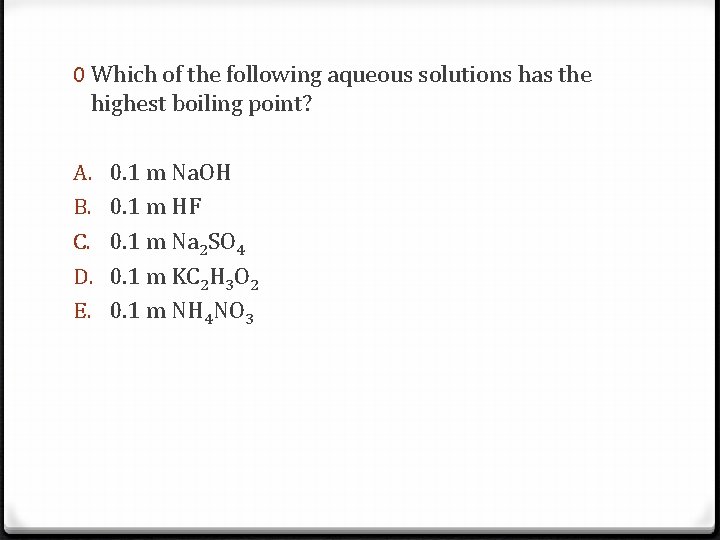
0 Which of the following aqueous solutions has the highest boiling point? A. B. C. D. E. 0. 1 m Na. OH 0. 1 m HF 0. 1 m Na 2 SO 4 0. 1 m KC 2 H 3 O 2 0. 1 m NH 4 NO 3
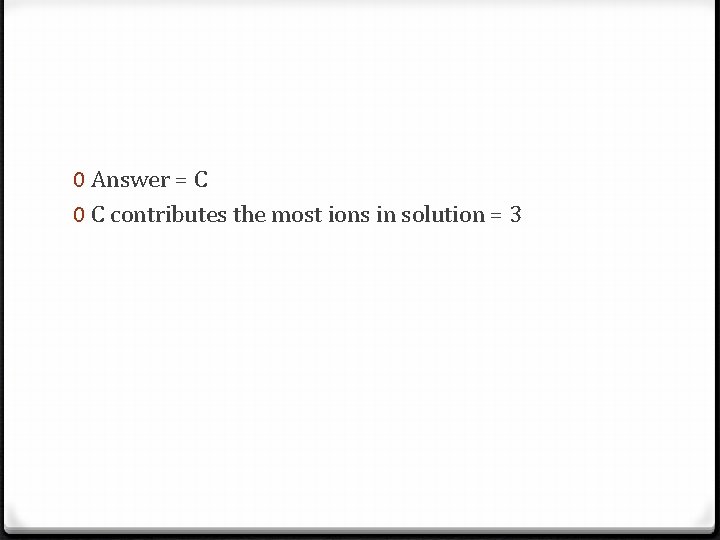
0 Answer = C 0 C contributes the most ions in solution = 3
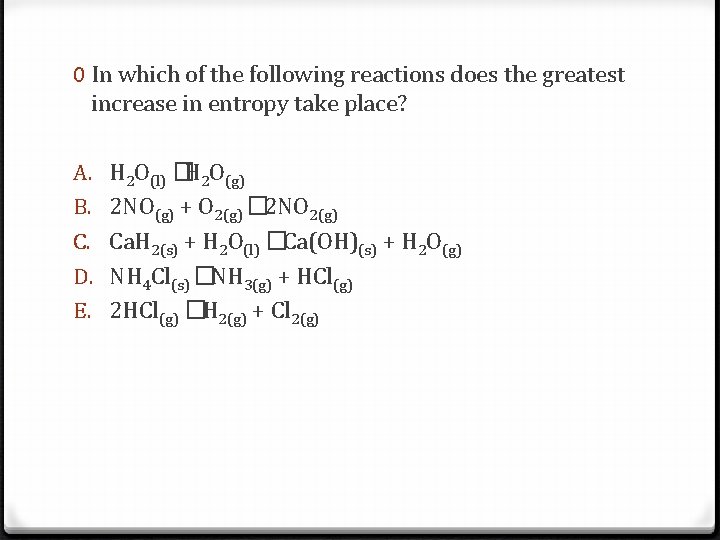
0 In which of the following reactions does the greatest increase in entropy take place? A. B. C. D. E. H 2 O(l) �H 2 O(g) 2 NO(g) + O 2(g) � 2 NO 2(g) Ca. H 2(s) + H 2 O(l) �Ca(OH)(s) + H 2 O(g) NH 4 Cl(s) �NH 3(g) + HCl(g) 2 HCl(g) �H 2(g) + Cl 2(g)
0 Answer = D
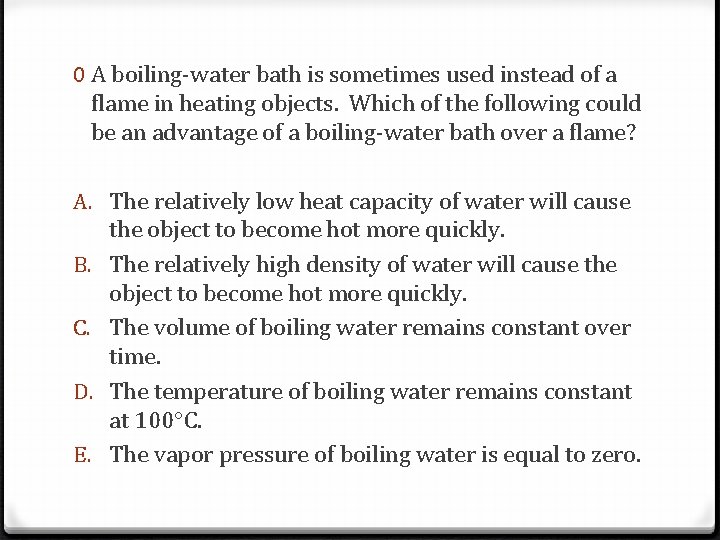
0 A boiling-water bath is sometimes used instead of a flame in heating objects. Which of the following could be an advantage of a boiling-water bath over a flame? A. The relatively low heat capacity of water will cause the object to become hot more quickly. B. The relatively high density of water will cause the object to become hot more quickly. C. The volume of boiling water remains constant over time. D. The temperature of boiling water remains constant at 100 C. E. The vapor pressure of boiling water is equal to zero.
0 Answer = D 0 The only statement that is true
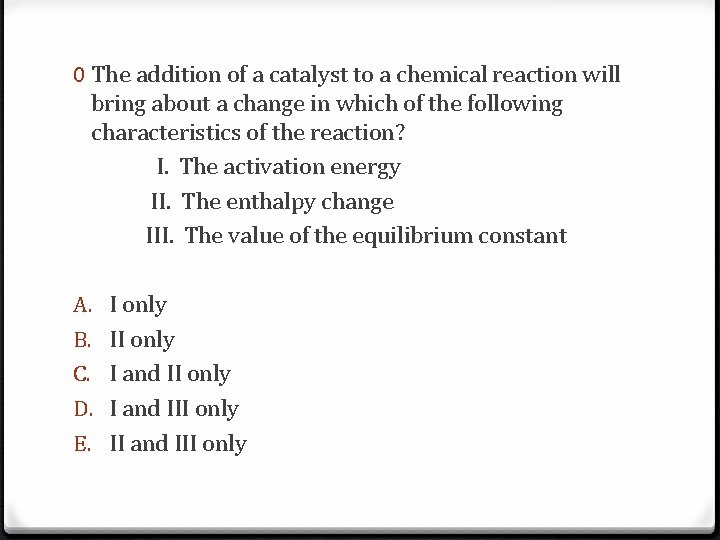
0 The addition of a catalyst to a chemical reaction will bring about a change in which of the following characteristics of the reaction? I. The activation energy II. The enthalpy change III. The value of the equilibrium constant A. B. C. D. E. I only I and III only II and III only
0 Answer = A 0 The addition of a catalyst lowers the activation energy of a reaction, making it easier for the reaction to proceed 0 The addition of a catalyst has not effect on the enthalpy change or equilibrium conditions of a reaction
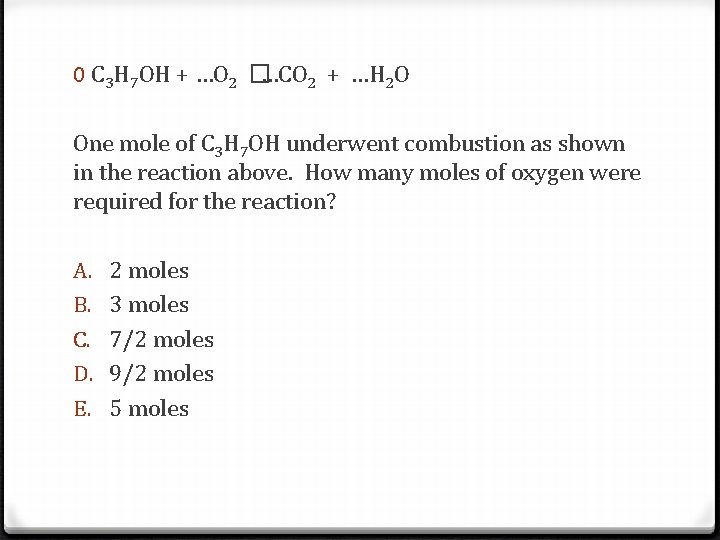
0 C 3 H 7 OH + …O 2 � …CO 2 + …H 2 O One mole of C 3 H 7 OH underwent combustion as shown in the reaction above. How many moles of oxygen were required for the reaction? A. B. C. D. E. 2 moles 3 moles 7/2 moles 9/2 moles 5 moles
0 Answer = D 0 Balance
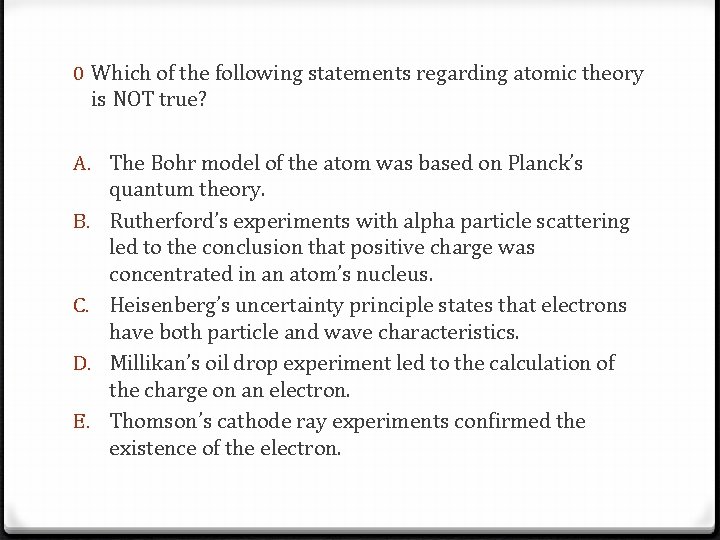
0 Which of the following statements regarding atomic theory is NOT true? A. The Bohr model of the atom was based on Planck’s quantum theory. B. Rutherford’s experiments with alpha particle scattering led to the conclusion that positive charge was concentrated in an atom’s nucleus. C. Heisenberg’s uncertainty principle states that electrons have both particle and wave characteristics. D. Millikan’s oil drop experiment led to the calculation of the charge on an electron. E. Thomson’s cathode ray experiments confirmed the existence of the electron.
0 Answer = C 0 Heisenberg Principle states that the momentum and location of an electron can never both be known with absolute certainty
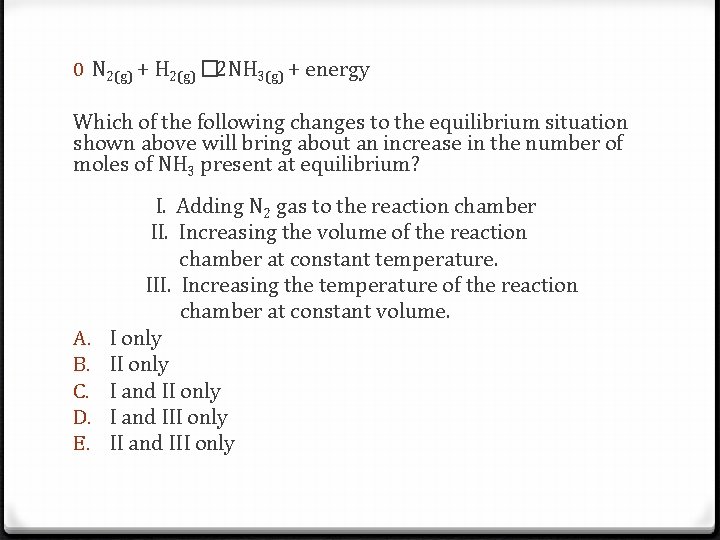
0 N 2(g) + H 2(g) � 2 NH 3(g) + energy Which of the following changes to the equilibrium situation shown above will bring about an increase in the number of moles of NH 3 present at equilibrium? A. B. C. D. E. I. Adding N 2 gas to the reaction chamber II. Increasing the volume of the reaction chamber at constant temperature. III. Increasing the temperature of the reaction chamber at constant volume. I only I and III only II and III only
0 Answer = A 0 Shift to alleviate the stress 0 If N 2 is added, the shift will be to remove excess N 2 – makes more products (I) 0 Increasing the volume will cause the shift to the side with the more moles 0 Increasing the temperature will favor the reverse reaction
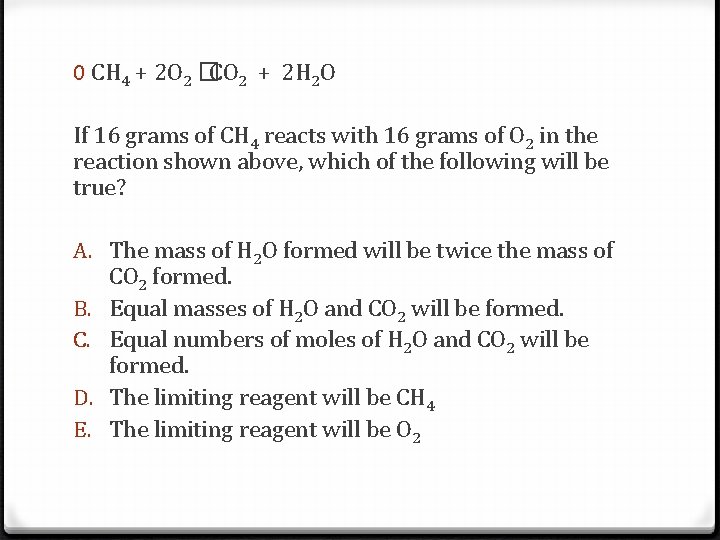
0 CH 4 + 2 O 2 � CO 2 + 2 H 2 O If 16 grams of CH 4 reacts with 16 grams of O 2 in the reaction shown above, which of the following will be true? A. The mass of H 2 O formed will be twice the mass of CO 2 formed. B. Equal masses of H 2 O and CO 2 will be formed. C. Equal numbers of moles of H 2 O and CO 2 will be formed. D. The limiting reagent will be CH 4 E. The limiting reagent will be O 2
0 Answer = E 0 Stoichiometry calculations
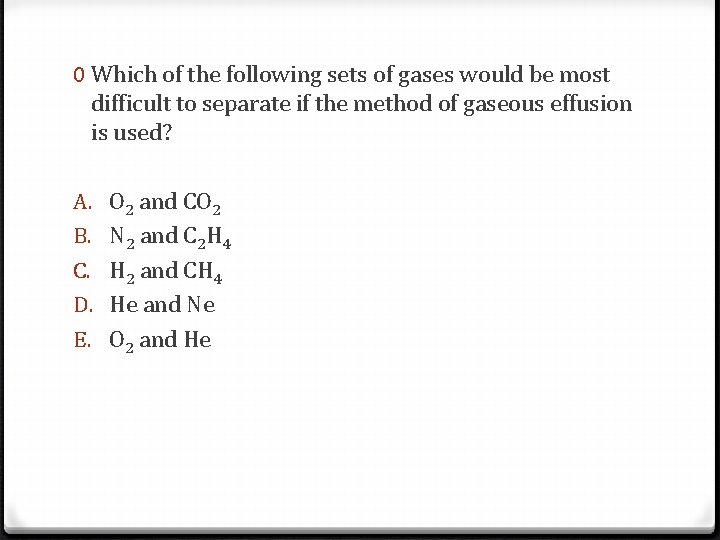
0 Which of the following sets of gases would be most difficult to separate if the method of gaseous effusion is used? A. B. C. D. E. O 2 and CO 2 N 2 and C 2 H 4 H 2 and CH 4 He and Ne O 2 and He
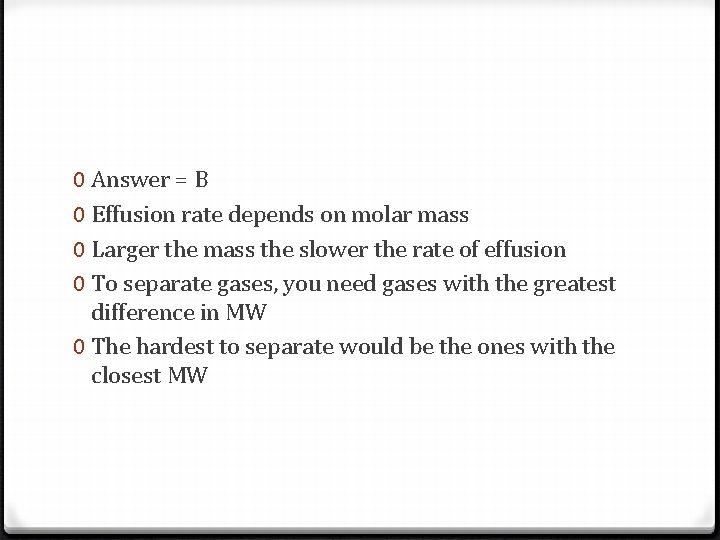
0 Answer = B 0 Effusion rate depends on molar mass 0 Larger the mass the slower the rate of effusion 0 To separate gases, you need gases with the greatest difference in MW 0 The hardest to separate would be the ones with the closest MW
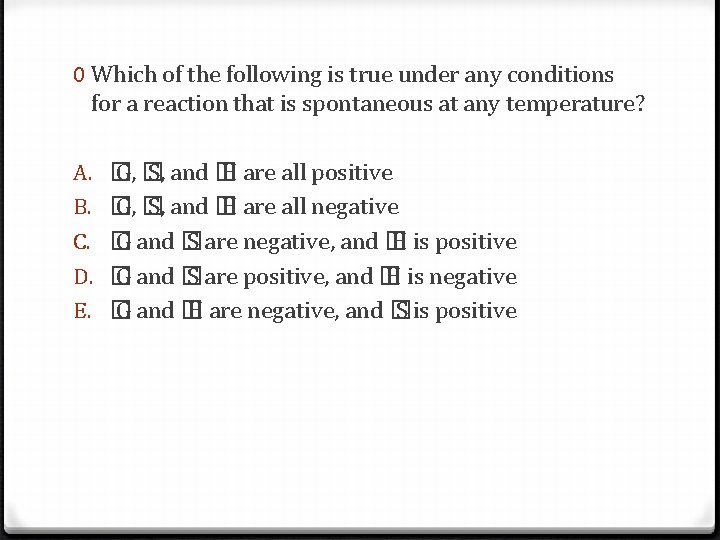
0 Which of the following is true under any conditions for a reaction that is spontaneous at any temperature? A. B. C. D. E. � G, � S, and � H are all positive � G, � S, and � H are all negative � G and � S are negative, and � H is positive � G and � S are positive, and � H is negative � G and � H are negative, and � S is positive
0 Answer = E 0 For spontaneous reactions delta G is negative Use � G= � H – T� S
0 If the temperature at which a reaction takes place is increased, the rate of the reaction will A. Increase if the reaction is endothermic and decrease if the reaction is exothermic. B. Decrease if the reaction is endothermic and increase if the reaction is exothermic. C. Increase if the reaction is endothermic and increase if the reaction is exothermic. D. Decrease if the reaction is endothermic and decrease if the reaction is exothermic. E. Remain the same for both an endothermic and an exothermic reaction.
0 Answer = C 0 An increase in temperature always increases the rate of a reaction, regardless of the change in enthalpy of the reaction
0 SO 42 -, PO 43 -, Cl. O 4 - The geometries of the polyatomic ions listed above can all be described as A. B. C. D. E. Square planar Square pyramidal Seesaw-shaped Tetrahedral Trigonal bipyramidal
0 Answer = D 0 4 electron domains
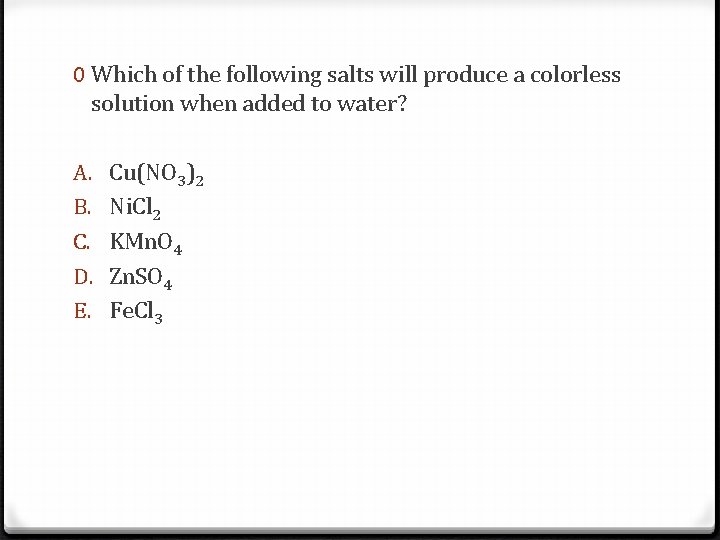
0 Which of the following salts will produce a colorless solution when added to water? A. B. C. D. E. Cu(NO 3)2 Ni. Cl 2 KMn. O 4 Zn. SO 4 Fe. Cl 3
0 Answer = D 0 Copper would be blue 0 Nickel would be green 0 Permanganate would be purple 0 Iron would be orange
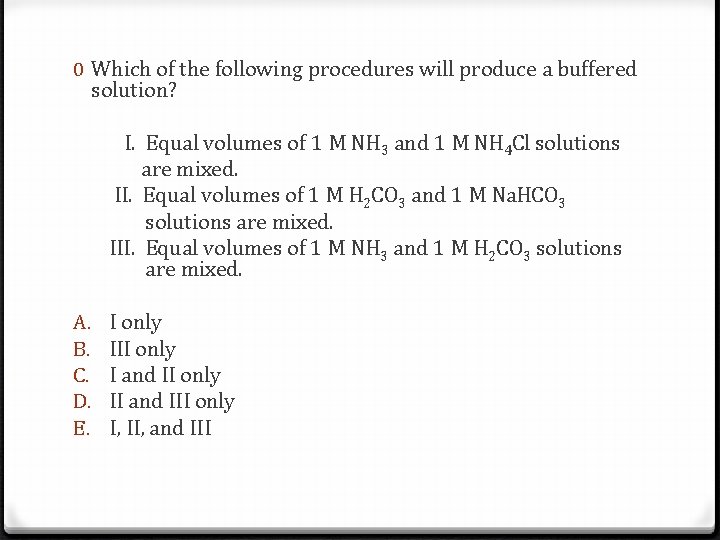
0 Which of the following procedures will produce a buffered solution? I. Equal volumes of 1 M NH 3 and 1 M NH 4 Cl solutions are mixed. II. Equal volumes of 1 M H 2 CO 3 and 1 M Na. HCO 3 solutions are mixed. III. Equal volumes of 1 M NH 3 and 1 M H 2 CO 3 solutions are mixed. A. B. C. D. E. I only III only I and II only II and III only I, II, and III
0 Answer = C 0 A buffer solution can be prepared by mixing a weak acid or base with an equal amount of its conjugate
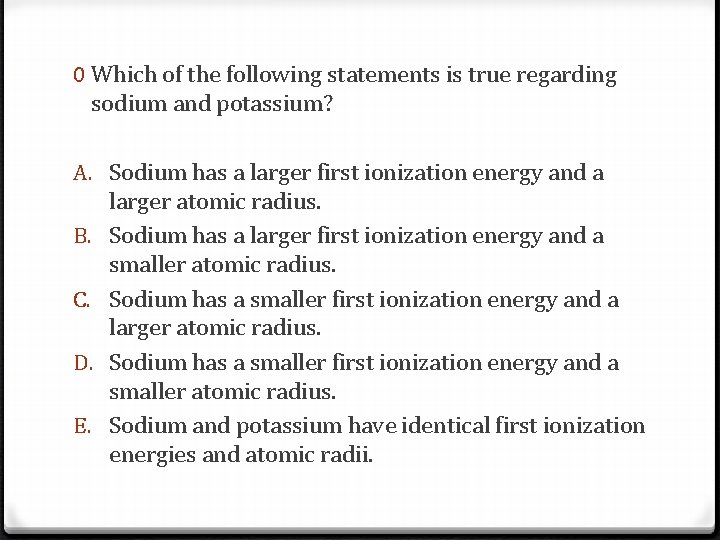
0 Which of the following statements is true regarding sodium and potassium? A. Sodium has a larger first ionization energy and a larger atomic radius. B. Sodium has a larger first ionization energy and a smaller atomic radius. C. Sodium has a smaller first ionization energy and a larger atomic radius. D. Sodium has a smaller first ionization energy and a smaller atomic radius. E. Sodium and potassium have identical first ionization energies and atomic radii.
0 Answer = B
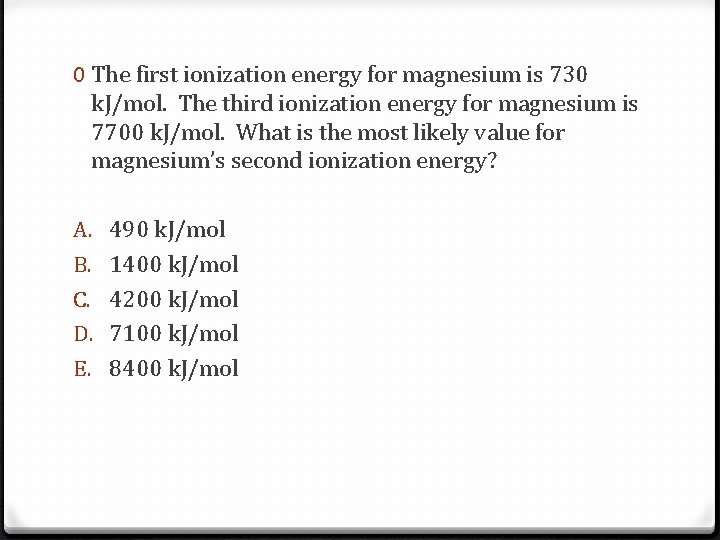
0 The first ionization energy for magnesium is 730 k. J/mol. The third ionization energy for magnesium is 7700 k. J/mol. What is the most likely value for magnesium’s second ionization energy? A. B. C. D. E. 490 k. J/mol 1400 k. J/mol 4200 k. J/mol 7100 k. J/mol 8400 k. J/mol
0 Answer = B 0 Magnesium has 2 valence electrons in the third energy level 0 Expect to see a small jump from first to second ionization 0 The third electron comes from a full octet
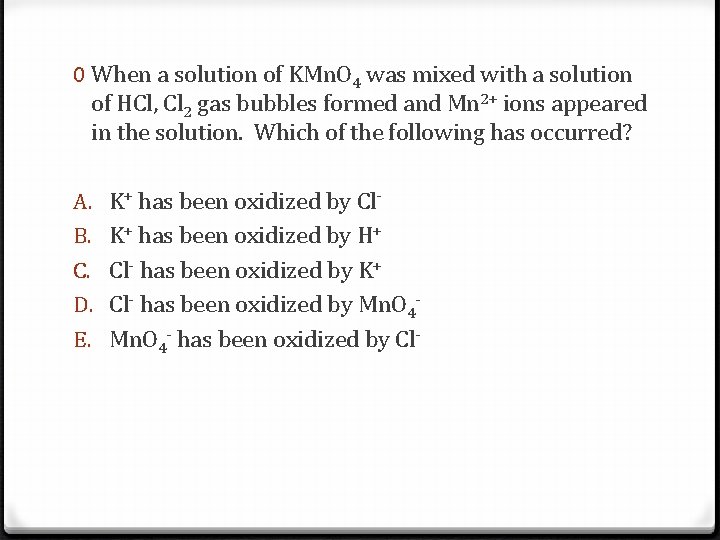
0 When a solution of KMn. O 4 was mixed with a solution of HCl, Cl 2 gas bubbles formed and Mn 2+ ions appeared in the solution. Which of the following has occurred? A. B. C. D. E. K+ has been oxidized by Cl. K+ has been oxidized by H+ Cl- has been oxidized by K+ Cl- has been oxidized by Mn. O 4 - has been oxidized by Cl-
0 Answer = D 0 The oxidation and reduction half reactions would identify that manganese is reduced and the chlorine is oxidized
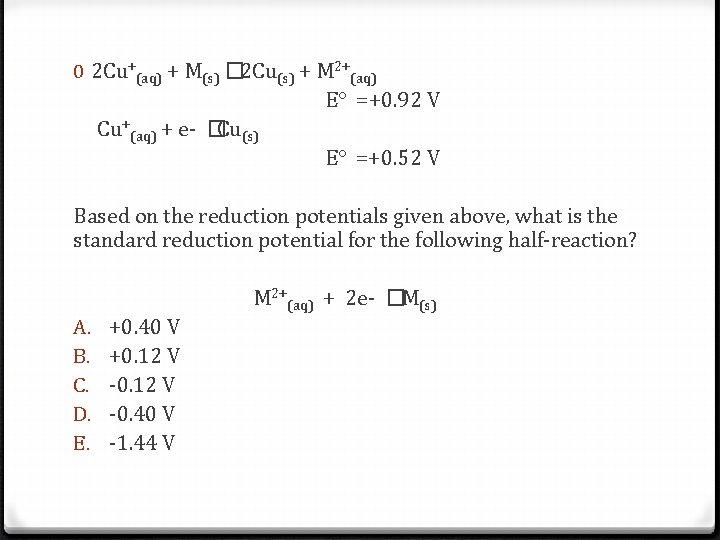
0 2 Cu+(aq) + M(s) � 2 Cu(s) + M 2+(aq) E =+0. 92 V Cu+(aq) + e- �Cu(s) E =+0. 52 V Based on the reduction potentials given above, what is the standard reduction potential for the following half-reaction? A. B. C. D. E. +0. 40 V +0. 12 V -0. 40 V -1. 44 V M 2+(aq) + 2 e- �M(s)
0 Answer = D
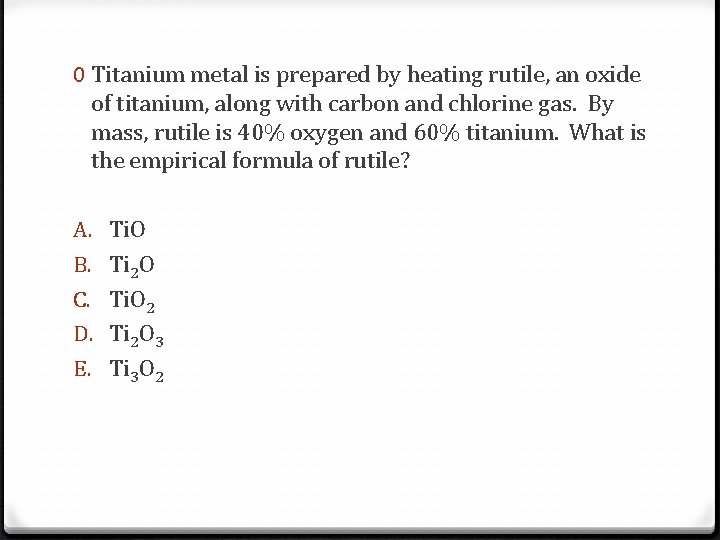
0 Titanium metal is prepared by heating rutile, an oxide of titanium, along with carbon and chlorine gas. By mass, rutile is 40% oxygen and 60% titanium. What is the empirical formula of rutile? A. B. C. D. E. Ti. O Ti 2 O Ti. O 2 Ti 2 O 3 Ti 3 O 2
0 Answer = C 0 Change percents to grams – calculate using EF
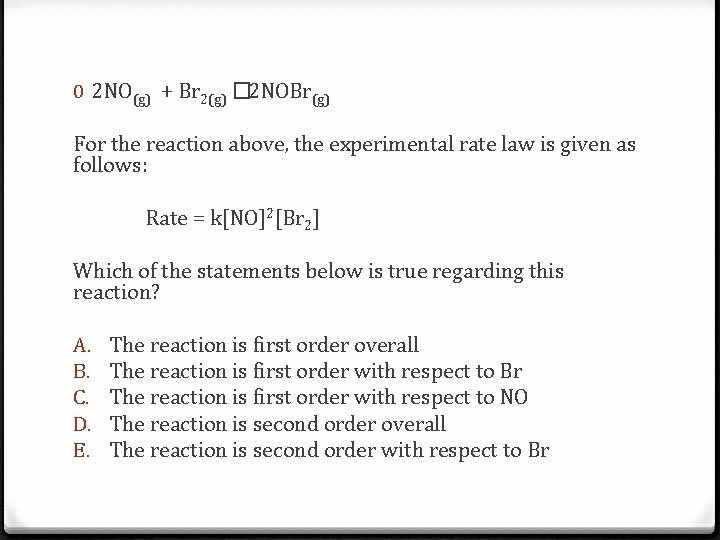
0 2 NO(g) + Br 2(g) � 2 NOBr(g) For the reaction above, the experimental rate law is given as follows: Rate = k[NO]2[Br 2] Which of the statements below is true regarding this reaction? A. B. C. D. E. The reaction is first order overall The reaction is first order with respect to Br The reaction is first order with respect to NO The reaction is second order overall The reaction is second order with respect to Br
0 Answer = B
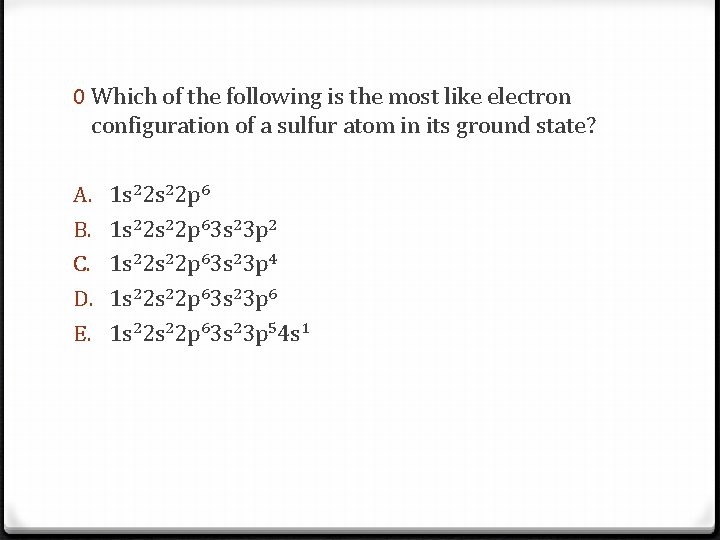
0 Which of the following is the most like electron configuration of a sulfur atom in its ground state? A. B. C. D. E. 1 s 22 s 22 p 63 s 23 p 2 1 s 22 p 63 s 23 p 4 1 s 22 p 63 s 23 p 6 1 s 22 p 63 s 23 p 54 s 1
0 Answer = C
- Slides: 75