
AP Chemistry Chapter 5 Jeopardy Jennie L Borders

AP Chemistry Chapter 5 Jeopardy Jennie L. Borders

Round 1 – Chapter 5
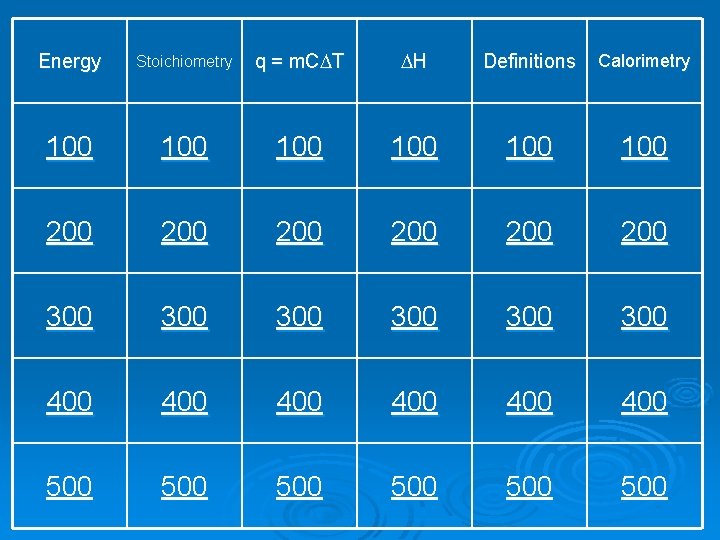
Energy Stoichiometry q = m. CDT DH Definitions Calorimetry 100 100 100 200 200 200 300 300 300 400 400 400 500 500 500
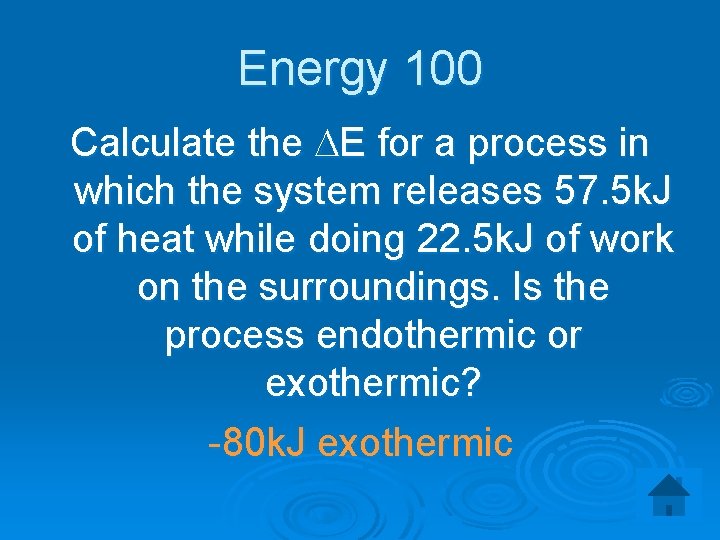
Energy 100 Calculate the DE for a process in which the system releases 57. 5 k. J of heat while doing 22. 5 k. J of work on the surroundings. Is the process endothermic or exothermic? -80 k. J exothermic
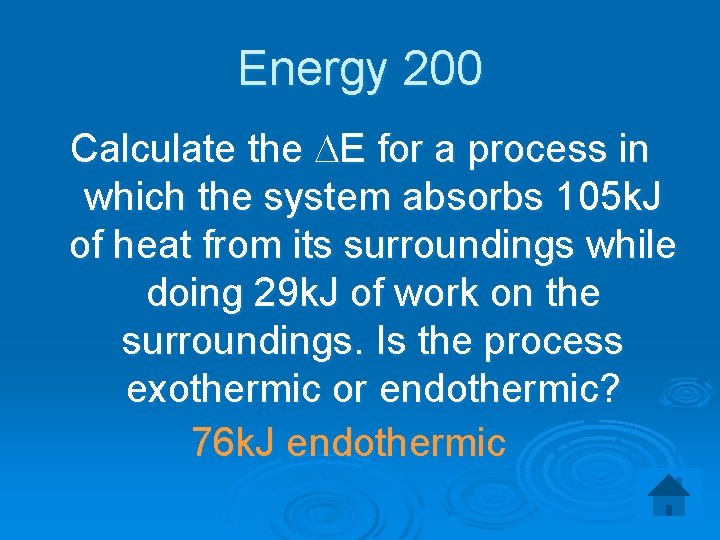
Energy 200 Calculate the DE for a process in which the system absorbs 105 k. J of heat from its surroundings while doing 29 k. J of work on the surroundings. Is the process exothermic or endothermic? 76 k. J endothermic
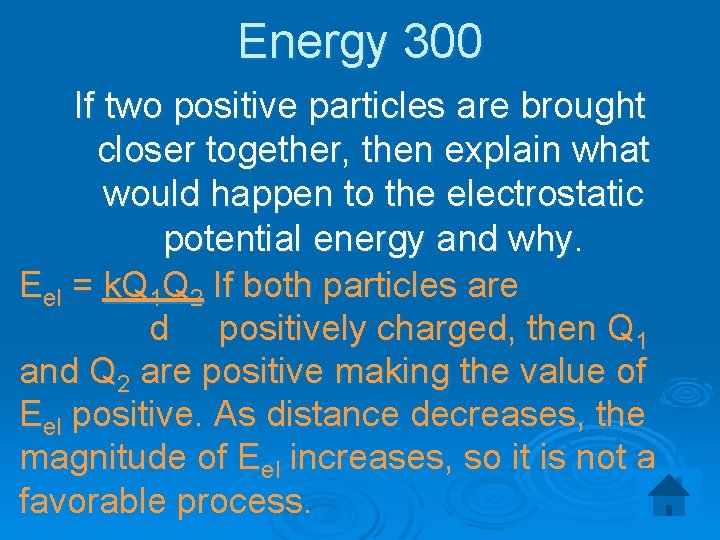
Energy 300 If two positive particles are brought closer together, then explain what would happen to the electrostatic potential energy and why. Eel = k. Q 1 Q 2 If both particles are d positively charged, then Q 1 and Q 2 are positive making the value of Eel positive. As distance decreases, the magnitude of Eel increases, so it is not a favorable process.
Energy 400 Calculate the kinetic energy in joules of a 45 g golf ball moving at 61 m/s. 84 J
Energy 500 What is the kinetic energy of an 850 lb. motorcycle moving at 66 mph? (1 kg = 2. 2047 lb. 1 mi = 1. 6093 km) 1. 7 x 10⁵ J
Stoichiometry 100 Calculate the DH for the production of 0. 200 mol of Ag. Cl by the following reaction: Ag+(aq) + Cl-(aq) Ag. Cl(s) DH = -65. 5 k. J -13. 1 k. J
Stoichiometry 200 For this reaction, DH for the formation of 0. 632 mol of O 2. 2 KCl. O 3(s) 2 KCl(s) + 3 O 2(g) DH = -89. 4 k. J -18. 8 k. J
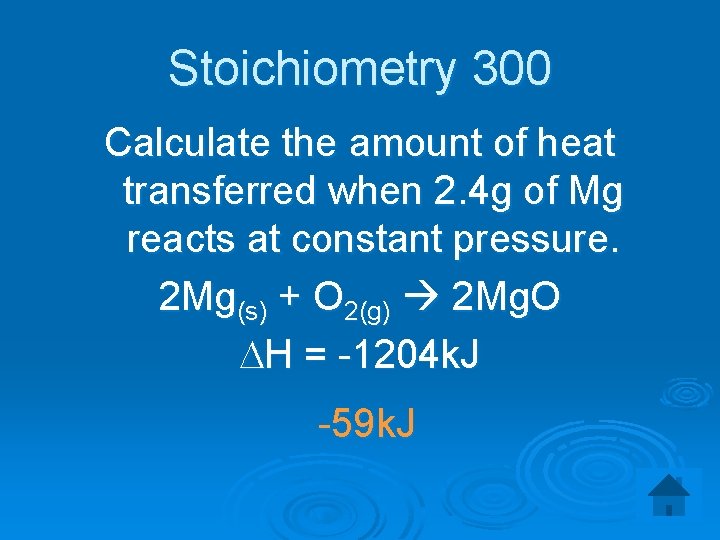
Stoichiometry 300 Calculate the amount of heat transferred when 2. 4 g of Mg reacts at constant pressure. 2 Mg(s) + O 2(g) 2 Mg. O DH = -1204 k. J -59 k. J
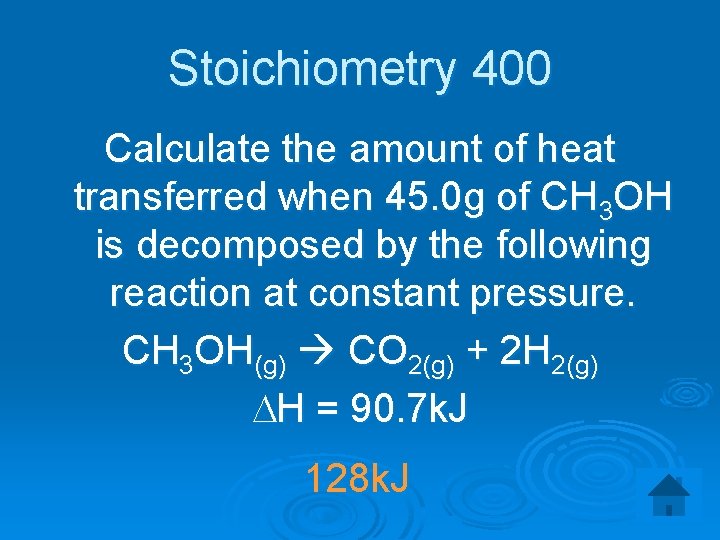
Stoichiometry 400 Calculate the amount of heat transferred when 45. 0 g of CH 3 OH is decomposed by the following reaction at constant pressure. CH 3 OH(g) CO 2(g) + 2 H 2(g) DH = 90. 7 k. J 128 k. J
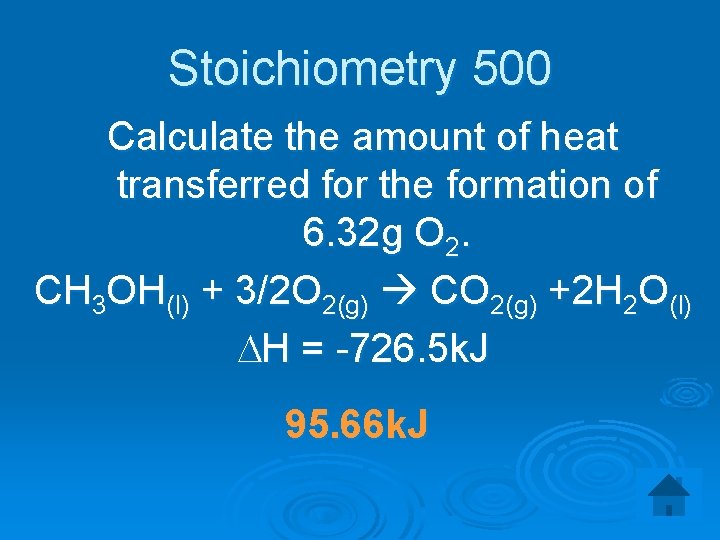
Stoichiometry 500 Calculate the amount of heat transferred for the formation of 6. 32 g O 2. CH 3 OH(l) + 3/2 O 2(g) CO 2(g) +2 H 2 O(l) DH = -726. 5 k. J 95. 66 k. J
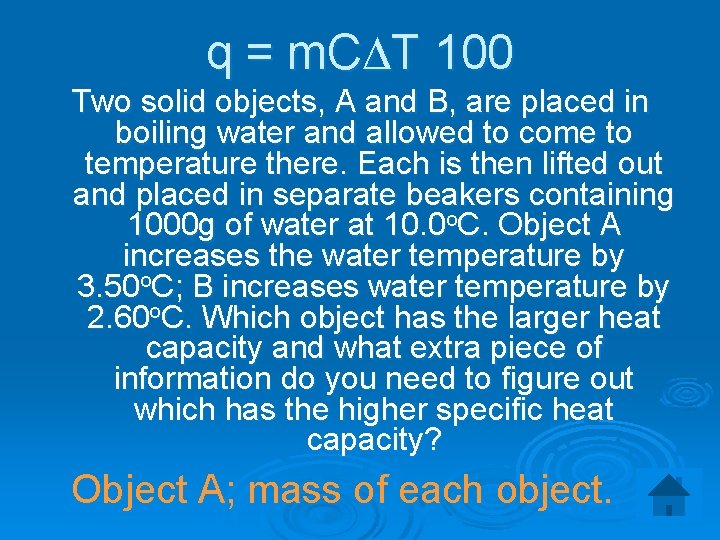
q = m. CDT 100 Two solid objects, A and B, are placed in boiling water and allowed to come to temperature there. Each is then lifted out and placed in separate beakers containing 1000 g of water at 10. 0 o. C. Object A increases the water temperature by 3. 50 o. C; B increases water temperature by 2. 60 o. C. Which object has the larger heat capacity and what extra piece of information do you need to figure out which has the higher specific heat capacity? Object A; mass of each object.
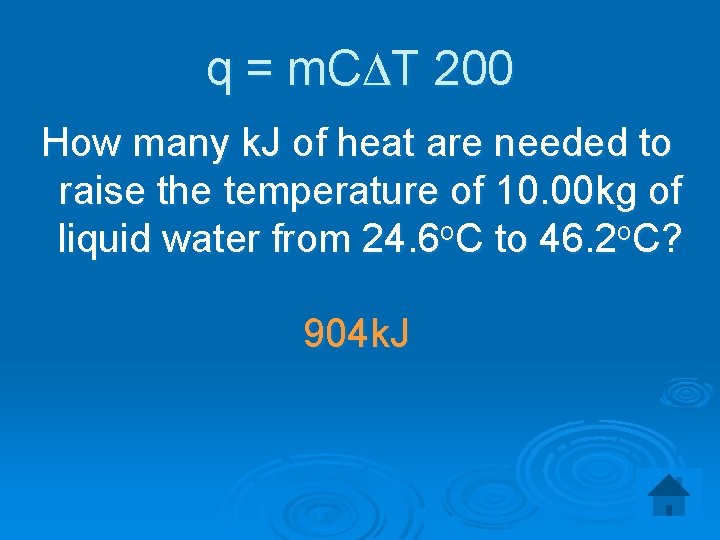
q = m. CDT 200 How many k. J of heat are needed to raise the temperature of 10. 00 kg of liquid water from 24. 6 o. C to 46. 2 o. C? 904 k. J
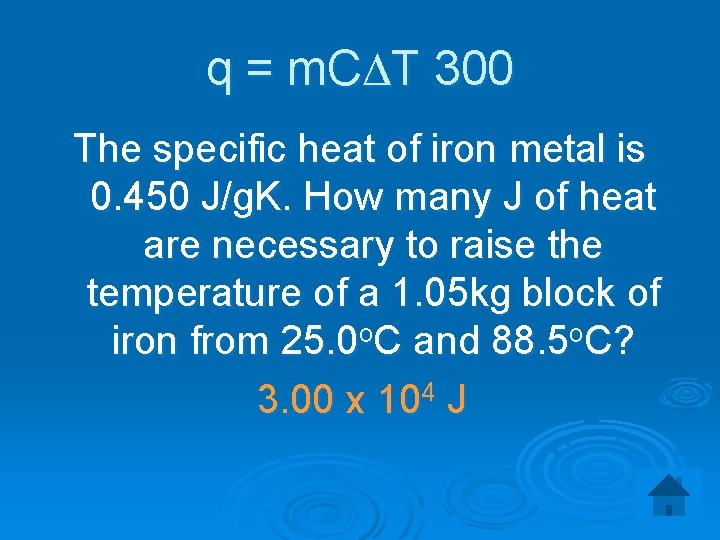
q = m. CDT 300 The specific heat of iron metal is 0. 450 J/g. K. How many J of heat are necessary to raise the temperature of a 1. 05 kg block of iron from 25. 0 o. C and 88. 5 o. C? 3. 00 x 104 J
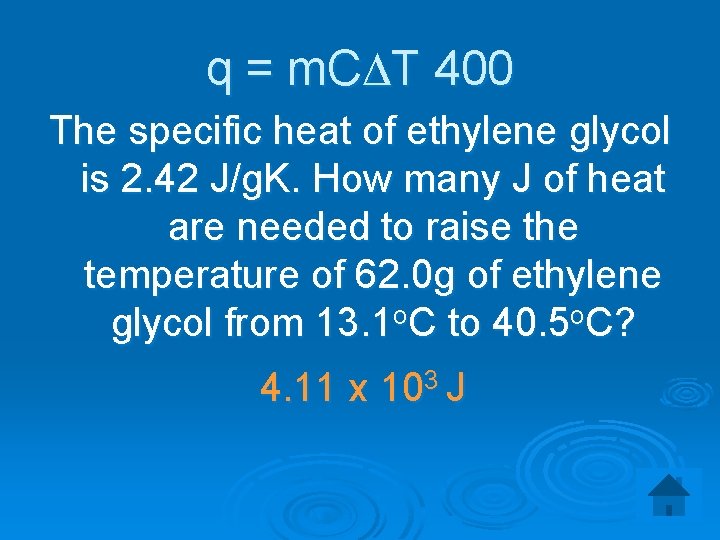
q = m. CDT 400 The specific heat of ethylene glycol is 2. 42 J/g. K. How many J of heat are needed to raise the temperature of 62. 0 g of ethylene glycol from 13. 1 o. C to 40. 5 o. C? 4. 11 x 103 J
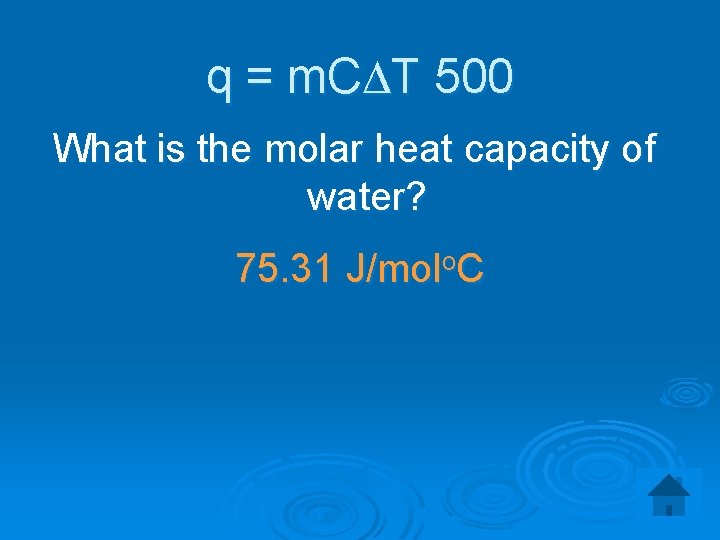
q = m. CDT 500 What is the molar heat capacity of water? 75. 31 J/molo. C
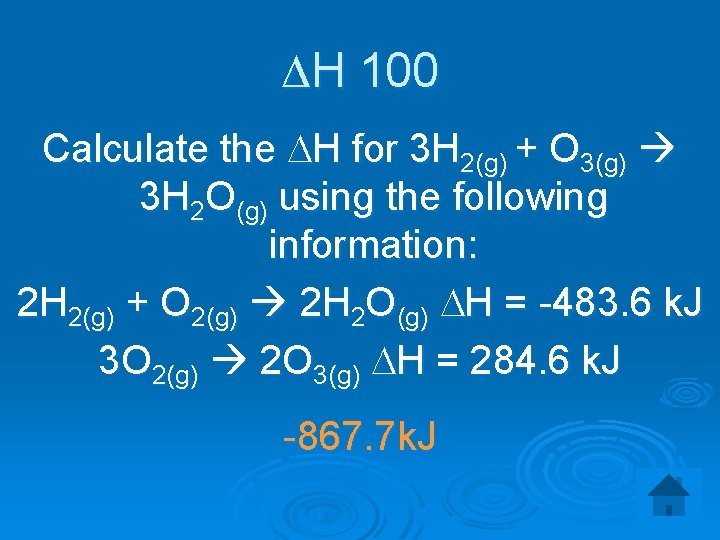
DH 100 Calculate the DH for 3 H 2(g) + O 3(g) 3 H 2 O(g) using the following information: 2 H 2(g) + O 2(g) 2 H 2 O(g) DH = -483. 6 k. J 3 O 2(g) 2 O 3(g) DH = 284. 6 k. J -867. 7 k. J
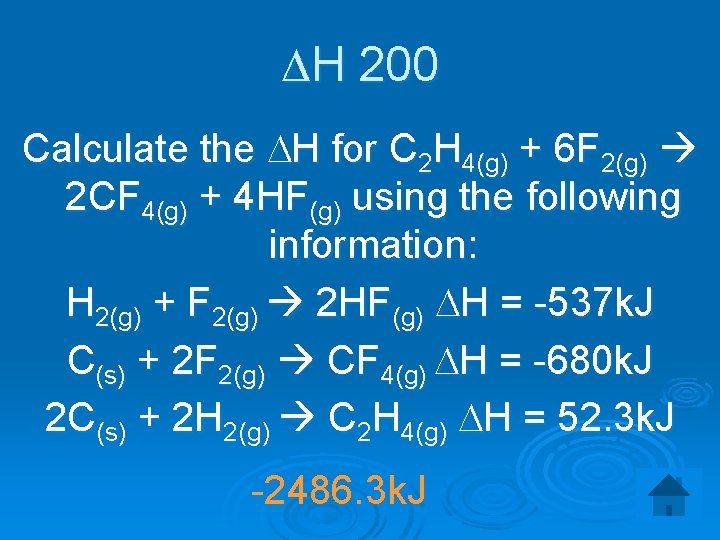
DH 200 Calculate the DH for C 2 H 4(g) + 6 F 2(g) 2 CF 4(g) + 4 HF(g) using the following information: H 2(g) + F 2(g) 2 HF(g) DH = -537 k. J C(s) + 2 F 2(g) CF 4(g) DH = -680 k. J 2 C(s) + 2 H 2(g) C 2 H 4(g) DH = 52. 3 k. J -2486. 3 k. J
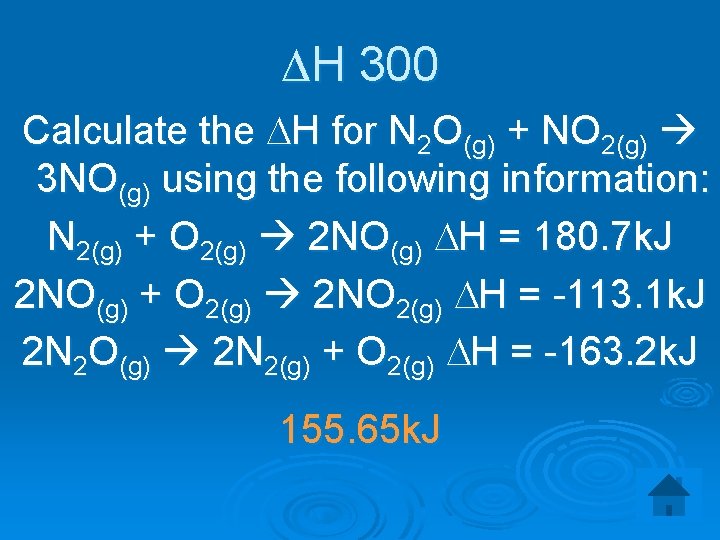
DH 300 Calculate the DH for N 2 O(g) + NO 2(g) 3 NO(g) using the following information: N 2(g) + O 2(g) 2 NO(g) DH = 180. 7 k. J 2 NO(g) + O 2(g) 2 NO 2(g) DH = -113. 1 k. J 2 N 2 O(g) 2 N 2(g) + O 2(g) DH = -163. 2 k. J 155. 65 k. J
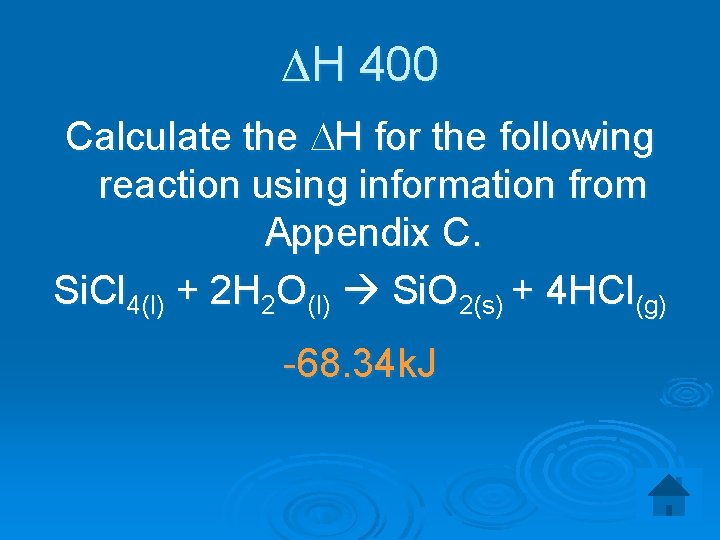
DH 400 Calculate the DH for the following reaction using information from Appendix C. Si. Cl 4(l) + 2 H 2 O(l) Si. O 2(s) + 4 HCl(g) -68. 34 k. J
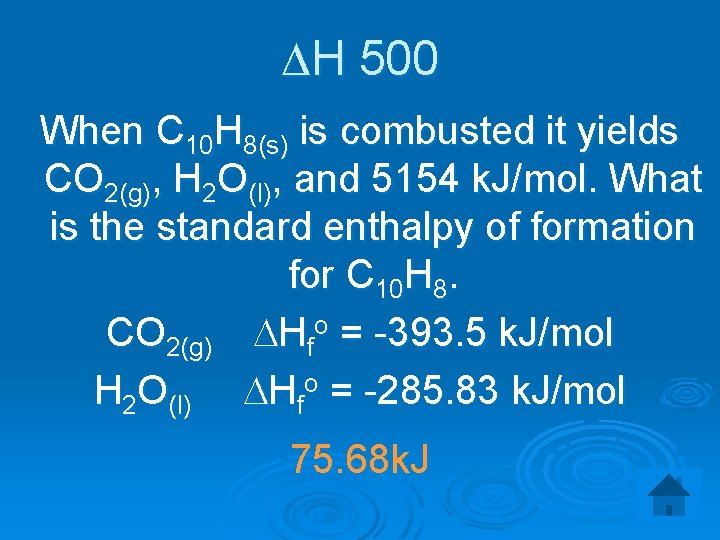
DH 500 When C 10 H 8(s) is combusted it yields CO 2(g), H 2 O(l), and 5154 k. J/mol. What is the standard enthalpy of formation for C 10 H 8. CO 2(g) DHfo = -393. 5 k. J/mol H 2 O(l) DHfo = -285. 83 k. J/mol 75. 68 k. J
Definitions 100 What is the internal energy of a system? Total kinetic and potential energy
Definitions 200 What is a closed system? A system in which heat can be transferred between the system and the surroundings but not mass.

Definitions 300 What is a state function? A property that only depends on the initial and final states, not on the path taken.
Definitions 400 For a given process at constant pressure, DH is negative. Is the process exothermic or endothermic? exothermic
Definitions 500 By what means can the internal energy of a closed system increase? Increase in heat of the system or work done on the system.
Calorimetry 100 A 2. 200 g sample of C 6 H 4 O 2 is burned in a bomb calorimeter whose total heat capacity is 7. 854 k. J/o. C. The temperature of the calorimeter increases from 23. 44 o. C to 30. 57 o. C. What is the heat of combustion per mole of C 6 H 4 O 2? -2740. 2 k. J/mol
Calorimetry 200 A 1. 800 g sample of C 6 H 5 OH was burned in a bomb calorimeter whose total heat capacity is 11. 66 k. J/o. C. The temperature of the calorimeter plus contents increased from 21. 36 o. C to 26. 37 o. C. What is the heat of combustion per mole of C 6 H 5 OH? -3074. 74 k. J
Calorimetry 300 A 2. 500 g sample of glucose is burned in a bomb calorimeter. The heat of combustion of glucose is 15. 57 k. J/g. The temperature of the calorimeter increases from 20. 55 o. C to 23. 25 o. C. What is the total heat capacity of the calorimeter? 14. 42 k. J/o. C
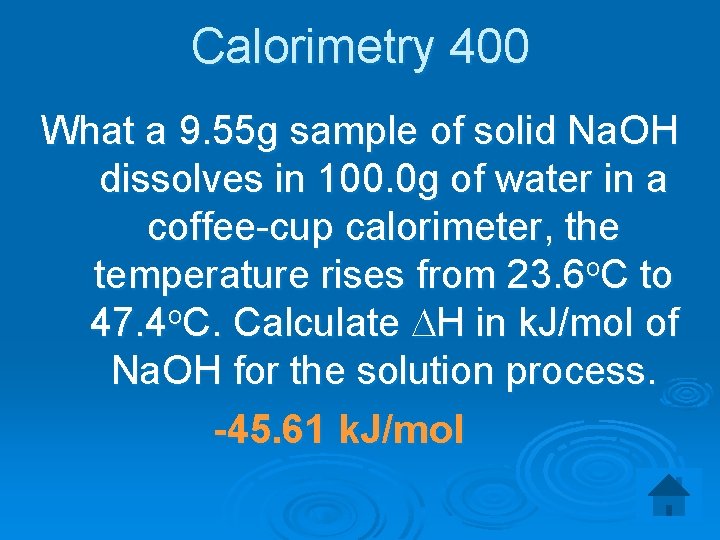
Calorimetry 400 What a 9. 55 g sample of solid Na. OH dissolves in 100. 0 g of water in a coffee-cup calorimeter, the temperature rises from 23. 6 o. C to 47. 4 o. C. Calculate DH in k. J/mol of Na. OH for the solution process. -45. 61 k. J/mol
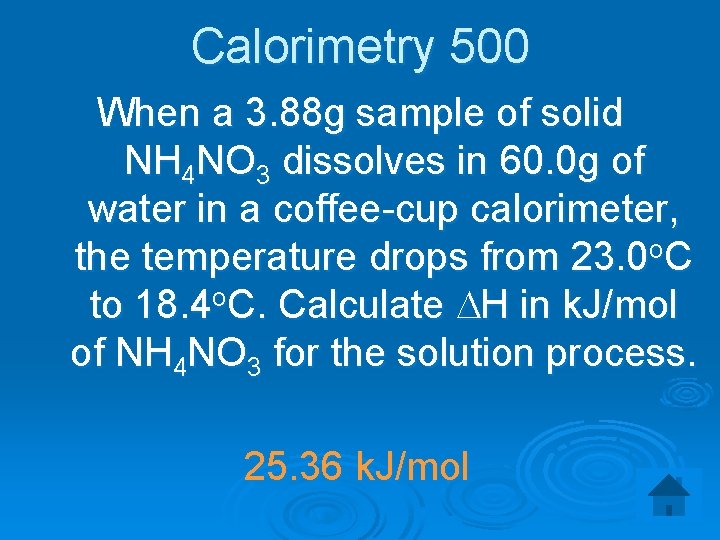
Calorimetry 500 When a 3. 88 g sample of solid NH 4 NO 3 dissolves in 60. 0 g of water in a coffee-cup calorimeter, the temperature drops from 23. 0 o. C to 18. 4 o. C. Calculate DH in k. J/mol of NH 4 NO 3 for the solution process. 25. 36 k. J/mol
- Slides: 33