
AP Chemistry Chapter 19 Jeopardy Jennie L Borders
AP Chemistry Chapter 19 Jeopardy Jennie L. Borders
Round 1 – Chapter 19
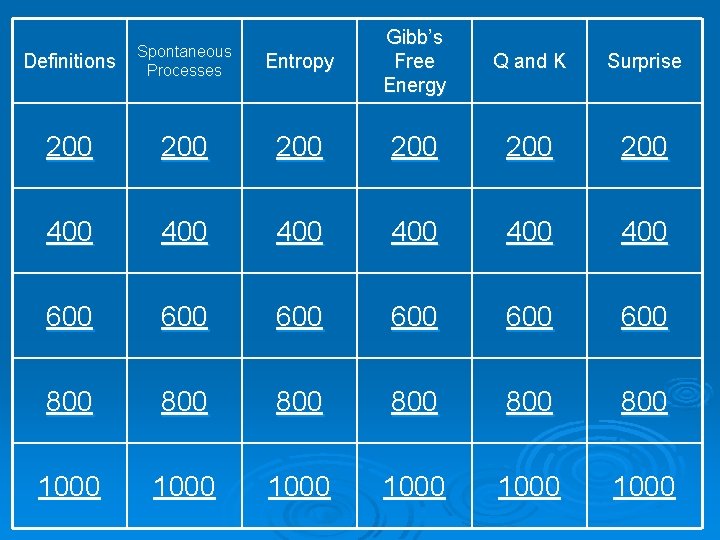
Entropy Gibb’s Free Energy Q and K Surprise 200 200 200 400 400 400 600 600 600 800 800 800 1000 1000 Definitions Spontaneous Processes 200
Definitions 200 What is a spontaneous process? A spontaneous process is one that proceeds on its own without any assistance.
Definitions 400 What is a reversible process? In a reversible process, a system is changed in such a way that the system and surroundings can be restored to their original state by exactly reversing the change. (DOES NOT EXIST)
Definitions 600 What is entropy? Entropy is the measure of the randomness, disorder, or dispersal of energy in a system.
Definitions 800 What is the difference in translational, vibrational, and rotational energy? Translational motion is the movement of an entire molecule. Vibrational motion is the stretching and bending of bonds. Rotational energy is the spinning of a molecule.
Definitions 1000 What are the 3 laws of thermodynamics? 1 st Law = Energy is conserved. 2 nd Law = Any irreversible process results in an increase in entropy. 3 rd Law = The entropy of a pure crystalline solid is 0 at 0 K.
Spontaneous Processes 200 Consider the vaporization of liquid water to steam at a pressure of 1 atm. In what temperature range is it a spontaneous process? Temperatures higher than 100 o. C.
Spontaneous Processes 400 Does the change in DE depend on the particular pathway taken to carry out a change of state? No, it is a state function.
Spontaneous Processes 600 Consider what happens when TNT explodes. Determine the sign for q, w, and DE. Explosions are combustion reactions so q is negative since it is exothermic. w is also negative because the reactants will expand to form products. Since q and w are negative, DE will also be negative.
Spontaneous Processes 800 Is the following process spontaneous, nonspontaneous, or at equilibrium? The formation of CH 4 and O 2 molecules from CO 2 and H 2 O. Nonspontaneous – It would be spontaneous in the reverse direction because it would be combustion.
Spontaneous Processes 1000 Is the following process spontaneous, nonspontaneous, or at equilibrium? Ice melting at 0 o. C equilibrium
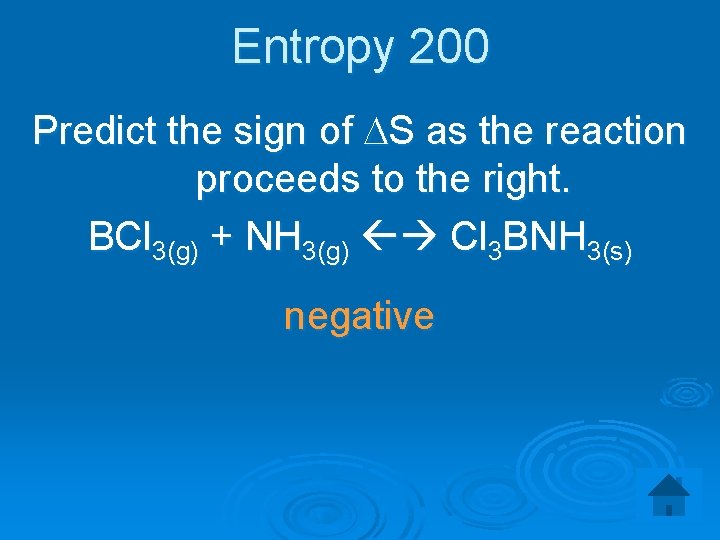
Entropy 200 Predict the sign of DS as the reaction proceeds to the right. BCl 3(g) + NH 3(g) Cl 3 BNH 3(s) negative
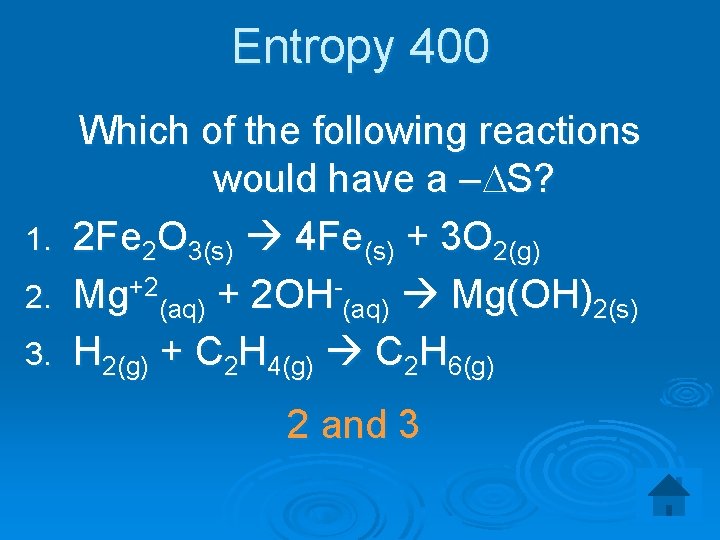
Entropy 400 1. 2. 3. Which of the following reactions would have a –DS? 2 Fe 2 O 3(s) 4 Fe(s) + 3 O 2(g) Mg+2(aq) + 2 OH-(aq) Mg(OH)2(s) H 2(g) + C 2 H 4(g) C 2 H 6(g) 2 and 3
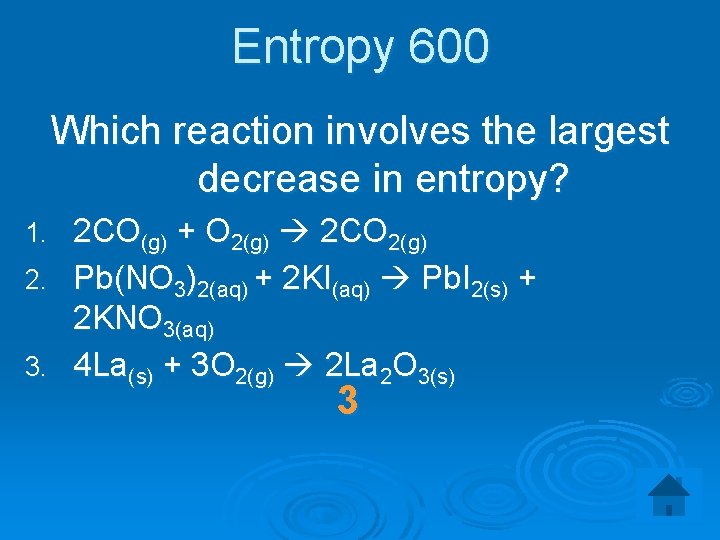
Entropy 600 Which reaction involves the largest decrease in entropy? 2 CO(g) + O 2(g) 2 CO 2(g) 2. Pb(NO 3)2(aq) + 2 KI(aq) Pb. I 2(s) + 2 KNO 3(aq) 3. 4 La(s) + 3 O 2(g) 2 La 2 O 3(s) 1. 3
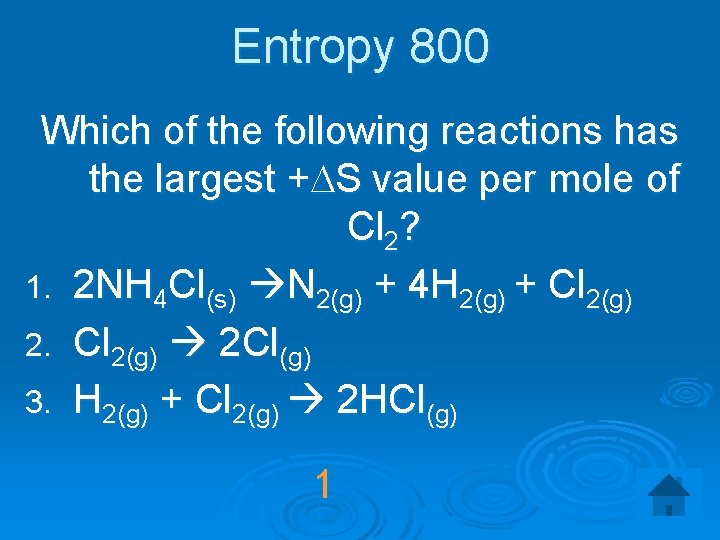
Entropy 800 Which of the following reactions has the largest +DS value per mole of Cl 2? 1. 2 NH 4 Cl(s) N 2(g) + 4 H 2(g) + Cl 2(g) 2. Cl 2(g) 2 Cl(g) 3. H 2(g) + Cl 2(g) 2 HCl(g) 1
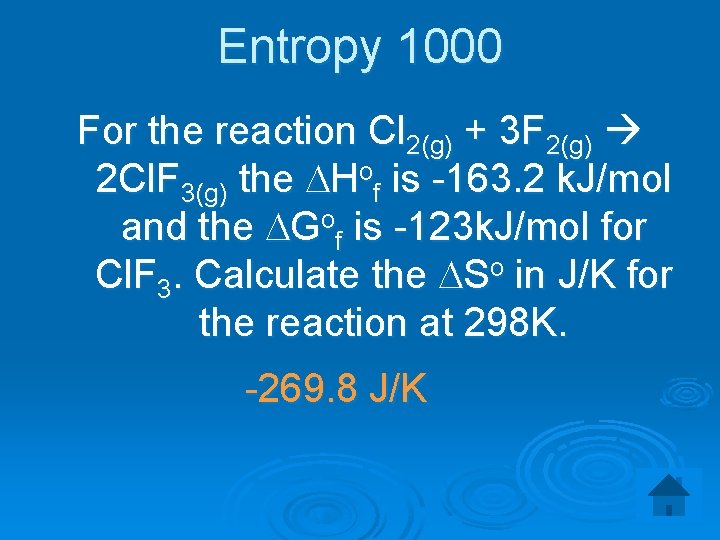
Entropy 1000 For the reaction Cl 2(g) + 3 F 2(g) 2 Cl. F 3(g) the DHof is -163. 2 k. J/mol and the DGof is -123 k. J/mol for Cl. F 3. Calculate the DSo in J/K for the reaction at 298 K. -269. 8 J/K
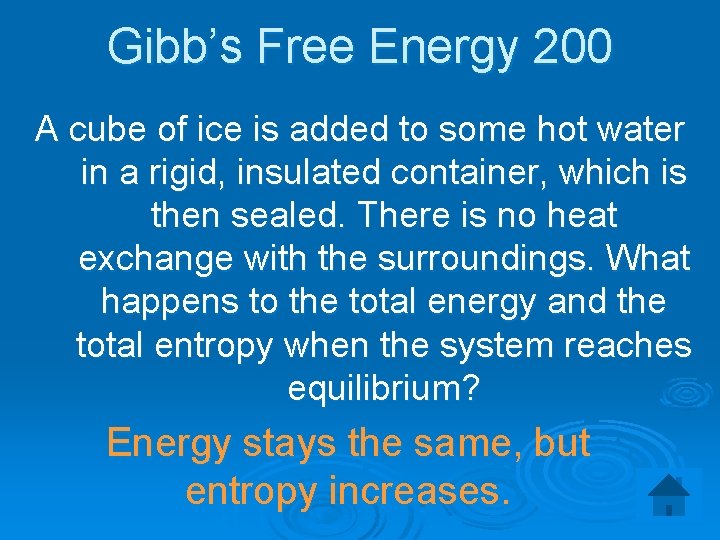
Gibb’s Free Energy 200 A cube of ice is added to some hot water in a rigid, insulated container, which is then sealed. There is no heat exchange with the surroundings. What happens to the total energy and the total entropy when the system reaches equilibrium? Energy stays the same, but entropy increases.
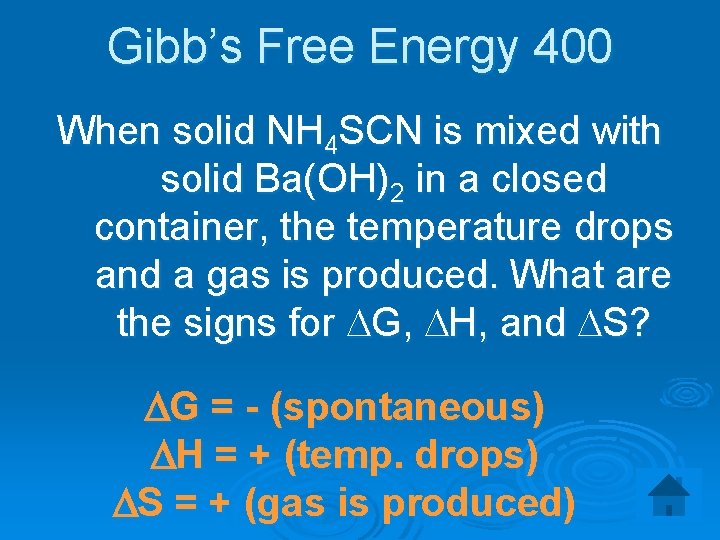
Gibb’s Free Energy 400 When solid NH 4 SCN is mixed with solid Ba(OH)2 in a closed container, the temperature drops and a gas is produced. What are the signs for DG, DH, and DS? DG = - (spontaneous) DH = + (temp. drops) DS = + (gas is produced)
Gibb’s Free Energy 600 The following reaction is spontaneous at 298 K, but becomes nonspontaneous at higher temperatures. What are the signs for DG, DH, and DS? N 2(g) + 3 H 2(g) 2 NH 3(g) DG = - (spontaneous) DH = - (DG = DH – TDS) DS = - (less gas)
Gibb’s Free Energy 800 For a particular reaction, DH = -32 k. J and DS = -98 J/K. Assume that DH and DS do not change with temperature. If T is increased, will the reaction be spontaneous or nonspontaneous? nonspontaneous
Gibb’s Free Energy 1000 Classify the following reaction as spontaneous, nonspontaneous, or spontaneous at certain temperatures (specify the temperatures). N 2 F 4(g) 2 NF 2(g) DHo = 85 k. J; DSo = 198 J/K Nonspontaneous at low temperatures, but spontaneous at high temperatures.
Q and K 200 What must be true about DGo and Keq for a reaction that proceeds spontaneously from initial standard conditions? DGo must be negative and Keq must be larger than 1.
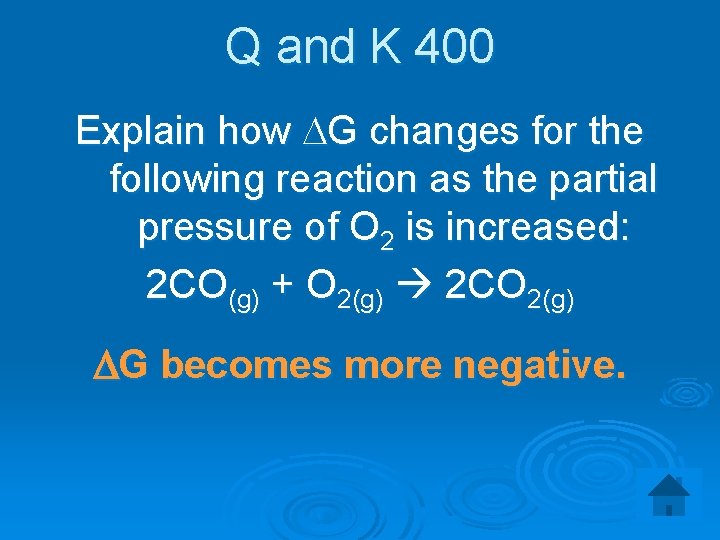
Q and K 400 Explain how DG changes for the following reaction as the partial pressure of O 2 is increased: 2 CO(g) + O 2(g) 2 CO 2(g) DG becomes more negative.
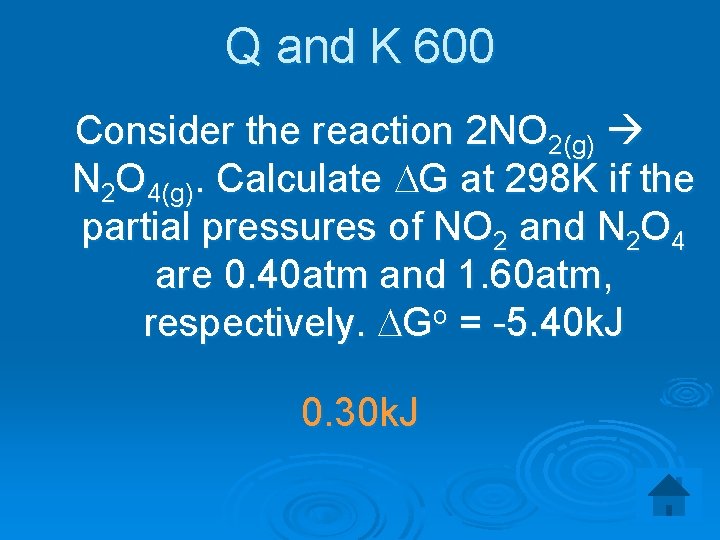
Q and K 600 Consider the reaction 2 NO 2(g) N 2 O 4(g). Calculate DG at 298 K if the partial pressures of NO 2 and N 2 O 4 are 0. 40 atm and 1. 60 atm, respectively. DGo = -5. 40 k. J 0. 30 k. J
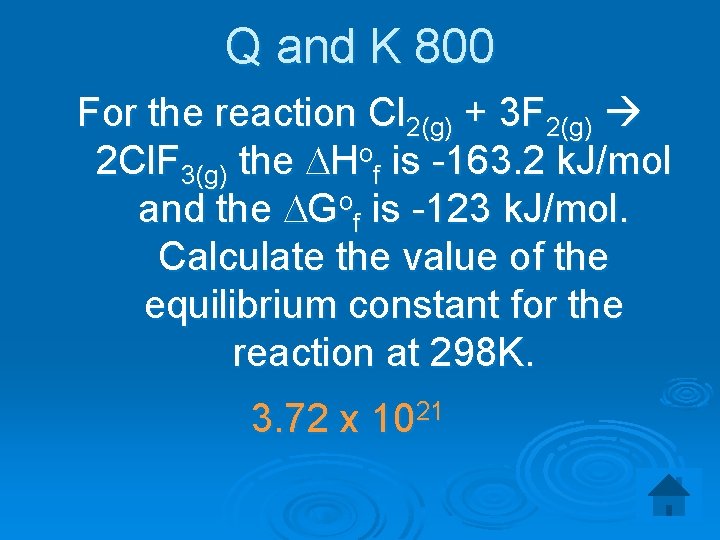
Q and K 800 For the reaction Cl 2(g) + 3 F 2(g) 2 Cl. F 3(g) the DHof is -163. 2 k. J/mol and the DGof is -123 k. J/mol. Calculate the value of the equilibrium constant for the reaction at 298 K. 3. 72 x 1021
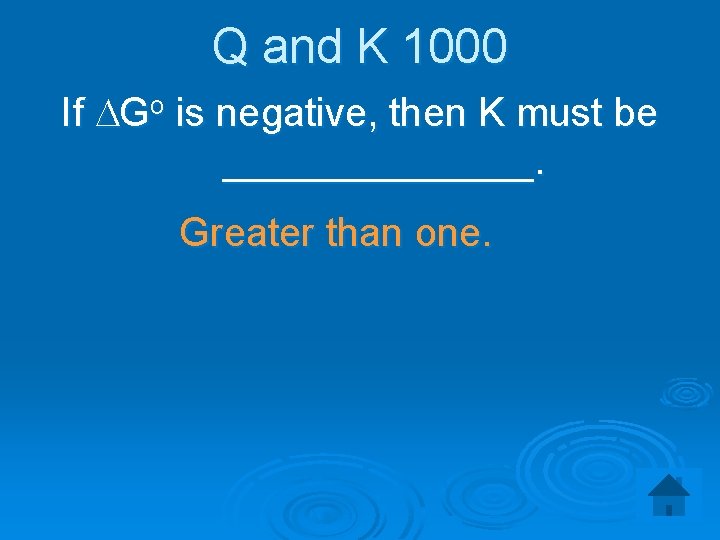
Q and K 1000 If DGo is negative, then K must be _______. Greater than one.
Surprise 200 What is a microstate? A microstate is a single possible arrangement of particles in a system.
Surprise 400 What does it mean if DG = 0 k. J? The system is at equilibrium.
Surprise 600 Which substance experiences more entropy when they are at the same temperature and contain the same amount of particles? CO 2(g) or SO 3(g) since it has more bonds which means more vibrational energy.
Surprise 800 Can an endothermic process be spontaneous? Explain. Yes, as long as there is an increase in the entropy that counteracts the decrease in enthalpy.
Surprise 1000 What are the common units for S? J/K
- Slides: 33