
AP Chem Review Big idea 2 Types of
AP Chem Review Big idea 2
Types of Bonds 1. Ionic – Metal + nonmetal (or polyatomic ion) 2. Metallic - Metal + Metal 3. Covalent - Non Metal + nonmetal
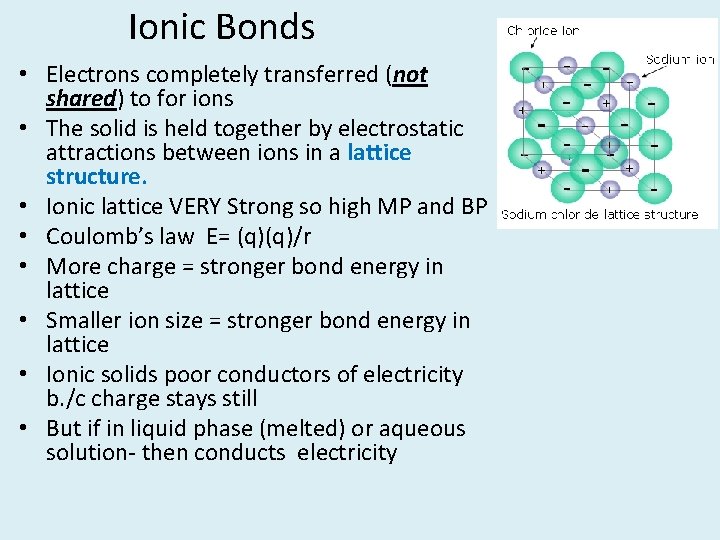
Ionic Bonds • Electrons completely transferred (not shared) to for ions • The solid is held together by electrostatic attractions between ions in a lattice structure. • Ionic lattice VERY Strong so high MP and BP • Coulomb’s law E= (q)(q)/r • More charge = stronger bond energy in lattice • Smaller ion size = stronger bond energy in lattice • Ionic solids poor conductors of electricity b. /c charge stays still • But if in liquid phase (melted) or aqueous solution- then conducts electricity
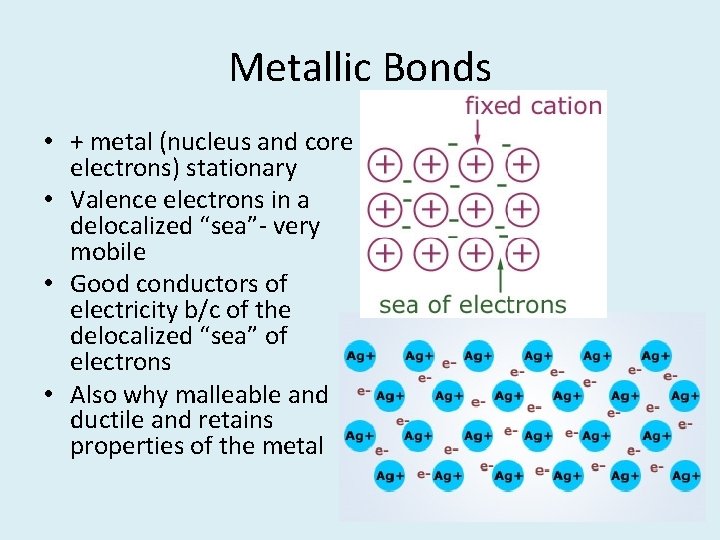
Metallic Bonds • + metal (nucleus and core electrons) stationary • Valence electrons in a delocalized “sea”- very mobile • Good conductors of electricity b/c of the delocalized “sea” of electrons • Also why malleable and ductile and retains properties of the metal
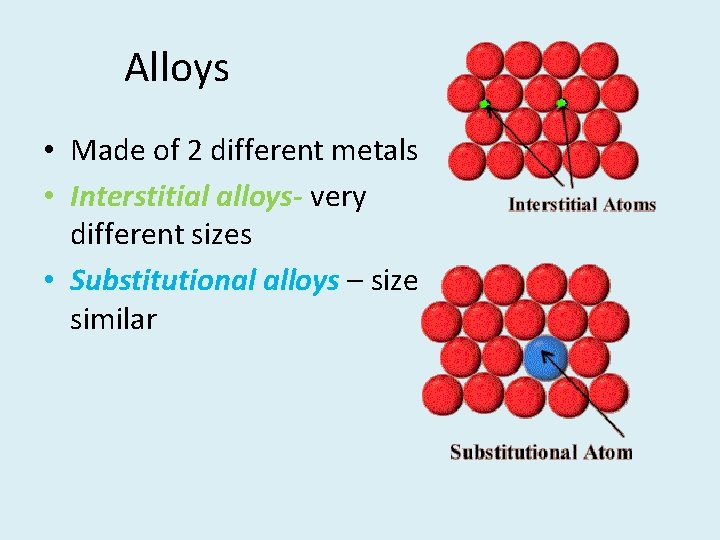
Alloys • Made of 2 different metals • Interstitial alloys- very different sizes • Substitutional alloys – size similar

Covalent Bonds- electrons shared bond single double triple length longest med shortest strength s/ p weakest 1 s med 1 s + 1 p strongest 1 s +2 p
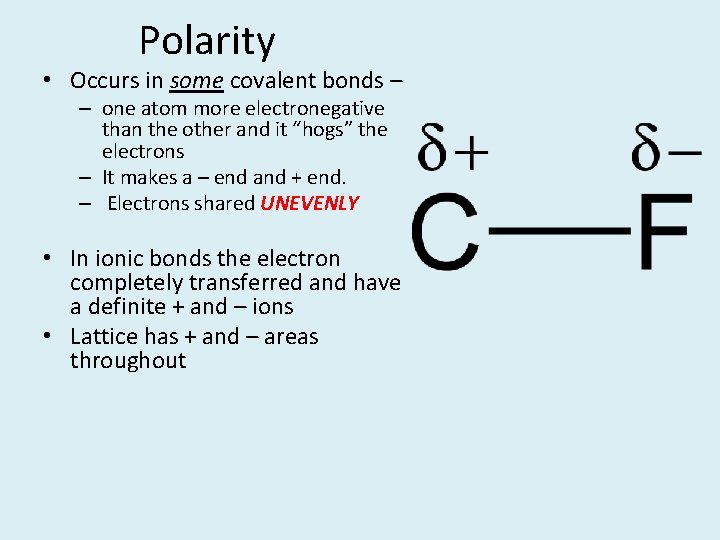
Polarity • Occurs in some covalent bonds – – one atom more electronegative than the other and it “hogs” the electrons – It makes a – end and + end. – Electrons shared UNEVENLY • In ionic bonds the electron completely transferred and have a definite + and – ions • Lattice has + and – areas throughout
What holds solids together? 1. Covalent network solid 1. doping 2. Ionic bond 3. Metallic bond-
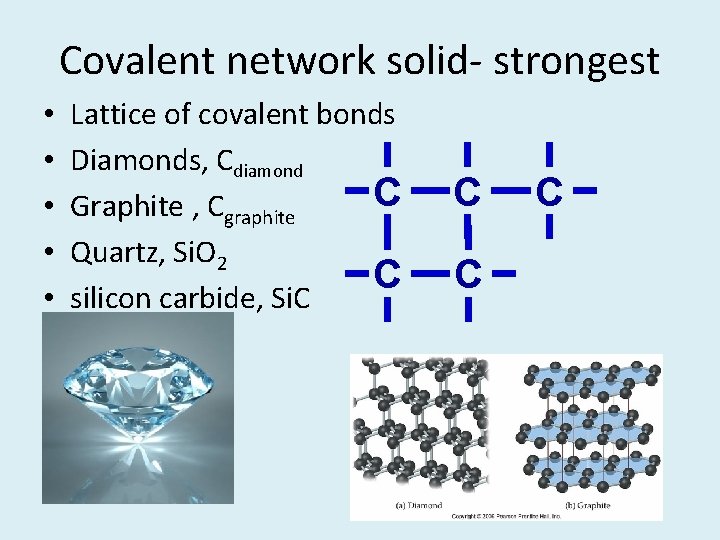
Covalent network solid- strongest • • • Lattice of covalent bonds Diamonds, Cdiamond C Graphite , Cgraphite Quartz, Si. O 2 C silicon carbide, Si. C C
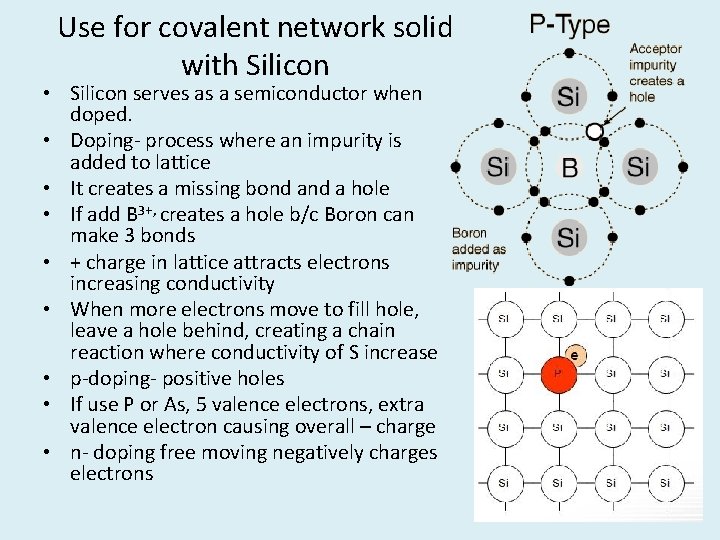
Use for covalent network solid with Silicon • Silicon serves as a semiconductor when doped. • Doping- process where an impurity is added to lattice • It creates a missing bond a hole • If add B 3+, creates a hole b/c Boron can make 3 bonds • + charge in lattice attracts electrons increasing conductivity • When more electrons move to fill hole, leave a hole behind, creating a chain reaction where conductivity of S increase • p-doping- positive holes • If use P or As, 5 valence electrons, extra valence electron causing overall – charge • n- doping free moving negatively charges electrons
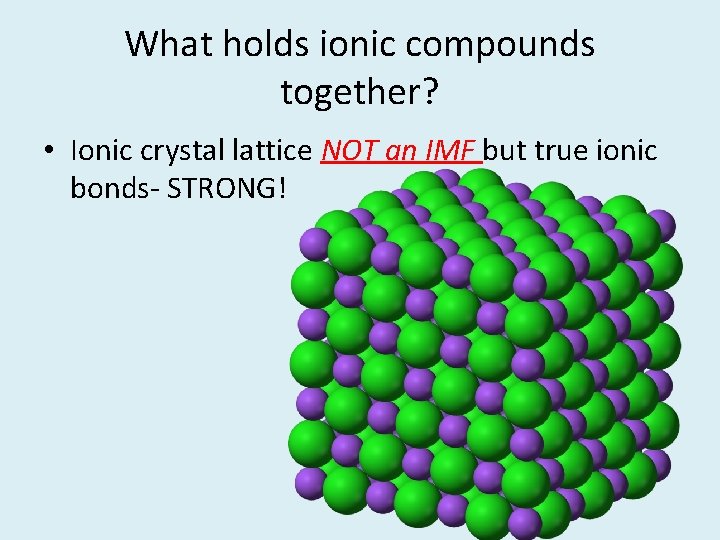
What holds ionic compounds together? • Ionic crystal lattice NOT an IMF but true ionic bonds- STRONG!
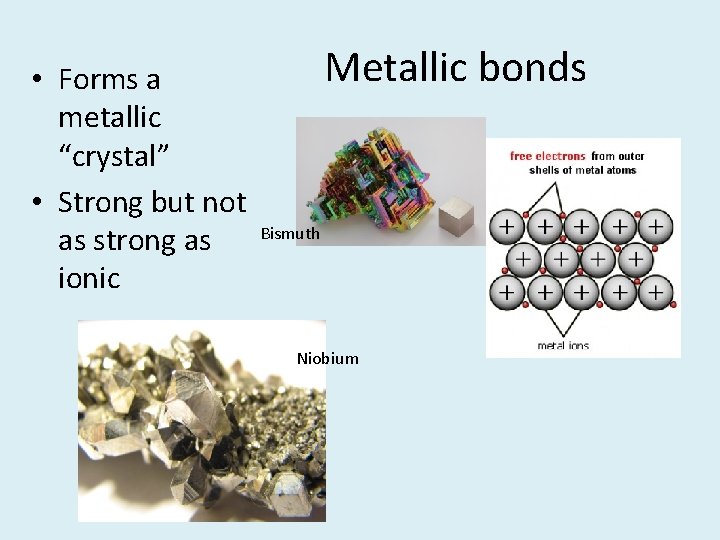
• Forms a metallic “crystal” • Strong but not as strong as ionic Metallic bonds Bismuth Niobium
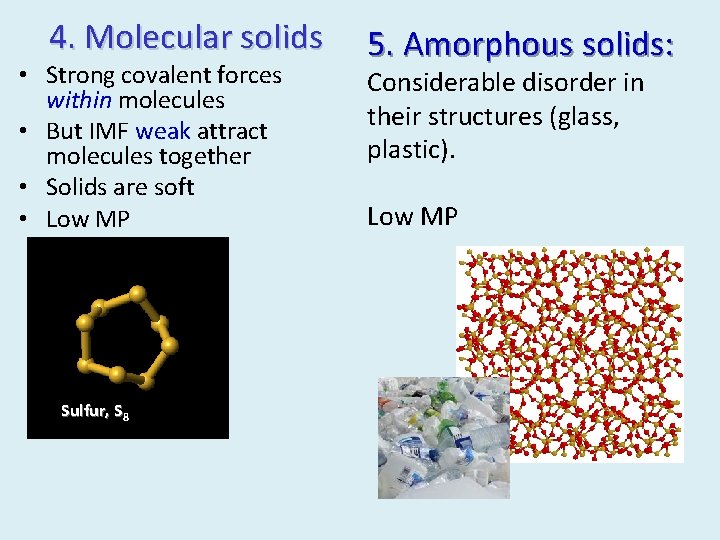
4. Molecular solids • Strong covalent forces within molecules • But IMF weak attract molecules together • Solids are soft • Low MP Sulfur, S 8 5. Amorphous solids: Considerable disorder in their structures (glass, plastic). Low MP
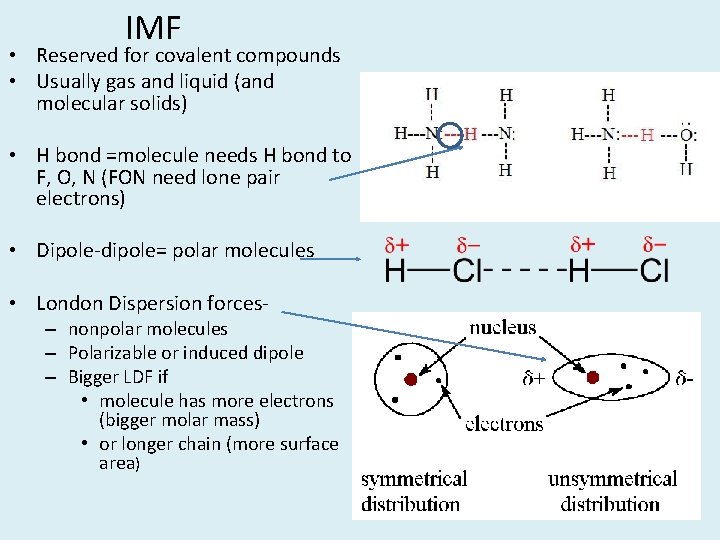
IMF • Reserved for covalent compounds • Usually gas and liquid (and molecular solids) • H bond =molecule needs H bond to F, O, N (FON need lone pair electrons) • Dipole-dipole= polar molecules • London Dispersion forces- – nonpolar molecules – Polarizable or induced dipole – Bigger LDF if • molecule has more electrons (bigger molar mass) • or longer chain (more surface area)
IMF and Phases 1. Solid- strongest IMF (Note: ionic substances and metallic do not experience IMF-solid at room temp b/c bonding very strong) 2. Liquid- medium 3. Gas – weaker
Melting point and boiling point • Phase change involves IMF • Stronger IMF higher MP and BP • If strong IMF takes more energy to break IMF and to melt a solid or boil a liquid
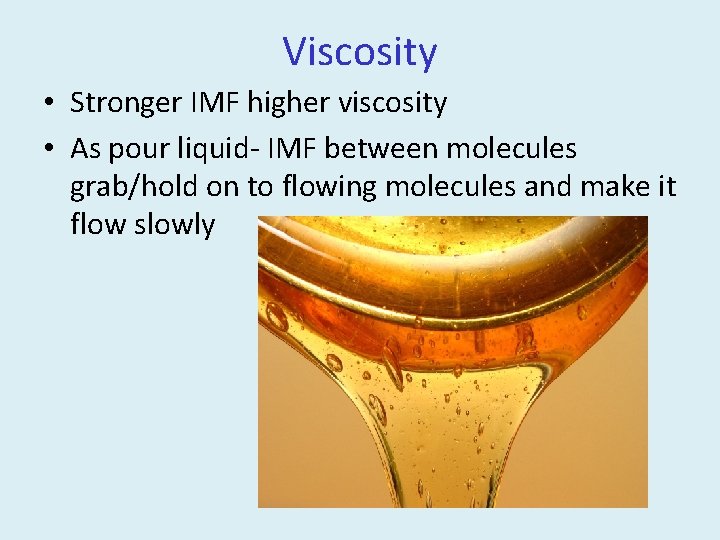
Viscosity • Stronger IMF higher viscosity • As pour liquid- IMF between molecules grab/hold on to flowing molecules and make it flow slowly
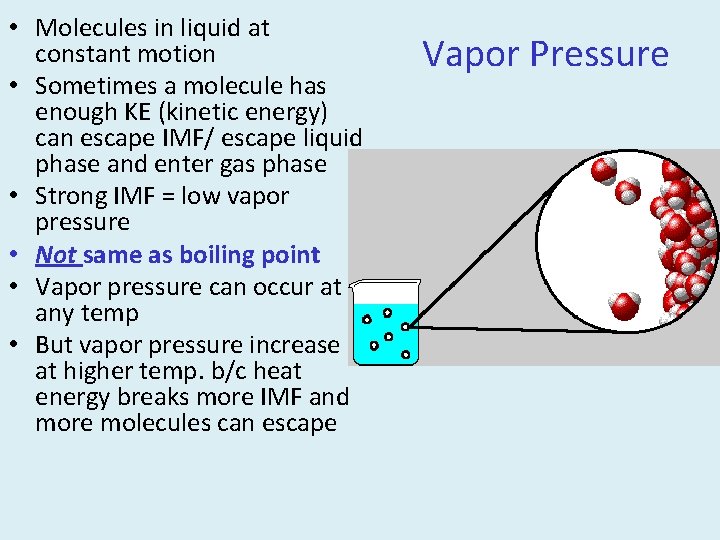
• Molecules in liquid at constant motion • Sometimes a molecule has enough KE (kinetic energy) can escape IMF/ escape liquid phase and enter gas phase • Strong IMF = low vapor pressure • Not same as boiling point • Vapor pressure can occur at any temp • But vapor pressure increase at higher temp. b/c heat energy breaks more IMF and more molecules can escape Vapor Pressure
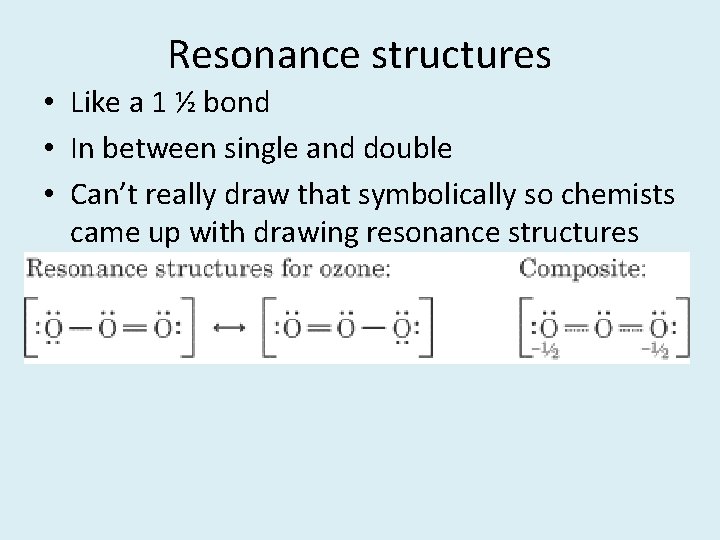
Resonance structures • Like a 1 ½ bond • In between single and double • Can’t really draw that symbolically so chemists came up with drawing resonance structures
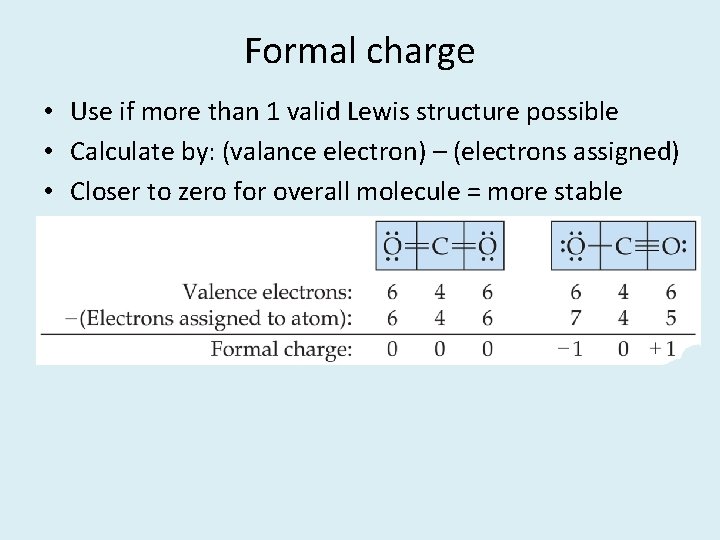
Formal charge • Use if more than 1 valid Lewis structure possible • Calculate by: (valance electron) – (electrons assigned) • Closer to zero for overall molecule = more stable
Day 2 - Big Idea 2
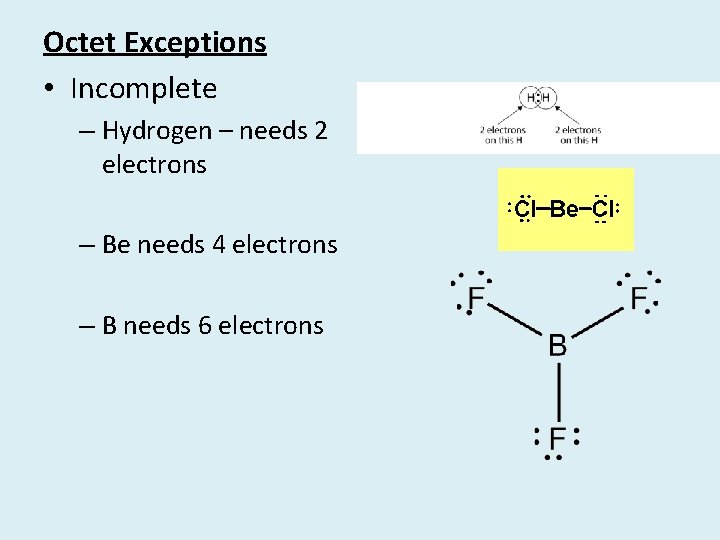
Octet Exceptions • Incomplete – Hydrogen – needs 2 electrons – Be needs 4 electrons – B needs 6 electrons
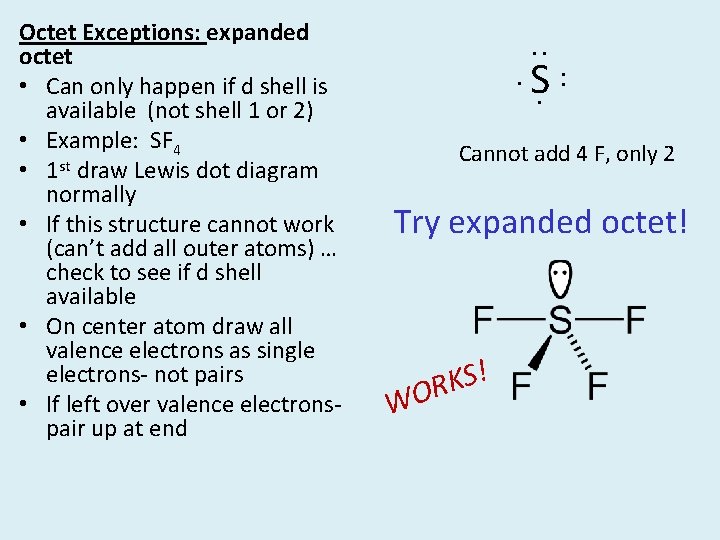
. . . S. . . Octet Exceptions: expanded octet • Can only happen if d shell is available (not shell 1 or 2) • Example: SF 4 • 1 st draw Lewis dot diagram normally • If this structure cannot work (can’t add all outer atoms) … check to see if d shell available • On center atom draw all valence electrons as single electrons- not pairs • If left over valence electronspair up at end Cannot add 4 F, only 2 Try expanded octet! W ! S K OR
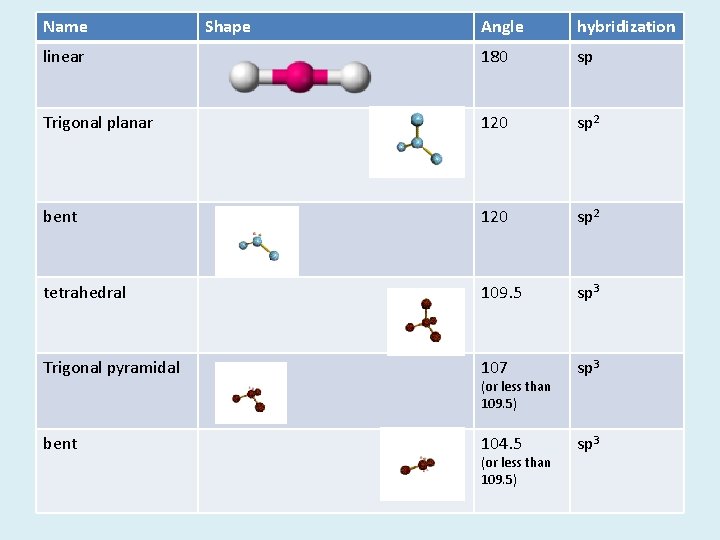
Name Shape Angle hybridization linear 180 sp Trigonal planar 120 sp 2 bent 120 sp 2 tetrahedral 109. 5 sp 3 Trigonal pyramidal 107 sp 3 bent 104. 5 sp 3 (or less than 109. 5)
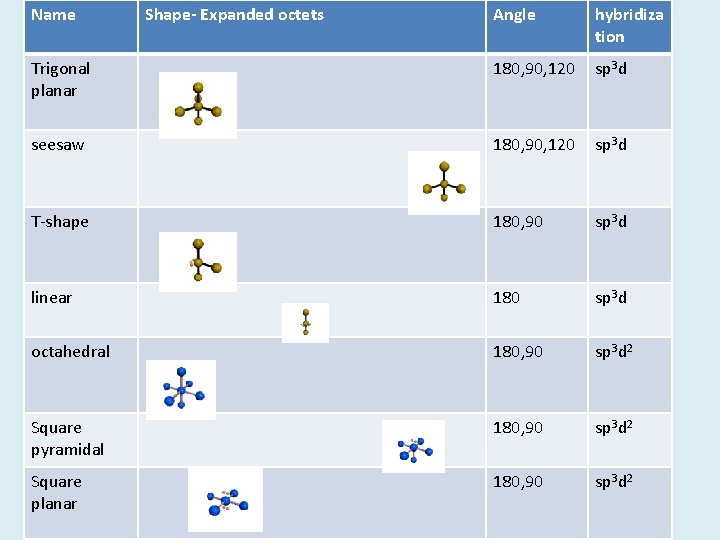
Name Shape- Expanded octets Angle hybridiza tion Trigonal planar 180, 90, 120 sp 3 d seesaw 180, 90, 120 sp 3 d T-shape 180, 90 sp 3 d linear 180 sp 3 d octahedral 180, 90 sp 3 d 2 Square pyramidal 180, 90 sp 3 d 2 Square planar 180, 90 sp 3 d 2
Gas laws • • • Kinetic Molecular Theory for Ideal Gases Kinetic Energy (KE) of ideal gas is directly prop. To temp. Greater temp = greater KE KE = ½ mv 2 m= mass v = velocity if different gases are present in a sample (mixture) at same temp- all gasses have same KE The average KE of a gas mixture depends only on absolute temp- not identify of gas Ideal gases have no IMF (theoretically) Ideal Gas molecules in constant motion colliding with each other and walls of container w/out losing energy
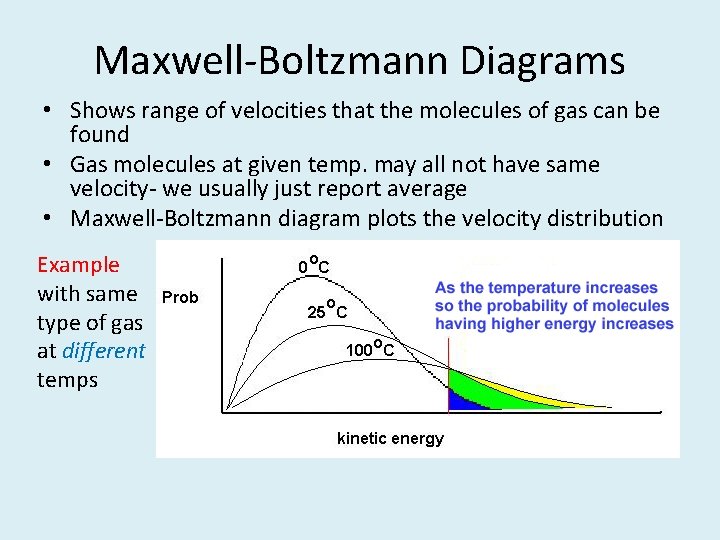
Maxwell-Boltzmann Diagrams • Shows range of velocities that the molecules of gas can be found • Gas molecules at given temp. may all not have same velocity- we usually just report average • Maxwell-Boltzmann diagram plots the velocity distribution Example with same type of gas at different temps
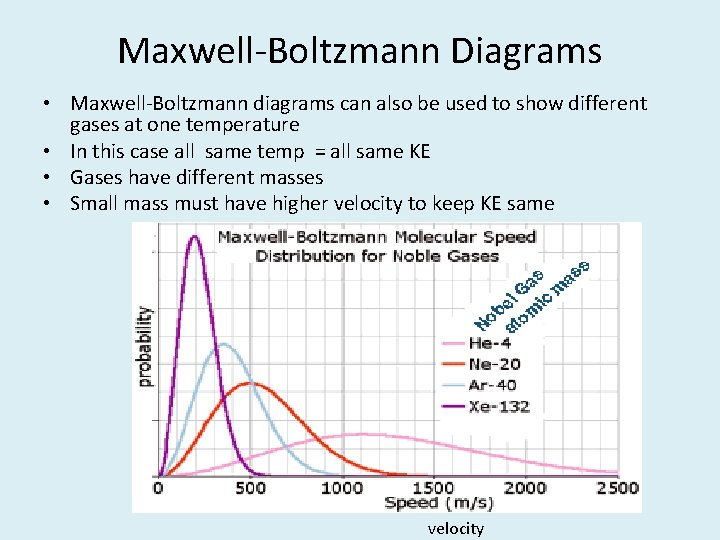
Maxwell-Boltzmann Diagrams • Maxwell-Boltzmann diagrams can also be used to show different gases at one temperature • In this case all same temp = all same KE • Gases have different masses • Small mass must have higher velocity to keep KE same velocity
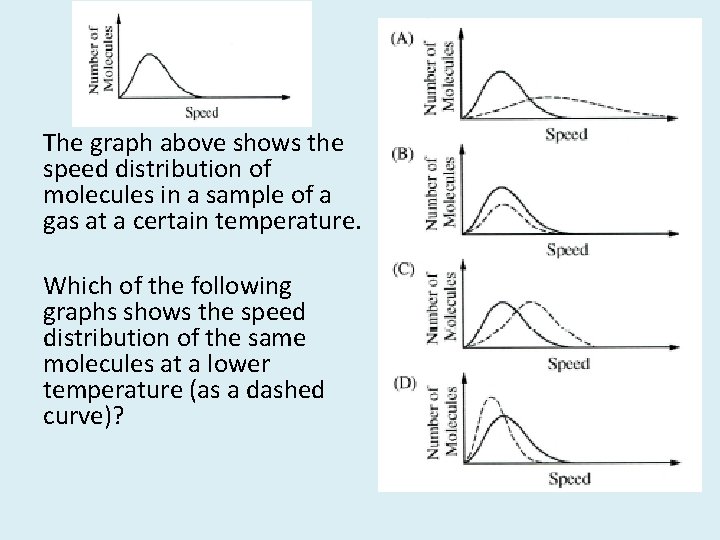
The graph above shows the speed distribution of molecules in a sample of a gas at a certain temperature. Which of the following graphs shows the speed distribution of the same molecules at a lower temperature (as a dashed curve)?
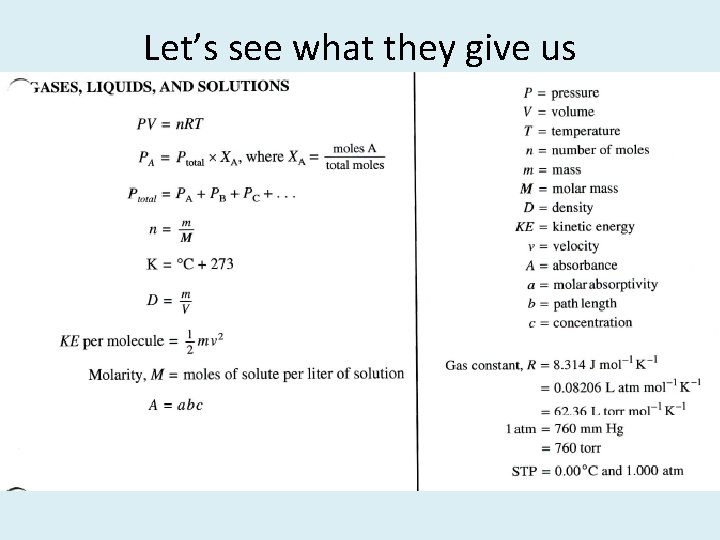
Let’s see what they give us
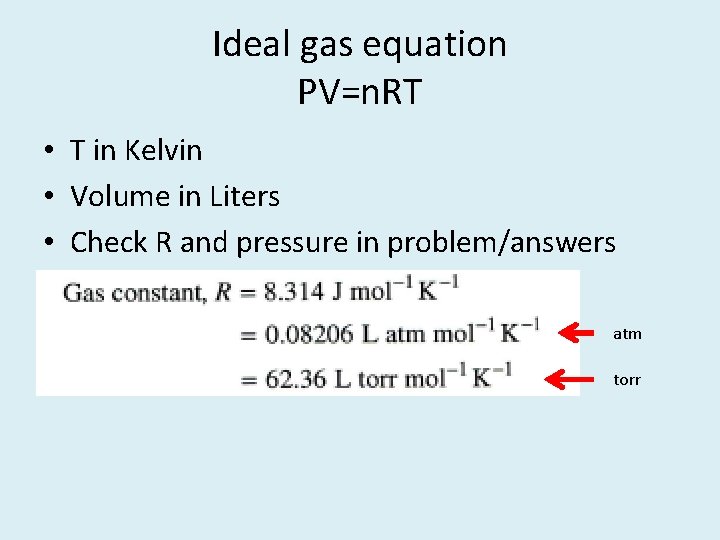
Ideal gas equation PV=n. RT • T in Kelvin • Volume in Liters • Check R and pressure in problem/answers atm torr
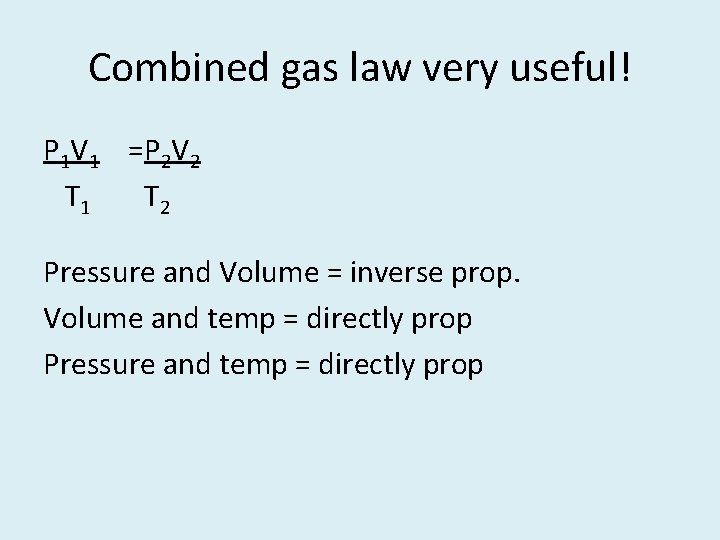
Combined gas law very useful! P 1 V 1 =P 2 V 2 T 1 T 2 Pressure and Volume = inverse prop. Volume and temp = directly prop Pressure and temp = directly prop
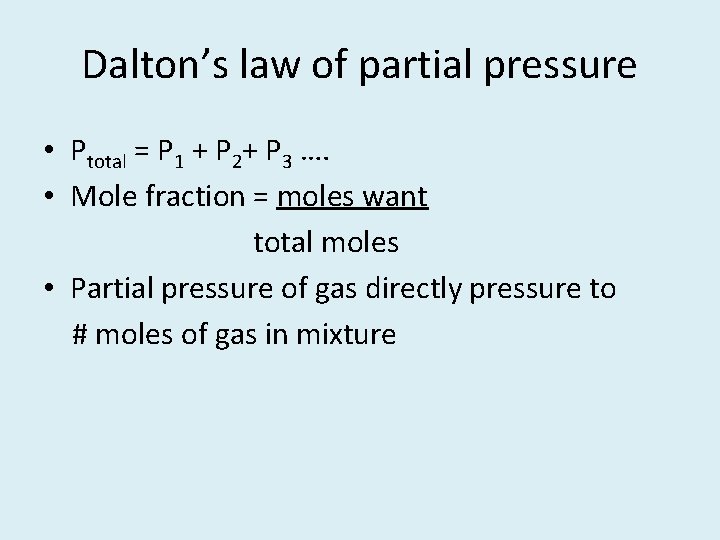
Dalton’s law of partial pressure • Ptotal = P 1 + P 2+ P 3 …. • Mole fraction = moles want total moles • Partial pressure of gas directly pressure to # moles of gas in mixture
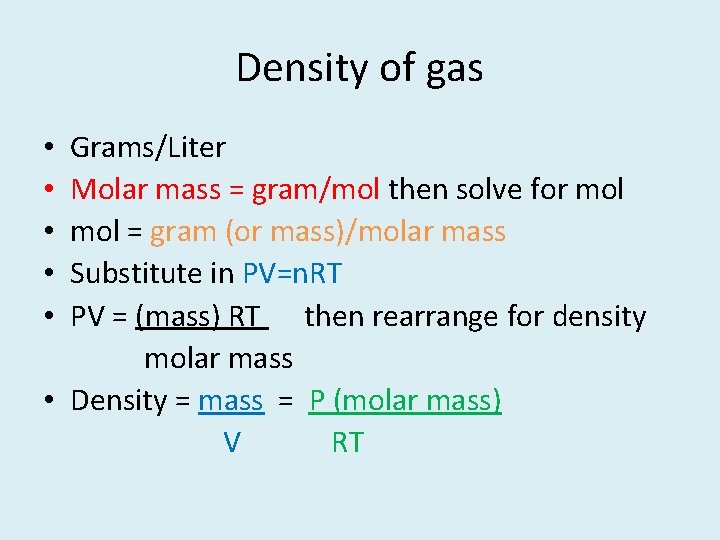
Density of gas Grams/Liter Molar mass = gram/mol then solve for mol = gram (or mass)/molar mass Substitute in PV=n. RT PV = (mass) RT then rearrange for density molar mass • Density = mass = P (molar mass) V RT • • •
![Solutions • Molarity = mol/L • Can be represented [Na. Cl], as we saw](http://slidetodoc.com/presentation_image_h2/a06fc4552afbf13e3db8e6a783b216b8/image-35.jpg "Solutions • Molarity = mol/L • Can be represented [Na. Cl], as we saw")
Solutions • Molarity = mol/L • Can be represented [Na. Cl], as we saw in equilibrium • Mole fraction = moles want (or interested in) total moles • Mole fraction has no units
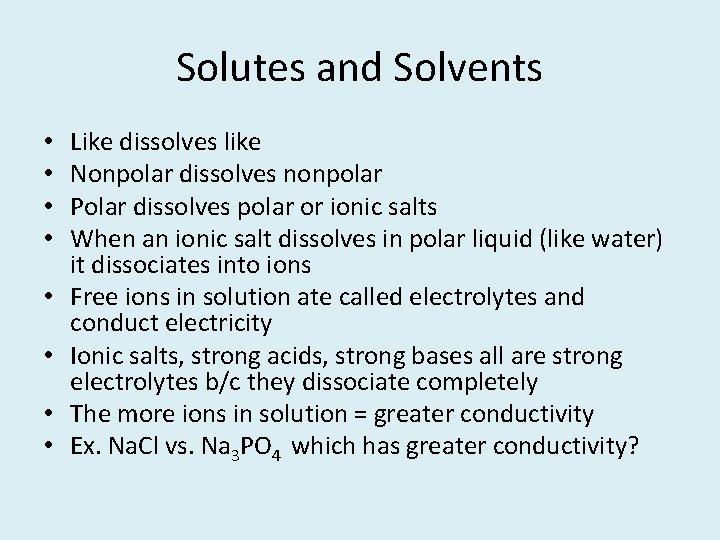
Solutes and Solvents • • Like dissolves like Nonpolar dissolves nonpolar Polar dissolves polar or ionic salts When an ionic salt dissolves in polar liquid (like water) it dissociates into ions Free ions in solution ate called electrolytes and conduct electricity Ionic salts, strong acids, strong bases all are strong electrolytes b/c they dissociate completely The more ions in solution = greater conductivity Ex. Na. Cl vs. Na 3 PO 4 which has greater conductivity?
- Slides: 36