
AP Chapter 5 Gases AP Learning Objectives LO
AP* Chapter 5 Gases
AP Learning Objectives § LO 1. 3 The student is able to select and apply mathematical relationships to mass data in order to justify a claim regarding the identify and/or estimated purity of a substance. (Sec 5. 5, 5. 7) § LO 1. 4 The student is able to connect the number of particles, moles, mass, and volume of substances to one another, both qualitatively and quantitatively. (Sec 5. 2 -5. 3) § LO 2. 4 The student is able to use KMT and concepts of intermolecular forces to make predictions about the macroscopic properties of gases, including both ideal and nonideal behavior. (Sec 5. 1 -5. 3, 5. 6) § LO 2. 5 The student is able to refine multiple representations of a sample of matter in the gas phase to accurately represent the effect of changes in macroscopic properties on the sample. (Sec 5. 3) § LO 2. 6 The student can apply mathematical relationships or estimation to determine macroscopic variables for ideal gases. (Sec 5. 1 -5. 5)
AP Learning Objectives § LO 2. 12 The student can qualitatively analyze data regarding real gases to identify deviations from ideal behavior and relate these to molecular interactions. (Sec 5. 8) § LO 2. 15 The student is able to explain observations regarding the solubility of ionic solids and molecules in water and other solvents on the basis of particle views that include intermolecular interactions and entropic effects. (Sec 5. 8 -5. 9) § LO 3. 4 The student is able to relate quantities (measured mass of substances, volumes of solutions, or volumes and pressures of gases) to identify stoichiometric relationships for a reaction, including situations involving limiting reactants and situations in which the reaction has not gone to completion. (Sec 5. 4) § LO 5. 2: The student is able to relate temperature to the motions of particles, either via particulate representations, such as drawings of particles with arrows indicating velocities, and/or via representations of average kinetic energy and distribution of kinetic energies of the particles, such as plots of the Maxwell. Boltzmann distribution. (Sec 5. 6)
Section 5. 1 Pressure AP Learning Objectives, Margin Notes and References § Learning Objectives § § LO 2. 4 The student is able to use KMT and concepts of intermolecular forces to make predictions about the macroscopic properties of gases, including both ideal and nonideal behavior. LO 2. 6 The student can apply mathematical relationships or estimation to determine macroscopic variables for ideal gases.
Section 5. 1 Pressure Why study gases? § An understanding of real world phenomena. § An understanding of how science “works. ” Copyright © Cengage Learning. All rights reserved 5
Section 5. 1 Pressure A Gas § § Uniformly fills any container. Easily compressed. Mixes completely with any other gas. Exerts pressure on its surroundings. Copyright © Cengage Learning. All rights reserved 6
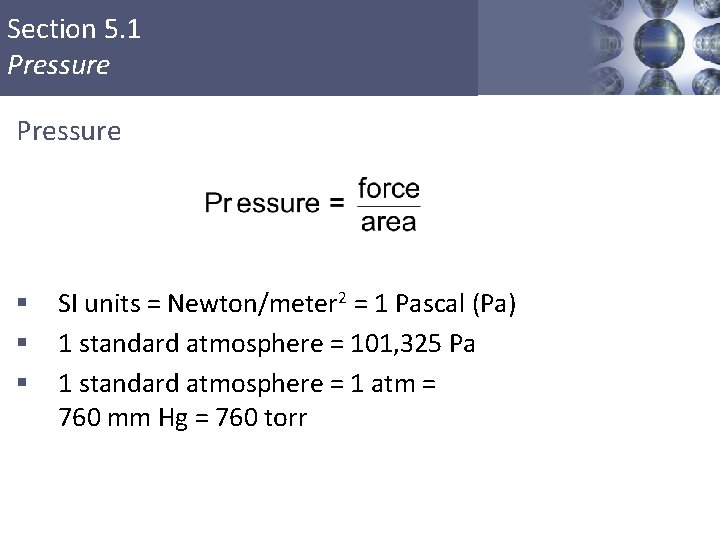
Section 5. 1 Pressure § § § SI units = Newton/meter 2 = 1 Pascal (Pa) 1 standard atmosphere = 101, 325 Pa 1 standard atmosphere = 1 atm = 760 mm Hg = 760 torr Copyright © Cengage Learning. All rights reserved 7
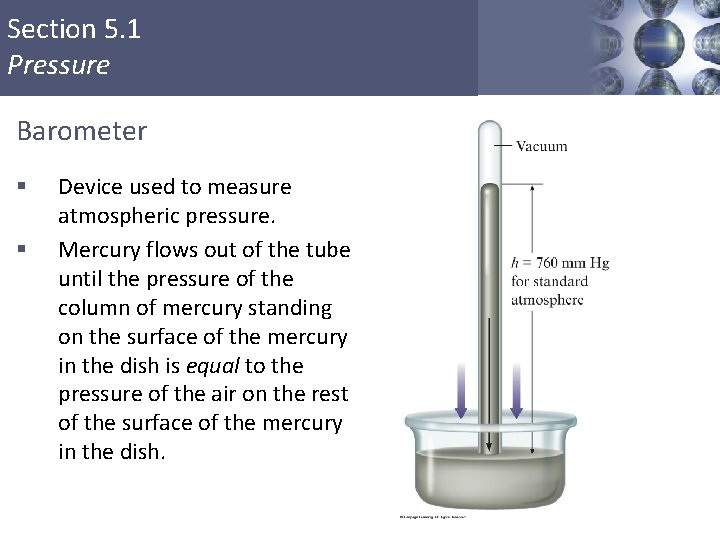
Section 5. 1 Pressure Barometer § § Device used to measure atmospheric pressure. Mercury flows out of the tube until the pressure of the column of mercury standing on the surface of the mercury in the dish is equal to the pressure of the air on the rest of the surface of the mercury in the dish. Copyright © Cengage Learning. All rights reserved 8
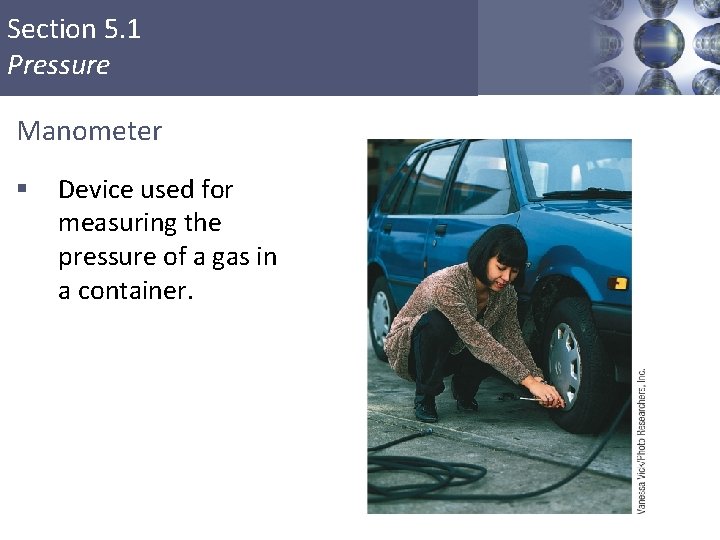
Section 5. 1 Pressure Manometer § Device used for measuring the pressure of a gas in a container. Copyright © Cengage Learning. All rights reserved 9
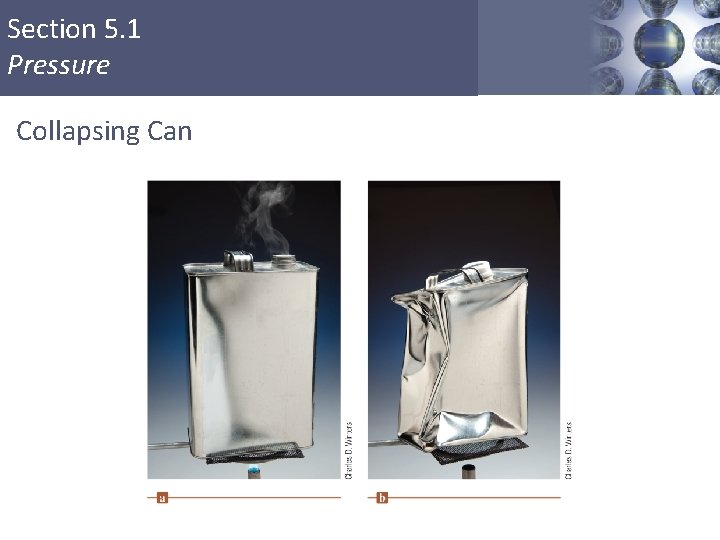
Section 5. 1 Pressure Collapsing Can Copyright © Cengage Learning. All rights reserved 10
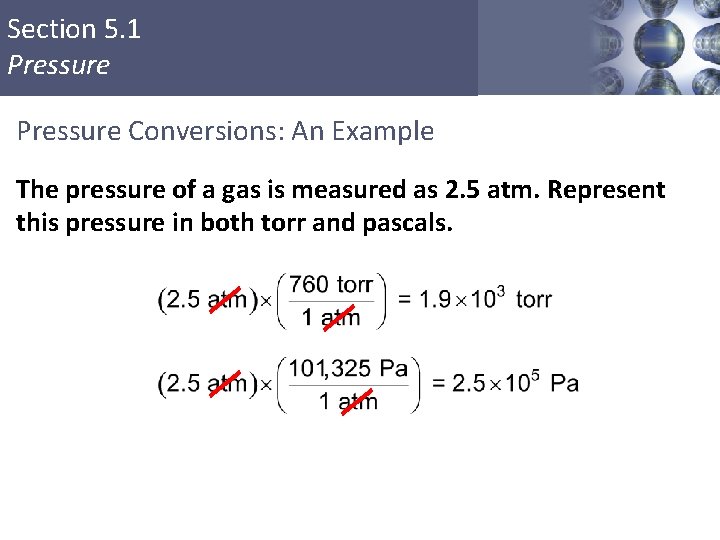
Section 5. 1 Pressure Conversions: An Example The pressure of a gas is measured as 2. 5 atm. Represent this pressure in both torr and pascals. Copyright © Cengage Learning. All rights reserved 11
Section 5. 2 The Gas Laws of Boyle, Charles, and Avogadro AP Learning Objectives, Margin Notes and References § Learning Objectives § § § LO 1. 4 The student is able to connect the number of particles, moles, mass, and volume of substances to one another, both qualitatively and quantitatively. LO 2. 4 The student is able to use KMT and concepts of intermolecular forces to make predictions about the macroscopic properties of gases, including both ideal and nonideal behavior. LO 2. 6 The student can apply mathematical relationships or estimation to determine macroscopic variables for ideal gases.
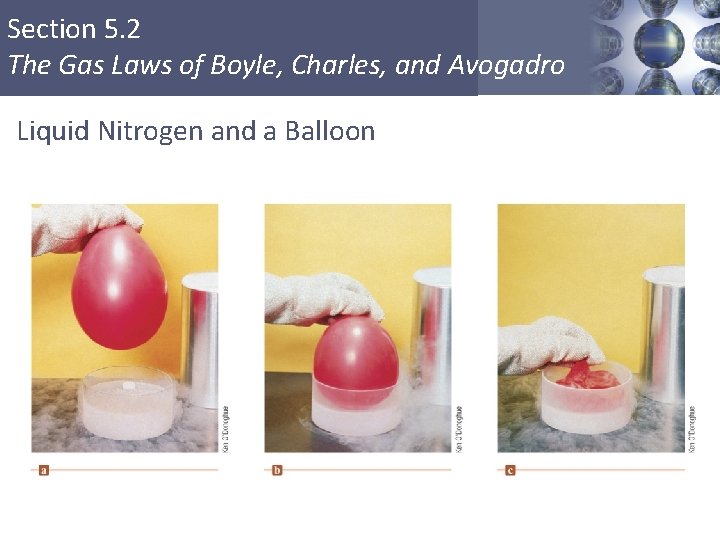
Section 5. 2 The Gas Laws of Boyle, Charles, and Avogadro Liquid Nitrogen and a Balloon Copyright © Cengage Learning. All rights reserved 13
Section 5. 2 The Gas Laws of Boyle, Charles, and Avogadro Liquid Nitrogen and a Balloon § § What happened to the gas in the balloon? A decrease in temperature was followed by a decrease in the pressure and volume of the gas in the balloon. Copyright © Cengage Learning. All rights reserved 14
Section 5. 2 The Gas Laws of Boyle, Charles, and Avogadro Liquid Nitrogen and a Balloon § § This is an observation (a fact). It does NOT explain “why, ” but it does tell us “what happened. ” Copyright © Cengage Learning. All rights reserved 15
Section 5. 2 The Gas Laws of Boyle, Charles, and Avogadro § § Gas laws can be deduced from observations like these. Mathematical relationships among the properties of a gas (Pressure, Volume, Temperature and Moles) can be discovered. Copyright © Cengage Learning. All rights reserved 16
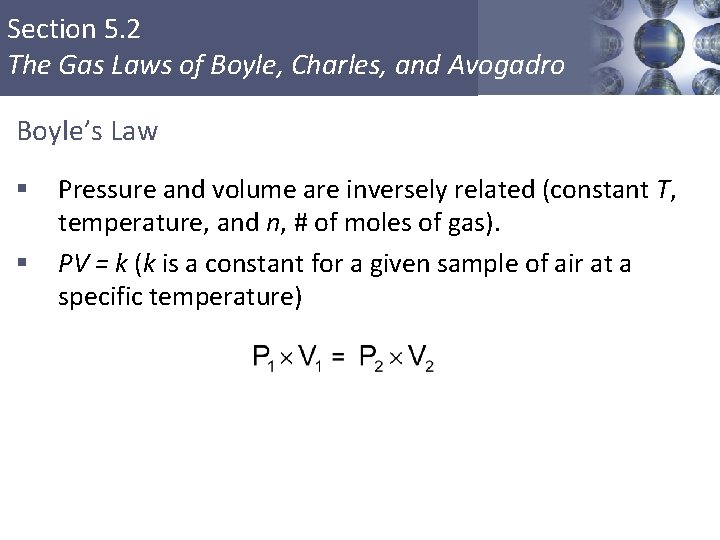
Section 5. 2 The Gas Laws of Boyle, Charles, and Avogadro Boyle’s Law § § Pressure and volume are inversely related (constant T, temperature, and n, # of moles of gas). PV = k (k is a constant for a given sample of air at a specific temperature) Copyright © Cengage Learning. All rights reserved 17
Section 5. 2 The Gas Laws of Boyle, Charles, and Avogadro Boyle’s law To play movie you must be in Slide Show Mode PC Users: Please wait for content to load, then click to play Mac Users: CLICK HERE Copyright © Cengage Learning. All rights reserved 18
Section 5. 2 The Gas Laws of Boyle, Charles, and Avogadro EXERCISE! A sample of helium gas occupies 12. 4 L at 23°C and 0. 956 atm. What volume will it occupy at 1. 20 atm assuming that the temperature stays constant? 9. 88 L Copyright © Cengage Learning. All rights reserved 19
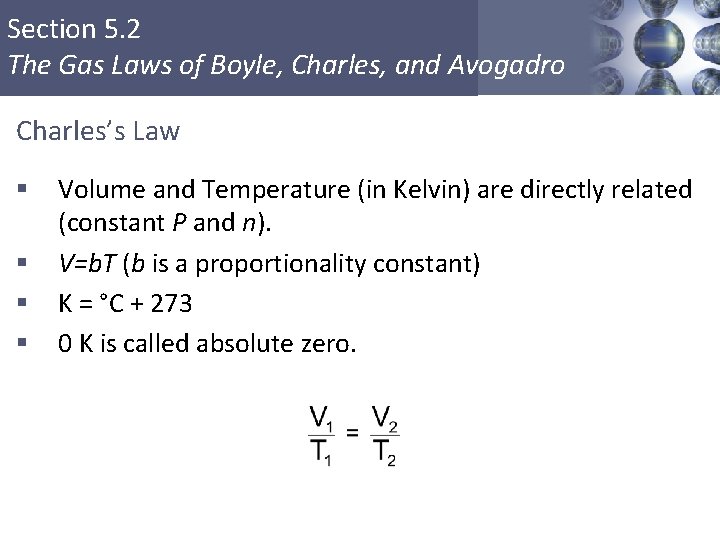
Section 5. 2 The Gas Laws of Boyle, Charles, and Avogadro Charles’s Law § § Volume and Temperature (in Kelvin) are directly related (constant P and n). V=b. T (b is a proportionality constant) K = °C + 273 0 K is called absolute zero. Copyright © Cengage Learning. All rights reserved 20
Section 5. 2 The Gas Laws of Boyle, Charles, and Avogadro Charles’s Law To play movie you must be in Slide Show Mode PC Users: Please wait for content to load, then click to play Mac Users: CLICK HERE Copyright © Cengage Learning. All rights reserved 21
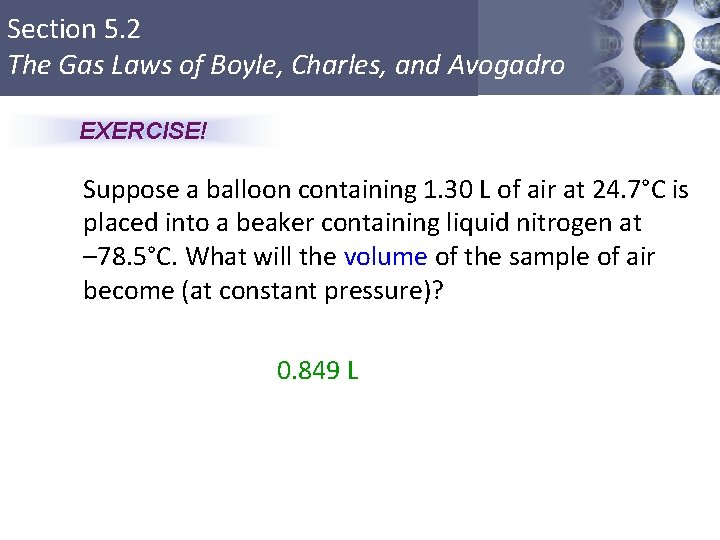
Section 5. 2 The Gas Laws of Boyle, Charles, and Avogadro EXERCISE! Suppose a balloon containing 1. 30 L of air at 24. 7°C is placed into a beaker containing liquid nitrogen at – 78. 5°C. What will the volume of the sample of air become (at constant pressure)? 0. 849 L Copyright © Cengage Learning. All rights reserved 22
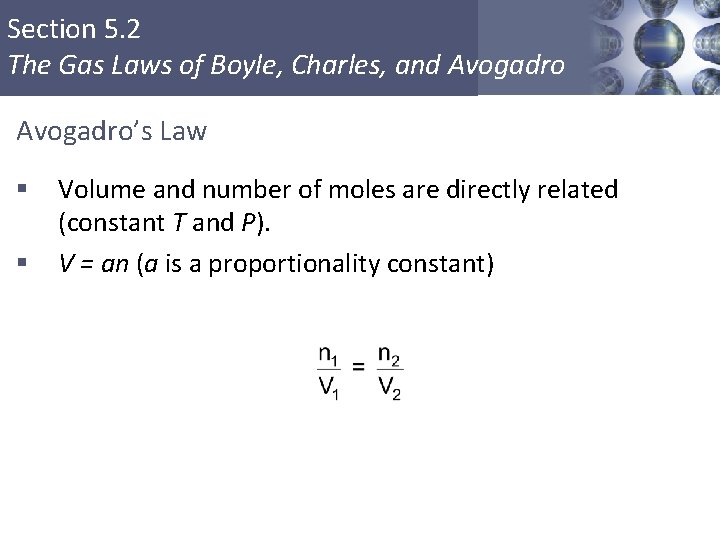
Section 5. 2 The Gas Laws of Boyle, Charles, and Avogadro’s Law § § Volume and number of moles are directly related (constant T and P). V = an (a is a proportionality constant) Copyright © Cengage Learning. All rights reserved 23
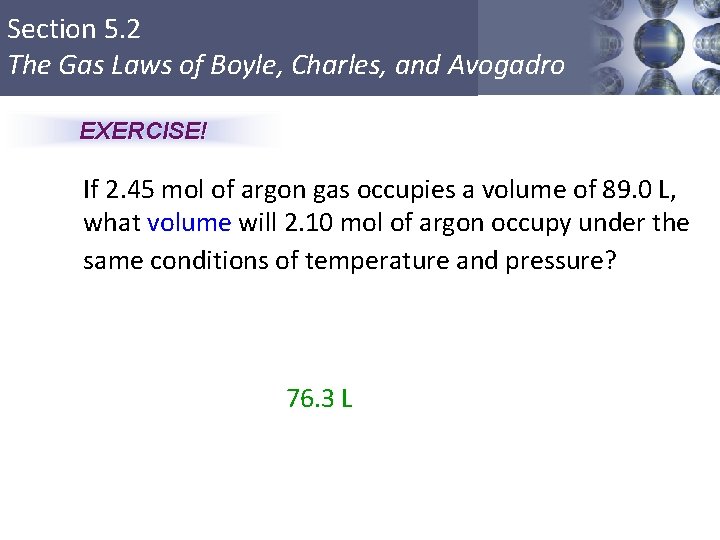
Section 5. 2 The Gas Laws of Boyle, Charles, and Avogadro EXERCISE! If 2. 45 mol of argon gas occupies a volume of 89. 0 L, what volume will 2. 10 mol of argon occupy under the same conditions of temperature and pressure? 76. 3 L Copyright © Cengage Learning. All rights reserved 24
Section 5. 3 The Ideal Gas Law AP Learning Objectives, Margin Notes and References § Learning Objectives § § LO 1. 4 The student is able to connect the number of particles, moles, mass, and volume of substances to one another, both qualitatively and quantitatively. LO 2. 4 The student is able to use KMT and concepts of intermolecular forces to make predictions about the macroscopic properties of gases, including both ideal and nonideal behavior. LO 2. 5 The student is able to refine multiple representations of a sample of matter in the gas phase to accurately represent the effect of changes in macroscopic properties on the sample. LO 2. 6 The student can apply mathematical relationships or estimation to determine macroscopic variables for ideal gases.
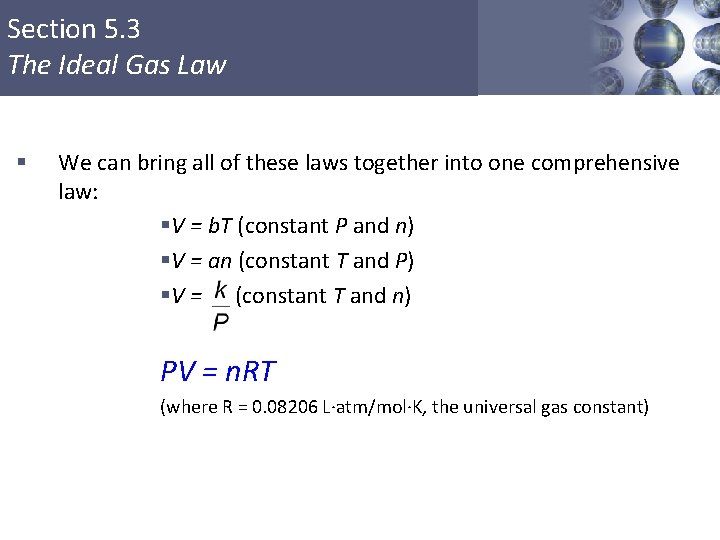
Section 5. 3 The Ideal Gas Law § We can bring all of these laws together into one comprehensive law: §V = b. T (constant P and n) §V = an (constant T and P) §V = (constant T and n) PV = n. RT (where R = 0. 08206 L·atm/mol·K, the universal gas constant) Copyright © Cengage Learning. All rights reserved 26
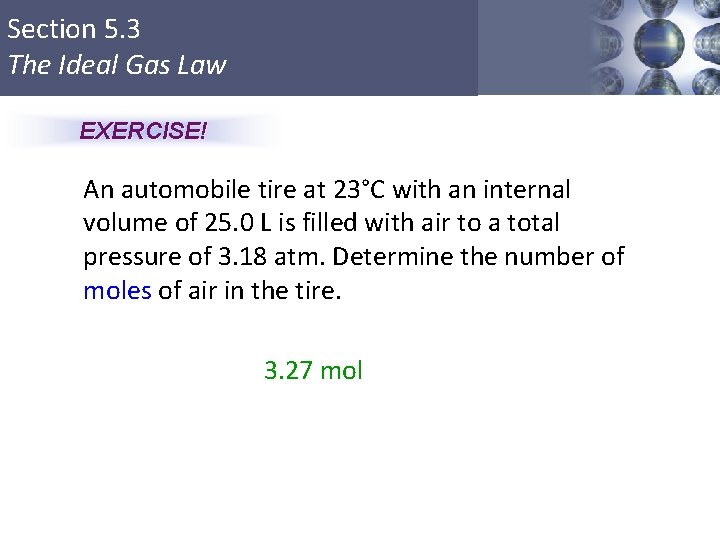
Section 5. 3 The Ideal Gas Law EXERCISE! An automobile tire at 23°C with an internal volume of 25. 0 L is filled with air to a total pressure of 3. 18 atm. Determine the number of moles of air in the tire. 3. 27 mol Copyright © Cengage Learning. All rights reserved 27
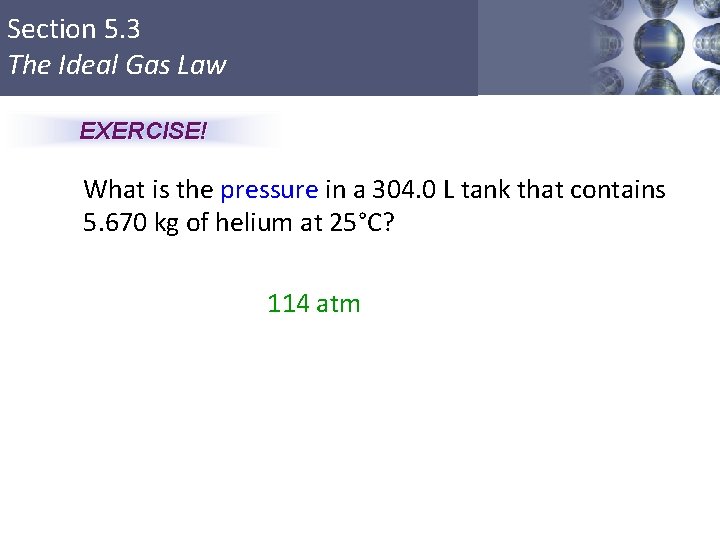
Section 5. 3 The Ideal Gas Law EXERCISE! What is the pressure in a 304. 0 L tank that contains 5. 670 kg of helium at 25°C? 114 atm Copyright © Cengage Learning. All rights reserved 28
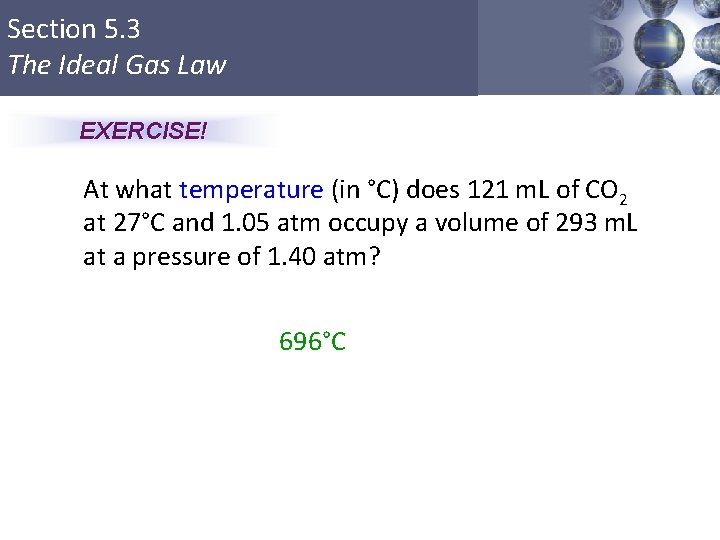
Section 5. 3 The Ideal Gas Law EXERCISE! At what temperature (in °C) does 121 m. L of CO 2 at 27°C and 1. 05 atm occupy a volume of 293 m. L at a pressure of 1. 40 atm? 696°C Copyright © Cengage Learning. All rights reserved 29
Section 5. 4 Gas Stoichiometry AP Learning Objectives, Margin Notes and References § Learning Objectives § § LO 2. 6 The student can apply mathematical relationships or estimation to determine macroscopic variables for ideal gases. LO 3. 4 The student is able to relate quantities (measured mass of substances, volumes of solutions, or volumes and pressures of gases) to identify stoichiometric relationships for a reaction, including situations involving limiting reactants and situations in which the reaction has not gone to completion.
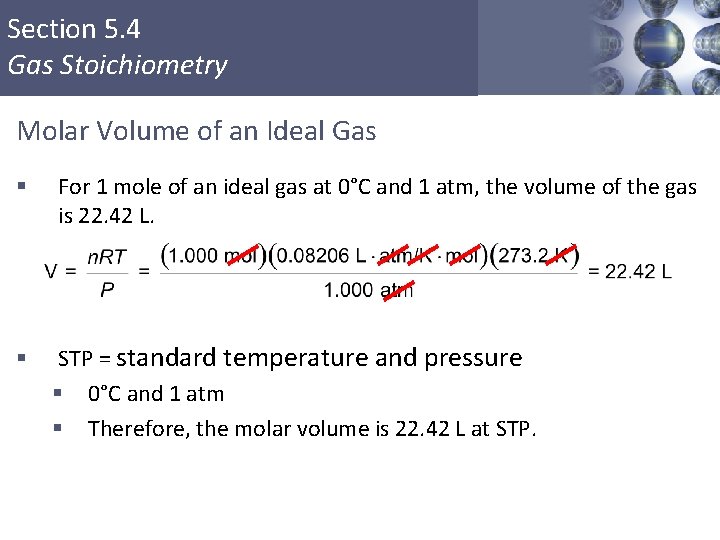
Section 5. 4 Gas Stoichiometry Molar Volume of an Ideal Gas § For 1 mole of an ideal gas at 0°C and 1 atm, the volume of the gas is 22. 42 L. § STP = standard temperature and pressure § 0°C and 1 atm § Therefore, the molar volume is 22. 42 L at STP. Copyright © Cengage Learning. All rights reserved 31
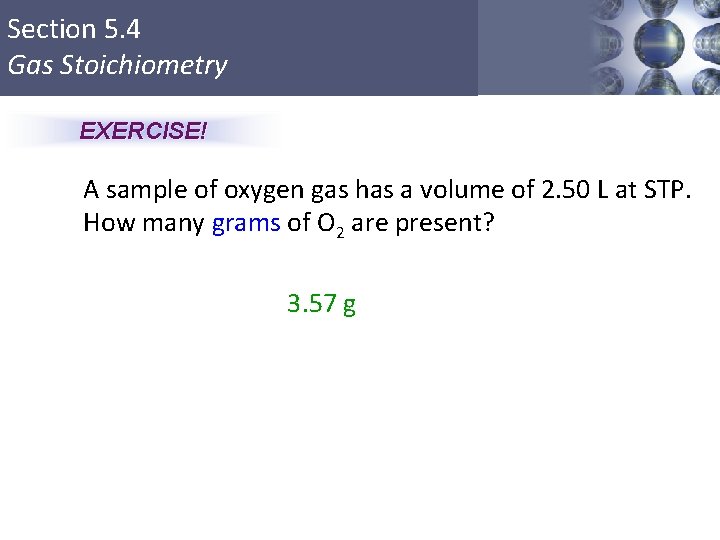
Section 5. 4 Gas Stoichiometry EXERCISE! A sample of oxygen gas has a volume of 2. 50 L at STP. How many grams of O 2 are present? 3. 57 g Copyright © Cengage Learning. All rights reserved 32
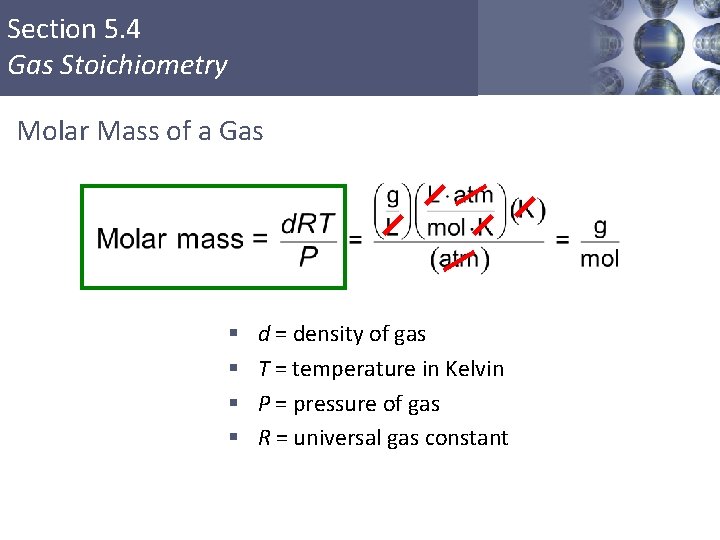
Section 5. 4 Gas Stoichiometry Molar Mass of a Gas § § Copyright © Cengage Learning. All rights reserved d = density of gas T = temperature in Kelvin P = pressure of gas R = universal gas constant 33
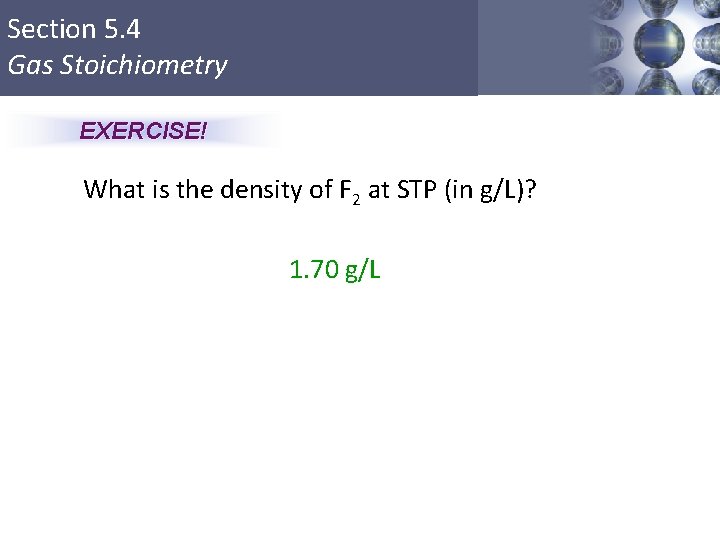
Section 5. 4 Gas Stoichiometry EXERCISE! What is the density of F 2 at STP (in g/L)? 1. 70 g/L Copyright © Cengage Learning. All rights reserved 34
Section 5. 5 Dalton’s Law of Partial Pressures AP Learning Objectives, Margin Notes and References § Learning Objectives § § LO 1. 3 The student is able to select and apply mathematical relationships to mass data in order to justify a claim regarding the identify and/or estimated purity of a substance. LO 2. 6 The student can apply mathematical relationships or estimation to determine macroscopic variables for ideal gases.
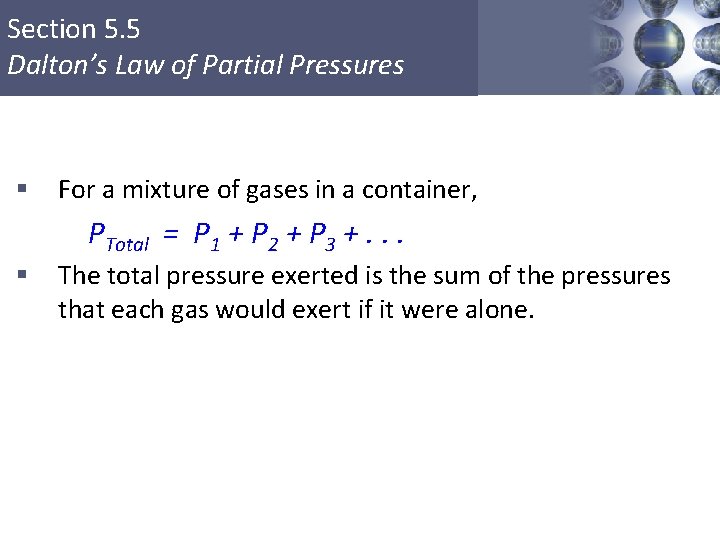
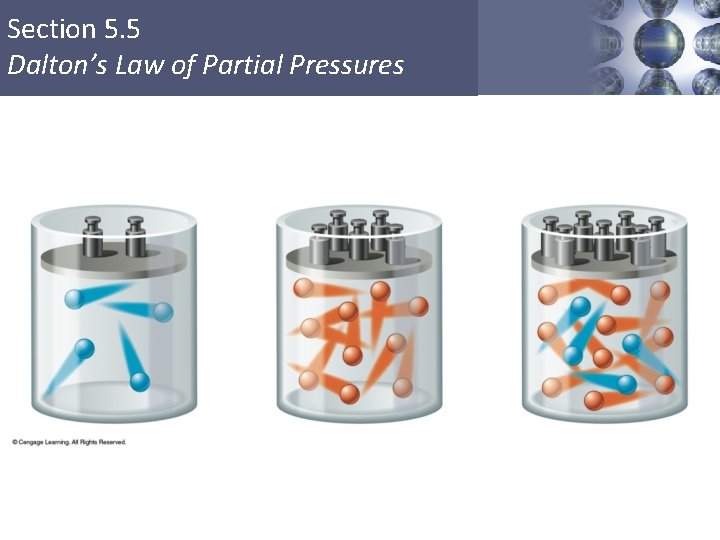
Section 5. 5 Dalton’s Law of Partial Pressures § For a mixture of gases in a container, PTotal = P 1 + P 2 + P 3 +. . . § The total pressure exerted is the sum of the pressures that each gas would exert if it were alone. Copyright © Cengage Learning. All rights reserved 36
Section 5. 5 Dalton’s Law of Partial Pressures Copyright © Cengage Learning. All rights reserved 37
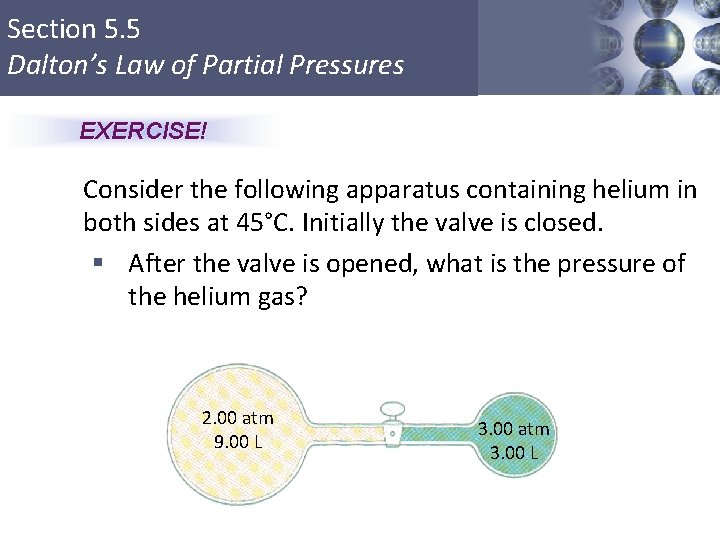
Section 5. 5 Dalton’s Law of Partial Pressures EXERCISE! Consider the following apparatus containing helium in both sides at 45°C. Initially the valve is closed. § After the valve is opened, what is the pressure of the helium gas? 2. 00 atm 9. 00 L Copyright © Cengage Learning. All rights reserved 3. 00 atm 3. 00 L 38
Section 5. 5 Dalton’s Law of Partial Pressures EXERCISE! 27. 4 L of oxygen gas at 25. 0°C and 1. 30 atm, and 8. 50 L of helium gas at 25. 0°C and 2. 00 atm were pumped into a tank with a volume of 5. 81 L at 25°C. § Calculate the new partial pressure of oxygen. 6. 13 atm § Calculate the new partial pressure of helium. 2. 93 atm § Calculate the new total pressure of both gases. 9. 06 atm Copyright © Cengage Learning. All rights reserved 39
Section 5. 6 The Kinetic Molecular Theory of Gases AP Learning Objectives, Margin Notes and References § Learning Objectives § § LO 2. 4 The student is able to use KMT and concepts of intermolecular forces to make predictions about the macroscopic properties of gases, including both ideal and nonideal behavior. LO 5. 2: The student is able to relate temperature to the motions of particles, either via particulate representations, such as drawings of particles with arrows indicating velocities, and/or via representations of average kinetic energy and distribution of kinetic energies of the particles, such as plots of the Maxwell-Boltzmann distribution. § Additional AP References § LO 5. 2 (see Appendix 7. 2, “Thermal Equilibrium, the Kinetic Molecular Theory, and the Process of Heat”)
Section 5. 6 The Kinetic Molecular Theory of Gases § § So far we have considered “what happens, ” but not “why. ” In science, “what” always comes before “why. ” Copyright © Cengage Learning. All rights reserved 41
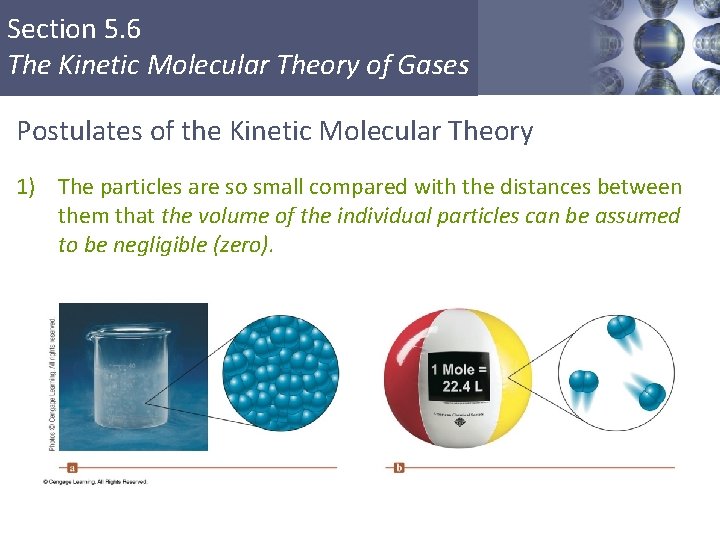
Section 5. 6 The Kinetic Molecular Theory of Gases Postulates of the Kinetic Molecular Theory 1) The particles are so small compared with the distances between them that the volume of the individual particles can be assumed to be negligible (zero). Copyright © Cengage Learning. All rights reserved 42
Section 5. 6 The Kinetic Molecular Theory of Gases Postulates of the Kinetic Molecular Theory 2) The particles are in constant motion. The collisions of the particles with the walls of the container are the cause of the pressure exerted by the gas. Copyright © Cengage Learning. All rights reserved 43
Section 5. 6 The Kinetic Molecular Theory of Gases Postulates of the Kinetic Molecular Theory 3) The particles are assumed to exert no forces on each other; they are assumed neither to attract nor to repel each other. Copyright © Cengage Learning. All rights reserved 44
Section 5. 6 The Kinetic Molecular Theory of Gases Postulates of the Kinetic Molecular Theory 4) The average kinetic energy of a collection of gas particles is assumed to be directly proportional to the Kelvin temperature of the gas. Copyright © Cengage Learning. All rights reserved 45
Section 5. 6 The Kinetic Molecular Theory of Gases Kinetic Molecular Theory To play movie you must be in Slide Show Mode PC Users: Please wait for content to load, then click to play Mac Users: CLICK HERE Copyright © Cengage Learning. All rights reserved 46
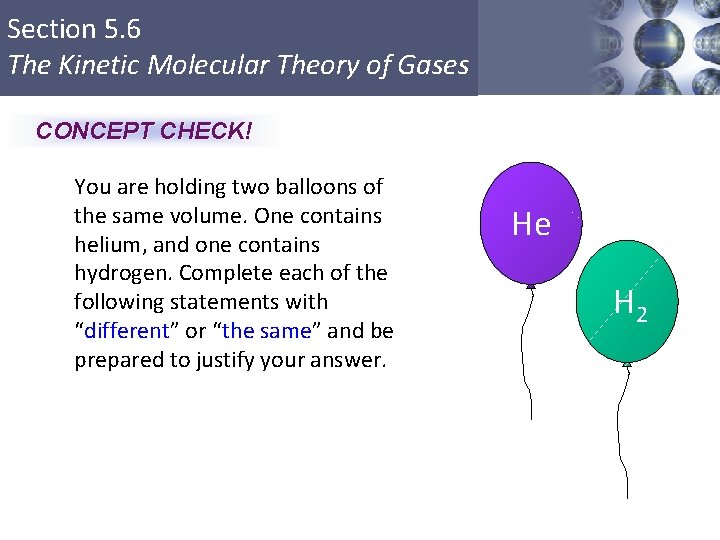
Section 5. 6 The Kinetic Molecular Theory of Gases CONCEPT CHECK! You are holding two balloons of the same volume. One contains helium, and one contains hydrogen. Complete each of the following statements with “different” or “the same” and be prepared to justify your answer. Copyright © Cengage Learning. All rights reserved He H 2 47
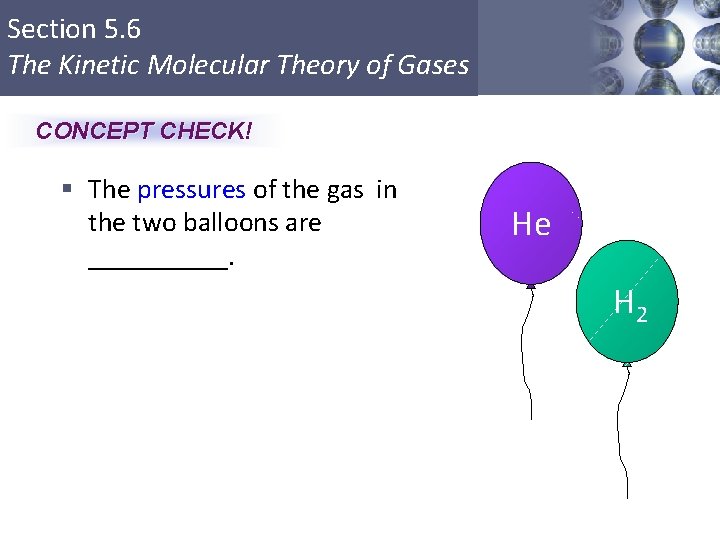
Section 5. 6 The Kinetic Molecular Theory of Gases CONCEPT CHECK! § The pressures of the gas in the two balloons are _____. He H 2 Copyright © Cengage Learning. All rights reserved 48
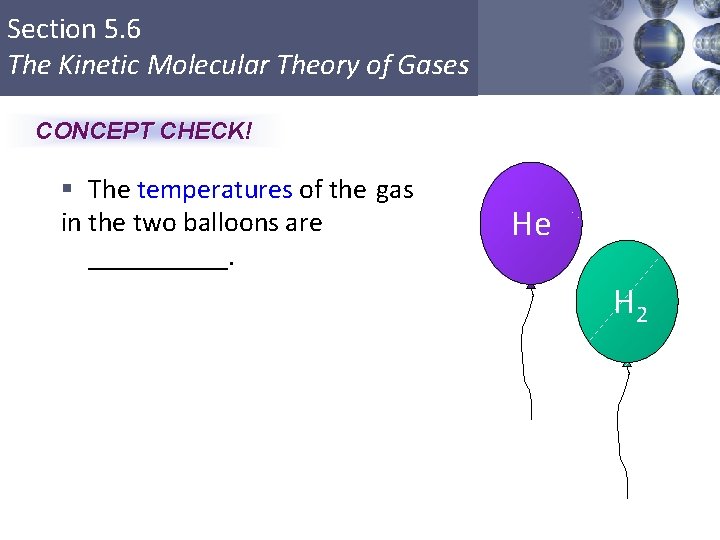
Section 5. 6 The Kinetic Molecular Theory of Gases CONCEPT CHECK! § The temperatures of the gas in the two balloons are _____. He H 2 Copyright © Cengage Learning. All rights reserved 49
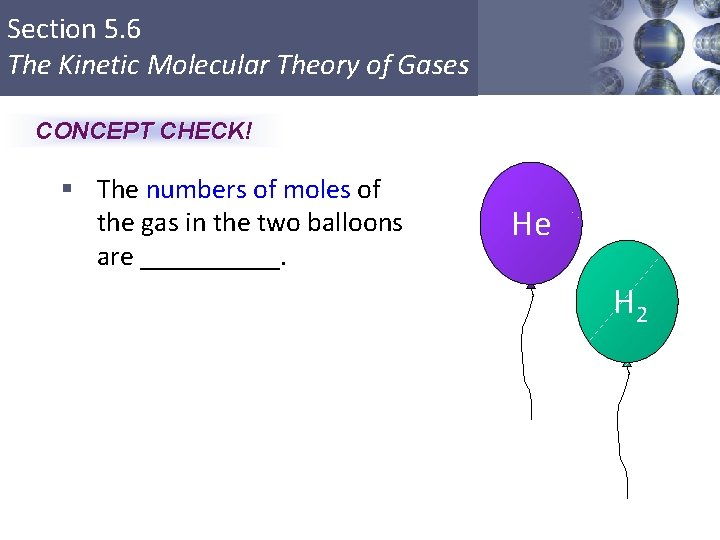
Section 5. 6 The Kinetic Molecular Theory of Gases CONCEPT CHECK! § The numbers of moles of the gas in the two balloons are _____. He H 2 Copyright © Cengage Learning. All rights reserved 50
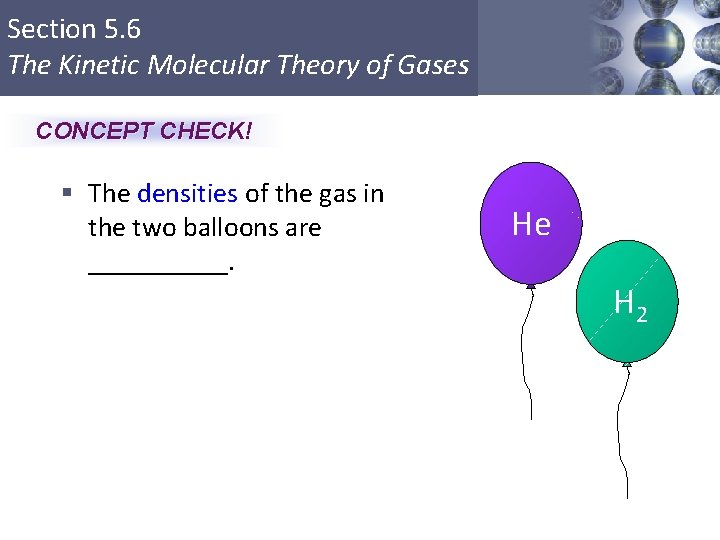
Section 5. 6 The Kinetic Molecular Theory of Gases CONCEPT CHECK! § The densities of the gas in the two balloons are _____. He H 2 Copyright © Cengage Learning. All rights reserved 51
Section 5. 6 The Kinetic Molecular Theory of Gases CONCEPT CHECK! Sketch a graph of: I. Pressure versus volume at constant temperature and moles. Copyright © Cengage Learning. All rights reserved 52
Section 5. 6 The Kinetic Molecular Theory of Gases Molecular View of Boyle’s Law To play movie you must be in Slide Show Mode PC Users: Please wait for content to load, then click to play Mac Users: CLICK HERE Copyright © Cengage Learning. All rights reserved 53
Section 5. 6 The Kinetic Molecular Theory of Gases CONCEPT CHECK! Sketch a graph of: II. Volume vs. temperature (°C) at constant pressure and moles. Copyright © Cengage Learning. All rights reserved 54
Section 5. 6 The Kinetic Molecular Theory of Gases CONCEPT CHECK! Sketch a graph of: III. Volume vs. temperature (K) at constant pressure and moles. Copyright © Cengage Learning. All rights reserved 55
Section 5. 6 The Kinetic Molecular Theory of Gases Molecular View of Charles’s Law To play movie you must be in Slide Show Mode PC Users: Please wait for content to load, then click to play Mac Users: CLICK HERE Copyright © Cengage Learning. All rights reserved 56
Section 5. 6 The Kinetic Molecular Theory of Gases CONCEPT CHECK! Sketch a graph of: IV. Volume vs. moles at constant temperature and pressure. Copyright © Cengage Learning. All rights reserved 57
Section 5. 6 The Kinetic Molecular Theory of Gases Molecular View of the Ideal Gas Law To play movie you must be in Slide Show Mode PC Users: Please wait for content to load, then click to play Mac Users: CLICK HERE Copyright © Cengage Learning. All rights reserved 58
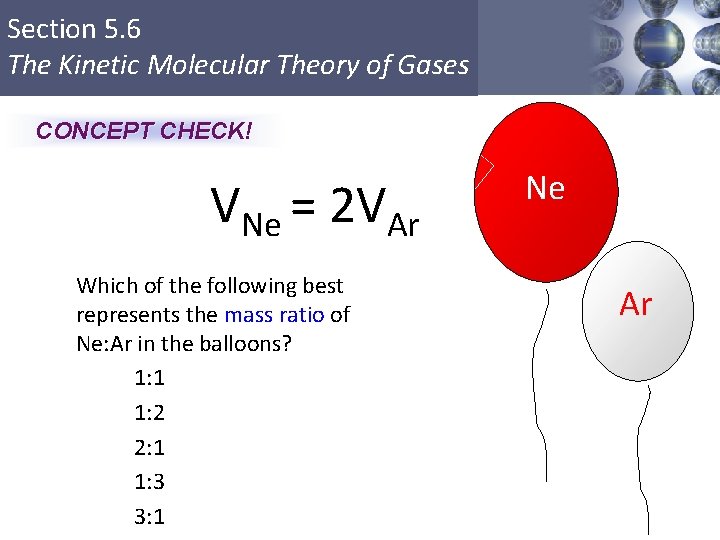
Section 5. 6 The Kinetic Molecular Theory of Gases CONCEPT CHECK! VNe = 2 VAr Which of the following best represents the mass ratio of Ne: Ar in the balloons? 1: 1 1: 2 2: 1 1: 3 3: 1 Copyright © Cengage Learning. All rights reserved Ne Ar 59
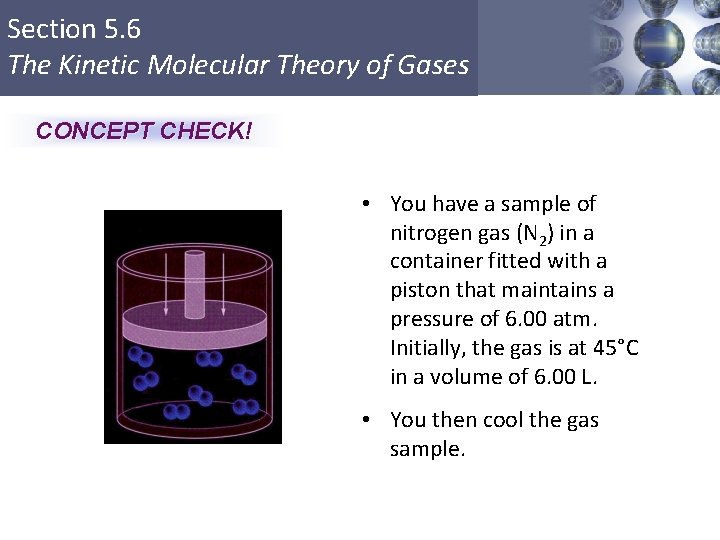
Section 5. 6 The Kinetic Molecular Theory of Gases CONCEPT CHECK! • You have a sample of nitrogen gas (N 2) in a container fitted with a piston that maintains a pressure of 6. 00 atm. Initially, the gas is at 45°C in a volume of 6. 00 L. • You then cool the gas sample. Copyright © Cengage Learning. All rights reserved 60
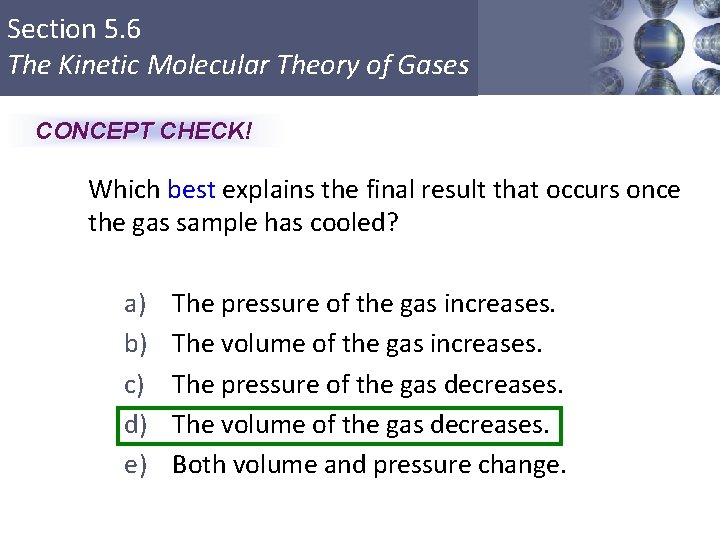
Section 5. 6 The Kinetic Molecular Theory of Gases CONCEPT CHECK! Which best explains the final result that occurs once the gas sample has cooled? a) b) c) d) e) The pressure of the gas increases. The volume of the gas increases. The pressure of the gas decreases. The volume of the gas decreases. Both volume and pressure change. Copyright © Cengage Learning. All rights reserved 61
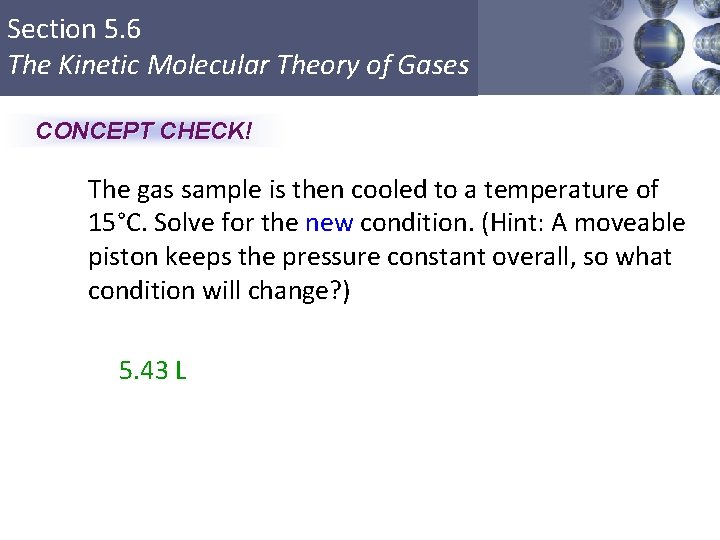
Section 5. 6 The Kinetic Molecular Theory of Gases CONCEPT CHECK! The gas sample is then cooled to a temperature of 15°C. Solve for the new condition. (Hint: A moveable piston keeps the pressure constant overall, so what condition will change? ) 5. 43 L Copyright © Cengage Learning. All rights reserved 62
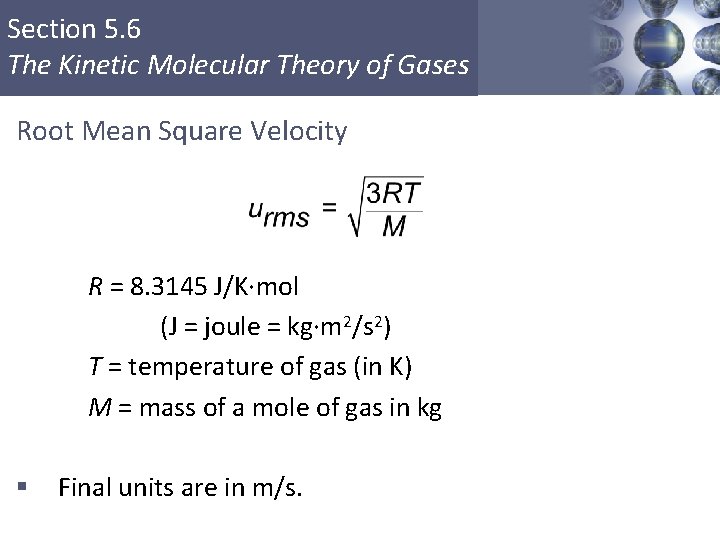
Section 5. 6 The Kinetic Molecular Theory of Gases Root Mean Square Velocity R = 8. 3145 J/K·mol (J = joule = kg·m 2/s 2) T = temperature of gas (in K) M = mass of a mole of gas in kg § Final units are in m/s. Copyright © Cengage Learning. All rights reserved 63
Section 5. 7 Effusion and Diffusion AP Learning Objectives, Margin Notes and References § Learning Objectives § LO 1. 3 The student is able to select and apply mathematical relationships to mass data in order to justify a claim regarding the identify and/or estimated purity of a substance.
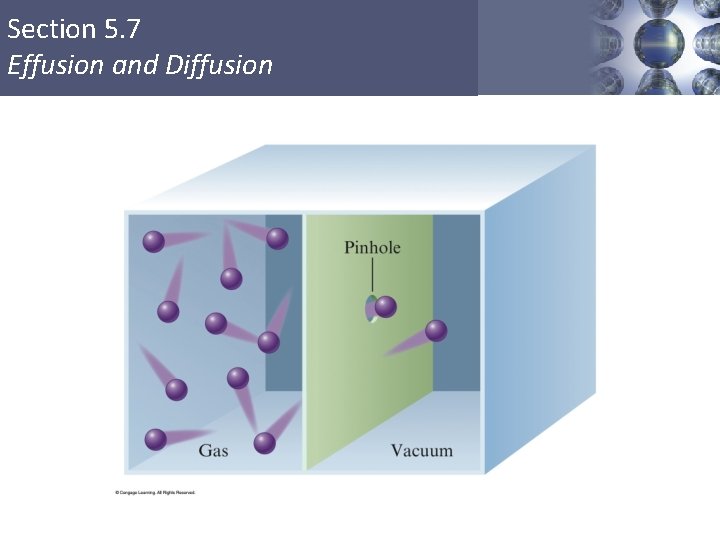
Section 5. 7 Effusion and Diffusion § § § Diffusion – the mixing of gases. Effusion – describes the passage of a gas through a tiny orifice into an evacuated chamber. Rate of effusion measures the speed at which the gas is transferred into the chamber. Copyright © Cengage Learning. All rights reserved 65

Section 5. 7 Effusion and Diffusion Effusion To play movie you must be in Slide Show Mode PC Users: Please wait for content to load, then click to play Mac Users: CLICK HERE Copyright © Cengage Learning. All rights reserved 66

Section 5. 7 Effusion and Diffusion To play movie you must be in Slide Show Mode PC Users: Please wait for content to load, then click to play Mac Users: CLICK HERE Copyright © Cengage Learning. All rights reserved 67
Section 5. 7 Effusion and Diffusion Copyright © Cengage Learning. All rights reserved 68
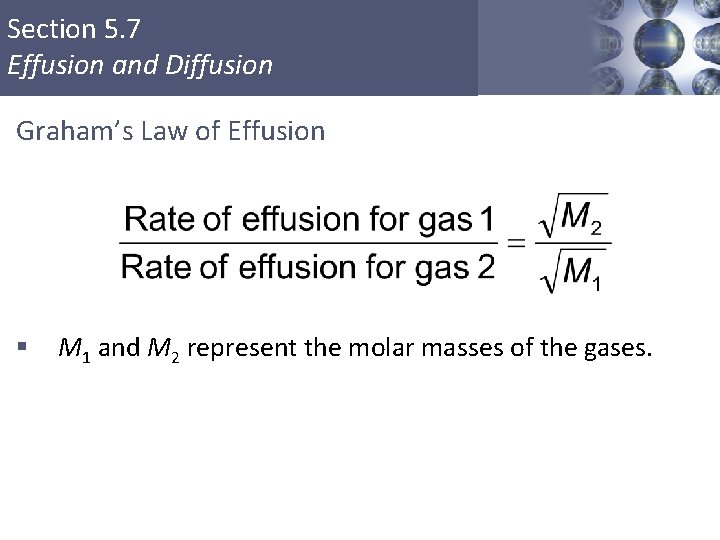
Section 5. 7 Effusion and Diffusion Graham’s Law of Effusion § M 1 and M 2 represent the molar masses of the gases. Copyright © Cengage Learning. All rights reserved 69
Section 5. 8 Real Gases AP Learning Objectives, Margin Notes and References § Learning Objectives § § LO 2. 12 The student can qualitatively analyze data regarding real gases to identify deviations from ideal behavior and relate these to molecular interactions. LO 2. 15 The student is able to explain observations regarding the solubility of ionic solids and molecules in water and other solvents on the basis of particle views that include intermolecular interactions and entropic effects.
Section 5. 8 Real Gases An ideal gas is a hypothetical concept. No gas exactly follows the ideal gas law. § We must correct for non-ideal gas behavior when: § Pressure of the gas is high. § Temperature is low. § Under these conditions: § Concentration of gas particles is high. § Attractive forces become important. § Copyright © Cengage Learning. All rights reserved 71
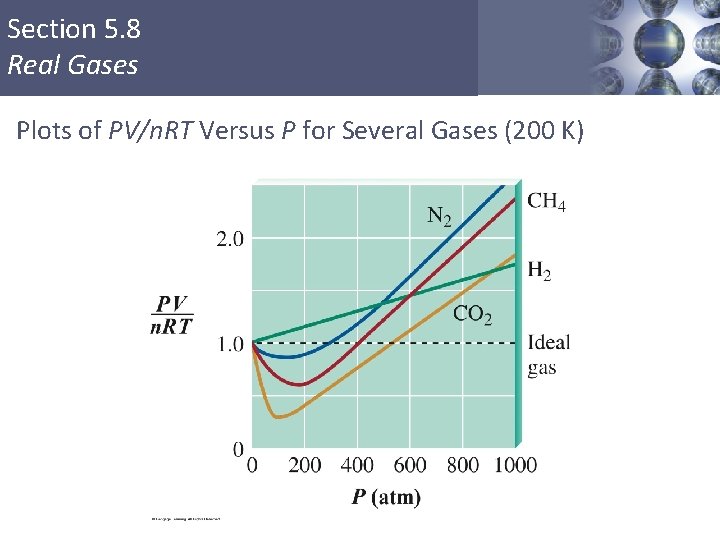
Section 5. 8 Real Gases Plots of PV/n. RT Versus P for Several Gases (200 K) Copyright © Cengage Learning. All rights reserved 72
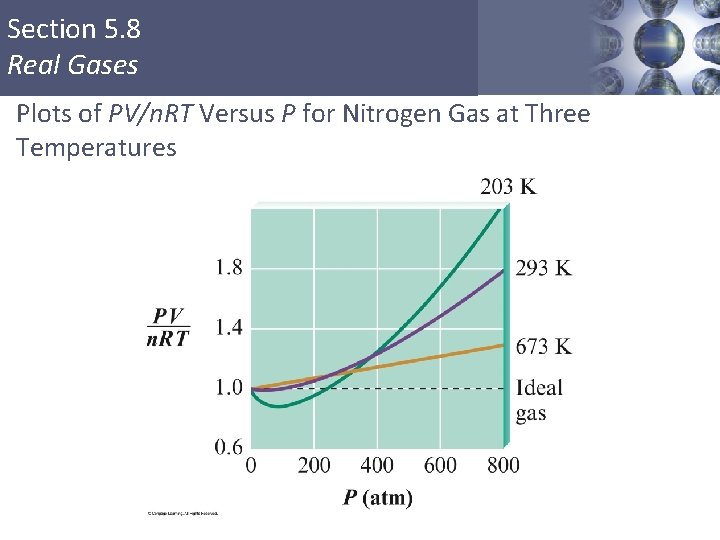
Section 5. 8 Real Gases Plots of PV/n. RT Versus P for Nitrogen Gas at Three Temperatures Copyright © Cengage Learning. All rights reserved 73
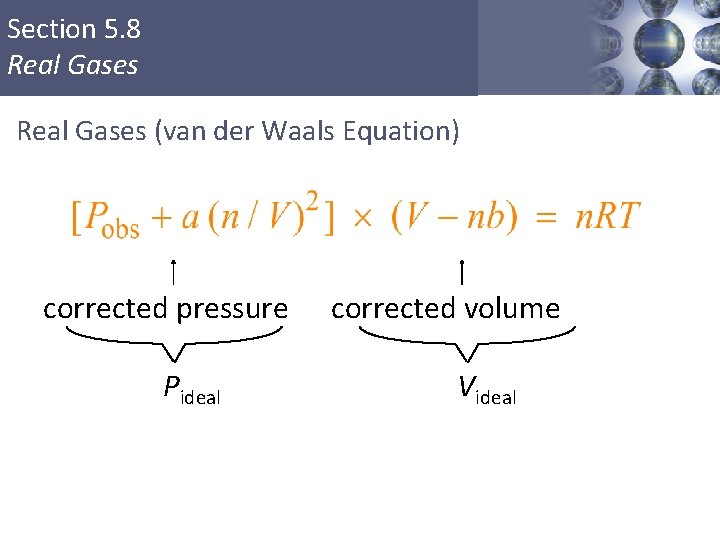
Section 5. 8 Real Gases (van der Waals Equation) corrected pressure Pideal Copyright © Cengage Learning. All rights reserved corrected volume Videal 74
Section 5. 9 Characteristics of Several Real Gases AP Learning Objectives, Margin Notes and References § Learning Objectives § LO 2. 15 The student is able to explain observations regarding the solubility of ionic solids and molecules in water and other solvents on the basis of particle views that include intermolecular interactions and entropic effects.
Section 5. 9 Characteristics of Several Real Gases § For a real gas, the actual observed pressure is lower than the pressure expected for an ideal gas due to the intermolecular attractions that occur in real gases. Copyright © Cengage Learning. All rights reserved 76
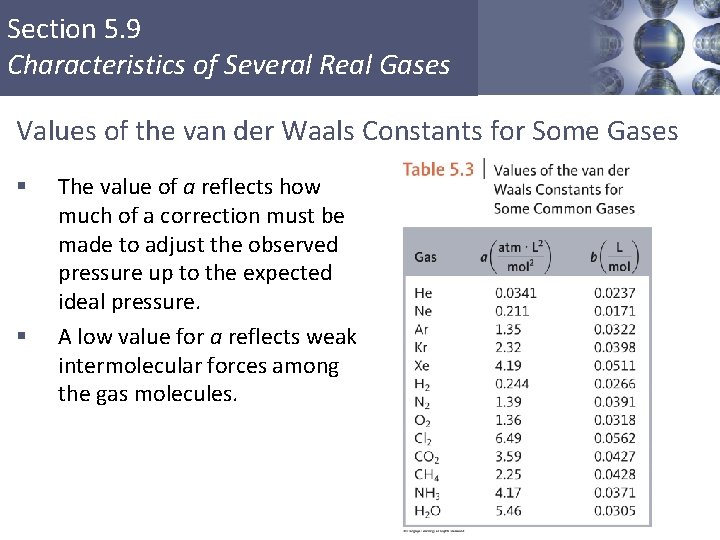
Section 5. 9 Characteristics of Several Real Gases Values of the van der Waals Constants for Some Gases § § The value of a reflects how much of a correction must be made to adjust the observed pressure up to the expected ideal pressure. A low value for a reflects weak intermolecular forces among the gas molecules. Copyright © Cengage Learning. All rights reserved 77
- Slides: 77