
AP Calculus Mrs Mongold Mean Value Theorem for

- Slides: 22
AP Calculus Mrs. Mongold
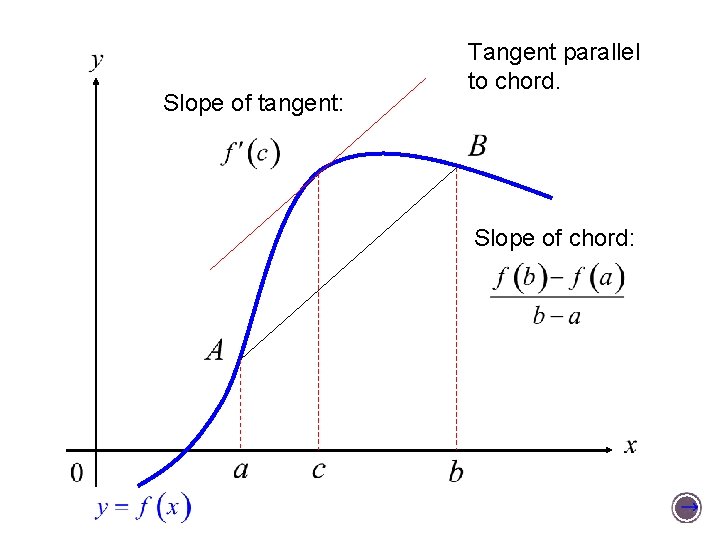
Mean Value Theorem for Derivatives The Mean Value Theorem only applies over a closed interval.
Slope of tangent: Tangent parallel to chord. Slope of chord:
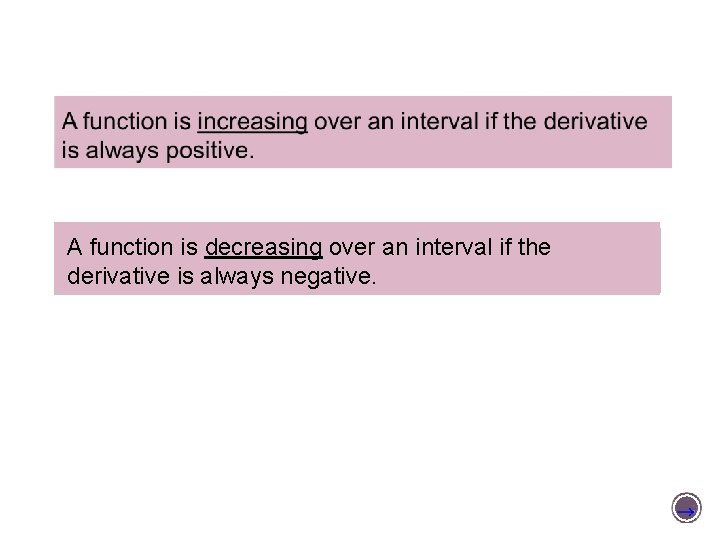
A couple of somewhat obvious definitions: A function is decreasing over an interval if the derivative is always negative.
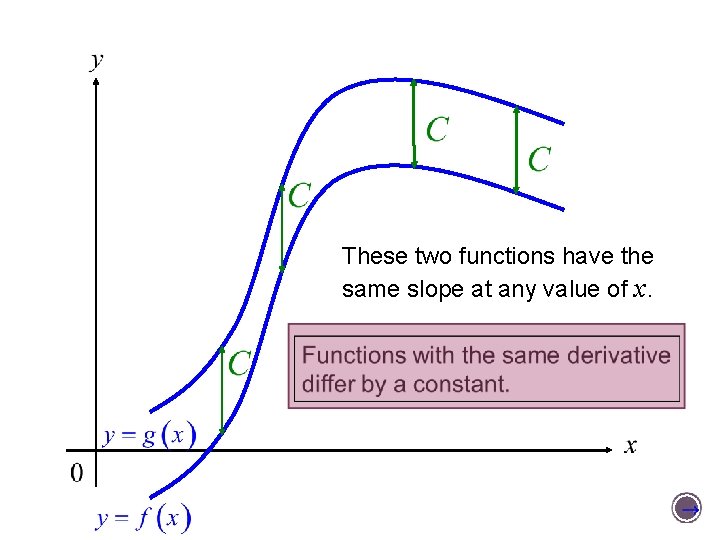
These two functions have the same slope at any value of x.
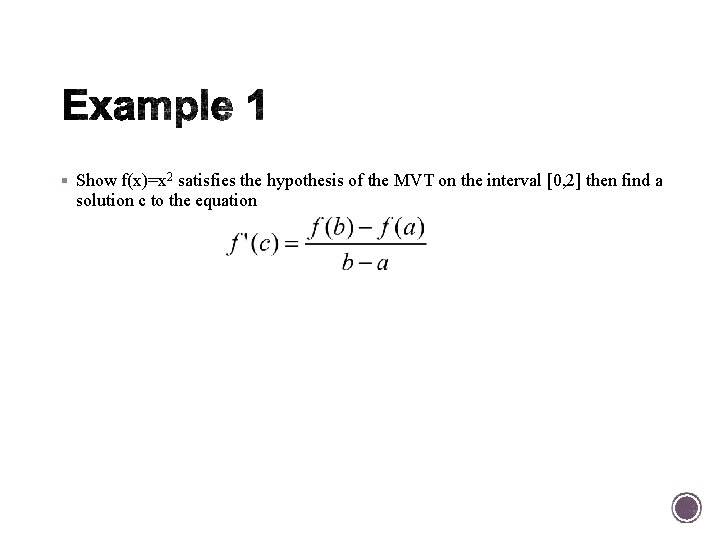
§ Show f(x)=x 2 satisfies the hypothesis of the MVT on the interval [0, 2] then find a solution c to the equation
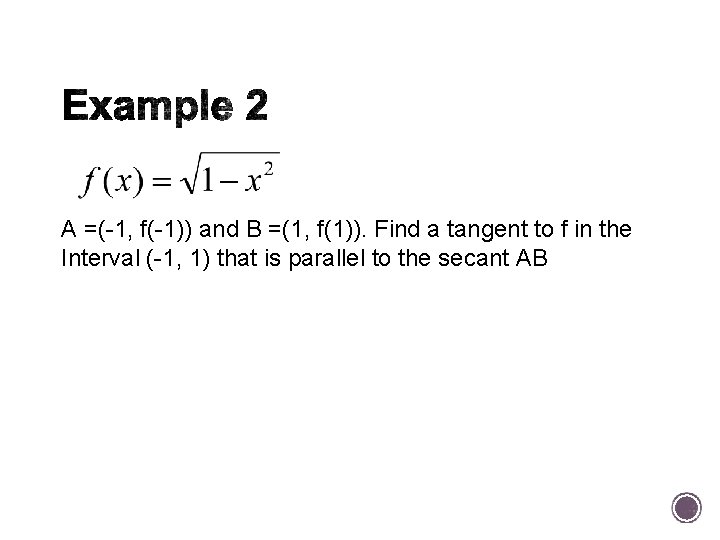
A =(-1, f(-1)) and B =(1, f(1)). Find a tangent to f in the Interval (-1, 1) that is parallel to the secant AB
§ If a car acceleration from zero takes 8 seconds to go 352 feet, its avg. velocity for the 8 sec. Interval is 352/8= 44 ft/sec or 30 mph. At some point during the acceleration the thm says, the speedometer must read exactly 30 mph
§ F is increasing on I if x, x 1 < x 2 then f(x 1) < f(x 2) § F is decreasing on I if x, x 1 < x 2 then f(x 1) > f(x 2) § F’>0 the f is increasing § F’<0 then f is decreasing
§ Determine where y =x 2 rises and falls
§ Where is f(x) = x 3 – 4 x increases and decreases
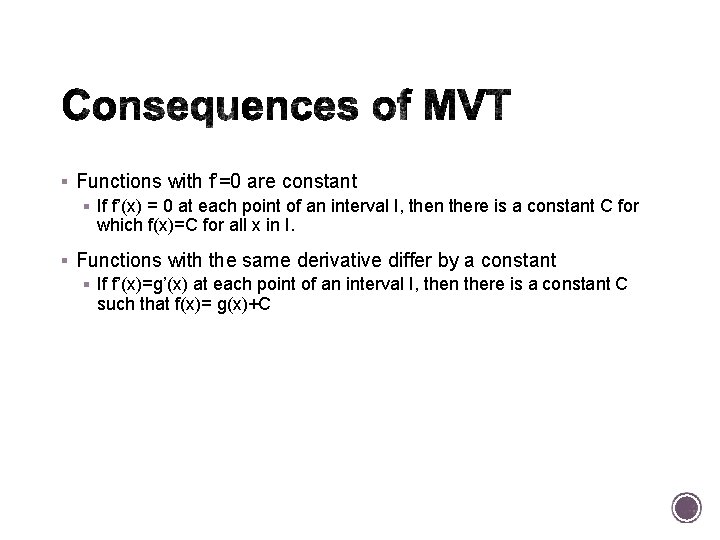
§ Functions with f’=0 are constant § If f’(x) = 0 at each point of an interval I, then there is a constant C for which f(x)=C for all x in I. § Functions with the same derivative differ by a constant § If f’(x)=g’(x) at each point of an interval I, then there is a constant C such that f(x)= g(x)+C
§ For a differentiable function, the derivative is 0 at the point where f changes direction. Thus, we expect there to be a point c where the tangent is horizontal. These ideas are precisely stated by Rolle's Theorem: § Rolle's Theorem § Let f be differentiable on (a b) and continuous on [a b]. If f(a)=f(b)=0, then there is at least one point c in (a b) for which f (c)=0. § Notice that both conditions on f are necessary. Without either one, the statement is false! § For a discontinuous function, the conclusion of Rolle's Theorem may not hold: For a continuous, non-differentiable function, again this might not be the case:
§ Probably will not say Mean Value Theorem the word “average” will probably be used to indirectly imply that the use of MVT is what they are looking for.
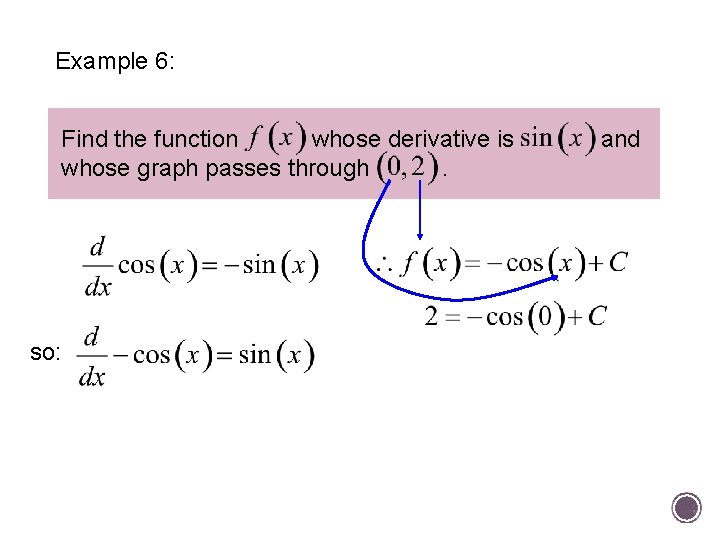
Example 6: Find the function whose derivative is whose graph passes through. and so: could be or could vary by some constant .
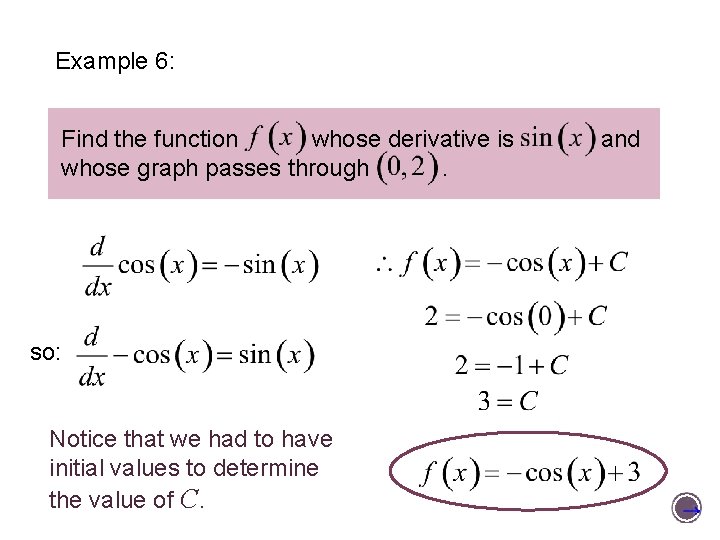
Example 6: Find the function whose derivative is whose graph passes through. so: Notice that we had to have initial values to determine the value of C. and
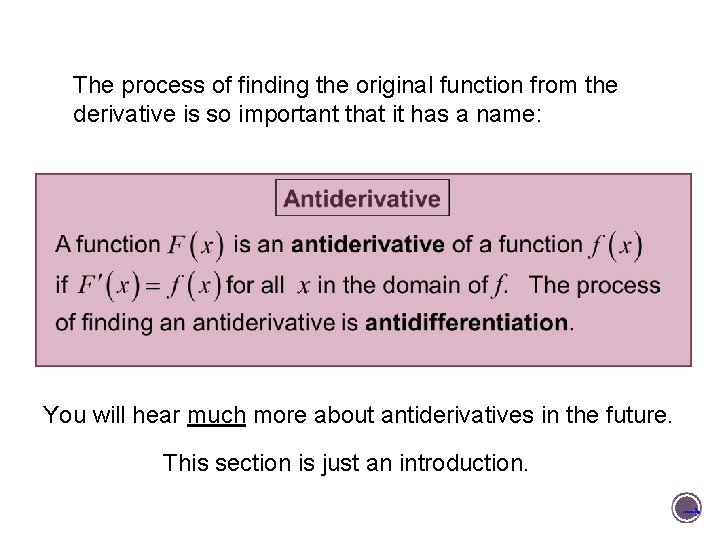
The process of finding the original function from the derivative is so important that it has a name: You will hear much more about antiderivatives in the future. This section is just an introduction.
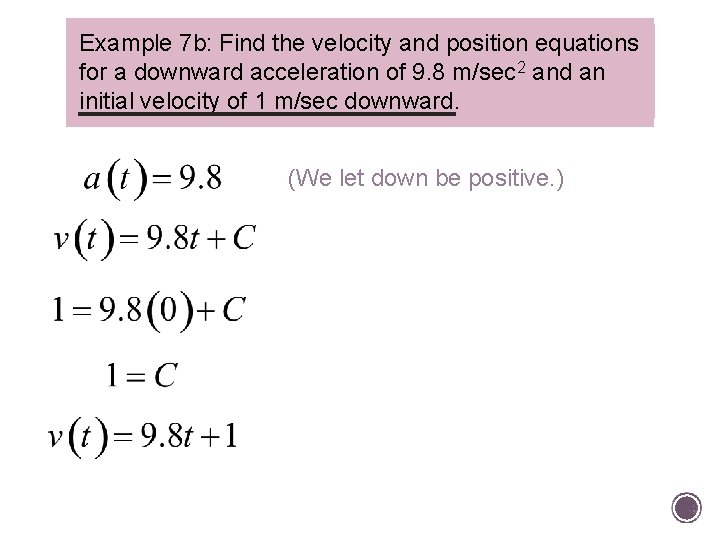
Example 7 b: Find the velocity and position equations for a downward acceleration of 9. 8 m/sec 2 and an initial velocity of 1 m/sec downward. (We let down be positive. ) Since acceleration is the derivative of velocity, velocity must be the antiderivative of acceleration.
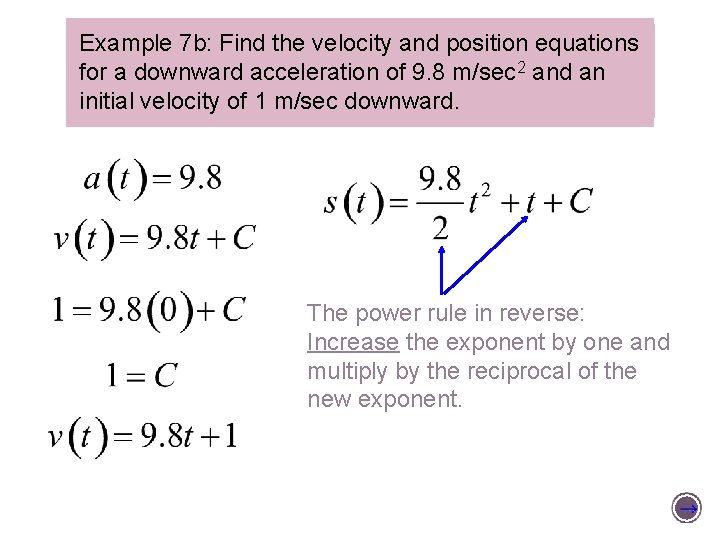
Example 7 b: Find the velocity and position equations for a downward acceleration of 9. 8 m/sec 2 and an initial velocity of 1 m/sec downward. The power rule in reverse: Increase the exponent by one and multiply by the reciprocal of the new exponent. Since velocity is the derivative of position, position must be the antiderivative of velocity.
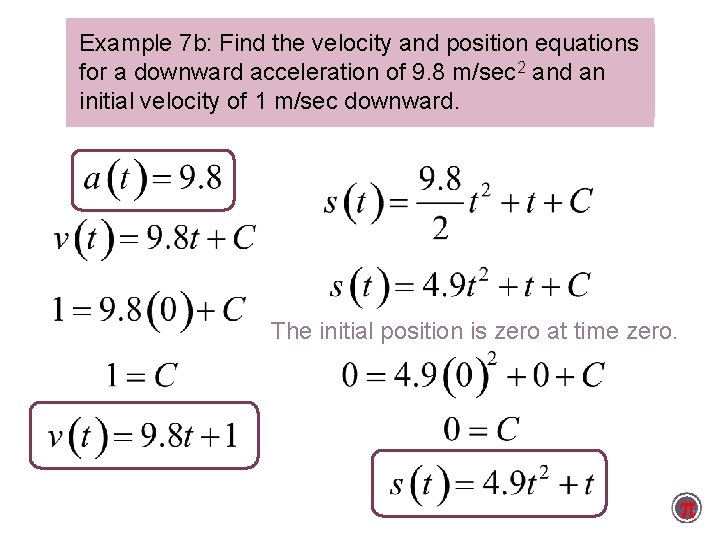
Example 7 b: Find the velocity and position equations for a downward acceleration of 9. 8 m/sec 2 and an initial velocity of 1 m/sec downward. The initial position is zero at time zero. p
§ Page 192 -193/20 -44 even and 45 -49 all