
AP Calculus AB 5 2 Mean Value Theorem
AP Calculus AB 5. 2 Mean Value Theorem for Derivatives
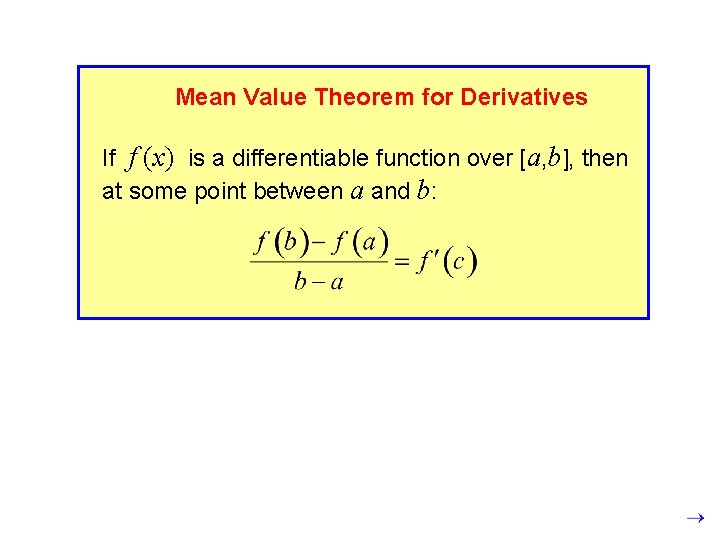
Mean Value Theorem for Derivatives If f (x) is a differentiable function over [a, b], then at some point between a and b:
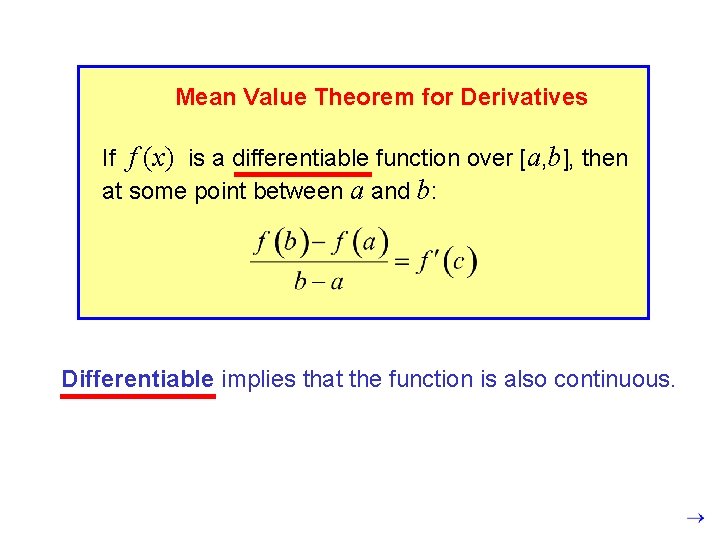
Mean Value Theorem for Derivatives If f (x) is a differentiable function over [a, b], then at some point between a and b: Differentiable implies that the function is also continuous.
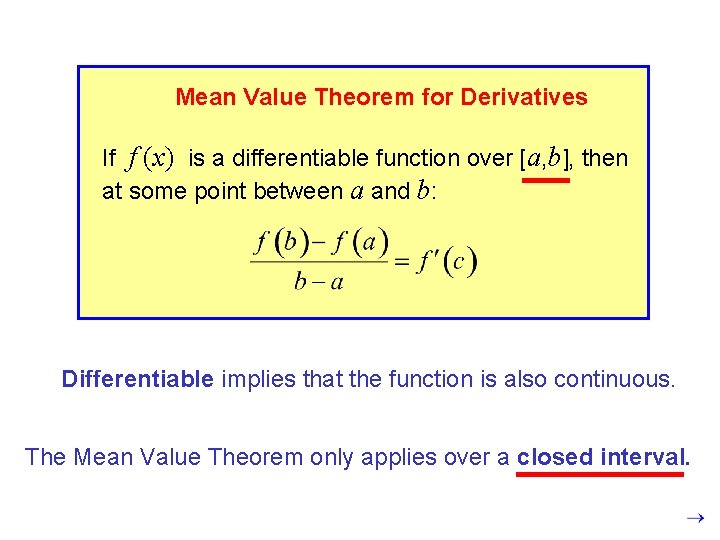
Mean Value Theorem for Derivatives If f (x) is a differentiable function over [a, b], then at some point between a and b: Differentiable implies that the function is also continuous. The Mean Value Theorem only applies over a closed interval.
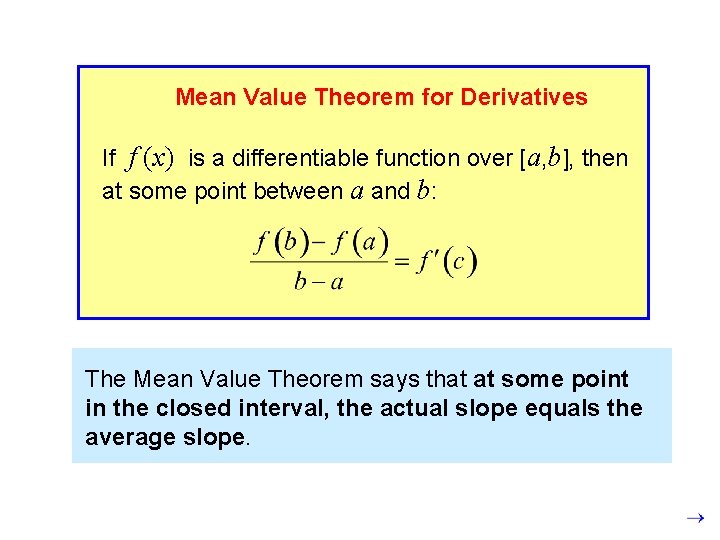
Mean Value Theorem for Derivatives If f (x) is a differentiable function over [a, b], then at some point between a and b: The Mean Value Theorem says that at some point in the closed interval, the actual slope equals the average slope.
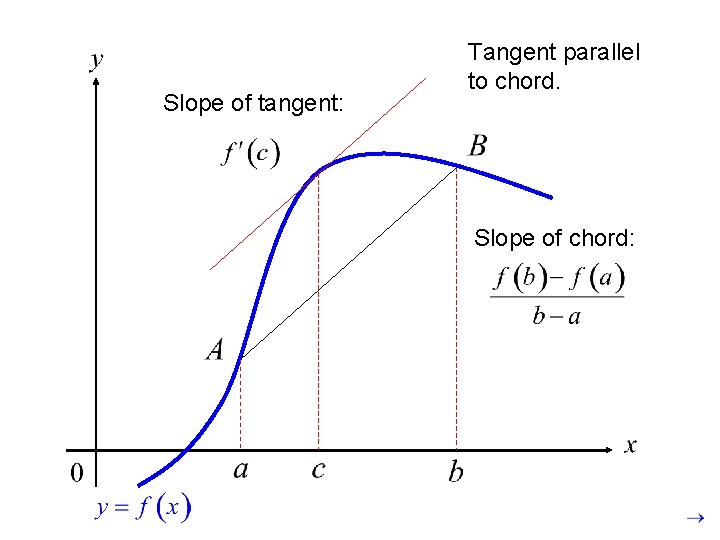
Slope of tangent: Tangent parallel to chord. Slope of chord:
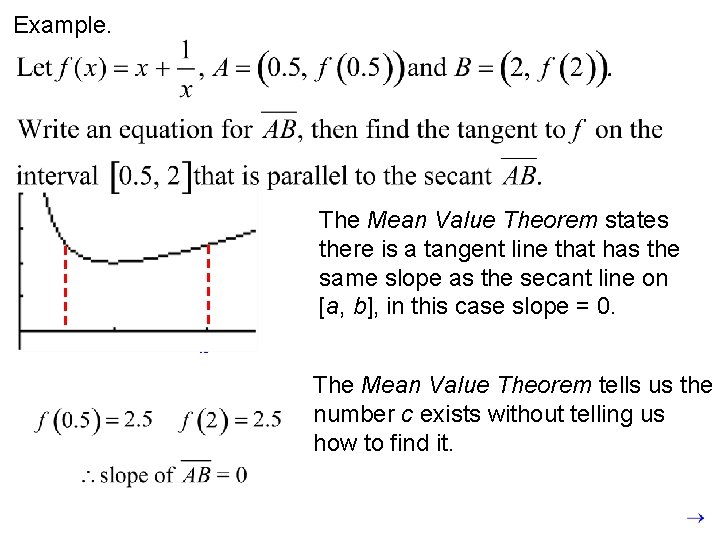
Example. The Mean Value Theorem states there is a tangent line that has the same slope as the secant line on [a, b], in this case slope = 0. a b The Mean Value Theorem tells us the number c exists without telling us how to find it.
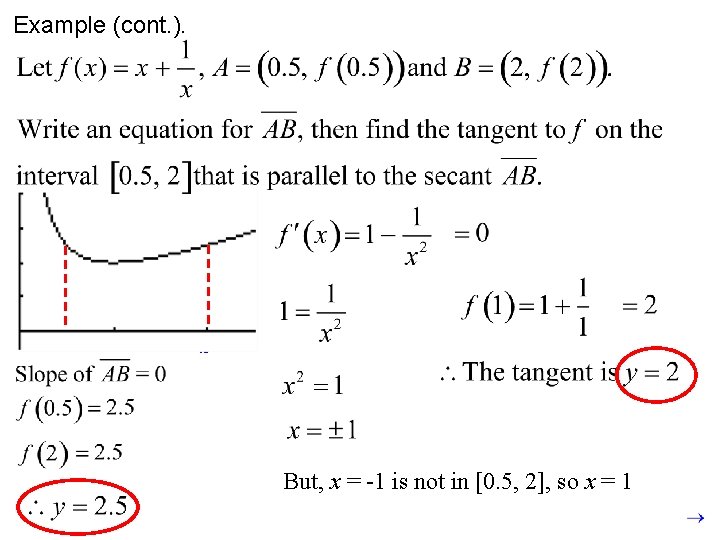
Example (cont. ). a b But, x = -1 is not in [0. 5, 2], so x = 1
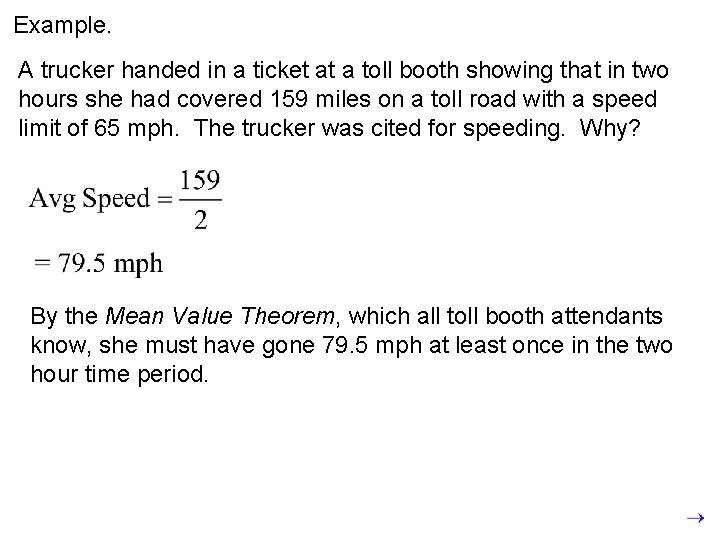
Example. A trucker handed in a ticket at a toll booth showing that in two hours she had covered 159 miles on a toll road with a speed limit of 65 mph. The trucker was cited for speeding. Why? By the Mean Value Theorem, which all toll booth attendants know, she must have gone 79. 5 mph at least once in the two hour time period.
A couple of somewhat obvious definitions: A function is increasing over an interval if the derivative is always positive. A function is decreasing over an interval if the derivative is always negative.
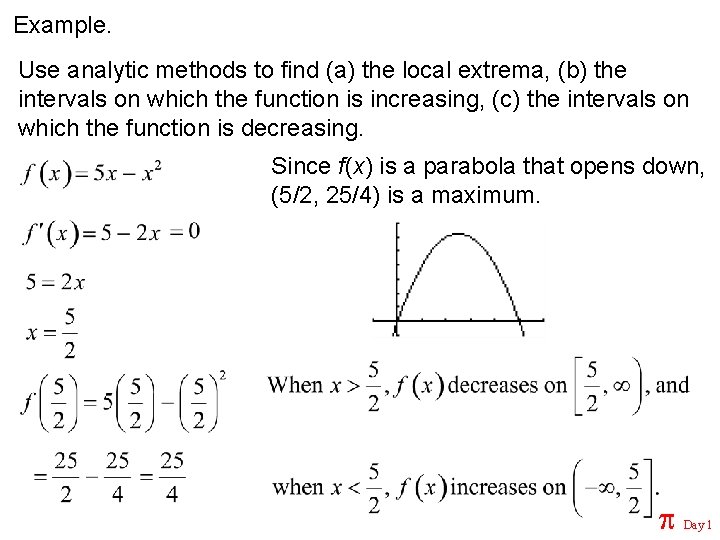
Example. Use analytic methods to find (a) the local extrema, (b) the intervals on which the function is increasing, (c) the intervals on which the function is decreasing. Since f(x) is a parabola that opens down, (5/2, 25/4) is a maximum. p Day 1
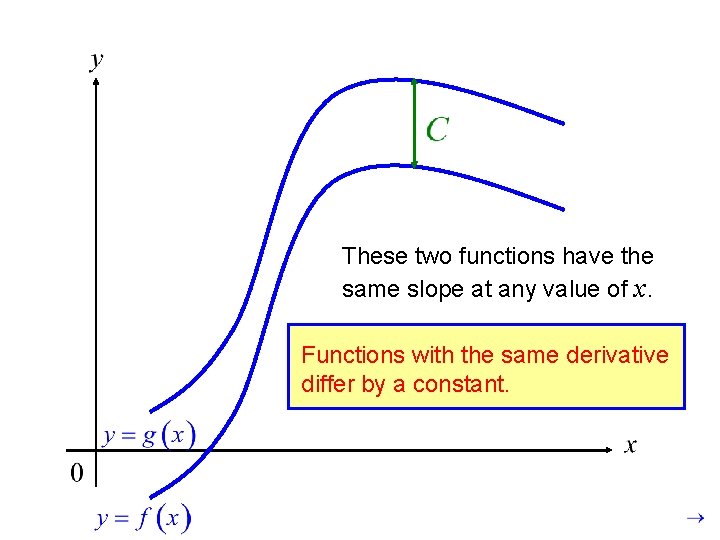
These two functions have the same slope at any value of x. Functions with the same derivative differ by a constant.
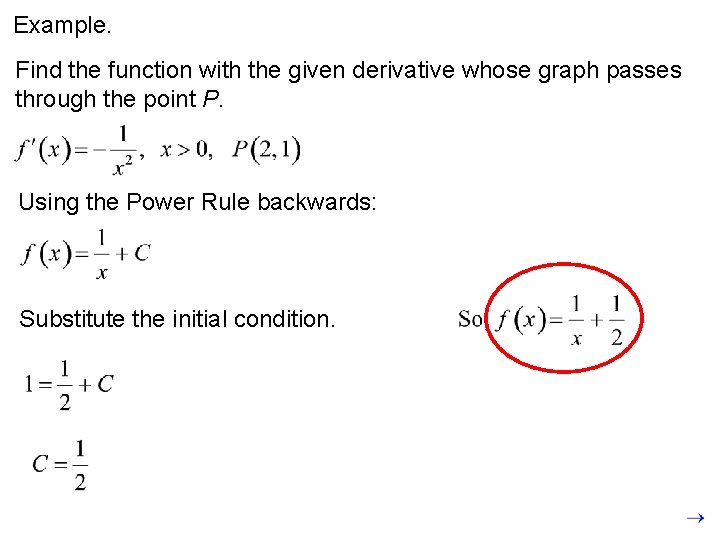
Example. Find the function with the given derivative whose graph passes through the point P. Using the Power Rule backwards: Substitute the initial condition.
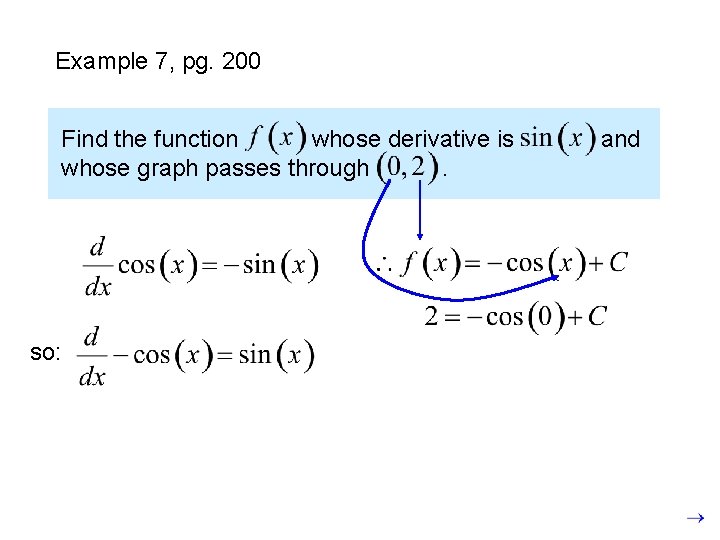
Example 7, pg. 200 Find the function whose derivative is whose graph passes through. and so: could be or could vary by some constant .
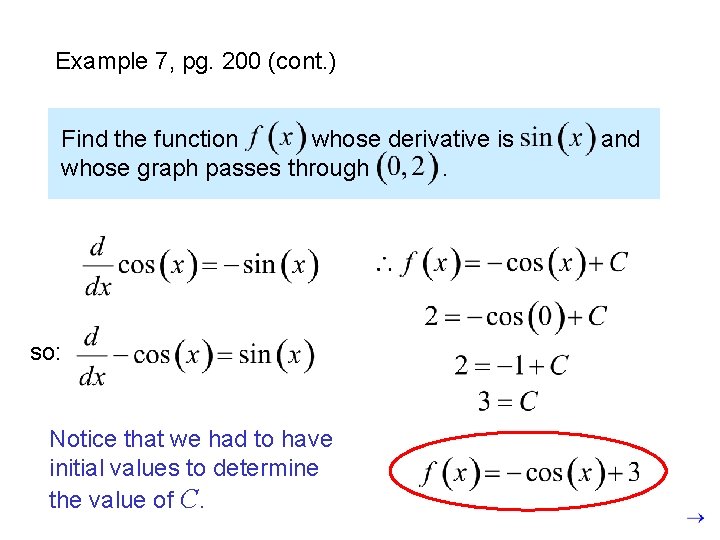
Example 7, pg. 200 (cont. ) Find the function whose derivative is whose graph passes through. so: Notice that we had to have initial values to determine the value of C. and
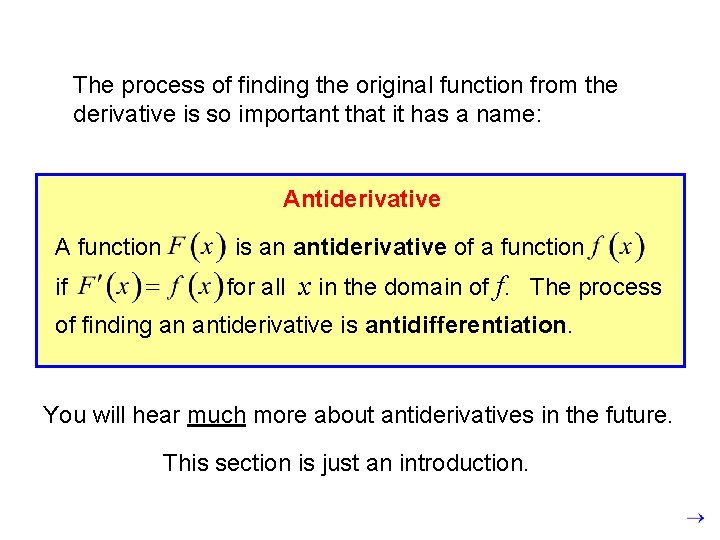
The process of finding the original function from the derivative is so important that it has a name: Antiderivative A function if is an antiderivative of a function for all x in the domain of f. The process of finding an antiderivative is antidifferentiation. You will hear much more about antiderivatives in the future. This section is just an introduction.
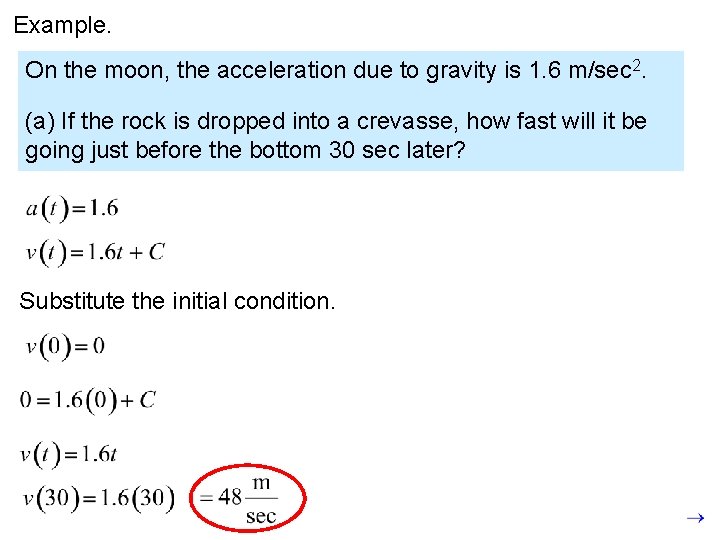
Example. On the moon, the acceleration due to gravity is 1. 6 m/sec 2. (a) If the rock is dropped into a crevasse, how fast will it be going just before the bottom 30 sec later? Substitute the initial condition.
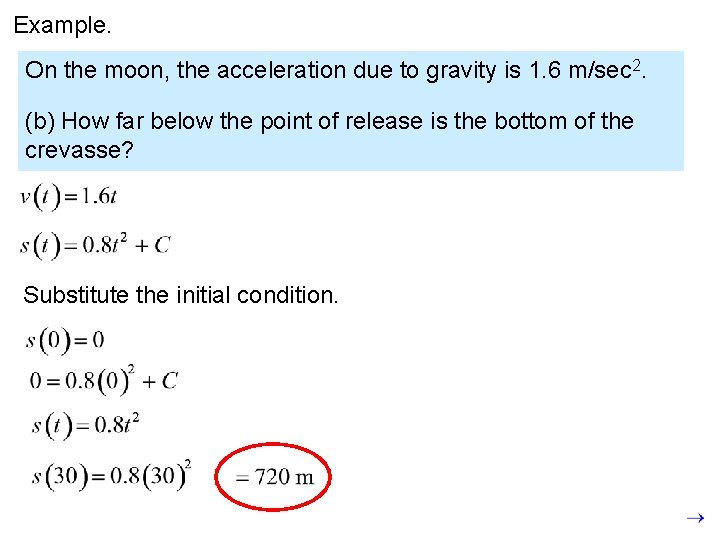
Example. On the moon, the acceleration due to gravity is 1. 6 m/sec 2. (b) How far below the point of release is the bottom of the crevasse? Substitute the initial condition.
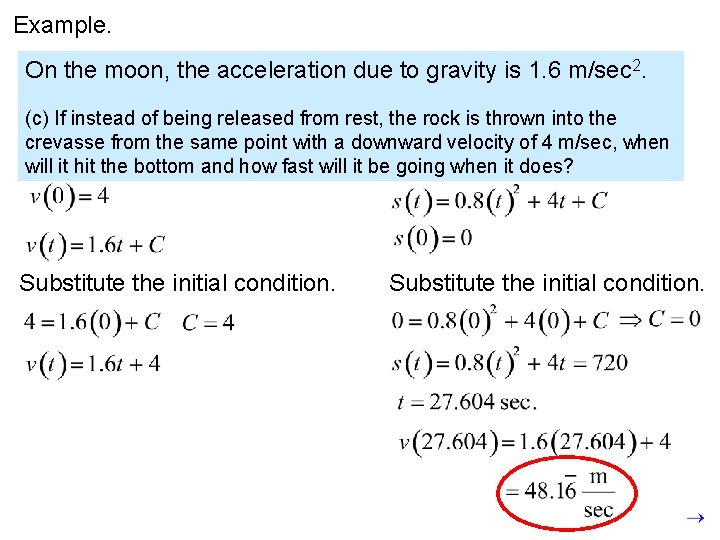
Example. On the moon, the acceleration due to gravity is 1. 6 m/sec 2. (c) If instead of being released from rest, the rock is thrown into the crevasse from the same point with a downward velocity of 4 m/sec, when will it hit the bottom and how fast will it be going when it does? Substitute the initial condition.
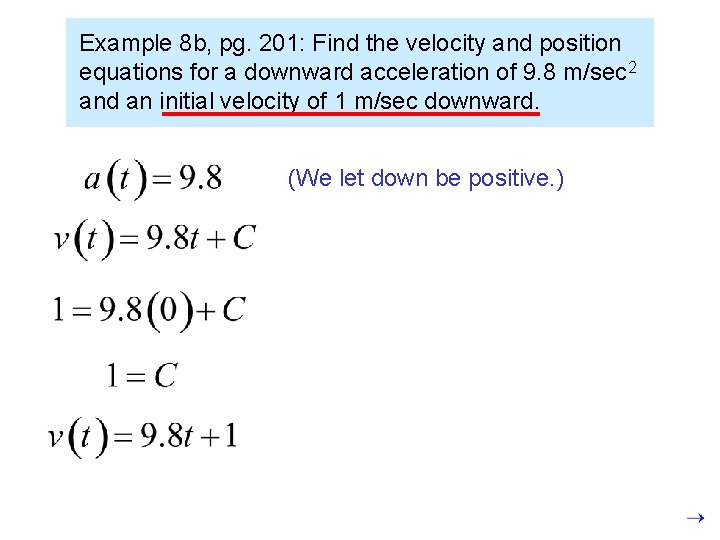
Example 8 b, pg. 201: Find the velocity and position equations for a downward acceleration of 9. 8 m/sec 2 and an initial velocity of 1 m/sec downward. (We let down be positive. ) Since acceleration is the derivative of velocity, velocity must be the antiderivative of acceleration.
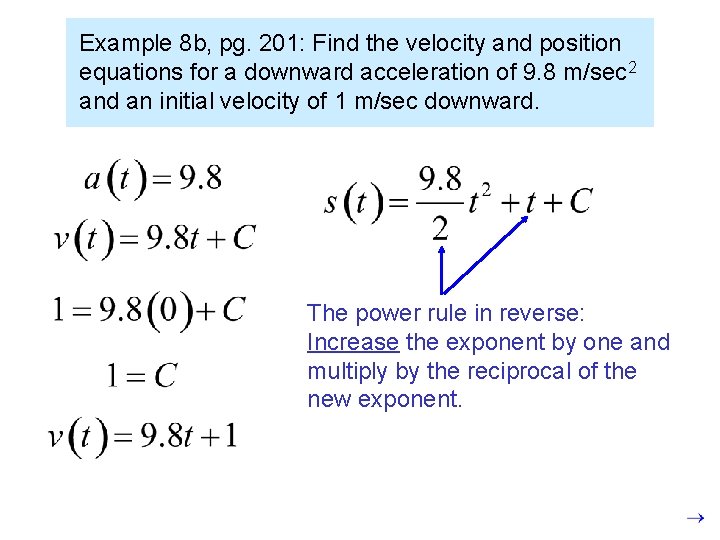
Example 8 b, pg. 201: Find the velocity and position equations for a downward acceleration of 9. 8 m/sec 2 and an initial velocity of 1 m/sec downward. The power rule in reverse: Increase the exponent by one and multiply by the reciprocal of the new exponent. Since velocity is the derivative of position, position must be the antiderivative of velocity.
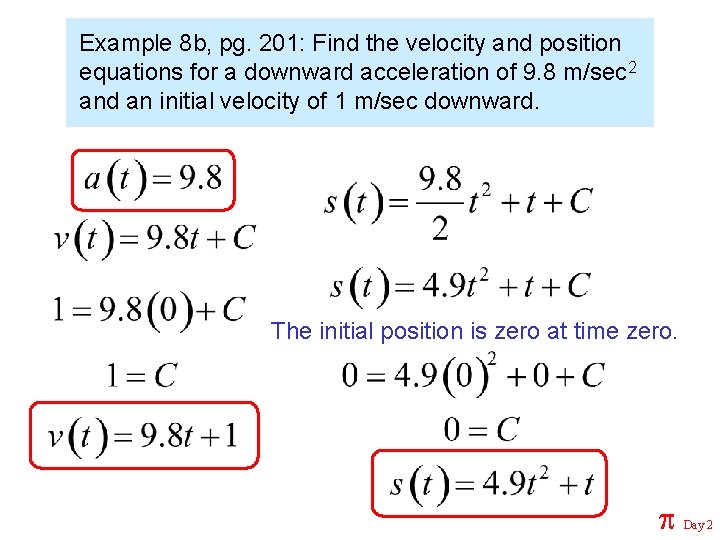
Example 8 b, pg. 201: Find the velocity and position equations for a downward acceleration of 9. 8 m/sec 2 and an initial velocity of 1 m/sec downward. The initial position is zero at time zero. p Day 2
- Slides: 22