
AP Biology Unit 1 How to tackle AP
AP Biology – Unit 1 How to tackle AP Exam Questions
Do Now • What are some strategies you use to answer multiple choice questions?
Overview • Today, we’ll be answering and analyzing real AP biology multiple choice exam questions on Unit 1 (Ch. 1 -3) – I will walk us through questions 1 -3. – We will complete questions 4 -8 as a class in groups. – You will complete questions 9 -15 independently using the strategies learned today.
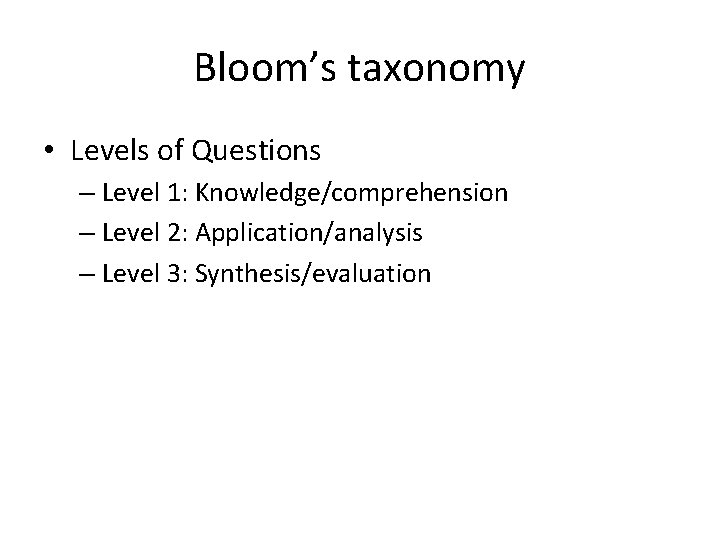
Bloom’s taxonomy • Levels of Questions – Level 1: Knowledge/comprehension – Level 2: Application/analysis – Level 3: Synthesis/evaluation
Let’s start off simple… Prokaryotes are classified as belonging to two different domains. What are the domains? A) Bacteria and Eukarya B) Archaea and Monera C) Bacteria and Protista D) Bacteria and Archaea Bloom's Taxonomy: Knowledge/Comprehension Section: 1. 2
Let’s start off simple… Prokaryotes are classified as belonging to two different domains. What are the domains? A) Bacteria and Eukarya B) Archaea and Monera C) Bacteria and Protista D) Bacteria and Archaea Bloom's Taxonomy: Knowledge/Comprehension Section: 1. 2
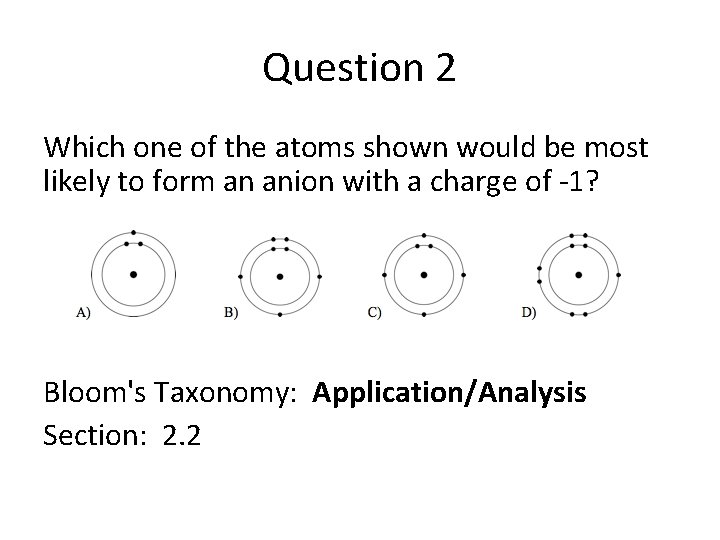
Question 2 Which one of the atoms shown would be most likely to form an anion with a charge of -1? Bloom's Taxonomy: Application/Analysis Section: 2. 2
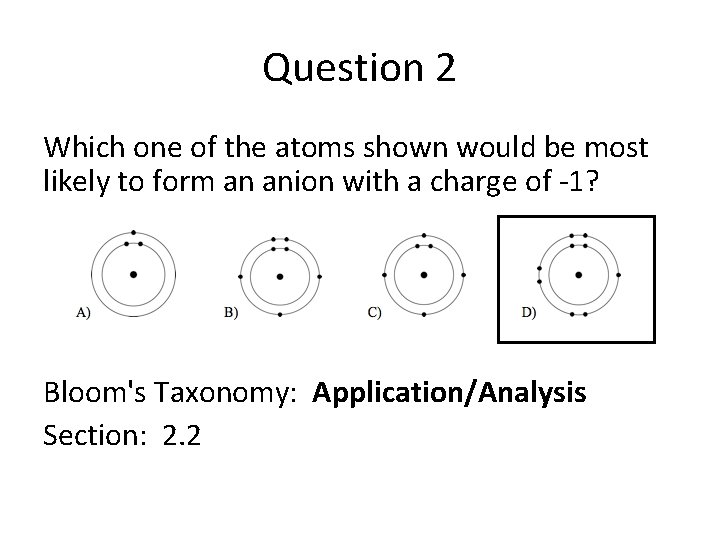
Question 2 Which one of the atoms shown would be most likely to form an anion with a charge of -1? Bloom's Taxonomy: Application/Analysis Section: 2. 2
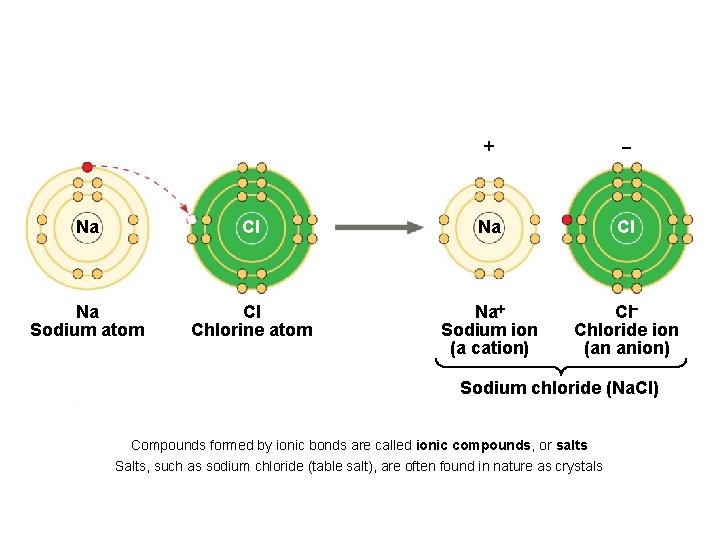
+ - Na Cl Na Sodium atom Cl Chlorine atom Na+ Sodium ion (a cation) Cl. Chloride ion (an anion) Sodium chloride (Na. Cl) Compounds formed by ionic bonds are called ionic compounds, or salts Salts, such as sodium chloride (table salt), are often found in nature as crystals
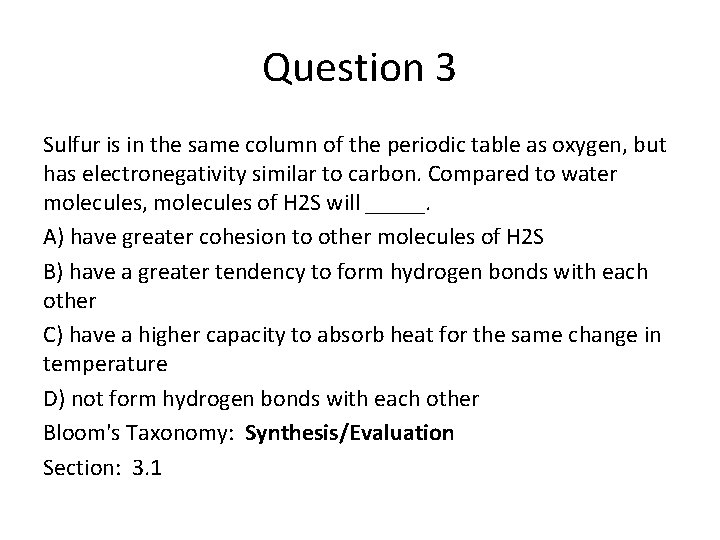
Question 3 Sulfur is in the same column of the periodic table as oxygen, but has electronegativity similar to carbon. Compared to water molecules, molecules of H 2 S will _____. A) have greater cohesion to other molecules of H 2 S B) have a greater tendency to form hydrogen bonds with each other C) have a higher capacity to absorb heat for the same change in temperature D) not form hydrogen bonds with each other Bloom's Taxonomy: Synthesis/Evaluation Section: 3. 1
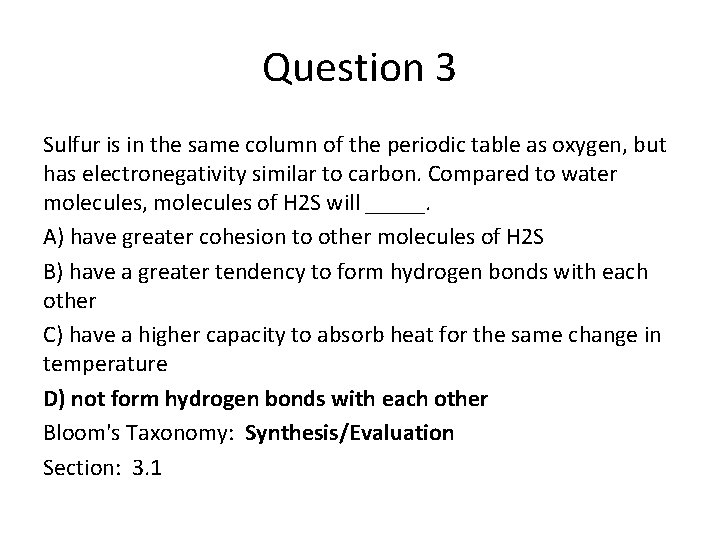
Question 3 Sulfur is in the same column of the periodic table as oxygen, but has electronegativity similar to carbon. Compared to water molecules, molecules of H 2 S will _____. A) have greater cohesion to other molecules of H 2 S B) have a greater tendency to form hydrogen bonds with each other C) have a higher capacity to absorb heat for the same change in temperature D) not form hydrogen bonds with each other Bloom's Taxonomy: Synthesis/Evaluation Section: 3. 1
For the next 5 questions… • Work in your groups to come up with ONE consensus answer • Be prepared to explain your reasoning! (one “volunteer”)
Question 4 A friend of yours calls to say that his car would not start this morning. He asks for your help. You say that you think the battery must be dead. If so, then jump-starting the car from a good battery will solve the problem. In doing so, you are _____. A) testing a theory for why the car will not start B) making observations to inspire a theory for why the car will not start C) stating a hypothesis and using that hypothesis to make a testable prediction D) comparing multiple hypotheses for why the car will not start Bloom's Taxonomy: Application/Analysis Section: 1. 3
Question 4 A friend of yours calls to say that his car would not start this morning. He asks for your help. You say that you think the battery must be dead. If so, then jump-starting the car from a good battery will solve the problem. In doing so, you are _____. A) testing a theory for why the car will not start B) making observations to inspire a theory for why the car will not start C) stating a hypothesis and using that hypothesis to make a testable prediction D) comparing multiple hypotheses for why the car will not start Bloom's Taxonomy: Application/Analysis Section: 1. 3
Question 5 A salamander relies on hydrogen bonding to stick to various surfaces. Therefore, a salamander would have the greatest difficulty clinging to a _____. A) slightly damp surface B) surface of hydrocarbons C) surface of mostly carbon-oxygen bonds D) surface of mostly carbon-nitrogen bonds Bloom's Taxonomy: Synthesis/Evaluation Section: 2. 3
Question 5 A salamander relies on hydrogen bonding to stick to various surfaces. Therefore, a salamander would have the greatest difficulty clinging to a _____. A) slightly damp surface B) surface of hydrocarbons C) surface of mostly carbon-oxygen bonds D) surface of mostly carbon-nitrogen bonds Bloom's Taxonomy: Synthesis/Evaluation Section: 2. 3
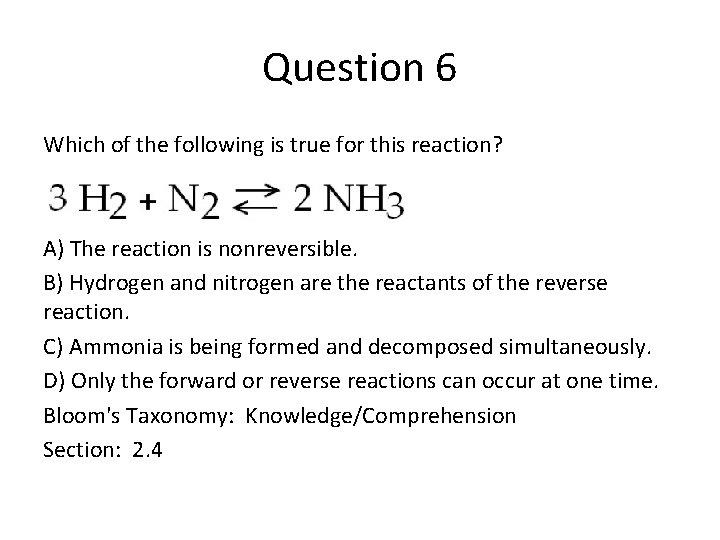
Question 6 Which of the following is true for this reaction? A) The reaction is nonreversible. B) Hydrogen and nitrogen are the reactants of the reverse reaction. C) Ammonia is being formed and decomposed simultaneously. D) Only the forward or reverse reactions can occur at one time. Bloom's Taxonomy: Knowledge/Comprehension Section: 2. 4
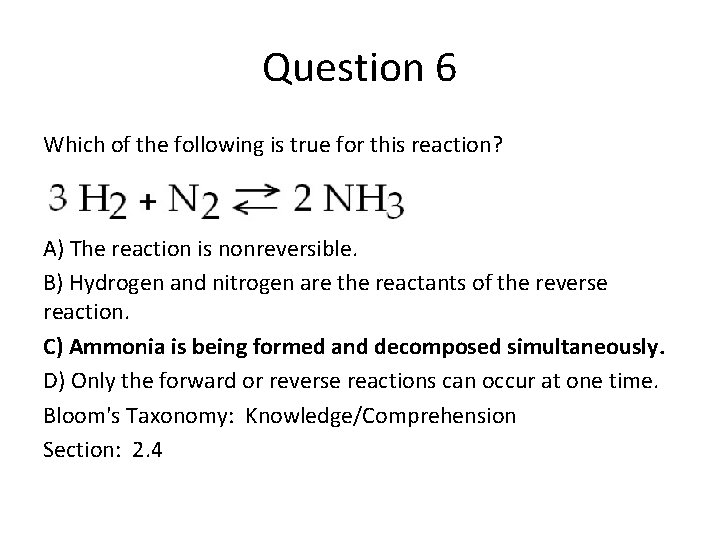
Question 6 Which of the following is true for this reaction? A) The reaction is nonreversible. B) Hydrogen and nitrogen are the reactants of the reverse reaction. C) Ammonia is being formed and decomposed simultaneously. D) Only the forward or reverse reactions can occur at one time. Bloom's Taxonomy: Knowledge/Comprehension Section: 2. 4
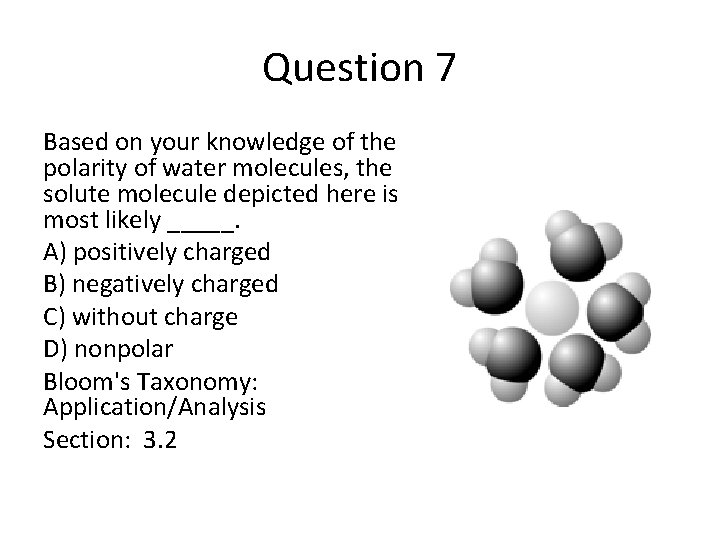
Question 7 Based on your knowledge of the polarity of water molecules, the solute molecule depicted here is most likely _____. A) positively charged B) negatively charged C) without charge D) nonpolar Bloom's Taxonomy: Application/Analysis Section: 3. 2
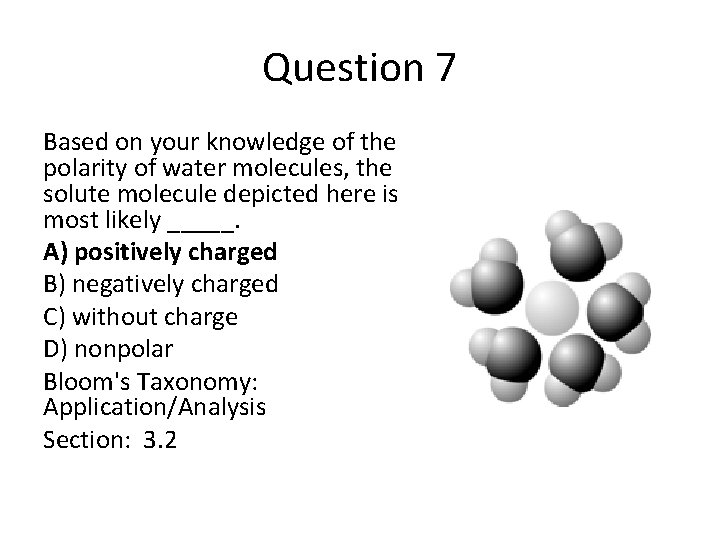
Question 7 Based on your knowledge of the polarity of water molecules, the solute molecule depicted here is most likely _____. A) positively charged B) negatively charged C) without charge D) nonpolar Bloom's Taxonomy: Application/Analysis Section: 3. 2
Question 8 Why does ice float in liquid water? A) The high surface tension of liquid water keeps the ice on top. B) The ionic bonds between the molecules in ice prevent the ice from sinking. C) Stable hydrogen bonds keep water molecules of ice farther apart than water molecules of liquid water. D) The crystalline lattice of ice causes it to be denser than liquid water. Bloom's Taxonomy: Knowledge/Comprehension Section: 3. 2
Question 8 Why does ice float in liquid water? A) The high surface tension of liquid water keeps the ice on top. B) The ionic bonds between the molecules in ice prevent the ice from sinking. C) Stable hydrogen bonds keep water molecules of ice farther apart than water molecules of liquid water. D) The crystalline lattice of ice causes it to be denser than liquid water. Bloom's Taxonomy: Knowledge/Comprehension Section: 3. 2
Questions 9 -15 • Independently complete these questions. Be sure to use the strategies we’ve discussed!
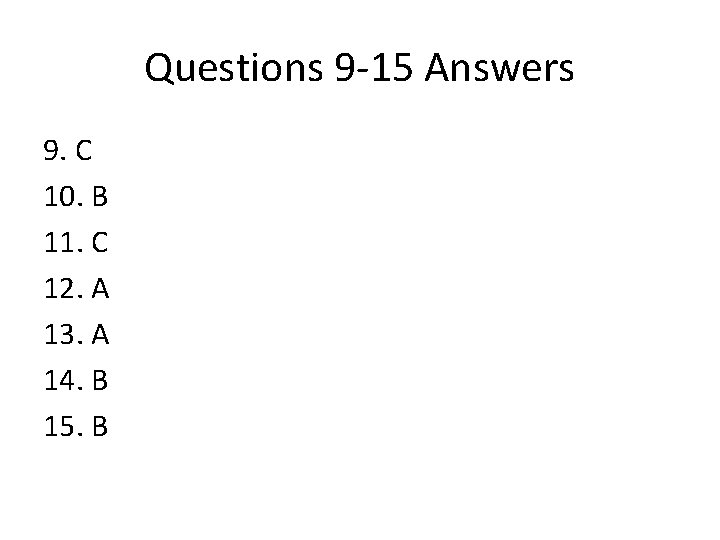
Questions 9 -15 Answers 9. C 10. B 11. C 12. A 13. A 14. B 15. B

Exit Ticket • In groups, come up with your own multiple choice question/answer from any topic covered thus far. • Be sure to appropriately classify it using Bloom’s taxonomy. – Level 1: Knowledge/comprehension – Level 2: Application/analysis – Level 3: Synthesis/evaluation
- Slides: 25