
AP BIOLOGY RNA DNA Proteins Chapters 16 17
AP BIOLOGY RNA, DNA, & Proteins Chapters 16 & 17 Review
Enzyme that adds nucleotide subunits to an RNA primer during replication DNA polymerase III Another name for protein synthesis translation Sugar used to make DNA dexoyribose
Process of making a DNA copy replication Nitrogen base with 1 ring such as cytosine and thymine pyrimidine Organism whose cells have a nucleus eukaryote
Process in which the genetic code of DNA is copied into a strand of RNA transcription Three sequential nucleotides in an m. RNA molecule that code for a specific amino acid codon Organism without a nucleus prokaryote

Nitrogen base with 2 rings like adenine and guanine Purine Subunit composed of a sugar, nitrogen base, and a phosphate group used to make DNA and RNA nucleotide DNA cutting enzyme nuclease
Process in which one strain of bacteria is genetically changed by receiving DNA from another transformation Mutation caused by UV light which distorts the shape of the DNA molecule Thymine dimer
Enyzme the removes the RNA primers and replaces them with DNA polymerase I Group of three nucleotide bases on a t-RNA molecule that are complementary to an m. RNA codon anticodon
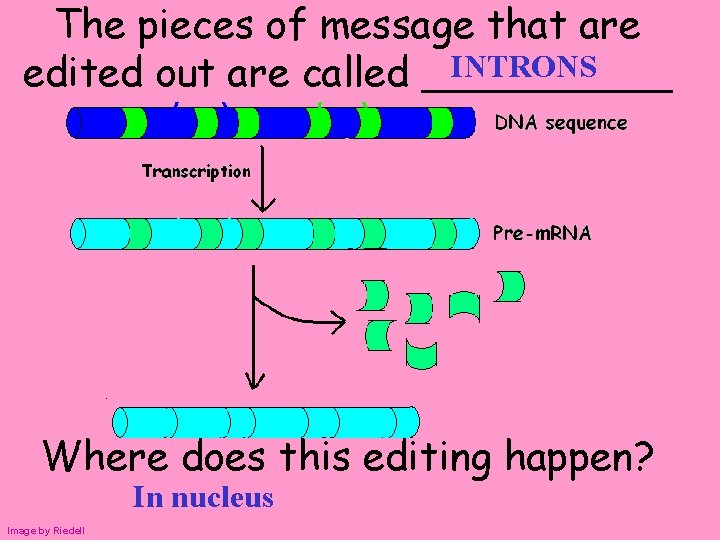
The pieces of message that are INTRONS edited out are called _____ Where does this editing happen? In nucleus Image by Riedell
replication Making a DNA copy = _______ Using DNA code to transcription make an RNA = __________ Using an RNA message translation to make a protein = ________
DNA strand that is synthesized continuously Leading strand Portion of the pre-m. RNA that is expressed in the final protein exon Process of making proteins from an RNA message Translation (protein synthesis)
Type of RNA that carries information in the DNA code from the nucleus out to the cytoplasm Messenger RNA DNA strand that is synthesized in segments Lagging strand Segments of RNA that act as enzymes ribozymes
Sugar used to make DNA deoxyribose Weak bonds between nitrogen bases that hold the 2 DNA strands together Hydrogen bonds Nitrogen base NOT found in RNA thymine
Type of RNA that matches its anticodon and attaches the correct amino acid to the growing protein chain during protein synthesis Transfer RNA Structures found in the cytoplasm made of r. RNA and proteins where protein synthesis happens Ribosomes
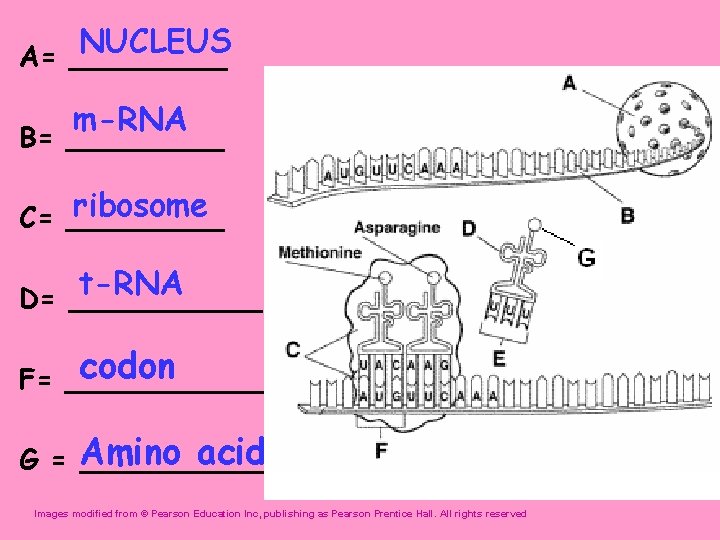
NUCLEUS A= _____ m-RNA B= _____ amino acid ribosome C= _____ t-RNA D= ______ codon F= _______ acid G = Amino _________ Images modified from © Pearson Education Inc, publishing as Pearson Prentice Hall. All rights reserved
Type of RNA that combines with proteins to make ribosomes Ribosomal RNA Segments formed when the lagging strand is copied Okazaki fragments Complex made of sn. RNP’s and proteins that edits and removes introns spliceosome
Sugar used to make RNA ribose Molecules that make up the DNA backbone Phosphates and sugar (deoxyribose) Nitrogen base NOT found in DNA uracil
Describe the processing of pre-m. RNA’s before they leave the nucleus Removal of introns addition of 5’ cap Addition of poly-A tail Enzyme that binds to DNA and adds nucleotides when making RNA polymerase
Macromolecule made by joining nucleotide subunits together Nucleic acid (DNA & RNA) Virus that infects bacteria bacteriophage Bond that holds amino acid subunits together make a protein peptide
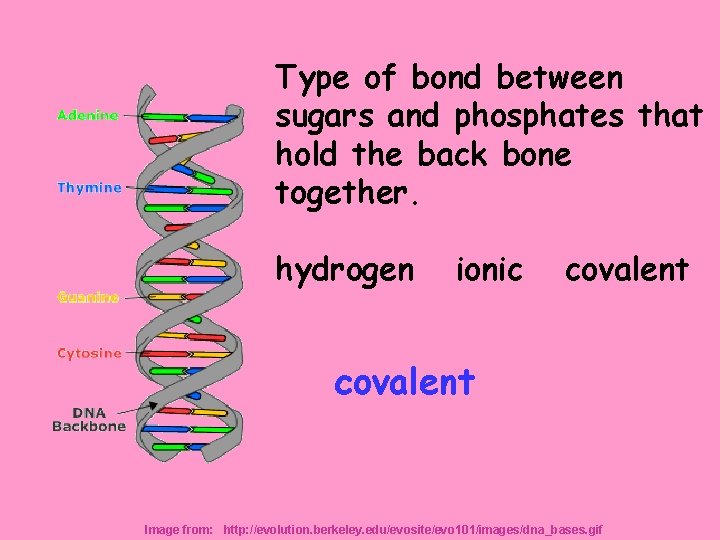
Type of bond between sugars and phosphates that hold the back bone together. hydrogen ionic covalent Image from: http: //evolution. berkeley. edu/evosite/evo 101/images/dna_bases. gif
Macromolecule made by joining amino acid subunits together protein Small molecules made of RNA and proteins that recognize splice sites on pre-m. RNA’s and combine with other proteins to make spliceosomes Small ribonucleoproteins (sn. RNP’s)
Sequence of DNA that is NOT involved in coding for a protein which is cut of the m-RNA molecule before it is read by the ribosomes intron Where does transcription happen? nucleus
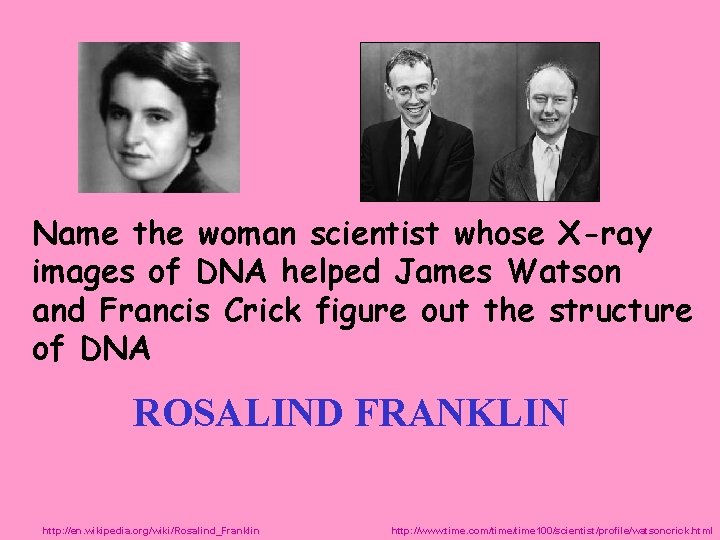
Name the woman scientist whose X-ray images of DNA helped James Watson and Francis Crick figure out the structure of DNA ROSALIND FRANKLIN http: //en. wikipedia. org/wiki/Rosalind_Franklin http: //www. time. com/time 100/scientist/profile/watsoncrick. html
Tell 2 ways DNA is different from RNA Double stranded Deoxyribose sugar A, T, C, G No Uracil RNA Single stranded Ribose sugar A, U, C, G No thymine Contains genetic code Carries code from Stays in nucleus to cytoplasm Helps with protein synthesis
A genetic change in a cell due to DNA received from another cell = TRANSFORMATION __________. Modification added to the 3’ end of a m-RNA which may promote export from nucleus and protect it from degradation Poly-A tail
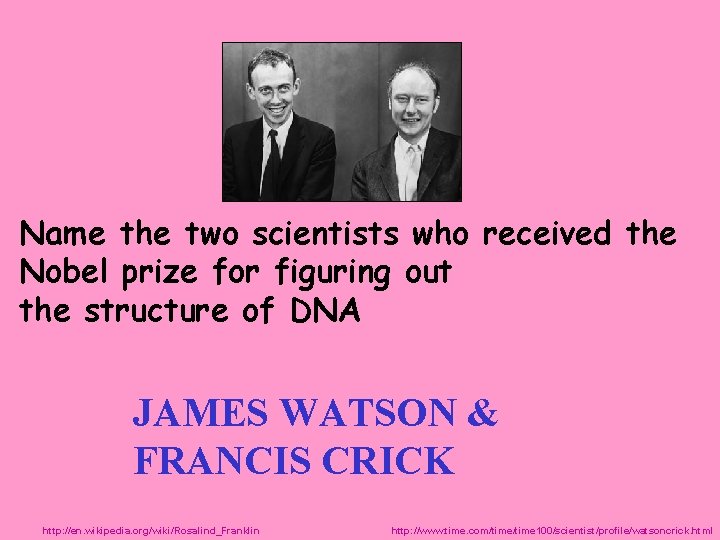
Name the two scientists who received the Nobel prize for figuring out the structure of DNA JAMES WATSON & FRANCIS CRICK http: //en. wikipedia. org/wiki/Rosalind_Franklin http: //www. time. com/time 100/scientist/profile/watsoncrick. html
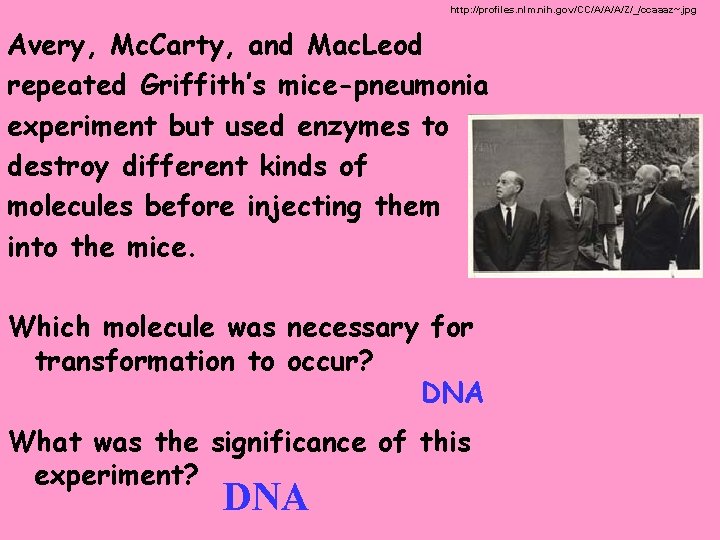
http: //profiles. nlm. nih. gov/CC/A/A/A/Z/_/ccaaaz~. jpg Avery, Mc. Carty, and Mac. Leod repeated Griffith’s mice-pneumonia experiment but used enzymes to destroy different kinds of molecules before injecting them into the mice. Which molecule was necessary for transformation to occur? DNA What was the significance of this experiment? DNA
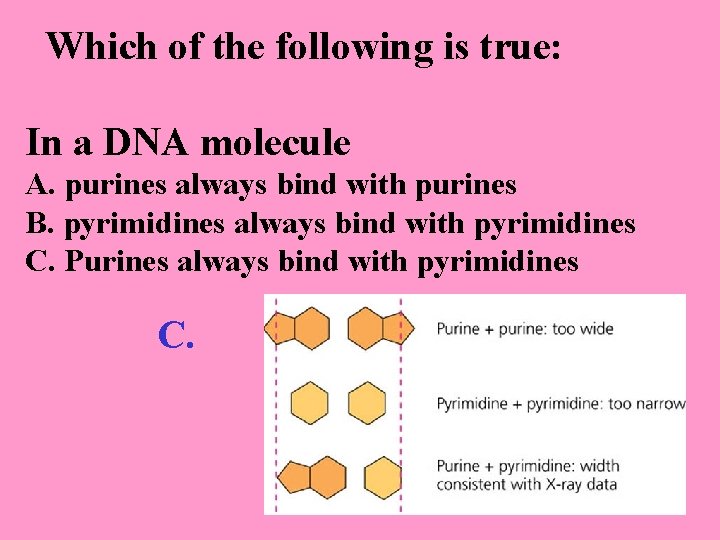
Which of the following is true: In a DNA molecule A. purines always bind with purines B. pyrimidines always bind with pyrimidines C. Purines always bind with pyrimidines C.
Name the 3 parts of a nucleotide Sugar, nitrogen base, phosphate DNA polymerase only works in one direction so a DNA molecule is always built by adding nucleotides in the 5’ to 3’ ______ direction
NAME THE REPLICATION ENYZME Adds RNA primer to start copying a DNA segment PRIMASE ___________ Joins DNA segments LIGASE _________ Unwinds the DNA strand HELICASE ________
NAME THE REPLICATION ENYZME Adds nucleotide subunits continuously to leading strand DNA POLYMERASE III ___________ Removes RNA primers and adds nucleotides DNA POLYMERASE I _________
Protective structures at the ends of eukaryotic chromosomes that prevent loss of information when the 5’ end is shortened during replication telomeres DNA polymerase works by joining a 3’ end of an new nucleotide to the _____ existing nucleotide chain. 3’ or 5’
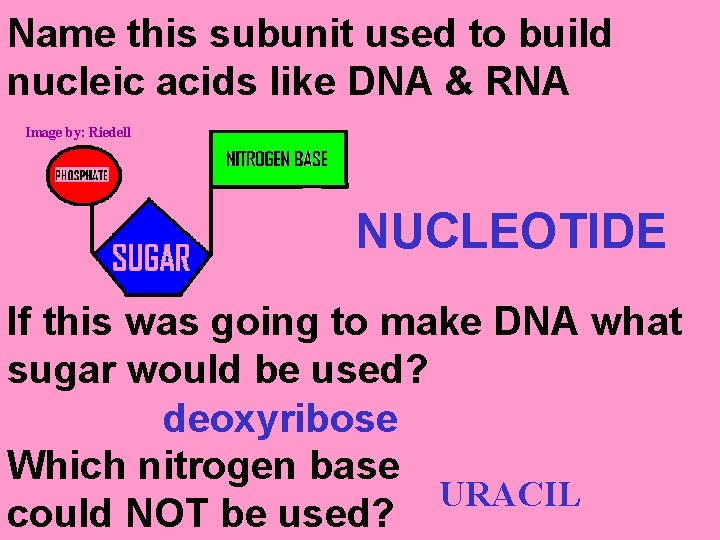
Name this subunit used to build nucleic acids like DNA & RNA Image by: Riedell NUCLEOTIDE If this was going to make DNA what sugar would be used? deoxyribose Which nitrogen base URACIL could NOT be used?
DNA → DNA replication = _______ DNA → RNA = __________ transcription translation RNA → protein = ________
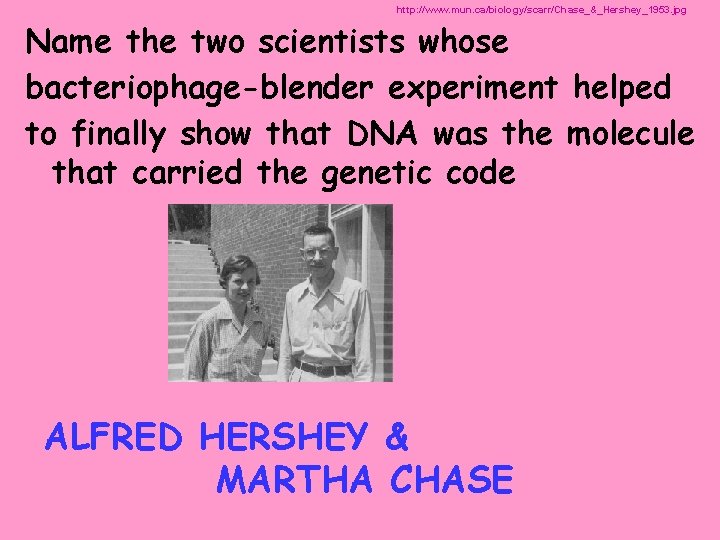
http: //www. mun. ca/biology/scarr/Chase_&_Hershey_1953. jpg Name the two scientists whose bacteriophage-blender experiment helped to finally show that DNA was the molecule that carried the genetic code ALFRED HERSHEY & MARTHA CHASE
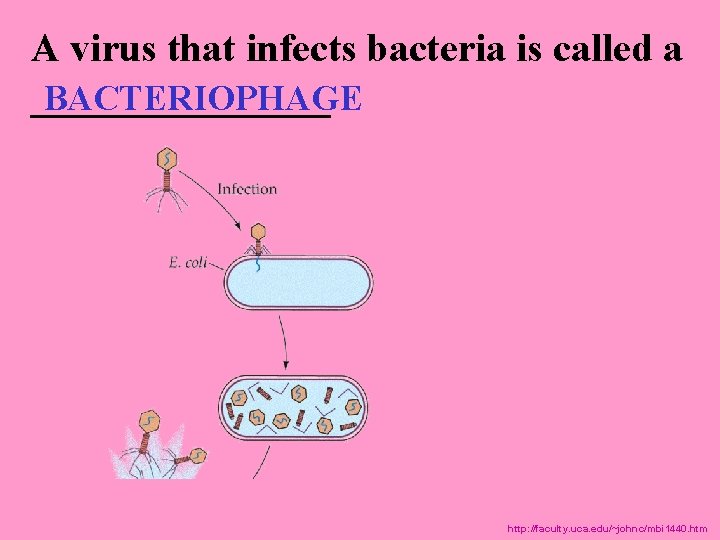
A virus that infects bacteria is called a ________ BACTERIOPHAGE http: //faculty. uca. edu/~johnc/mbi 1440. htm
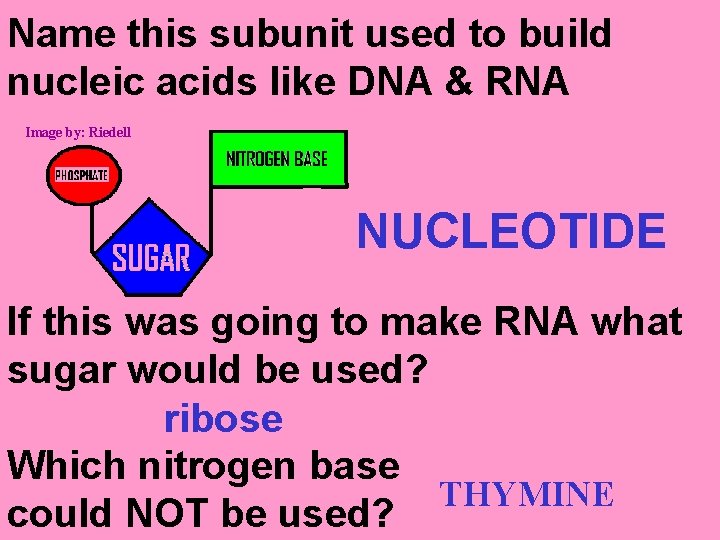
Name this subunit used to build nucleic acids like DNA & RNA Image by: Riedell NUCLEOTIDE If this was going to make RNA what sugar would be used? ribose Which nitrogen base THYMINE could NOT be used?
Tell what nitrogen base these letters stand for _______= ADENINE A _______ GUANINE = G _______ CYTOSINE = C _______ THYMINE = T URACIL = U _______
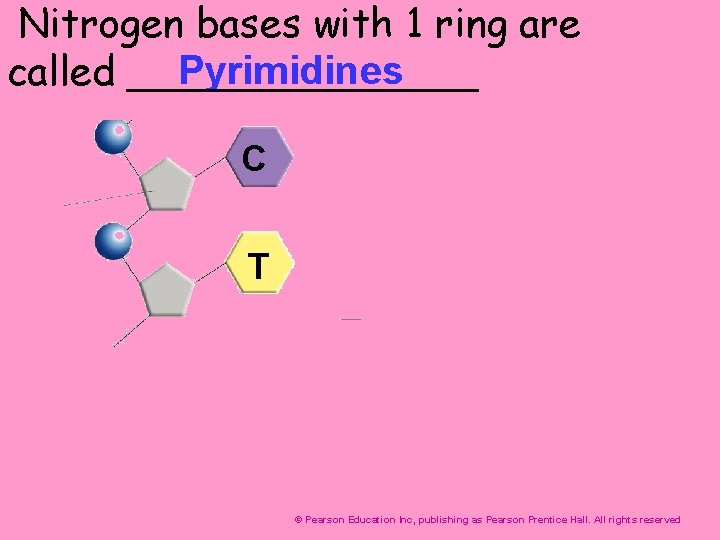
Nitrogen bases with 1 ring are Pyrimidines called _______ C T © Pearson Education Inc, publishing as Pearson Prentice Hall. All rights reserved
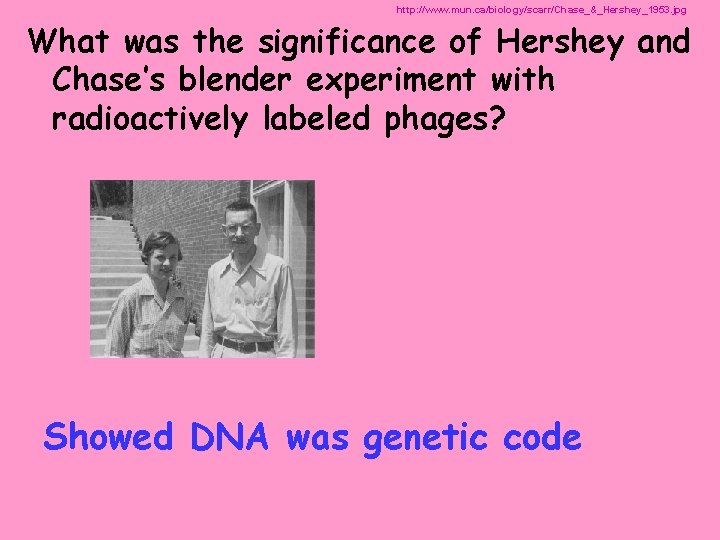
http: //www. mun. ca/biology/scarr/Chase_&_Hershey_1953. jpg What was the significance of Hershey and Chase’s blender experiment with radioactively labeled phages? Showed DNA was genetic code
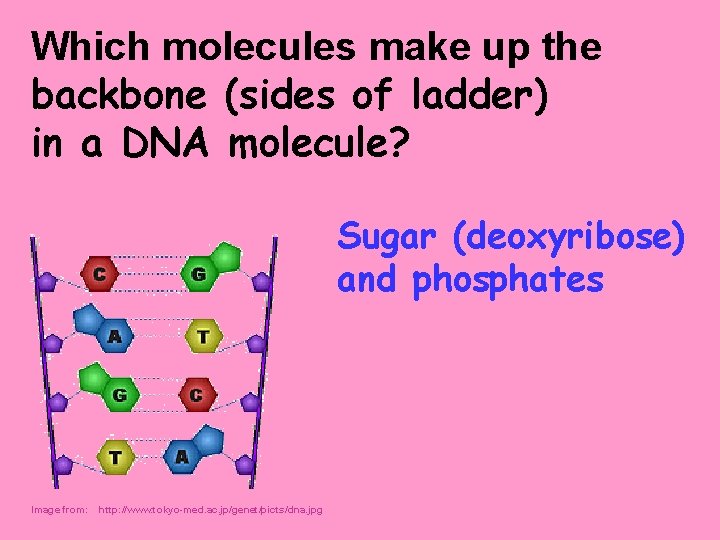
Which molecules make up the backbone (sides of ladder) in a DNA molecule? Sugar (deoxyribose) and phosphates Image from: http: //www. tokyo-med. ac. jp/genet/picts/dna. jpg
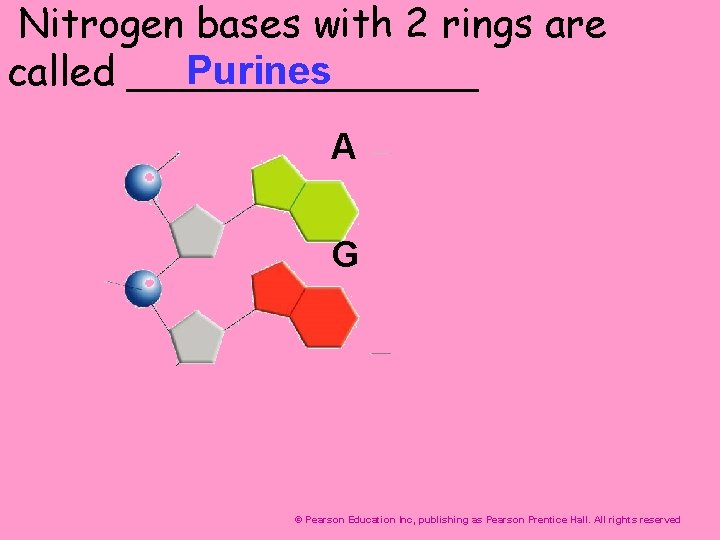
Nitrogen bases with 2 rings are Purines called _______ A G © Pearson Education Inc, publishing as Pearson Prentice Hall. All rights reserved
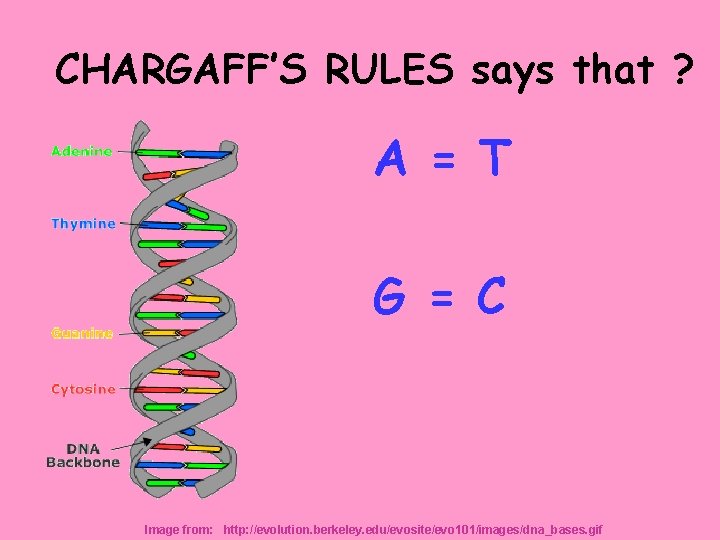
CHARGAFF’S RULES says that ? A = T G = C Image from: http: //evolution. berkeley. edu/evosite/evo 101/images/dna_bases. gif
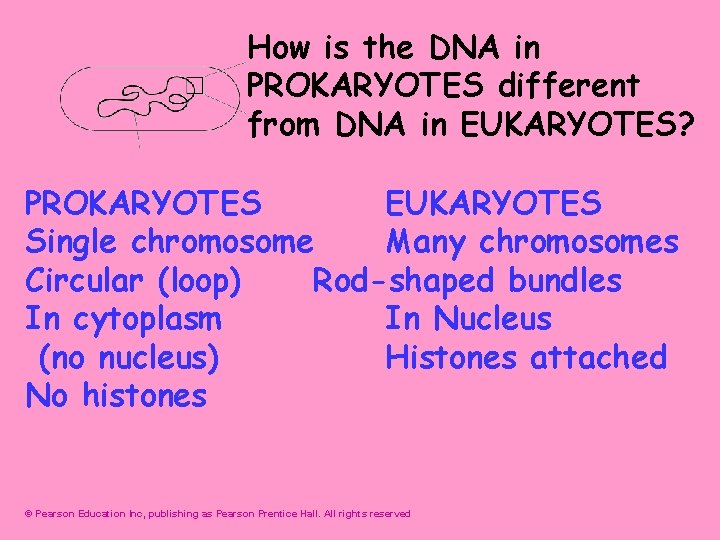
How is the DNA in PROKARYOTES different from DNA in EUKARYOTES? PROKARYOTES EUKARYOTES Single chromosome Many chromosomes Circular (loop) Rod-shaped bundles In cytoplasm In Nucleus (no nucleus) Histones attached No histones © Pearson Education Inc, publishing as Pearson Prentice Hall. All rights reserved
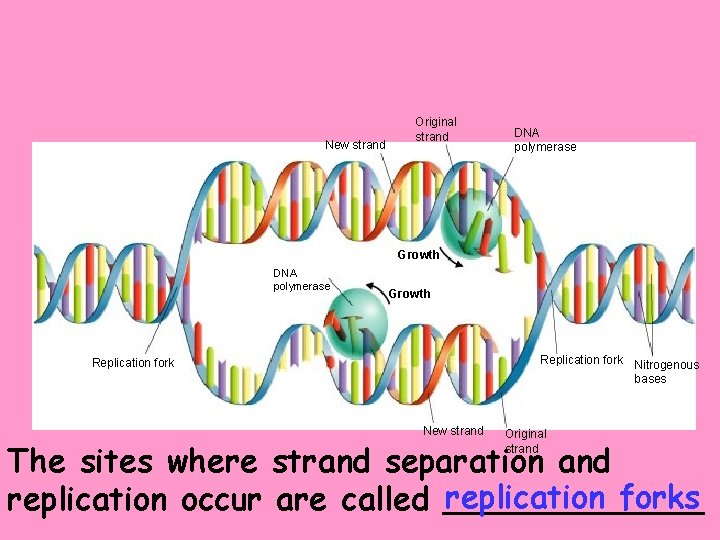
New strand Original strand DNA polymerase Growth Replication fork Nitrogenous bases Replication fork New strand Original strand The sites where strand separation and replication forks replication occur are called _______
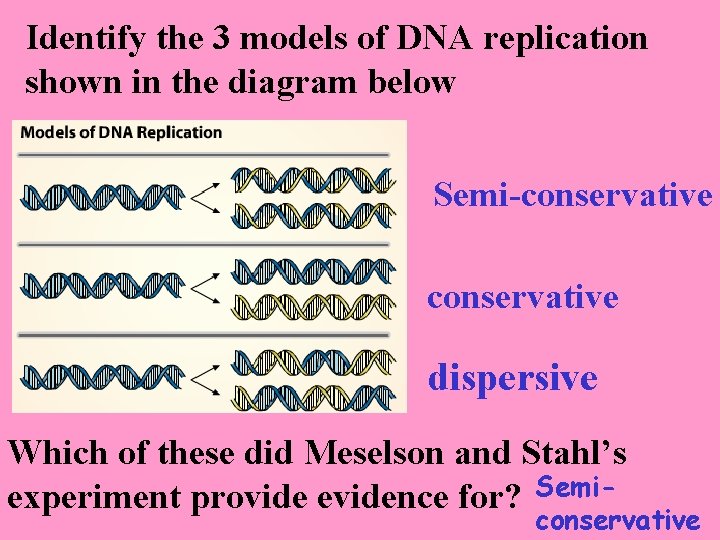
Identify the 3 models of DNA replication shown in the diagram below Semi-conservative dispersive Which of these did Meselson and Stahl’s experiment provide evidence for? Semi- conservative
Enzyme found in eukaryotic germ cells, stem cells, and cancer cells which lengthen telomeres telomerase Archibald Garrod coined the term “inborn __________” errors of metabolism to describe inherited diseases are due to an inability to make a specific enzyme
Genetic disorder described by Garrod in which individuals lack the enzyme to break down the amino acid tyosine resulting in black urine alcaptonuria Genetic disorder in which individuals lack the enzymes to repair damage from UV light Xeroderma pigmentosum
Beadle and Tatum came up with the one gene-one enzyme “ _____________” hypothesis that stated the function of a gene was to code for the production of one specific protein. How has our understanding of this idea changed since then? Changed to one gene-one polypeptide (not all proteins are enzymes) Now know: Some genes code for RNA’s with important functions that are not made into proteins
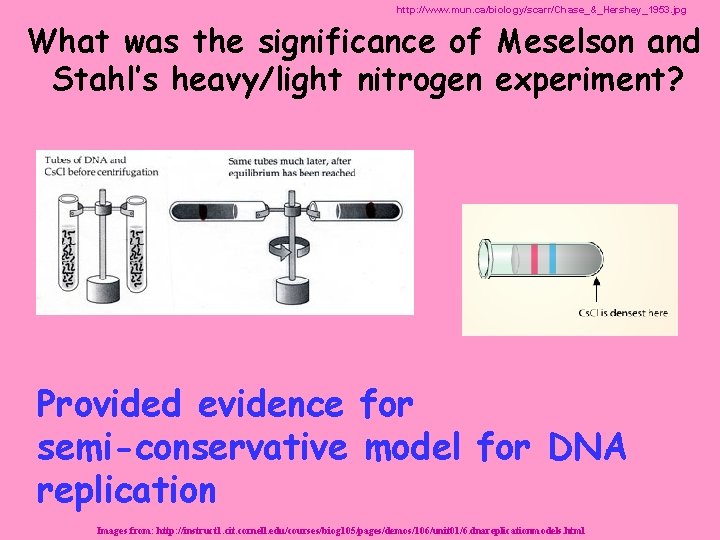
http: //www. mun. ca/biology/scarr/Chase_&_Hershey_1953. jpg What was the significance of Meselson and Stahl’s heavy/light nitrogen experiment? Provided evidence for semi-conservative model for DNA replication Images from: http: //instruct 1. cit. cornell. edu/courses/biog 105/pages/demos/106/unit 01/6. dnareplicationmodels. html
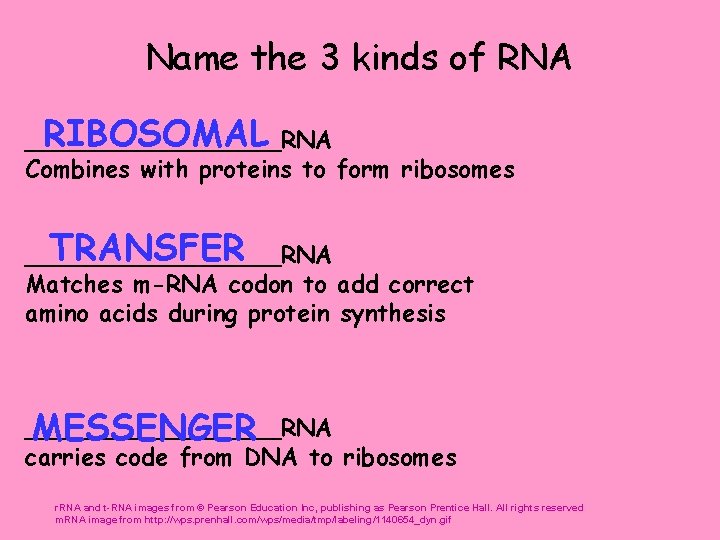
Name the 3 kinds of RNA RIBOSOMAL _________RNA Combines with proteins to form ribosomes TRANSFER _________RNA Matches m-RNA codon to add correct amino acids during protein synthesis _________RNA MESSENGER carries code from DNA to ribosomes r. RNA and t-RNA images from © Pearson Education Inc, publishing as Pearson Prentice Hall. All rights reserved m. RNA image from http: //wps. prenhall. com/wps/media/tmp/labeling/1140654_dyn. gif
MUTATIONS ________ are changes in the genetic material. Substances that can cause mutations are MUTAGENS called _______ Give some examples Cigarette smoke UV light X rays
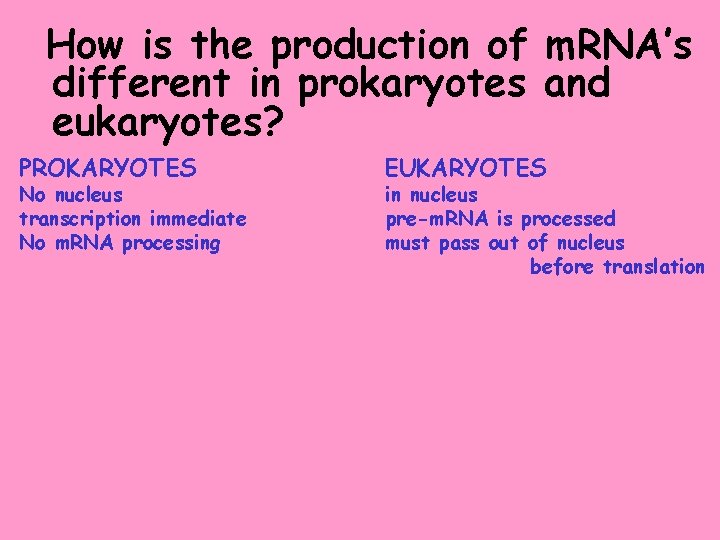
How is the production of m. RNA’s different in prokaryotes and eukaryotes? PROKARYOTES No nucleus transcription immediate No m. RNA processing EUKARYOTES in nucleus pre-m. RNA is processed must pass out of nucleus before translation
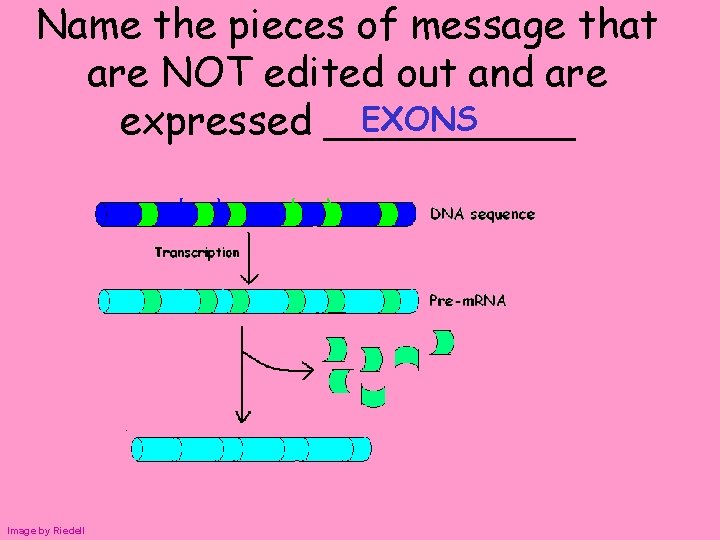
Name the pieces of message that are NOT edited out and are EXONS expressed _____ Image by Riedell
Mutations involving only one base pair are point called ____ mutations Explain why frameshift mutations at the beginning of a gene are more harmful than at the end. Frameshifts cause everything after the mutation to shift and be misread so mutations at the beginning change more of the code.
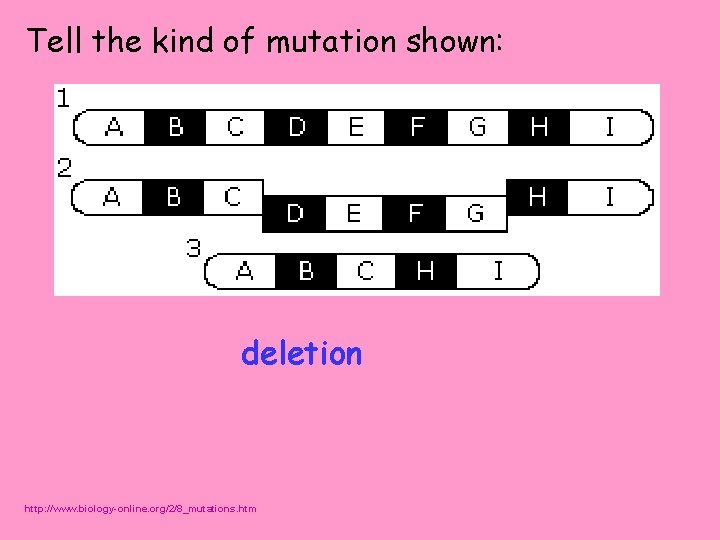
Tell the kind of mutation shown: deletion http: //www. biology-online. org/2/8_mutations. htm
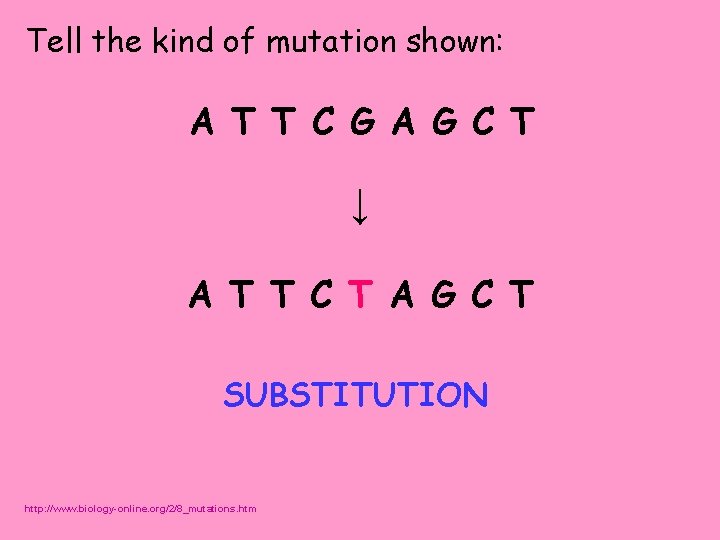
Tell the kind of mutation shown: A T T C G A G C T → A T T C T A G C T SUBSTITUTION http: //www. biology-online. org/2/8_mutations. htm
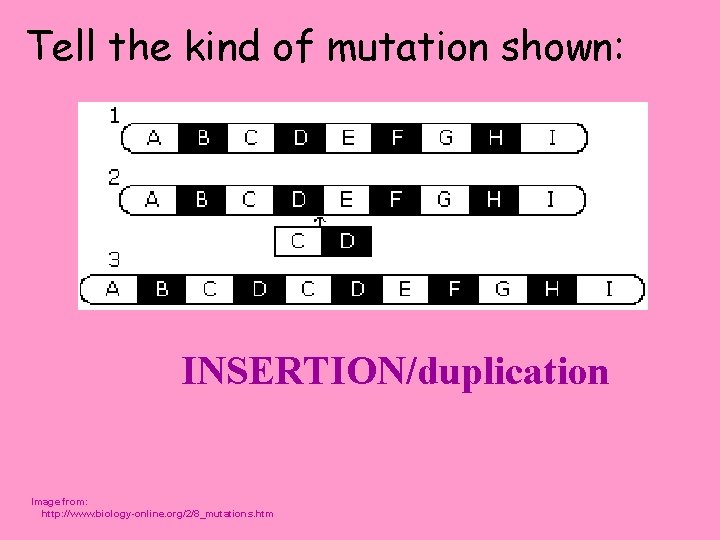
Tell the kind of mutation shown: INSERTION/duplication Image from: http: //www. biology-online. org/2/8_mutations. htm
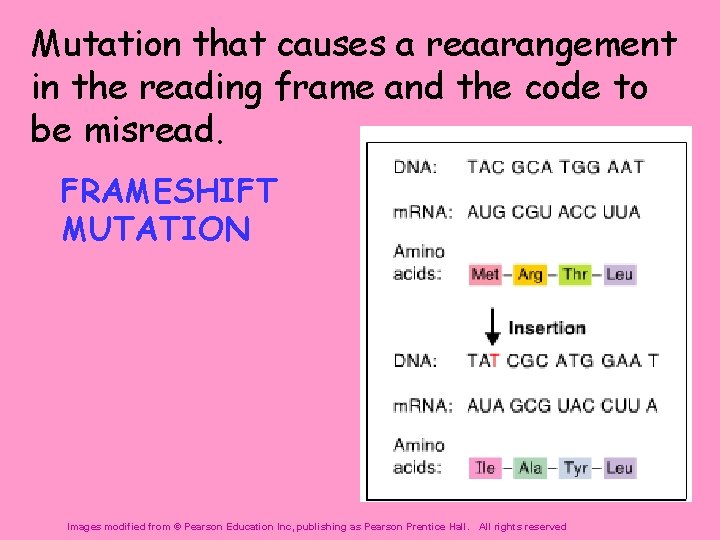
Mutation that causes a reaarangement in the reading frame and the code to be misread. FRAMESHIFT MUTATION Images modified from © Pearson Education Inc, publishing as Pearson Prentice Hall. All rights reserved
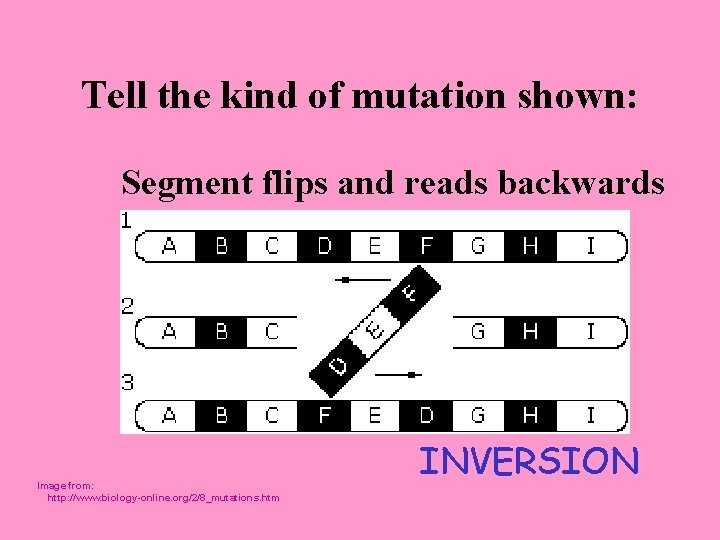
Tell the kind of mutation shown: Segment flips and reads backwards Image from: http: //www. biology-online. org/2/8_mutations. htm INVERSION
DNA polymerase can only add 3 end of a nucleotides to the ____’ growing strand What happens to polypeptides that will become membrane proteins or be secreted while they are being translated? SRP (signal recognition particle) attaches them to ER so they are inserted into lumen
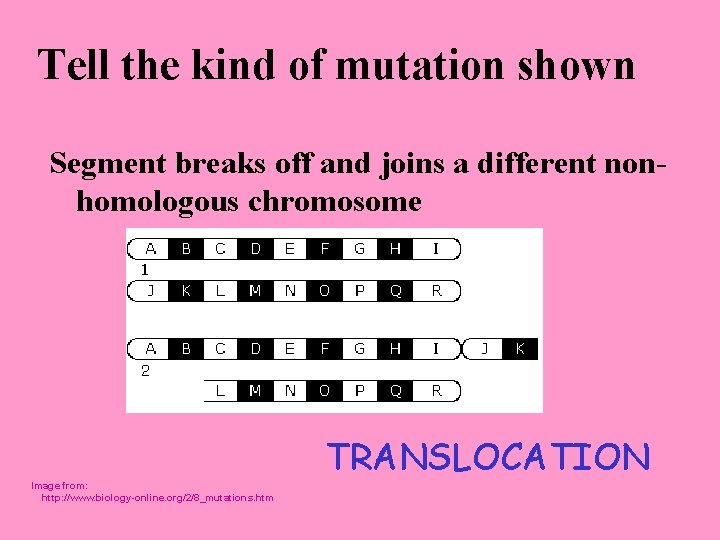
Tell the kind of mutation shown Segment breaks off and joins a different nonhomologous chromosome Image from: http: //www. biology-online. org/2/8_mutations. htm TRANSLOCATION
Sequence where RNA polymerase attaches and begins transcription promoter Promoter sequence in eukaryotic DNA crucial in forming the transcription initiation complex TATA box Relaxation of base pairing rules that explains why amino acids can differ in the 3 rd base wobble
Discrete structural and functional regions that can be edited and shuffled in different combinations to make different arrangements of protein sequences DOMAINS Arrangement of multiple ribosomes translating an m. RNA at the same time polyribosomes
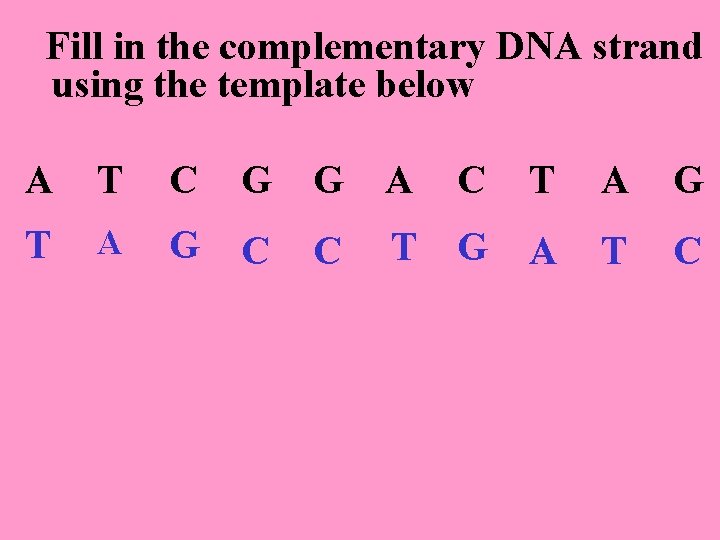
Fill in the complementary DNA strand using the template below A T C G G A C T A G C C T G A T C
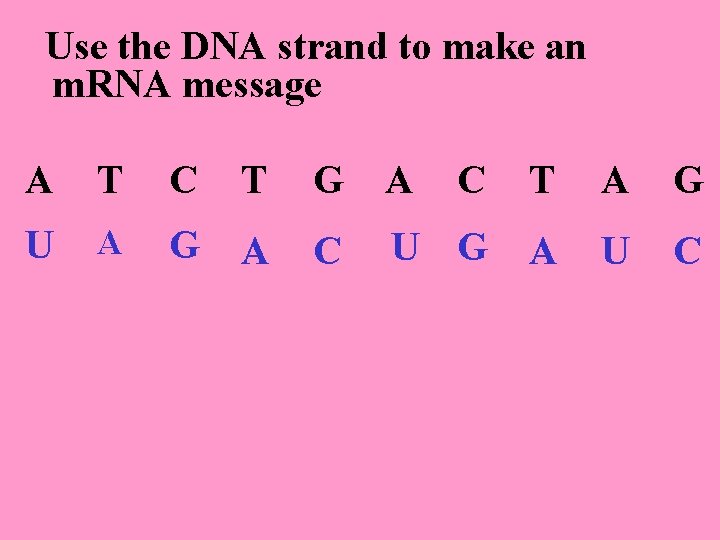
Use the DNA strand to make an m. RNA message A T C T G A C T A G U A G A C U G A U C
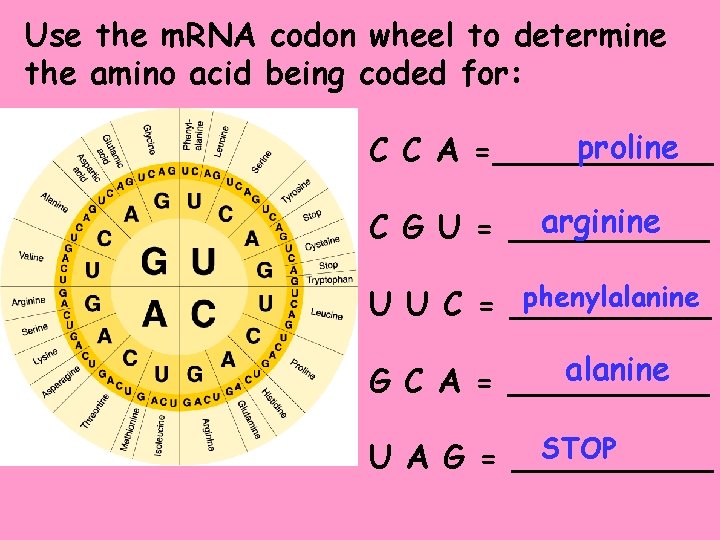
Use the m. RNA codon wheel to determine the amino acid being coded for: proline C C A =______ arginine C G U = _____ phenylalanine U U C = _____ alanine G C A = _____ STOP U A G = _____
- Slides: 66