
AP Biology Math Review Bozeman Math in Biology
AP Biology Math Review ▪ Bozeman - Math in Biology ▪ Standard Error ▪ Standard Deviation ▪ Statistics for Science ▪ Probability in Genetics: Multiplication and Addition Rules
Tips • Grid LEFT to right • Use the formula sheet • Don’t round until the end • Look at HOW the answer should be given “round to nearest…”
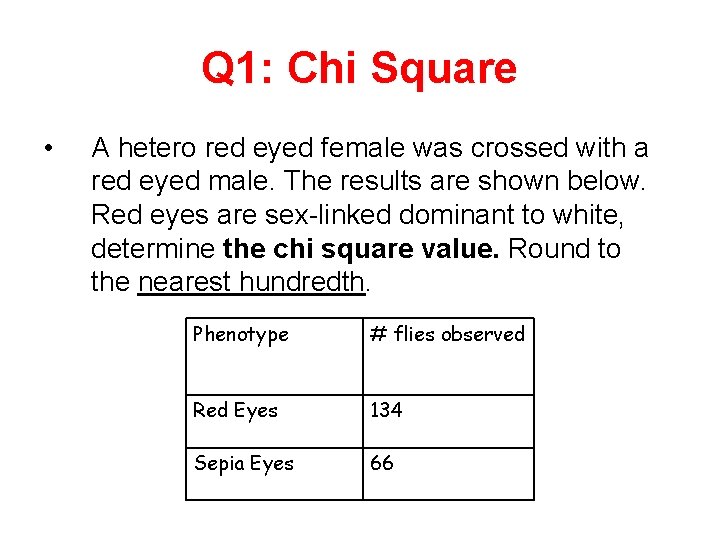
Q 1: Chi Square • A hetero red eyed female was crossed with a red eyed male. The results are shown below. Red eyes are sex-linked dominant to white, determine the chi square value. Round to the nearest hundredth. Phenotype # flies observed Red Eyes 134 Sepia Eyes 66
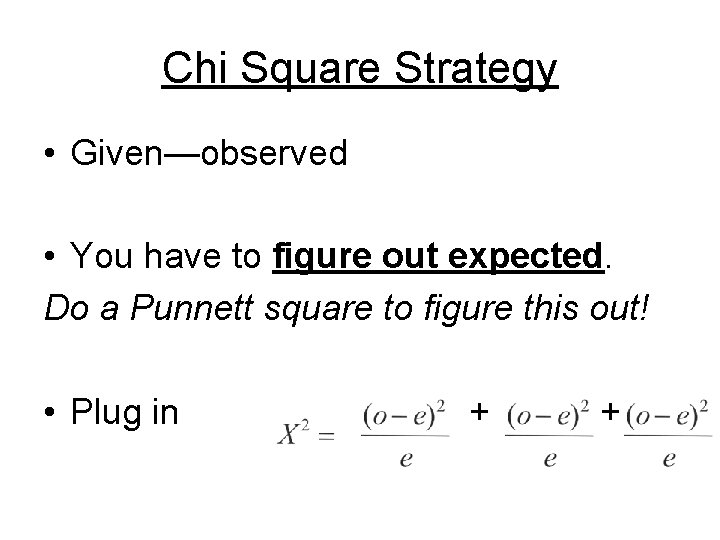
Chi Square Strategy • Given—observed • You have to figure out expected. Do a Punnett square to figure this out! • Plug in + +
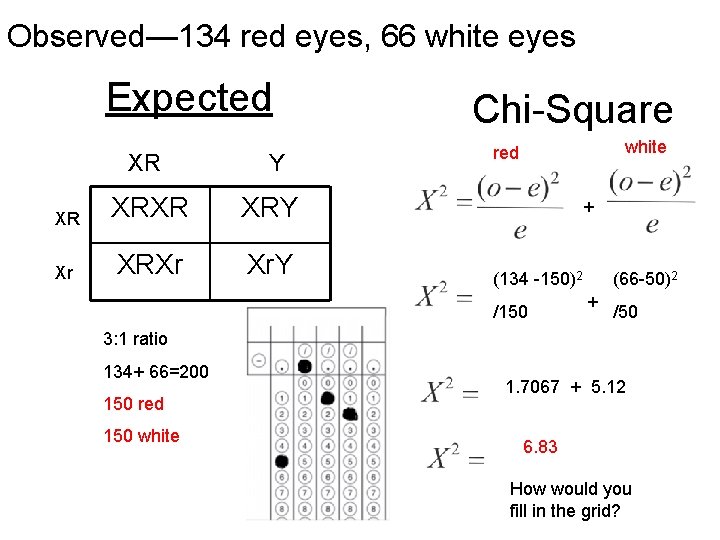
Observed— 134 red eyes, 66 white eyes XR Y XR XRY Xr XRXr Xr. Y Chi-Square white red + (134 -150)2 /150 (66 -50)2 + Expected /50 3: 1 ratio 134+ 66=200 150 red 150 white 1. 7067 + 5. 12 6. 83 How would you fill in the grid?
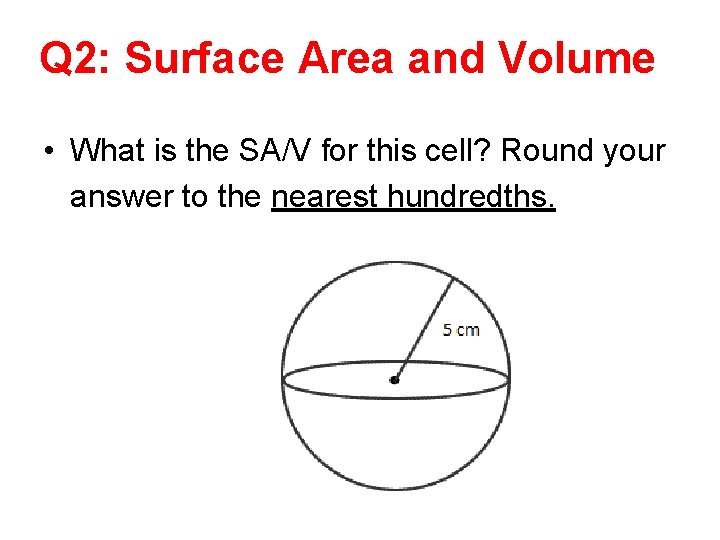
Q 2: Surface Area and Volume • What is the SA/V for this cell? Round your answer to the nearest hundredths.
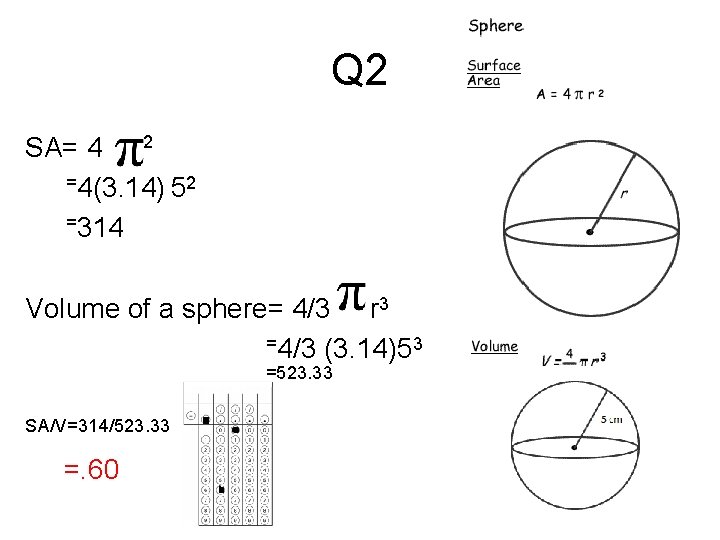
Q 2 SA= 4 r 2 =4(3. 14) 52 =314 Volume of a sphere= 4/3 r 3 = 4/3 (3. 14)53 =523. 33 SA/V=314/523. 33 =. 60
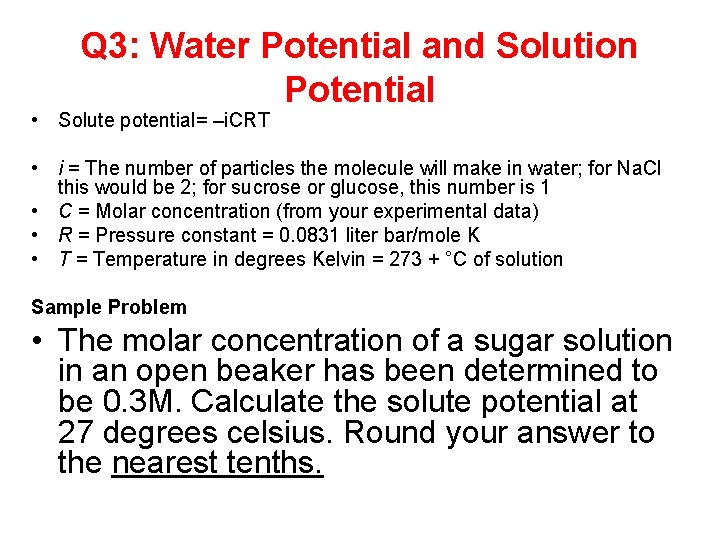
Q 3: Water Potential and Solution Potential • Solute potential= –i. CRT • i = The number of particles the molecule will make in water; for Na. Cl this would be 2; for sucrose or glucose, this number is 1 • C = Molar concentration (from your experimental data) • R = Pressure constant = 0. 0831 liter bar/mole K • T = Temperature in degrees Kelvin = 273 + °C of solution Sample Problem • The molar concentration of a sugar solution in an open beaker has been determined to be 0. 3 M. Calculate the solute potential at 27 degrees celsius. Round your answer to the nearest tenths.
Q 3 • Solute potential= –i. CRT -i= 1 C= 0. 3 R = Pressure constant = 0. 0831 T= 27 +273=300 K Solute potential = -7. 5
Q 4: Hardy Weinberg • A census of birds nesting on a Galapagos Island revealed that 24 of them show a rare recessive condition that affected beak formation. The other 63 birds in this population show no beak defect. If this population is in HW equilibrium, what is the frequency of the dominant allele? Give your answer to the nearest hundredth
Hardy Weinberg Strategy • Figure out what you are given • Allele (p or q) or Genotypes (p 2, 2 pq, q 2) • Figure out what you are solving for • Manipulate formulas to go from given to solving for • Always dealing with decimals
Q 4: Looking for p—dominant allele • Homozygous Recessive=q 2=24/87=. 2758 q 2=. 2758 q=. 5252 p+q=1 p=. 47
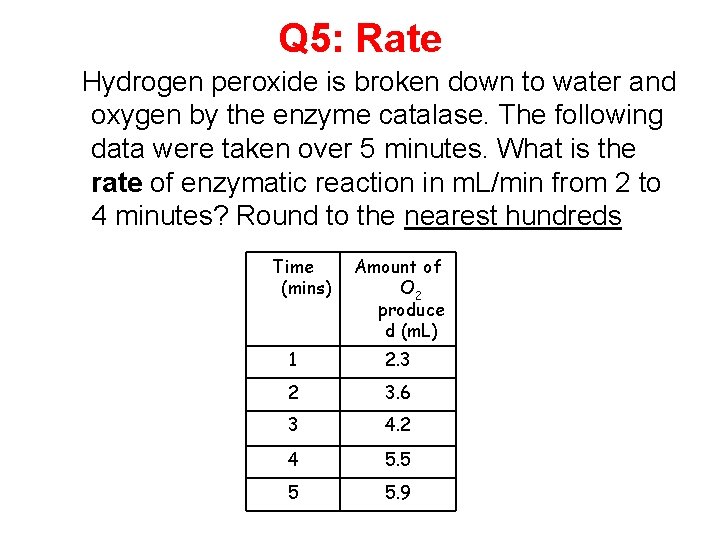
Q 5: Rate Hydrogen peroxide is broken down to water and oxygen by the enzyme catalase. The following data were taken over 5 minutes. What is the rate of enzymatic reaction in m. L/min from 2 to 4 minutes? Round to the nearest hundreds Time (mins) Amount of O 2 produce d (m. L) 1 2. 3 2 3. 6 3 4. 2 4 5. 5 5 5. 9
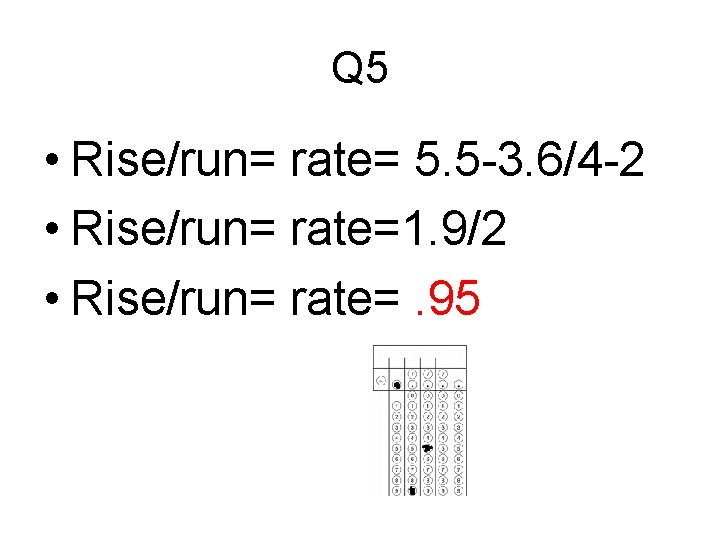
Q 5 • Rise/run= rate= 5. 5 -3. 6/4 -2 • Rise/run= rate=1. 9/2 • Rise/run= rate=. 95
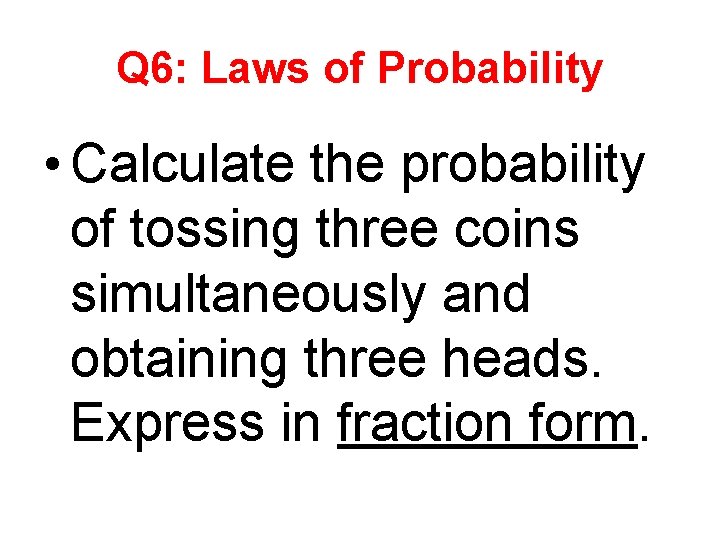
Q 6: Laws of Probability • Calculate the probability of tossing three coins simultaneously and obtaining three heads. Express in fraction form.
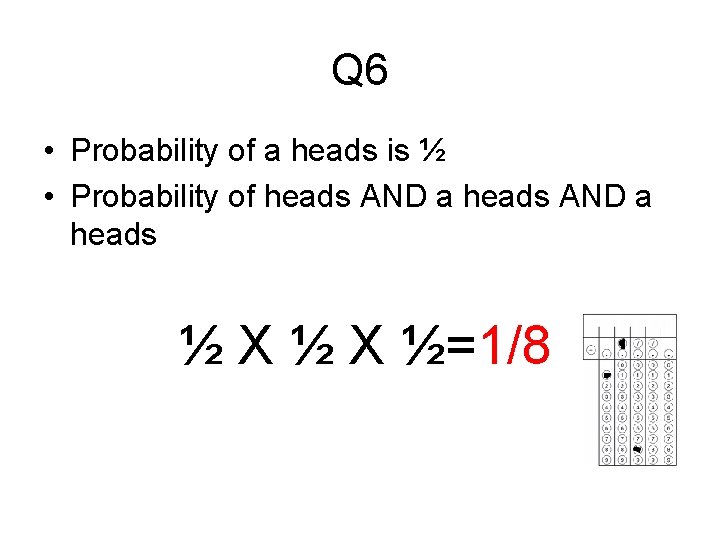
Q 6 • Probability of a heads is ½ • Probability of heads AND a heads ½ X ½=1/8
Q 7: Population Growth N—total number in pop r—rate of growth • There are 2, 000 mice living in a field. If 1, 000 mice are born each month and 200 mice die each month, what is the per capita growth rate of mice over a month? Round to the nearest tenths.
• N=2000 • d. N/dt= Births – Deaths d. N/dt = 1000 -200=800 Use equation: d. N/dt (per capita rate) = rmax. N • 800/2000= 0. 4
Q 8 Primary Productivity • The net annual primary productivity of a particular wetland ecosystem is found to be 8, 000 kcal/m 2. If respiration by the aquatic producers is 12, 000 kcal/m 2 per year, what is the gross annual primary productivity for this ecosystem, in kcal/m 2 per year? Round to the nearest whole number.
Q 8 Answer • Net Primary Productivity = GPP - amount from Respiration • 8, 000 = GPP – 12, 000 • 8, 000+ 12, 000= GPP • 20, 000=GPP
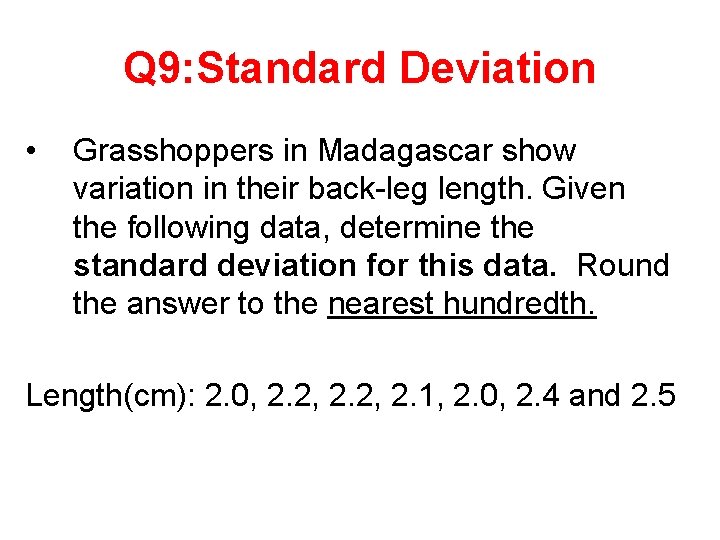
Q 9: Standard Deviation • Grasshoppers in Madagascar show variation in their back-leg length. Given the following data, determine the standard deviation for this data. Round the answer to the nearest hundredth. Length(cm): 2. 0, 2. 2, 2. 1, 2. 0, 2. 4 and 2. 5
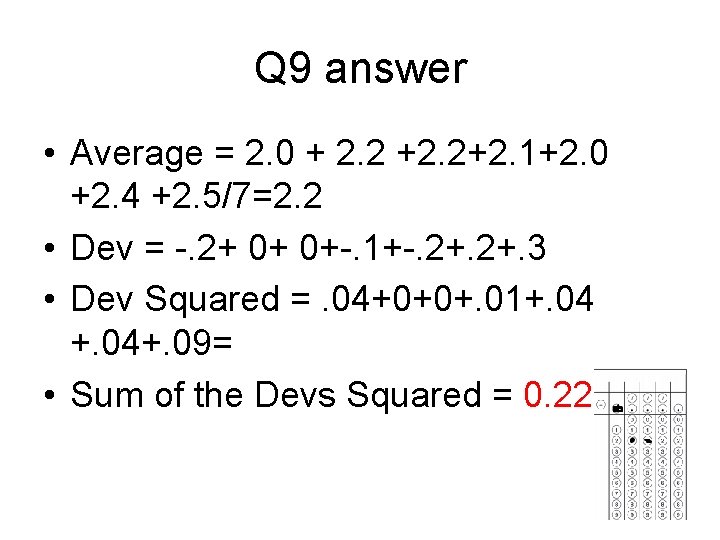
Q 9 answer • Average = 2. 0 + 2. 2 +2. 2+2. 1+2. 0 +2. 4 +2. 5/7=2. 2 • Dev = -. 2+ 0+ 0+-. 1+-. 2+. 3 • Dev Squared =. 04+0+0+. 01+. 04+. 09= • Sum of the Devs Squared = 0. 22
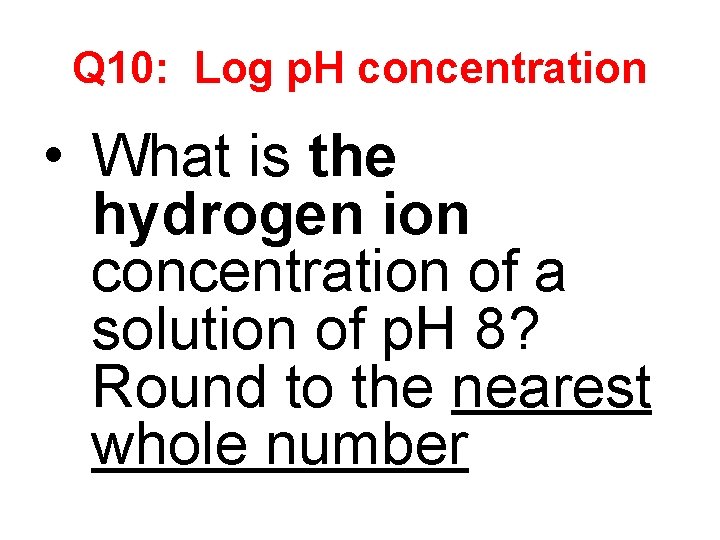
Q 10: Log p. H concentration • What is the hydrogen ion concentration of a solution of p. H 8? Round to the nearest whole number
![Q 10 • [H+] if p. H = 8. 0 -p. H • [H+]](http://slidetodoc.com/presentation_image_h/a98f2da985ff508eb33d569d41e10f81/image-24.jpg "Q 10 • [H+] if p. H = 8. 0 -p. H • [H+]")
Q 10 • [H+] if p. H = 8. 0 -p. H • [H+] = 10 -8. 0 [H+] = 10 • 1÷ 10⁸ = 0. 00000001
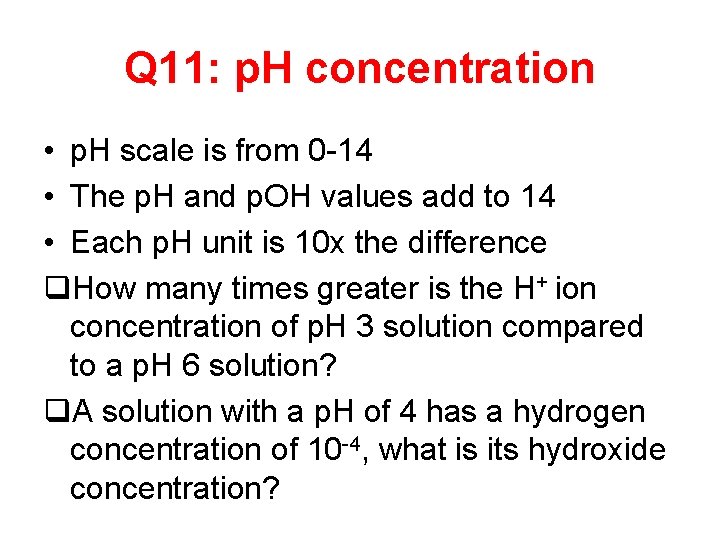
Q 11: p. H concentration • p. H scale is from 0 -14 • The p. H and p. OH values add to 14 • Each p. H unit is 10 x the difference q. How many times greater is the H+ ion concentration of p. H 3 solution compared to a p. H 6 solution? q. A solution with a p. H of 4 has a hydrogen concentration of 10 -4, what is its hydroxide concentration?
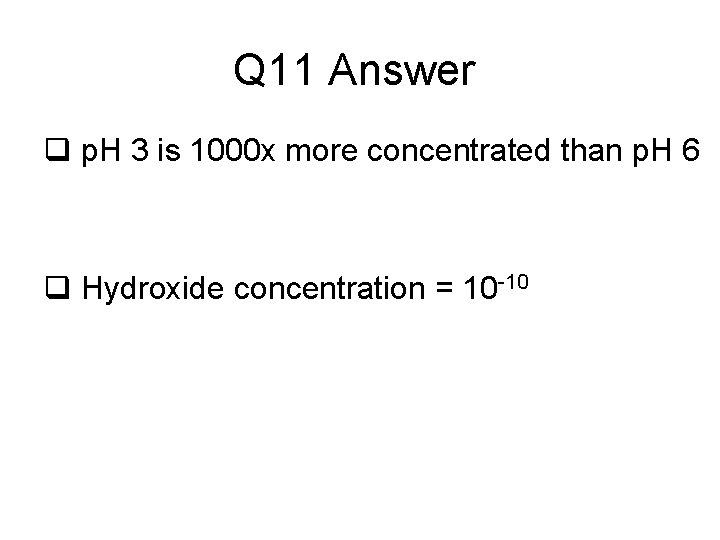
Q 11 Answer q p. H 3 is 1000 x more concentrated than p. H 6 q Hydroxide concentration = 10 -10
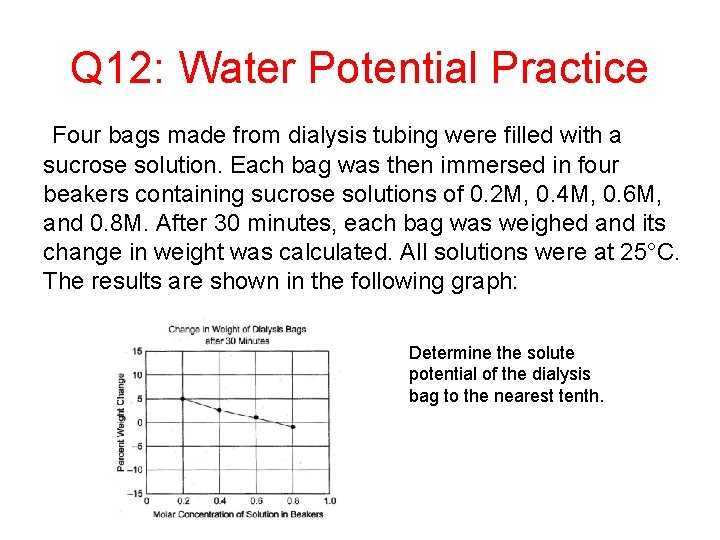
Q 12: Water Potential Practice Four bags made from dialysis tubing were filled with a sucrose solution. Each bag was then immersed in four beakers containing sucrose solutions of 0. 2 M, 0. 4 M, 0. 6 M, and 0. 8 M. After 30 minutes, each bag was weighed and its change in weight was calculated. All solutions were at 25°C. The results are shown in the following graph: Determine the solute potential of the dialysis bag to the nearest tenth.
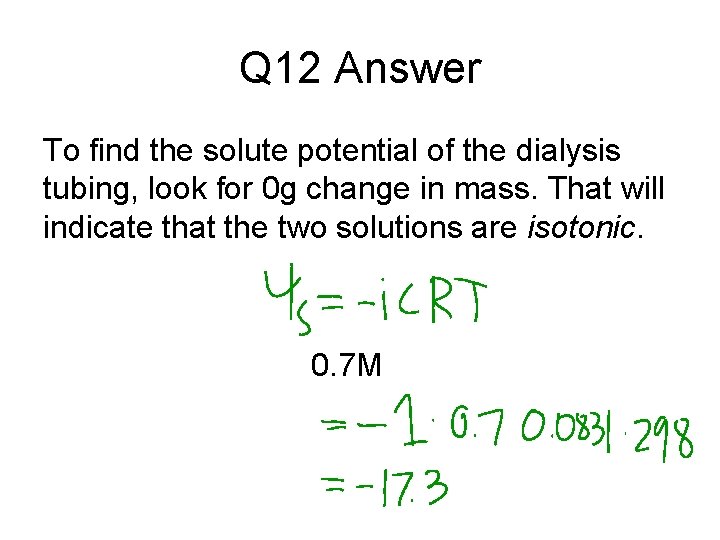
Q 12 Answer To find the solute potential of the dialysis tubing, look for 0 g change in mass. That will indicate that the two solutions are isotonic. 0. 7 M
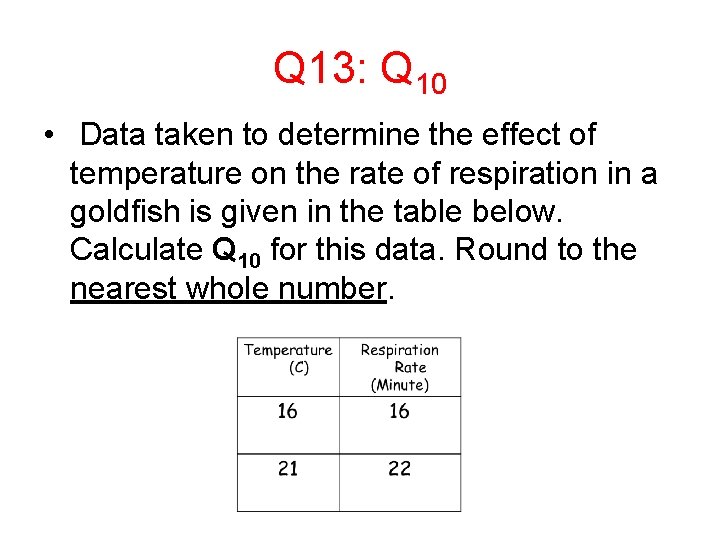
Q 13: Q 10 • Data taken to determine the effect of temperature on the rate of respiration in a goldfish is given in the table below. Calculate Q 10 for this data. Round to the nearest whole number.
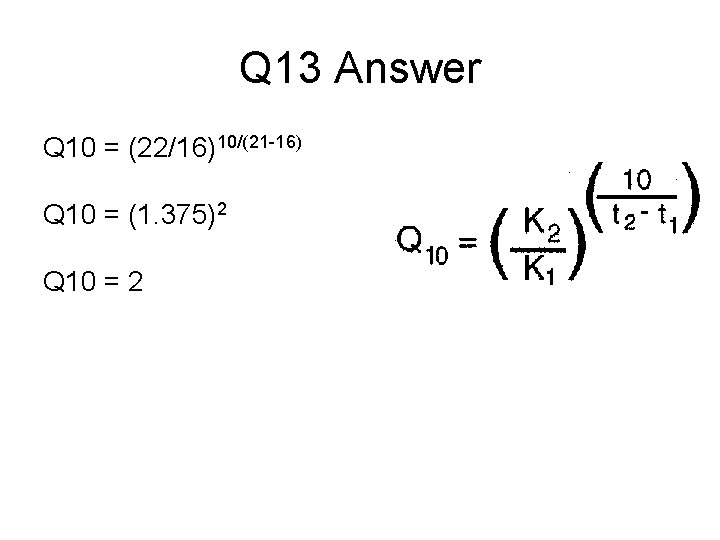
Q 13 Answer Q 10 = (22/16)10/(21 -16) Q 10 = (1. 375)2 Q 10 = 2
Q 14: Dilution • Joe has a 2 g/L solution. He dilutes it and creates 3 L of a 1 g/L solution. How much of the original solution did he dilute? Round to the nearest tenths.
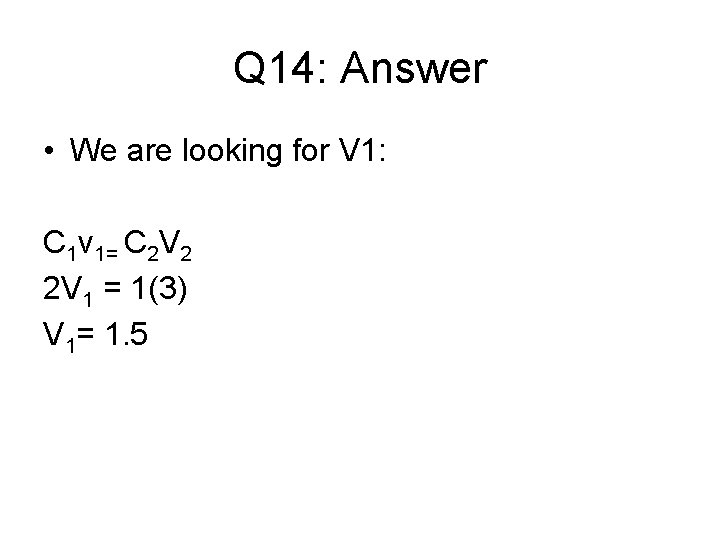
Q 14: Answer • We are looking for V 1: C 1 v 1= C 2 V 2 2 V 1 = 1(3) V 1= 1. 5
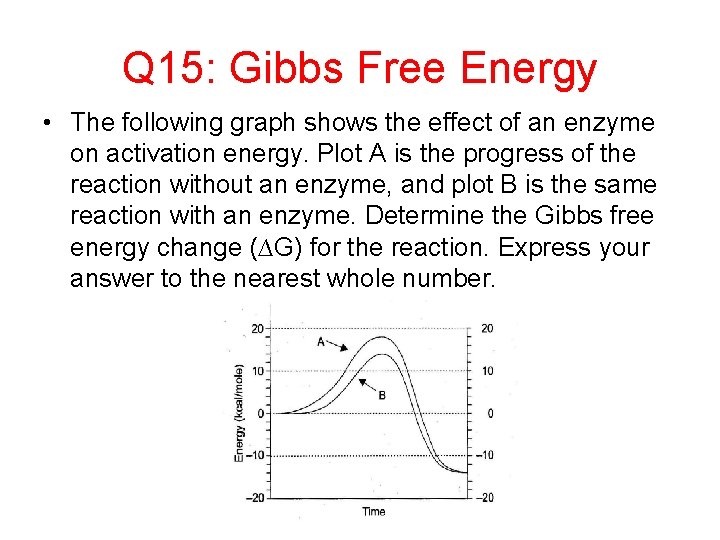
Q 15: Gibbs Free Energy • The following graph shows the effect of an enzyme on activation energy. Plot A is the progress of the reaction without an enzyme, and plot B is the same reaction with an enzyme. Determine the Gibbs free energy change (∆G) for the reaction. Express your answer to the nearest whole number.
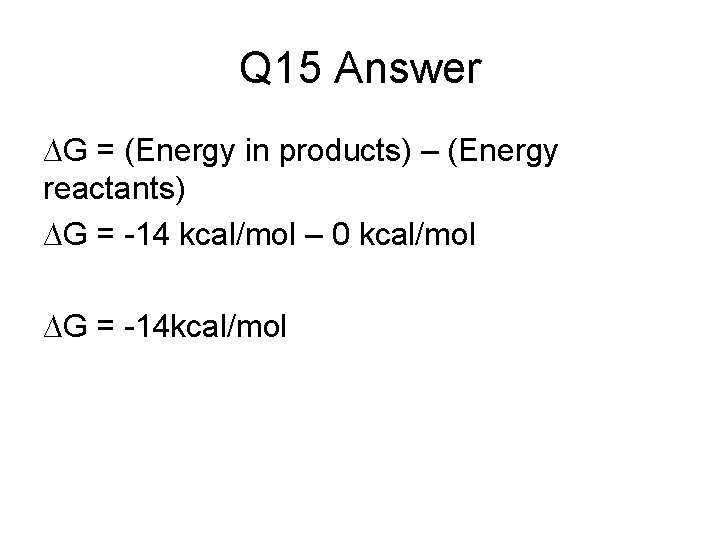
Q 15 Answer ∆G = (Energy in products) – (Energy reactants) ∆G = -14 kcal/mol – 0 kcal/mol ∆G = -14 kcal/mol
- Slides: 34