
AP Biology Biochemistry Water Part 2 Text Readings
AP Biology Biochemistry: Water Part 2
Text Readings Ch 3 • • Universal Solvent – p. 50 -55 Mole/Molarity – p. 52 Acids/Bases- p. 53 -54 Acid Precip- p. 54
Universal Solvent
Solution-substance possessing equal distribution of material
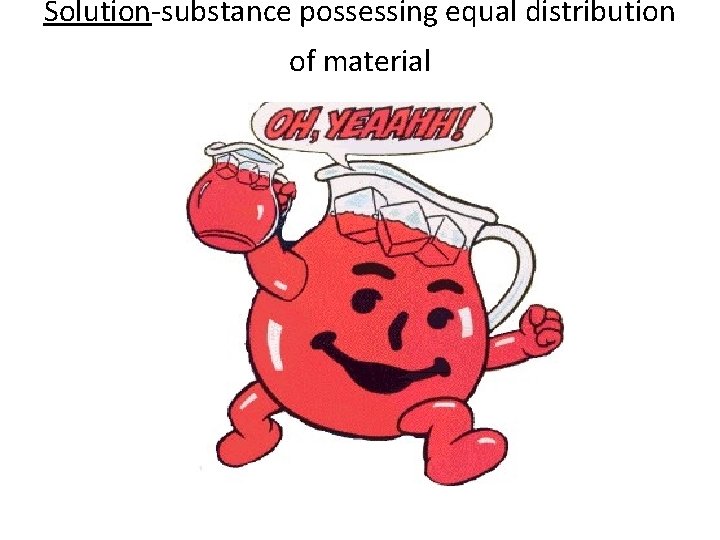
Solutions • Solute- substance being dissolved (ex. Sugar) • Solvent- substance doing the dissolving (ex. Water)
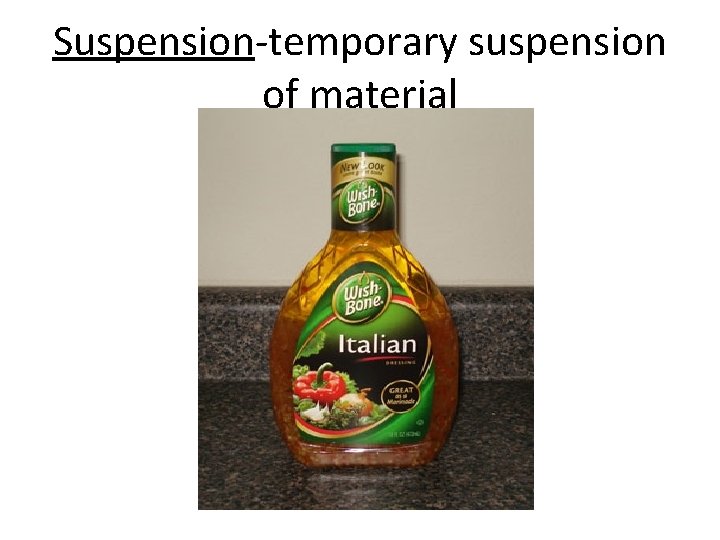
Suspension-temporary suspension of material
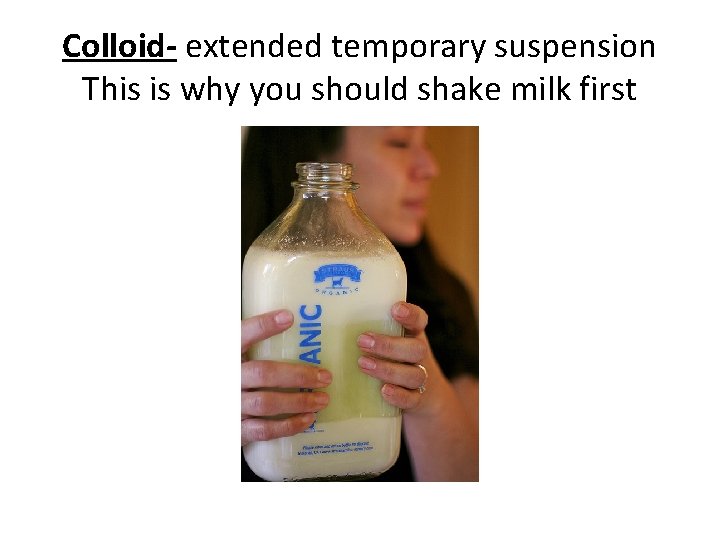
Colloid- extended temporary suspension This is why you should shake milk first
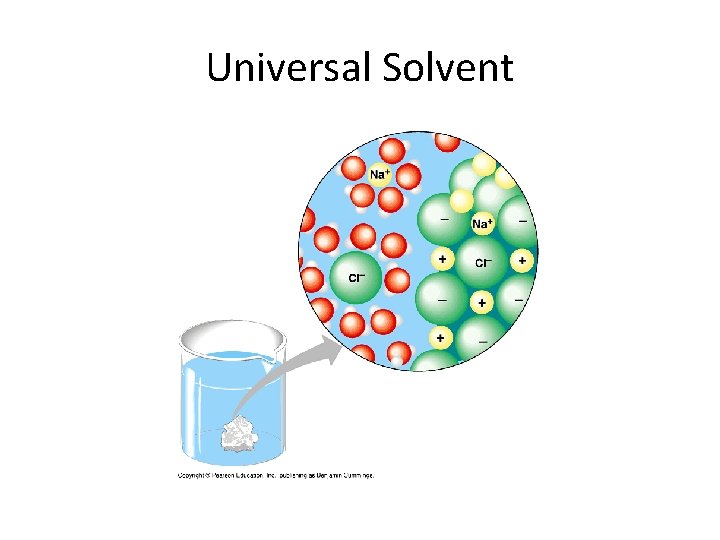
Hydrogen bonds of water make all of these situations possible! Hydration shell- water surrounding a molecule. Substance is dissolved and “disappears”
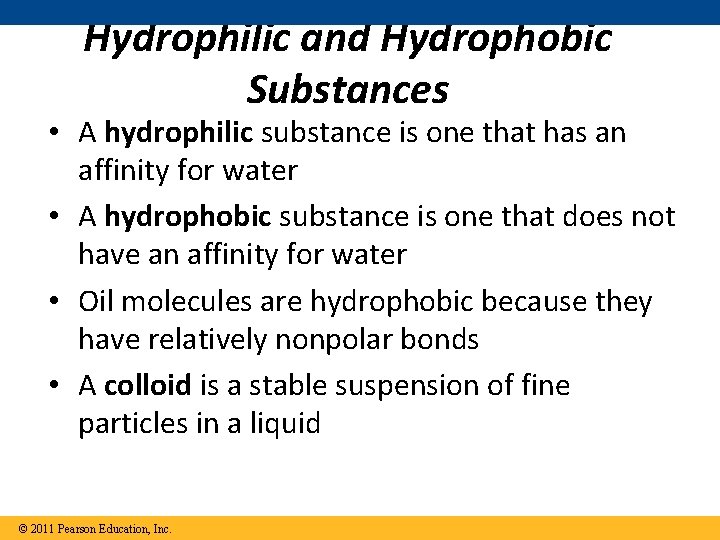
Hydrophilic and Hydrophobic Substances • A hydrophilic substance is one that has an affinity for water • A hydrophobic substance is one that does not have an affinity for water • Oil molecules are hydrophobic because they have relatively nonpolar bonds • A colloid is a stable suspension of fine particles in a liquid © 2011 Pearson Education, Inc.
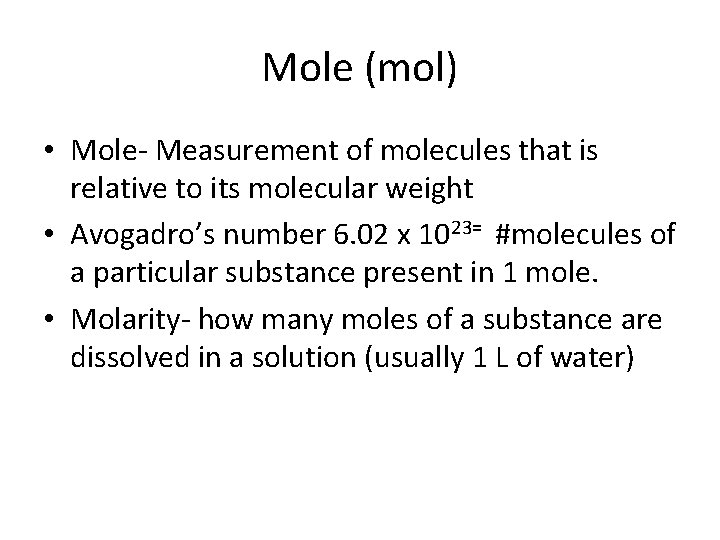
Mole (mol) • Mole- Measurement of molecules that is relative to its molecular weight • Avogadro’s number 6. 02 x 1023= #molecules of a particular substance present in 1 mole. • Molarity- how many moles of a substance are dissolved in a solution (usually 1 L of water)
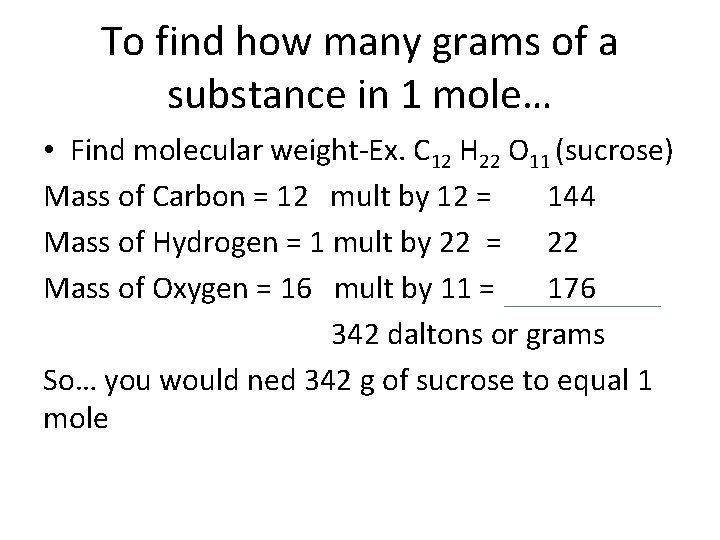
To find how many grams of a substance in 1 mole… • Find molecular weight-Ex. C 12 H 22 O 11 (sucrose) Mass of Carbon = 12 mult by 12 = 144 Mass of Hydrogen = 1 mult by 22 = 22 Mass of Oxygen = 16 mult by 11 = 176 342 daltons or grams So… you would ned 342 g of sucrose to equal 1 mole
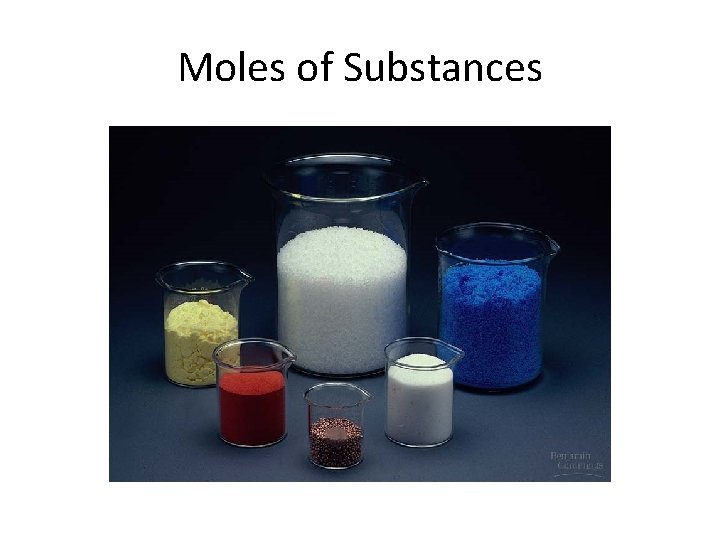
Moles of Substances
Concept 3. 3: Acidic and basic conditions affect living organisms • A hydrogen atom in a hydrogen bond between two water molecules can shift from one to the other – The hydrogen atom leaves its electron behind and is transferred as a proton, or hydrogen ion (H+) – The molecule with the extra proton is now a hydronium ion (H 3 O+), though it is often represented as H+ – The molecule that lost the proton is now a hydroxide ion (OH–) © 2011 Pearson Education, Inc.
• Concentrations of H+ and OH– are equal in pure water • Adding certain solutes, called acids and bases, modifies the concentrations of H+ and OH– • Biologists use something called the p. H scale to describe whether a solution is acidic or basic (the opposite of acidic) © 2011 Pearson Education, Inc.
Acids and Bases • An acid is any substance that increases the H+ concentration of a solution • A base is any substance that reduces the H+ concentration of a solution © 2011 Pearson Education, Inc.
• Acidic solutions have p. H values less than 7 • Basic solutions have p. H values greater than 7 • Most biological fluids have p. H values in the range of 6 to 8 © 2011 Pearson Education, Inc.
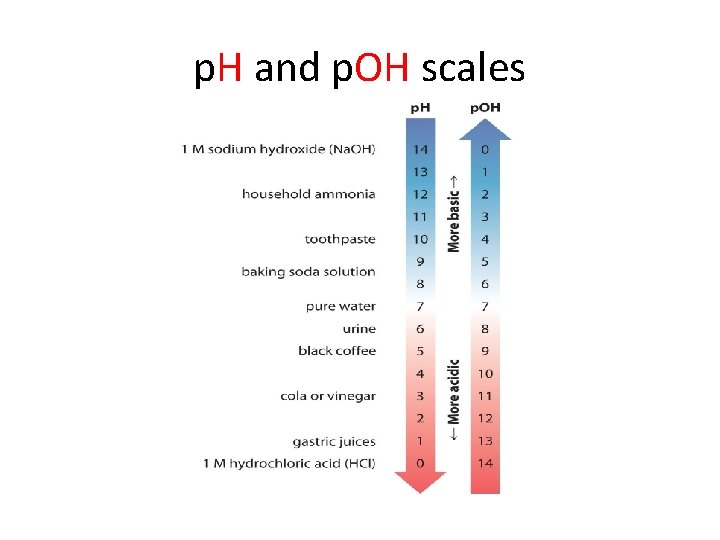
p. H and p. OH scales
Buffers • The internal p. H of most living cells must remain close to p. H 7 • Buffers are substances that minimize changes in concentrations of H+ and OH– in a solution • Most buffers consist of an acid-base pair that reversibly combines with H+ © 2011 Pearson Education, Inc.
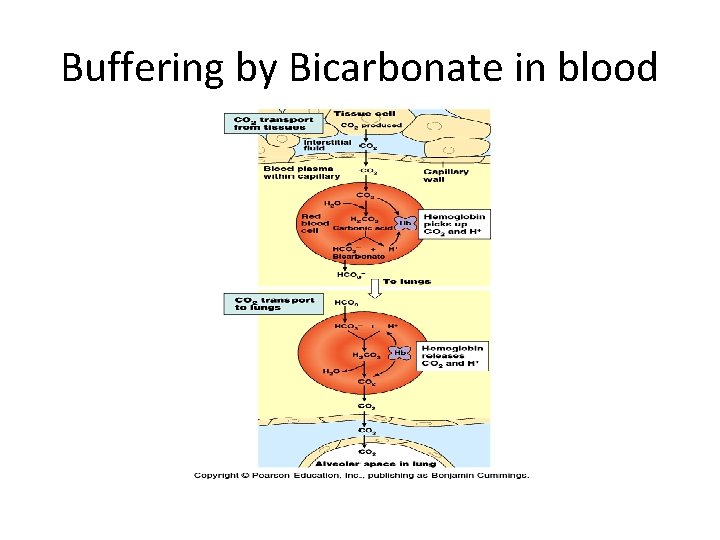
Buffering by Bicarbonate in blood
Acidification: A Threat to Water Quality • Human activities such as burning fossil fuels threaten water quality • CO 2 is the main product of fossil fuel combustion • About 25% of human-generated CO 2 is absorbed by the oceans • CO 2 dissolved in sea water forms carbonic acid; this process is called ocean acidification © 2011 Pearson Education, Inc.
• The burning of fossil fuels is also a major source of sulfur oxides and nitrogen oxides • These compounds react with water in the air to form strong acids that fall in rain or snow • Acid precipitation is rain, fog, or snow with a p. H lower than 5. 2 • Acid precipitation damages life in lakes and streams and changes soil chemistry on land © 2011 Pearson Education, Inc.
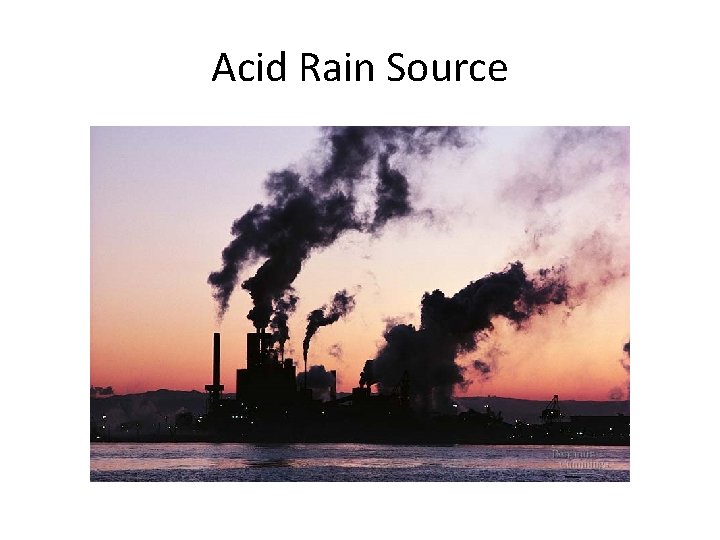
Acid Rain Source
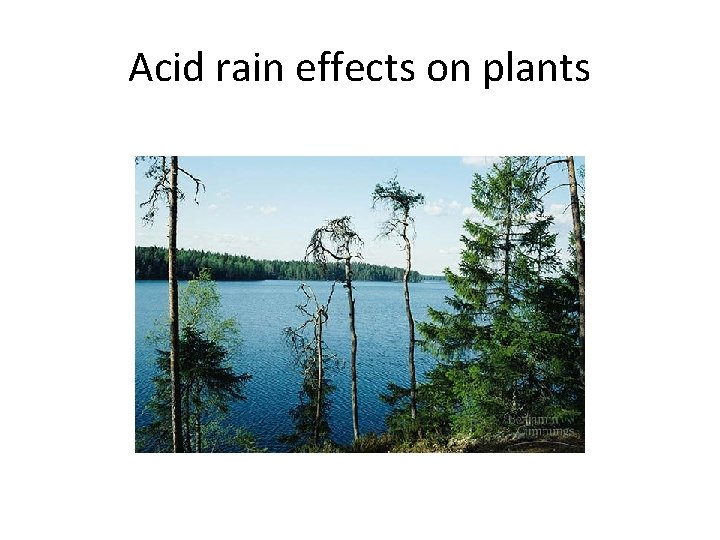
Acid rain effects on plants
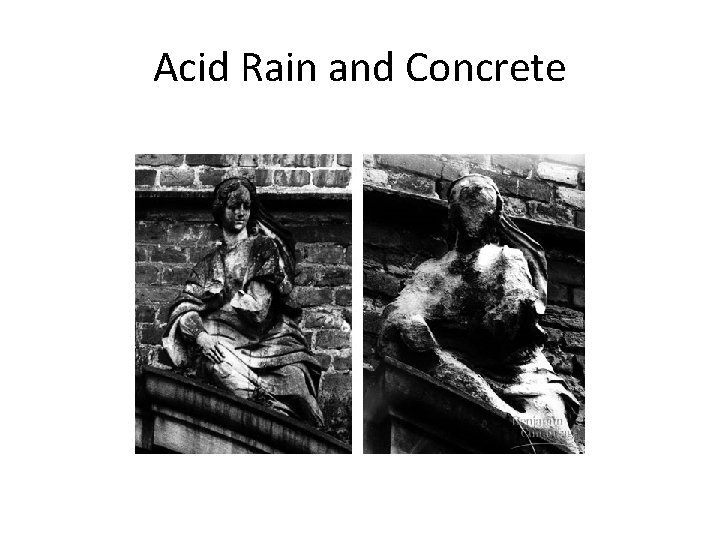
Acid Rain and Concrete
- Slides: 24