
AP and Dual Courses Prof Susan Wildburger AP

AP and Dual Courses Prof. Susan Wildburger
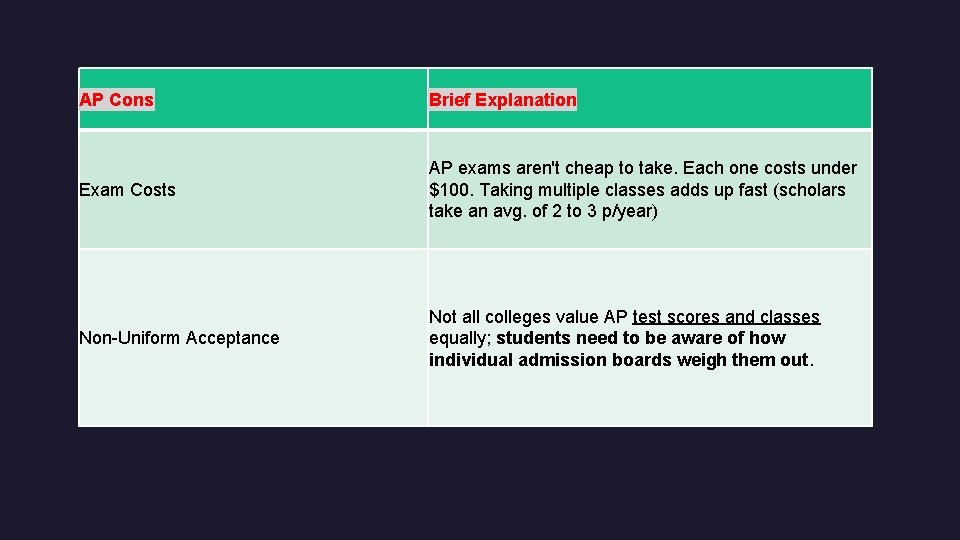
AP Cons Brief Explanation Exam Costs AP exams aren't cheap to take. Each one costs under $100. Taking multiple classes adds up fast (scholars take an avg. of 2 to 3 p/year) Non-Uniform Acceptance Not all colleges value AP test scores and classes equally; students need to be aware of how individual admission boards weigh them out.
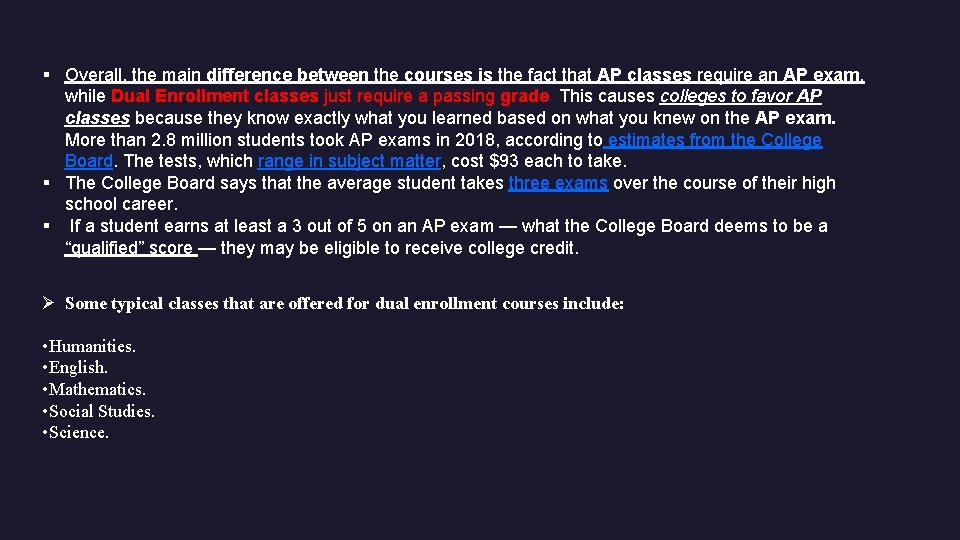
§ Overall, the main difference between the courses is the fact that AP classes require an AP exam, while Dual Enrollment classes just require a passing grade. This causes colleges to favor AP classes because they know exactly what you learned based on what you knew on the AP exam. More than 2. 8 million students took AP exams in 2018, according to estimates from the College Board. The tests, which range in subject matter, cost $93 each to take. § The College Board says that the average student takes three exams over the course of their high school career. § If a student earns at least a 3 out of 5 on an AP exam — what the College Board deems to be a “qualified” score — they may be eligible to receive college credit. Ø Some typical classes that are offered for dual enrollment courses include: • Humanities. • English. • Mathematics. • Social Studies. • Science.

What Are Dual Credit Courses? § Dual Credit courses are offered in a variety of subject areas including math, science, English, economics, history, government and a wide variety of technical courses. § Dual Credit courses are taught either at the college or at the high school. Courses are taught by college faculty or by qualified high school instructors who meet the same criteria as college faculty. § All students enrolled in a Dual Credit course at any of our partnering high schools should expect the same level of course rigor and student expectations that are placed on undergraduate students enrolled in the same course at Dallas College. § Dual Credit academic courses are transferable to all Texas public colleges and universities and to some private and out-of-state institutions. What Are the Benefits? § Dual Credit offers motivated high school students the opportunity to earn college and high school credit simultaneously. https: //www. dcccd. edu/high-school-students/dual-credit/pages/default. aspx
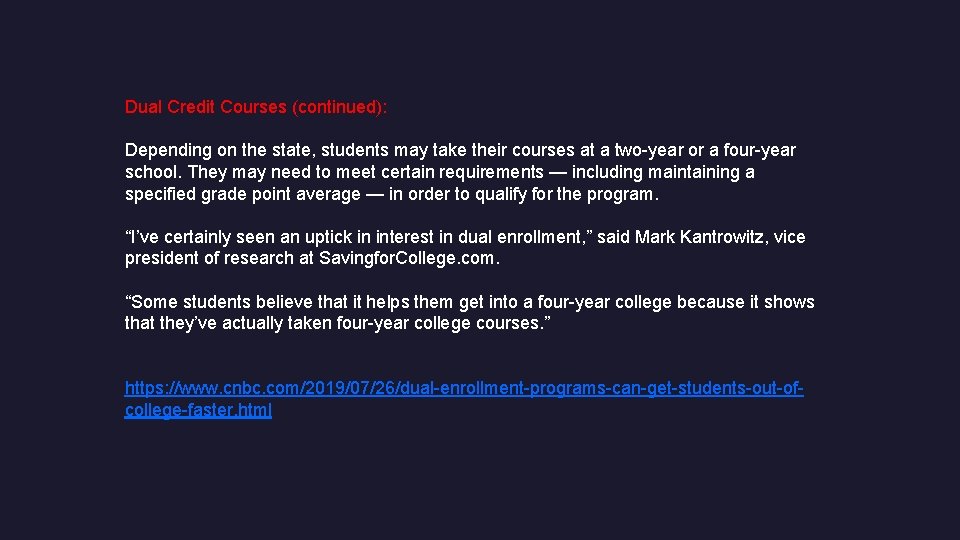
Dual Credit Courses (continued): Depending on the state, students may take their courses at a two-year or a four-year school. They may need to meet certain requirements — including maintaining a specified grade point average — in order to qualify for the program. “I’ve certainly seen an uptick in interest in dual enrollment, ” said Mark Kantrowitz, vice president of research at Savingfor. College. com. “Some students believe that it helps them get into a four-year college because it shows that they’ve actually taken four-year college courses. ” https: //www. cnbc. com/2019/07/26/dual-enrollment-programs-can-get-students-out-ofcollege-faster. html
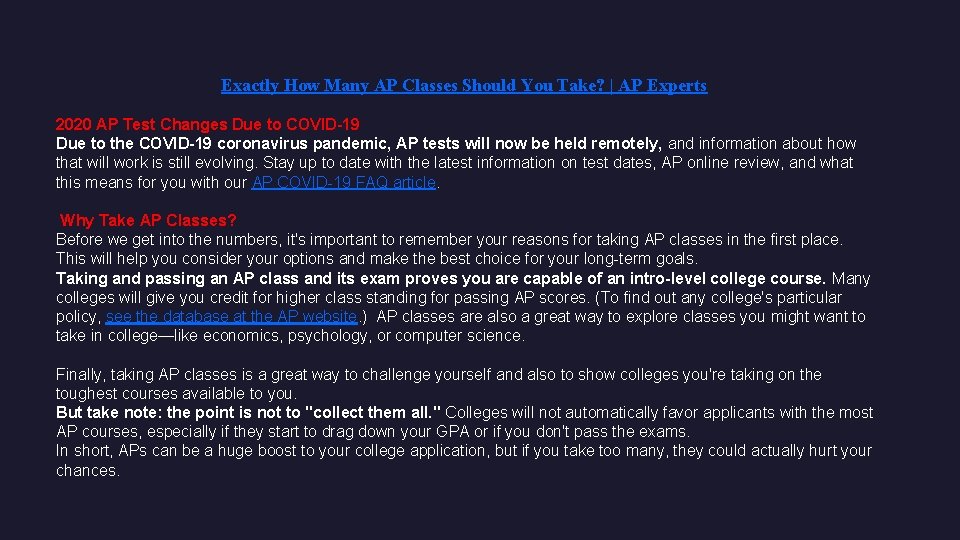
Exactly How Many AP Classes Should You Take? | AP Experts 2020 AP Test Changes Due to COVID-19 Due to the COVID-19 coronavirus pandemic, AP tests will now be held remotely, and information about how that will work is still evolving. Stay up to date with the latest information on test dates, AP online review, and what this means for you with our AP COVID-19 FAQ article. Why Take AP Classes? Before we get into the numbers, it's important to remember your reasons for taking AP classes in the first place. This will help you consider your options and make the best choice for your long-term goals. Taking and passing an AP class and its exam proves you are capable of an intro-level college course. Many colleges will give you credit for higher class standing for passing AP scores. (To find out any college's particular policy, see the database at the AP website. ) AP classes are also a great way to explore classes you might want to take in college—like economics, psychology, or computer science. Finally, taking AP classes is a great way to challenge yourself and also to show colleges you're taking on the toughest courses available to you. But take note: the point is not to "collect them all. " Colleges will not automatically favor applicants with the most AP courses, especially if they start to drag down your GPA or if you don't pass the exams. In short, APs can be a huge boost to your college application, but if you take too many, they could actually hurt your chances.
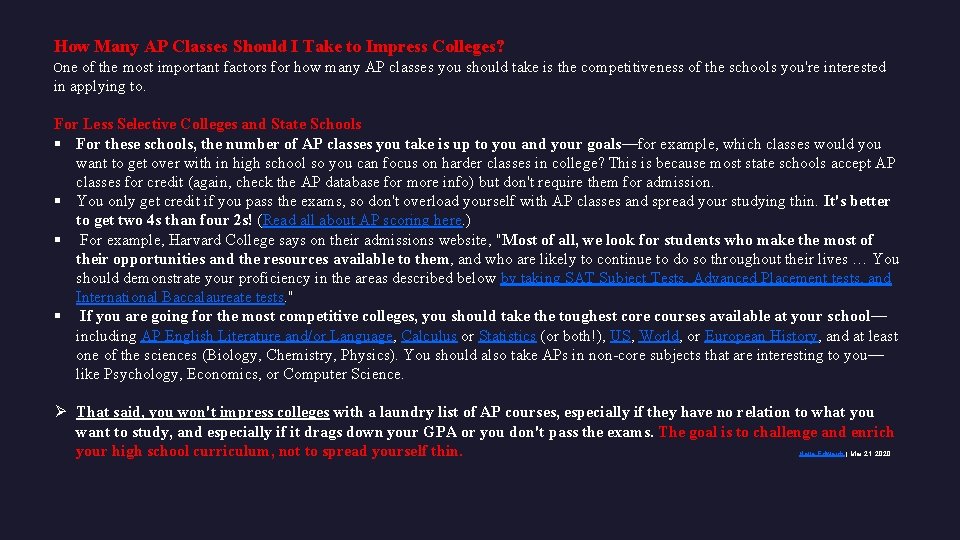
How Many AP Classes Should I Take to Impress Colleges? One of the most important factors for how many AP classes you should take is the competitiveness of the schools you're interested in applying to. For Less Selective Colleges and State Schools § For these schools, the number of AP classes you take is up to you and your goals—for example, which classes would you want to get over with in high school so you can focus on harder classes in college? This is because most state schools accept AP classes for credit (again, check the AP database for more info) but don't require them for admission. § You only get credit if you pass the exams, so don't overload yourself with AP classes and spread your studying thin. It's better to get two 4 s than four 2 s! (Read all about AP scoring here. ) § For example, Harvard College says on their admissions website, "Most of all, we look for students who make the most of their opportunities and the resources available to them, and who are likely to continue to do so throughout their lives … You should demonstrate your proficiency in the areas described below by taking SAT Subject Tests, Advanced Placement tests, and International Baccalaureate tests. " § If you are going for the most competitive colleges, you should take the toughest core courses available at your school— including AP English Literature and/or Language, Calculus or Statistics (or both!), US, World, or European History, and at least one of the sciences (Biology, Chemistry, Physics). You should also take APs in non-core subjects that are interesting to you— like Psychology, Economics, or Computer Science. Ø That said, you won't impress colleges with a laundry list of AP courses, especially if they have no relation to what you want to study, and especially if it drags down your GPA or you don't pass the exams. The goal is to challenge and enrich your high school curriculum, not to spread yourself thin. Halle Edwards | Mar 21, 2020

So, What's the Right Number of AP Classes? § You need to challenge yourself, but not overload your schedule. Also keep in mind your target schedule depends on which type of college you are trying to get into, and the AP availability at your school. As a general rule, you should aim for the following AP class numbers: § Most Selective Schools (Top 20): APs in most or all of the core courses (English, Mathematics, Science, History, and Foreign Language), plus additional AP courses that relate to your goals, future major, or interests. This will end up being between 7 and 12 AP courses. § Selective Schools (Top 100): APs in most core courses, plus one or two additional courses. This will end up being between 4 and 8 AP courses. § Less Selective Schools: APs in some core courses, or in courses related to your anticipated major. This will end up being between 1 and 5 AP courses. Ø Sophomore Year: Take one to three AP classes. Consider adding a more challenging AP class, like World History or US History, and one or two lessdemanding APs. Continue to take honors courses if possible in your other core classes. Ø Junior Year: Based on your experience and scores from freshman and sophomore year, start taking APs in core classes, for example AP English, AP Calculus, or AP Biology. Take as many as you can handle without spreading yourself thin, and make sure you will have time to study for the ACT or SAT this year. An Ivy League hopeful might take 3 to 5 AP classes, while if you're aiming for less-selective schools, 2 to 4 would be enough. Ø Senior Year: Take more APs in core subjects and additional subjects, again being careful not to overburden your schedule and to leave time for college applications. It's not uncommon for applicants to highly selective schools to have as many as 5 or 6 AP classes senior year, but keep your own schedule and limits in mind. Adding one more AP class will not have a huge effect on your college chances at this point, but it could significantly reduce the time you spend on applications and therefore hurt your admission chances.

Below is a chart summarizing the above information. And again, these rules aren't hard and fast, as there is no set formula for admission to the most selective schools. The bottom line is to take the most challenging course load you can handle while also doing very well academically. 9 th Grade 0 -2 Human Geography Environmental Science 10 th Grade 1 -3 World History European History Psychology 11 th Grade 2 -4 English Language Year United States History Biology Chemistry 12 th Grade 3 -4 English Literature AB or BC Calculus Statistics Computer Science Physics US Government and Politics Foreign Language Recommended Number of AP Classes to Take AP Class Suggestions

“Here's an interesting fact: If typically take honors and AP courses but decide to take a dual enrollment course, you might find that even an A in a dual enrollment course brings down your high school GPA. Most colleges recalculate your GPA when you apply, so it likely won't affect your application !” (E. Sawyer, 2019). Be careful about burning yourself out, especially senior year. You will need to devote lots of time and energy to your college apps! Questions: feel free to email me at susan. wildburger@islamicschoolofirving. org or Mr. Abdi: fazlur. abdi@islamicschoolofirving. org
- Slides: 10