
AOTA Representative Assembly Your Link to Action on
AOTA Representative Assembly Your Link to Action on Issues and Concerns Affecting Occupational Therapy Presented by: Audrey Gargiullo, MS, OTR/L Erin B. Povse, MS, OTR/L
Learning Objectives • Provide link from AOTA to GOTA members as well as Georgia OT Practitioners • Educate and enhance knowledge of AOTA initiatives, 2018 -2020 Strategic Plan and Vision 2025 • Discuss past and current AOTA issues including recent move by AOTA BOD to put OTD/OTA educational mandates in abeyance • Establish Mandates and provide history/timeline of AOTA and ABIM with the Choosing Wisely program to improve OT practice

Vision 2025 • Occupational therapy maximizes health, wellbeing, and quality of life for all people, populations, and communities through effective solutions that facilitate participation in everyday living.
Four Pillars • Four “pillars” help articulate and define how our efforts need to be focused to attain the Vision. They are: • Effective: Occupational therapy is evidence-based, clientcentered, and cost-effective. • Leaders: Occupational therapy is influential in changing policies, environments, and complex systems. • Collaborative: Occupational therapy excels in working with clients and within systems to produce effective outcomes. • Accessible: Occupational therapy provides culturally responsive and customized services. • Vision 2025 builds on the success of the Centennial Vision while positioning us to meet the challenges of the changing health care system.
AOTA Strategic Plan 2018 -2020 • https: //www. aota. org/~/media/Corporate/Fil es/About. AOTA/Governance/AOTA-Strategic. Goals-and-Objectives-2018 -2020. pdf
Strategic Plan Goal 1 • Expand our Reach and Impact – Advocate for and promote occupational therapy’s distinct value to maximize health, well-being, and quality of life by: • Advocate for public and payer policies that expand the impact of occupational therapy in the changing health care, education, and community systems at the state and federal levels.
Strategic Plan Goal 1 • Promote state regulatory requirements that recognize AOTA as the professional standard-setting authority for occupational therapy • Increase the number and impact of occupational therapy practitioners serving in influential roles in health care, education, and community systems. • Increase health services and systems research and publications focusing on occupational therapy’s distinct value. • Design and implement a communication program to articulate the distinct value of occupational therapy with practitioners and external audiences.
Strategic Plan Goal 2 • Prepare and Develop the Profession – Inform, educate, and activate occupational therapy practitioners to be agents of change to foster excellence in practice by: • Implement an occupational therapy educational model that prepares practitioners to deliver value in the changing health care and education delivery system • Support members’ professional growth to enable them to adapt and thrive in dynamic practice environments
Strategic Plan Goal 2 • Advance the leadership skills and competencies of OT practitioners, educators, and scientists • Promote capacity of OT practitioners to deliver culturally responsive services to diverse populations. • Expand opportunities for underrepresented populations of practitioners to engage with and increase their visibility within the profession. • Address licensure portability, allowing OT practitioners to enable participation in emerging delivery models such as telehealth
Strategic Plan Goal 3 • Serve as the Professional Home. – Connect, engage, and inspire our community to participate actively in advancing our mission and achieving our shared vision.
Strategic Plan Goal 3 • Connect and leverage AOTA’s membership community to create engagement and value through information sharing, networking, and creative collaboration. • Provide enhanced services that deliver explicit value to AOTA members based on career stage, work setting, and practice areas.
Strategic Plan Goal 4 • Goal 4. Advance Quality and Recognition of Occupational Therapy Practice. – Foster widespread adoption of evidence-based approaches in occupational therapy that reduce cost, increase access, and improve outcomes across the continuum of care.
Strategic Plan Goal 4 • Fill critical knowledge and data gaps to showcase the positive impact of OT services, including effective knowledge translation initiatives. • Foster the development of programs that ensure occupational therapy practitioners are adequately supported to provide quality care.
Representative Assembly (RA) • The body of the Association which establishes professional policies and standards affecting the direction of the profession • Your link to action on issues and concerns affecting occupational therapy.
RA also… • Charges RA officials, RA committees, ad hoc committees, and at times, the Board of Directors to direct the Executive Director to do things within the jurisdiction of the RA • Elects RA officials and standing committee chairs – Speaker; Vice Speaker; Recorder – Agenda Committee; Credentials Review and Accountability Committee
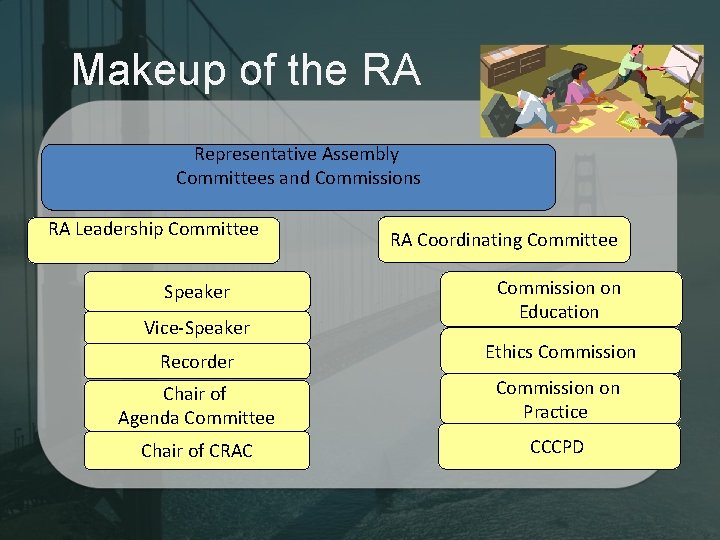
Makeup of the RA Representative Assembly Committees and Commissions RA Leadership Committee Speaker Vice-Speaker Recorder RA Coordinating Committee Commission on Education Ethics Commission Chair of Agenda Committee Commission on Practice Chair of CRAC CCCPD
RA Abbreviations • CCCPD-Commission on Continued Competency and Professional Development – Develops and maintains the Standards for Continuing Competence. The CCCPD provides guidelines and tools that support the ongoing professional development of practitioners • CRAC- Credentials Review and Accountability Committee – Verifies credentials for eligibility for RA • RACC- RA Coordinating Committee chaired by Vice Speaker – Made up of all RA committees- COE, COP, CCCPD & Ethics • RALC-RA Leadership Committee – Guides the functions and processes of the RA; made up of Speaker, Vice Speaker, Recorder, Chair of the Agenda Committee, CRAC chair
More Abbreviations • COE- Commission on Education – identifies, analyzes, and anticipates issues in education and generates education-related policy • COP-Commission on Practice – promotes the quality of occupational therapy practice and develops practice standards for occupational therapists and occupational therapy assistants relative to provider and consumer needs. • EC-Ethics Commission – maintains the AOTA Code of Ethics, educates and interprets the Code of Ethics to members and consumers, and reviews cases of non-compliance with the Code of Ethics
RA Facts • Represents the membership – 50 states, 2 territories • Meets at least twice per year (online in the Fall and in-person or online in the Spring) • Reports information to and helps AOTA members access information • Solicits motions from AOTA members • Representatives serve as a conduit of information from AOTA to members in their states
What is a motion? • A proposal that introduces an item to the membership of AOTA for their consideration • Motions can be submitted any time in the year but there are deadlines for submission for both Fall and Spring Meetings of the RA. Fall deadline just passed last month, September 24 th
A Motion May… • Recommend an ad hoc committee be formed to investigate the need for action or resources • Create a change to the AOTA by-laws • Recommend the development/adoption of an official document • State the RA’s position on an initiative or issue • Charge the Board to direct the Executive Director towards an action
Historical Trends that Have Resulted in RA Motions and Action • Federal & State legislation impacting the profession/practice • Entry level education • Strengthening of the OTA position • Standards of practice • Research and advanced-degree education • Continuing Education & Continuing Competency • Recruitment & Personnel • Specialization • International Community
Why write a motion? • A motion tells the RA what action you want taken and why it should be taken • A motion expresses a certain view or directs that a particular investigation be conducted and the findings be reported for further action
RA Motions the Following Criteria Related to professional policy or standards Relevant to contemporary practice Of national importance and relevance Relates to a broad range of AOTA members Impacts practice or education in a positive and meaningful way • Is appropriate for consideration by a national professional organization • Moves the profession forward in a meaningful way • • •
Process to Submit Motions 1. Work with your State Representative to complete the Motions Submission Form together: https: //www. aota. org/About. AOTA/Get. Involved/RA/Motions. aspx 2. Submit COMPLETED form to motions@aota. org 3. Motion is reviewed by Agenda Committee, RALC, Staff Liaison, and resource people 4. Any questions or clarifications are made in collaboration with the State Representative and the originator of the motion 5. Fiscal implication and charge sections are completed by AOTA Staff once the motion is moved forward 6. Motion is included in RA business at the next scheduled meeting
We are here to help! Your Georgia Representative until June 2020: Audrey Gargiullo, MS, OTR/L agargiullo 2142@att. net (Please Put Subject Line Georgia RA) (770)355 -1253 Fall On-Line meeting of the RA will be November 5 -12 th r the o f s on Moti Meeting FALL ue 9/24 d were

Resources on the AOTA Website. . . http: //www. aota. org/aboutaota/ get-involved/ra. aspx
Recent RA Meeting Highlights Spring 2018 Meeting– The RA voted for the adoption of the official document “Occupational Therapy’s Role in Case Management”
Recent RA Meeting Highlights Fall 2017 The RA approved : – The adoption of the Societal Statement on Disaster Response and Risk Reduction – The adoption of the Societal Statement on Stress, Trauma and Posttraumatic Stress Disorder – Motion charging the COE to develop a Standardized Evaluation Tool for OTD Student Performance during Doctoral Experiential Therapy Curricula – COE paper on the Importance of Collaborative OT/OTA Intraprofessional Education in Occupational Therapy Curricula
AOTA Educates the country about Occupational Therapy • In July 2018, stories about Occupational Therapy appeared in a total of 55 publications or outlets including 24 outlets with 5 million or more views including TODAY Show, Psychology Today, Reader’s Digest • AOTA Created series of videos about how Occupational Therapy helps children and families with play, see full version at: https: //www. aota. org/About-Occupational. Therapy/Patients-Clients/Children. And. Youth/video -play-important-part-of-your-day. aspx:
Future Discussion for RA • 8/10/2018: AOTA Board of Directors putting the ACOTE mandates for one entry point OTD and dual entry OTA in abeyance. The reason for this action because the decision to go to a single point of entry did not go through the proper governance processes since the RA is charged with determining the entry level to the profession • I will be asking for input from Georgia Occupational Therapy Practitioners in the future and providing more education on the matter as we prepare to address this in the RA
AOTA Links for BOD Announcement, Background Materials and FAQs • https: //www. aota. org/About. AOTA/Get. Involved/BOD/News/2018/Message-From-AOTA-Board. Directors-OTD-OTA-Mandates. aspx • https: //www. aota. org/About. AOTA/Get. Involved/BOD/ACOTE-Mandate-Background-Materials. aspx • https: //www. aota. org/About. AOTA/Get. Involved/BOD/FAQs-ACOTE-Mandate. aspx? utm_source=OT OTA%20 Mandates%20090418&utm_medium=email&utm_ campaign=FAQs%20 From%20 AOTA%E 2%80%99 s%20 Board %20 of%20 Directors%20 on%20 the%20 OT%20 and%20 OTA% 20 Mandates
AOTA -Recent Successes • Legislation Introduced to Allow OTs to Open Medicare Home Healthcare Cases • House Ways and Means Committee passed multiple bills in May related to opioids and pain management alternative within Medicare. Two of the bills included occupational therapy practitioners as part of the treatment team to be considered by Medicare when developing policies. . • AOTA’s Pediatric Practice Manager led the Annual Meeting of the National Coordinating Committee for Safe and Healthy Schools (NCCSHS)
AOTA COORDINATED ONLINE OPPORTUNITIES FOR LEADERSHIP (COOL) VOLUNTEER DATABASE ØCreate a profile to get involved ØShort-term and long-term volunteer leadership opportunities available ØAOTA leadership nominations open in the Fall each year ØAOTA leadership elections are in January each year
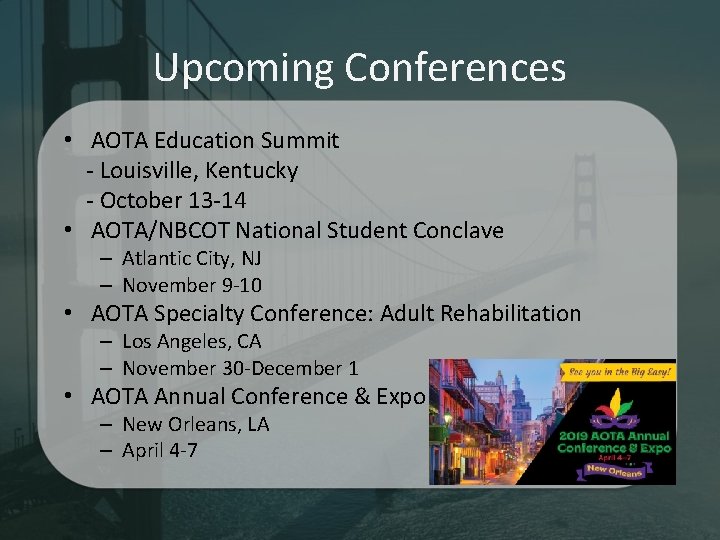
Upcoming Conferences • AOTA Education Summit - Louisville, Kentucky - October 13 -14 • AOTA/NBCOT National Student Conclave – Atlantic City, NJ – November 9 -10 • AOTA Specialty Conference: Adult Rehabilitation – Los Angeles, CA – November 30 -December 1 • AOTA Annual Conference & Expo – New Orleans, LA – April 4 -7
Official Documents • Approved by the Representative Assembly • Types of Official Documents – Guidelines – Position Papers – Standards – Statements – Societal Statements
Critically Appraised Topics • Synthesis of Articles surrounding a topic • Key findings for practice • Variety of practice areas – Children & Youth – Health & Wellness – Mental Health – Productive Aging – Rehabilitation & Disability – Work & Industry
Evidence-Based Practice Resources • AOTA Practice Guideline Series • Special Issues of the American Journal of Occupational Therapy • Evidence Exchange • Research Opportunities Tables • Journal Club Toolkit • Evidence-based Resource Directory

Join your STATE OT ASSOCIATION • • Be a part of the growth of OT in your state Connect with local and state members Advocate for state level policy changes Access continuing education opportunities and other member resources
Benefits of AOTA Membership • Practice, education, and research information delivered through subscriptions to OT Practice, American Journal of Occupational Therapy (AJOT), OT Practice Pulse, AOTA Alerts e-newsletters, and resources on www. aota. org • Discounts on AOTA books, continuing education, AOTA Conferences • Social networking on Commun. OT
More Benefits Free On-line Webinars for members including recent topics of: • How OT Practitioners Can Prepare for the new SNF Payment Model • Advocacy: Taking Action to a Whole New Level • Identifying and Preventing Burnout in Occupational Therapy Practice • Facilitate Conversations About Driving for Older Adults
More Benefits… • Special Interest Sections (SISs) give access to online community forums and the Quarterly Practice Connections newsletter and archives • Professional certification and credentials for qualifying members that demonstrate professional excellence • Career advancement through OT joblink. org • Leadership opportunities through volunteer roles on COOL, the Coordinated Online Opportunities for Leadership database, committees; and more
Choosing Wisely Initiative • Initiative of American Board of Internal Medicine (ABIM) • Primary aim to promote meaningful conversations between practitioners and clients to ensure appropriate, quality care • Goals: – All care supported by evidence – Not duplicative of other services received – Free from harm – Truly necessary
Choosing Wisely Initiative Timeline • History of Choosing Wisely campaign by ABIM- launched in 2012 • AOTA joins Choosing Wisely in 2016 with the charge to create a list: “Things Providers and Patients Should Question” • Phase 1: at AOTA 2017 (April) announced, subsequent discussions, conference calls, items disseminated on AOTA’s website, call out to members via survey, list narrowed down • Phase 2: Provide members ability to give input, rank list via online survey, Draft discussed at AOTA (April 2018), BOD finalizes, presents to ABIM after AOTA conference • Phase 3: ABIM approval (May 2018), AOTA goal to publicize and disseminate to members, then share to all OT practitioners with assistance from members (June 2018 to present)
Choosing Wisely # 1 • Don’t provide intervention activities that are non-purposeful (e. g. , cones, pegs, shoulder arc, arm bike). • Purposeful activities – tasks that are part of daily routines and hold meaning, relevance, and perceived utility such as personal care, home management, school, and work—are a core premise of occupational therapy. Research shows that using purposeful activity (occupation) in interventions is an intrinsic motivator for patients. Such activities can increase attention, endurance, motor performance, pain tolerance, and engagement, resulting in better patient outcomes. Purposeful activities build on a person’s ability and lead to achievement of personal and functional goals. Conversely, non-purposeful activities do not stimulate interest or motivation, resulting in reduced patient participation and suboptimal outcomes.
Choosing Wisely # 2 • Don’t provide sensory-based interventions to individual children or youth without documented assessment results of difficulties processing or integrating sensory information. • Many children and youth are affected by challenges in processing and integrating sensations that negatively affect their ability to participate in meaningful and valued occupations. Processing and integrating sensations are complex and result in individualized patterns of dysfunction that must be addressed in personalized ways. Interventions that do not target the documented patterns of dysfunction can produce ineffective or negative results. Therefore, it is imperative to assess and document specific sensory difficulties before providing sensory-based interventions such as Ayres Sensory Integration®, weighted vests, listening programs, or sensory diets.
Choosing Wisely # 3 • Don’t use physical agent modalities (PAMs) without providing purposeful and occupation-based intervention activities. • The exclusive use of PAMs (e. g. , superficial thermal agents, deep thermal agents, electrotherapeutic agents, mechanical devices) as a therapeutic intervention without direct application to occupational performance is not considered occupational therapy. PAMs provided with a functional component can lead to more positive health outcomes. PAMs should be integrated into a broader occupational therapy program and intervention plan in preparation for or concurrently with purposeful activities or interventions that ultimately enhance engagement in occupation.
Choosing Wisely # 4 • Don’t use pulleys for individuals with a hemiplegic shoulder. • Use of an overhead pulley for individuals with a hemiplegic shoulder resulting from a stroke or other clinical condition is considered too aggressive and should be avoided, as it presents the highest risk of the patient developing shoulder pain. Gentler and controlled range of motion exercises and activities are preferred.
Choosing Wisely # 5 • Don’t provide cognitive-based interventions (e. g. , paper-and-pencil tasks, table-top tasks, cognitive training software) without direct application to occupational performance. • To improve occupational performance, cognitive-based interventions should be embedded in an occupation relevant to the patient. Examples of cognitive-based interventions include awareness approaches, strategy training, task training, environmental modifications, and assistive technology. The use of cognitive-based interventions not based on occupational performance will result in suboptimal patient outcomes.

Questions RA
- Slides: 50