
AOSC 400 2011 November 3 Lecture 16 Last
AOSC 400 -2011 November 3, Lecture # 16 Last Lecture: Local wind patterns ØSea breezes ØMonsoon Circulations ØSanta Ana wind Today: Global wind patterns: q One cell model q Three cell model q Effect of land on wind patterns q Surface-wind effects on the circulation of the oceans q Major Ocean Currents q Ocean transport (Ekman spiral)
Concept that were discussed previously and will be used in today’s lecture: (review if necessary) • How winds blow at the surface and higher in the atmopshere • What is Coriolis force • Flow around L and H in upper atmosphere • Flow around L and H at the surface • Upper level and surface maps • The forces at play: – High in the atmosphere: these include the pressure gradient force and the Coriolis force – At the surface: friction force needs to be added
General Circulation of the Atmosphere • “General” refers to the average air flow; actual winds will vary considerably. • Average conditions help identify driving forces. • The basic cause of the general circulation is unequal heating of the Earth’s surface – Warm air is transferred from the Tropics to the Poles – Cool air is transferred from the Poles to the Tropics
General Circulation of the Atmosphere • Early attempts to understand the general features of atmospheric circulations were based on the concept of Single Cell Model – Assume 1. Uniform water surface 2. Sun always directly overhead the Equator 3. Earth does not rotate Result: Huge thermally direct convection cell (Hadley cell)
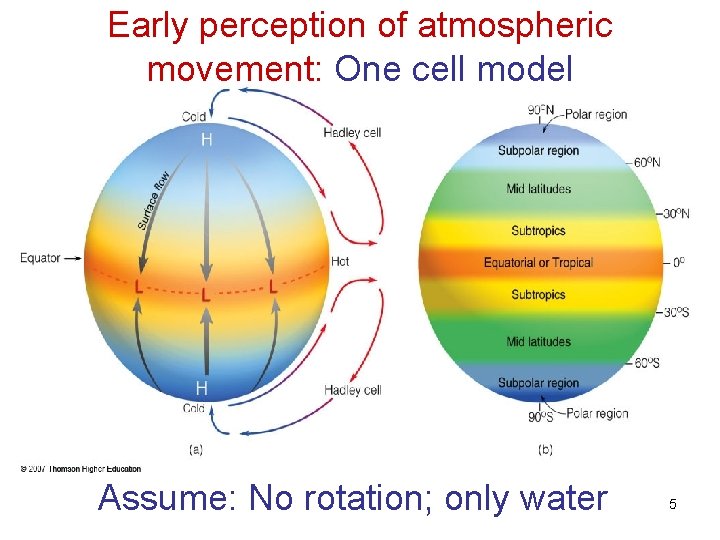
Early perception of atmospheric movement: One cell model Assume: No rotation; only water 5
General Circulation of the Atmosphere • Observation did not fully support this model. Next attempt was to fit the observations to a Three Cell Model – Allow earth to spin = three cells (Hadley, Ferrell, Polar) – Alternating belts of pressure starting with L at Equator – Alternating belts of wind with NE just North of Equator
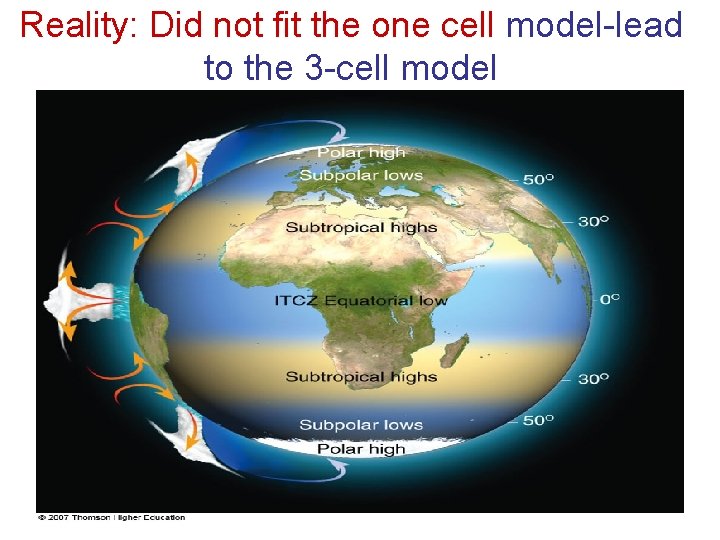
Reality: Did not fit the one cell model-lead to the 3 -cell model 7
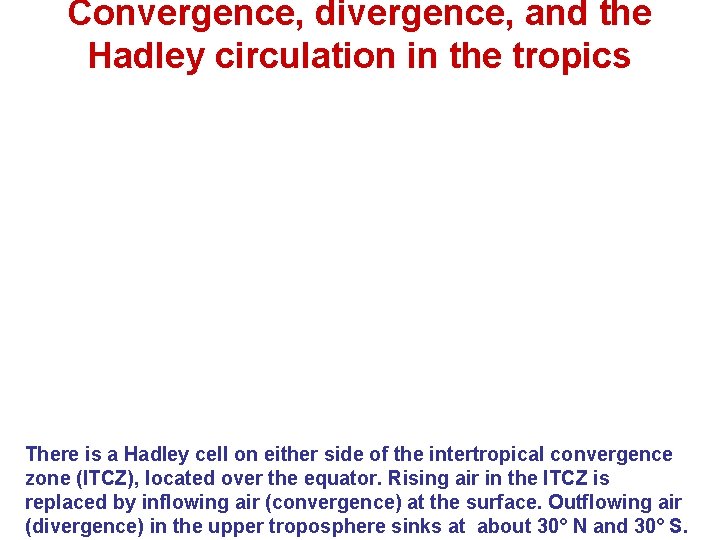
Convergence, divergence, and the Hadley circulation in the tropics There is a Hadley cell on either side of the intertropical convergence zone (ITCZ), located over the equator. Rising air in the ITCZ is replaced by inflowing air (convergence) at the surface. Outflowing air (divergence) in the upper troposphere sinks at about 30° N and 30° S.
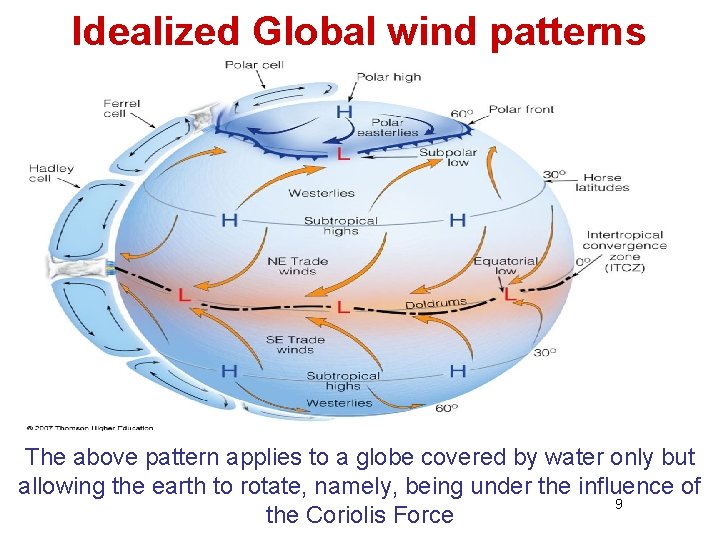
Idealized Global wind patterns The above pattern applies to a globe covered by water only but allowing the earth to rotate, namely, being under the influence of 9 the Coriolis Force
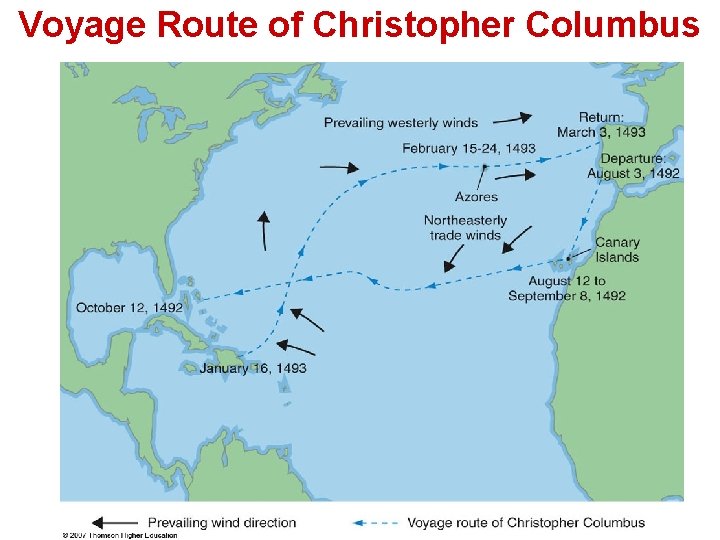
Voyage Route of Christopher Columbus 10

Some features of the 3 -cell model: Doldrums • Doldrums –a low-pressure area around the equator where the prevailing winds are calm. • The low pressure - due to strong heating at the equator; air rises and moves north and south in the atmosphere, until it subsides around 300. • In the doldrums - trapping of sailing boats for long periods. 11
Features of the 3 -cell model: Horse Latitudes • Horse latitudes – sub-tropic latitudes between 30 and 35 degrees both north and south. Under the influence of high pressure - an area which receives little precipitation and has calm winds. • The term "Horse Latitudes" –due to the fact that early sailors would come close to this area while crossing the Atlantic Ocean and have trouble to proceed. • The crew would throw horses overboard to conserve water and food and make the ship lighter for movement. 12

Features of the 3 -cell model: Precipitation Patterns – Rain where air rises (low pressure) – Less rain where air sinks (high pressure) • Average Wind Flow and Pressure Patterns Aloft – North-South temperature and pressure gradient at high altitudes creates West. East winds, particularly at mid to high latitudes.
• • • Features of the 3 -cell model: Location of Deserts The warm and dry conditions of the horse latitudes contribute to the existence of deserts, such as: Sahara Dessert in Africa southwestern United States and northern Mexico parts of the Middle East in the Northern Hemisphere Acatame Desert (plateau in South America); Kalahari Desert (S. Africa); Australian Desert in SH 14
Features of the 3 -cell model: Jet Streams Polar and Subtropical Jet – Established by steep temperature and pressure gradients between circulation cells. – Between tropical-mid-latitude cell (subtropical) and mid-latitude-polar cell (polar) – Gradients greatest at polar jet
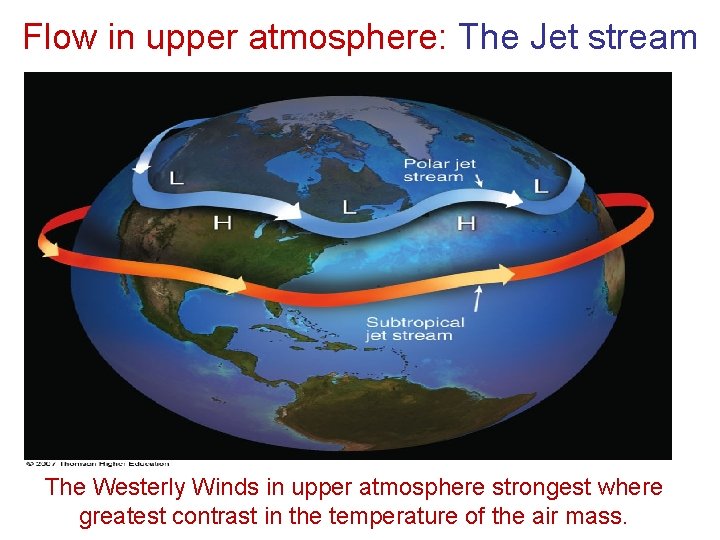
Flow in upper atmosphere: The Jet stream The Westerly Winds in upper atmosphere strongest where greatest contrast in the temperature of the air mass.
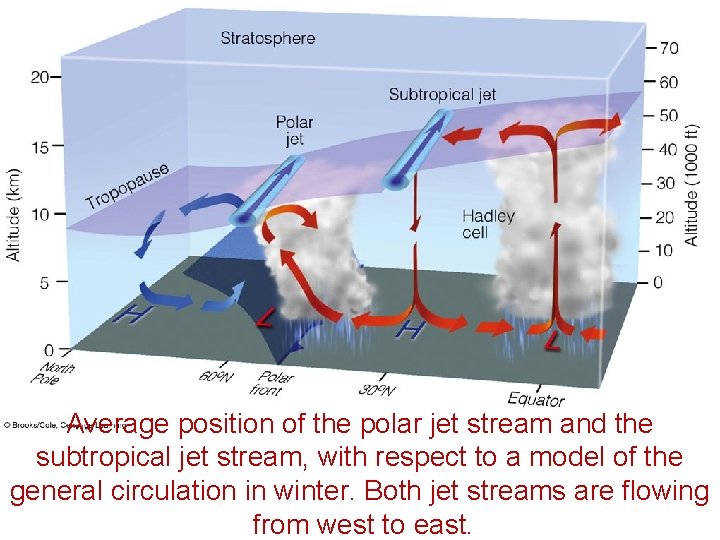
Average position of the polar jet stream and the subtropical jet stream, with respect to a model of the general circulation in winter. Both jet streams are flowing from west to east.
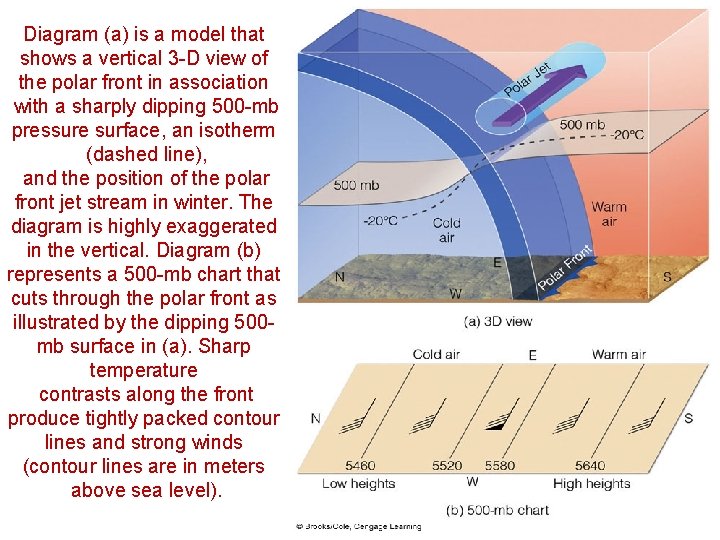
Diagram (a) is a model that shows a vertical 3 -D view of the polar front in association with a sharply dipping 500 -mb pressure surface, an isotherm (dashed line), and the position of the polar front jet stream in winter. The diagram is highly exaggerated in the vertical. Diagram (b) represents a 500 -mb chart that cuts through the polar front as illustrated by the dipping 500 mb surface in (a). Sharp temperature contrasts along the front produce tightly packed contour lines and strong winds (contour lines are in meters above sea level).
Jet Streams • 100 -200 kt winds at 10 -15 km, thousands of km long, several 100 km wide and a few km thick (polar and subtropical) • Observations: Dishpan Experiment – Illustrates waves, with trough and ridge, develops in a rotating pan with heat on the exterior and cold at the center.
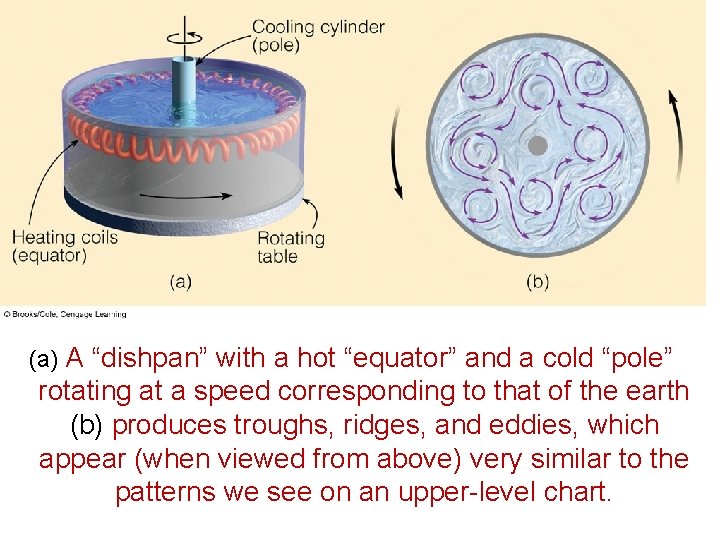
(a) A “dishpan” with a hot “equator” and a cold “pole” rotating at a speed corresponding to that of the earth (b) produces troughs, ridges, and eddies, which appear (when viewed from above) very similar to the patterns we see on an upper-level chart.
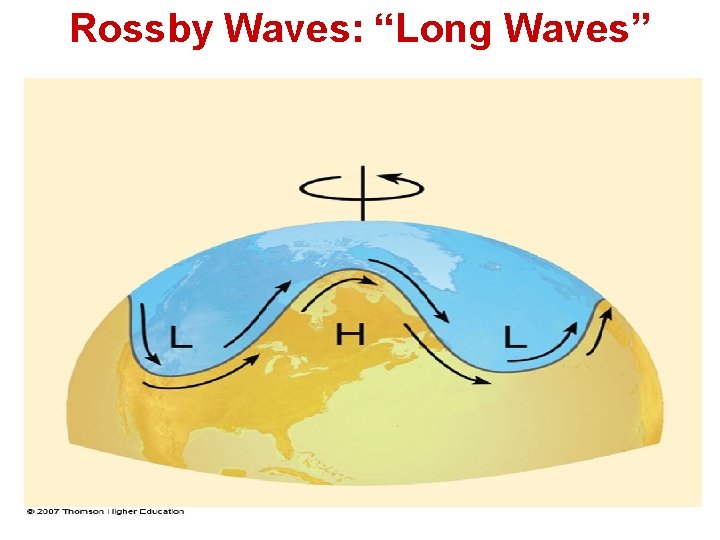
Rossby Waves: “Long Waves” 21
Jet Streams • Other Jet Streams –Tropical easterly jet stream –Low-level jet (nocturnal) –Polar night jet streams
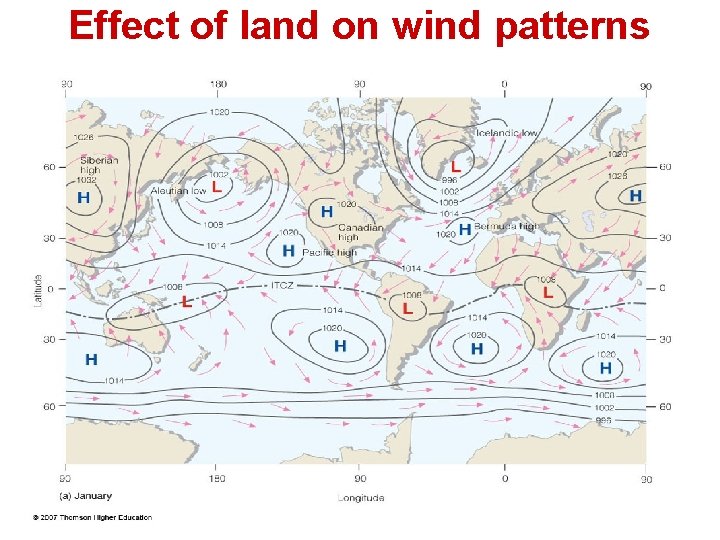
Actual Global Wind Distribution • The described pattern of wind distribution is for an idealized sphere that has only water. • Once land is introduced, many of these patterns break. • The following two figures illustrate what the actual patterns look-like. 23
General Circulation of the Atmosphere • Average Surface Wind and Pressure: The Real World – Semi-permanent high and lows – Northern vs. Southern Hemisphere – Major features shift seasonally with the high sun • North in July • South in December
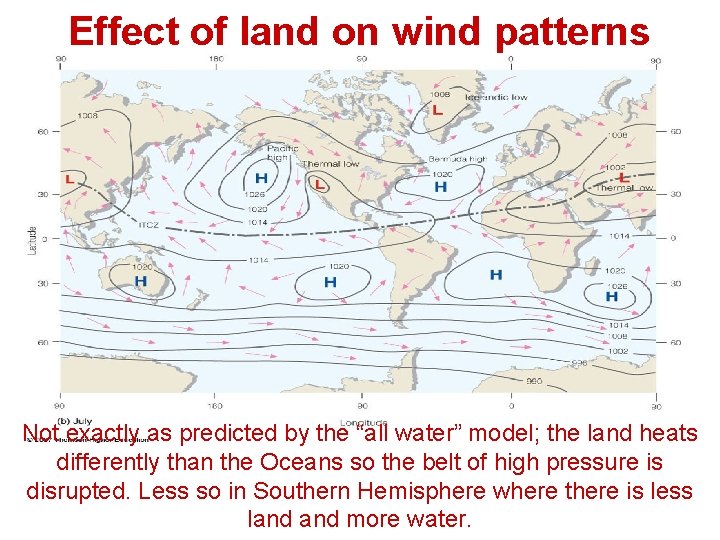
Effect of land on wind patterns Not exactly as predicted by the “all water” model; the land heats differently than the Oceans so the belt of high pressure is disrupted. Less so in Southern Hemisphere where there is less land more water.
Effect of land on wind patterns 26
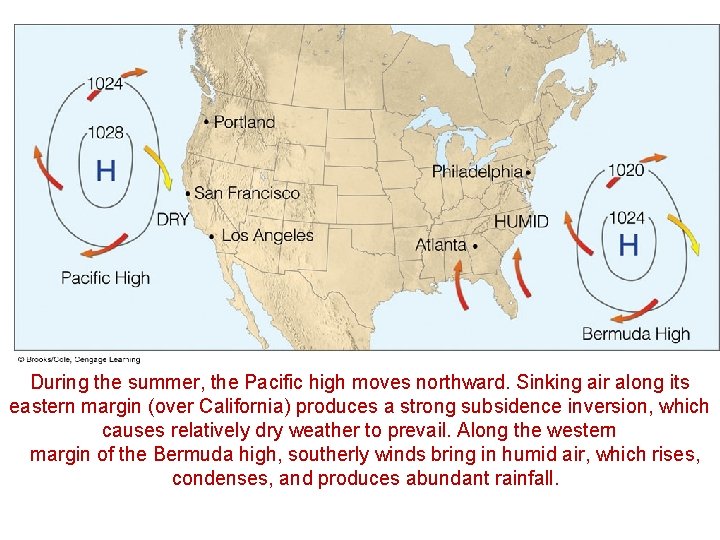
During the summer, the Pacific high moves northward. Sinking air along its eastern margin (over California) produces a strong subsidence inversion, which causes relatively dry weather to prevail. Along the western margin of the Bermuda high, southerly winds bring in humid air, which rises, condenses, and produces abundant rainfall.
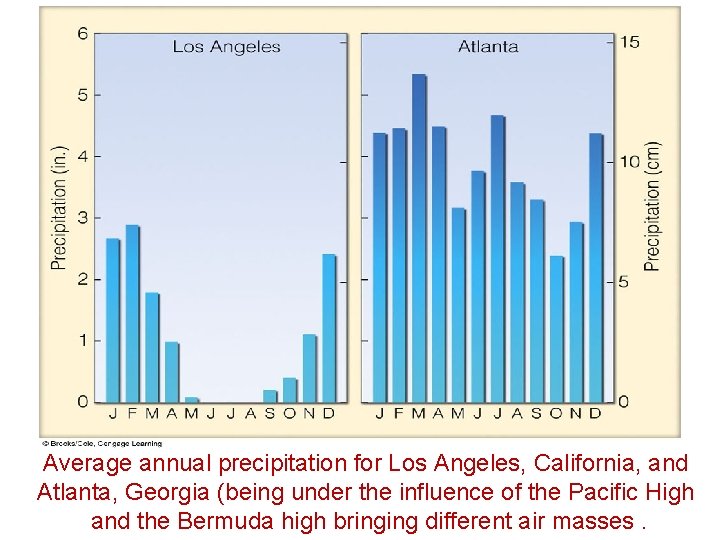
Average annual precipitation for Los Angeles, California, and Atlanta, Georgia (being under the influence of the Pacific High and the Bermuda high bringing different air masses.
What effects do surface-winds have on the circulation of the oceans? • The movement of the wind over the ocean causes friction at the surface. • As a result of this friction, the wind drags the ocean surface with it as it blows, thus setting up a pattern of surface-ocean wind-drift currents. 29
Atmosphere Ocean Interactions • Global Winds and Surface Ocean Currents – Ocean surface dragged by wind, basins react to high pressure circulation forming gyres – Cold current, flowing north to south, on west side of continenst – Warm current, flowing south to north, on east side of continenst – Oceanic front
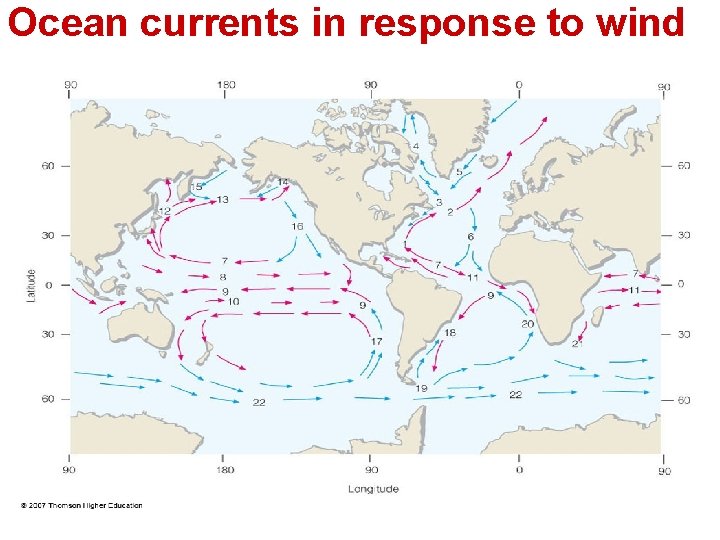
Ocean currents in response to wind 31
Why do ocean currents not move in exactly the same direction as the wind? • • • Because of the Coriolis Effect ocean currents do not move in exactly the same direction as the wind. The Coriolis Effect influences ocean currents just as it does winds, so the water is deflected to the right of the path of the wind in the Northern Hemisphere (and to the left of the wind’s path in the Southern Hemisphere). Observations show that this deflection tends to be approximately 20– 25° from the wind 32 direction.
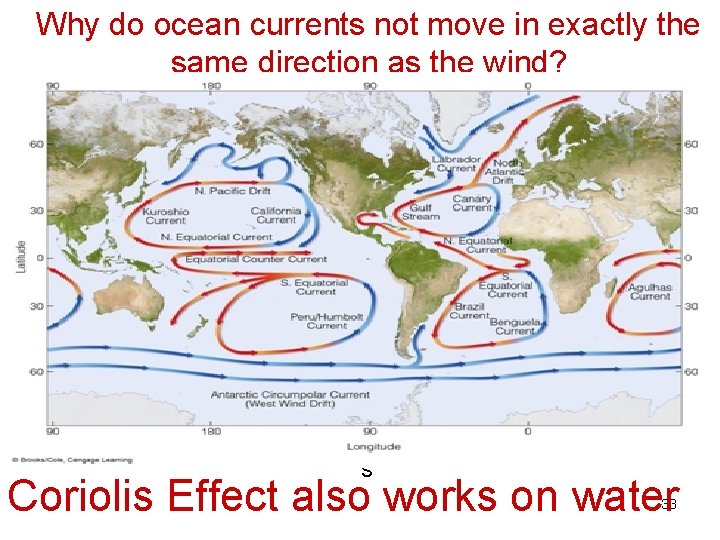
Why do ocean currents not move in exactly the same direction as the wind? N Equator S Coriolis Effect also works on water 33
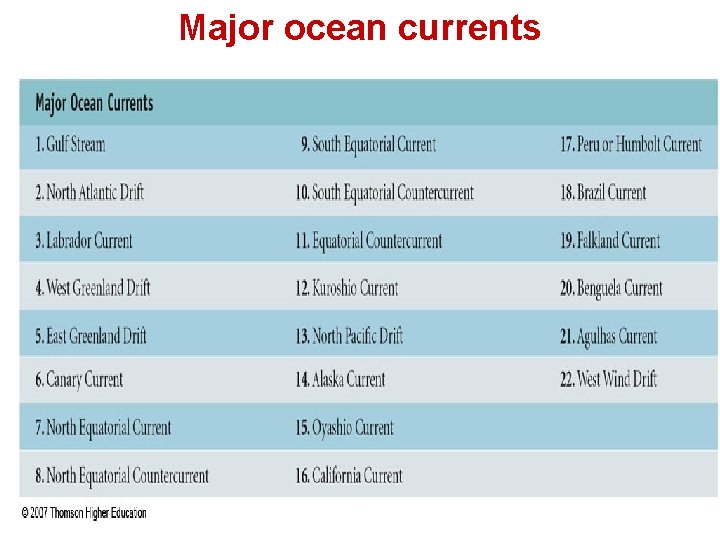
Major ocean currents 34
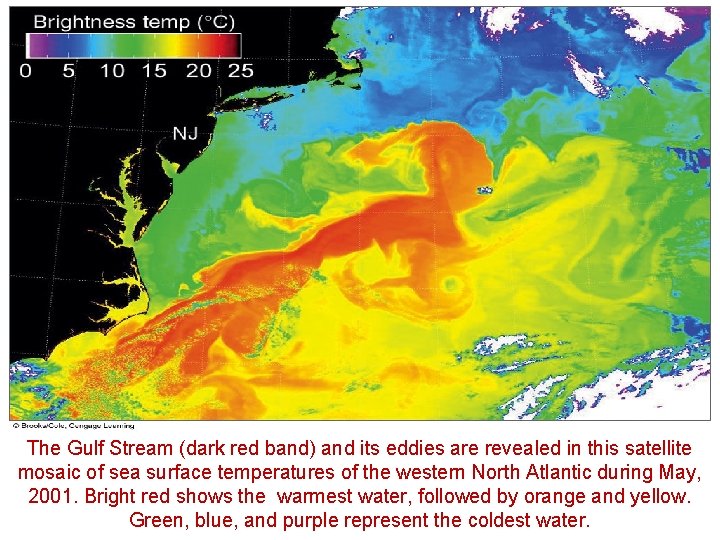
The Gulf Stream (dark red band) and its eddies are revealed in this satellite mosaic of sea surface temperatures of the western North Atlantic during May, 2001. Bright red shows the warmest water, followed by orange and yellow. Green, blue, and purple represent the coldest water.
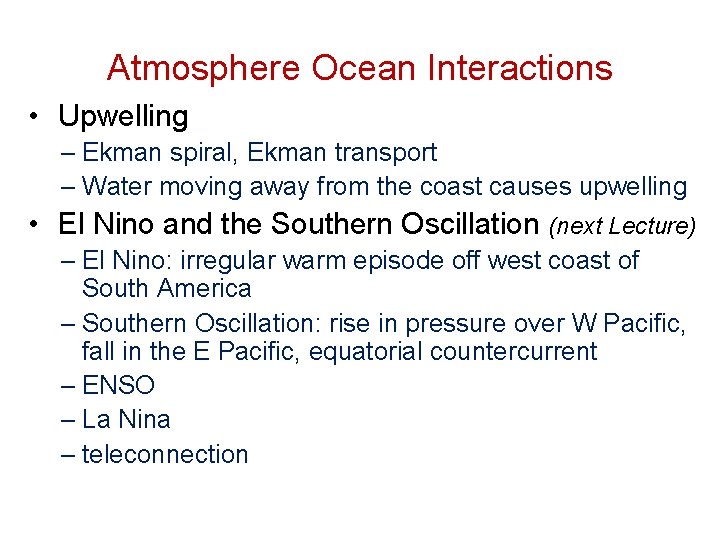
Atmosphere Ocean Interactions • Upwelling – Ekman spiral, Ekman transport – Water moving away from the coast causes upwelling • El Nino and the Southern Oscillation (next Lecture) – El Nino: irregular warm episode off west coast of South America – Southern Oscillation: rise in pressure over W Pacific, fall in the E Pacific, equatorial countercurrent – ENSO – La Nina – teleconnection
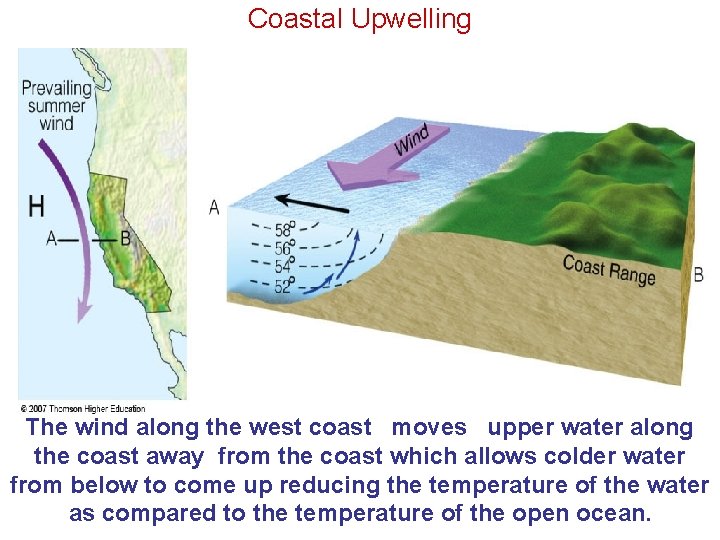
Coastal Upwelling The wind along the west coast moves upper water along the coast away from the coast which allows colder water from below to come up reducing the temperature of the water as compared to the temperature of the open ocean.
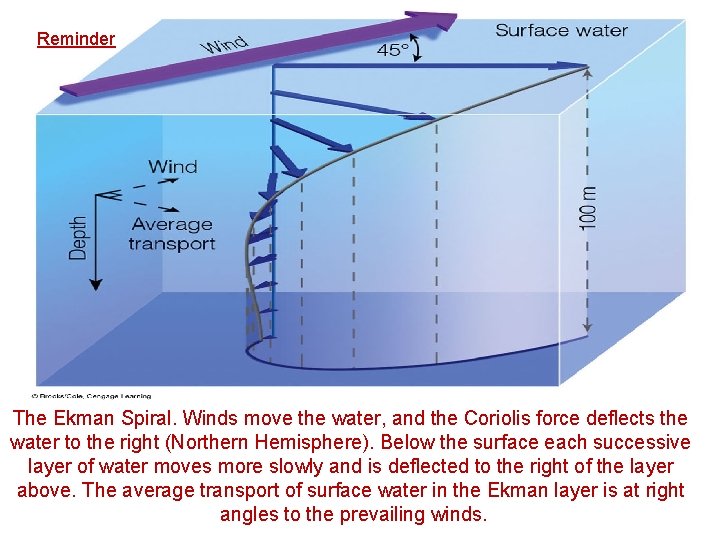
Reminder The Ekman Spiral. Winds move the water, and the Coriolis force deflects the water to the right (Northern Hemisphere). Below the surface each successive layer of water moves more slowly and is deflected to the right of the layer above. The average transport of surface water in the Ekman layer is at right angles to the prevailing winds.
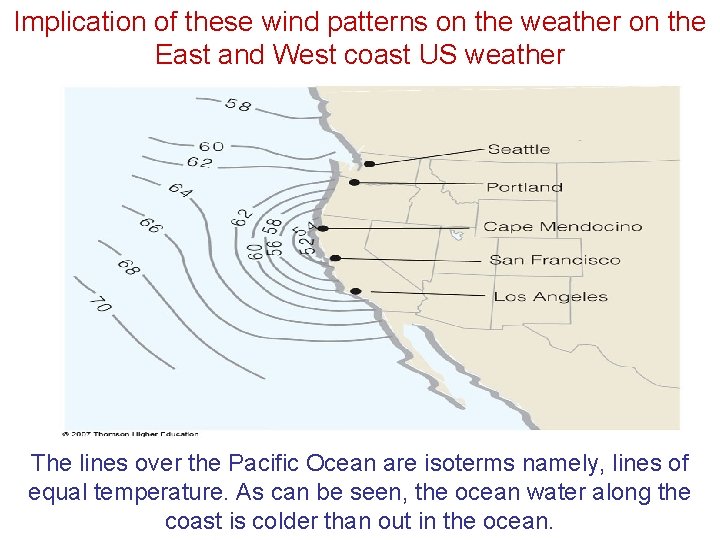
Implication of these wind patterns on the weather on the East and West coast US weather The lines over the Pacific Ocean are isoterms namely, lines of equal temperature. As can be seen, the ocean water along the coast is colder than out in the ocean.
Learning Objectives • • • How our perception of the general features of the atmosphere developed Major observed features: Impact of land/water distribution on semi-permanent highs and lows Two major semi-permanent subtropical highs that influence the weather of North America Reason for the location of major deserts Polar front - a zone of low pressure where storms often form Location of trade winds Location of ITCZ – a boundary where air rises in response to convergence of NE and SE trade winds How is the jet stream formed The effect of surface winds on driving the major ocean currents Why do we have upwelling in the oceans along certain coasts? What is the Ekman Spiral?
- Slides: 40