
Aortic arch anomalies Dr Deepak Raju Embryology Heart
Aortic arch anomalies Dr. Deepak Raju
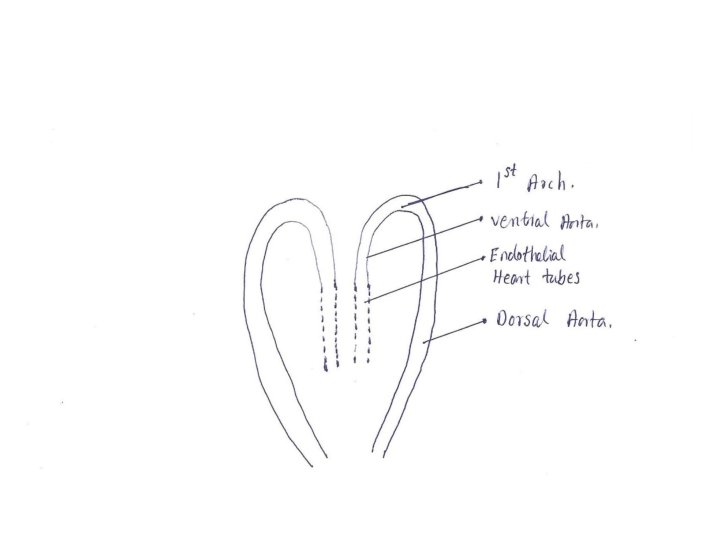
Embryology • Heart is first seen in the form of two endothelial heart tubes-18 th day of foetal life • Fusion results in a single tube with a series of dilatations(sinus venosus , atrium , ventricle &bulbus cordis) and begins to beat by 22 nd day • Bulbus cordis represents arterial end of the tube-prox part conus, distal truncus arteriosus • First arteries to appear are right and left primitive aorta connected to the endothelial heart tubes • Portion lying ventral to foregut(ventral aorta)connected to first pharyngeal arch-to the portion dorsal to foregut(dorsal aorta)
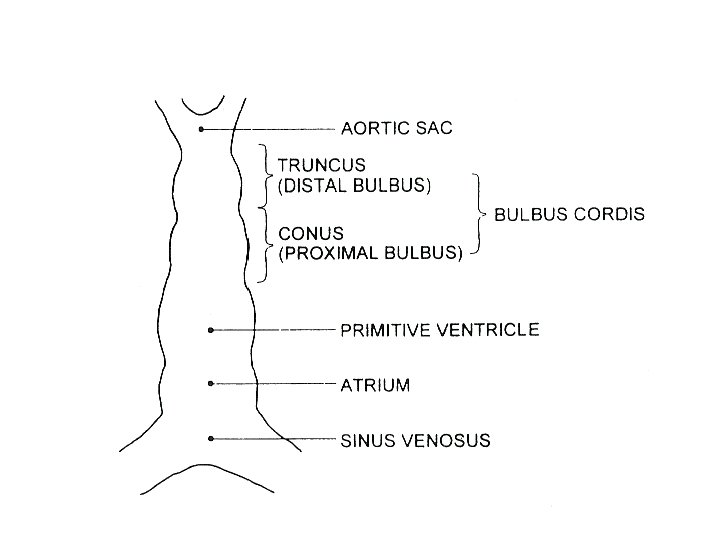
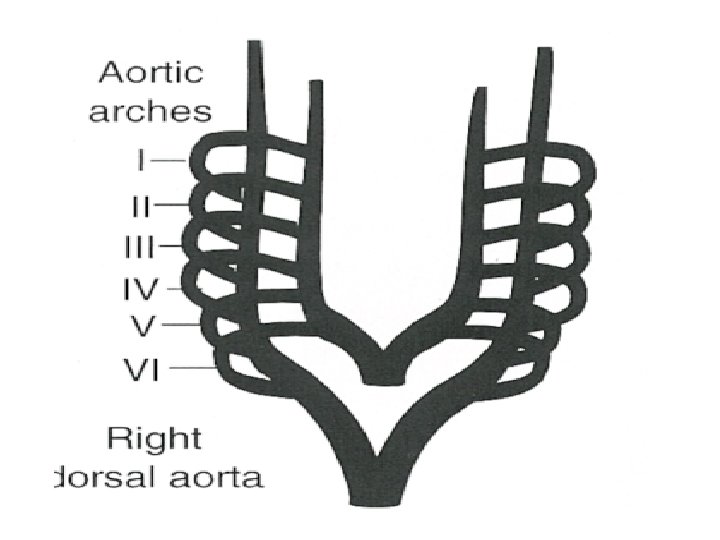
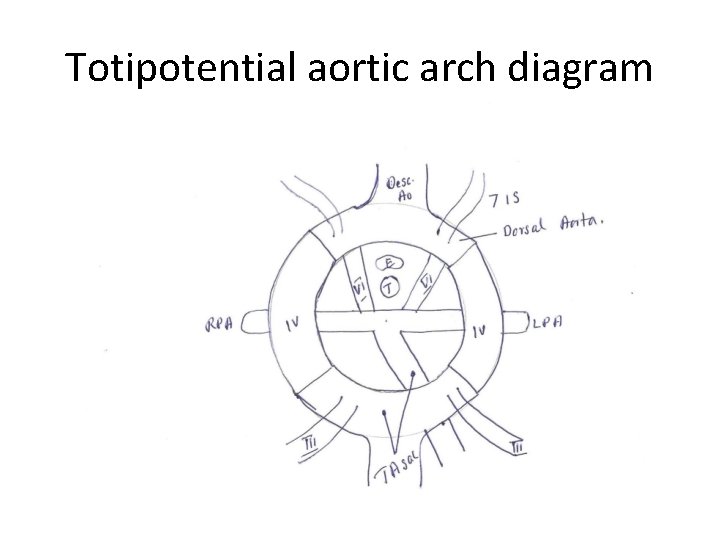
• After the fusion of endocardial heart tubes, ventral aorta fuse to form aortic sac • Truncus continues with the aortic sac from which right and left pharyngeal arch arteries arises • They arch backward on lateral side of foregut – continues as right and left dorsal aorta-fuse to form descending aorta • During 4 th and 5 th week, successive arterial arches appear in 2 nd to 6 th pharyngeal arches • Each connects ventrally to aortic sac&dorsally to dorsal aorta
• Greater part of 1 st &2 nd arch arteries disappear. 1 st arch remnant-maxillary artery, 2 nd arch remnant –hyoid and stapedial artery • 5 th arch artery regress completely • 3 rd and 4 th open to ventral part of aortic sac. 6 th to dorsal part. • Spiral septum formed in truncus in the 5 th week extends to aortic sac. blood from pul. artery goes to 6 th arch artery, from aorta to 3 rd &4 th arch arteries. • Dorsal aorta gives lateral intersegmental branches to body wall. 7 th cervical intersegmental supplies upper limb bud.
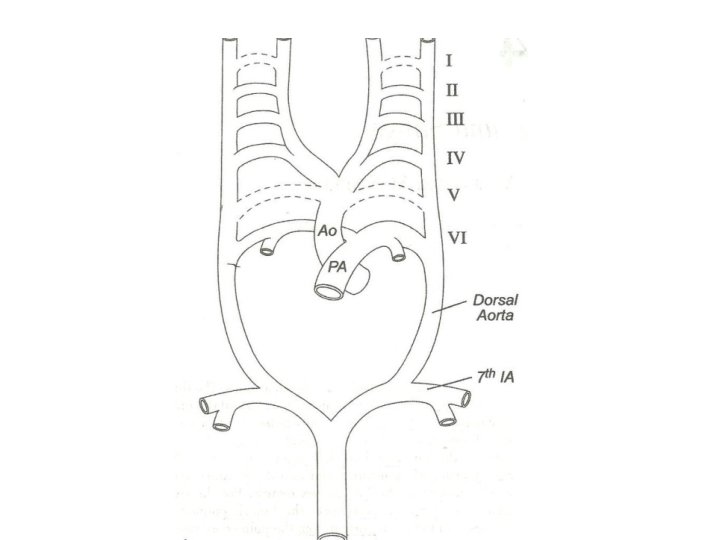
• Portion of dorsal aorta b/w 3 rd and 4 th (ductus caroticus)disappear • Each 6 th arch artery connects to the pulmonary vascular tree. portion b/w this connection and dorsal aorta-ductus arteriosus -regresses on right side
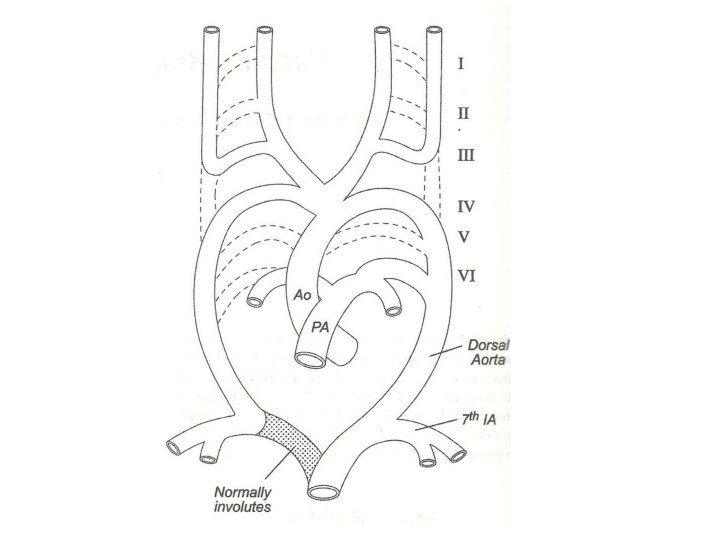
• 3 rd-common carotid and prox. int. carotid • 4 th – – Lt. -aortic arch b/w LCCA and LSCA. – Rt-prox RSCA • 6 TH – – prox part –prox pul art – distal part-ductus on left and right side involutes • Lt dorsal aorta-aortic arch distal to LSCA • Rt dorsal aorta– cranial portion-RSCA distal to 4 th arch. – distal portion-involutes
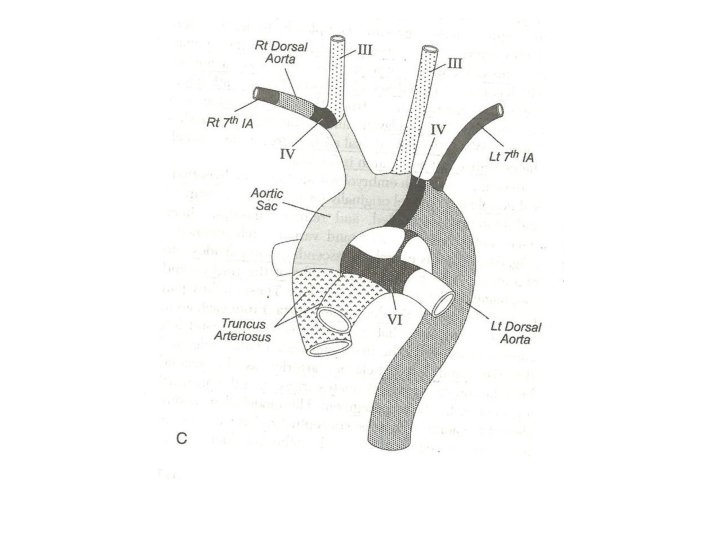
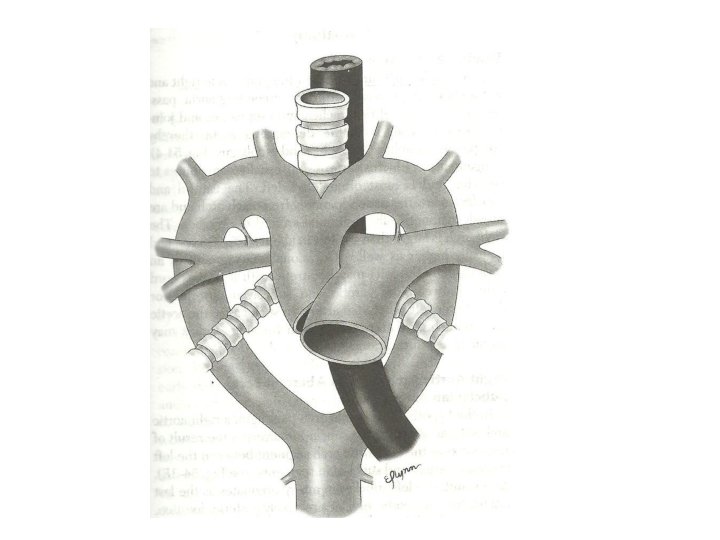
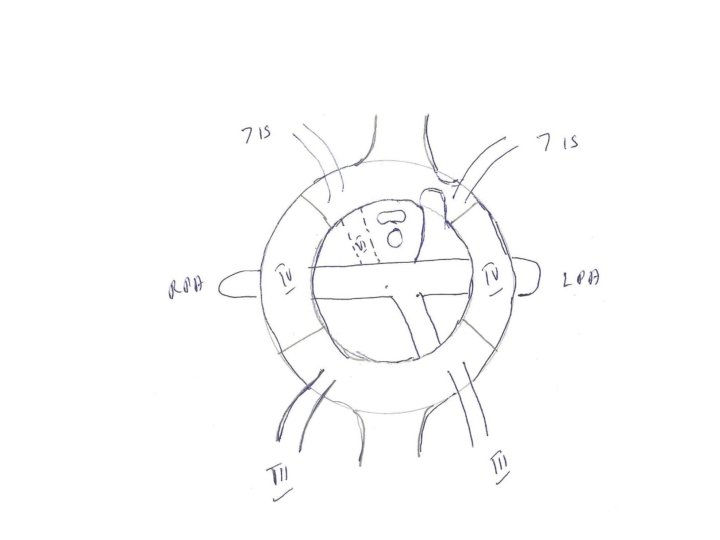
Edward s double aortic arch model • Anomalies of aortic arch to be conceptualised as variations in regression of different segments from the hypothetical double arch
Totipotential aortic arch diagram
History Anomalous RSCA-Hunauld, 1735 Double aortic arch-Hommel 1737 Right aortic arch –Fioratti, Aglieti-1763 Interrupted aortic arch-Steidele-1788 Bayford, 1787 -dysphagia by vasc ring-coined term dysphagia lusoria Gross, 1945 -first division of a vasc ring
Sidedness of the arch • Left and right arch refers to which bronchus is crossed by the arch • Echo or angio-branching pattern of brachiocephalic vessels • First arch vessel that contains carotid artery opposite side of arch • Retroesophageal or isolated vessels-opp to side of arch • MRI and CT-conclusive
Anatomical classification • Abnormalities of branching • Abnormalites of arch position-cervical arch, right arch • Supernumary arches-double aortic arch and persistent 5 th arch • IAA • Anomalous origin of pulmonary artery branch
Clinical classification • • Vascular rings Non-ring vasc. compression Non-compressive arch malformations Ductal dependent arch anomalies
vascular ring-aortic arch anomaly in which trachea and esophagus surrounded by vasc. structures Double aortic arch most common(40%), rt. aortic arch with lt. ligamentum(30%), aberrant RSCA(20%), anomalous innominate(10%).
• Symptoms– Stridor, Pneumonia, bronchitis – Reflex apnoea or choking on eating – Hyperextension of neck – Increased resp distress a/w intercurrent resp. infections – swallowing difficulty
• 3 d΄s opposite to side of archdiverticulum, dimple, descending aorta • Diverticulum –large vessel from desc. aorta giving rise to a smaller calibre vessel with a sudden taper • Dimple –tapered blindly ending outpouching • Descending aorta in upper thorax opp. to side of arch-connected by ligamentum arteriosum
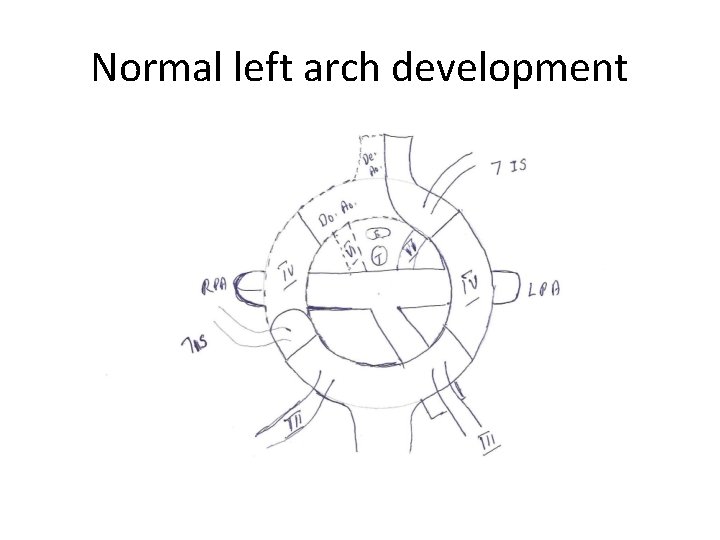
Normal left arch development
Variants of left aortic arch • Common brachiocephalic trunk – Right innominate and left carotid from single origin – 10% of normal – Compression of trachea possible • Separate origin of left vertebral artery – 10% – Prox to LSCA – 3 rd arch vessel smaller than 4 th
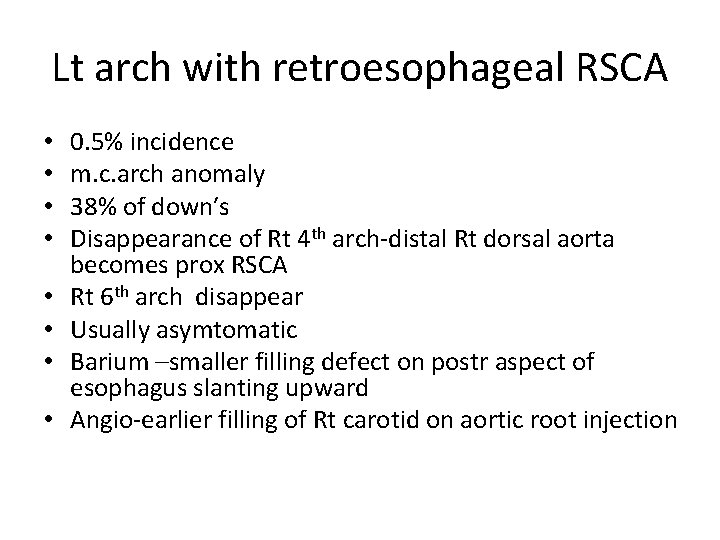
Lt arch with retroesophageal RSCA • • 0. 5% incidence m. c. arch anomaly 38% of down′s Disappearance of Rt 4 th arch-distal Rt dorsal aorta becomes prox RSCA Rt 6 th arch disappear Usually asymtomatic Barium –smaller filling defect on postr aspect of esophagus slanting upward Angio-earlier filling of Rt carotid on aortic root injection
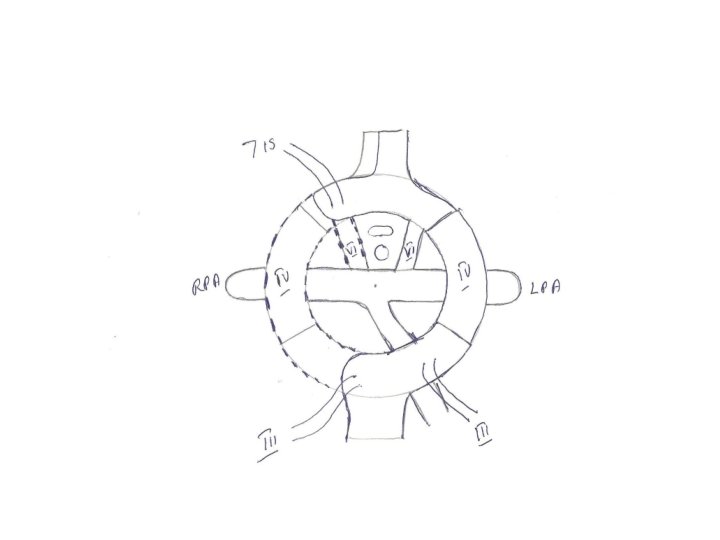
Lt ao. arch and retroesophageal diverticulum of Kommerell • First vasc ring to be diagnosed during life • Similar to previous except for persistent 6 th arch-ligamentum which completes a vasc. Ring • Prox. RSCA dilated to form diverticulum
Lt ao. arch, rt. desc aorta, rt. ductus(circumflex aortic arch) • Branching pattern similar to earlier-arch retroesophageal, RSCA the last arch vessel is not retroesophageal • Desc. aorta connected to RPA by ligamentumforms vasc. ring
Lt ao arch &isolated RSCA • • Right 6 th arch persists RSCA from rt ductus RSCA and vertebral fills from PA in foetal life When ductus closes-retrogradely from circle of willis – Vertebrobasilar insufficiency – Congenital subclavian steal – Absent rt arm pulse
Lt ao arch with cervical origin of Rt subclavian • Marker of 22 q 11 deletion • Innominate trifurcates in the neck-RSCA travels back to thorax • Subclavian origin from 3 rd arch
Right aortic arch • A single aortic arch that crosses rt mainstem bronchus • 13 -34% in TOF • 30 -40% in truncus arteriosus • 20% in pul. atresia with VSD • 7. 7% in tricuspid atresia • 8 -10% in transposition
Right aortic arch-mirror image type • Sequence of arch vessels-lt. innominate, rt carotid, RSCA • Ligamentum lt sided • No vasc ring. can form rarely if Lt. ductus from rt desc aorta • CCHD in 98%(48% TOF)
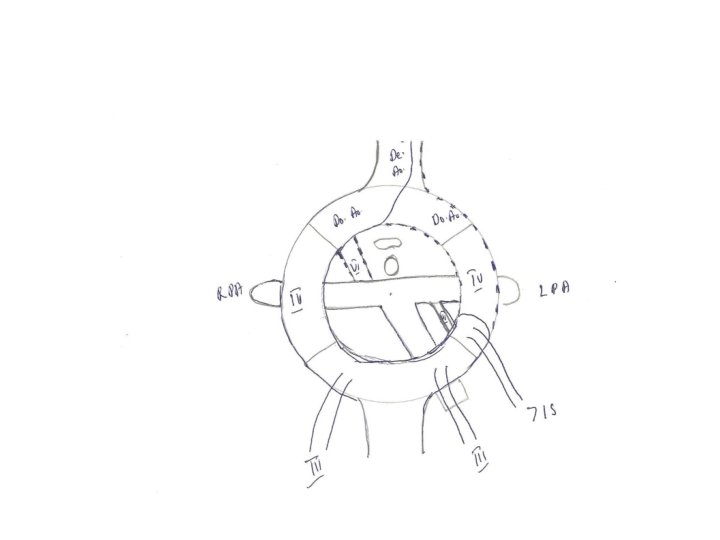
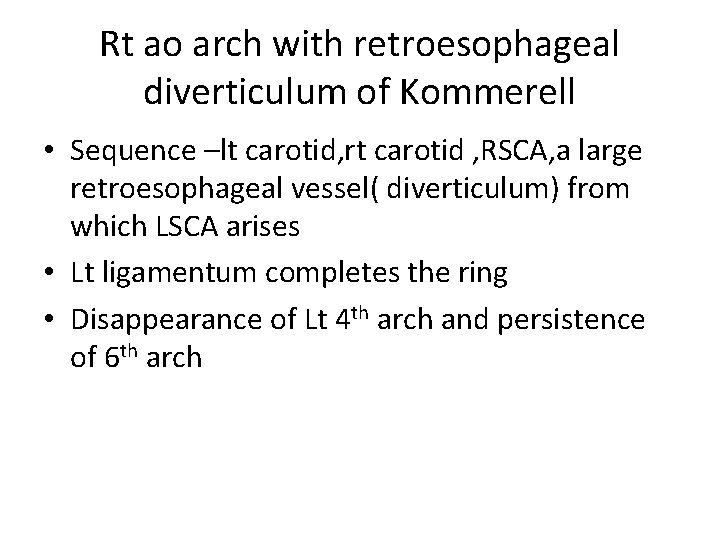
Rt ao arch with retroesophageal diverticulum of Kommerell • Sequence –lt carotid, rt carotid , RSCA, a large retroesophageal vessel( diverticulum) from which LSCA arises • Lt ligamentum completes the ring • Disappearance of Lt 4 th arch and persistence of 6 th arch
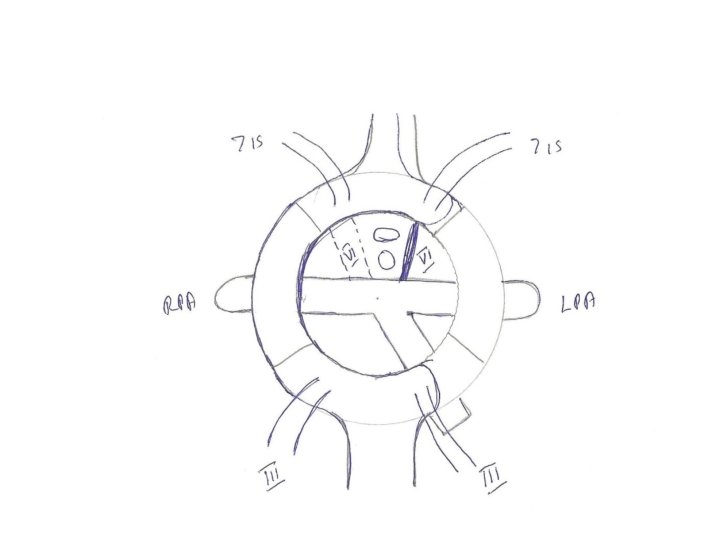
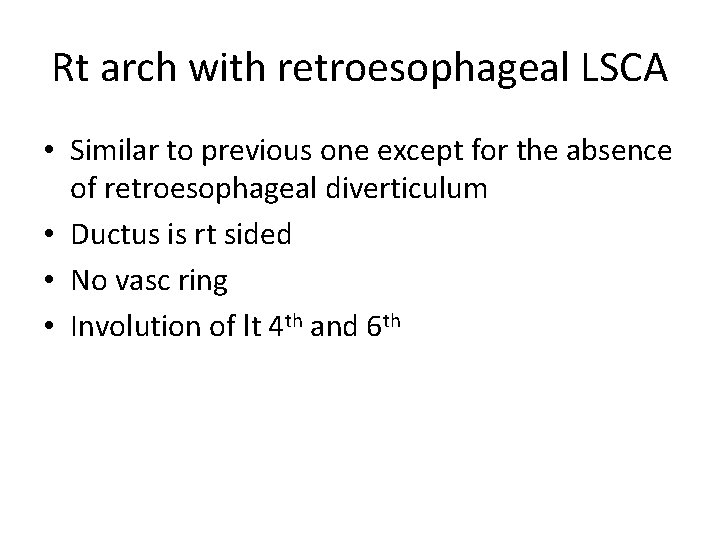
Rt arch with retroesophageal LSCA • Similar to previous one except for the absence of retroesophageal diverticulum • Ductus is rt sided • No vasc ring • Involution of lt 4 th and 6 th
Rt arch with Lt desc aorta and Lt ligamentum • Aortic arch itself crosses midline-connects to lt ductus to form vasc ring
Cervical aortic arch • Arch found above level of clavicle • Two categories-normal branching pattern or anomalous subclavian artery and vascular ring • 2 nd group-devided acc. to carotid origin(bicarotid trunk or separate origin of ext. &int carotid) • Mechanism– Failure of normal descent of aortic arch system – Persistence of ductus caroticus&involution of 4 th arch 3 rd arch becomes definitive aortic arch with separate origin of ext &int carotid from it
Double aortic arch • Both rt and lt arches present • Persistence of both rt and lt 4 th arch which join TA sac to dorsal aorta both of which persist • Only one 6 th remain • Rarely a/w other CHD, when present-TOF most common • Both arches can be patent or one hypoplastic or atretic(usu. left) • Form complete vasc. rings • Symmetric origin of 4 arch vessels from respective arches when both patent
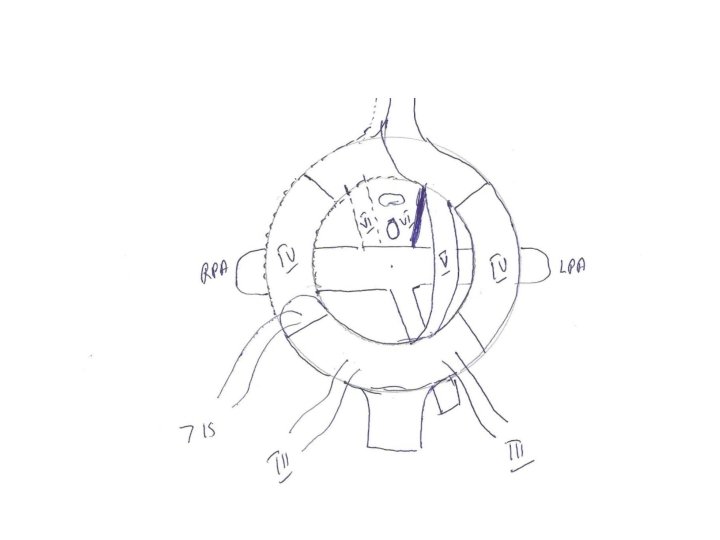
Persistent 5 th arch • First reported by Van praagh in 1969 • Double lumen aortic arch in which both arches appear on same side of trachea • 2 common sub categories– Subway vessel beneath normal arch(4 th arch)that extend from innominate to take off of LSCA – Double lumen aortic arch with atresia of superior arch with patent inferior arch-common origin of all brachiocephalic vessels from asc. aorta
Interrupted aortic arch • Defined as complete separation of ascending and descending aorta • Celoria and Patton classification(1959) – Type A-interruption distal to SCA that is ipsilateral to 2 nd carotid artery – Type B-interruption b/w 2 nd carotid and ipsilateral subclavian – Type C-interruption b/w carotids
• Each of the types subcategorised to 3 types – 1. without retroesophageal or isolated subclavian artery – 2. with retroesophageal subclavian artery – 3. with isolated subclavian artery • Interrupted rt arch seen only in Di. George syn. • Type A-aorticopulmonary septal defect, TGA • Type B-m. c, a/w conotruncal anomaly, Di. George syn. • Type C-rare
• Type A-involution of both dorsal aorta distal to 4 th arch, prox to persistent 6 th arch • Type b-involution of one 4 th arch and one dorsal aorta b/w 4 th and 6 th • Type C-involution of one limb of truncoaortic sac
• Present with acute cardiovasc collapse after closure of ductus • Absence of all limb pulse with strong carotid pulse suggest type B with anomalous subclavian
Anomalous origin of pulmonary artery from ascending aorta • Anomalous pulmonary artery branch arising from ascending aorta in presence of a MPA arising separately • Anomalous RPA– More common – Embryonic branch pul. artery joins rt side of TA sac, but fails to join MPA before septation – High incidence of aorticopulmonary septal defect • Anomalous LPA – a/w TOF in 74% – Embryonic branch pul. artery fails to join TA sac • CCF in infancy f/b early devt of pulmonary vascular disease
Anomalous origin of LPA from RPA • LPA arises from RPA and passes b/w trachea and esophagus-pulmonary artery sling • Tracheal compression-severe resp distress and stridor • Isolated anomaly, rarely a/w TOF • LPA passes beyond trachea before joining TA sac • Anterior indentation on barium swallow
Summary • Aortic arch anomalies and vascular rings can be interpreted on the basis of embryology • With the devt. Of MRI and CT 3 -D reconstruction is possible • Intervention required only when symptomatic or when a/w other cardiac anomalies

• Thank you
- Slides: 50