
AOIT Computer Networking Unit 5 Lesson 14 WiFi
- Slides: 10
AOIT Computer Networking Unit 5, Lesson 14 Wi-Fi Technology Copyright © 2008– 2016 NAF. All rights reserved.
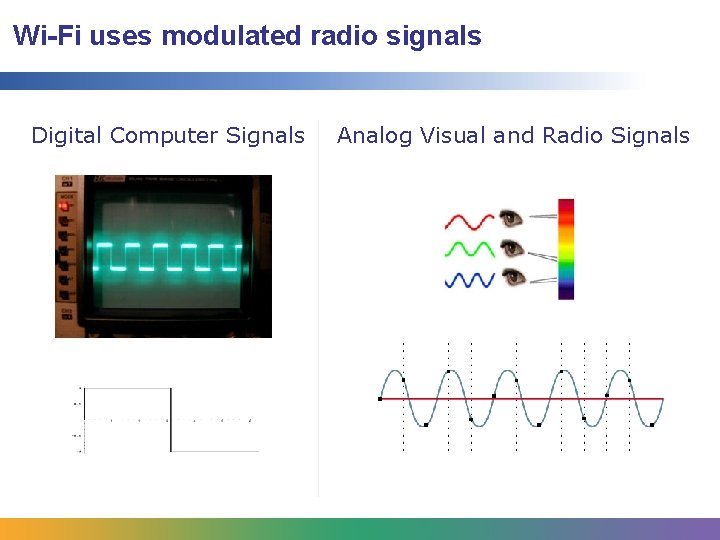
Wi-Fi uses modulated radio signals Digital Computer Signals Analog Visual and Radio Signals
Wi-Fi devices rely on radio frequencies and signal bandwidth • Radio frequency: The 5 GHz radio frequency has less signal interference than the 2. 4 GHz radio frequency, because there are fewer devices that operate at 5 GHz. • Signal bandwidth: The wider the bandwidth, the larger the amount of data that can be transferred. • Data transfer rate: How many megabits or gigabits of data can be transferred per second? • Range: How far can the signal travel? (measured in feet)
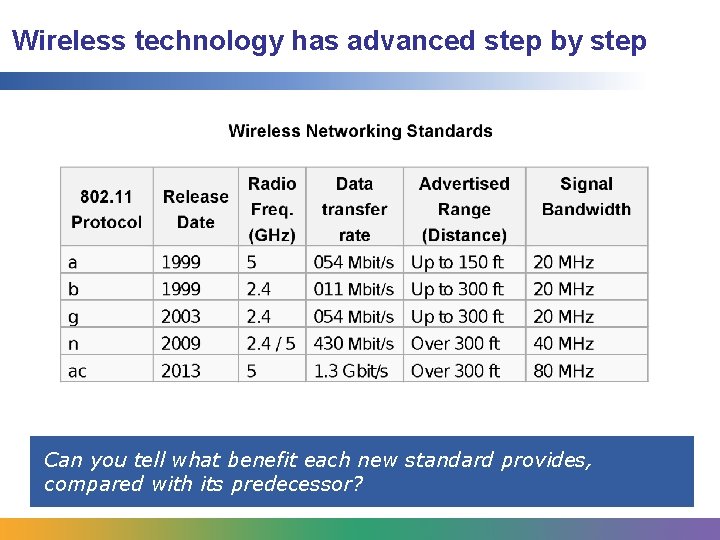
802. 11 is the IEEE standard for Wi-Fi communication • 1999: First standard is 802. 11 a o 54 megabits-per-second data transfer rate o 150 foot range • 2013: Most recent standard is 802. 11 ac o 1. 3 gigabits-per-second data transfer rate o 300 foot range
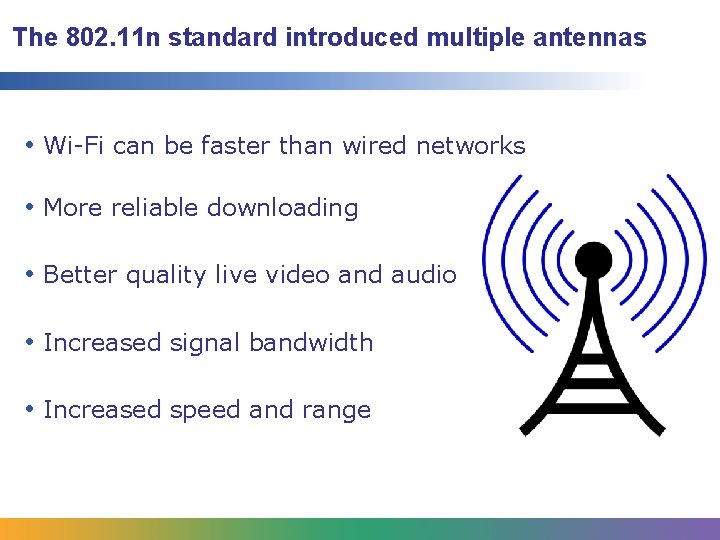
The 802. 11 n standard introduced multiple antennas • Wi-Fi can be faster than wired networks • More reliable downloading • Better quality live video and audio • Increased signal bandwidth • Increased speed and range
The 802. 11 ac standard improves connectivity and speed • Uses 5 GHz radio frequency to reduce signal interference • Up to 8 antennas creates 80 MHz of signal bandwidth, which increases the amount of data that can be transferred • Up to 1. 3 gigabits of data per second • Signal can travel at least 300 feet • Standard introduced in 2012 and approved in 2014
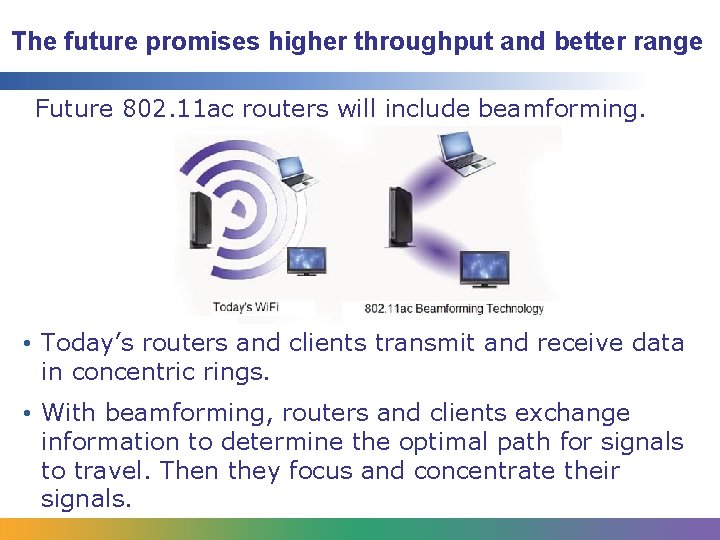
The future promises higher throughput and better range Future 802. 11 ac routers will include beamforming. • Today’s routers and clients transmit and receive data in concentric rings. • With beamforming, routers and clients exchange information to determine the optimal path for signals to travel. Then they focus and concentrate their signals.
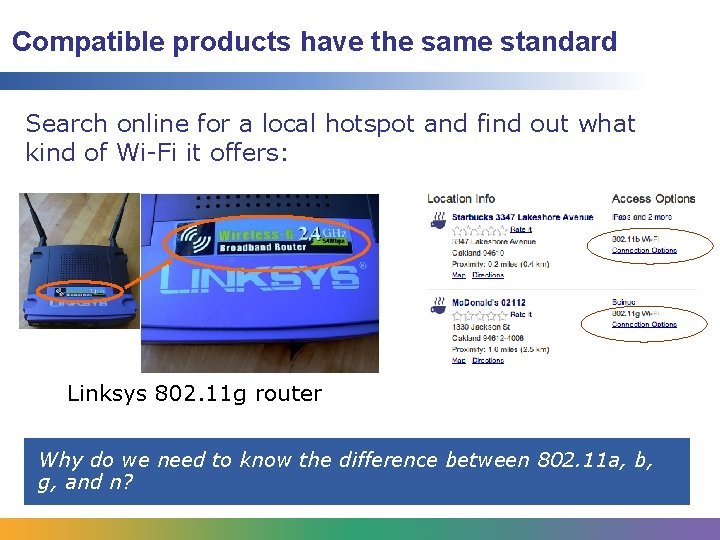
Compatible products have the same standard Search online for a local hotspot and find out what kind of Wi-Fi it offers: Linksys 802. 11 g router Why do we need to know the difference between 802. 11 a, b, g, and n?
Wireless technology has advanced step by step Can you tell what benefit each new standard provides, compared with its predecessor?
Remember that standards are important to Wi-Fi • Wi-Fi uses modulated radio signals to transmit data. • This transmission is based on standards. • The 802. 11 ac standard is the latest and greatest.