
AOF Financial Services Unit 2 Lesson 3 The
- Slides: 17
AOF Financial Services Unit 2, Lesson 3 The History of Money Copyright © 2007– 2016 NAF. All rights reserved.
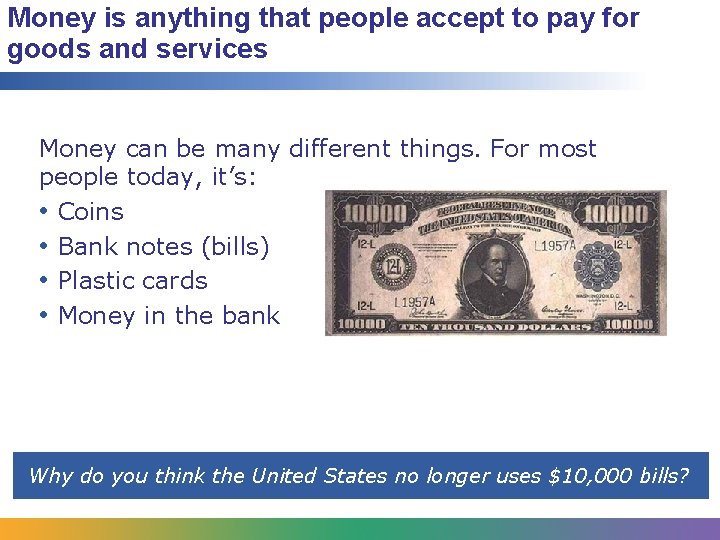
Money is anything that people accept to pay for goods and services Money can be many different things. For most people today, it’s: • Coins • Bank notes (bills) • Plastic cards • Money in the bank Why do you think the United States no longer uses $10, 000 bills?
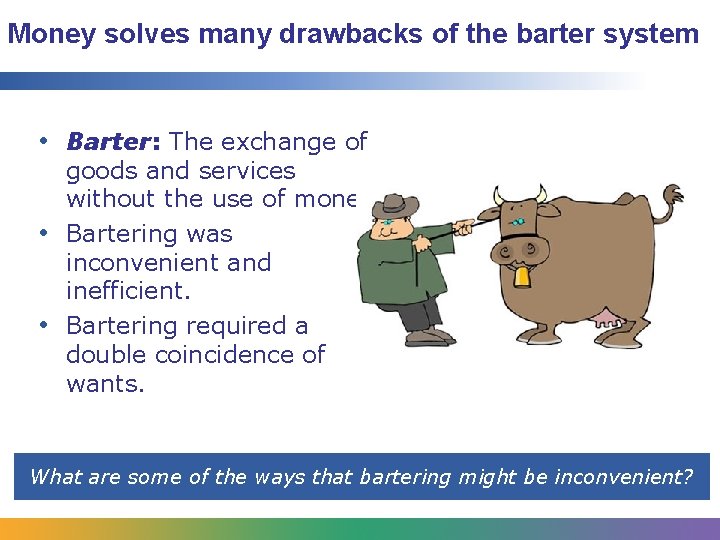
Money solves many drawbacks of the barter system • Barter: The exchange of • • goods and services without the use of money. Bartering was inconvenient and inefficient. Bartering required a double coincidence of wants. What are some of the ways that bartering might be inconvenient?
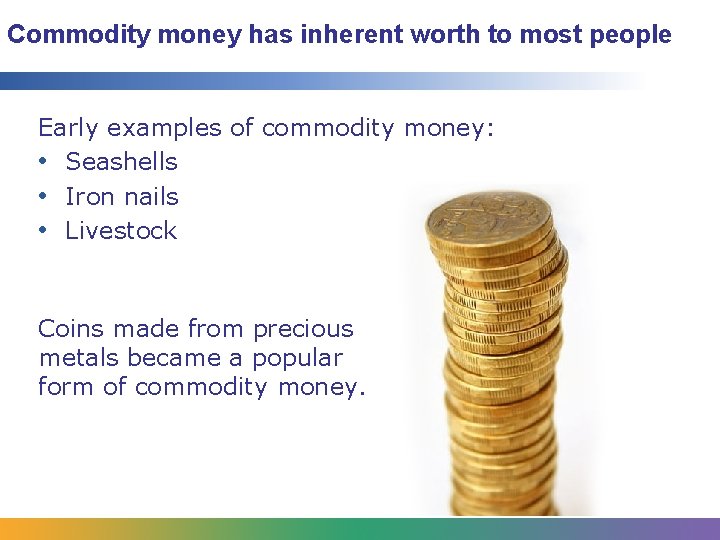
Commodity money has inherent worth to most people Early examples of commodity money: • Seashells • Iron nails • Livestock Coins made from precious metals became a popular form of commodity money.
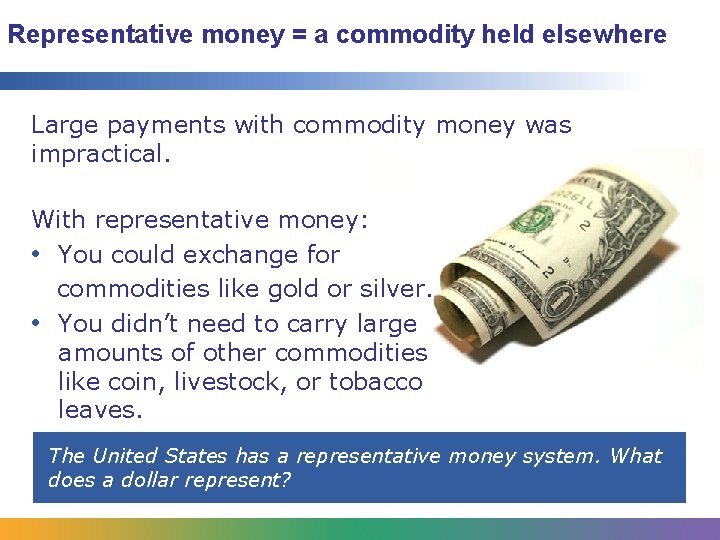
Representative money = a commodity held elsewhere Large payments with commodity money was impractical. With representative money: • You could exchange for commodities like gold or silver. • You didn’t need to carry large amounts of other commodities like coin, livestock, or tobacco leaves. The United States has a representative money system. What does a dollar represent?
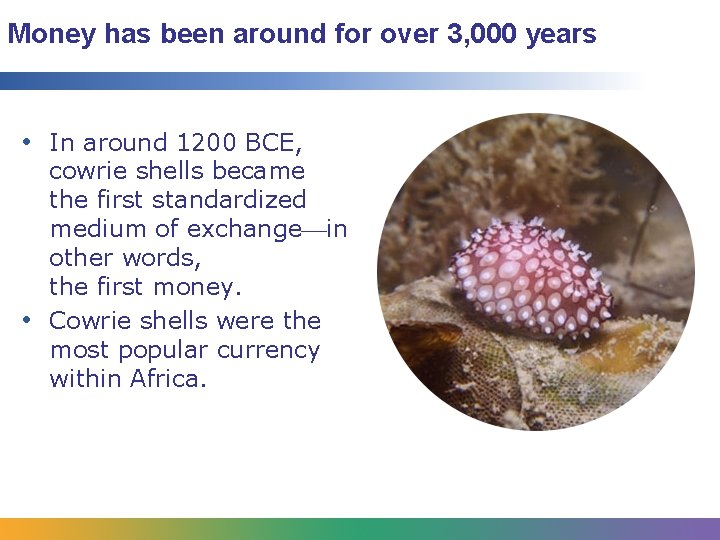
Money has been around for over 3, 000 years • In around 1200 BCE, • cowrie shells became the first standardized medium of exchange in other words, the first money. Cowrie shells were the most popular currency within Africa.
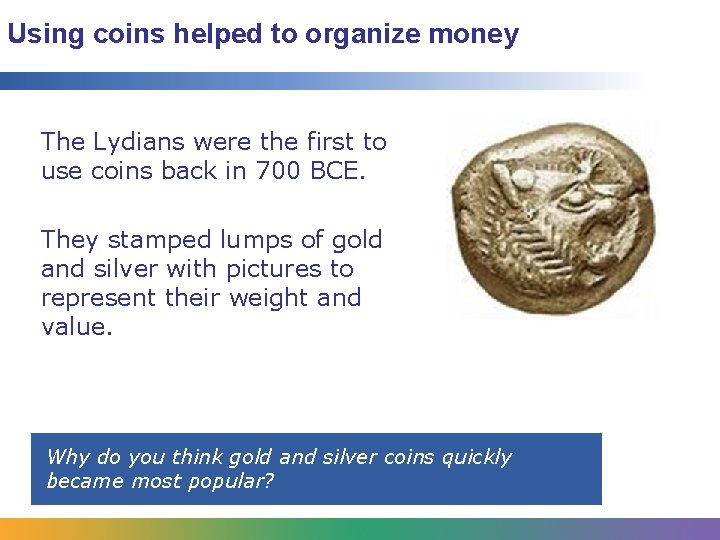
Using coins helped to organize money The Lydians were the first to use coins back in 700 BCE. They stamped lumps of gold and silver with pictures to represent their weight and value. Why do you think gold and silver coins quickly became most popular?
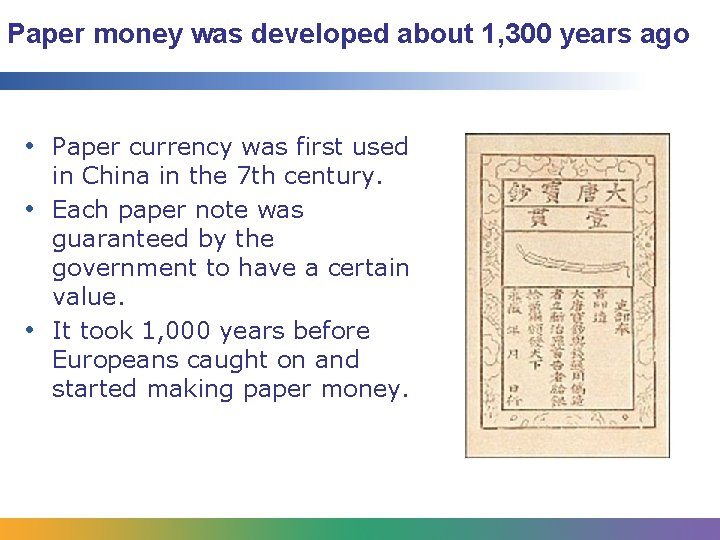
Paper money was developed about 1, 300 years ago • Paper currency was first used • • in China in the 7 th century. Each paper note was guaranteed by the government to have a certain value. It took 1, 000 years before Europeans caught on and started making paper money.
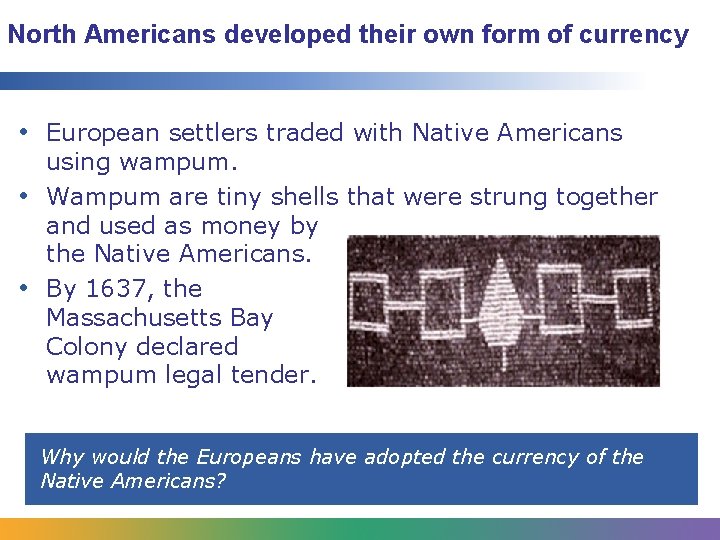
North Americans developed their own form of currency • European settlers traded with Native Americans • • using wampum. Wampum are tiny shells that were strung together and used as money by the Native Americans. By 1637, the Massachusetts Bay Colony declared wampum legal tender. Why would the Europeans have adopted the currency of the Native Americans?
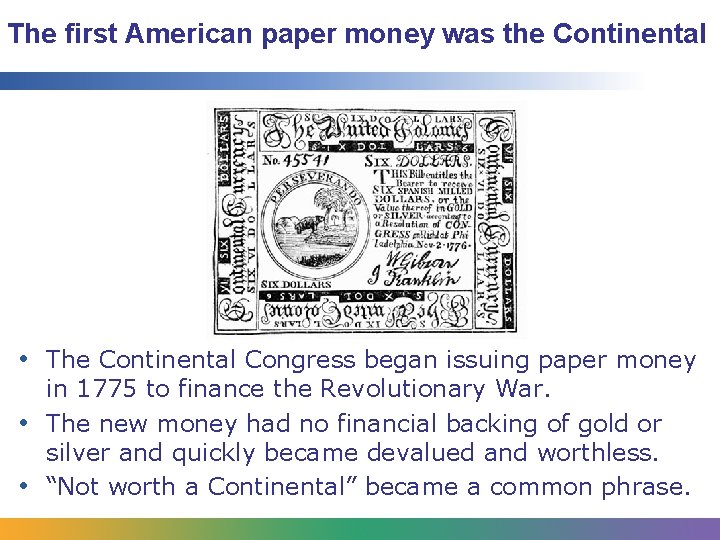
The first American paper money was the Continental • The Continental Congress began issuing paper money • • in 1775 to finance the Revolutionary War. The new money had no financial backing of gold or silver and quickly became devalued and worthless. “Not worth a Continental” became a common phrase.
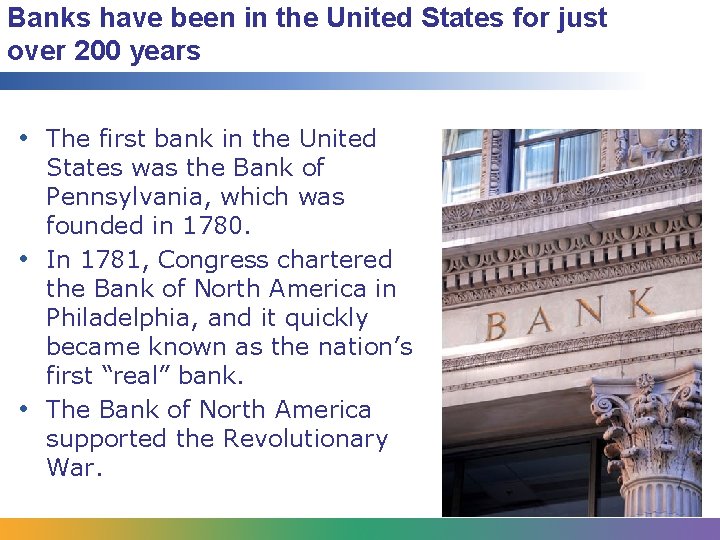
Banks have been in the United States for just over 200 years • The first bank in the United • • States was the Bank of Pennsylvania, which was founded in 1780. In 1781, Congress chartered the Bank of North America in Philadelphia, and it quickly became known as the nation’s first “real” bank. The Bank of North America supported the Revolutionary War.
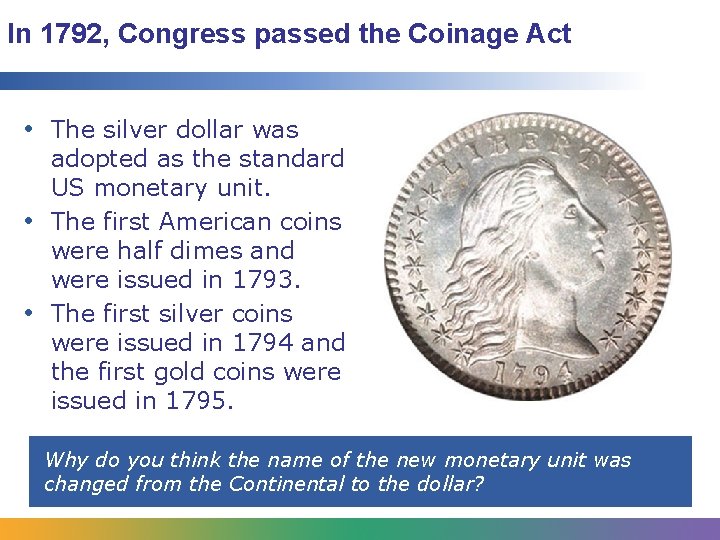
In 1792, Congress passed the Coinage Act • The silver dollar was • • adopted as the standard US monetary unit. The first American coins were half dimes and were issued in 1793. The first silver coins were issued in 1794 and the first gold coins were issued in 1795. Why do you think the name of the new monetary unit was changed from the Continental to the dollar?
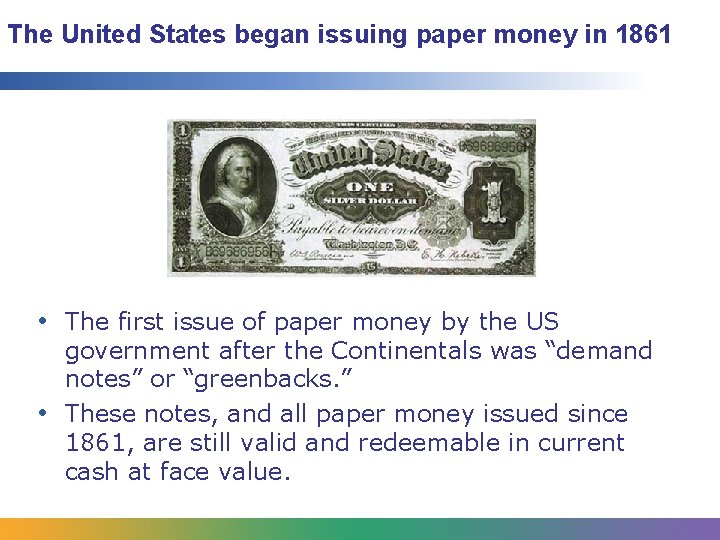
The United States began issuing paper money in 1861 • The first issue of paper money by the US • government after the Continentals was “demand notes” or “greenbacks. ” These notes, and all paper money issued since 1861, are still valid and redeemable in current cash at face value.
Today, we use fiat money • Fiat money is not backed by reserves of another • • • commodity, such as grain or gold. Many modern governments create fiat money by printing more money than they can back. Too much fiat money in circulation can create inflation. The money that we use today is an example of fiat money. Why would a government risk printing more money than it has reserves with which to back it?
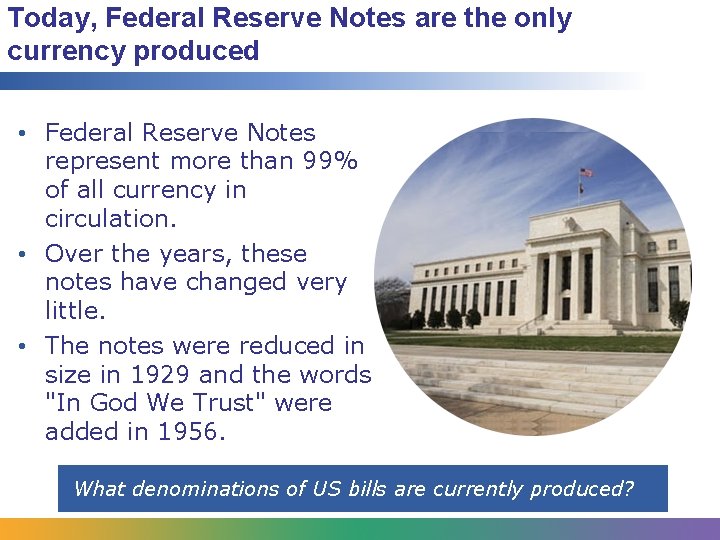
Today, Federal Reserve Notes are the only currency produced • Federal Reserve Notes represent more than 99% of all currency in circulation. • Over the years, these notes have changed very little. • The notes were reduced in size in 1929 and the words "In God We Trust" were added in 1956. What denominations of US bills are currently produced?
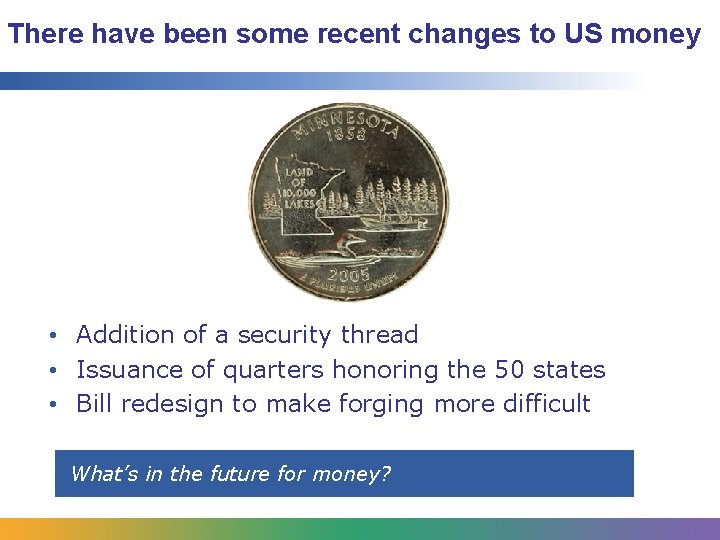
There have been some recent changes to US money • Addition of a security thread • Issuance of quarters honoring the 50 states • Bill redesign to make forging more difficult What’s in the future for money?
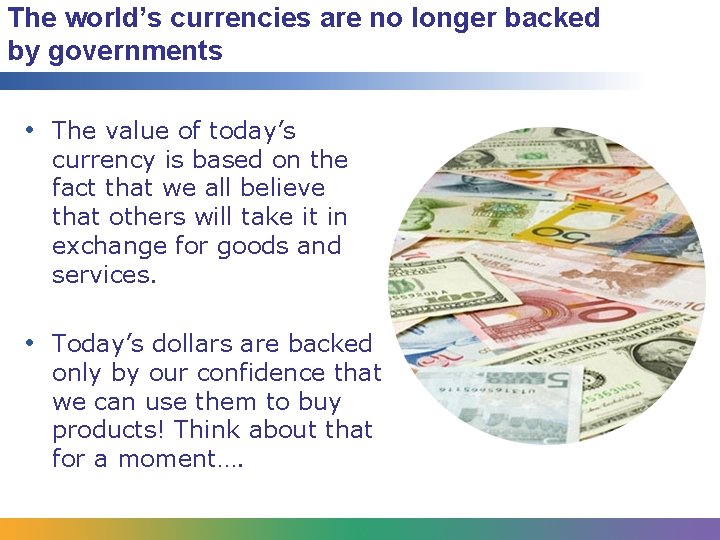
The world’s currencies are no longer backed by governments • The value of today’s currency is based on the fact that we all believe that others will take it in exchange for goods and services. • Today’s dollars are backed only by our confidence that we can use them to buy products! Think about that for a moment….