
ANYTHING IS POSSIBLE SCIENCE FICTION Key Learning Goals
ANYTHING IS POSSIBLE – SCIENCE FICTION Key Learning Goals: • I can respond to texts in different media, technologies and genres. • I can apply my understanding of the science fiction genre to my own writing, making effective language choices to shape meaning. • I can reflect on my own learning, making links between texts studied in class and my own compositions.
Three important elements of science fiction are speculation about humanity's future (what if? ), the impacts of science and technology on people, and settings in an alternate time and place. For example, Frank Herbert's novel "Dune" is a science fiction novel about a future intergalactic society with sometimes drastically changed humans confronting ecological, social and biological conflicts, while "Ender's Game" by Orson Scott Card tells the story of a boy who plays hightech games that are in reality, deadly combat against alien enemies.
Speculation The speculative question "what if? " is the starting point for all science fiction. Many scholars list Mary Shelley's novel "Frankenstein" as one of the first science fiction books. Shelley's book gave an answer to the question of what would happen if a scientist, Victor Frankenstein, used electricity to reanimate a corpse. Other science fiction stories answer questions about what would happen if first contact with aliens occurred or if humans achieved faster-than-light space travel. Science Impacts Science fiction frequently includes stories about the impact of scientific or technological change on people. For example, H. G. Wells' "The Time Machine" explored the consequences of building a machine that could carry its occupant far into the future. The "Star Trek" television shows and films portray a future "Federation of Planets" that couldn't "boldly go" anywhere without the warp drive that allows the Enterprise to travel between the stars. Setting Science fiction stories often take place in the future or in alternate universes. The "Star Wars" films, for example, contain many futuristic elements, even though they feature events that happened "a long time ago in a galaxy far, far away. " If they are set closer to the present day, they include scientific speculation that differs from ordinary daily life -- as in "The Running Man" book and film, which tell the story of a cop framed for a crime he didn't commit who must survive a deadly TV game show.

Sub-genres of Sci-Fi: Apocalyptic Science Fiction Apocalyptic texts are a sub-genre of Science-Fiction. The plot revolves around an impending disaster. Within this genre, the disaster is usually an alien invasion, a nuclear war, a pandemic, or a natural disaster. The development of technology plays a large role in these films and often serves as the source of conflict. While many films in this sub-genre center around the disaster, many focus on the postapocalyptic state of the world. Examples: Independence Day, War of the Worlds, Armageddon.
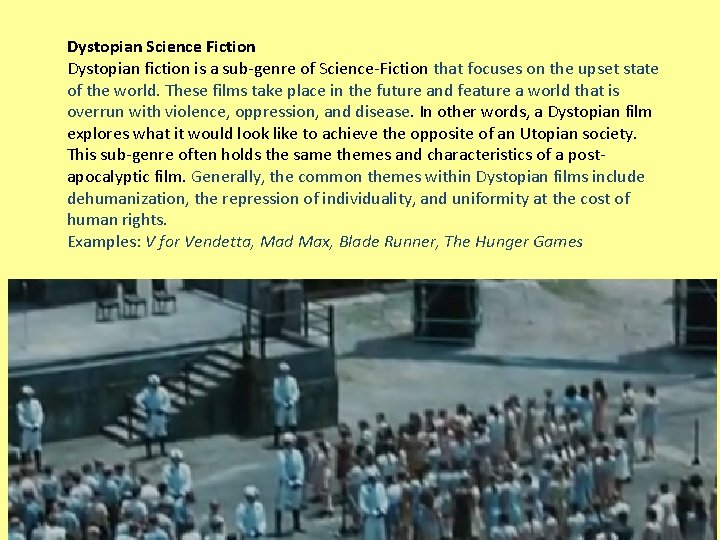
Dystopian Science Fiction Dystopian fiction is a sub-genre of Science-Fiction that focuses on the upset state of the world. These films take place in the future and feature a world that is overrun with violence, oppression, and disease. In other words, a Dystopian film explores what it would look like to achieve the opposite of an Utopian society. This sub-genre often holds the same themes and characteristics of a postapocalyptic film. Generally, the common themes within Dystopian films include dehumanization, the repression of individuality, and uniformity at the cost of human rights. Examples: V for Vendetta, Mad Max, Blade Runner, The Hunger Games

Time Travel As stated in its name, this sub-genre of Science-Fiction film centres around the concept of time travel. These texts can explore traditional time travel through futuristic devices or space-time travel. The Time Travel sub-genre can also explore the concept of alternate histories, alternate realities, and parallel universes. Examples: The Terminator, Back to the Future, Star Trek.
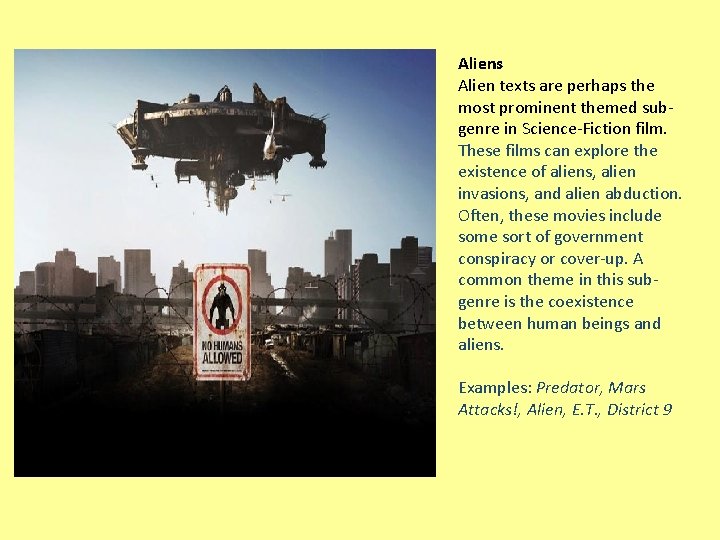
Aliens Alien texts are perhaps the most prominent themed subgenre in Science-Fiction film. These films can explore the existence of aliens, alien invasions, and alien abduction. Often, these movies include some sort of government conspiracy or cover-up. A common theme in this subgenre is the coexistence between human beings and aliens. Examples: Predator, Mars Attacks!, Alien, E. T. , District 9
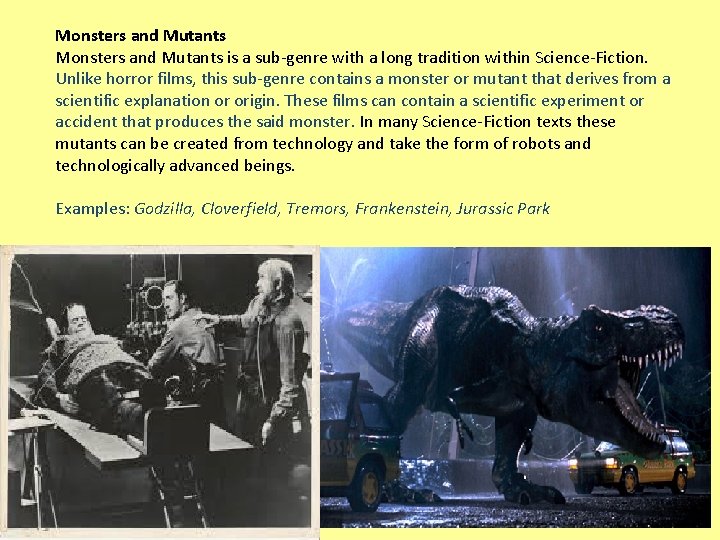
Monsters and Mutants is a sub-genre with a long tradition within Science-Fiction. Unlike horror films, this sub-genre contains a monster or mutant that derives from a scientific explanation or origin. These films can contain a scientific experiment or accident that produces the said monster. In many Science-Fiction texts these mutants can be created from technology and take the form of robots and technologically advanced beings. Examples: Godzilla, Cloverfield, Tremors, Frankenstein, Jurassic Park
Science fiction is any idea that occurs in the head and doesn't exist yet, but soon will, and will change everything for everybody, and nothing will ever be the same again. As soon as you have an idea that changes some small part of the world you are writing science fiction. It is always the art of the possible, never the impossible. Ray Bradbury
- Slides: 10