
Anxiety Disorders New Insights Dr R V S











- Slides: 90
Anxiety Disorders New Insights Dr. R. V. S. N. Sarma. , M. D. , M. Sc. , Consultant Physician visit : www. drsarma. in
What is anxiety ? Ø ���� It is a mood-state with Ø ���� Marked Negative effects Ø ���� Bodily symptoms of tension Ø ���� Apprehensions about future Ø Its consequence is ‘worry’
What is physiological worry ? Ø �� Worry is a normal response to stressful situations limited to particular situations Ø Should not exceed the duration of event Ø Should not spread to other topics Ø �� Excessive worry should not be seen as a normal response, as part of one’s personality
What is pathological worry ? Ø ���� It is a component of anxiety Ø ���� Negative emotional thoughts, images Ø ���� Uncontrollable and they occur in sequence Ø ���� Concern about future threats and danger Ø Their frequency and intensity are more
What do people worry about ? Ø ���� Real problems that could be potentially solved, but are not acted on Ø �� Real problems that probably cannot be solved (at least not by the individual), but can be coped with Ø �� “Imagined problems” that do not yet exist and probably will never exist Ø �� Worry about worry and its consequences
Pathological v/s normal anxiety Ø ���� Autonomous responses Ø ���� Greater intensity Ø ���� Longer duration Ø ���� Behavior significantly affected Ø Stressor may be minimal or absent
Origin of anxiety Ø ���� Protective response Ø ���� Normal/protective anxiety Ø Fear and pathological anxiety Ø Common underlying neuro-physiology Ø �� Two categories of fear/anxiety Ø Acute and Ø Chronic
Negative effects of worry 1. Unreasonable fear 2. Anxiety Disorder 3. Panic Disorder 4. Substance abuse 5. Depression
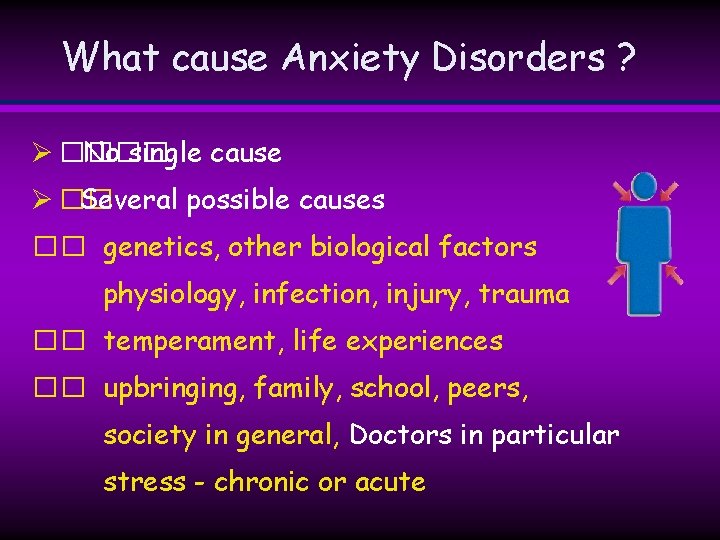
What cause Anxiety Disorders ? Ø ���� No single cause Ø �� Several possible causes �� genetics, other biological factors physiology, infection, injury, trauma �� temperament, life experiences �� upbringing, family, school, peers, society in general, Doctors in particular stress - chronic or acute
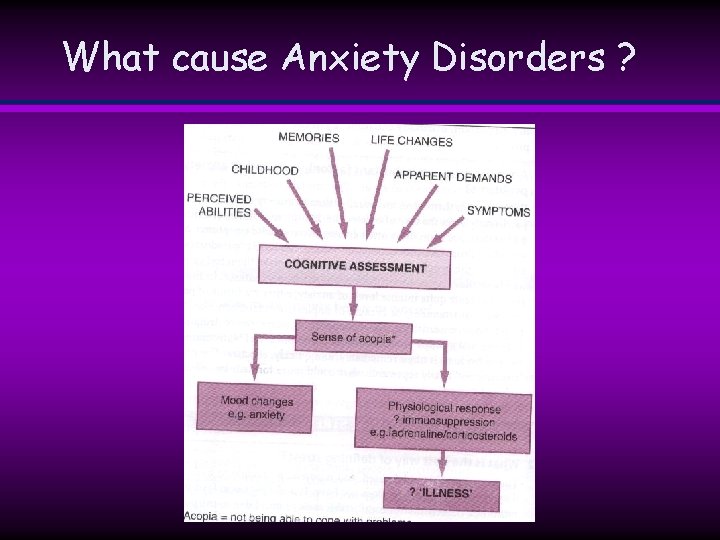
What cause Anxiety Disorders ?
Importance of Anxiety Disorders Ø ���� Accurate Dx and Rx of anxiety disorders is essential Ø Reduction of secondary psychiatric conditions Ø Depression Ø Substance abuse problems
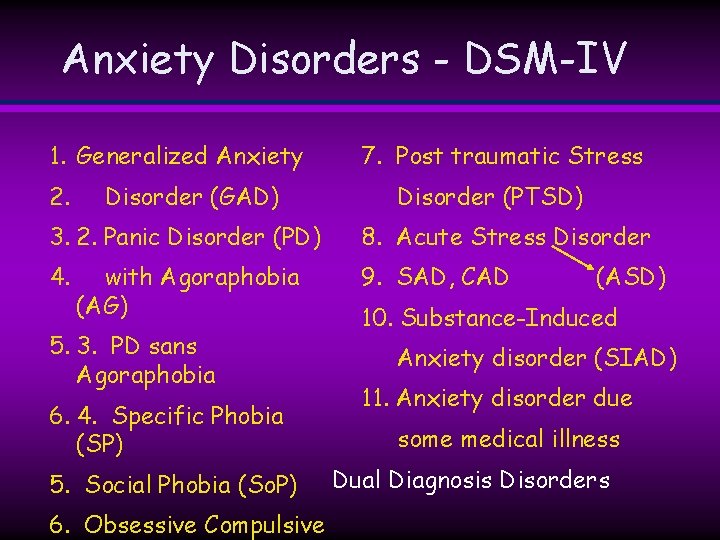
Anxiety Disorders - DSM-IV 1. Generalized Anxiety 2. Disorder (GAD) 7. Post traumatic Stress Disorder (PTSD) 3. 2. Panic Disorder (PD) 8. Acute Stress Disorder 4. 9. SAD, CAD with Agoraphobia (AG) 5. 3. PD sans Agoraphobia 6. 4. Specific Phobia (SP) 5. Social Phobia (So. P) 6. Obsessive Compulsive (ASD) 10. Substance-Induced Anxiety disorder (SIAD) 11. Anxiety disorder due some medical illness Dual Diagnosis Disorders
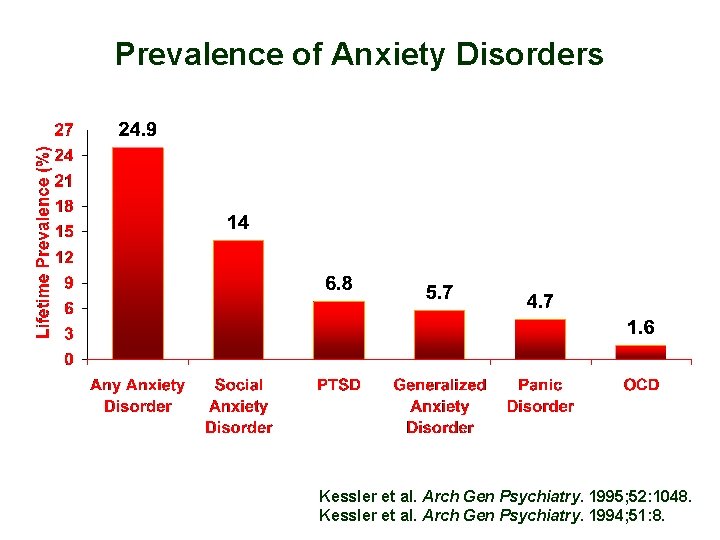
Prevalence of Anxiety Disorders Kessler et al. Arch Gen Psychiatry. 1995; 52: 1048. Kessler et al. Arch Gen Psychiatry. 1994; 51: 8.
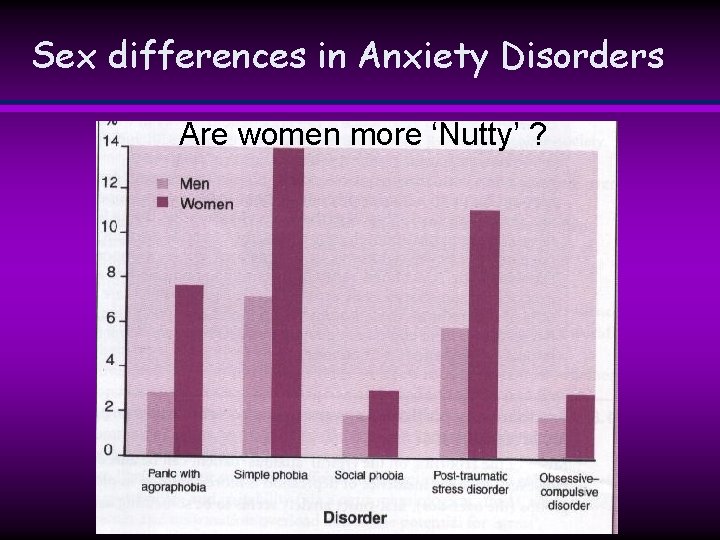
Sex differences in Anxiety Disorders Are women more ‘Nutty’ ?
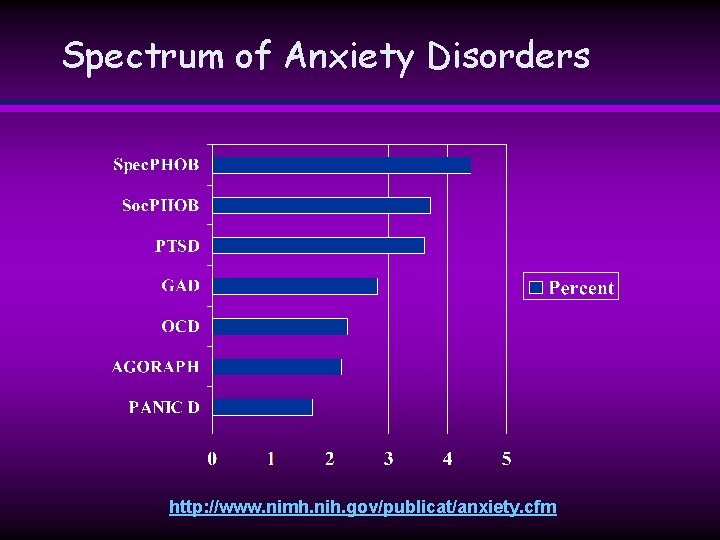
Spectrum of Anxiety Disorders http: //www. nimh. nih. gov/publicat/anxiety. cfm
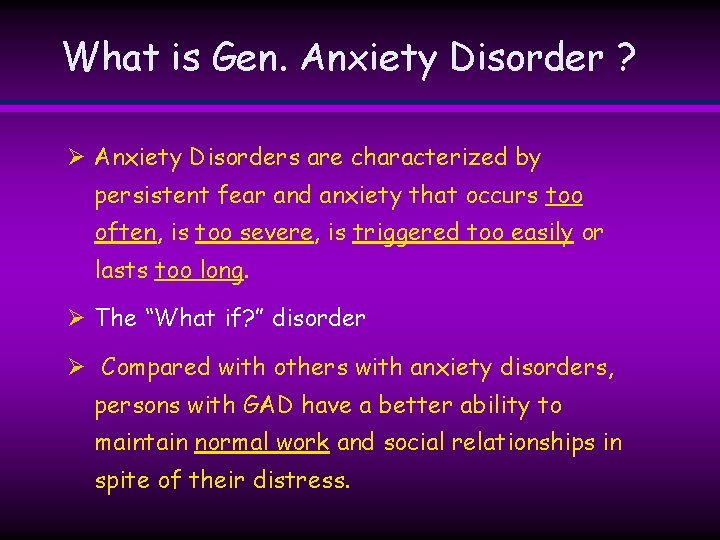
What is Gen. Anxiety Disorder ? Ø Anxiety Disorders are characterized by persistent fear and anxiety that occurs too often, is too severe, is triggered too easily or lasts too long. Ø The “What if? ” disorder Ø Compared with others with anxiety disorders, persons with GAD have a better ability to maintain normal work and social relationships in spite of their distress.
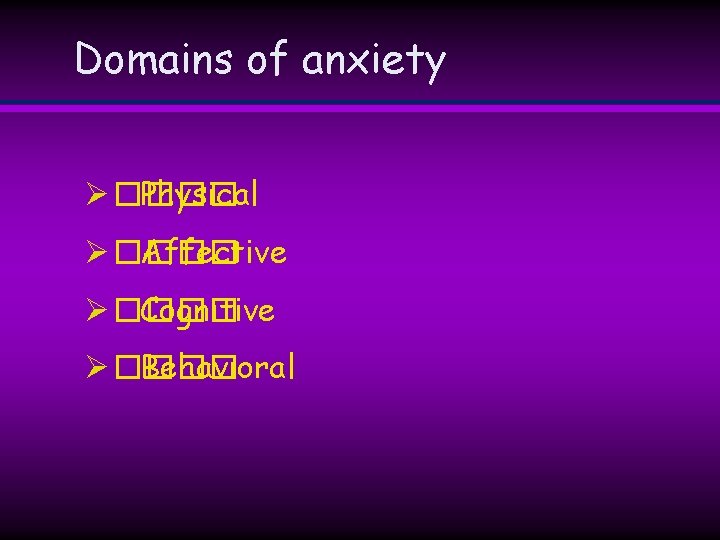
Domains of anxiety Ø ���� Physical Ø ���� Affective Ø ���� Cognitive Ø ���� Behavioral
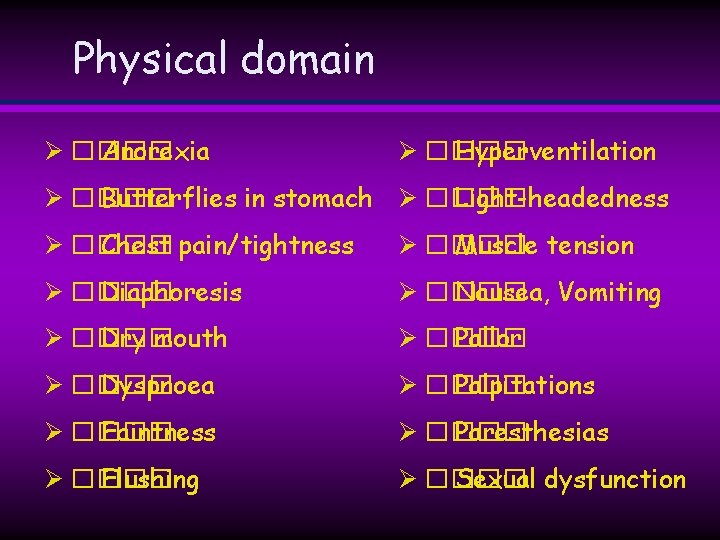
Physical domain Ø ���� Anorexia Ø ���� Hyperventilation Ø ���� Butterflies in stomach Ø ���� Light-headedness Ø ���� Chest pain/tightness Ø ���� Muscle tension Ø ���� Diaphoresis Ø ���� Nausea, Vomiting Ø ���� Dry mouth Ø ���� Pallor Ø ���� Dyspnoea Ø ���� Palpitations Ø ���� Faintness Ø ���� Paresthesias Ø ���� Flushing Ø ���� Sexual dysfunction
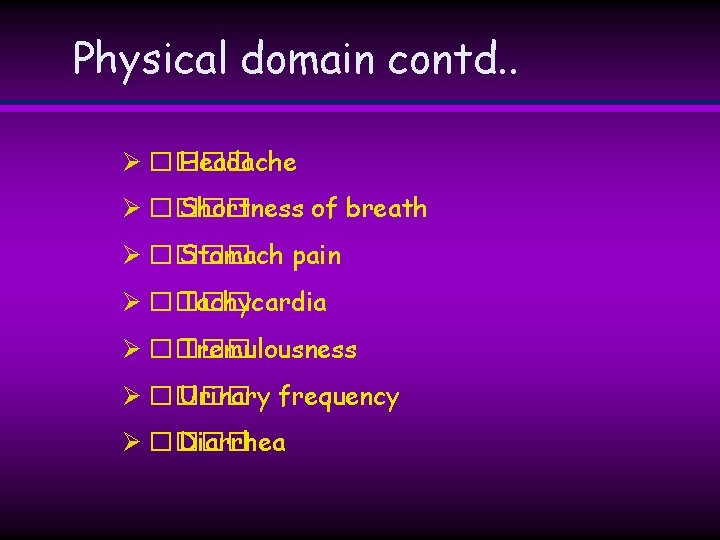
Physical domain contd. . Ø ���� Headache Ø ���� Shortness of breath Ø ���� Stomach pain Ø ���� Tachycardia Ø ���� Tremulousness Ø ���� Urinary frequency Ø ���� Diarrhea
Affective domain Ø ���� Edginess Ø ���� Uneasiness Ø ���� Terror Ø ���� Panic
Behavioral domain Ø ���� Triggers many responses Ø ���� Behavioral in nature Ø ���� Concerned with diminishing Ø ���� And even avoiding the distress
Regulation of locus ceruleus Ø ���� Alpha-noradrenergic auto receptors Ø ���� Serotonin receptors Ø ���� GABA-benzodiazepine receptors Ø ���� Opiate receptors Ø Dopamine receptors
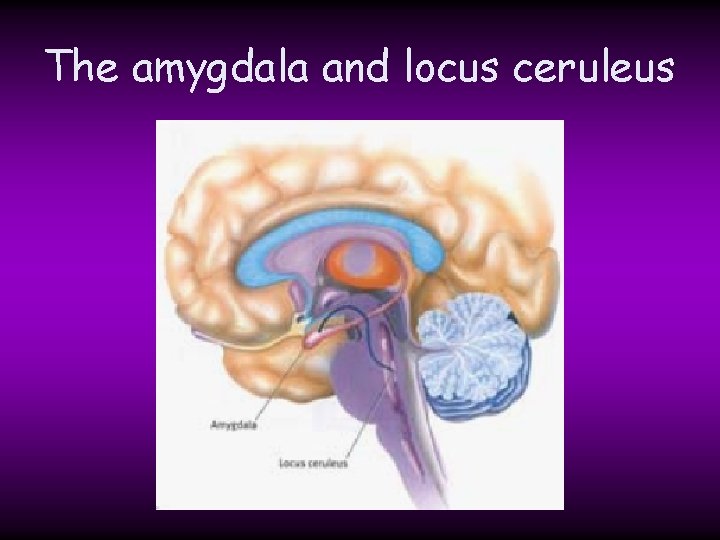
The amygdala and locus ceruleus
Generalized Anxiety Disorder -GAD Pathological anxiety, which is Ø excessive, chronic and Ø typically interferes with their ability to function in normal daily activities. Ø GAD is distinguished from Phobic anxiety – as it is not triggered by a specific object 1. Restlessness or feeling keyed up or on edge, 2. Being easily fatigued, 3. Difficulty concentrating or mind going blank, 4. Irritability, 5. Muscle tension, 6. Sleep disturbance Excessive anxiety and worry occurring more days than not for at least 6 months, about a number of events. The person finds it difficult to control the anxiety and worry and has associated three (or more) of the above six symptoms
Case # 1 Ø Ms. D has a chief c/o “worrying about everything” for the last year. She also c/o frequent headaches, fatigue and insomnia secondary to the anxiety. Ø These symptoms have worsened to the point where she has been distracted and making mistakes at work.
GAD – Mr. Fisc Worry that is Ø �� Excessive, uncontrollable Ø �� Frequent, multiple topics (not only onetime) Ø �� More than one day out of two 3 out of 6 other associated physical symptoms Ø �� Muscle tension, Restlessness Ø �� Fatigued easily, Irritability Ø �� Sleep disturbance, Concentration difficulty
Acute fear state Ø ���� Response to life-threatening danger Ø ���� Terror, helplessness, Ø Sense of impending disaster/doom Ø ���� Urgency to flee or seek safety Ø ���� Sympathetic/Nor-adrenergic activation Ø ���� Located in locus ceruleus Ø �� Corresponds to panic attacks
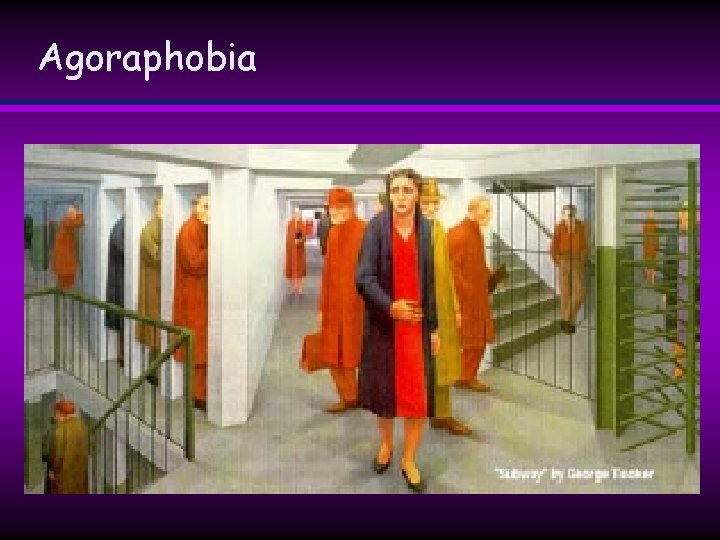
Agoraphobia Ø Anxiety in situations where escape might be difficult (or embarrassing) or help might not be available in the event of having a panic attack or panic-like symptoms Ø Situations are avoided or endured with marked distress Ø May not leave home or may need a companion Ø Can occur with and without panic disorder
Agoraphobia
Social Phobia Ø Marked, persistent fear of social or performance situations where a person is exposed to unfamiliar situations or people or possible scrutiny by others. Ø The individual fears acting in an embarrassing or humiliating way. Ø The Person recognizes fear as excessive. Ø Exposure causes anxiety symptoms or panic Ø Situations are avoided or endured with anxiety
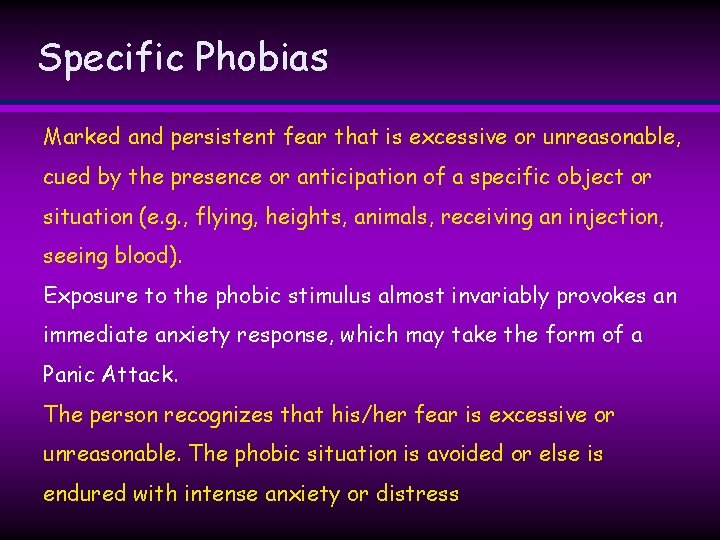
Specific Phobias Marked and persistent fear that is excessive or unreasonable, cued by the presence or anticipation of a specific object or situation (e. g. , flying, heights, animals, receiving an injection, seeing blood). Exposure to the phobic stimulus almost invariably provokes an immediate anxiety response, which may take the form of a Panic Attack. The person recognizes that his/her fear is excessive or unreasonable. The phobic situation is avoided or else is endured with intense anxiety or distress
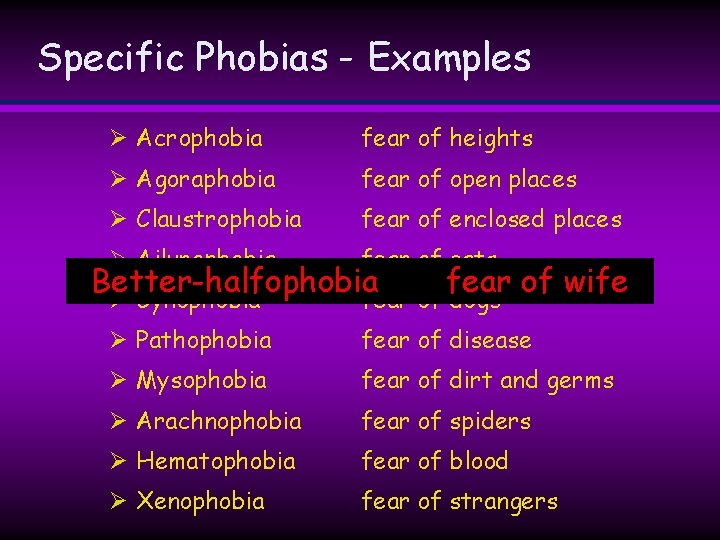
Specific Phobias - Examples Ø Acrophobia fear of heights Ø Agoraphobia fear of open places Ø Claustrophobia fear of enclosed places Ø Ailurophobia fear of cats Ø Pathophobia fear of disease Ø Mysophobia fear of dirt and germs Ø Arachnophobia fear of spiders Ø Hematophobia fear of blood Ø Xenophobia fear of strangers Better-halfophobia fear of wife Ø Cynophobia fear of dogs
PAN – The Greek God
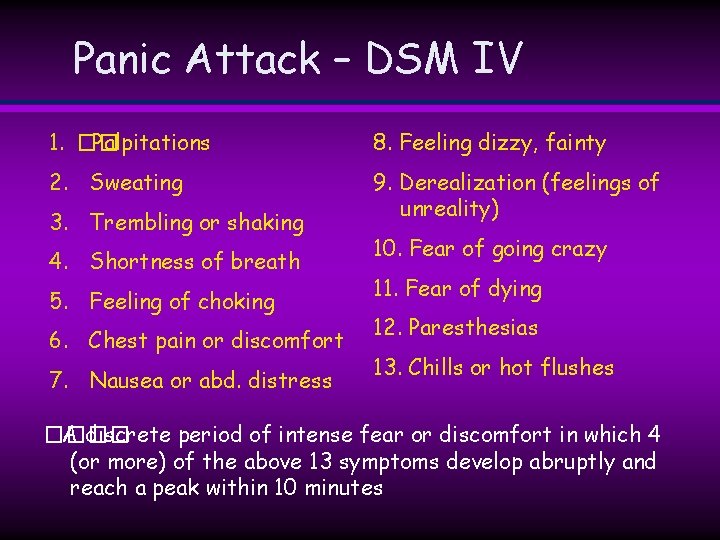
Panic Attack – DSM IV 1. �� Palpitations 8. Feeling dizzy, fainty 2. Sweating 9. Derealization (feelings of unreality) 3. Trembling or shaking 4. Shortness of breath 5. Feeling of choking 6. Chest pain or discomfort 7. Nausea or abd. distress 10. Fear of going crazy 11. Fear of dying 12. Paresthesias 13. Chills or hot flushes ���� A discrete period of intense fear or discomfort in which 4 (or more) of the above 13 symptoms develop abruptly and reach a peak within 10 minutes
Case # 2 Mrs. B c/o a long h/o episodes of anxiety, SOB, racing heart, sweating, CP, and fears that she is having a MI and will die. These last 30 minutes and are unexpected. She c/o anxiety while in malls and traveling alone to new places for fear of having another attack. Despite a negative w/u, she still worries about having a MI during an attack.
Panic Disorder with Agoraphobia Ø Recurrent unexpected panic attacks: anxiety associated with at least four physical and/or cognitive symptoms Ø At least 1 month of worry about having additional attacks or the consequences of an attack (losing control, having a heart attack, “going crazy”). Ø Agoraphobia
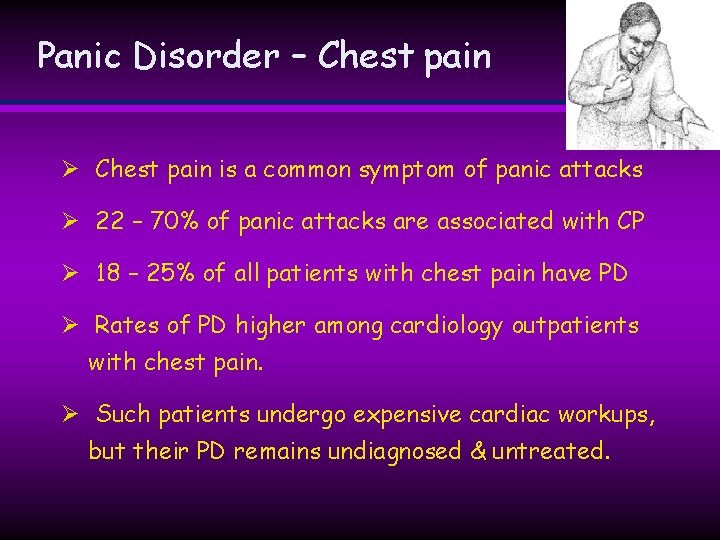
Panic Disorder – Chest pain Ø Chest pain is a common symptom of panic attacks Ø 22 – 70% of panic attacks are associated with CP Ø 18 – 25% of all patients with chest pain have PD Ø Rates of PD higher among cardiology outpatients with chest pain. Ø Such patients undergo expensive cardiac workups, but their PD remains undiagnosed & untreated.
Obsessive Compulsive Disorder - OCD Obsessions Ø Recurrent and persistent thoughts, impulses, or images that are experienced during the disturbance, as intrusive and inappropriate, and cause marked anxiety or distress. Ø The thoughts, impulses, or images are not simply excessive worries about real life problems. Ø The person attempts to ignore or suppress such thoughts impulses or to neutralize them with some other thought or action. Ø The person recognizes that the obsessive thoughts, impulses, or images are a product of his or her own mind
Obsessive Compulsive Disorder -OCD Compulsions Ø Repetitive behaviors (e. g. , hand washing, ordering, checking) or mental acts (e. g. , praying, counting, repeating words silently) Ø He/she is driven to perform in response to an obsession, Ø The behaviors or mental acts are aimed at preventing or reducing distress or preventing some dreaded event Ø But, these behaviors or mental acts are not connected in a realistic way with what they are designed to neutralize or prevent and are clearly excessive.
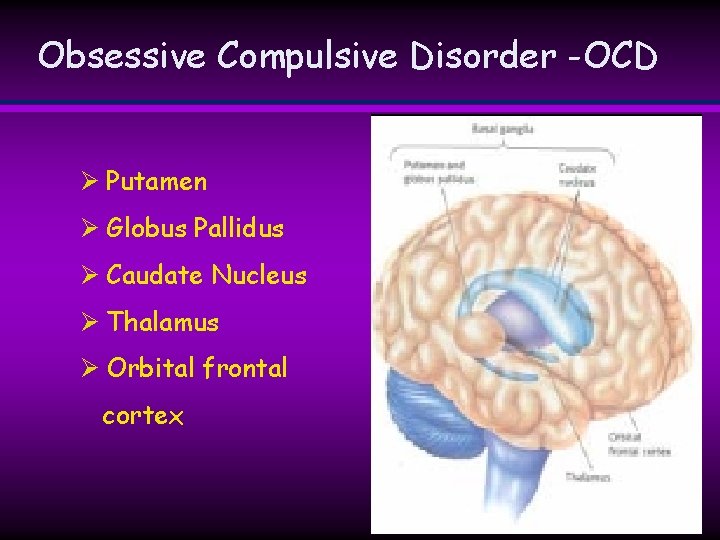
Obsessive Compulsive Disorder -OCD Ø Putamen Ø Globus Pallidus Ø Caudate Nucleus Ø Thalamus Ø Orbital frontal cortex
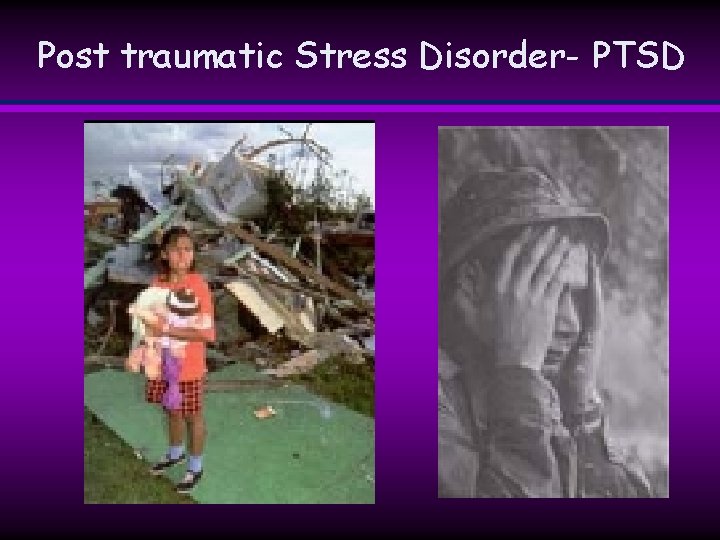
Post traumatic Stress Disorder- PTSD
Post traumatic Stress Disorder- PTSD Experiential requirements Ø The person has experienced a life-threatening event and has responded with intense fear, hopelessness or horror. Ø The person’s response to the event occurred more than 4 weeks after it was experienced and lasted more than one month. Ø The traumatic event is persistently re experienced in several ways, e. g. , by intrusive recollections, dreams, illusions, hallucinations, or flashbacks.
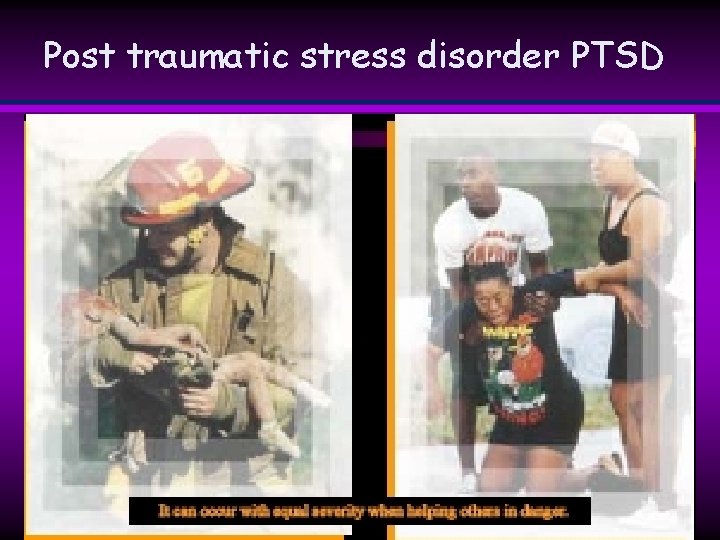
Post traumatic stress disorder PTSD
Post traumatic Stress Disorder- PTSD Behavioral requirements Ø Thought avoidance, related-activities and/or Ø People-avoidance behavior, Ø Feelings of detachment, Ø Blunted affect, Ø Sense of doom Ø Insomnia, Ø Irritability, Ø Hyper vigilance, Ø Exaggerated startle response
Post traumatic Stress Disorder- PTSD Subdivisions Ø Acute – when PTSD is diagnosed between 1 and 3 months after the event occurs it is called acute Ø Chronic - when PTSD continues longer than 3 months, it is considered chronic and long term Ø Delayed Onset PTSD-this term is used to describe those cases where the symptoms do not occur immediately after the experience, but, rather, months or years later
Case # 3 Mr. A witnessed a friend die in a MVA six weeks ago and c/o frequent nightmares of the accident, poor sleep, fears of driving, anxiety around highways, anhedonia and decreased affection highways, towards his girlfriend. His girlfriend also notes that he has been very irritable and startles easily since the accident.
Post traumatic Stress Disorder- PTSD Ø ���� Exposure to a traumatic event Ø ���� Response involving intense fear, Ø Helplessness and horror Ø ���� Re-experiencing of the traumatic event Ø Avoidance of stimuli/psychological numbing Ø ���� Increased arousal Ø ���� Symptoms greater than 1 month
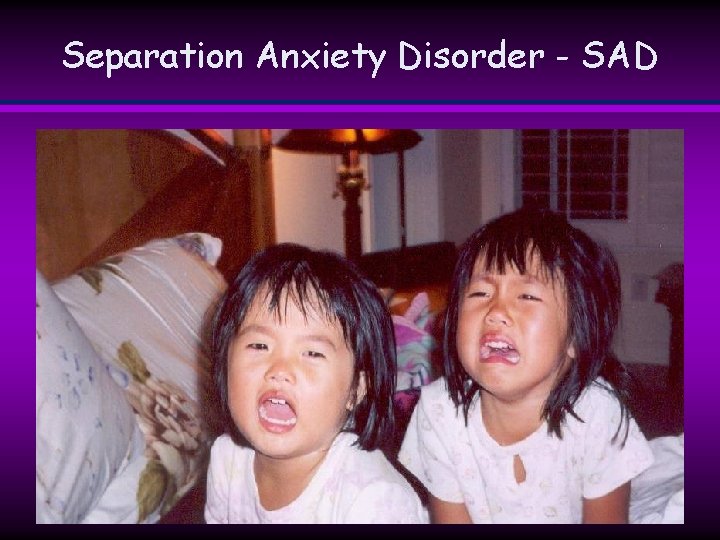
Separation Anxiety Disorder - SAD
Medical conditions causing anxiety Ø ���� Endocrine conditions Ø ���� Cardiovascular conditions Ø ���� Respiratory conditions Ø ���� Metabolic conditions Ø ���� Neurological conditions
Substances causing anxiety Ø ���� Alcohol Substances that cause Ø ���� Amphetamines anxiety (withdrawal) Ø ���� Caffeine Ø ���� Alcohol Ø ���� Cannabis Ø ���� Cocaine Ø ���� Sedatives Ø ���� Hallucinogens Ø ���� Hypnotics Ø ���� Inhalants Ø ���� Anxiolytics Ø ���� Phencyclidine
Medications causing anxiety Ø Anesthetics Ø Oral contraceptives Ø Analgesics Ø Antihistamines Ø Sympathomimetics Ø Anti-parkinsonians Ø Bronchodilators Ø �� Corticosteroids Ø Anti-cholinergics Ø Antihypertensives Ø �� Insulin Ø Cardiovascular drugs Ø Thyroid hormones Ø Anticonvulsants
Anxiety Disorders Current Management Strategies
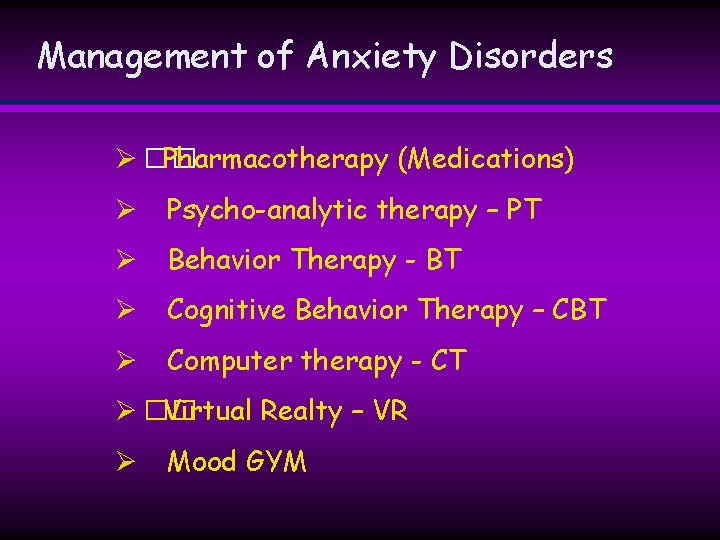
Management of Anxiety Disorders Ø �� Pharmacotherapy (Medications) Ø Psycho-analytic therapy – PT Ø Behavior Therapy - BT Ø Cognitive Behavior Therapy – CBT Ø Computer therapy - CT Ø �� Virtual Realty – VR Ø Mood GYM
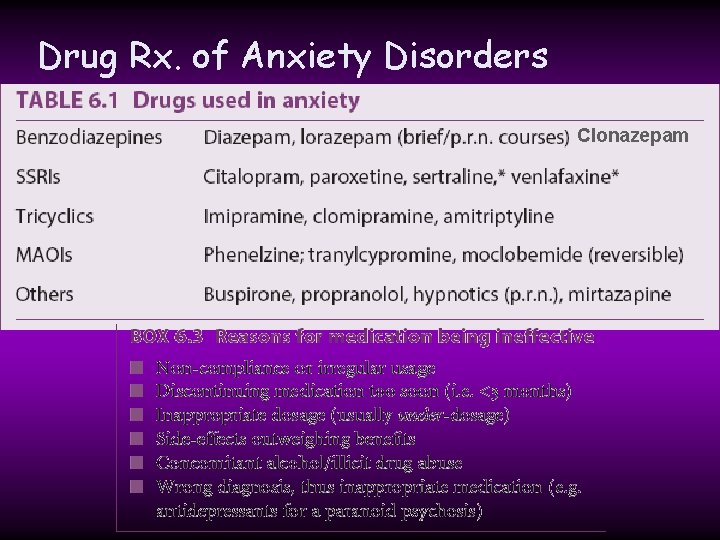
Drug Rx. of Anxiety Disorders Clonazepam
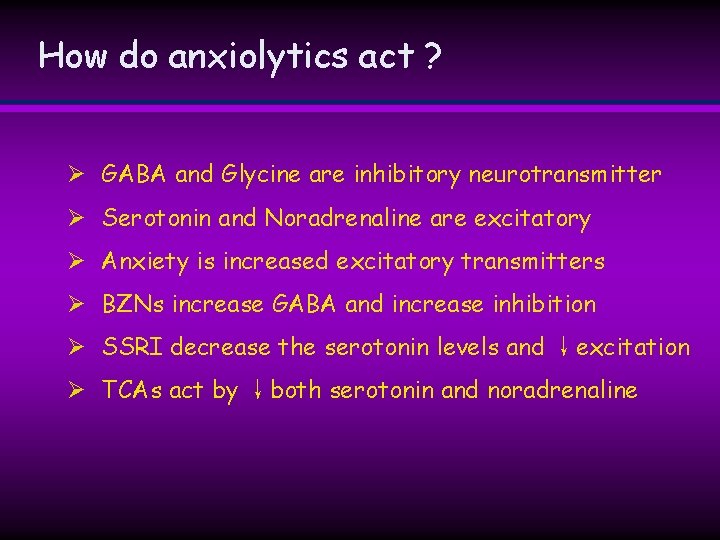
How do anxiolytics act ? Ø GABA and Glycine are inhibitory neurotransmitter Ø Serotonin and Noradrenaline are excitatory Ø Anxiety is increased excitatory transmitters Ø BZNs increase GABA and increase inhibition Ø SSRI decrease the serotonin levels and ↓excitation Ø TCAs act by ↓both serotonin and noradrenaline
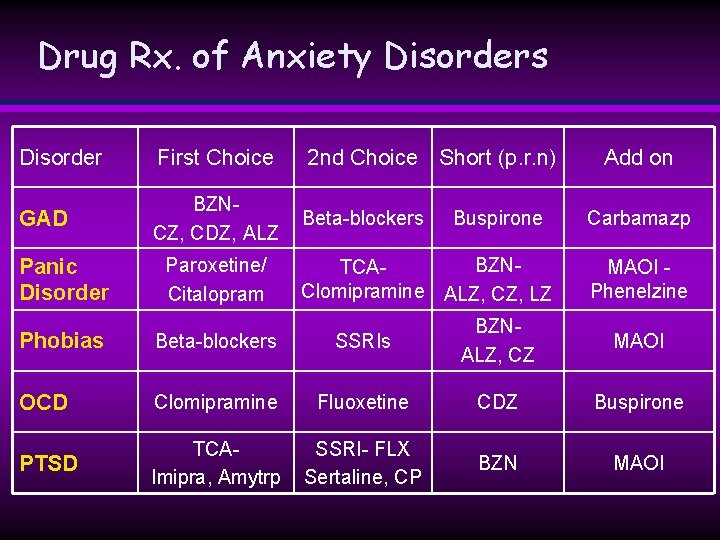
Drug Rx. of Anxiety Disorders Disorder First Choice 2 nd Choice Short (p. r. n) GAD BZNCZ, CDZ, ALZ Beta-blockers Buspirone BZNTCAClomipramine ALZ, CZ, LZ Add on Carbamazp Panic Disorder Paroxetine/ Citalopram Phobias Beta-blockers SSRIs BZNALZ, CZ MAOI OCD Clomipramine Fluoxetine CDZ Buspirone PTSD TCAImipra, Amytrp SSRI- FLX Sertaline, CP BZN MAOI Phenelzine
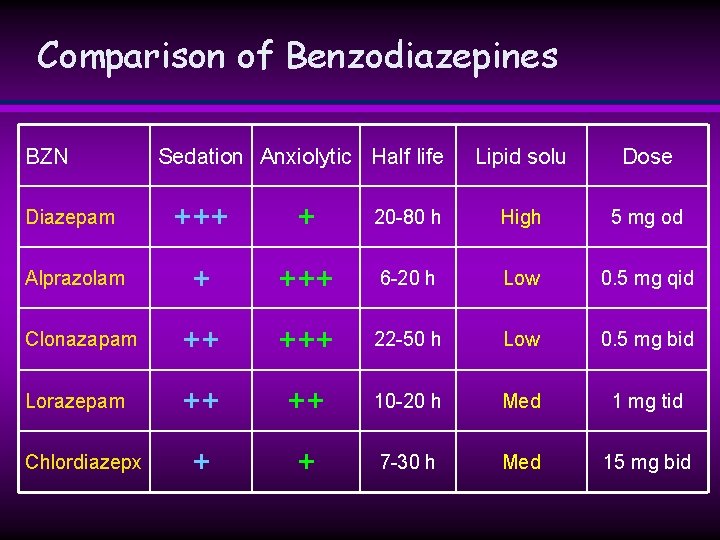
Comparison of Benzodiazepines BZN Sedation Anxiolytic Half life Lipid solu Dose Diazepam +++ + 20 -80 h High 5 mg od Alprazolam + +++ 6 -20 h Low 0. 5 mg qid Clonazapam ++ +++ 22 -50 h Low 0. 5 mg bid Lorazepam ++ ++ 10 -20 h Med 1 mg tid + + 7 -30 h Med 15 mg bid Chlordiazepx
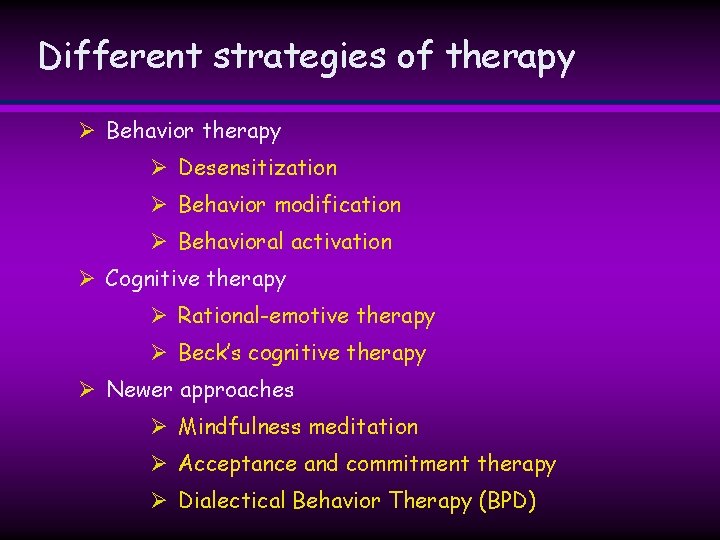
Different strategies of therapy Ø Behavior therapy Ø Desensitization Ø Behavior modification Ø Behavioral activation Ø Cognitive therapy Ø Rational-emotive therapy Ø Beck’s cognitive therapy Ø Newer approaches Ø Mindfulness meditation Ø Acceptance and commitment therapy Ø Dialectical Behavior Therapy (BPD)
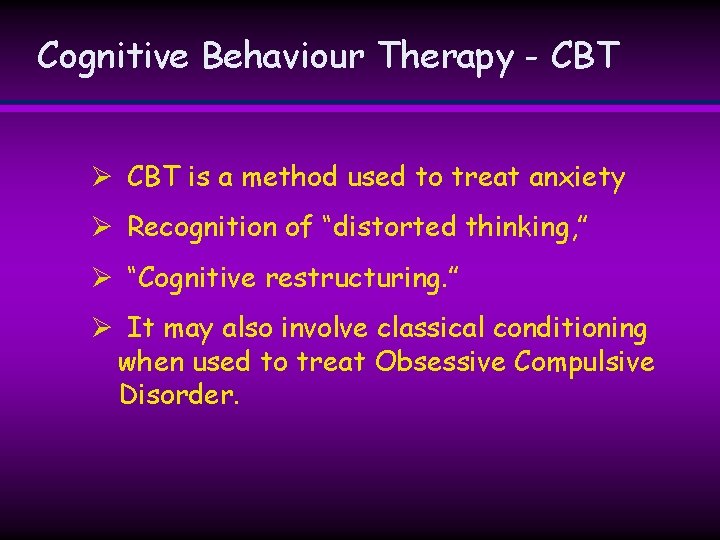
Cognitive Behaviour Therapy - CBT Ø CBT is a method used to treat anxiety Ø Recognition of “distorted thinking, ” Ø “Cognitive restructuring. ” Ø It may also involve classical conditioning when used to treat Obsessive Compulsive Disorder.
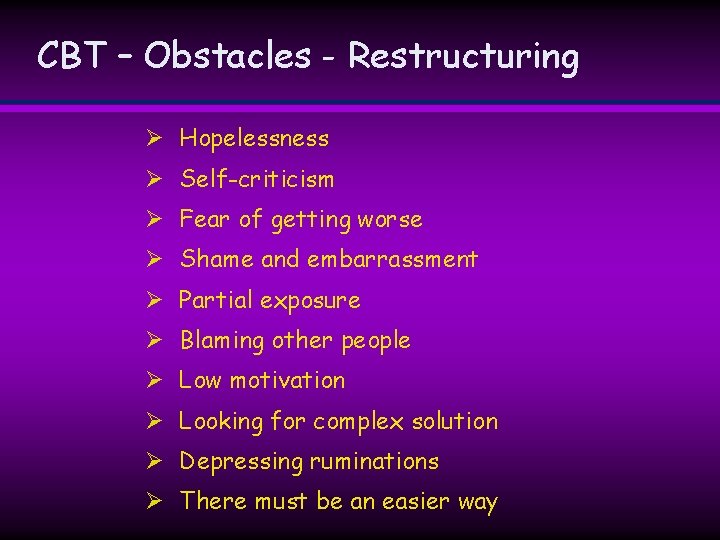
CBT – Obstacles - Restructuring Ø Hopelessness Ø Self-criticism Ø Fear of getting worse Ø Shame and embarrassment Ø Partial exposure Ø Blaming other people Ø Low motivation Ø Looking for complex solution Ø Depressing ruminations Ø There must be an easier way
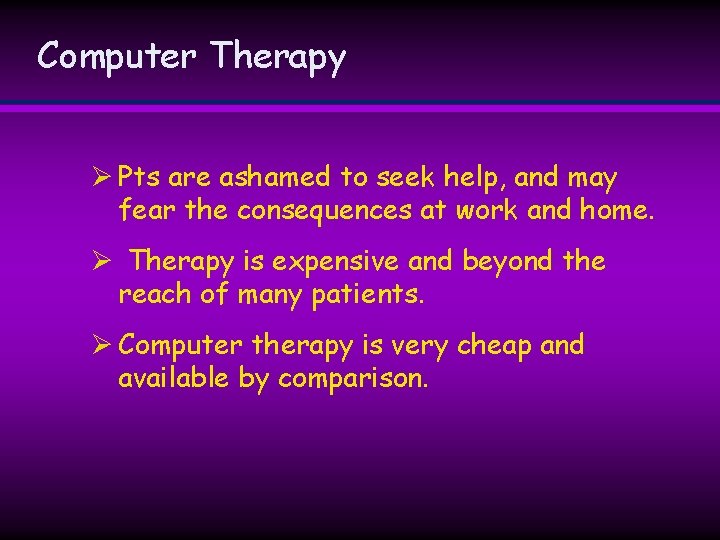
Computer Therapy Ø Pts are ashamed to seek help, and may fear the consequences at work and home. Ø Therapy is expensive and beyond the reach of many patients. Ø Computer therapy is very cheap and available by comparison.
Computer Therapy – Softwares Ø Fearfighter - for phobia/panic Ø Cope - for depression/anxiety Ø Balance - for GAD Ø BTSteps - for OCD These are PC based in a CD-Rom or phone based or Web-based
MENTAL OUTSIDE
Virtual Reality - VR Ø VR therapy via SD (Systematic Desensitization) is becoming very popular. Ø SD is a process of gradually introducing a disturbing stimulus (e. g. view from a high place) in otherwise pleasant surroundings. Ø This process gradually suppresses the anxiety response.
Virtual Reality – VR - Advantages Ø Patients often have difficulty imagining the stimulus themselves. Ø They are often afraid of experiencing it directly – which may also be expensive and time-consuming. Ø VR affords patient privacy and confidentiality during treatment. Ø Very good for phobias
Virtual Reality – VR - Imagination Ø “Projection in time” – rationally reconstructing the future Ø “De-catastrophizing an image” – modifying a disturbing image Ø “Image modeling and substitution” – interrupting a negative train of images Ø “Covert conditioning” – subtle conditioning using imagined rather than real stimuli
Virtual Reality – VR - Hutchworld Ø Hutchworld is a virtual community attached to the Hutchison Cancer Research Center. Ø Designed to provide social support for cancer patients and their families. Ø Based on Microsoft’s Vworld’s system.
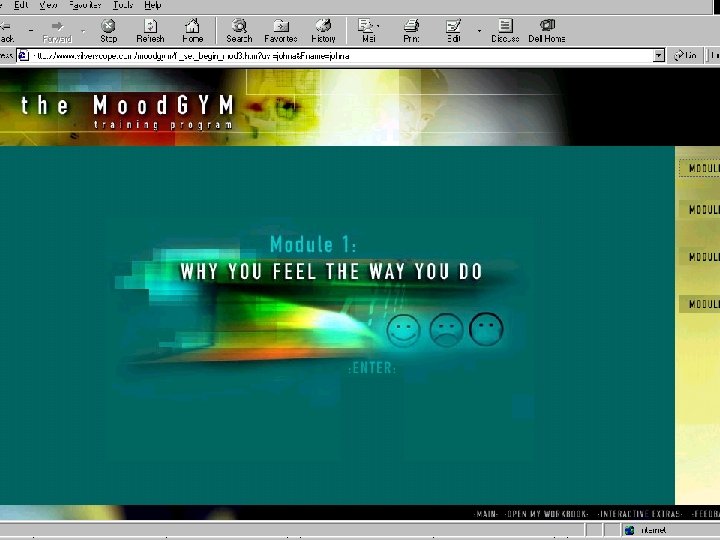
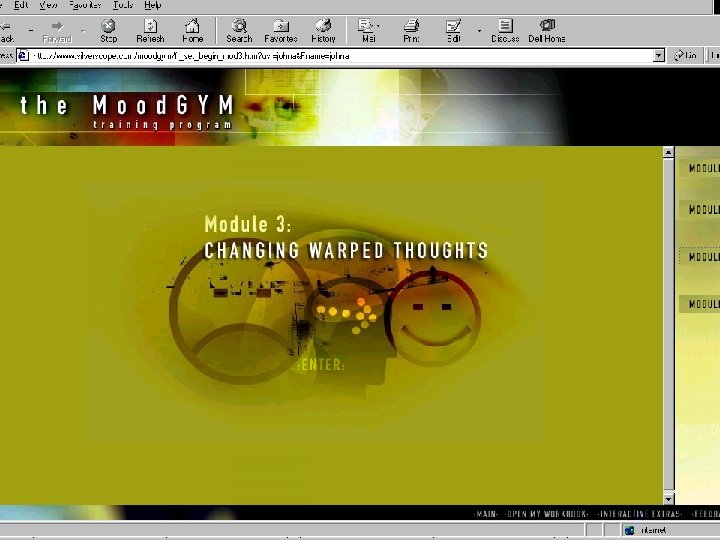
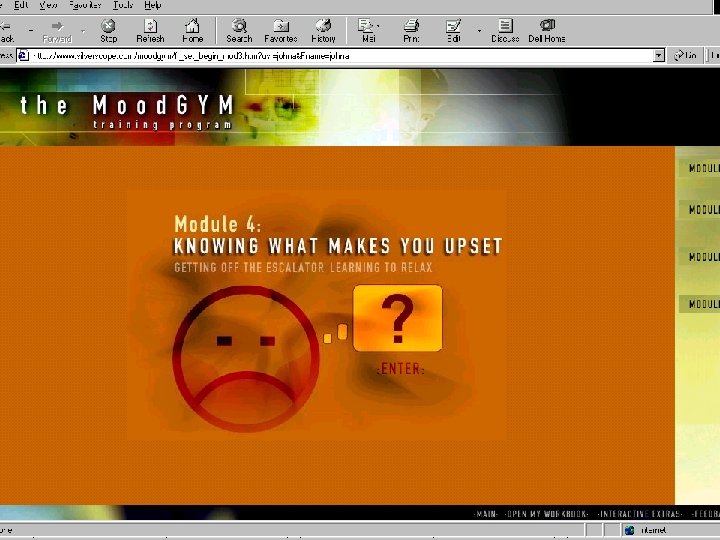
Mood GYM on the Internet Ø Few GPs are trained in CBT Ø Clinical psychologists are expensive Ø Young people are not easily reached Ø They may not want them – embarrassment Ø The web is accessible, convenient and popular with young people. Ø Deliver CBT via internet – 5 modules
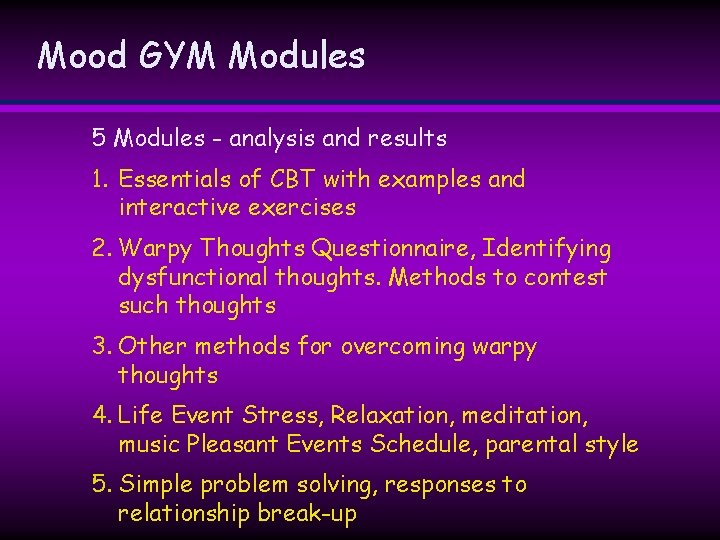
Mood GYM Modules 5 Modules - analysis and results 1. Essentials of CBT with examples and interactive exercises 2. Warpy Thoughts Questionnaire, Identifying dysfunctional thoughts. Methods to contest such thoughts 3. Other methods for overcoming warpy thoughts 4. Life Event Stress, Relaxation, meditation, music Pleasant Events Schedule, parental style 5. Simple problem solving, responses to relationship break-up
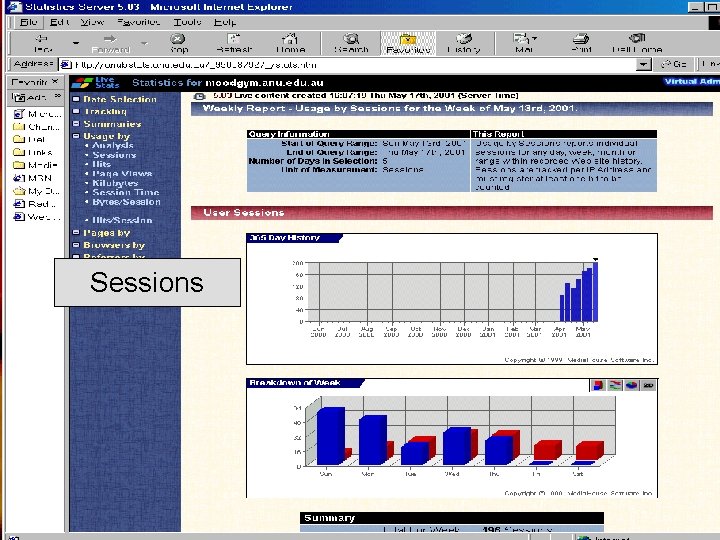
Web stats summary Sessions
Take home points Ø ���� Anxiety disorders are very common Ø ���� Just as fevers these are of different types Ø ���� Accurate Dx. and Rx. by GP is essential Ø ���� Depression and substance abuse potential Ø Minimum of six weeks to see Rx effect Ø Prolonged Rx. is necessary 6 m or more Ø Drug Rx is only a small part of management Ø SSRI, TCAs, BZNs, MAOIs, ß-blockers etc. Ø CBT, Computer treatment, VRs, Mood GYM
Thank You All Visit us at : www. drsarma. in This is sponsored by Torrent – Makers of Clonotril (Clonazepam)