
ANXIETY DISORDERS Chapter F 4 Acute and Chronic
- Slides: 30
ANXIETY DISORDERS Chapter F. 4 Acute and Chronic Reactions to Trauma in Children and Adolescents Eric Bui, Bonnie Ohye, Sophie Palitz, Bertrand Olliac, Nelly Goutaudier, Jean-Philippe Raynaud, Kossi B Kounou & Frederick J Stoddard Jr Companion Power. Point Presentation Adapted by Henrikje Klasen & Julie Chilton
The “IACAPAP Textbook of Child and Adolescent Mental Health” is available at the IACAPAP website http: //iacapap. org/iacapap-textbook-of-child-and-adolescentmental-health Please note that this book and its companion powerpoint are: · Free and no registration is required to read or download it · This is an open-access publication under the Creative Commons Attribution Noncommercial License. According to this, use, distribution and reproduction in any medium are allowed without prior permission provided the original work is properly cited and the use is non-commercial.
Acute and Chronic Reactions to Trauma Learning objectives • Screen for mental health problems following trauma • Differentiate and diagnose – Acute Stress Disorder and PTSD – Other related problems • Treat or manage through: – – Psycho-education Psychological first aid Basic psycho-social interventions Pharmacotherapy • Know when to refer patient to a specialist
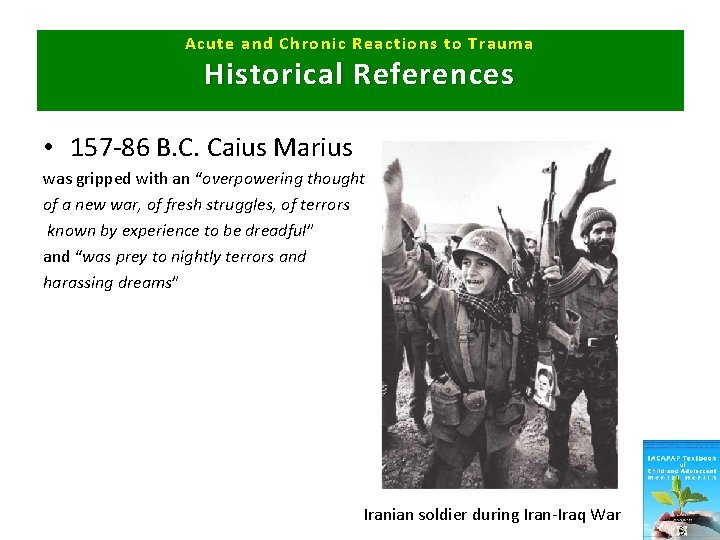
Acute and Chronic Reactions to Trauma Historical References • 157 -86 B. C. Caius Marius was gripped with an “overpowering thought of a new war, of fresh struggles, of terrors known by experience to be dreadful” and “was prey to nightly terrors and harassing dreams” Iranian soldier during Iran-Iraq War
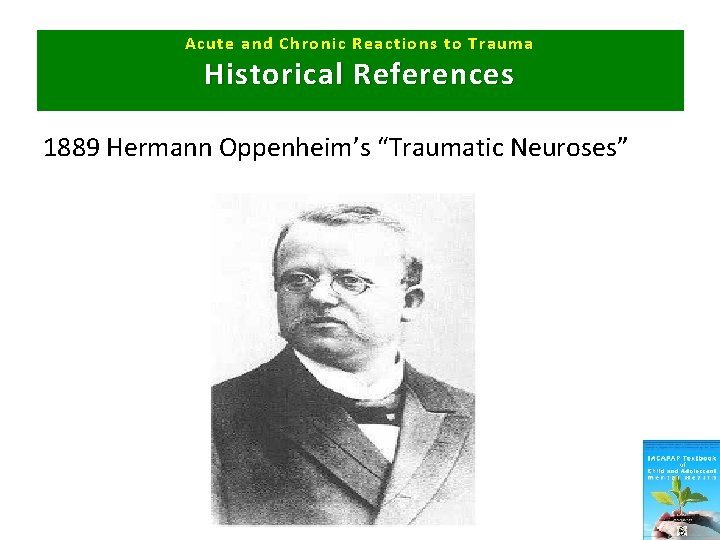
Acute and Chronic Reactions to Trauma Historical References 1889 Hermann Oppenheim’s “Traumatic Neuroses”
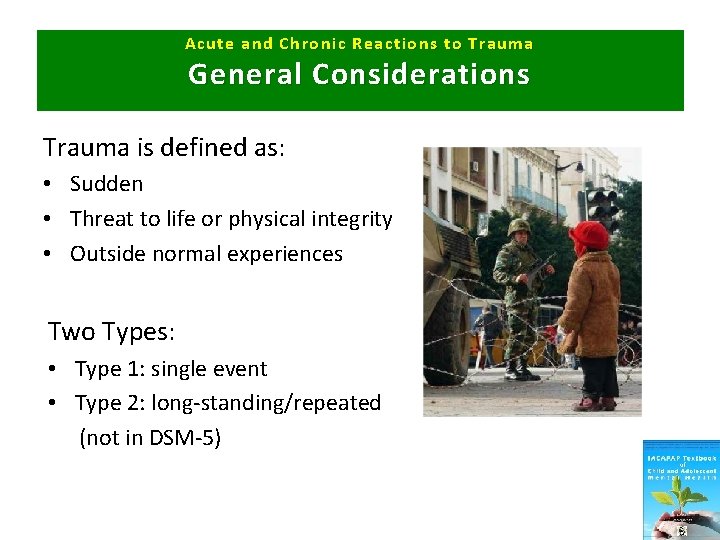
Acute and Chronic Reactions to Trauma General Considerations Trauma is defined as: • Sudden • Threat to life or physical integrity • Outside normal experiences Two Types: • Type 1: single event • Type 2: long-standing/repeated (not in DSM-5)
Acute and Chronic Reactions to Trauma General Considerations DSM 5 Changes: • • Type 2 not included No subjective reaction criterion Exposure through close family or friend added Extreme and repeated exposure to aversive details included Only work-related exposure through media For children “negative alterations in cognitions and mood” Distinct category New PTSD subcategory for children under 6
Acute and Chronic Reactions to Trauma In Your World • What is the relevance ? • Any cases? • Do local people recognize it? • Other points to discuss?
Acute and Chronic Reactions to Trauma Why I s T his I mportant? • Trauma is common • About 20% of children develop PTSD after trauma • Untreated symptoms may become chronic • Some approaches may worsen PTSD
Acute and Chronic Reactions to Trauma The Basics: ASD/ASR and PTSD Definition—according to duration of symptoms after the trauma: • Peri-traumatic: – symptoms lasting minutes or hours • Acute Stress Disorder (ASD): – symptoms lasting 2/3 days to 1 month • Post-Traumatic Stress Disorder (PTSD): – Symptoms for more than 1 month
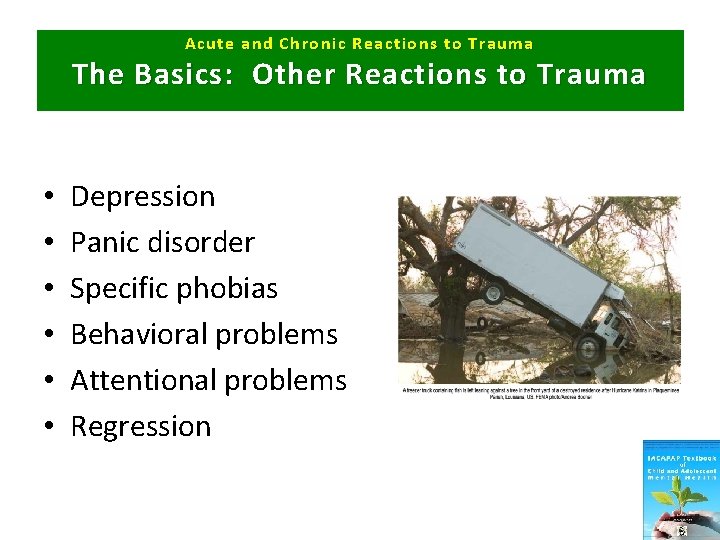
Acute and Chronic Reactions to Trauma The Basics: Other Reactions to Trauma • • • Depression Panic disorder Specific phobias Behavioral problems Attentional problems Regression
Acute and Chronic Reactions to Trauma Epidemiology • ASD: – 8 -10% of exposed children – 17% mean prevalence of exposed adults • PTSD: – 16% exposed children – 5% prevalence in US adolescents – 7 -10% lifetime prevalence in US adults – Females>males
Acute and Chronic Reactions to Trauma Clinical F eatures: Peri-Traumatic Reactions • Minutes to hours after event • Increased likelihood of PTSD and ASD – Peri-traumatic distress: • Fear, horror, helplessness, sadness, guilt, shame, fright, loss of bowel/bladder control etc. – Peri-traumatic dissociation: • Blanking out, feeling on autopilot, time distortion, depersonalization, derealization, confusion, amnesia, reduced awareness
Acute and Chronic Reactions to Trauma Clinical F eatures : Acute Stress Reaction/Disorder • Symptoms 2 -3 days to 1 month after trauma • Symptoms: – Intrusion – Dissociative symptoms – Avoidance symptoms – Arousal symptoms • Clinically significant distress or impairment
Acute and Chronic Reactions to Trauma The Basics: PTSD http: //www. monkeysee. com/play/21549 -non-military-ptsd
Acute and Chronic Reactions to Trauma Clinical F eatures: PTSD • Debate over application of adult criteria • Exposure to death or threatened death, actual or threatened serious injury, actual or threatened sexual assault 1. 2. 3. 4. ONE symptom of intrusion (flashbacks, nightmares etc. ) Persistent avoidance TWO symptoms of negative alterations in mood or cognition (e. g. , blame, emotional numbing, withdrawal etc. ) TWO symptoms of alterations in arousal or reactivity (e. g. , startle, irritability, sleep disturbance) • Present more than 1 month • Significant distress or impairment
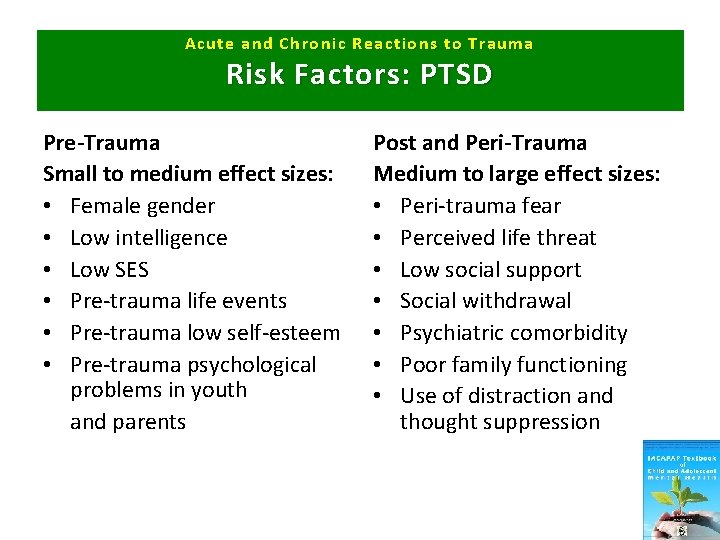
Acute and Chronic Reactions to Trauma Risk Factors: PTSD Pre-Trauma Small to medium effect sizes: • Female gender • Low intelligence • Low SES • Pre-trauma life events • Pre-trauma low self-esteem • Pre-trauma psychological problems in youth and parents Post and Peri-Trauma Medium to large effect sizes: • Peri-trauma fear • Perceived life threat • Low social support • Social withdrawal • Psychiatric comorbidity • Poor family functioning • Use of distraction and thought suppression
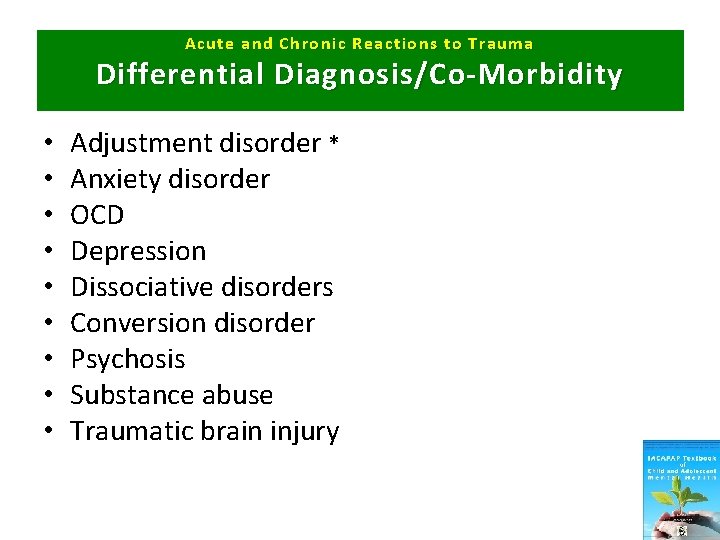
Acute and Chronic Reactions to Trauma Differential Diagnosis/Co-Morbidity • • • Adjustment disorder * Anxiety disorder OCD Depression Dissociative disorders Conversion disorder Psychosis Substance abuse Traumatic brain injury
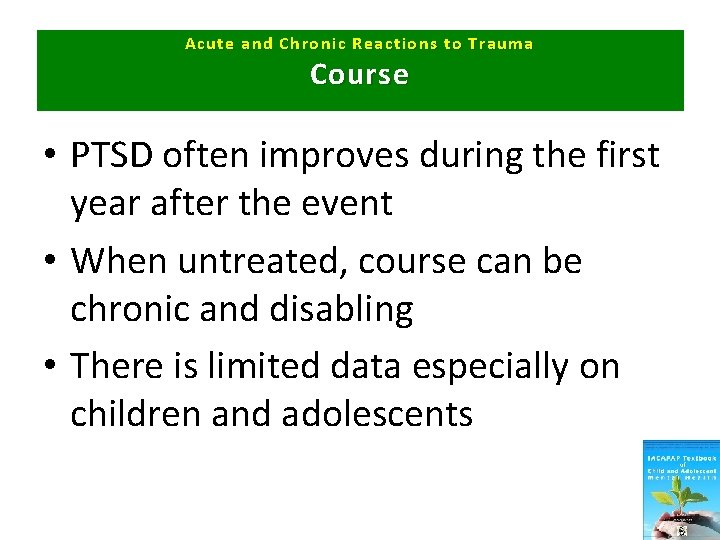
Acute and Chronic Reactions to Trauma Course • PTSD often improves during the first year after the event • When untreated, course can be chronic and disabling • There is limited data especially on children and adolescents
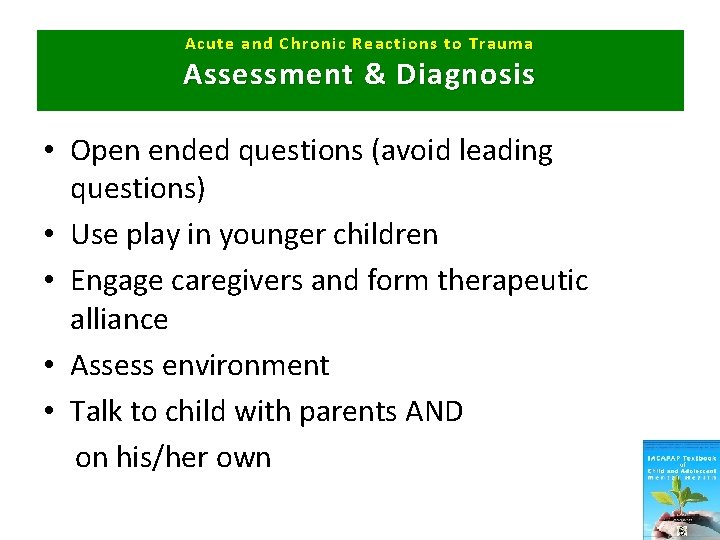
Acute and Chronic Reactions to Trauma Assessment & Diagnosis • Open ended questions (avoid leading questions) • Use play in younger children • Engage caregivers and form therapeutic alliance • Assess environment • Talk to child with parents AND on his/her own
Acute and Chronic Reactions to Trauma Cross-Cultural Differences How do people in your country express stress and distress?
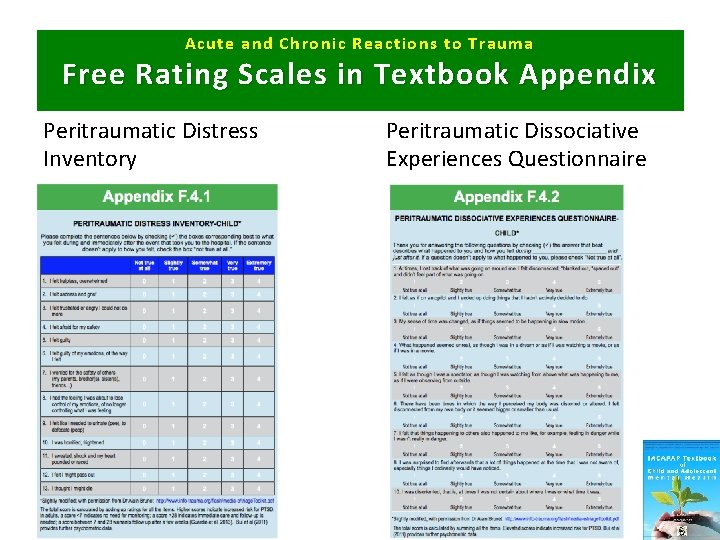
Acute and Chronic Reactions to Trauma Free Rating Scales in Textbook Appendix Peritraumatic Distress Inventory Peritraumatic Dissociative Experiences Questionnaire
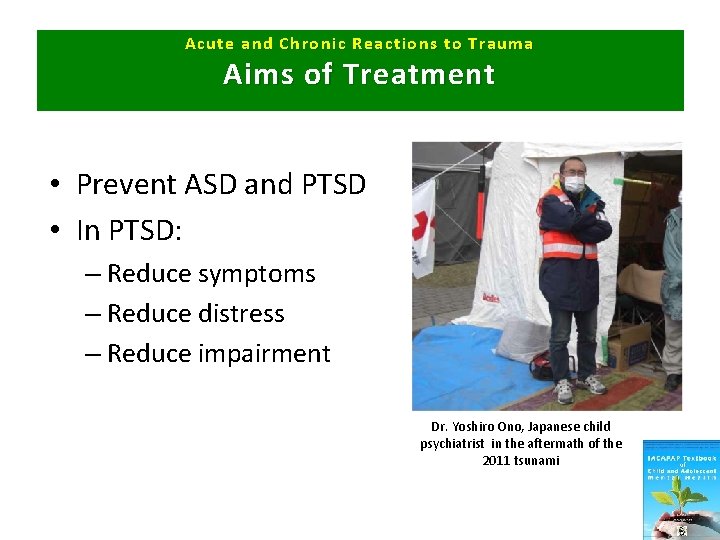
Acute and Chronic Reactions to Trauma Aims of Treatment • Prevent ASD and PTSD • In PTSD: – Reduce symptoms – Reduce distress – Reduce impairment Dr. Yoshiro Ono, Japanese child psychiatrist in the aftermath of the 2011 tsunami
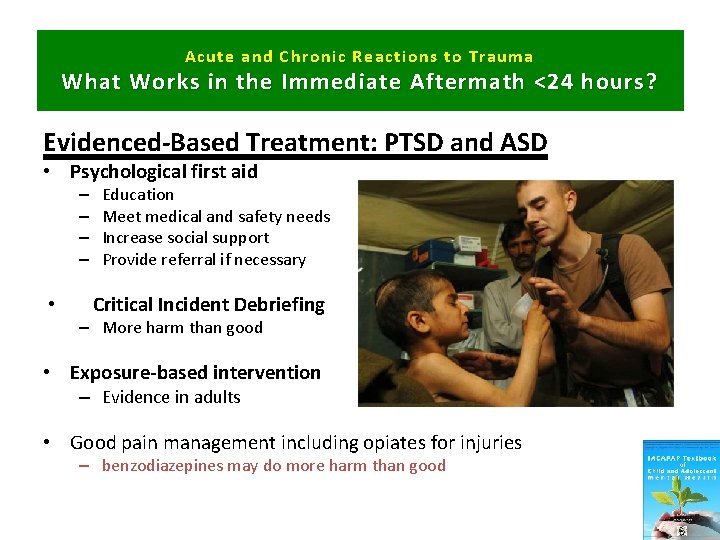
Acute and Chronic Reactions to Trauma What Works in the Immediate Aftermath <24 hours? Evidenced-Based Treatment: PTSD and ASD • Psychological first aid – – • Education Meet medical and safety needs Increase social support Provide referral if necessary Critical Incident Debriefing – More harm than good • Exposure-based intervention – Evidence in adults • Good pain management including opiates for injuries – benzodiazepines may do more harm than good 24
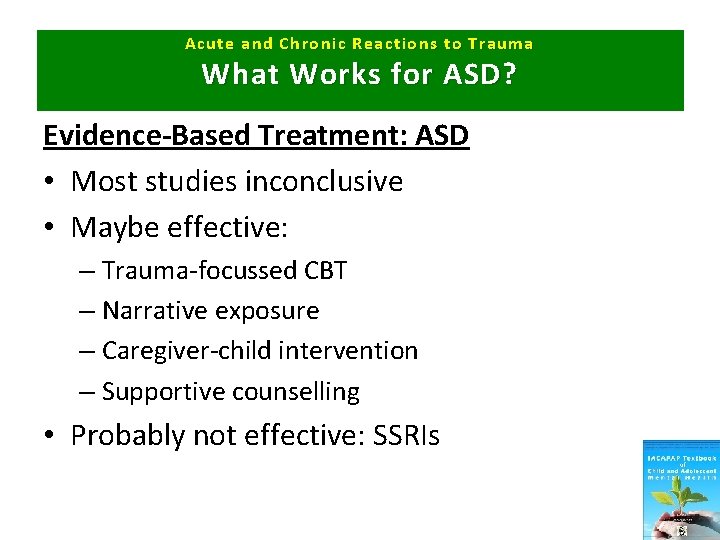
Acute and Chronic Reactions to Trauma What Works for ASD? Evidence-Based Treatment: ASD • Most studies inconclusive • Maybe effective: – Trauma-focussed CBT – Narrative exposure – Caregiver-child intervention – Supportive counselling • Probably not effective: SSRIs 25
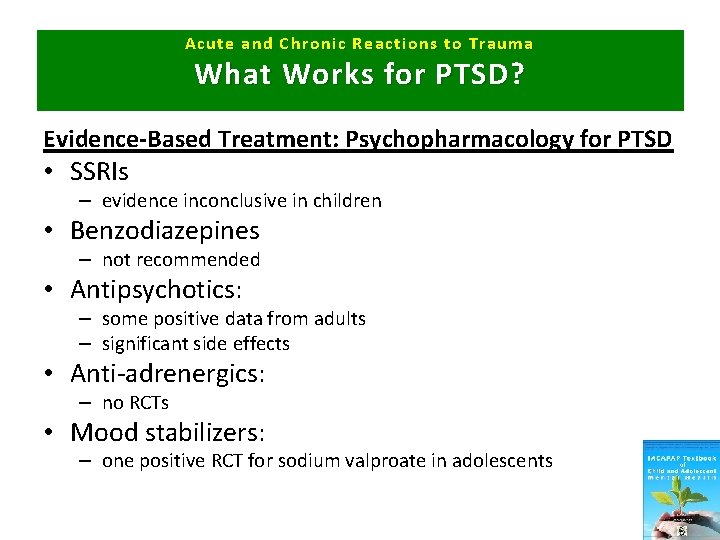
Acute and Chronic Reactions to Trauma What Works for PTSD? Evidence-Based Treatment: Psychopharmacology for PTSD • SSRIs – evidence inconclusive in children • Benzodiazepines – not recommended • Antipsychotics: – some positive data from adults – significant side effects • Anti-adrenergics: – no RCTs • Mood stabilizers: – one positive RCT for sodium valproate in adolescents 26
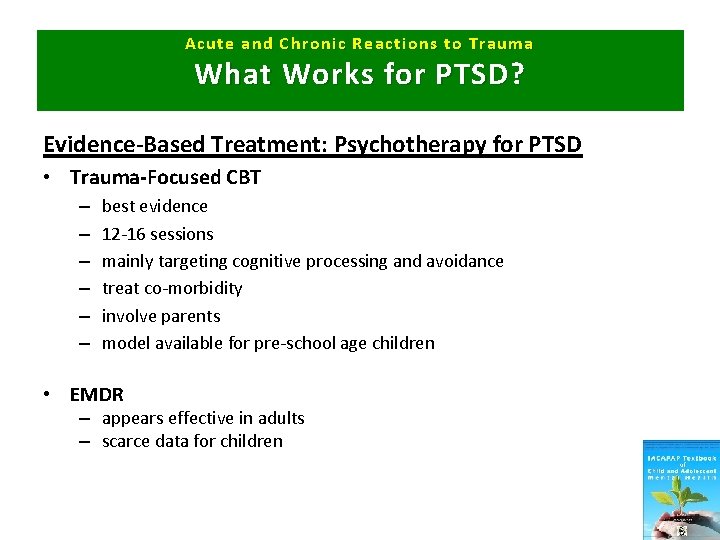
Acute and Chronic Reactions to Trauma What Works for PTSD? Evidence-Based Treatment: Psychotherapy for PTSD • Trauma-Focused CBT – – – best evidence 12 -16 sessions mainly targeting cognitive processing and avoidance treat co-morbidity involve parents model available for pre-school age children • EMDR – appears effective in adults – scarce data for children 27
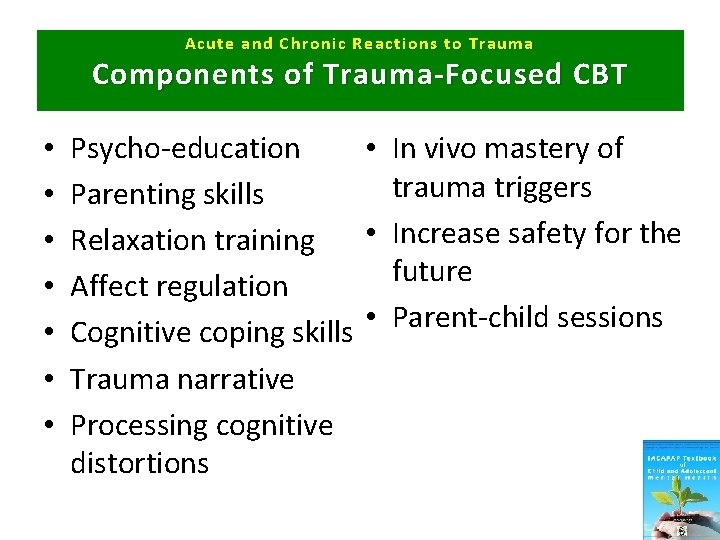
Acute and Chronic Reactions to Trauma Components of Trauma-Focused CBT • • In vivo mastery of Psycho-education trauma triggers Parenting skills • Increase safety for the Relaxation training future Affect regulation • Parent-child sessions Cognitive coping skills Trauma narrative Processing cognitive distortions 28
Acute and Chronic Reactions to Trauma Further Resources • AACAP PTSD Practice Parameter http: //www. jaacap. com/article/S 0890 -8567(10)00082 -1/pdf • Health Care Toolbox https: //www. healthcaretoolbox. org • International Society for Traumatic Stress Studies http: //www. istss. org/home. aspx • Australian Guidelines http: //www. phoenixaustralia. org 29
Medication: Thank You! ADHD Acute and Chronic Reactions to Trauma