
Antonina KALINICHENKO 1 Maksym KULYK 2 Oleg GORB
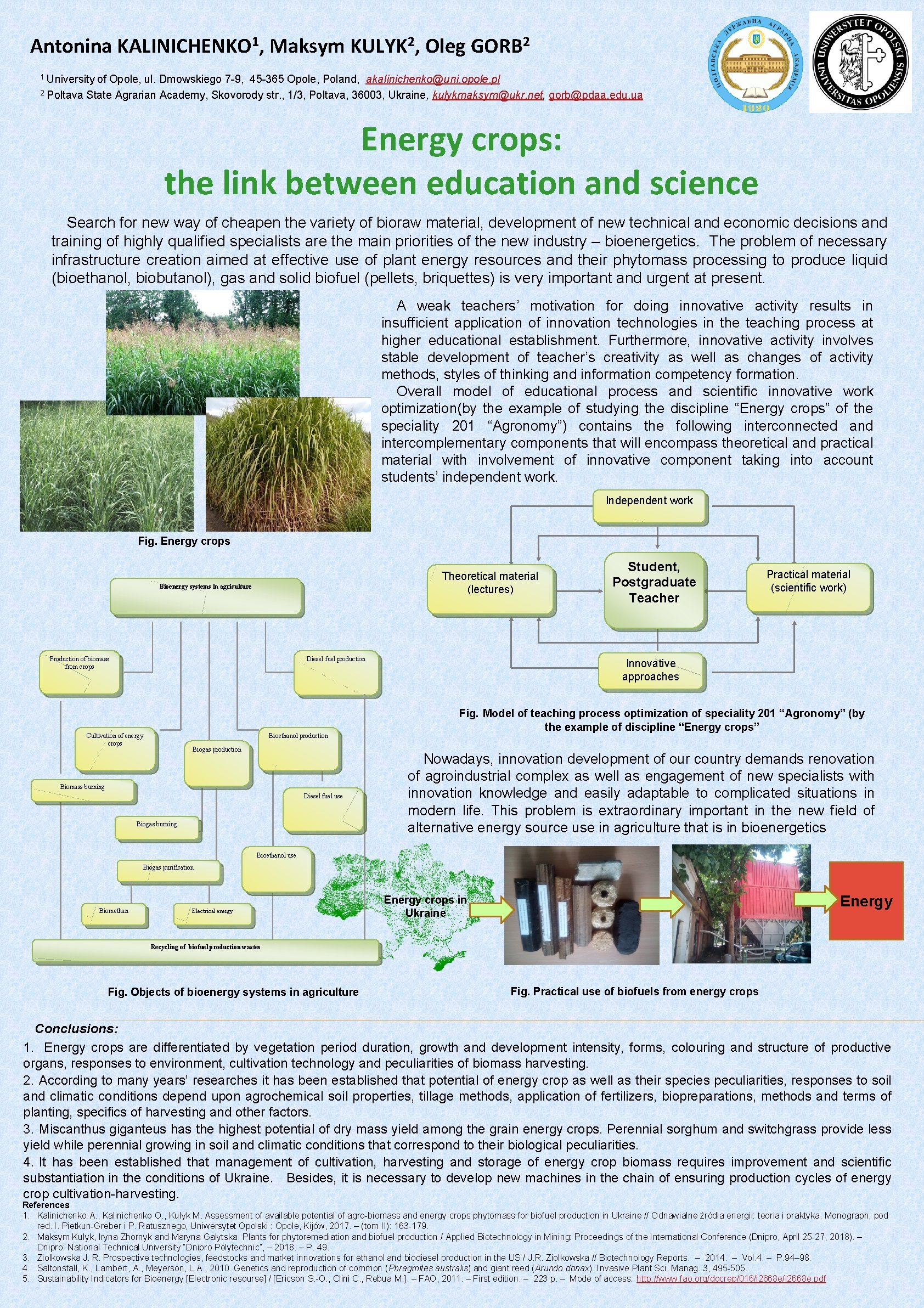
Antonina KALINICHENKO 1, Maksym KULYK 2, Oleg GORB 2 1 University of Opole, ul. Dmowskiego 7 -9, 45 -365 Opole, Poland, akalinichenko@uni. opole. pl 2 Poltava State Agrarian Academy, Skovorody str. , 1/3, Poltava, 36003, Ukraine, kulykmaksym@ukr. net, gorb@pdaa. edu. ua Energy crops: the link between education and science Search for new way of cheapen the variety of bioraw material, development of new technical and economic decisions and training of highly qualified specialists are the main priorities of the new industry – bioenergetics. The problem of necessary infrastructure creation aimed at effective use of plant energy resources and their phytomass processing to produce liquid (bioethanol, biobutanol), gas and solid biofuel (pellets, briquettes) is very important and urgent at present. A weak teachers’ motivation for doing innovative activity results in insufficient application of innovation technologies in the teaching process at higher educational establishment. Furthermore, innovative activity involves stable development of teacher’s creativity as well as changes of activity methods, styles of thinking and information competency formation. Overall model of educational process and scientific innovative work optimization(by the example of studying the discipline “Energy crops” of the speciality 201 “Agronomy”) contains the following interconnected and intercomplementary components that will encompass theoretical and practical material with involvement of innovative component taking into account students’ independent work. Independent work Fig. Energy crops Theoretical material (lectures) Bioenergy systems in agriculture Production of biomass from crops Diesel fuel production Cultivation of energy crops Bioethanol production Biogas production Biomass burning Diesel fuel use Biogas burning Student, Postgraduate Teacher Practical material (scientific work) Innovative approaches Fig. Model of teaching process optimization of speciality 201 “Аgronomy” (by the example of discipline “Energy crops” Nowadays, innovation development of our country demands renovation of agroindustrial complex as well as engagement of new specialists with innovation knowledge and easily adaptable to complicated situations in modern life. This problem is extraordinary important in the new field of alternative energy source use in agriculture that is in bioenergetics Bioethanol use Biogas purification Biomethan Electrical energy Energy crops in Ukraine Recycling of biofuel production wastes Fig. Objects of bioenergy systems in agriculture Fig. Practical use of biofuels from energy crops Conclusions: 1. Energy crops are differentiated by vegetation period duration, growth and development intensity, forms, colouring and structure of productive organs, responses to environment, cultivation technology and peculiarities of biomass harvesting. 2. According to many years’ researches it has been established that potential of energy crop as well as their species peculiarities, responses to soil and climatic conditions depend upon agrochemical soil properties, tillage methods, application of fertilizers, biopreparations, methods and terms of planting, specifics of harvesting and other factors. 3. Miscanthus giganteus has the highest potential of dry mass yield among the grain energy crops. Perennial sorghum and switchgrass provide less yield while perennial growing in soil and climatic conditions that correspond to their biological peculiarities. 4. It has been established that management of cultivation, harvesting and storage of energy crop biomass requires improvement and scientific substantiation in the conditions of Ukraine. Besides, it is necessary to develop new machines in the chain of ensuring production cycles of energy crop cultivation-harvesting. References 1. Kalinichenko А. , Kalinichenko О. , Kulyk М. Assessment of available potential of agro-biomass and energy crops phytomass for biofuel production in Ukraine // Odnawialne źródła energii: teoria i praktyka. Monograph; pod red. I. Pietkun-Greber i P. Ratusznego, Uniwersytet Opolski : Opole, Kijów, 2017. – (tom ІІ): 163 -179. 2. Maksym Kulyk, Iryna Zhornyk and Maryna Galytska. Plants for phytoremediation and biofuel production / Applied Biotechnology in Mining: Proceedings of the International Conference (Dnipro, April 25 -27, 2018). – Dnipro: National Technical University “Dnipro Polytechnic”, – 2018. – Р. 49. 3. Ziolkowska J. R. Prospective technologies, feedstocks and market innovations for ethanol and biodiesel production in the US / J. R. Ziolkowska // Biotechnology Reports. – 2014. – Vol. 4. – P. 94– 98. 4. Saltonstall, K. , Lambert, A. , Meyerson, L. A. , 2010. Genetics and reproduction of common (Phragmites australis) and giant reed (Arundo donax). Invasive Plant Sci. Manag. 3, 495 -505. 5. Sustainability Indicators for Bioenergy [Electronic resourse] / [Ericson S. -O. , Clini C. , Rebua M. ]. – FAO, 2011. – First edition. – 223 p. – Mode of access: http: //www. fao. org/docrep/016/i 2668 e. pdf
- Slides: 1