
Antipsychotics and Mood Stabilizers Julius Elefante 2014 Outline

Antipsychotics and Mood Stabilizers Julius Elefante 2014
Outline • Antipsychotics • Names: first-generation, second-generation, typical, atypical, etc. • MOA, Pharmacokinetics, Indications/Contraindications • Evidence • Side Effects • Mood stabilizers • Lithium • Background, PK, side-effects • Anticonvulsants • Evidence
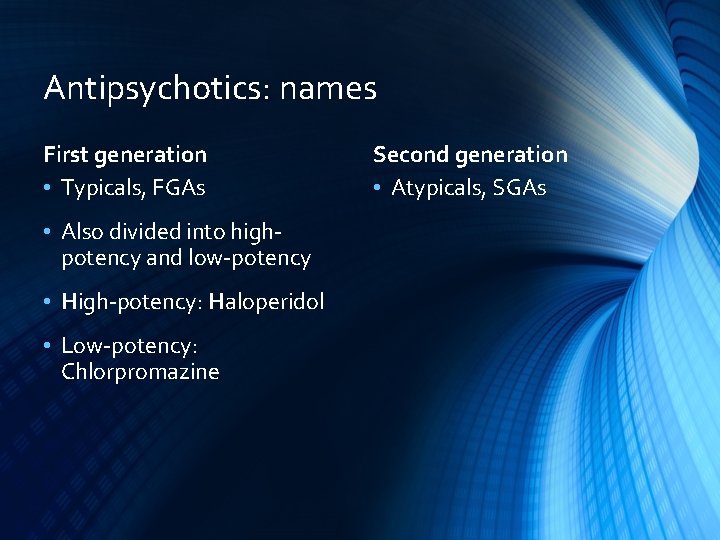
Antipsychotics: names First generation • Typicals, FGAs • Also divided into highpotency and low-potency • High-potency: Haloperidol • Low-potency: Chlorpromazine Second generation • Atypicals, SGAs
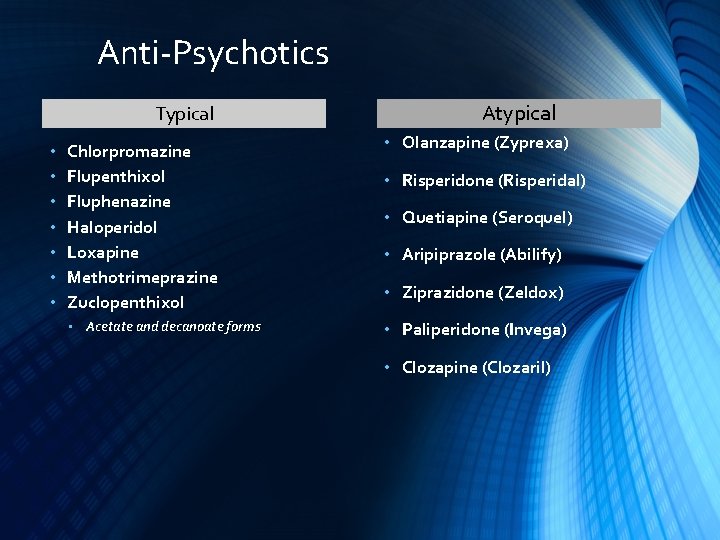
Anti-Psychotics Typical • • Chlorpromazine Flupenthixol Fluphenazine Haloperidol Loxapine Methotrimeprazine Zuclopenthixol • Acetate and decanoate forms Atypical • Olanzapine (Zyprexa) • Risperidone (Risperidal) • Quetiapine (Seroquel) • Aripiprazole (Abilify) • Ziprazidone (Zeldox) • Paliperidone (Invega) • Clozapine (Clozaril)
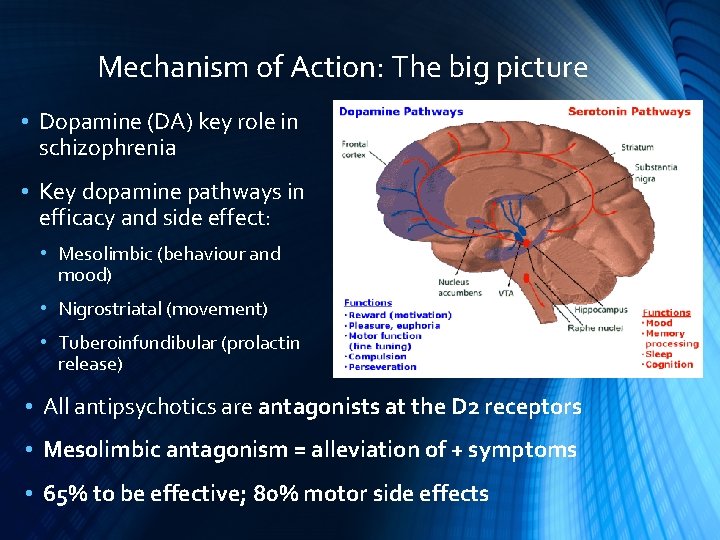
Mechanism of Action: The big picture • Dopamine (DA) key role in schizophrenia • Key dopamine pathways in efficacy and side effect: • Mesolimbic (behaviour and mood) • Nigrostriatal (movement) • Tuberoinfundibular (prolactin release) • All antipsychotics are antagonists at the D 2 receptors • Mesolimbic antagonism = alleviation of + symptoms • 65% to be effective; 80% motor side effects
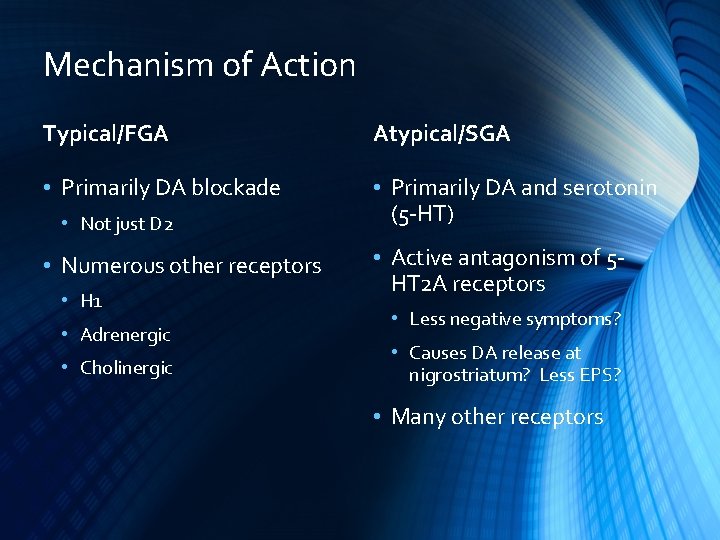
Mechanism of Action Typical/FGA Atypical/SGA • Primarily DA blockade • Primarily DA and serotonin (5 -HT) • Not just D 2 • Numerous other receptors • H 1 • Adrenergic • Cholinergic • Active antagonism of 5 HT 2 A receptors • Less negative symptoms? • Causes DA release at nigrostriatum? Less EPS? • Many other receptors
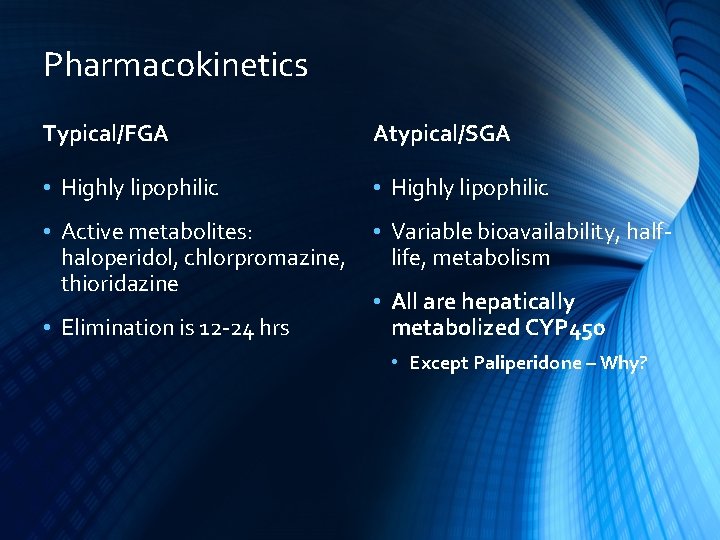
Pharmacokinetics Typical/FGA Atypical/SGA • Highly lipophilic • Active metabolites: haloperidol, chlorpromazine, thioridazine • Variable bioavailability, halflife, metabolism • Elimination is 12 -24 hrs • All are hepatically metabolized CYP 450 • Except Paliperidone – Why?
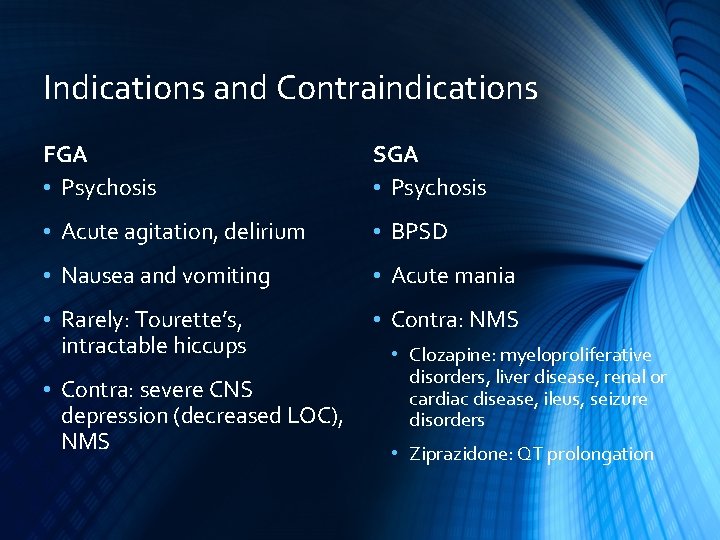
Indications and Contraindications FGA • Psychosis SGA • Psychosis • Acute agitation, delirium • BPSD • Nausea and vomiting • Acute mania • Rarely: Tourette’s, intractable hiccups • Contra: NMS • Contra: severe CNS depression (decreased LOC), NMS • Clozapine: myeloproliferative disorders, liver disease, renal or cardiac disease, ileus, seizure disorders • Ziprazidone: QT prolongation

Efficacy vs. effectiveness
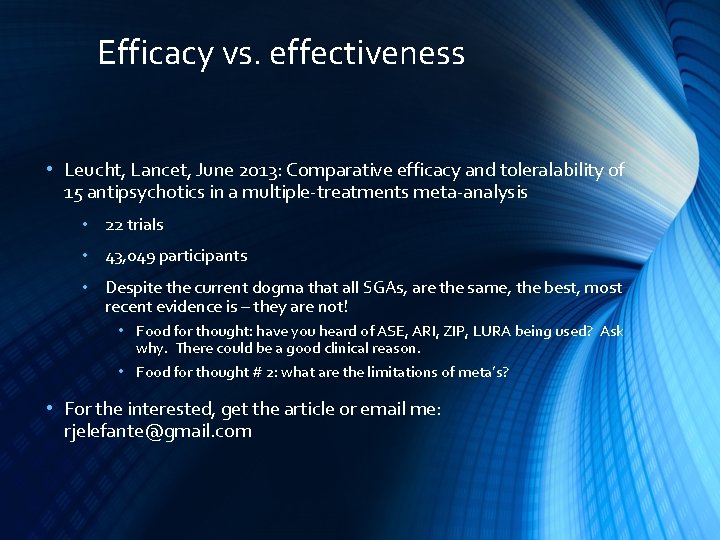
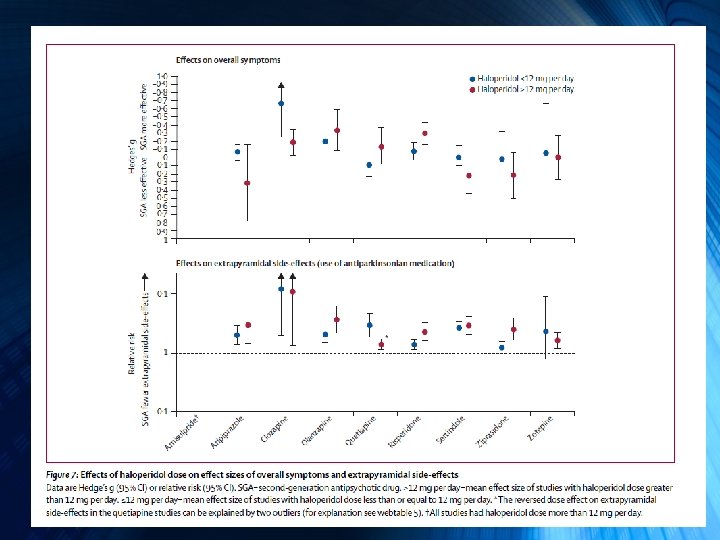
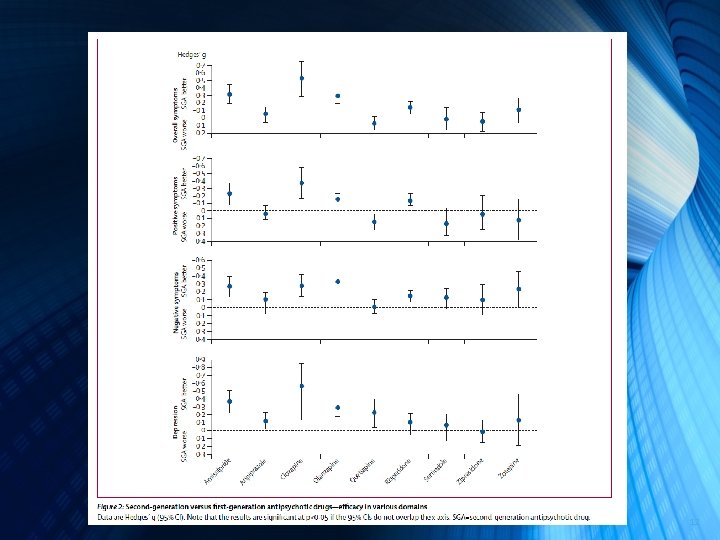
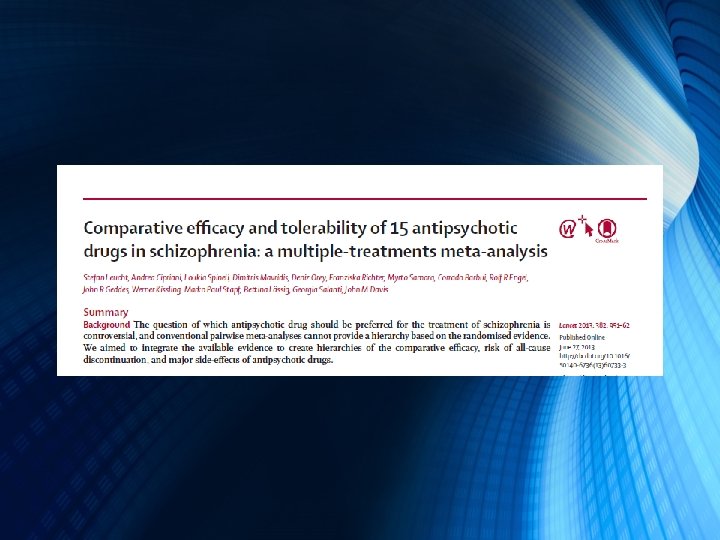
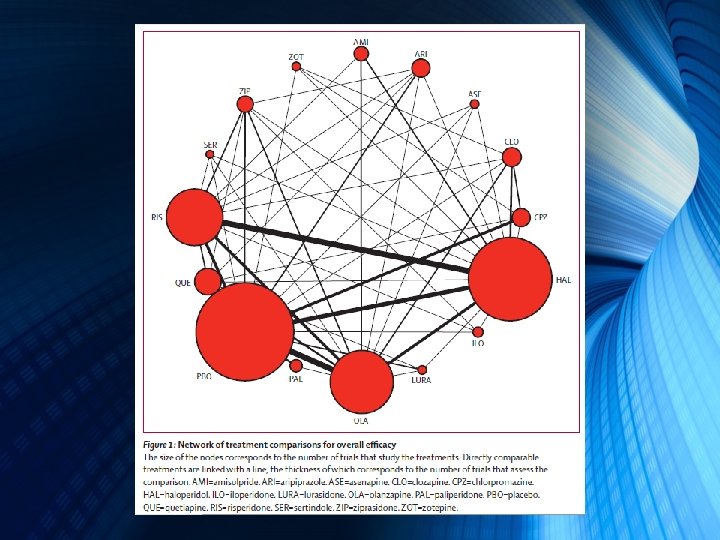
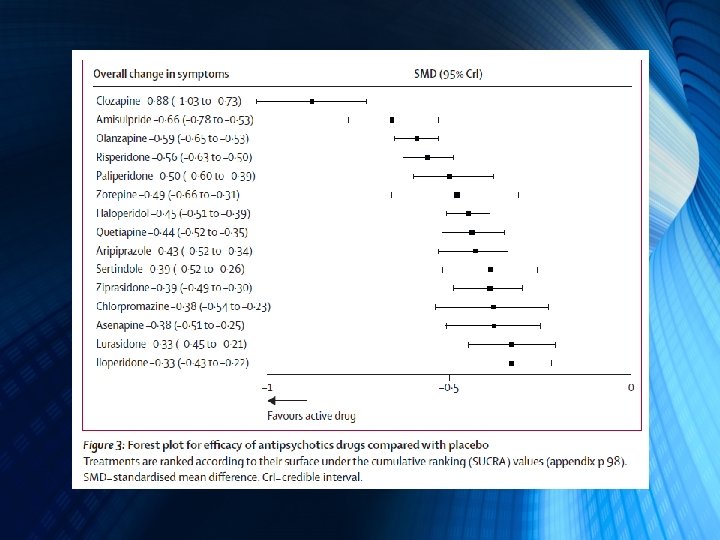
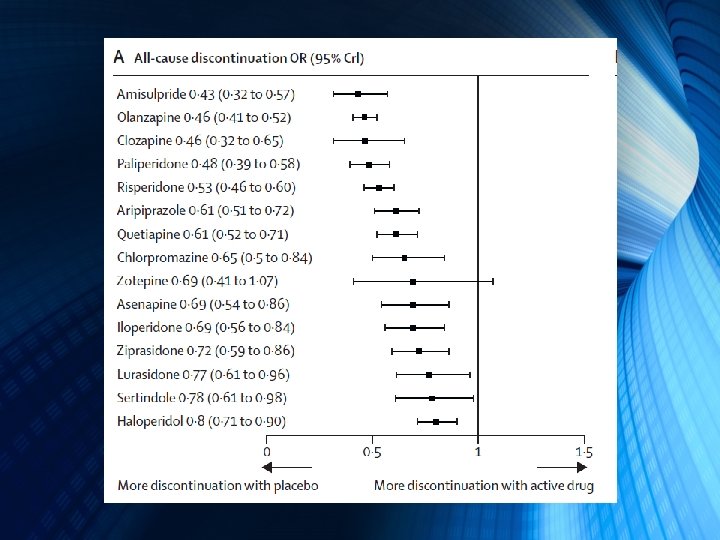
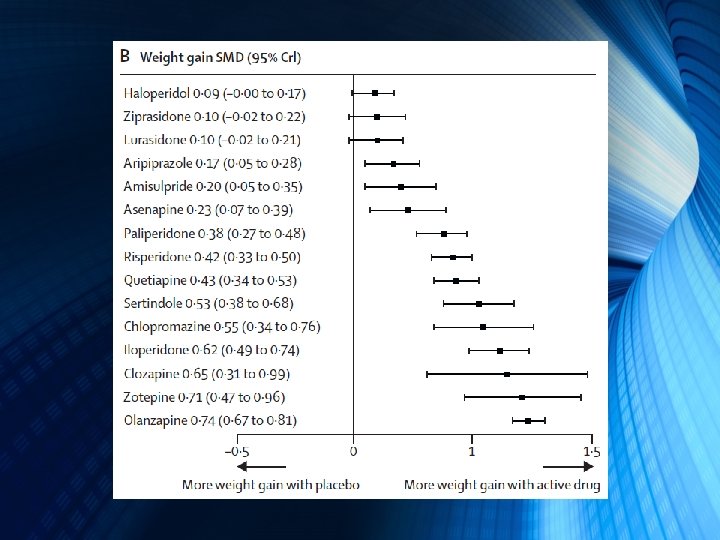
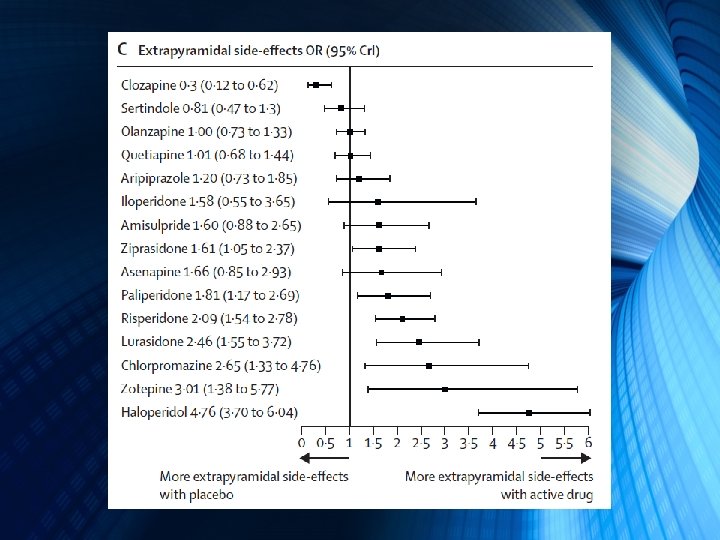
Efficacy vs. effectiveness • Leucht, Lancet, June 2013: Comparative efficacy and toleralability of 15 antipsychotics in a multiple-treatments meta-analysis • 22 trials • 43, 049 participants • Despite the current dogma that all SGAs, are the same, the best, most recent evidence is – they are not! • Food for thought: have you heard of ASE, ARI, ZIP, LURA being used? Ask why. There could be a good clinical reason. • Food for thought # 2: what are the limitations of meta’s? • For the interested, get the article or email me: rjelefante@gmail. com
11
12
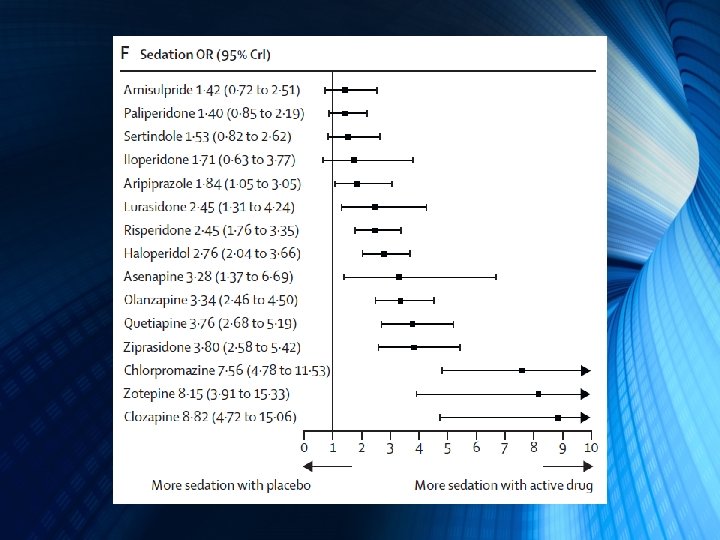
Olanzapine • Route: po, dissolvable (“Zyprexa, Zydis”), SA inj • Side-Effects to consider: • Most metabolic: weight gain, diabetes, hyperlipidemia, Liver • Moderate sedation • IM + Ativan = resp failure! **BLACK BOX WARNING** • Sure, but what is the NNH? • 1 adverse event per 3, 369 IM Olanzapine exposures • 1 serious event in 6, 494 • 1 fatality per 18, 586 • Key point: Respect black box warnings, but know the evidence behind them. In cases where BBWs limit tx (AD and suicidality in adolescents, AD and QTc), knowing the evidence helps in justifying going against BBW. This is not the case for parenteral OLA + BDZ.
Olanzapine • Indications: • Schizophrenia/psychosis • BP I – acute mania and/or maintenance • Dose Range: 5 to 30 mg • Up to 40 mg/d
Risperidone • Route: po, dissolvable “M-tab”, liquid or LA inj (Consta) • Side-Effects to Consider: • Metabolic: as previously mentioned • Most “typical” of atypicals • May elevate Prolactin levels • Sexual • Indications: • Schizophrenia/psychosis • BP I – acute mania and/or maintenance • Dose range: • PO 2 -8 mg • 25 -50 mg IM q 2 wks
Quetiapine (Seroquel) • Route: po (regular and XR) • Side-Effects to consider: • Metabolic • Most sedating of the atypicals • Indications: • Schizophrenia/Psychosis • BP I – acute mania and/or acute depression • Depression/anxiety Adjuvant • Usual dose range: • 300 to 900 (multiple times a day dosing) • 300 to 900 (once daily dosing for XR form) • Lower doses of 25 -100 if used as prn or augmentation
Aripiprazole (Abilify) • Route: PO • Side-effects to consider: • Less metabolic SE • Less sedation • Indications: • Schizophrenia/psychosis • BP I disorder – acute mania • Depression Adjuvant • Dose range: • 10 to 30 mg
Paliperidone (Invega) • Route: PO or LA inj • Side-Effects to consider: • Less metabolic side-effects • Less drug-drug interactions • Indications: • Schizophrenia/psychotic disorders • Dose range: • 3 to 9 mg
Ziprazidone (Zeldox) • Route: PO • Side-Effects to consider: • Less metabolic SE • Less sedation • QT prolongation • Indications: • Schizophrenia/psychosis • BP I disorder – acute mania • Dose range: • 40 mg BID to 80 mg BID
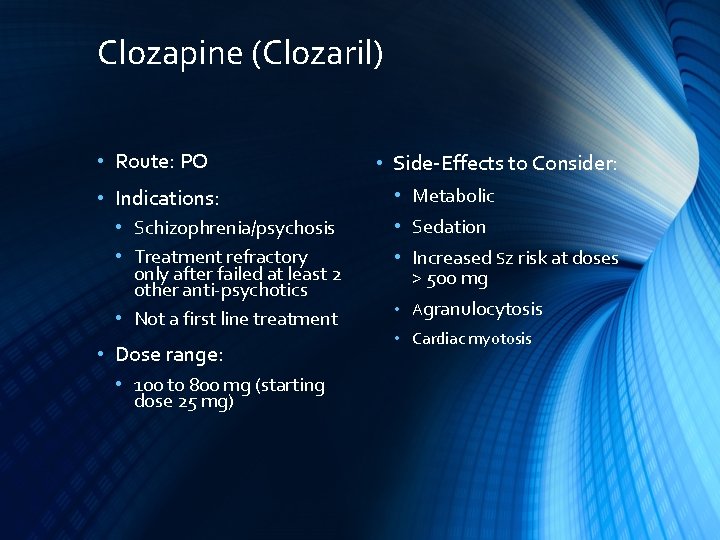
Clozapine (Clozaril) • Route: PO • Indications: • Schizophrenia/psychosis • Treatment refractory only after failed at least 2 other anti-psychotics • Not a first line treatment • Dose range: • 100 to 800 mg (starting dose 25 mg) • Side-Effects to Consider: • Metabolic • Sedation • Increased Sz risk at doses > 500 mg • Agranulocytosis • Cardiac myotosis
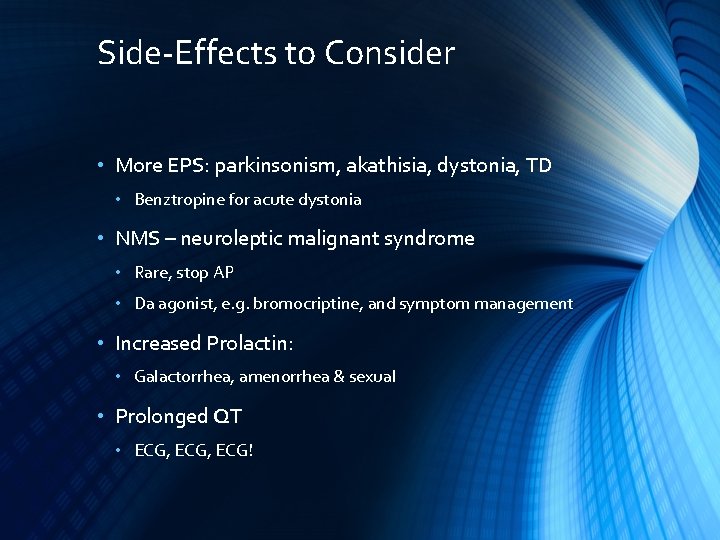
Side-Effects to Consider • More EPS: parkinsonism, akathisia, dystonia, TD • Benztropine for acute dystonia • NMS – neuroleptic malignant syndrome • Rare, stop AP • Da agonist, e. g. bromocriptine, and symptom management • Increased Prolactin: • Galactorrhea, amenorrhea & sexual • Prolonged QT • ECG, ECG!
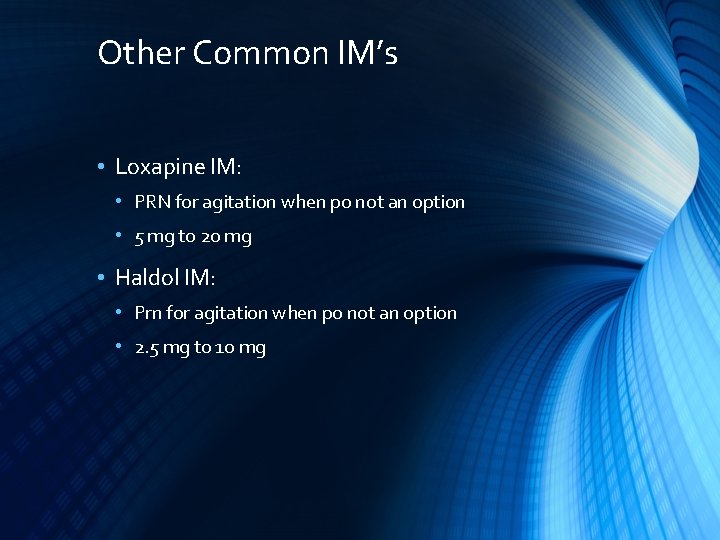
Other Common IM’s • Loxapine IM: • PRN for agitation when po not an option • 5 mg to 20 mg • Haldol IM: • Prn for agitation when po not an option • 2. 5 mg to 10 mg
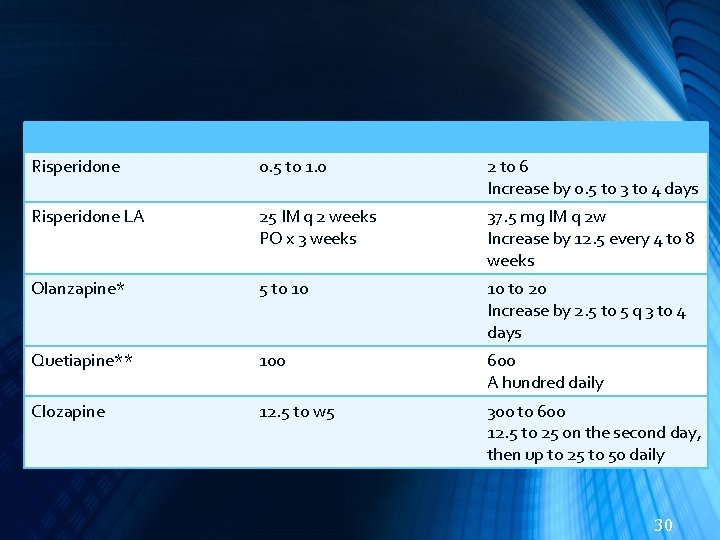
sga Risperidone 0. 5 t 0 1. 0 2 to 6 Increase by 0. 5 to 3 to 4 days Risperidone LA 25 IM q 2 weeks PO x 3 weeks 37. 5 mg IM q 2 w Increase by 12. 5 every 4 to 8 weeks Olanzapine* 5 to 10 10 to 20 Increase by 2. 5 to 5 q 3 to 4 days Quetiapine** 100 600 A hundred daily Clozapine 12. 5 to w 5 300 to 600 12. 5 to 25 on the second day, then up to 25 to 50 daily 30
depot • Flupentixol, Haloperidol, Fluphenazine, Pipotiazine • Zuclopenthixol • Risperidone Consta • Olanzapine (USA), Aripirazole (USA) 31
Acute phase • Emergency • Non-emergency • First episode, no previous tx • Multi-episode 32
Acute phase • Emergency • • PO, IM options 5 mg Haldol IM + 2 mg Ativan IM > Haldol alone IM Olanzapine 2. 5 to 10 mg is as effective as Haloperidol alone No benefit of adding BDZ to OLA, and there is package insert warning not to co-administer • 1: 3000, 1: 6000, 1: 18000 of AE, serious AE, mortality, respectively • Oral risperidone or Zydis is as effective as Haloperidol IM • Accuphase peaks in 24 to 48 hours and declines to 1/3 of peak in 72 hours. Avoid in drug-naïve patients. 33
Acute phase • First episode, no previous tx • Delay in tx is associated with distress and risk • Duration of untreated schizophrenia is related to less favourable outcome • SGA is indicated for first episode psychosis • Drug naïve are susceptible to EPS and sedation • BDZ to control agitaiton while initiating low dose SGA 34
Acute phase • Multi-episode • Drug history • Adequate trial: 4 to 8 weeks on maximum tolerated dose within the recommended range • Duration of adequate trial of Clozapine is considered to be 4 -6 months • General principle is to titrate up to an initial traget dose range in 1 – 2 weeks and monitor for side effects 35
Stabilization phase • First episode • Multi-episode • 4 – 8 weeks to reduce acute psychosis • Other symptoms (-) take longer • Improvement may carry over the year • Premature discontinuation = risk of relapse 36
Stable phase • First episode • Multi-episode • Inadequate response • Persistent positive symptoms • Persistent negative symptoms • Depression • SI • Violence • Sex Differences 37
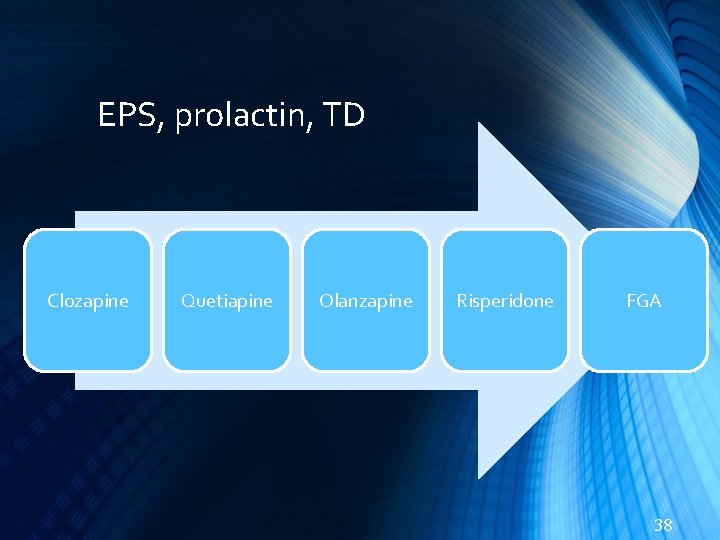
EPS, prolactin, TD Clozapine Quetiapine Olanzapine Risperidone FGA 38
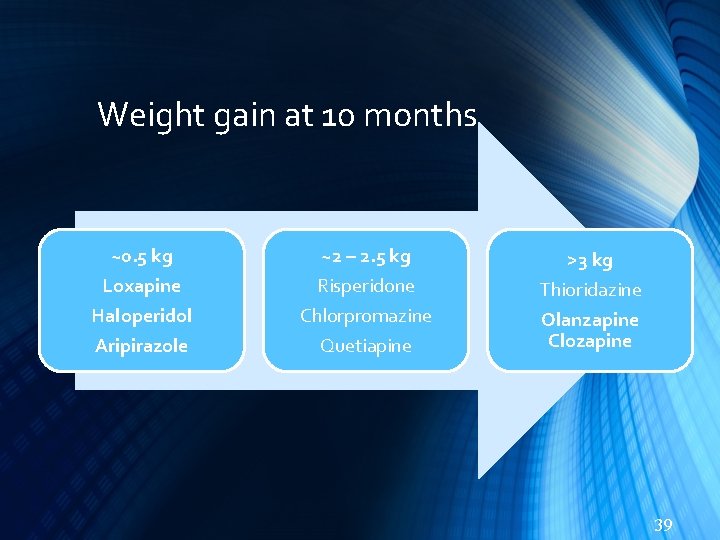
Weight gain at 10 months ~0. 5 kg ~2 – 2. 5 kg >3 kg Loxapine Risperidone Thioridazine Haloperidol Aripirazole Chlorpromazine Quetiapine Olanzapine Clozapine 39
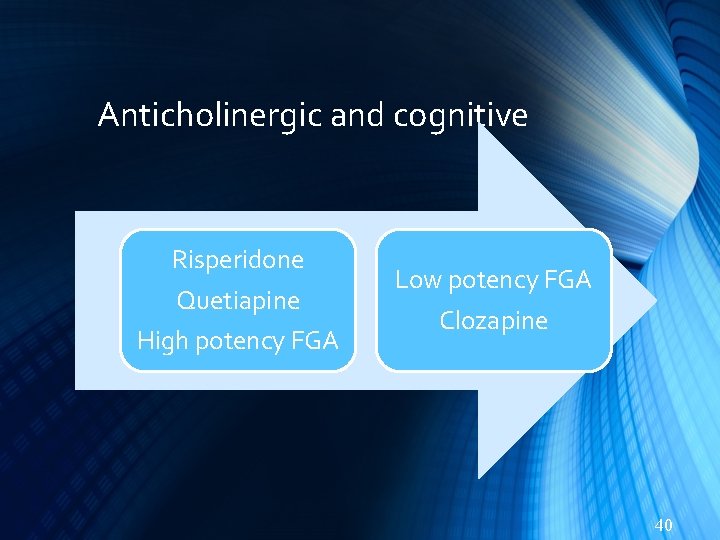
Anticholinergic and cognitive Risperidone Quetiapine High potency FGA Low potency FGA Clozapine 40
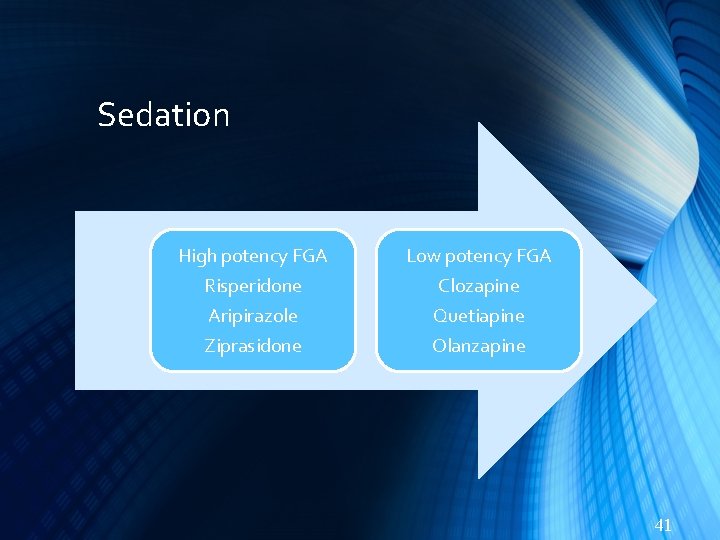
Sedation High potency FGA Low potency FGA Risperidone Clozapine Aripirazole Ziprasidone Quetiapine Olanzapine 41
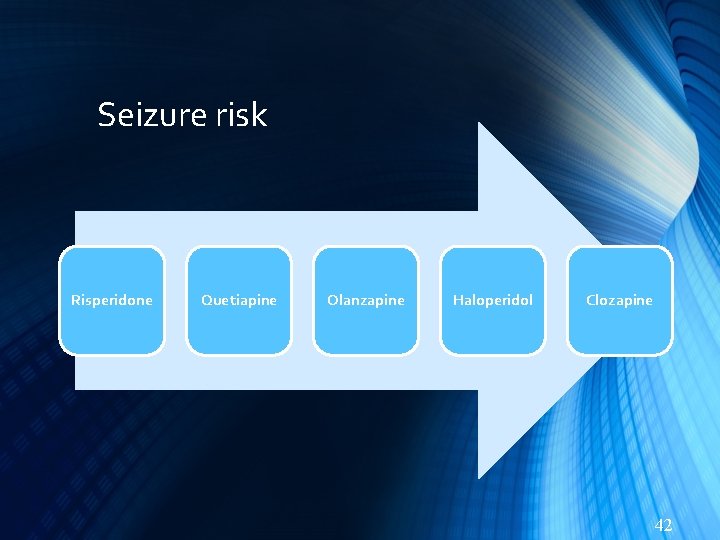
Seizure risk Risperidone Quetiapine Olanzapine Haloperidol Clozapine 42
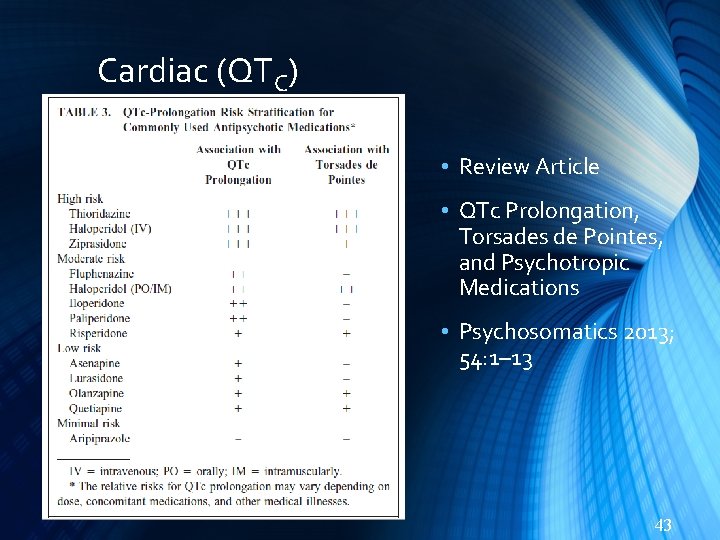
Cardiac (QTC) • Review Article • QTc Prolongation, Torsades de Pointes, and Psychotropic Medications • Psychosomatics 2013; 54: 1– 13 43
Clozapine side effects • Agranulocytosis 0. 5% to 2% • First 6 mos: weekly bloodwork, then q 2 w • WBC must be >3000 and ANC > 1500 • Carbamazepine may induce agranulocytosis if given with CLO 44
Clozapine side effects • Seizures 2% to 3% • >500 mg dose • Smoking cessation increases seizures • Dose reduction up to 50% with smoking cessation • Myocarditis, cardiomyopathy – rare • Ssx: fever, chest pain, peripheral edema, tachycardia, respiratory distress 45
Clozapine side effects • Weight gain, lipids, glucose • Sialorrhea, sedation, hypotension, tachycardia • Anticholinergic: constipation, dry mouth, blurred vision, gastroparesis, enuresis • Low propensity to elevate PRL or induce EPS 46
Outline • Antipsychotics • Names: first-generation, second-generation, typical, atypical, etc. • MOA, Pharmacokinetics, Indications/Contraindications • Evidence • Side Effects • Mood stabilizers • Lithium • Background, PK, side-effects • Anticonvulsants • Evidence
Mood Stabilizers Lithium Anticonvulsants • Valproic acid • Lamotrigine • Carbamazepine
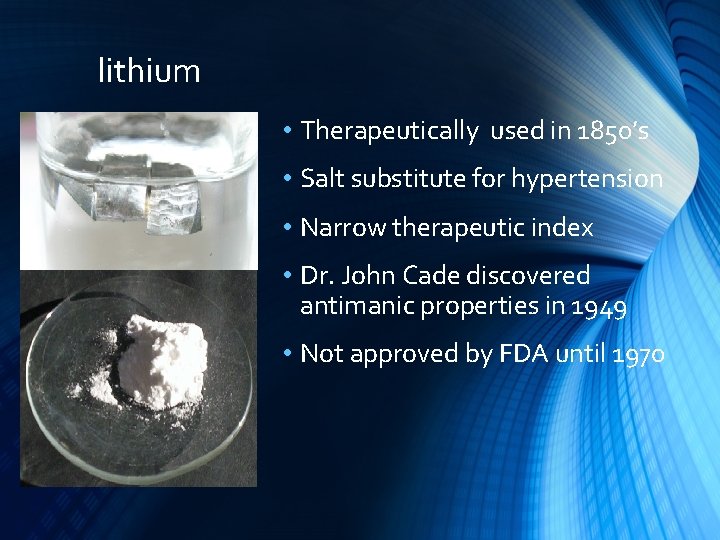
lithium • Therapeutically used in 1850’s • Salt substitute for hypertension • Narrow therapeutic index • Dr. John Cade discovered antimanic properties in 1949 • Not approved by FDA until 1970
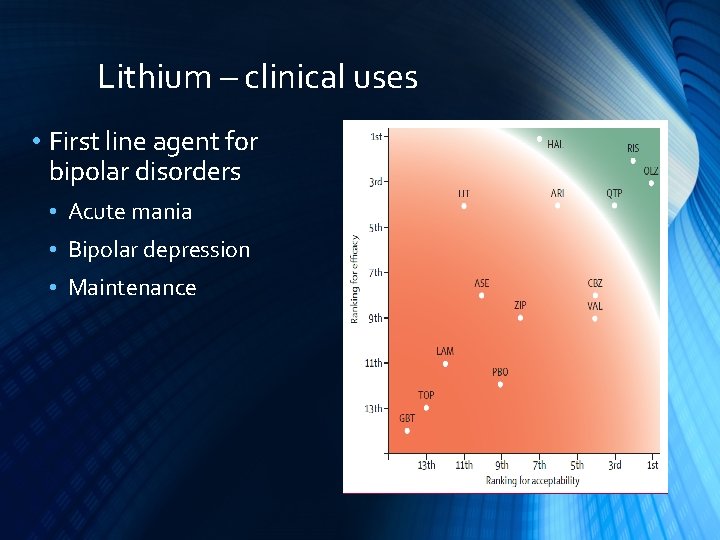
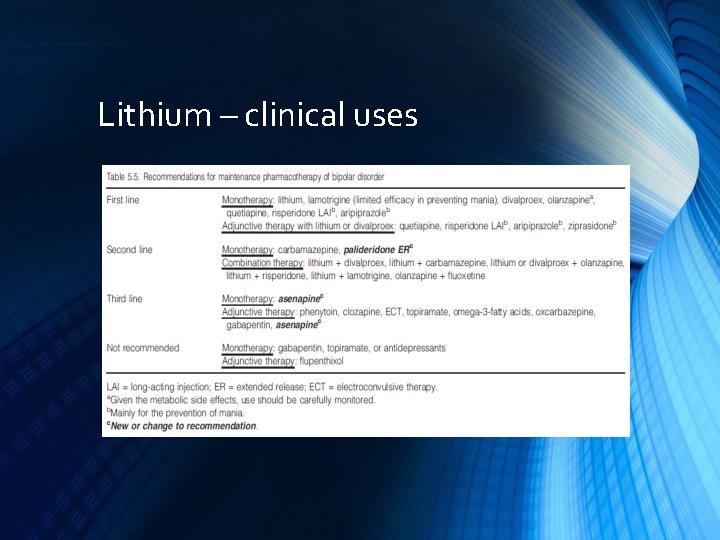
Lithium – clinical uses • First line agent for bipolar disorders • Acute mania • Bipolar depression • Maintenance
Lithium – clinical uses
Lithium – clinical uses • Adjunct to antidepressants in treatmentresistant depression • Suicide prevention • Cluster headaches
Lithium - pharmacology • Rapidly absorbed after oral administration • Max concentrations 1 -5 hours after intake • Minimally protein bound • Excreted unchanged in the urine
Lithium - pharmacology • Half-life 18 -36 hours • Almost entirely renally secreted • Cleared 10 -40 m. L/hour (20%-30% of GFR) • In chronically exposed groups clearance decreases to about 12 m. L/hour • 50% to 80% is excreted in 24 hours
Lithium - pharmacology • Acute 0. 8 -1. 2 m. Eq/L • Maintenance 0. 6 -0. 8 m. Eq/L • Steady state in 5 -6 days • Peak levels 2 -3 x steady state especially early in therapy
Lithium - pharmacology • Na+ depletion promotes Li retention • Volume contraction which activates Na+ conserving mechanism also promotes Li retention
Lithium • Cellular uptake of Li is higher when there is hypokalemia and hypocalcemia • Hyperthyroidism increases Li reuptake at the kidneys
Lithium • Drugs may precipitate Li toxicity • NSAIDS, ACE inhibitors, Thiazides • More drugs in later slides
lithium • Brain Li levels do not correlate well with serum Li levels • Brain-serum ratio is 0. 4 to 0. 75 • Brain levels can fluctuate even without any change in serum levels • Brain concentrations lag behind plasma by about 24 hours, and may exceed plasma concentrations
Clinical subtypes of lithium toxicity 1. Acute 2. Acute on chronic 3. Chronic
Acute toxicity • Toxicity that occurs in lithium-naïve patients • Prototypical symptoms • GI: nausea, vomiting, diarrhea • Neuro: drowsiness, slurred speech, apathy, confusion
Acute on chronic • Acute overdose in a lithium-treated patient • Sudden salt restriction • Drugs that raise serum lithium levels
Chronic • Toxicity that occurs insidiously, often due to decreased renal clearance • Distinction between acute-on-chronic or chronic can be blurred
• Severe neurotoxicity, including persistent symptoms, primarily occur in acute-on-chronic and chronic lithium intoxication • May occur even when serum lithium levels are normal
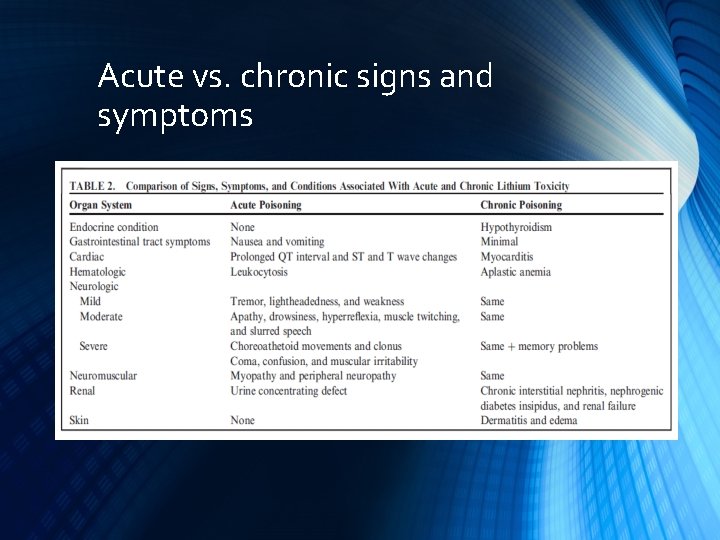
Acute vs. chronic signs and symptoms
Lithium Toxicity • Neurotoxicity • Toxicity profile of other body systems
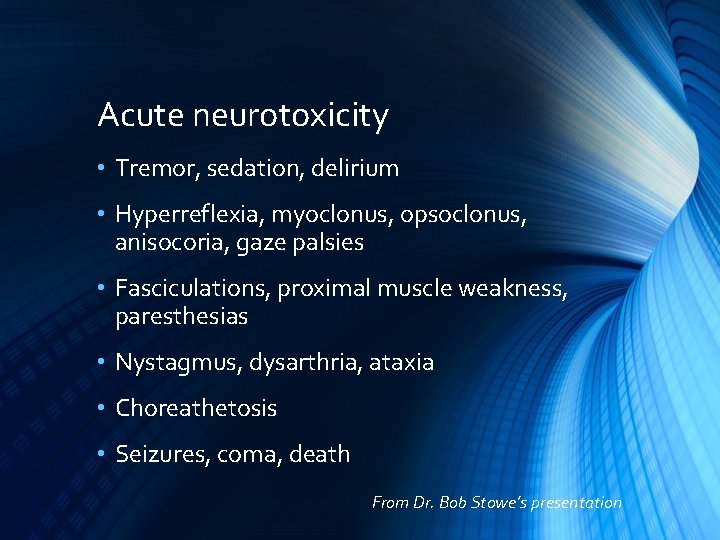
Acute neurotoxicity • Tremor, sedation, delirium • Hyperreflexia, myoclonus, opsoclonus, anisocoria, gaze palsies • Fasciculations, proximal muscle weakness, paresthesias • Nystagmus, dysarthria, ataxia • Choreathetosis • Seizures, coma, death From Dr. Bob Stowe’s presentation
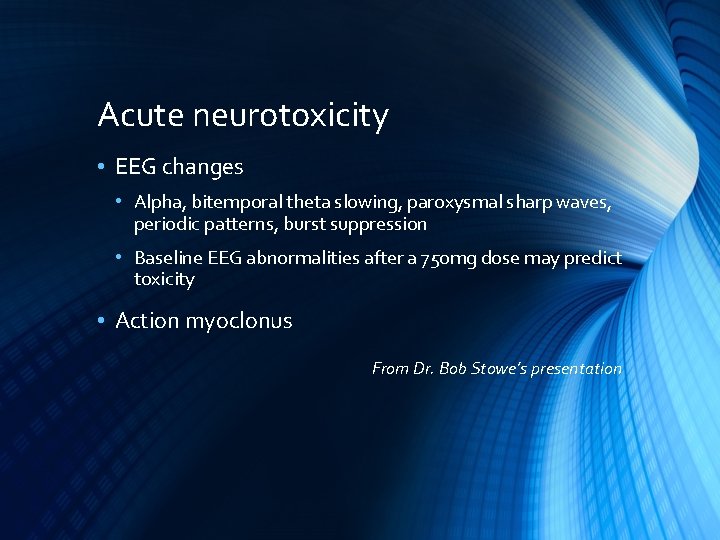
Acute neurotoxicity • EEG changes • Alpha, bitemporal theta slowing, paroxysmal sharp waves, periodic patterns, burst suppression • Baseline EEG abnormalities after a 750 mg dose may predict toxicity • Action myoclonus From Dr. Bob Stowe’s presentation
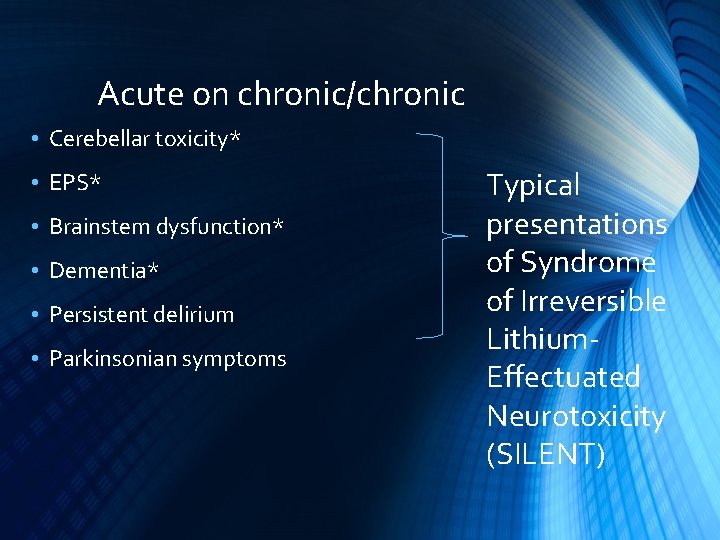
Acute on chronic/chronic • Cerebellar toxicity* • EPS* • Brainstem dysfunction* • Dementia* • Persistent delirium • Parkinsonian symptoms Typical presentations of Syndrome of Irreversible Lithium. Effectuated Neurotoxicity (SILENT)
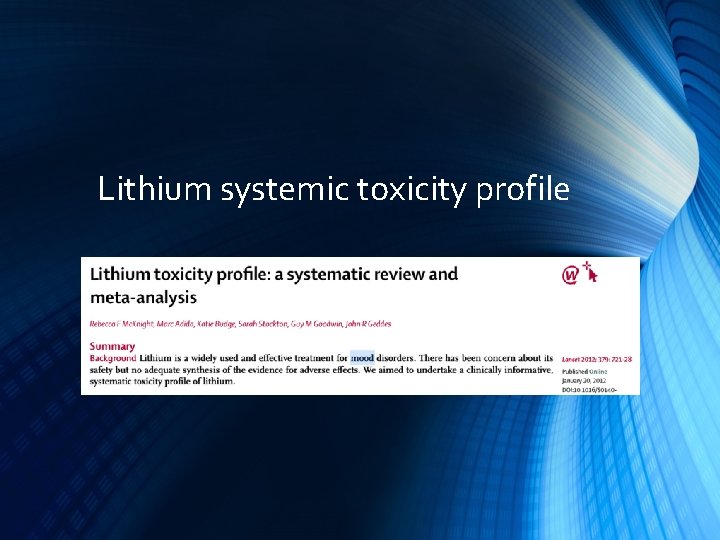
Lithium systemic toxicity profile
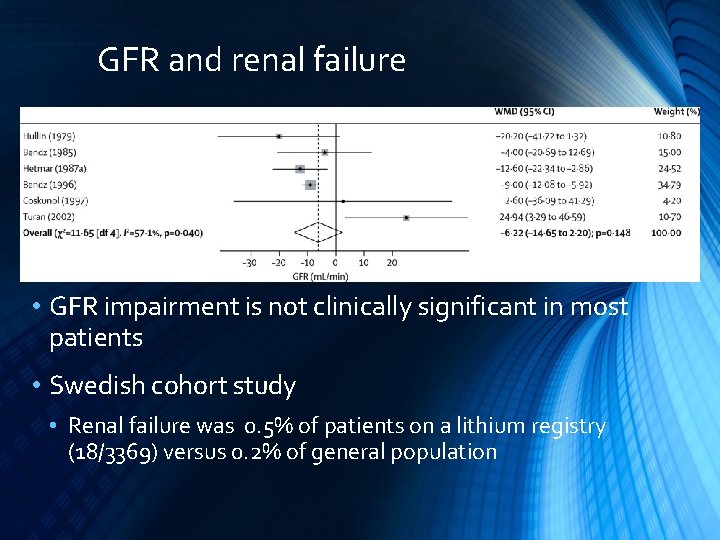
GFR and renal failure • GFR impairment is not clinically significant in most patients • Swedish cohort study • Renal failure was 0. 5% of patients on a lithium registry (18/3369) versus 0. 2% of general population
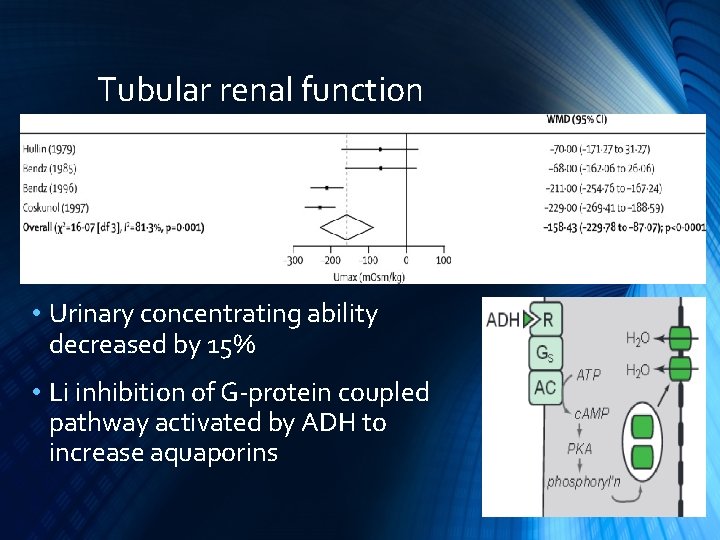
Tubular renal function • Urinary concentrating ability decreased by 15% • Li inhibition of G-protein coupled pathway activated by ADH to increase aquaporins
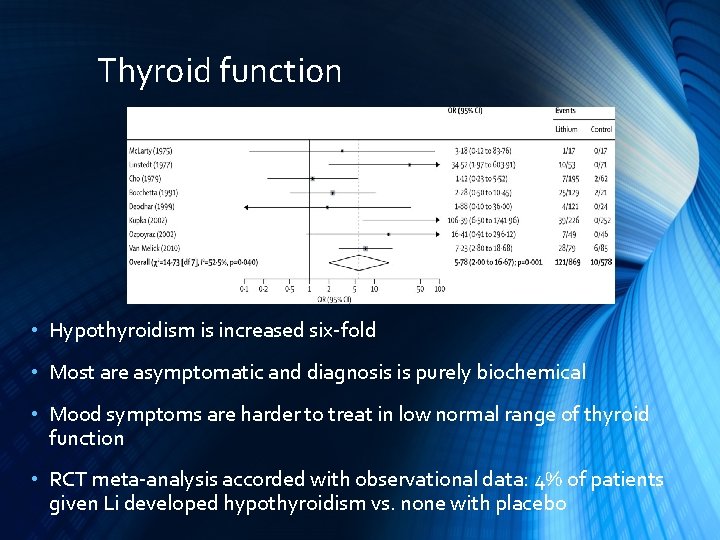
Thyroid function • Hypothyroidism is increased six-fold • Most are asymptomatic and diagnosis is purely biochemical • Mood symptoms are harder to treat in low normal range of thyroid function • RCT meta-analysis accorded with observational data: 4% of patients given Li developed hypothyroidism vs. none with placebo
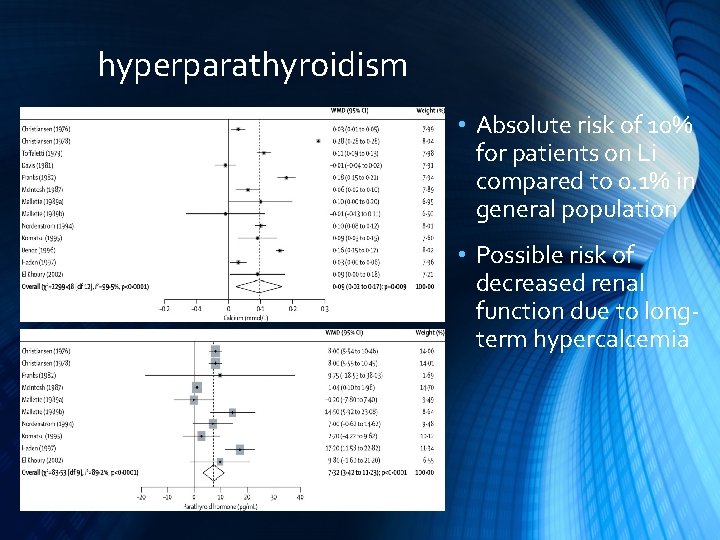
hyperparathyroidism • Absolute risk of 10% for patients on Li compared to 0. 1% in general population • Possible risk of decreased renal function due to longterm hypercalcemia
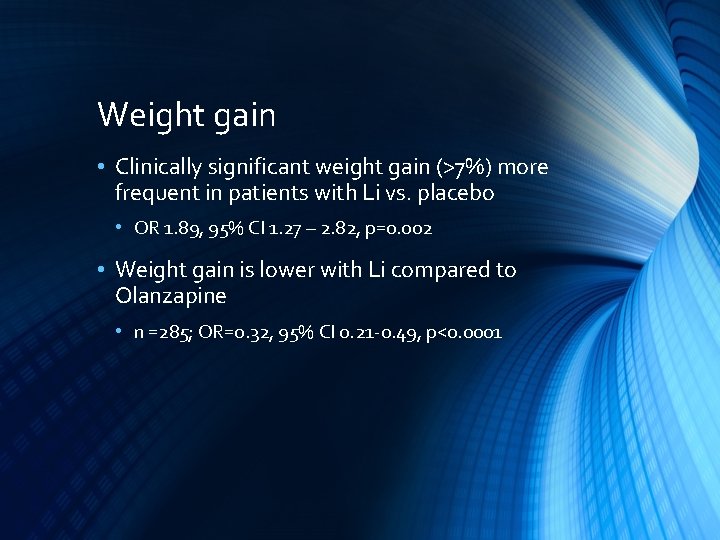
Weight gain • Clinically significant weight gain (>7%) more frequent in patients with Li vs. placebo • OR 1. 89, 95% CI 1. 27 – 2. 82, p=0. 002 • Weight gain is lower with Li compared to Olanzapine • n =285; OR=0. 32, 95% CI 0. 21 -0. 49, p<0. 0001
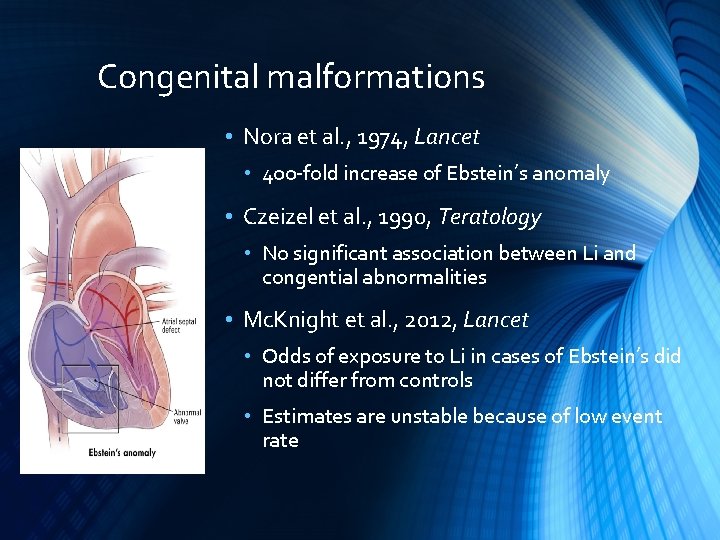
Congenital malformations • Nora et al. , 1974, Lancet • 400 -fold increase of Ebstein’s anomaly • Czeizel et al. , 1990, Teratology • No significant association between Li and congential abnormalities • Mc. Knight et al. , 2012, Lancet • Odds of exposure to Li in cases of Ebstein’s did not differ from controls • Estimates are unstable because of low event rate

No significant increased risks with • Congenital malformations • Alopecia • Skin disorders • Little evidence for a clinically significant reduction in renal function in most patients
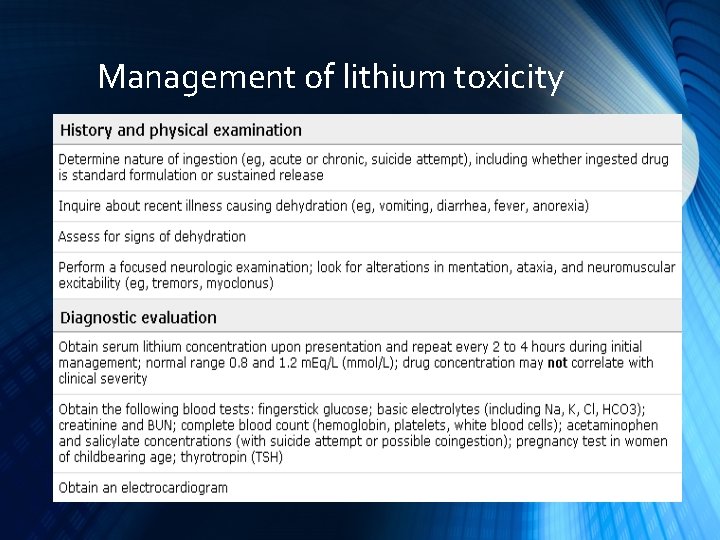
Management of lithium toxicity
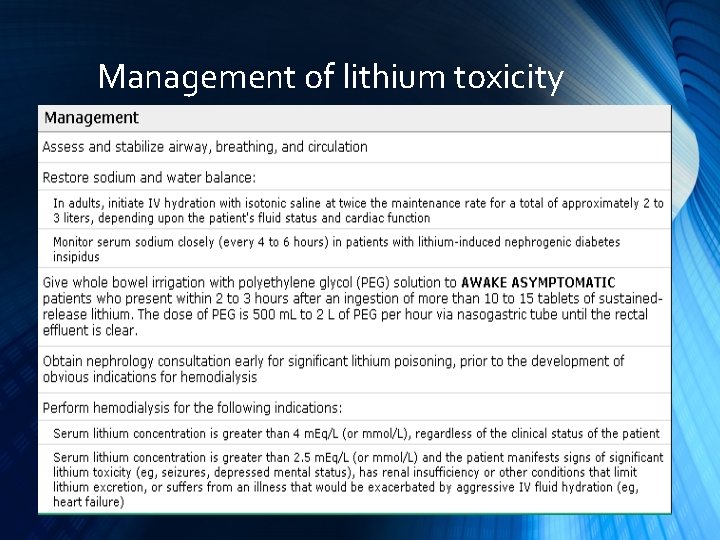
Management of lithium toxicity
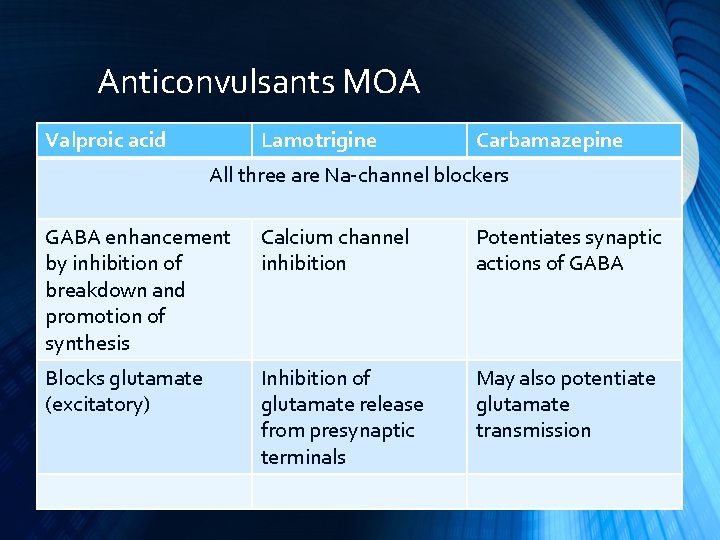
Anticonvulsants MOA Valproic acid Lamotrigine Carbamazepine All three are Na-channel blockers GABA enhancement by inhibition of breakdown and promotion of synthesis Calcium channel inhibition Potentiates synaptic actions of GABA Blocks glutamate (excitatory) Inhibition of glutamate release from presynaptic terminals May also potentiate glutamate transmission
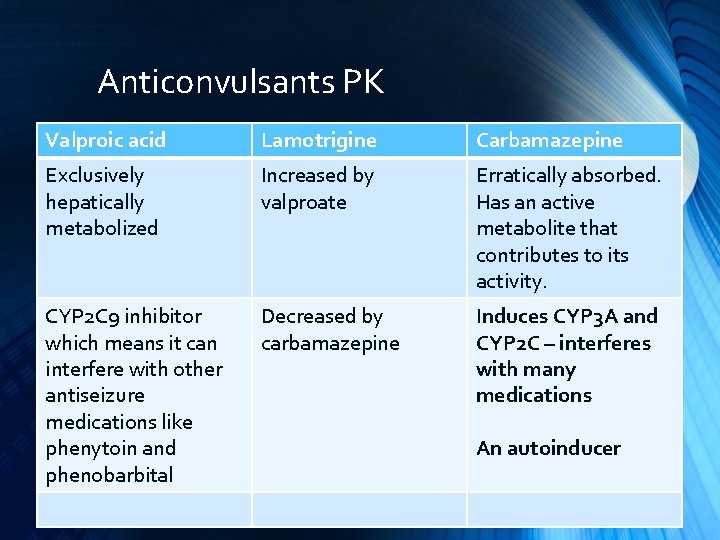
Anticonvulsants PK Valproic acid Lamotrigine Carbamazepine Exclusively hepatically metabolized Increased by valproate Erratically absorbed. Has an active metabolite that contributes to its activity. CYP 2 C 9 inhibitor which means it can interfere with other antiseizure medications like phenytoin and phenobarbital Decreased by carbamazepine Induces CYP 3 A and CYP 2 C – interferes with many medications An autoinducer
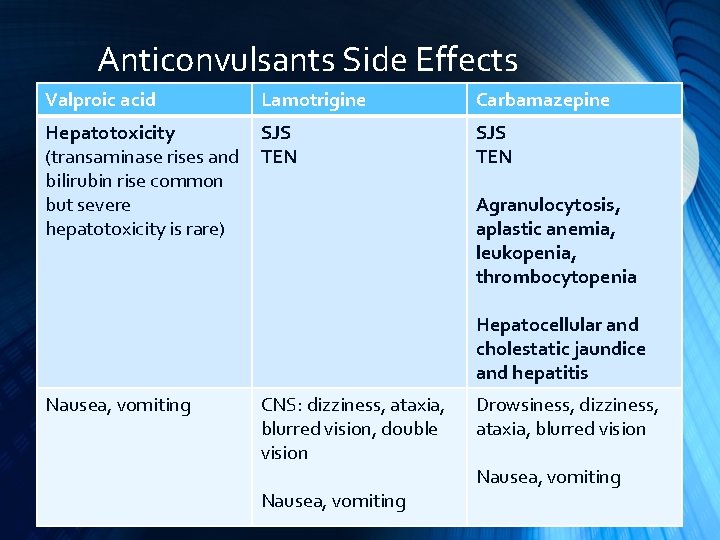
Anticonvulsants Side Effects Valproic acid Lamotrigine Carbamazepine Hepatotoxicity (transaminase rises and bilirubin rise common but severe hepatotoxicity is rare) SJS TEN Agranulocytosis, aplastic anemia, leukopenia, thrombocytopenia Hepatocellular and cholestatic jaundice and hepatitis Nausea, vomiting CNS: dizziness, ataxia, blurred vision, double vision Nausea, vomiting Drowsiness, dizziness, ataxia, blurred vision Nausea, vomiting
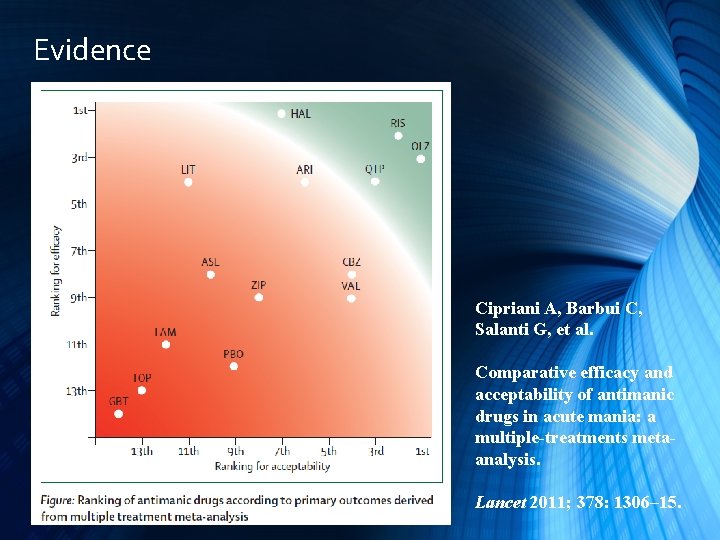
Evidence Cipriani A, Barbui C, Salanti G, et al. Comparative efficacy and acceptability of antimanic drugs in acute mania: a multiple-treatments metaanalysis. Lancet 2011; 378: 1306– 15.
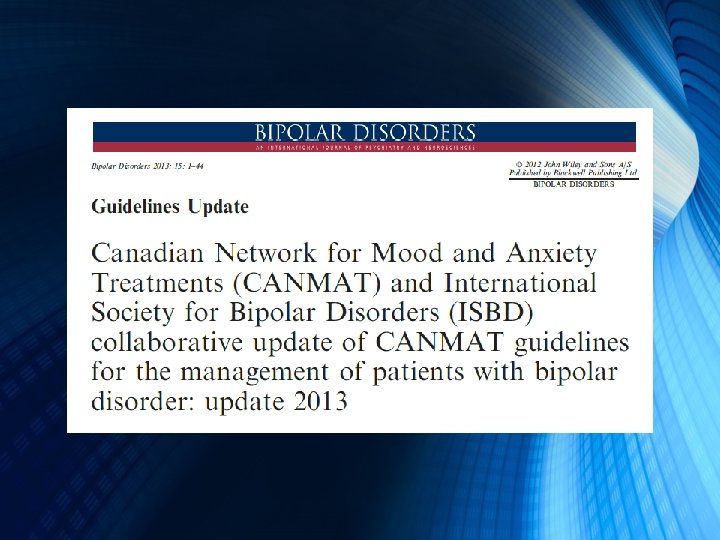

Acute Mania
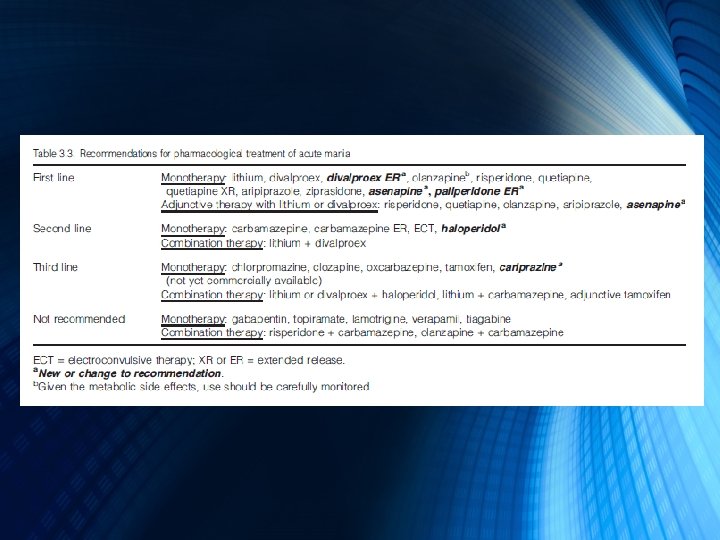
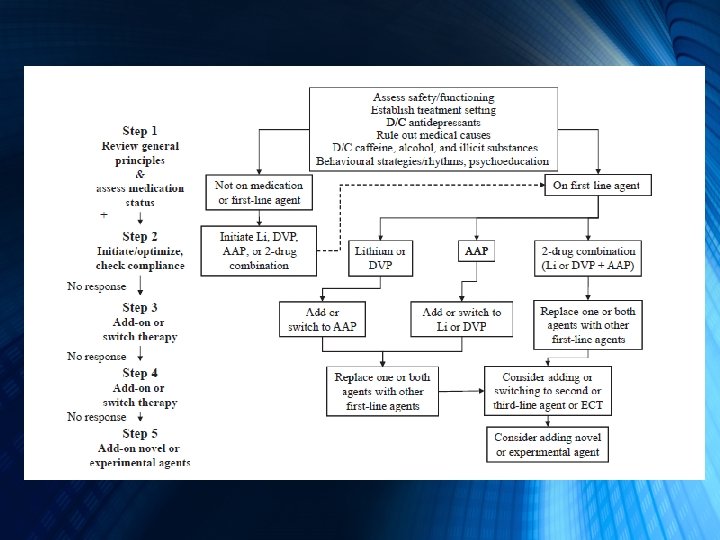
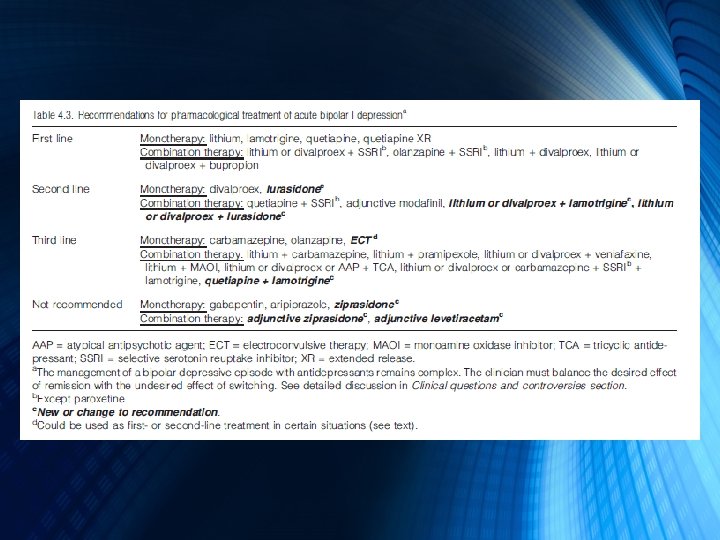
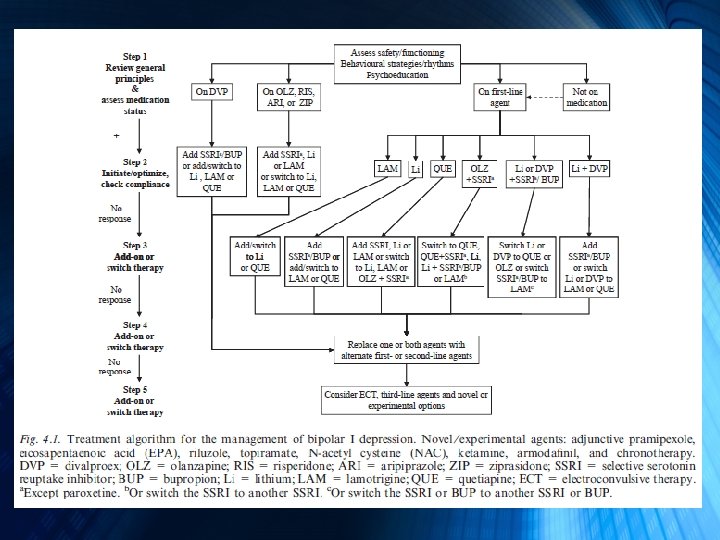
Acute Bipolar Depression

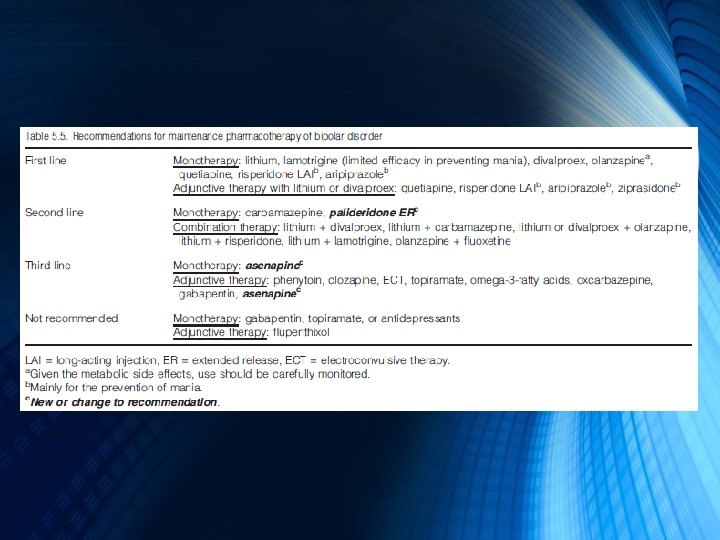
Maintenance
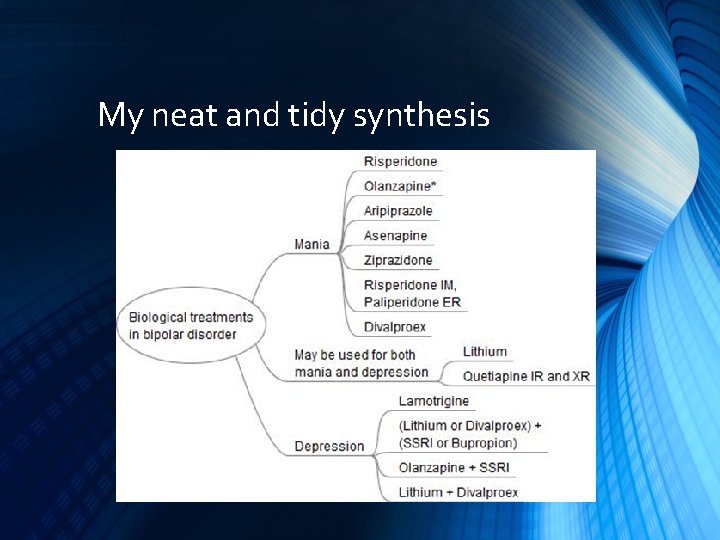
My neat and tidy synthesis
- Slides: 93