
AntiPoverty Technology Research Principles of Feedback Control Lecture

Anti-Poverty Technology: Research: Principles of Feedback Control Lecture 11. 2 https: //hecourse. engineering. osu. edu

Principles of feedback control Seen in most areas of engineering. . . Examples: Cruise control on a car, anti-skid brakes in a car, engine control, altitude hold on an airplane, thermostat for temperature control, control of a distillation column, water level in an irrigation system, homeostatic mechanisms In the human body, interactions in an ecosystem, control for the electricity 2 smart grid, maximum power point tracking for solar energy, wind turbine control. . .
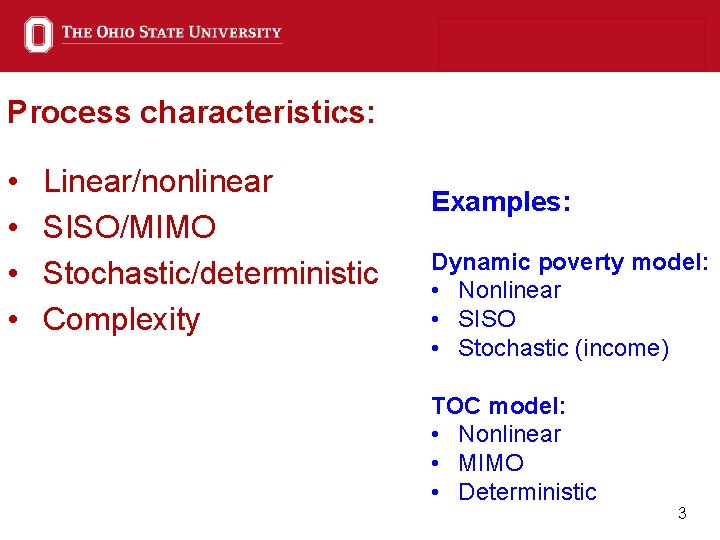
Process characteristics: • • Linear/nonlinear SISO/MIMO Stochastic/deterministic Complexity Examples: Dynamic poverty model: • Nonlinear • SISO • Stochastic (income) TOC model: • Nonlinear • MIMO • Deterministic 3
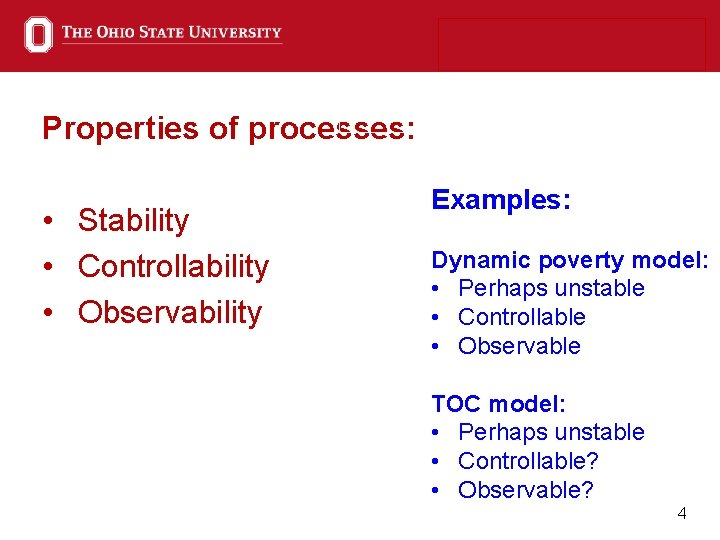
Properties of processes: • Stability • Controllability • Observability Examples: Dynamic poverty model: • Perhaps unstable • Controllable • Observable TOC model: • Perhaps unstable • Controllable? • Observable? 4
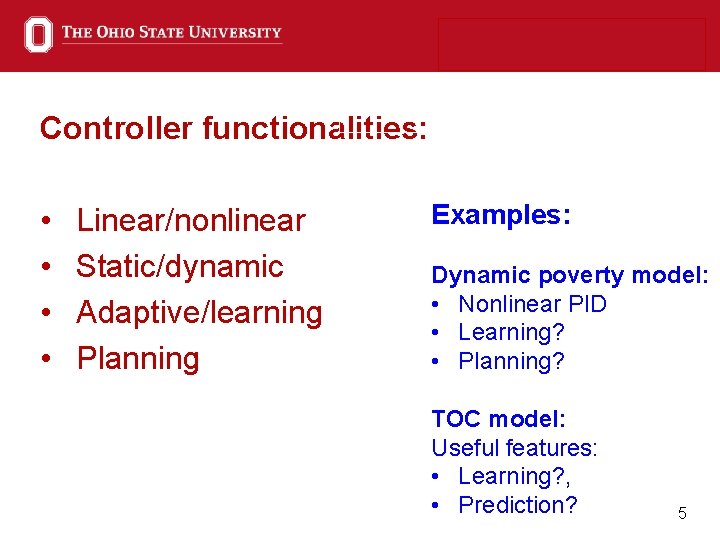
Controller functionalities: • • Linear/nonlinear Static/dynamic Adaptive/learning Planning Examples: Dynamic poverty model: • Nonlinear PID • Learning? • Planning? TOC model: Useful features: • Learning? , • Prediction? 5
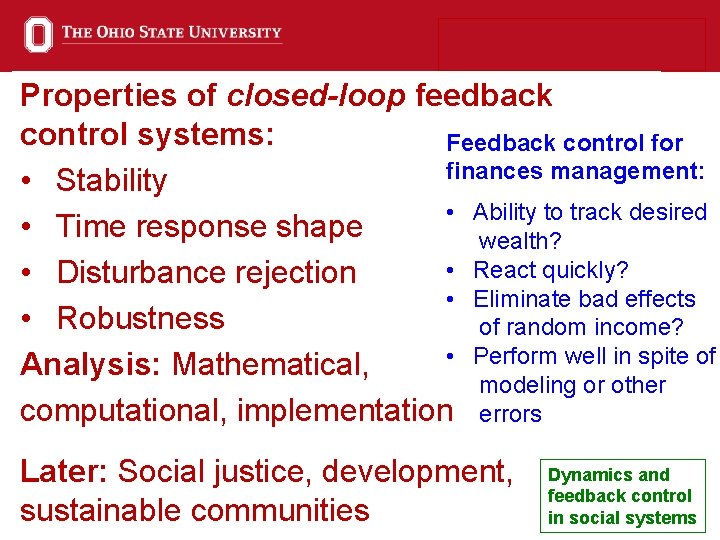
Properties of closed-loop feedback control systems: Feedback control for finances management: • Stability • Ability to track desired • Time response shape wealth? • React quickly? • Disturbance rejection • Eliminate bad effects • Robustness of random income? • Perform well in spite of Analysis: Mathematical, modeling or other computational, implementation errors Later: Social justice, development, sustainable communities Dynamics and feedback control 6 in social systems

7

8

9
- Slides: 9