
ANTIOXIDANTS POLYPHENOLS Lecture content provided by GSSI a
ANTIOXIDANTS & POLYPHENOLS Lecture content provided by GSSI, a division of Pepsi. Co, Inc. Any opinions or scientific interpretations expressed in this presentation are those of the author and do not necessarily reflect the position or policy of Pepsi. Co, Inc.
ANTIOXIDANT S
What is an antioxidant? Does it help exercise performance?
FIRST: Oxidants *First, we need to understand what an oxidant is before we can understand antioxidants What is an OXIDANT? • Any atom/molecule that “steals/accepts” electrons from other molecules • Molecules that promote oxidation What is oxidation? • The removal of electrons Note: It is a relative term depending on the redox state of what it is reacting with. Chemicals always work as “REDOX PAIRS”.
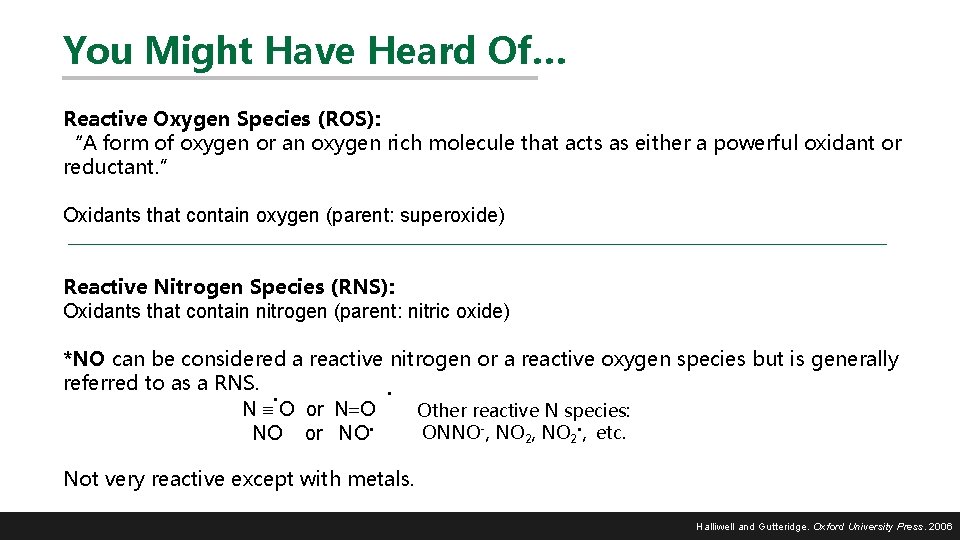
You Might Have Heard Of… Reactive Oxygen Species (ROS): “A form of oxygen or an oxygen rich molecule that acts as either a powerful oxidant or reductant. ” Oxidants that contain oxygen (parent: superoxide) Reactive Nitrogen Species (RNS): Oxidants that contain nitrogen (parent: nitric oxide) *NO can be considered a reactive nitrogen or a reactive oxygen species but is generally referred to as a RNS. • • N O or N O Other reactive N species: ONNO-, NO 2 • , etc. NO or NO • Not very reactive except with metals. Halliwell and Gutteridge. Oxford University Press. 2006
What is an Antioxidant? “Substance that prevents or delays oxidation. ” Anti-oxidants prevent or limit the actions of free radicals usually by removing their unpaired electron and thus converting them into something far less reactive. Jeukendrup & Gleeson. Champaign, IL. Human Kinetics. 2004
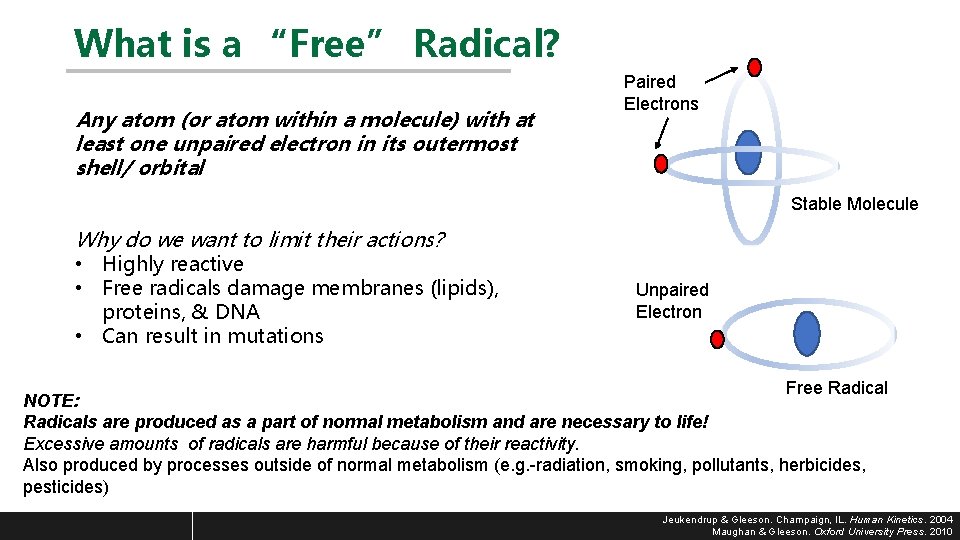
What is a “Free” Radical? Any atom (or atom within a molecule) with at least one unpaired electron in its outermost shell/ orbital Paired Electrons Stable Molecule Why do we want to limit their actions? • Highly reactive • Free radicals damage membranes (lipids), proteins, & DNA • Can result in mutations Unpaired Electron Free Radical NOTE: Radicals are produced as a part of normal metabolism and are necessary to life! Excessive amounts of radicals are harmful because of their reactivity. Also produced by processes outside of normal metabolism (e. g. -radiation, smoking, pollutants, herbicides, pesticides) Jeukendrup & Gleeson. Champaign, IL. Human Kinetics. 2004 Maughan & Gleeson. Oxford University Press. 2010
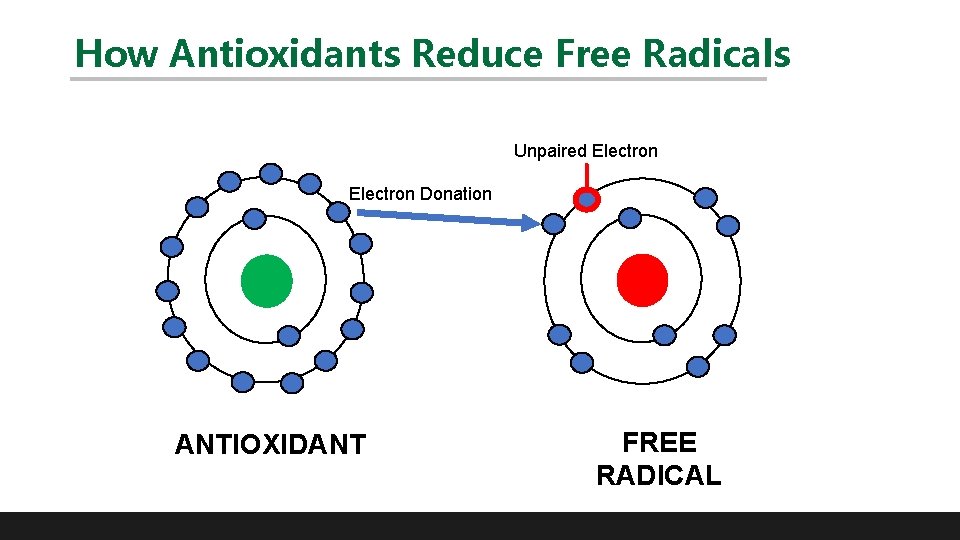
How Antioxidants Reduce Free Radicals Unpaired Electron Donation ANTIOXIDANT FREE RADICAL
What happens During Exercise? Skeletal muscle continuously produces ROS and NO • ↑ dramatically during exercise • Repetitive contractions ↑ ROS content Buffered by endogenous antioxidants in the muscle: • Superoxide Dismutase (SOD) • Catalase Major antioxidant pathway in the muscle: • Glutathione/glutathione peroxidase system • Buffers an array of oxidant species Reid M. J Physiol. 2016; 594: 5125 -5133
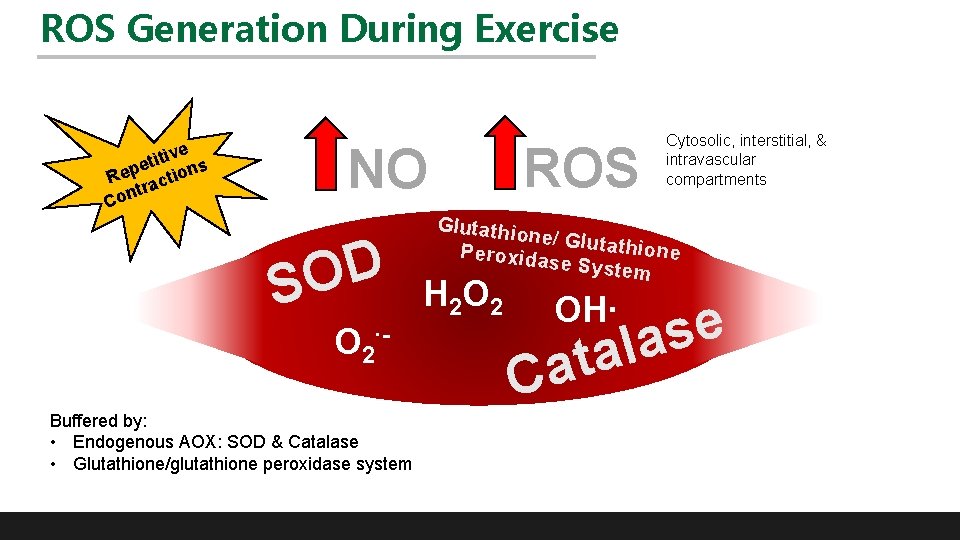
ROS Generation During Exercise e v i t i et ons p e R ti c a r t Con ROS NO D O S O 2∙- Buffered by: • Endogenous AOX: SOD & Catalase • Glutathione/glutathione peroxidase system Cytosolic, interstitial, & intravascular compartments Glutathio ne/ Gluta thione Peroxida se Syste m H 2 O 2 OH∙ Ca e s a l a t
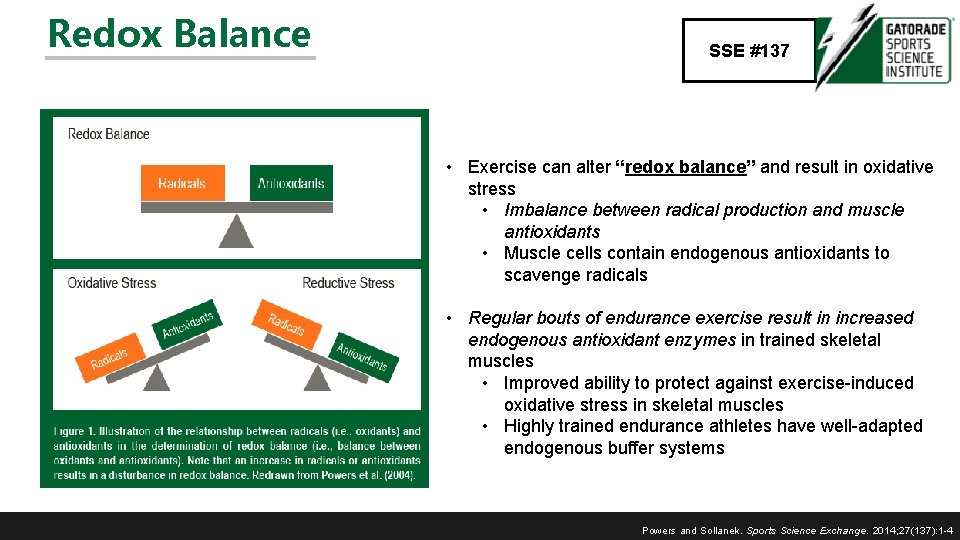
Redox Balance SSE #137 • Exercise can alter “redox balance” and result in oxidative stress • Imbalance between radical production and muscle antioxidants • Muscle cells contain endogenous antioxidants to scavenge radicals • Regular bouts of endurance exercise result in increased endogenous antioxidant enzymes in trained skeletal muscles • Improved ability to protect against exercise-induced oxidative stress in skeletal muscles • Highly trained endurance athletes have well-adapted endogenous buffer systems Powers and Sollanek. Sports Science Exchange. 2014; 27(137): 1 -4
Oxidative Stress Mechanisms • Elevated oxidants disrupt potassium regulation • ↓ Skeletal muscle Na+/K+ pump • ↑ K+ concentration • Exercise associated oxidants: • Limit the bioavailability of circulating NO • Restrict blood flow • Depress changes in hematological indices • Oxidative stress: • Lessen endurance exercise • K+ regulation and perfusion • Elevated oxidants: • ↓ fat oxidation & circulating glucose while ↑ lactate Reid M. J Physiol. 2016; 594: 5125 -5133
Antioxidant Mechanisms Enzymatic and nonenzymatic antioxidants prevent oxidation initiated by ROS by: • Preventing ROS formation • Scavenging reactive metabolites and converting them to less reactive molecules • Binding transition metal ion catalysts and preventing initiation of free radical reactions • E. g. copper to iron • Preventing continued hydrogen abstraction from fatty acid chains • Providing a favorable environment • Effective functioning of other antioxidants • Regenerating nonenzymatic antioxidant molecules REMEMBER: *Exercise TRAINING INCREASES the levels of antioxidant enzymes Jeukendrup & Gleeson. Champaign, IL. Human Kinetics. 2004
ROS Does Contribute to Fatigue Despite these protective mechanisms high rates of ROS production can exceed the antioxidant capacity of myofibers, promoting oxidative stress and depressing the force of muscle contraction So Why Not Supplement with Antioxidants? Reid M. J Physiol. 2016; 594: 5125 -5133
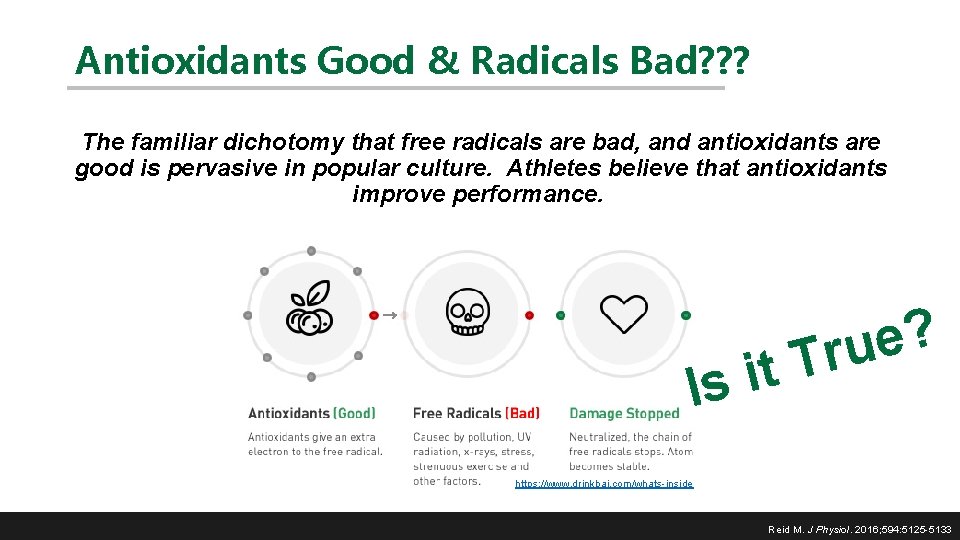
Antioxidants Good & Radicals Bad? ? ? The familiar dichotomy that free radicals are bad, and antioxidants are good is pervasive in popular culture. Athletes believe that antioxidants improve performance. ? e u r T t i s I https: //www. drinkbai. com/whats-inside Reid M. J Physiol. 2016; 594: 5125 -5133
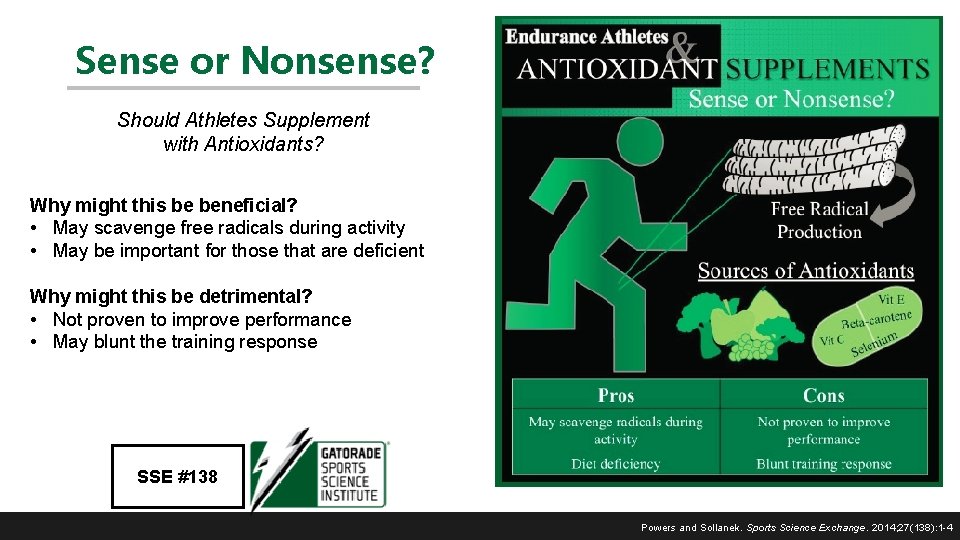
Sense or Nonsense? Should Athletes Supplement with Antioxidants? Why might this be beneficial? • May scavenge free radicals during activity • May be important for those that are deficient Why might this be detrimental? • Not proven to improve performance • May blunt the training response SSE #138 Powers and Sollanek. Sports Science Exchange. 2014; 27(138): 1 -4
Antioxidant Supplementation & Exercise Many antioxidants do not improve exercise performance • Including: Vitamin C, Vitamin E, Resveratrol, Coenzyme Q 10, Quercetin • Little evidence that nutritional supplementation improves either strength or endurance exercise • Increase antioxidant markers without ergogenic effects • May blunt biomarkers for oxidative stress during exercise • Exercise performance is usually unaffected, sometimes impaired Reid M. J Physiol. 2016; 594: 5125 -5133
Findings from NAC Research The drug N- acetylcysteine (NAC) effectively opposes oxidative stress when administered systemically and is approved for use in humans (smells, mild side effects) *First antioxidant shown to inhibit experimental muscle fatigue • Effective at submaximal but not during near maximal contractions • DEMONSTRATING: Oxidants contribute to low but not high frequency fatigue • NAC does not alter short term recovery of force immediately after muscle fatigue • DEMONSTRATING: Oxidants do not influence recovery from fatigue • NAC increases cycling endurance • Time to task failure • Delays fatigue in repeated bouts of damaging exercise Reid M. J Physiol. 2016; 594: 5125 -5133
Findings From Dietary Nitrate Research • Can increase exercise efficiency and improve performance • Mechanisms include: • Greater ATP supply via altered mitochondrial respiration • More efficient ATP utilization during muscle contraction • Increase bioavailability of NO derivatives • Promotes NO signaling • Buccal flora convert nitrate to nitrite • Via bacterial nitrate reductase • Circulating Nitrite is converted to NO • Central nervous system • Modulation of cortical function Reid M. J Physiol. 2016; 594: 5125 -5133
Take Homes: NAC & NO Thiol antioxidants (like NAC) and dietary nitrates appear to improve endurance exercise • Safe for human use • Laboratory doses • Both effective as a single dose shortly before exercise • Both work via redox mechanisms • Thiols are not practical for widespread use • Thiols preserve contractile function of myofibers • Buffer exercise induced ROS • Dietary nitrates increase exercise efficiency • Augment NO actions on mitochondrial metabolism, blood flow distribution, or both Reid M. J Physiol. 2016; 594: 5125 -5133
Risks of High Dose Supplementation • ROS are important intermediate messengers in apoptosis pathways • Antioxidants may inhibit apoptosis • Necessary defense mechanism to inhibit tumor development/ mutated cells • Prevents effective removal of damaged cells • Side effects of excessive vitamin intake • Can impair athlete’s exercise induced training adaptations Jeukendrup & Gleeson. Champaign, IL. Human Kinetics. 2004
High Dose Supplementation Can Hurt! Muscle recovery from damaging exercise is mediated in part by oxidant signaling • Antioxidants can blunt: • Signaling events • Repair mechanisms • Training responses to exercise can be depressed • ↓ mitochondrial biogenesis • ↓ insulin sensitivity • One dose can: • ↓ exercise induced vasodilation • Inhibit post exercise increases in HSPs Reid M. J Physiol. 2016; 594: 5125 -5133
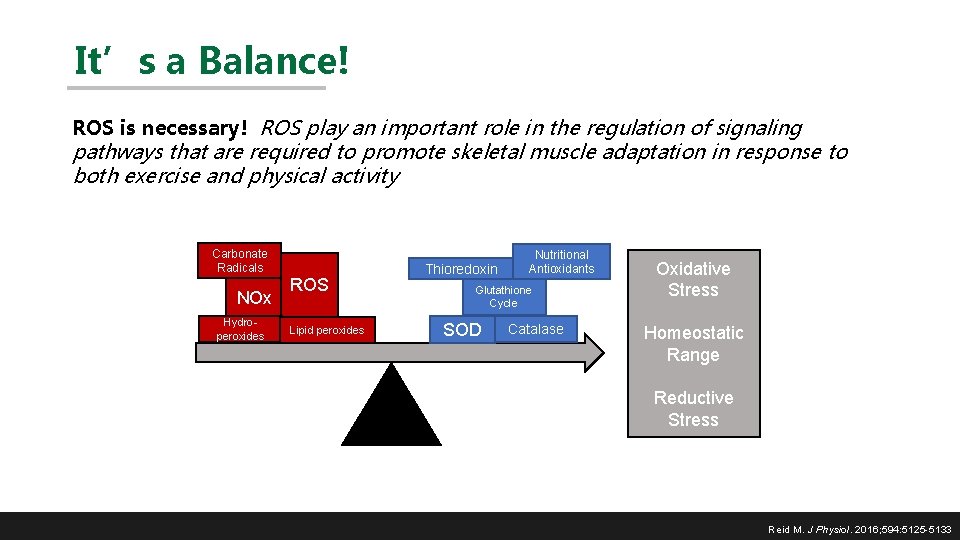
It’s a Balance! ROS is necessary! ROS play an important role in the regulation of signaling pathways that are required to promote skeletal muscle adaptation in response to both exercise and physical activity Carbonate Radicals NOx Hydroperoxides ROS Lipid peroxides Thioredoxin Nutritional Antioxidants Glutathione Cycle SOD Catalase Oxidative Stress Homeostatic Range Reductive Stress Reid M. J Physiol. 2016; 594: 5125 -5133
ROS: A New View OLD VIEW: ROS are by-products of metabolism and have only deleterious effects on muscle function NEW VIEW: Specific ROS are generated in a controlled manner by skeletal muscle fibers in response to physiological stimuli and play important roles in the physiological adaptations of muscle to contractions that result in muscle adaptation! Maughan & Gleeson. Oxford University Press. 2010
Micronutrients as Antioxidants Vitamins that act as antioxidants include: Vitamin A Vitamin E: • Free radical scavenger Vitamin C • Prevents initiation and propagation of lipid peroxidation in cellular membranes Vitamin E • Maintains membrane stability Beta carotene Vitamin C: • Capable of regenerating vitamin E in the antioxidant cascade Jeukendrup & Gleeson. Champaign, IL. Human Kinetics. 2004
Micronutrients as Antioxidants Minerals Several minerals are components of antioxidant enzymes involved in the defense of free radicals: • Selenium • Cofactor of glutathione peroxidase • Influences quenching of ROS • Copper • Manganese Jeukendrup & Gleeson. Champaign, IL. Human Kinetics. 2004
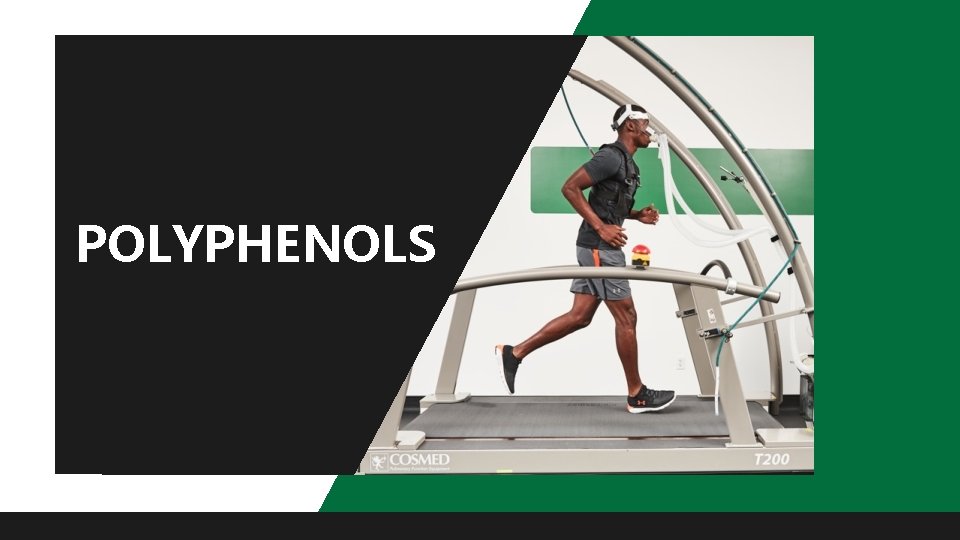
POLYPHENOLS
Polyphenols A compound containing more than one phenolic hydroxyl group Scavenge peroxyl, superoxide, and NO radicals Flavonoids are a subclass of polyphenols that include: • Flavanols, flavanones, and anthocyanidins • Contain phenolic hydroxyl groups attached to their ring structures that give antioxidant activity Jeukendrup & Gleeson. Champaign, IL. Human Kinetics. 2004
Name foods that contain polyphenols.
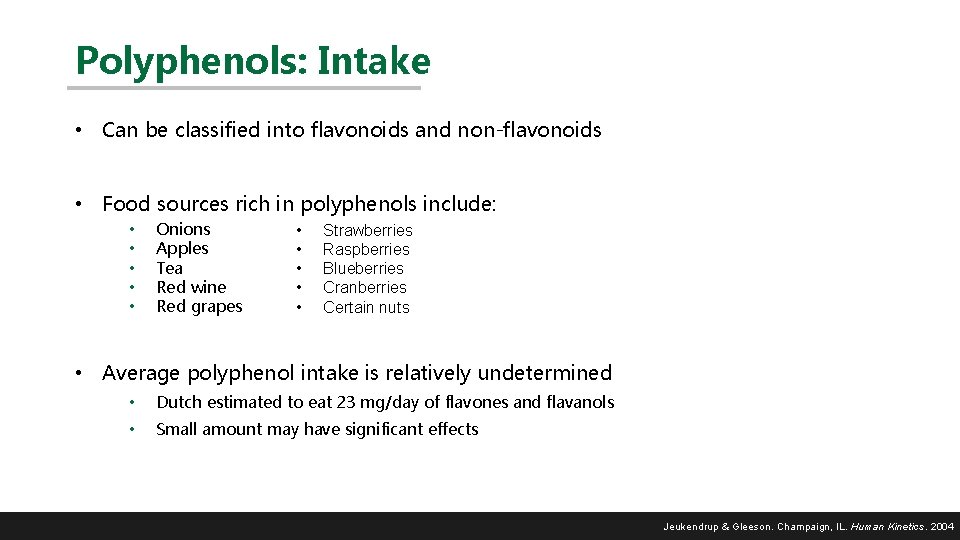
Polyphenols: Intake • Can be classified into flavonoids and non-flavonoids • Food sources rich in polyphenols include: • • • Onions Apples Tea Red wine Red grapes • • • Strawberries Raspberries Blueberries Cranberries Certain nuts • Average polyphenol intake is relatively undetermined • Dutch estimated to eat 23 mg/day of flavones and flavanols • Small amount may have significant effects Jeukendrup & Gleeson. Champaign, IL. Human Kinetics. 2004
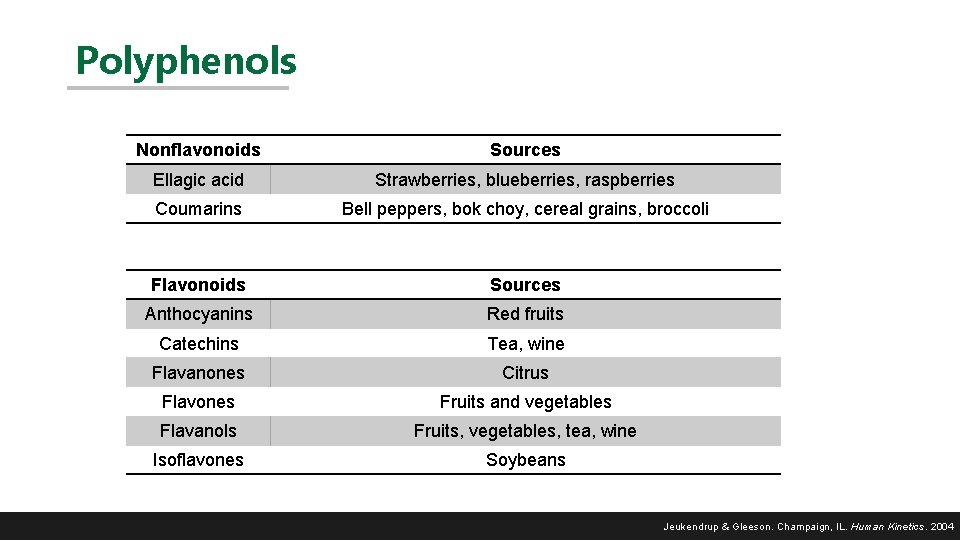
Polyphenols Nonflavonoids Sources Ellagic acid Strawberries, blueberries, raspberries Coumarins Bell peppers, bok choy, cereal grains, broccoli Flavonoids Sources Anthocyanins Red fruits Catechins Tea, wine Flavanones Citrus Flavones Fruits and vegetables Flavanols Fruits, vegetables, tea, wine Isoflavones Soybeans Jeukendrup & Gleeson. Champaign, IL. Human Kinetics. 2004
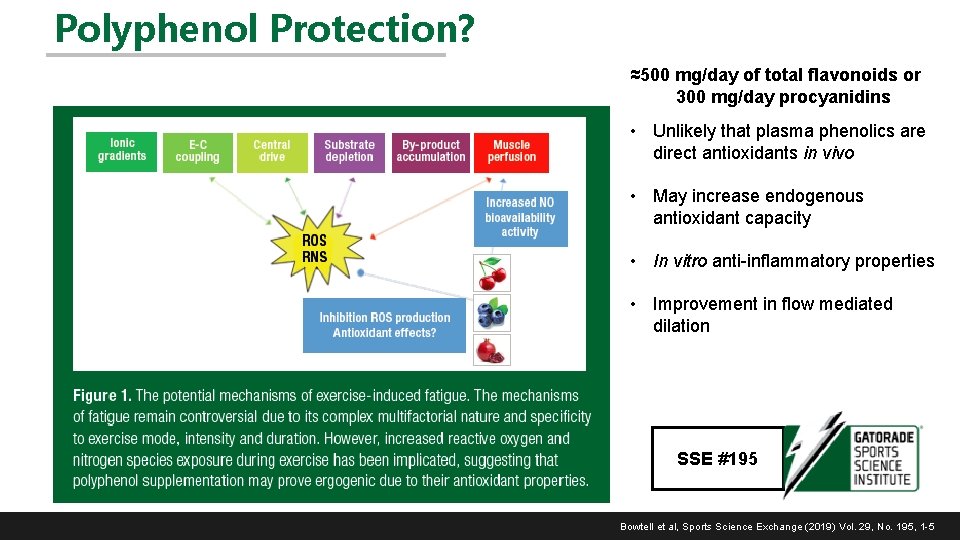
Polyphenol Protection? ≈500 mg/day of total flavonoids or 300 mg/day procyanidins • Unlikely that plasma phenolics are direct antioxidants in vivo • May increase endogenous antioxidant capacity • In vitro anti-inflammatory properties • Improvement in flow mediated dilation SSE #195 Bowtell et al, Sports Science Exchange (2019) Vol. 29, No. 195, 1 -5
Polyphenol Supplementation? Preliminary studies suggest: • ≈300 mg of polyphenol 1 h prior to exercise • Recreationally active • Enhance endurance performance • Enhance repeated sprint performance • Mediated via vascular mechanisms SSE #195 • Recovery of muscle strength and performance may be enhanced • Optimal dose & blend unknown • Suggested consumption: • ≈1200 mg/d Montmorency cherry or pomegranate polyphenols for >3 days prior to exercise Bowtell et al. Sports Science Exchange. 2019; 29(195): 1 -5
Polyphenol Supplementation? “Evidence is insufficient to make recommendations for or against the use of polyphenol supplementation (neither specific polyphenols nor specific doses) for either recreational, competitive or elite athletes. ” Myburgh KH. Sports Med. 2014; 44(1): 57 -70
Summary Antioxidants: Antioxidants limit the action of free radicals Exercise training improves antioxidant capacity Little to no evidence for supplementation ROS play an important role in adaptation to exercise Polyphenols: Scavenge radicals May provide protection through multiple mechanisms More research is needed
- Slides: 35