
Antimicrobial stewardship in nursing homes introducing the antibiogram

Antimicrobial stewardship in nursing homes: introducing the antibiogram, increasing physician engagement Christopher A Czaja MD MPH Antimicrobial Stewardship Medical Epidemiologist Healthcare-Associated Infections Program December 4, 2018 christopher. czaja@state. co. us
Objectives 1. Describe the uses of an antibiogram and access the Colorado Antibiogram for antibiotic stewardship 2. Recognize the need for physician input and involvement in nursing home antibiotic stewardship programs Slide 2 of 27
SECTION 1 The nursing home antibiogram Slide 3 of 27
Antibiogram definition and uses Definition • Facility-specific summary of antibiotic susceptibility of organisms cultured from clinical isolates (local data) Uses • To inform choice of initial antibiotic therapy • To inform antimicrobial stewardship program planning Slide 4 of 27
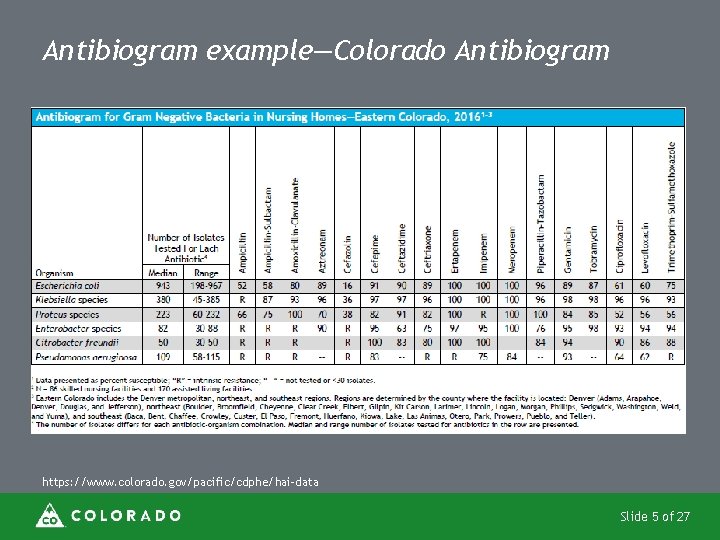
Antibiogram example—Colorado Antibiogram https: //www. colorado. gov/pacific/cdphe/hai-data Slide 5 of 27

Organizations recommend antibiogram use • Centers for Disease Control and Prevention (CDC. The core elements of antibiotic stewardship for nursing homes. 2015) • Centers for Medicare & Medicaid Services (CMS. State operations manual. Appendix PP-Guidance to surveyors for long term care facilities (F 881). 2017. ) • Infectious Diseases Society of America (Barlam et al. Implementing an antibiotic stewardship program: guidelines by the Infectious Diseases Society of America and the Society for Healthcare Epidemiology of America. 2016) Slide 6 of 27
Evidence for antibiograms • Antibiograms improve choice of “active” initial therapy (Boggan. Pediatrics 2012. ) • Choice of “appropriate” therapy requires knowledge of additional principals of antibiotic use (Boggan. Pediatrics 2012. ) • Improvement in antibiotic use requires that data and knowledge be incorporated into practice (Furuno. ICHE 2014. ; Tallman. ICHE 2018. ) Slide 7 of 27
Antibiogram preparation 1. Analyze and present data annually 2. Include only final, verified results 3. Include only species with at least 30 isolates tested 4. Include diagnostic, not surveillance, isolates 5. Include only the first isolate per patient (no duplicates) 6. Include results only for drugs that are routinely tested 7. Calculate the percentage susceptible CLSI. M 39 -A 4 2014; Hindler and Stelling. CID 2007. Slide 8 of 27
Antibiogram quality • Variable adherence to guidelines for preparation • Breakpoints for susceptibility testing may not be up to date • Small facilities have too few isolates Zapantis. JCM 2005; Boehme. Public Health Reports 2010; Heil. JCM 2016; Moehring JCM 2015. Slide 9 of 27

Approach to reading an antibiogram • What is the quality of the data? • What organisms are you trying to cover? • What are the preferred antibiotics (based on proven effectiveness)? • What antibiotics are likely to be active (based on the antibiogram)? • What are the opportunities for stewardship? Slide 10 of 27
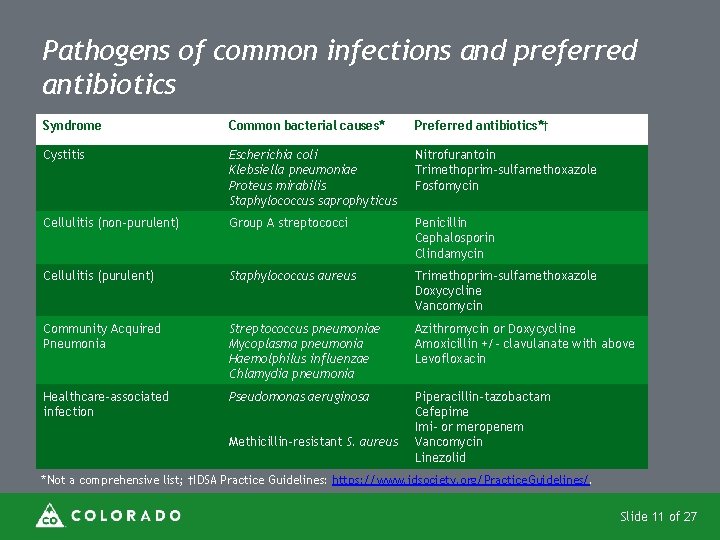
Pathogens of common infections and preferred antibiotics Syndrome Common bacterial causes* Preferred antibiotics*† Cystitis Escherichia coli Klebsiella pneumoniae Proteus mirabilis Staphylococcus saprophyticus Nitrofurantoin Trimethoprim-sulfamethoxazole Fosfomycin Cellulitis (non-purulent) Group A streptococci Penicillin Cephalosporin Clindamycin Cellulitis (purulent) Staphylococcus aureus Trimethoprim-sulfamethoxazole Doxycycline Vancomycin Community Acquired Pneumonia Streptococcus pneumoniae Mycoplasma pneumonia Haemolphilus influenzae Chlamydia pneumonia Azithromycin or Doxycycline Amoxicillin +/- clavulanate with above Levofloxacin Healthcare-associated infection Pseudomonas aeruginosa Piperacillin-tazobactam Cefepime Imi- or meropenem Vancomycin Linezolid Methicillin-resistant S. aureus *Not a comprehensive list; †IDSA Practice Guidelines: https: //www. idsociety. org/Practice. Guidelines/. Slide 11 of 27
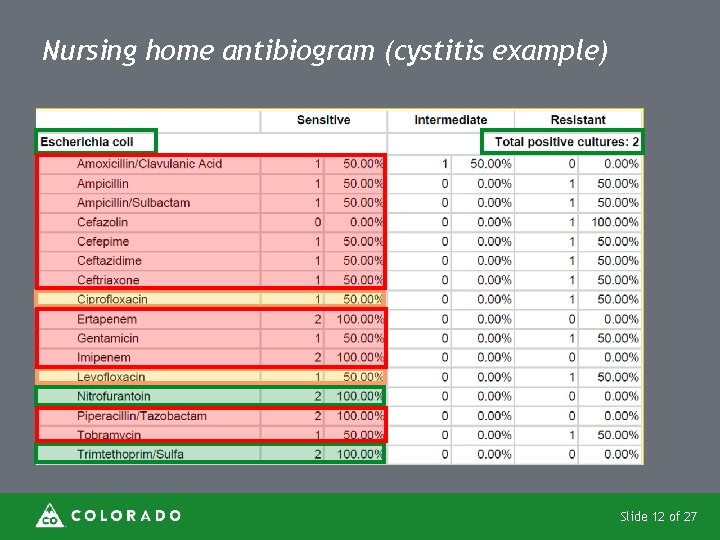
Nursing home antibiogram (cystitis example) Slide 12 of 27
Guidance for use • Choose antibiotics based on activity, proven effectiveness, potential for antibiotic resistance or adverse events, and use clinical judgement • Consider principles of antibiotic stewardship, including appropriate initial use of broad-spectrum antibiotics, deescalation to targeted therapy, and limited duration • Be aware of limited ability to generalize findings from a small number of isolates Slide 13 of 27

https: //www. colorado. gov/pacific/cdphe/hai-data Slide 14 of 27

Objectives of the Colorado Antibiogram • To be a publicly available tool for antibiotic stewardship • Increase public knowledge of antibiotic resistance • Inform allocation of resources to improve antibiotic use • Demonstrate antibiotic resistance patterns by region Slide 15 of 27
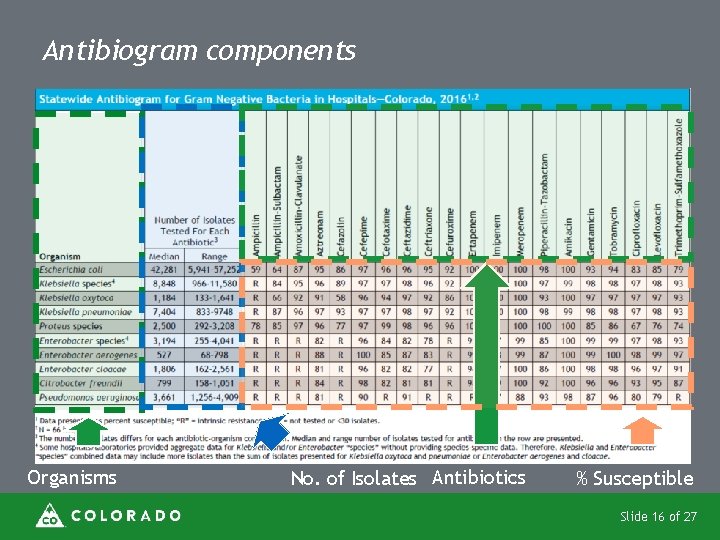
Antibiogram components Organisms No. of Isolates Antibiotics % Susceptible Slide 16 of 27
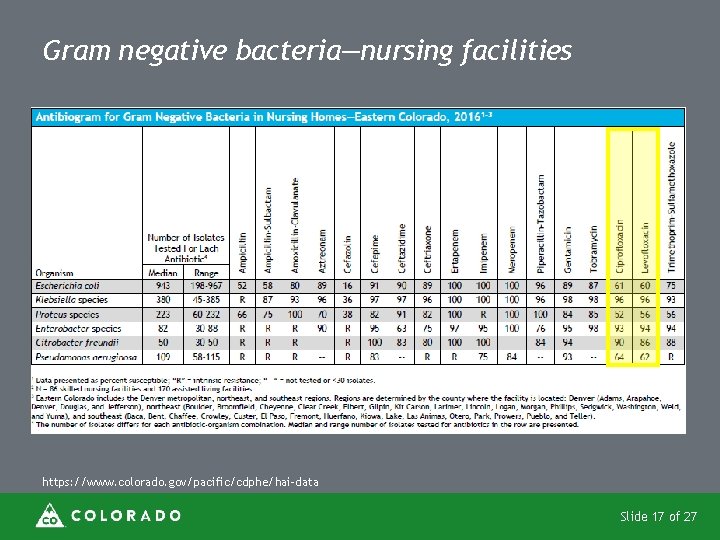
Gram negative bacteria—nursing facilities https: //www. colorado. gov/pacific/cdphe/hai-data Slide 17 of 27
Limitations • Use requires knowledge of appropriate pathogen-directed therapy • Non-standard quality and content of source antibiograms • Regional differences are multifactorial; no statistical tests of comparison • High quality, facility-specific data will better represent facility-specific antibiotic susceptibility patterns Slide 18 of 27
SECTION 2 Engaging physicians in antibiotic stewardship in nursing homes Slide 19 of 27
Long-term goals of antibiotic stewardship • Improve patient outcomes (including mortality) • Fewer adverse events • Lower rates of C. difficile • Reduced antimicrobial resistance Schuts Lancet Infect Dis 2016. Slide 20 of 27
Immediate goals of antibiotic stewardship • Right indication first, make the right diagnosis • Right drug most effective, narrowest spectrum • Right duration evidence-based shorter courses • Right dose most effective, safest dose • Right route Intravenous vs. oral/other Slide 21 of 27

Targets for antibiotic stewardship Urinary Tract Infection Respiratory Infection Skin/Soft Tissue Infection Diagnosis Choice of Antibiotic Duration of Antibiotic Slide 22 of 27
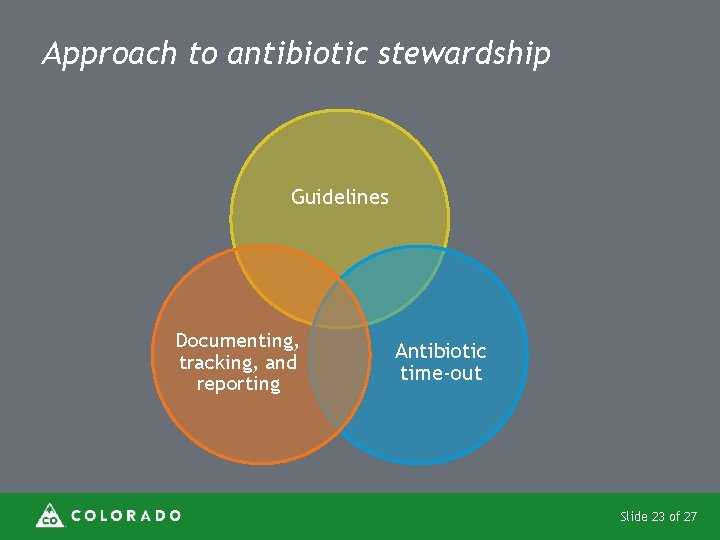
Approach to antibiotic stewardship Guidelines Documenting, tracking, and reporting Antibiotic time-out Slide 23 of 27
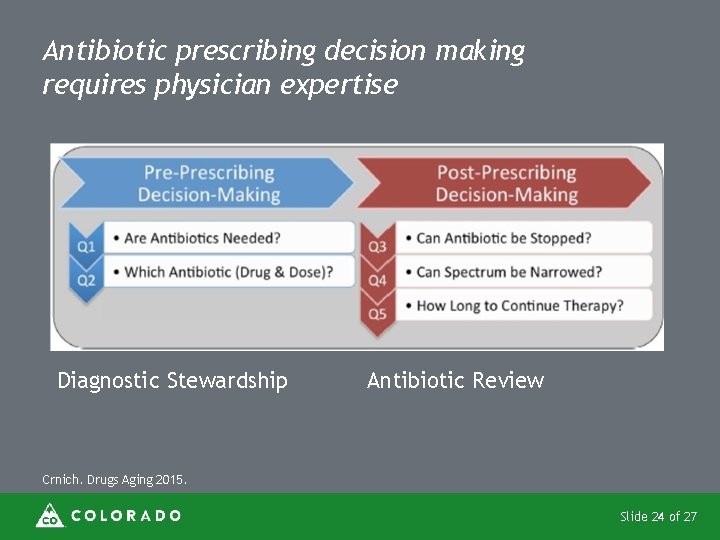
Antibiotic prescribing decision making requires physician expertise Diagnostic Stewardship Antibiotic Review Crnich. Drugs Aging 2015. Slide 24 of 27
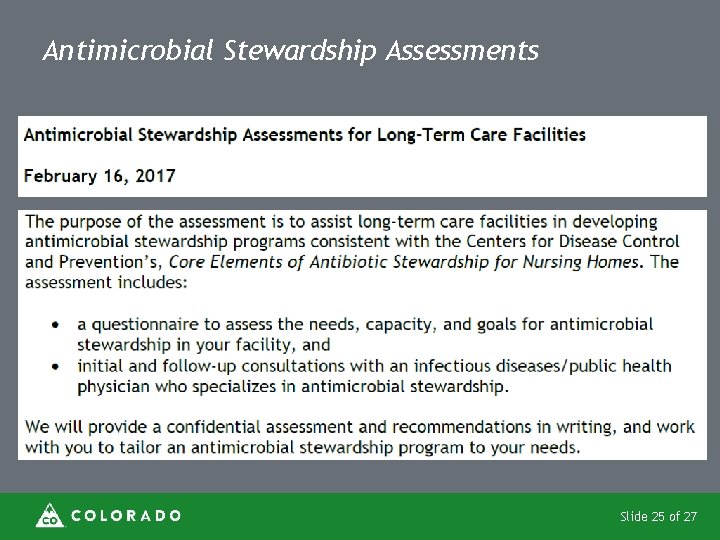
Antimicrobial Stewardship Assessments Slide 25 of 27

Call for physician input • Please contact me if you are interested in participating in an antimicrobial stewardship assessment at your facility with attendance by the antimicrobial stewardship team including physician staff • E-mail: christopher. czaja@state. co. us • Tele: 303 -692 -3561 • Engage your antimicrobial stewardship team! Slide 26 of 27

Slide 27 of 27
- Slides: 27