
ANTIMICROBIAL STEWARDSHIP Dr Sue Partridge Consultant Microbiologist West

ANTIMICROBIAL STEWARDSHIP Dr Sue Partridge Consultant Microbiologist West Suffolk NHSFT
‘Sepsis’ and ‘Antibiotics’ Sepsis Antibiotic resistance/stewardship Some other points
Sepsis: definitions § SEPSIS Sepsis is a clinical syndrome caused by the body's immune and coagulation systems being switched on by an infection. • SEPTIC SHOCK Sepsis with shock is a life-threatening condition that is characterised by low blood pressure despite adequate fluid replacement, and organ dysfunction or failure. • (SP reservations…)
Sepsis: NICE guidance • NICE Quality Standard QS 5 relates to GPs – Covers assessment/management/advice on referral, risk stratification, information for patients & carers who are deemed ‘low risk’ for sepsis • 2016 guidance (updated) includes Risk Stratification Tool
• Service providers (such as primary, ambulatory and secondary care services) ensure that written protocols are in place on the use of structured sets of observations to stratify risk of severe illness or death (such as an early warning score) when people are suspected to have sepsis.
• Healthcare professionals (such as GPs, paramedics and healthcare professionals working in emergency departments) consider sepsis if a person presents with signs or symptoms that indicate possible infection. They should use a structured set of observations to stratify risk of severe illness or death in people with suspected sepsis. Healthcare professionals outside acute healthcare settings should also be aware of the criteria that indicate when to refer people for emergency medical care.
• Commissioners (such as clinical commissioning groups and NHS England) ensure that primary, ambulatory and secondary care services demonstrate the use of structured sets of observations for people presenting with symptoms that suggest sepsis. They should also monitor performance against the national CQUIN on the timely identification of sepsis.
Identifying Sepsis in Hospital • ‘Sepsis 6’ to identify patients with possible sepsis, then appropriate initial management • MEWS, NEWS 2… • Now e-Care alerts • Process should be: • Appropriate specimens →antibiotics reviewed • In practice…
Hospital CQUIN • Identifying patients with sepsis (ED and inpatients) • Antibiotics within 1 hour those at severe/high risk • Antibiotic review within 72 hours for those at severe/high risk
Antibiotic CQUIN • Overall reduction in antibiotic use of 2% c. f. 2013 -14 • Reduction in piperacillin-tazobactam and meropenem use • A contraindication, particularly in the light of antibiotic shortages…

ANTIBIOTIC RESISTANCE
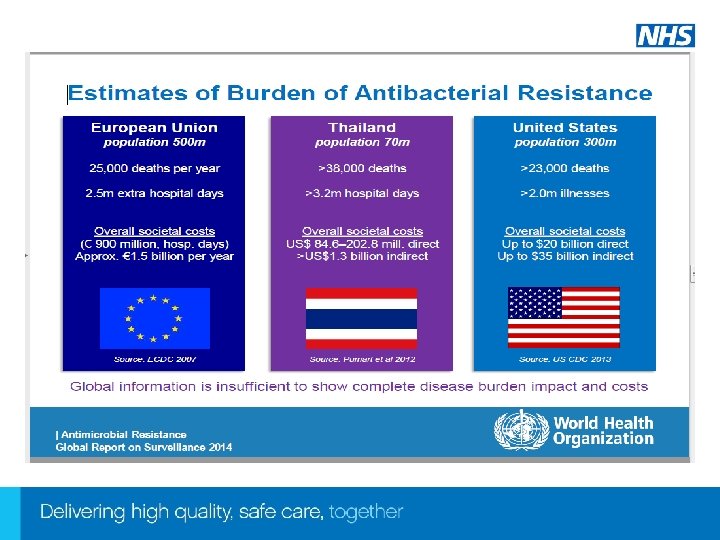
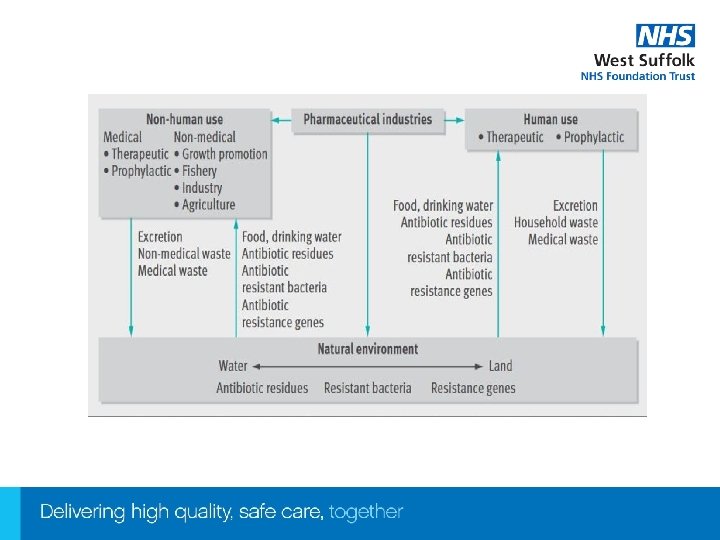
Antimicrobial resistance is an evolutionary process • Resistance genes found in humans and animals in areas with no antibiotic exposure • …in 30, 000 year old frozen arctic bacteria • …in bacteria in underground caves isolated for 4 million years

• Evolution is driven by antibiotic exposure: – Human – Animal – Environmental • Spread by globalisation of travel and trade
Antibiotic residues in the environment of South East Asia BMJ 2017; 358 doi: https: //doi. org/10. 1136/bmj. j 2440 (Published 05 September 2017)
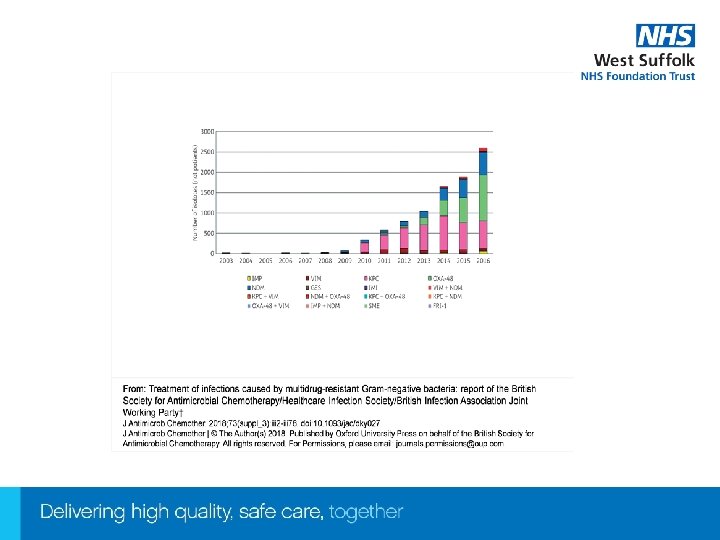
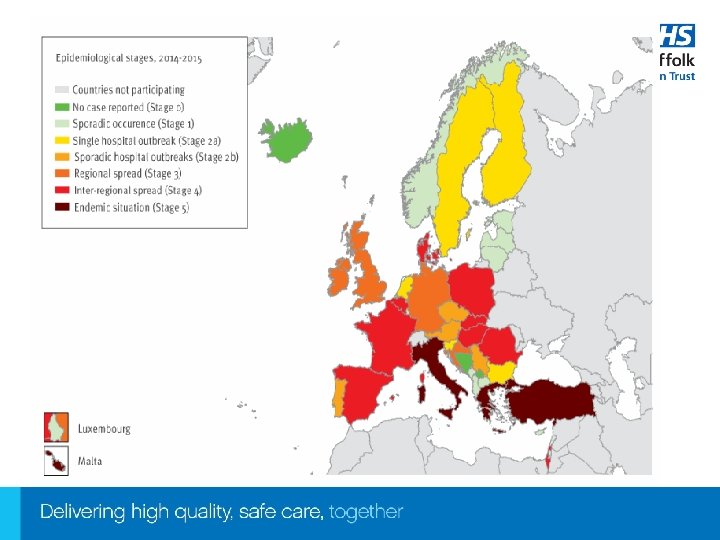
“Superbugs” • Meticillin resistant Staphylococcus aureus • Multi resistant Neisseria gonorrhoeae • Multi-drug resistant/extensively drug resistant Mycobacterium tuberculosis • Multi-resistant enterobacteriacae • Carbapenemase-producing enterobacteriacae
Resistant enterobacteriacae • Amp. C/ESBL production → resistance to penicillins and cephalosporins • Often linked to resistance to quinolones • CPE – also resistant to Meropenem etc.
CPE • Resistant to penicillins and cephalosporins • Often resistant to quinolones and aminoglycosides • RESISTANT TO CARBAPENEMS
Consequences of antibiotic resistance • Limited treatment options • More expensive antibiotics • E. g. need to use Fosfomycin/Pivmecillinam for UTI, or admit patients for IVAB • More toxic antibiotics • No treatment options
Potential impacts on healthcare • No prosthetic surgery • No major surgery • No chemotherapy or immunosuppressive treatment
What can we do? • Minimise exposure to antibiotics in humans (and animals) • Reduce antibiotic contamination of the environment • Infection prevention measures including screening
DH 5 year plan • Programme 1: to reduce healthcare associated Gram-negative bloodstream infections in England by 50% by 2020/21; led by the Executive Director of Nursing, NHS Improvement. • Programme 2: to reduce inappropriate antibiotic prescribing by 50% with the aim of being a world leader in reducing antibiotic prescribing by 2020/21; led by the Chief Pharmaceutical Officer, NHS England.
• Programme 3: to ensure that diagnostic tests or epidemiological data are used to support clinical decision making, implement our vision and delivering high quality diagnostics in the NHS in support of the other ambitions; led by the Chief Scientific Officer, NHS England. • Programme 4: to reduce use of antibiotics in livestock and fish farmed for food to a multispecies average of 50 mg/kg by 2018; to agree sector specific targets for the animal sectors by the end of 2017, and to set agreed rules for use of antibiotics which are most critically important for human health; led by the Chief Executive of the Veterinary Medicines Directorate, an executive agency of Defra
What can be done in General Practice? PHE ‘Target Antibiotics’ toolkit Antibiotic formulary ‘Think Pharmacist’ leaflet Letter from NHSE to exceptionally high prescribers, suggesting approaches to reduce prescribing • Prescribing decision support ‘Scriptswitch’ • •
CCG Targets • Overall reduction in antibiotic use • Specific reductions in Co-Amoxiclav, cephalosporins and quinolones • TMP: NFT (to reduce TMP usage) • Reduce TPM in pt >70 yrs by 10% of baseline
Every little helps… • • • BUT: Resistant organisms are out there Don’t fully understand the epidemiology Can’t stop people travelling Could screen more, but can’t eradicate MRGNs when identified
Management of UTIs
Is it really a UTI? • Bacteriuria is common in elderly patients; treatment is not usually required for asymptomatic bacteriuria • Bacteriuria is the norm in patients with indwelling catheters; treatment is usually required only if there are systemic signs of infection • Antibiotics will not reliably clear bacterial colonisation of a catheter
Requesting urine specimens • I don’t care what the dipstick shows! • Only do a dipstick if there is clinical suspicion of infection. Do not do dipstick testing of CSUs • Accurate information about type of specimen i. e. MSU, CCU, CSU, ileal conduit • Key symptoms • Information about current/proposed antibiotic treatment
Reporting urine cultures • Must assume that there has been an appropriate clinical assessment leading to the submission of a specimen – hence the dipstick result it of no interest to me • ‘Mixed bacterial growth’ means (usually) >2 organisms are present. Significance doubtful so not pursued. NOT an indication for antibiotic treatment. A carefully-taken repeat specimen may be helpful.
• Nitrofurantoin is not appropriate if there are systemic signs of infection • If resistant to Co. Amoxiclav then assume resistant to oral cephalosporins • ‘Mecillinam’ on reports = Pivmecillinam (sorry)

And finally: (nothing to do with UTIs)
Erythromycin/macrolides • Laboratory tests and reports erythromycin. • For staphylococci and streptococci, the sensitivity result also applies to clarithromycin/azithromycin • Haemophilus influenzae is resistant to erythromycin, but may be sensitive to other macrolides
- Slides: 36