
Antimicrobial Resistance AMR Global Overview Evolving challenge Nordic
Antimicrobial Resistance (AMR) Global Overview: Evolving challenge Nordic Health Summit Oslo 10 May 2016 Keiji Fukuda

Where are we? Why? Where do we want to go? How?
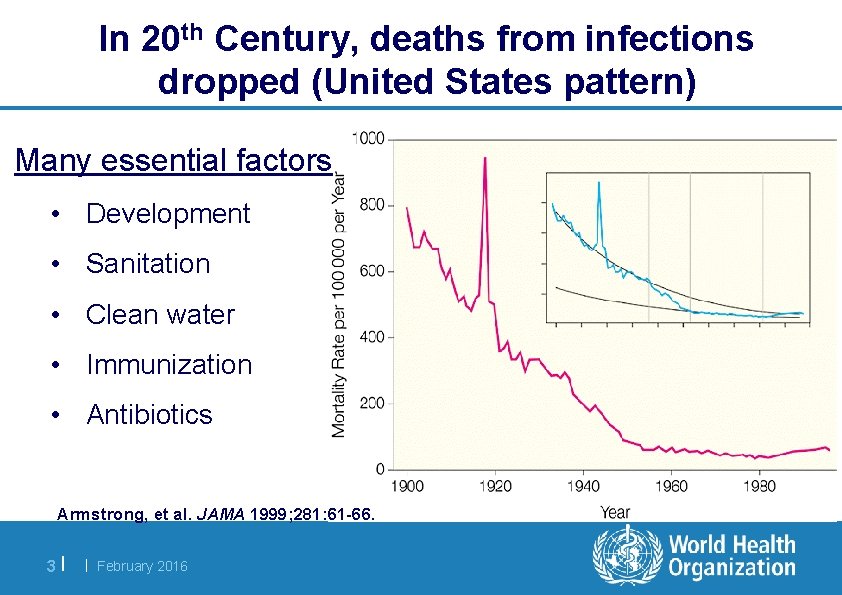
In 20 th Century, deaths from infections dropped (United States pattern) Many essential factors • Development • Sanitation • Clean water • Immunization • Antibiotics Armstrong, et al. JAMA 1999; 281: 61 -66. 3| | February 2016
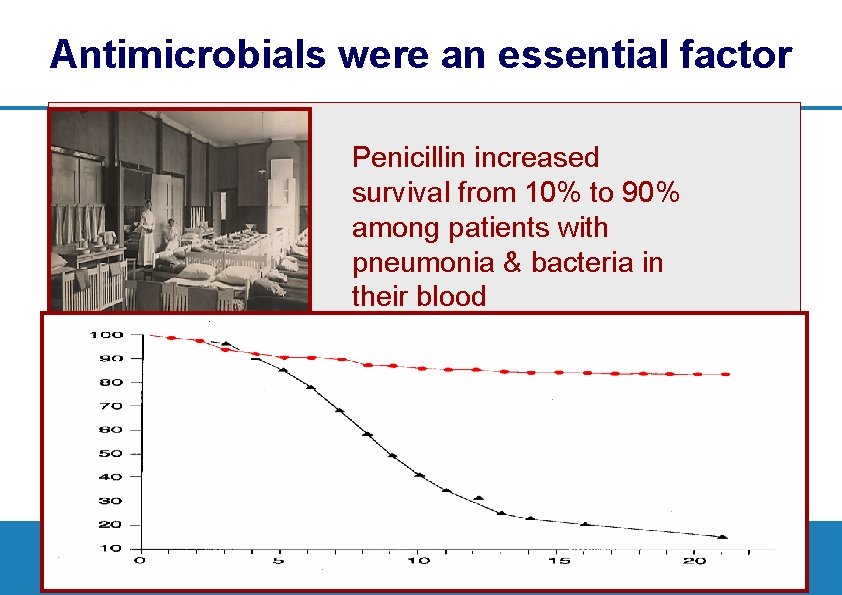
Antimicrobials were an essential factor Penicillin increased survival from 10% to 90% among patients with pneumonia & bacteria in their blood % survivors Penicillin Untreated 4| | February 2016 Days
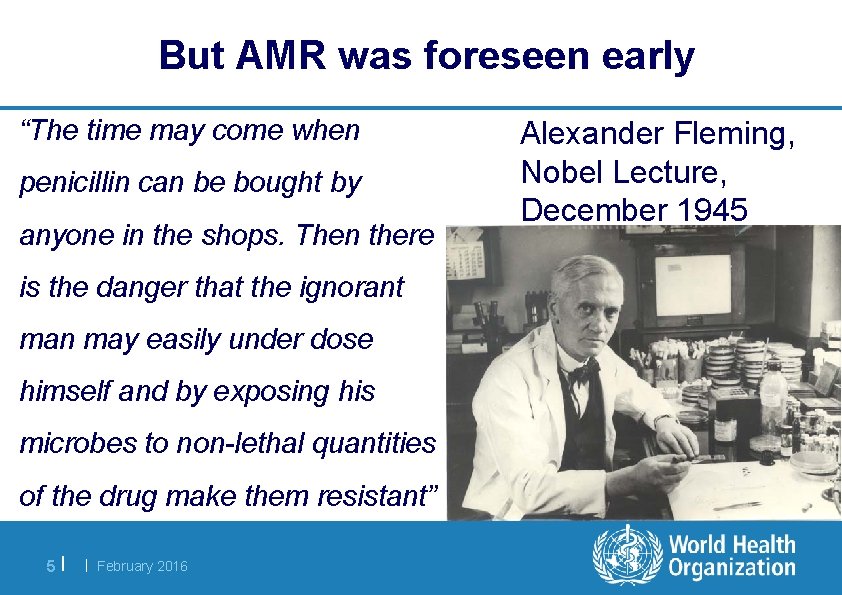
But AMR was foreseen early “The time may come when penicillin can be bought by anyone in the shops. Then there is the danger that the ignorant man may easily under dose himself and by exposing his microbes to non-lethal quantities of the drug make them resistant” 5| | February 2016 Alexander Fleming, Nobel Lecture, December 1945
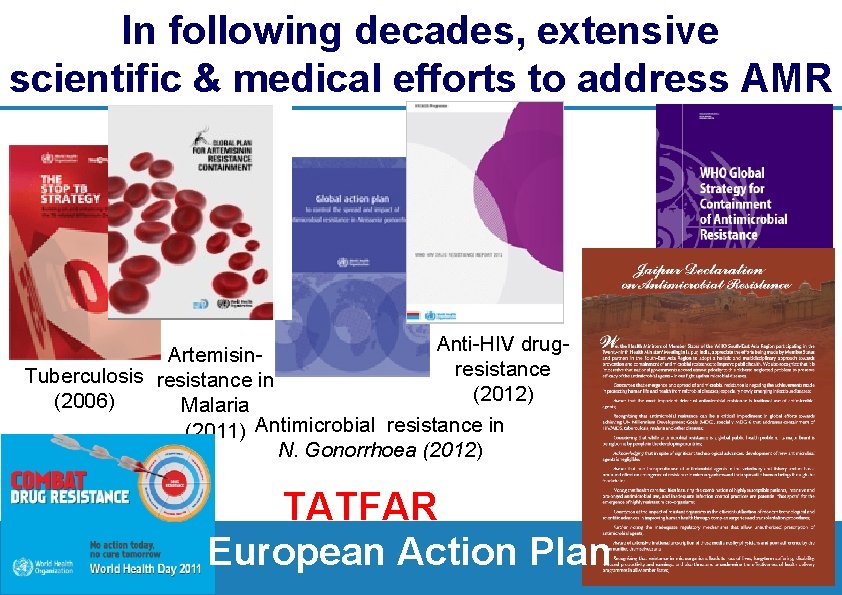
In following decades, extensive scientific & medical efforts to address AMR Anti-HIV drug. Artemisinresistance Tuberculosis resistance in (2012) (2006) Malaria (2011) Antimicrobial resistance in N. Gonorrhoea (2012) 6| | February 2016 TATFAR European Action Plan

Report card? l Significant progress related to AMR – Scientific knowledge – Development of new antimicrobials – Public health & clinical guidance & other practical tools • Health system based surveillance • Antibiotic sensitivity testing to guide clinical decisions ……… l But …. . war was being lost 7| | February 2016
2014 WHO report “Antimicrobial resistance: global report on surveillance” l Survey of 114 countries in all regions l Selected hospital & community bacteria & antibiotic resistance patterns l Data limitations – Surveillance gaps in many countries – No standard methodology l But best available global picture 8| | February 2016

General Findings l In all regions, very high AMR levels in common bacteria to major antibiotics – E coli, K pneumoniae, S aureus, S pneumoniae, N gonorrhea …. – 3 rd generation cephalosporins, fluoroquinolones, methicillin …. . l Under reporting of key patterns like MDR TB l Significant gaps in surveillance & information 9| | February 2016
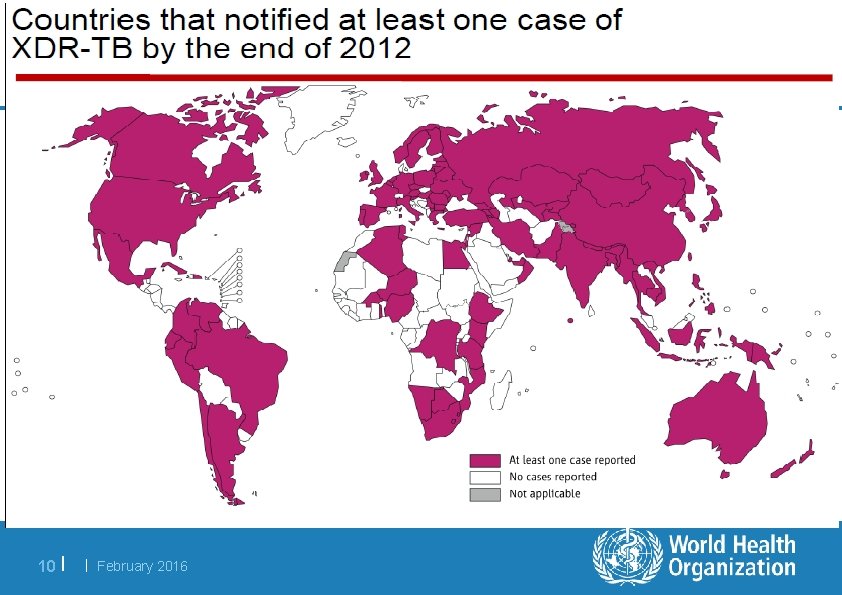
10 | | February 2016
More recently reports of new AMR mechanisms l In 2015, Liu & colleagues reported plasmid-based gene (mcr-1) conferring resistance to colistin & polymyxin B l First detected in E coli from pigs from Shanghai l Then E coli from pork & poultry from slaughter houses & supermarkets in 4 provinces l Then E coli & K pneumoniae from hospital patients in 2 hospitals in 2 provinces l Subsequently UK, Denmark, Malaysia, France, the Netherlands, Portugal, Thailand, Laos…. 11 | | February 2016
Implications l Colistin considered “last-line” treatment for patients with some serious infections l Resistance to polymyxins previously based on chromosomal mutations l Efficient mechanism for geographic & interspecies spread through travel, food, animals 12 | | February 2016

Direct health consequences of AMR l Longer illnesses l >Deaths in all age groups – Europe 25, 000 per year – Thailand 38, 0000 – USA ~2 million AMR cases >23, 000 deaths l Estimated annual US costs – Direct 20 billion USD – Indirect 35 billion USD 13 | | February 2016
Broader health implications l Shrinking safety net – Surgery, injuries, immuno-compromising conditions (e. g. , diabetes, cancer, malnourishment)… l Erosion of major public health gains – HIV, TB, malaria …. l If uncontrolled, UK Review on Antimicrobial Resistance has projected – More annual deaths than cancer (>10 million per year) – Cumulative cost of 100 trillion USD 14 | | February 2016
Larger social implications l Border crossing global health security threat l Sustainable agricultural practices l Emerging consumer food preferences l Adequate & sustainable R & D l Global developmental gains – Previous Millennium Development Goals – Current Sustainable Development Goals 15 | | February 2016
Why is FAO concerned? • FAO: eradicate hunger and poverty; food insecurity and malnutrition are globally challenged with economic uncertainties and a changing climate. • AMR contributes to disease persistence - and diseases cripple production, economic growth, livelihoods, and welfare. • FAO is in a unique position as the sole international organization combining agricultural aspects, food-safety, and environmental issues in aquatic and terrestrial animal production and health settings, as well as crops. • Problems related to AMR are linked to antimicrobial misuse and overuse
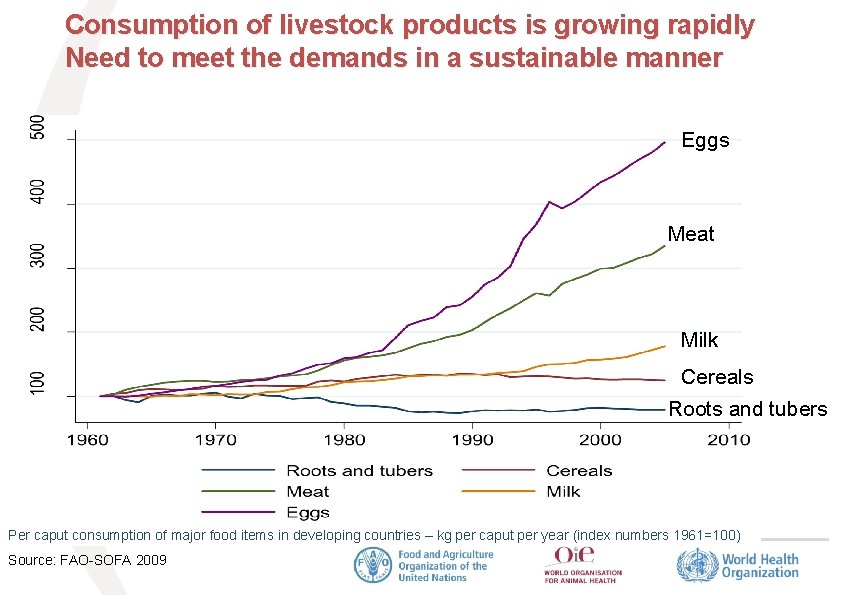
Consumption of livestock products is growing rapidly Need to meet the demands in a sustainable manner Eggs Meat Milk Cereals Roots and tubers Per caput consumption of major food items in developing countries – kg per caput per year (index numbers 1961=100) Source: FAO-SOFA 2009

Why are we here? (What is AMR? )
What is AMR? l For decades, approached as a scientific & health issue with resulting benefits – Understanding of some aspects: e. g. , microbiological mechanisms – Clinical & health system targeted solutions – Some new antibiotics l Perspective was natural but is no longer adequate 19 | | February 2016

What is AMR? l Inescapable natural phenomenon to a certain extent l Greatly accelerated by overuse & misuse of antimicrobial drugs in both health and agriculture l Overuse & misuse rooted in cultural norms, perceptions & expectations and economic incentives – Patient/family interactions with health systems – Growth promotion of animals, fish, plants …. . – Grey economy in medicines 20 | | February 2016
What is AMR? l Sustained by lack of awareness & understanding – Terms like “antimicrobial resistance” are a barrier l Market, distribution & regulatory failure issue – Unmet but open-ended need for new antibiotics, diagnostics – Many manufacturers have left the field – At same time, profit-based distribution intensifying over use & misuse of available drugs especially in poor regulatory oversight settings 21 | | February 2016
What is AMR? l A health security challenge – Like any emerging infectious disease, AMR will travel the world by plane, train, cars, foot etc l An equity issue – All countries & persons at-risk – But effective solutions will be harder for poorer countries & communities – Less access 22 | | February 2016
What is AMR? l Like climate change, now a major global, social, intersectoral challenge requiring a response commensurate in scope 23 | | February 2016

Where do we want to go? How?
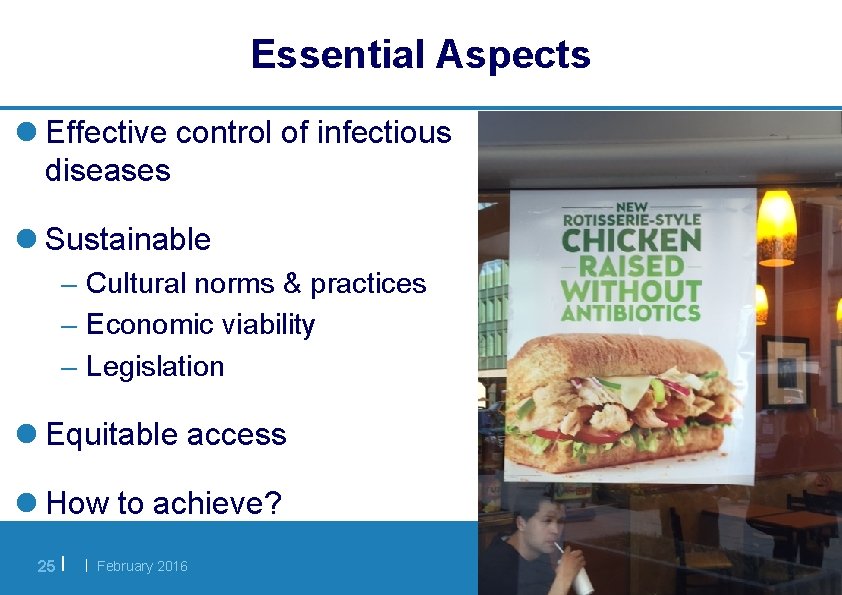
Essential Aspects l Effective control of infectious diseases l Sustainable – Cultural norms & practices – Economic viability – Legislation l Equitable access l How to achieve? 25 | | February 2016
AMR Global Action Plan l Adopted by World Health Assembly in May 2015 l Technical blueprint reflecting global scientific & intersectoral consensus on what to do – Endorsed by governing bodies of FAO & OIE – Participation of civil society & others l Acceptability based in part on stepwise approach 26 | | February 2016
Five strategic objectives 1. Improve awareness and understanding 2. Strengthen knowledge through surveillance & research 3. Reduce incidence of infection 4. Optimize use of antimicrobial medicines 5. Ensure sustainable investment 27 | | February 2016
Moving on, key next steps l Continue awareness & socialization of AMR l Development & implementation of National Action Plans reflecting Global Action Plan on AMR l Accelerated implementation of key priority streams l Strengthen political engagement & support l Look ahead on how concretely to resolve most difficult issues 28 | | February 2016
High level meeting on AMR at United National General Assembly l September 2016 l Heads of state level l 3 rd time UNGA will address a health issue l Optimal outcome will enable – Implementation of global / national plans – Multisectoral engagement – Developmental perspective & support 29 | | February 2016
Nordic role & value added in a global context l Ahead of other countries – But cannot afford complacency in globalized world l Continued political & technical leadership – Nordic response initiatives l Help find ways to make Nordic models & experience more broadly applicable 30 | | February 2016
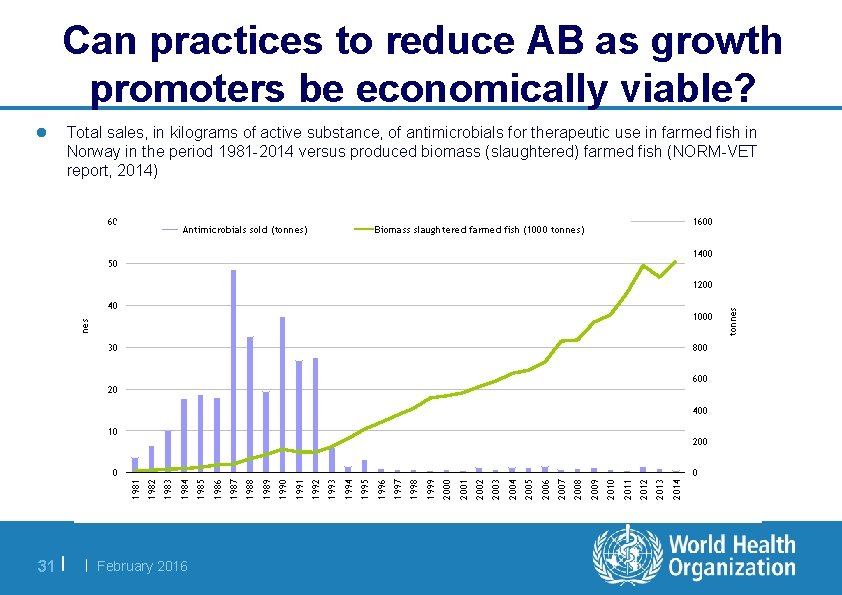
Can practices to reduce AB as growth promoters be economically viable? l Total sales, in kilograms of active substance, of antimicrobials for therapeutic use in farmed fish in Norway in the period 1981 -2014 versus produced biomass (slaughtered) farmed fish (NORM-VET report, 2014) 60 Antimicrobials sold (tonnes) 1600 Biomass slaughtered farmed fish (1000 tonnes) 1400 50 Tonnes 40 1000 30 800 600 20 400 10 200 31 | | February 2016 2014 2013 2012 2011 2010 2009 2008 2007 2006 2005 2004 2003 2002 2001 2000 1999 1998 1997 1996 1995 1994 1993 1992 1991 1990 1989 1988 1987 1986 1985 1984 1983 1982 0 1981 0 1000 tonnes 1200
Concluding Points l AMR now an urgent, global, societal threat requiring strategies & solution commensurate with scope l Each major aspect is solvable l Did we start on time? No l Are we responding too late? Not if action is taken 32 | | February 2016

Thank you
- Slides: 33