
Antimetabolites Dr Hafiz Muhammad Irfan Folate antagonists Folate

Antimetabolites Dr. Hafiz Muhammad Irfan
Folate antagonists Folate anatgonist Methotrexate Pralatrexate Pemetrexed Purine antagonists 6 -Mercaptopurine (6 -MP) 6 -Thioguanine Pyrimidine antagonists 5 -Fluorouracil (5 -FU)
Folate antagonist Folic acid and many of its analogs are polar, they cross the blood-brain barrier poorly. So they require specific transport mechanisms to enter mammalian cells. There are three inward folate transport systems: 1) a folate receptor, which has high affinity for folic acid but much reduced ability to transport methotrexate and other analogs; . 2) the reduced folate transporter, the major transit protein for methotrexate. 3) a transporter that is active at low p. H. The reduced folate transporter is highly expressed in the hyperdiploid subtype of acute lymphoblastic leukemia, due to the presence of multiple copies of chromosome 21, on which its gene resides; these cells have extreme sensitivity to methotrexate
Methotrexate Folic acid is an essential dietary factor that is converted by enzymatic reduction to a series of tetrahydrofolate (FH 4) cofactors that provide methyl groups for the synthesis of precursors of DNA (thymidylate and purines) and RNA (purines). Interference with FH 4 metabolism reduces the synthesis of purine ribonucleotides and thymidine monophosphate (TMP), thereby inhibiting DNA replication. Methotrexate is a folic acid antagonist that binds to the active catalytic site of dihydrofolate reductase (DHFR). Inhibition of DHFR leads to partial depletion of the FH 4 cofactors (5 -10 methylene tetrahydro-folic acid and N-10 formyl tetrahydrofolic acid) required for the respective synthesis of thymidylate and purines. Thus interfering with the formation of DNA, RNA and protein.
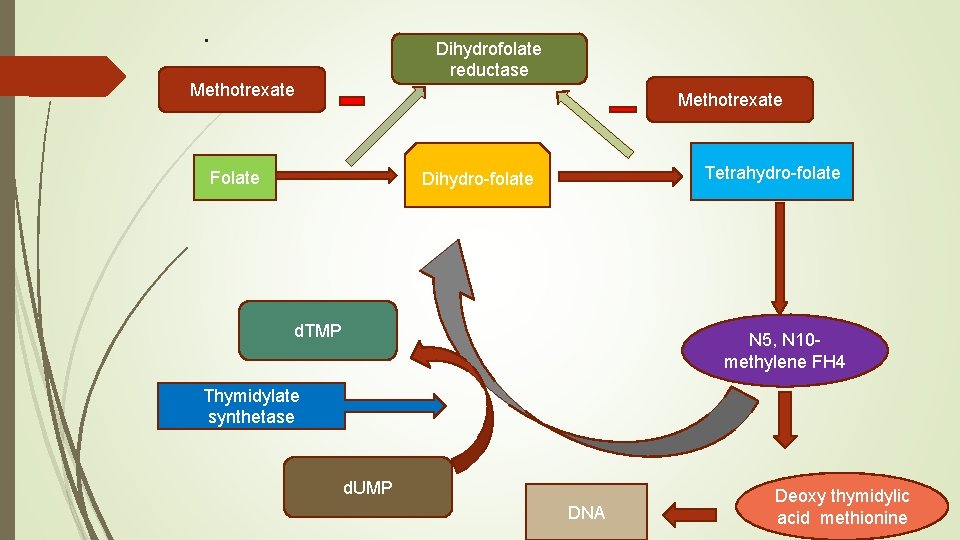
. Dihydrofolate reductase Methotrexate Folate Tetrahydro-folate Dihydro-folate d. TMP N 5, N 10 methylene FH 4 Thymidylate synthetase d. UMP DNA Deoxy thymidylic acid methionine
Methotrexate Recognition that methotrexate, an inhibitor of dihydrofolate reductase (DHFR), also directly inhibits the folate-dependent enzymes of de novo purine and thymidylate synthesis led to development of antifolate analogs that specifically target these other folate dependent enzymes. Methotrexate is only partially selective for tumor cells and kills rapidly dividing normal cells, such as those of the intestinal epithelium and bone marrow. Folate antagonists kill cells during the S phase of the cell cycle and are most effective when cells are proliferating rapidly
Mechanism of resistance Impaired transport of methotrexate into cells Production of altered forms of DHFR that have decreased affinity for the inhibitor Increased concentrations of intracellular DHFR through gene amplification or altered gene regulation Decreased ability to synthesize methotrexate polyglutamates
Therapeutics uses Methotrexate is a critical drug in the management of acute lymphoblastic leukemia (ALL) in children. The intrathecal administration of methotrexate has been employed for treatment or prophylaxis of meningeal leukemia or lymphoma and for treatment of meningeal carcinomatosis. Methotrexate is of established value in choriocarcinoma and related trophoblastic tumors of women; cure is achieved in ~75% of advanced cases treated sequentially with methotrexate and dactinomycin and in >90% when early diagnosis is made. Methotrexate is a component of regimens for carcinomas of the breast, head and neck, ovary, and bladder.
Folate antagonist Bone marrow suppression, haemorrhage, alopecia, dermatitis, allergic reactions, nephrotoxicity, neurotoxicity. The toxic effects of methotrexate may be terminated by administering leucovorin, a fully reduced folate coenzyme, which filled the intracellular pool of FH 4 cofactors. But it does not reverse neurotoxicity.
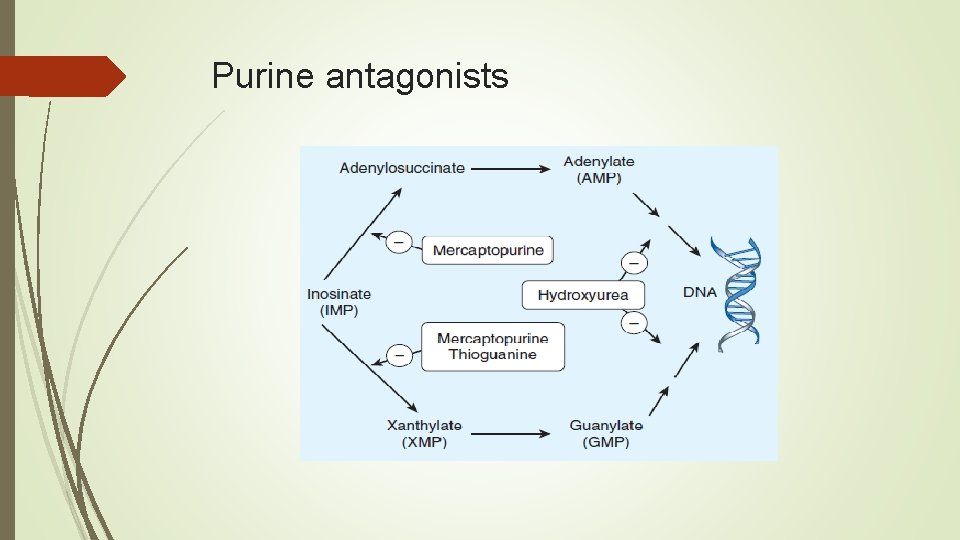
Purine antagonists 6 -mercaptopurine 6 -Thioguanine 6 -MP is metabolized into monophosphate nucleotide 6 -thioinosinic acid in the presence of hypoxanthine-guanine phosphoribosyl transferase (HGPRT). Which by inhibiting different enzymes inhibit de novo purine nucleotide synthesis. Monophosphate form of 6 -MP may be converted into triphosphate form which may also incorporate into DNA and RNA. Significant active metabolites of 6 -MP are thioguanylic acid and 6 methylmercaptopurine ribonucleotide. 6 -thiouric acid is inactive metabolite formed by xanthine oxidase.
Purine antagonists
Purine antagonists The thiopurines are also metabolized by the enzyme thiopurine methyltransferase (TPMT), in which a methyl group is attached to the thiopurine ring. Patients who have a pharmaco-genetic syndrome involving partial or complete deficiency of this enzyme are at increased risk for developing severe toxicities in the form of myelosuppression and gastrointestinal toxicity with mucositis and diarrhea. 6 -Mercaptopurine (6 -MP) was the first of the thiopurine analogs found to be effective in cancer therapy. This agent is used primarily in the treatment of childhood acute leukemia.
Pyrimidine antagonists 5 -Fluorouracil undergoes biotransformation to form 5 -fluorodeoxyuridine monophosphate. This active form acts as pseudo-substrate for the enzyme thymidylate synthetase which convert deoxyuridine monophosphate (d. UMP)to deoxythymidylate monophosphate (DTMP). Inhibition of thymidylate synthetase enzyme by 5 -FU active form inhibit the formation of d. TMP which is need for DNA synthesis and cell growth. 5 -FU also converted into 5 -fluorouridine triphosphate (5 -FUTP) which is incorporated into RNA and interferes with RNA processing and functions.
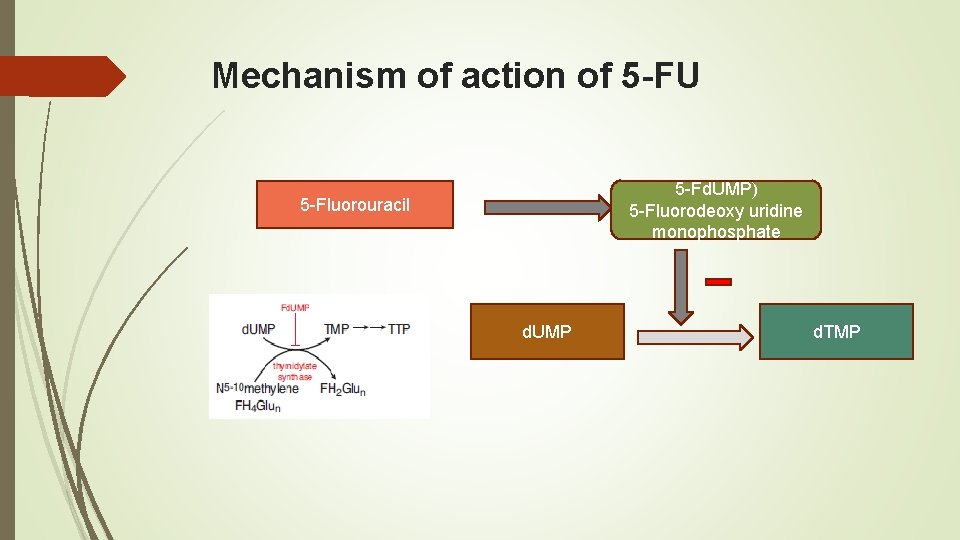
Mechanism of action of 5 -FU 5 -Fd. UMP) 5 -Fluorodeoxy uridine monophosphate 5 -Fluorouracil d. UMP d. TMP
Pyrimidine antagonists Therapeutic uses 5 -FU produces partial responses in 10 -20% of patients with metastatic colon carcinomas, upper GI tract carcinomas, and breast carcinomas but rarely is used as a single agent. 5 -FU in combination with leucovorin and oxaliplatin or irinotecan in the adjuvant setting is associated with a survival advantage for patients with colorectal cancers Toxicities Alopecia. Diarrhea, severe ulceration, anorexia and bone marrow suppression
- Slides: 15