
Antimatter in materials research defect spectroscopy and study
- Slides: 23
Antimatter in materials research: defect spectroscopy and study of porous systems using positrons Laszlo Liszkay DAPNIA/SACM/LEDA CEA DSM Dapnia
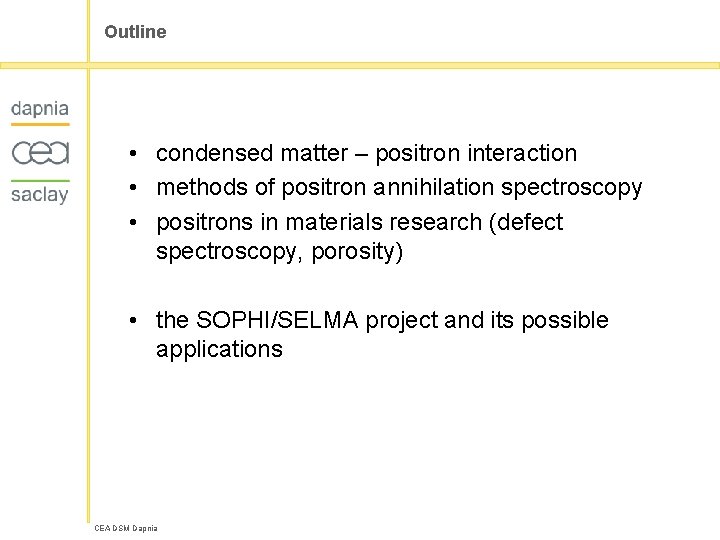
Outline • condensed matter – positron interaction • methods of positron annihilation spectroscopy • positrons in materials research (defect spectroscopy, porosity) • the SOPHI/SELMA project and its possible applications CEA DSM Dapnia
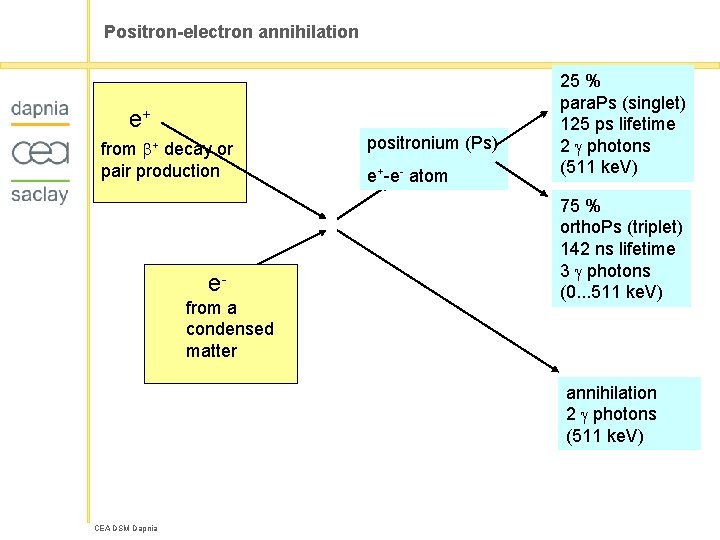
Positron-electron annihilation e+ from b+ decay or pair production efrom a condensed matter positronium (Ps) e+-e- atom 25 % para. Ps (singlet) 125 ps lifetime 2 photons (511 ke. V) 75 % ortho. Ps (triplet) 142 ns lifetime 3 photons (0. . . 511 ke. V) annihilation 2 photons (511 ke. V) CEA DSM Dapnia
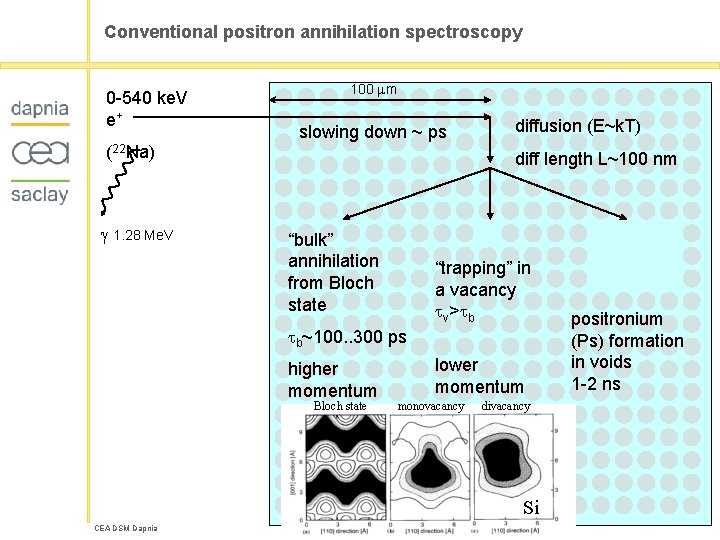
Conventional positron annihilation spectroscopy 0 -540 ke. V e+ (22 Na) 1. 28 Me. V 100 mm slowing down ~ ps diffusion (E~k. T) diff length L~100 nm “bulk” annihilation from Bloch state “trapping” in a vacancy tv>tb tb~100. . 300 ps higher momentum Bloch state lower momentum monovacancy divacancy Si CEA DSM Dapnia positronium (Ps) formation in voids 1 -2 ns
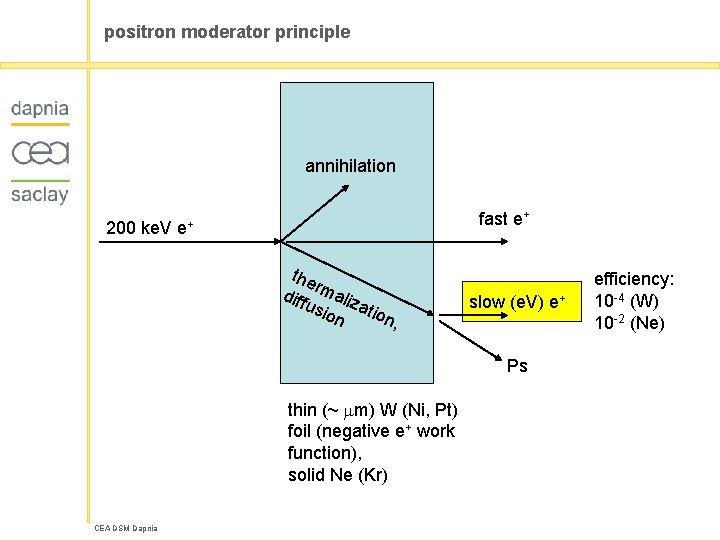
positron moderator principle annihilation 200 ke. V fast e+ e+ the r diff maliz usi on ation, slow (e. V) e+ Ps thin (~ mm) W (Ni, Pt) foil (negative e+ work function), solid Ne (Kr) CEA DSM Dapnia efficiency: 10 -4 (W) 10 -2 (Ne)
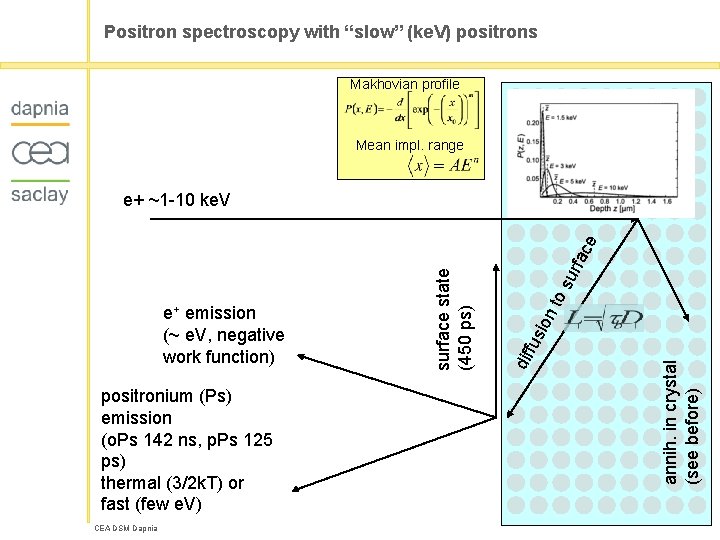
Positron spectroscopy with “slow” (ke. V) positrons Makhovian profile Mean impl. range CEA DSM Dapnia rfa su to ion fus annih. in crystal (see before) positronium (Ps) emission (o. Ps 142 ns, p. Ps 125 ps) thermal (3/2 k. T) or fast (few e. V) dif e+ emission (~ e. V, negative work function) surface state (450 ps) ce e+ ~1 -10 ke. V
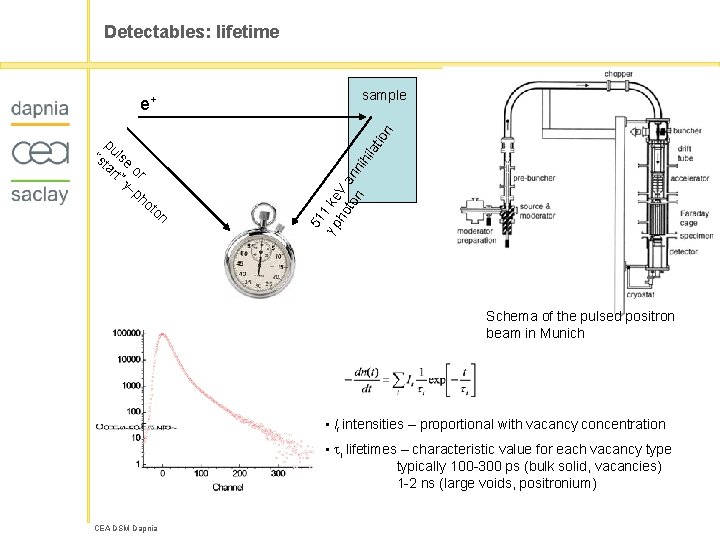
Detectables: lifetime sample n p 1 ke ho V to an n nih ila t to 51 p “s ulse ta rt” or ph o ion e+ Schema of the pulsed positron beam in Munich • Ii intensities – proportional with vacancy concentration • ti lifetimes – characteristic value for each vacancy type typically 100 -300 ps (bulk solid, vacancies) 1 -2 ns (large voids, positronium) CEA DSM Dapnia
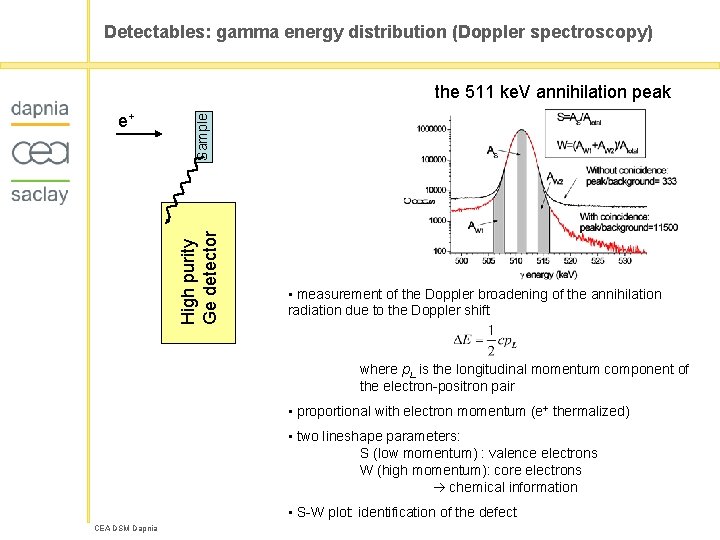
Detectables: gamma energy distribution (Doppler spectroscopy) High purity Ge detector e+ Sample the 511 ke. V annihilation peak • measurement of the Doppler broadening of the annihilation radiation due to the Doppler shift where p. L is the longitudinal momentum component of the electron-positron pair • proportional with electron momentum (e+ thermalized) • two lineshape parameters: S (low momentum) : valence electrons W (high momentum): core electrons chemical information • S-W plot: identification of the defect CEA DSM Dapnia
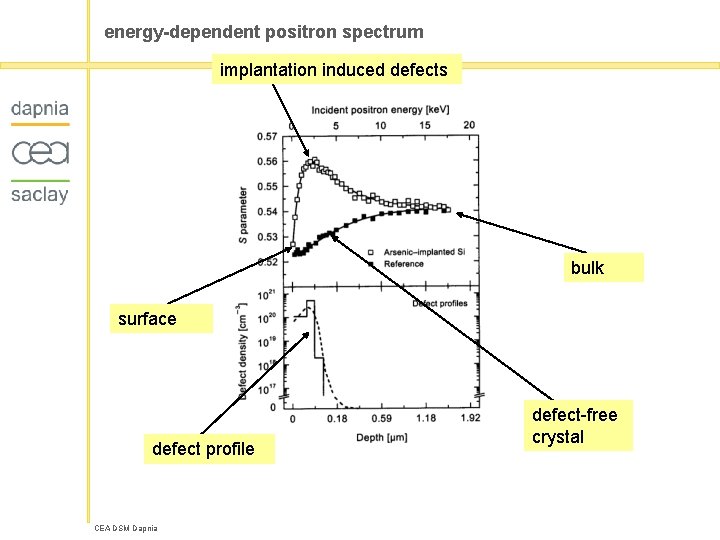
energy-dependent positron spectrum implantation induced defects bulk surface defect profile CEA DSM Dapnia defect-free crystal
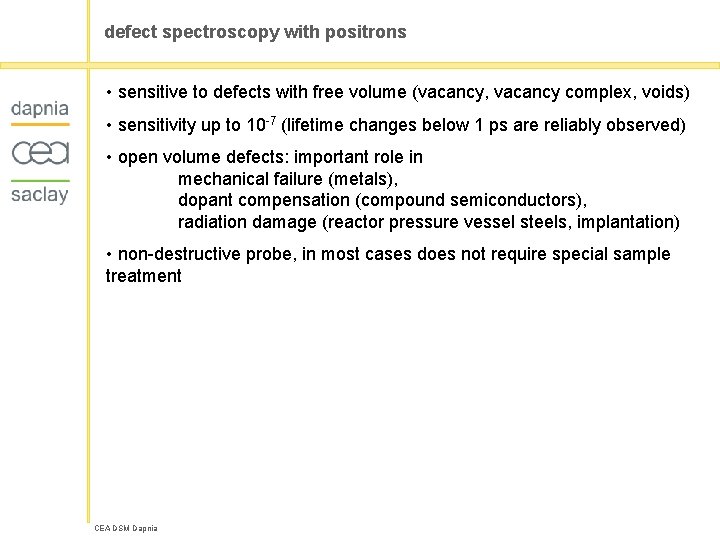
defect spectroscopy with positrons • sensitive to defects with free volume (vacancy, vacancy complex, voids) • sensitivity up to 10 -7 (lifetime changes below 1 ps are reliably observed) • open volume defects: important role in mechanical failure (metals), dopant compensation (compound semiconductors), radiation damage (reactor pressure vessel steels, implantation) • non-destructive probe, in most cases does not require special sample treatment CEA DSM Dapnia
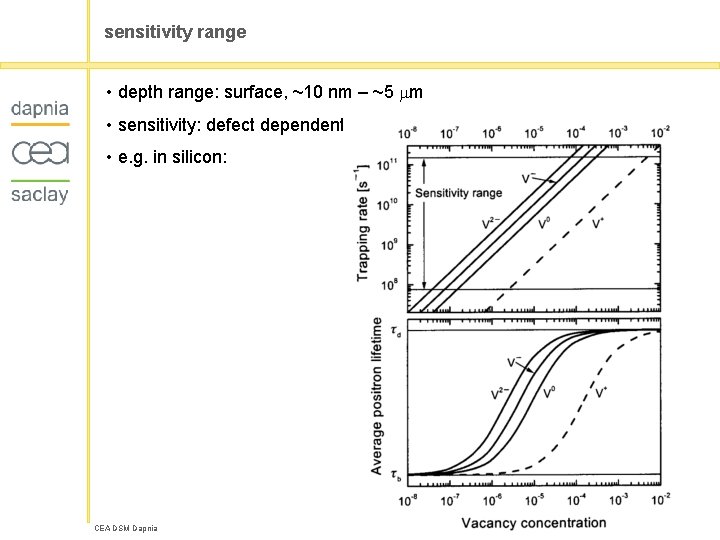
sensitivity range • depth range: surface, ~10 nm – ~5 mm • sensitivity: defect dependent • e. g. in silicon: CEA DSM Dapnia
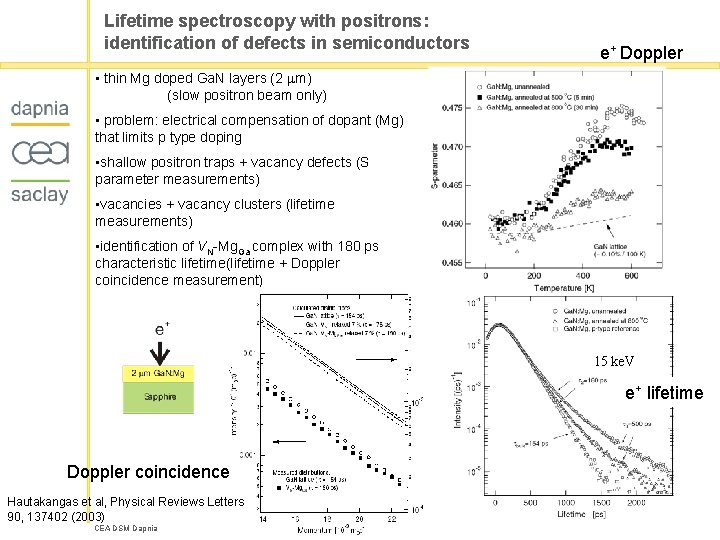
Lifetime spectroscopy with positrons: identification of defects in semiconductors e+ Doppler • thin Mg doped Ga. N layers (2 mm) (slow positron beam only) • problem: electrical compensation of dopant (Mg) that limits p type doping • shallow positron traps + vacancy defects (S parameter measurements) • vacancies + vacancy clusters (lifetime measurements) • identification of VN-Mg. Ga complex with 180 ps characteristic lifetime(lifetime + Doppler coincidence measurement) 15 ke. V e+ lifetime Doppler coincidence Hautakangas et al, Physical Reviews Letters 90, 137402 (2003) CEA DSM Dapnia
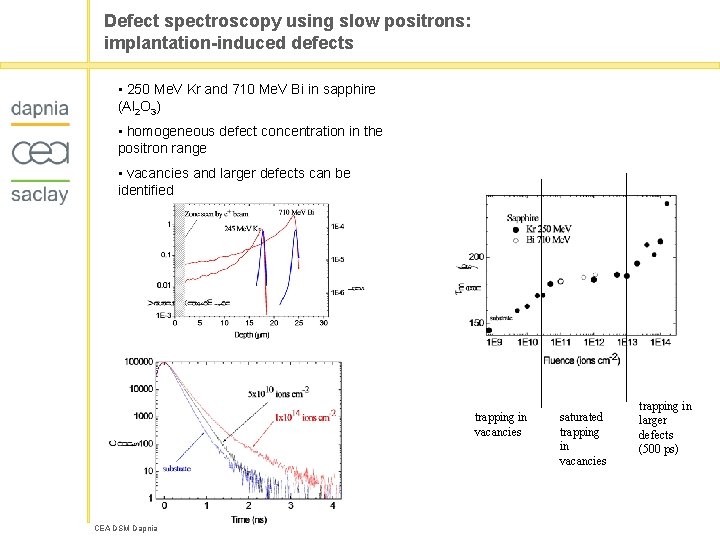
Defect spectroscopy using slow positrons: implantation-induced defects • 250 Me. V Kr and 710 Me. V Bi in sapphire (Al 2 O 3) • homogeneous defect concentration in the positron range • vacancies and larger defects can be identified trapping in vacancies CEA DSM Dapnia saturated trapping in vacancies trapping in larger defects (500 ps)
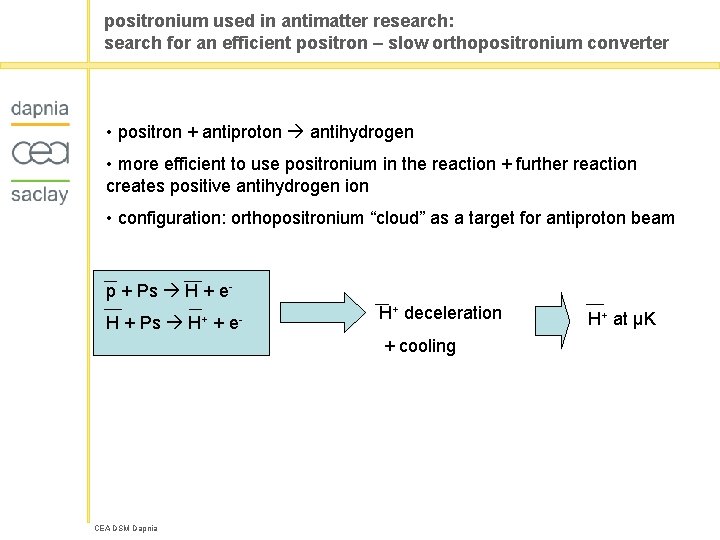
positronium used in antimatter research: search for an efficient positron – slow orthopositronium converter • positron + antiproton antihydrogen • more efficient to use positronium in the reaction + further reaction creates positive antihydrogen ion • configuration: orthopositronium “cloud” as a target for antiproton beam p + Ps H + e. H + Ps H+ + e- H+ deceleration + cooling CEA DSM Dapnia H+ at μK
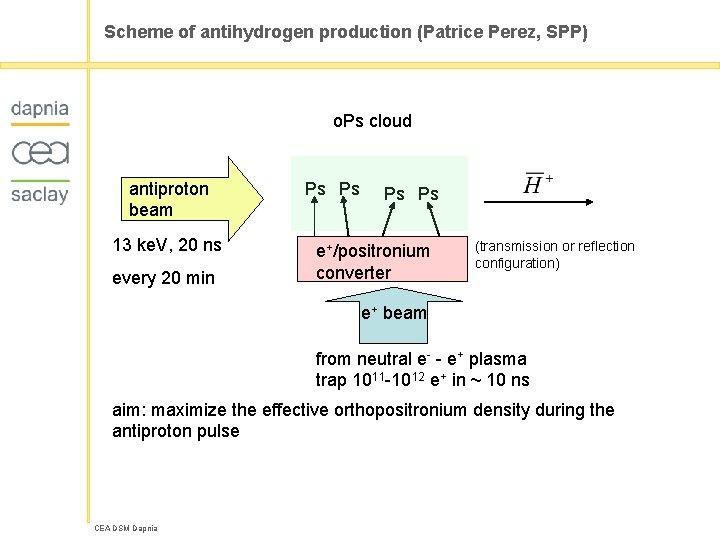
Scheme of antihydrogen production (Patrice Perez, SPP) o. Ps cloud antiproton beam 13 ke. V, 20 ns every 20 min Ps Ps e+/positronium converter (transmission or reflection configuration) e+ beam from neutral e- - e+ plasma trap 1011 -1012 e+ in ~ 10 ns aim: maximize the effective orthopositronium density during the antiproton pulse CEA DSM Dapnia
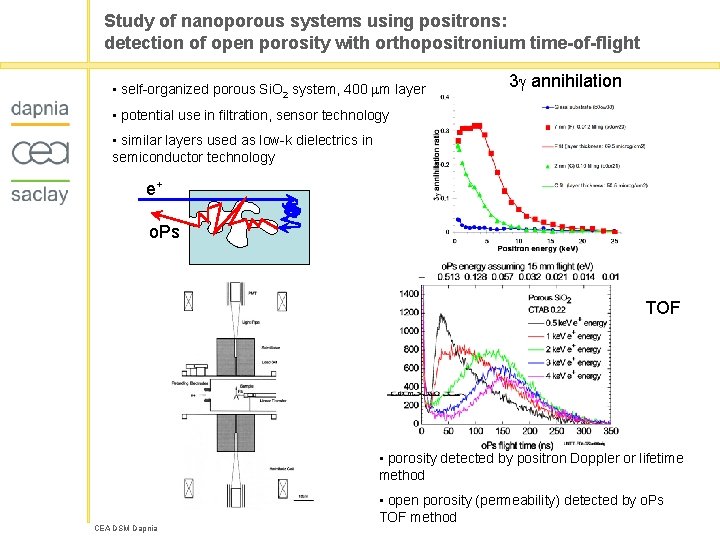
Study of nanoporous systems using positrons: detection of open porosity with orthopositronium time-of-flight • self-organized porous Si. O 2 system, 400 mm layer 3 annihilation • potential use in filtration, sensor technology • similar layers used as low-k dielectrics in semiconductor technology e+ o. Ps TOF • porosity detected by positron Doppler or lifetime method CEA DSM Dapnia • open porosity (permeability) detected by o. Ps TOF method
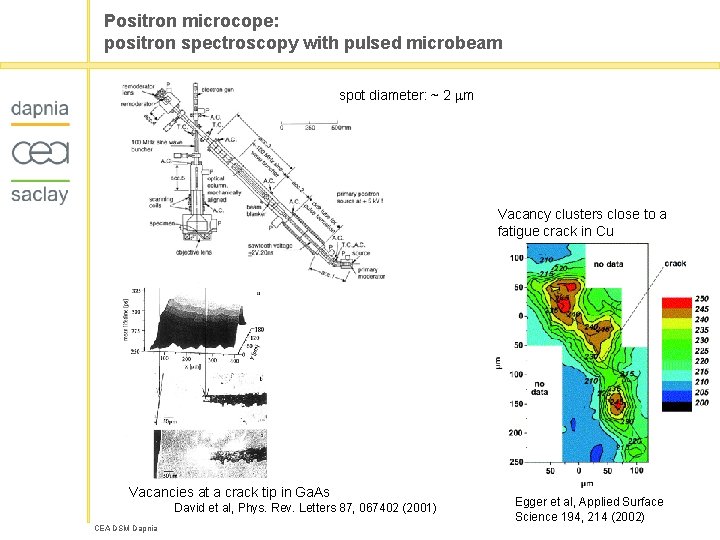
Positron microcope: positron spectroscopy with pulsed microbeam spot diameter: ~ 2 mm Vacancy clusters close to a fatigue crack in Cu Vacancies at a crack tip in Ga. As David et al, Phys. Rev. Letters 87, 067402 (2001) CEA DSM Dapnia Egger et al, Applied Surface Science 194, 214 (2002)
III. Potential use of the SELMA/SOPHI system in materials research • potential development of the SELMA/SOPHI system • why do we need intense positron sources for positron spectroscopy? • the positron source in international comparison CEA DSM Dapnia
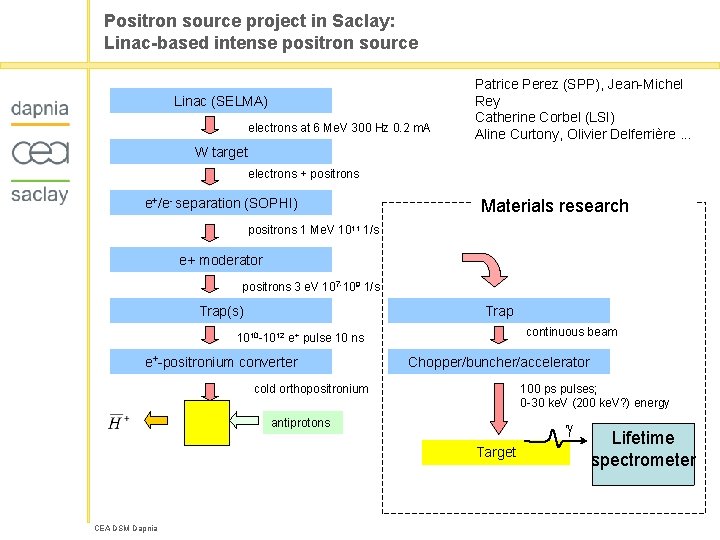
Positron source project in Saclay: Linac-based intense positron source Linac (SELMA) electrons at 6 Me. V 300 Hz 0. 2 m. A Patrice Perez (SPP), Jean-Michel Rey Catherine Corbel (LSI) Aline Curtony, Olivier Delferrière. . . W target electrons + positrons e+/e- separation (SOPHI) Materials research positrons 1 Me. V 1011 1/s e+ moderator positrons 3 e. V 107 -109 1/s Trap(s) Trap continuous beam 1010 -1012 e+ pulse 10 ns e+-positronium converter Chopper/buncher/accelerator cold orthopositronium 100 ps pulses; 0 -30 ke. V (200 ke. V? ) energy antiprotons Target CEA DSM Dapnia Lifetime spectrometer
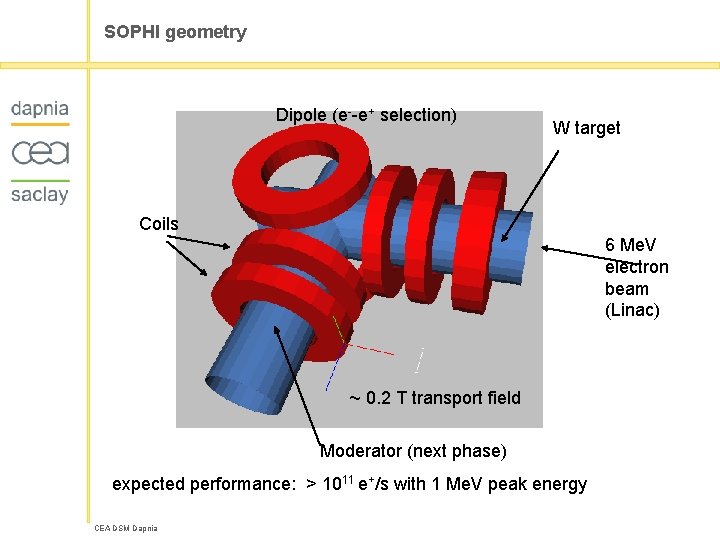
SOPHI geometry Dipole (e--e+ selection) W target Coils 6 Me. V electron beam (Linac) ~ 0. 2 T transport field Moderator (next phase) expected performance: > 1011 e+/s with 1 Me. V peak energy CEA DSM Dapnia
Why do we need intense positron sources? • conventional 22 Na-based sources with up to 100 m. Ci (4 x 10⁹ Bq) activity 106 -107 cps slow positron yield ~ 1 -2 energy-dependent positron measurement in a day temperature-dependent, electric field-dependent measurement, annealing is very time consuming • positron microscopy: losses during focussing even longer measuring time / pixel imaging with positrons is hardly feasible • measurements requiring longer specimen-detector distance (e. g. at very high temperature or angular correlation) are very time consuming • effects on shorter (s, min) timescale are not detectable with long measurements • experiments with Bose-Einstein condensed positronium requires high positronium density • antihydrogen production CEA DSM Dapnia
Performance of SOPHI/SELMA: comparison with other intense source projects • conventional 22 Na source: max. 4 x 10⁹ fast, ~106 -107 moderated e+ Intense positron source projects in Europe: • NEPOMUC (Garching near Munich, Germany) based on a 20 MW research reactor (FRM II, 8 x 1014 cm-2 s-1 thermal neutron flux) 8 5 x 10 moderated e+/s (functional) • EPOS (Rossendorf, near Dresden, Germany) based on a 40 Me. V (0. 4 m. A avg. max. current) Linac 8 x 10⁸ moderated e+/s expected (1/4 max Linac current) (not yet functional) • POSH (Delft, The Netherlands) based on a research reactor about 7 x 10⁷ moderated e+/s (2001), max. 4 x 10⁸ e+/s (with fresh moderator) SELMA/SOPHI project in Saclay 1011 fast (unmoderated) e+ /s ( ~ 20 strong 22 Na source) 107 -109 moderated e+/s can be expected advantages: • no permanent radioactivity, source can be switched off, easy to maintain (no neutron production) • dedicated Linac, no maintenance needed, no shared resource available nearly 100% of the time CEA DSM Dapnia
Summary SOPHI/SELMA project: possibility of a stable, reliable, independent positron source for materials research with competitive slow positron yield CEA DSM Dapnia