
Antigone ORAnd you thought your family had problems
Antigone -ORAnd you thought your family had problems…
Greek Drama/Tragedy Terms § Drama – written to be acted out for an audience § Chorus – made up of elders whose age and opinions would be respected § Choragus – leader of chorus; gave opinions on the story § Ode – follows each scene; separates scenes (there was no curtain); provides a place for the chorus to respond to the previous scene
§ Parados – first song chanted by chorus § Strophe/antistrophe – part of the ode that the chorus chants as they move across the stage § Tragedy – a work that involves serious and important events; main character comes to an unhappy end
The Tragic Hero § According to Aristotle’s Poetics, a tragic hero is, “"a [great] man who is neither a paragon of virtue and justice nor undergoes the change to misfortune through any real badness or wickedness but because of some mistake. "
The Tragic Hero- here are the characteristics 1. Noble or high-ranking 2. Hamartia- aka the tragic flaw (can be part of the character’s personality, an error in judgment, or a physical flaw) 3. Oftentimes the tragic flaw involves hubris: arrogant pride or over-confidence 4. Fall from power- this is usually the character’s own fault (due to hamartia)
The Tragic Hero- here are the characteristics 5. The punishment for the character’s crime is usually worse than the actual crime 6. The fall is not pure loss. The hero learns something…
Tragedy- why? § Tragedies are meant to make you depressed- let’s just face it. Aristotle argues that one function of tragedy is to arouse the "unhealthy" emotions of pity and fear and through a catharsis cleanses us of those emotions. § Catharsis - the purging of the emotions or relieving of emotional tensions, especially through certain kinds of art such as tragedy or music (dictionary. com)
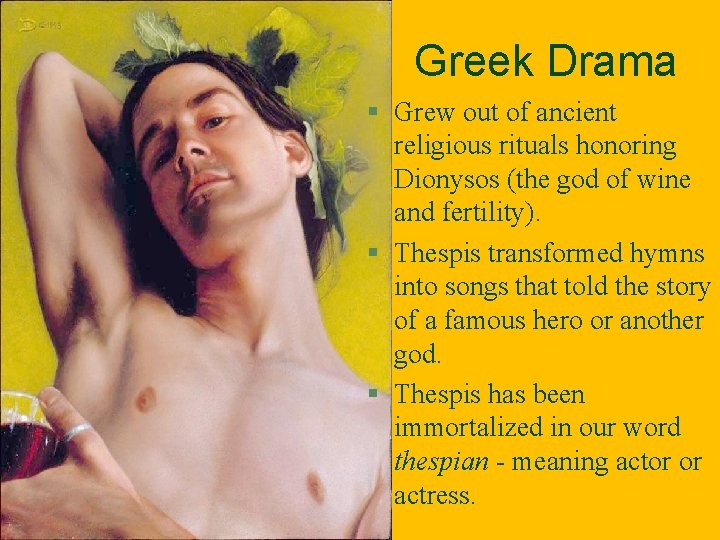
Greek Drama § Grew out of ancient religious rituals honoring Dionysos (the god of wine and fertility). § Thespis transformed hymns into songs that told the story of a famous hero or another god. § Thespis has been immortalized in our word thespian - meaning actor or actress.
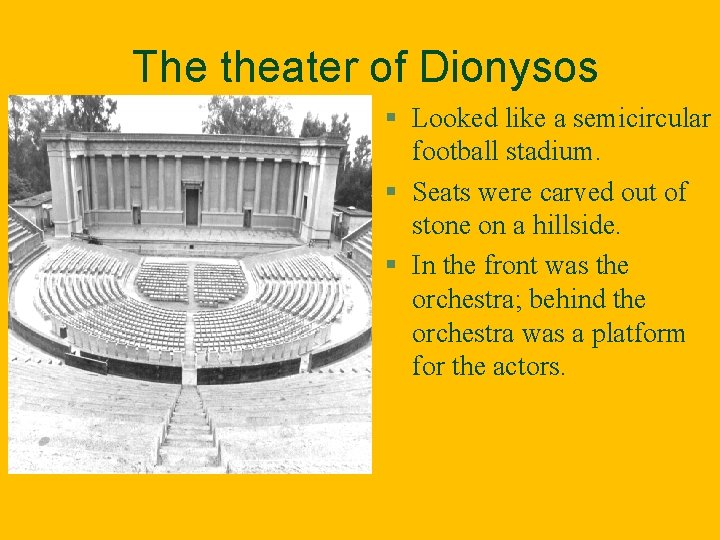
The theater of Dionysos § Looked like a semicircular football stadium. § Seats were carved out of stone on a hillside. § In the front was the orchestra; behind the orchestra was a platform for the actors.
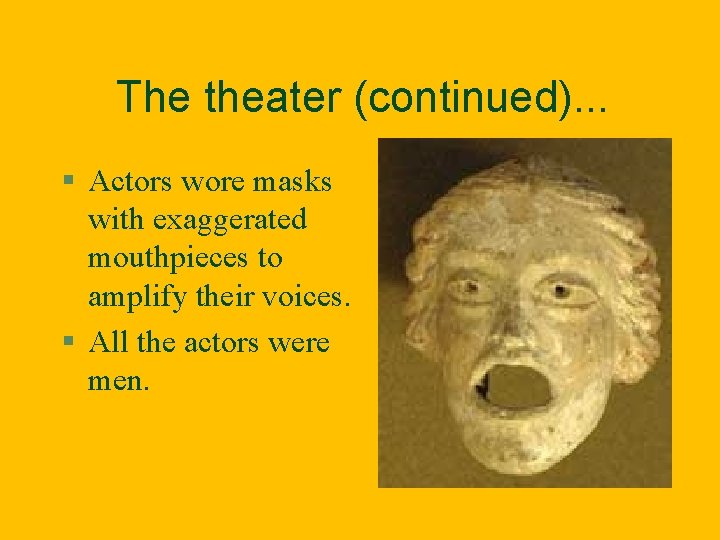
The theater (continued). . . § Actors wore masks with exaggerated mouthpieces to amplify their voices. § All the actors were men.
The story of Oedipus § King Laios and Queen Jocasta learn from an oracle that their son will kill his father and marry his mother. § They give their baby to a shepherd with orders to leave him on a lonely mountainside to die. § The shepherd takes pity on the infant and gives him to a Corinthian shepherd. § Who in turn gives the infant to the childless king and queen of Corinth.
Oedipus’s story (continued). . . § The infant is named Oedipus, which means “swollen foot” or “club foot”. § When Oedipus is a young man, he learns of the oracle’s prophecy and leaves Corinth, believing the king and queen are his birth parents. § On his journey he runs into an old man who tries to run Oedipus off the road - they fight, and Oedipus kills him. § Before reaching Thebes, Oedipus encounters the Sphinx - a monster with the wings of an eagle, body of a lion and the breasts and face of a woman.
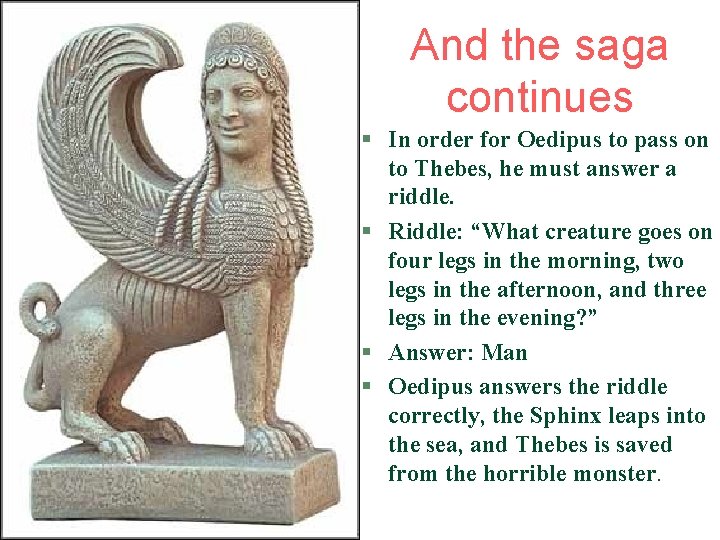
And the saga continues § In order for Oedipus to pass on to Thebes, he must answer a riddle. § Riddle: “What creature goes on four legs in the morning, two legs in the afternoon, and three legs in the evening? ” § Answer: Man § Oedipus answers the riddle correctly, the Sphinx leaps into the sea, and Thebes is saved from the horrible monster.

Hero’s Welcome § People of Thebes welcome Oedipus as their savior. § Since the king had recently been killed, they offer the throne and the widowed queen as a reward.
Oedipus & Iocaste § Oedipus and Jocasta marry and have four children: 2 sons Polynieces and Eteocles; and 2 daughters Antigone and Ismene.
A Dark Cloud Looms. . . § All went well for Oedipus and Jocasta until a plague struck Thebes - desperate to learn the cause, Oedipus sends Iocaste’s brother, Creon, to the oracle at Delphi.
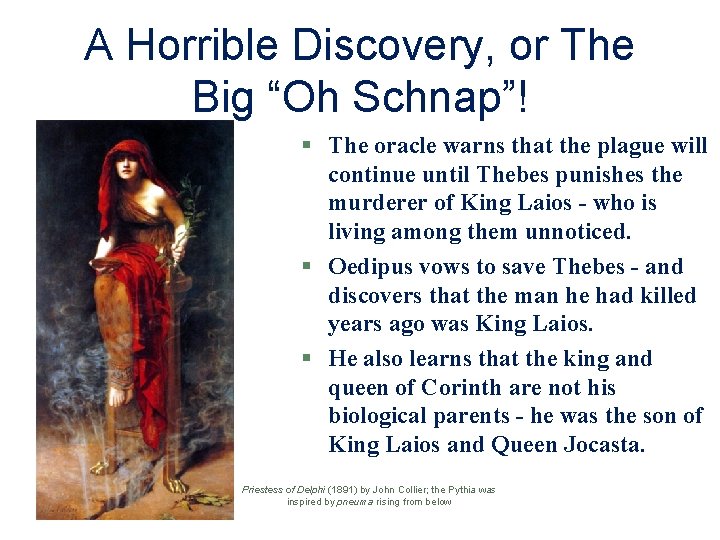
A Horrible Discovery, or The Big “Oh Schnap”! § The oracle warns that the plague will continue until Thebes punishes the murderer of King Laios - who is living among them unnoticed. § Oedipus vows to save Thebes - and discovers that the man he had killed years ago was King Laios. § He also learns that the king and queen of Corinth are not his biological parents - he was the son of King Laios and Queen Jocasta. Priestess of Delphi (1891) by John Collier; the Pythia was inspired by pneuma rising from below
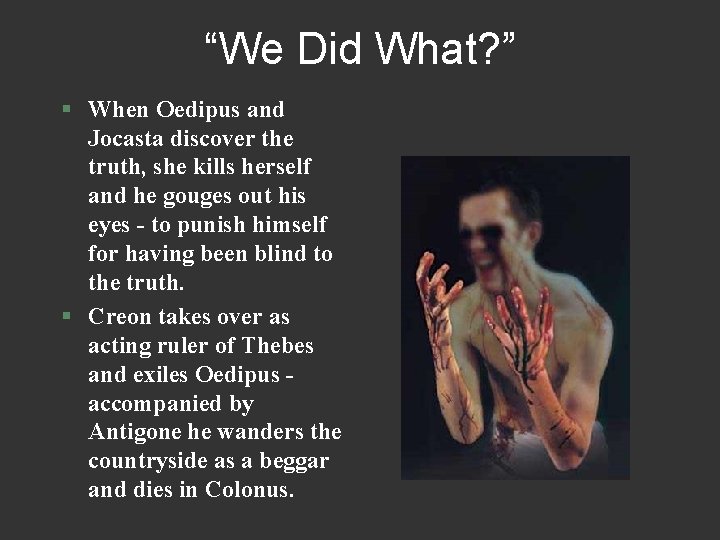
“We Did What? ” § When Oedipus and Jocasta discover the truth, she kills herself and he gouges out his eyes - to punish himself for having been blind to the truth. § Creon takes over as acting ruler of Thebes and exiles Oedipus accompanied by Antigone he wanders the countryside as a beggar and dies in Colonus.
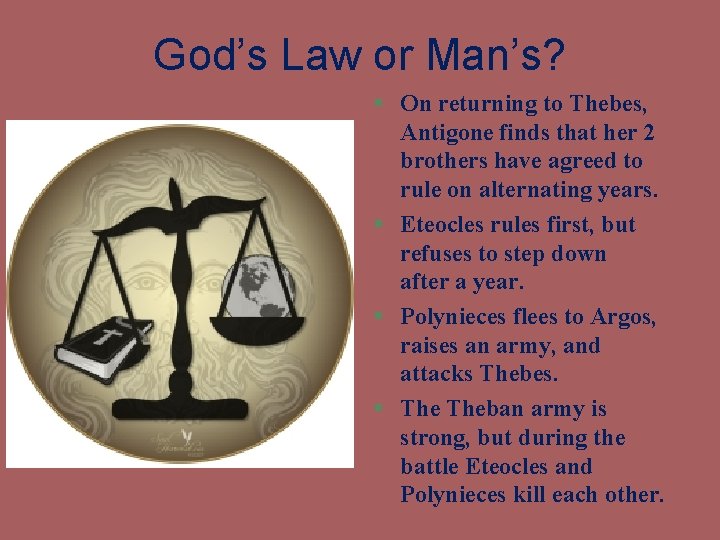
God’s Law or Man’s? § On returning to Thebes, Antigone finds that her 2 brothers have agreed to rule on alternating years. § Eteocles rules first, but refuses to step down after a year. § Polynieces flees to Argos, raises an army, and attacks Thebes. § Theban army is strong, but during the battle Eteocles and Polynieces kill each other.
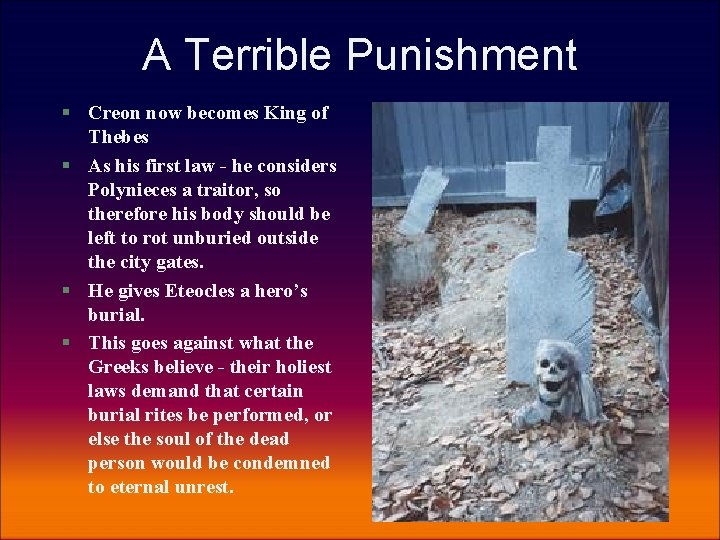
A Terrible Punishment § Creon now becomes King of Thebes § As his first law - he considers Polynieces a traitor, so therefore his body should be left to rot unburied outside the city gates. § He gives Eteocles a hero’s burial. § This goes against what the Greeks believe - their holiest laws demand that certain burial rites be performed, or else the soul of the dead person would be condemned to eternal unrest.
Which Side Will You Take? § Is it right to follow man’s law even when you know it’s morally wrong? § Would you have the courage to disobey man’s law - even if the consequence was death? § Who is right and who is wrong? You decide. . .
- Slides: 21