
AntigenAntibody reactions Lets start The immune system The
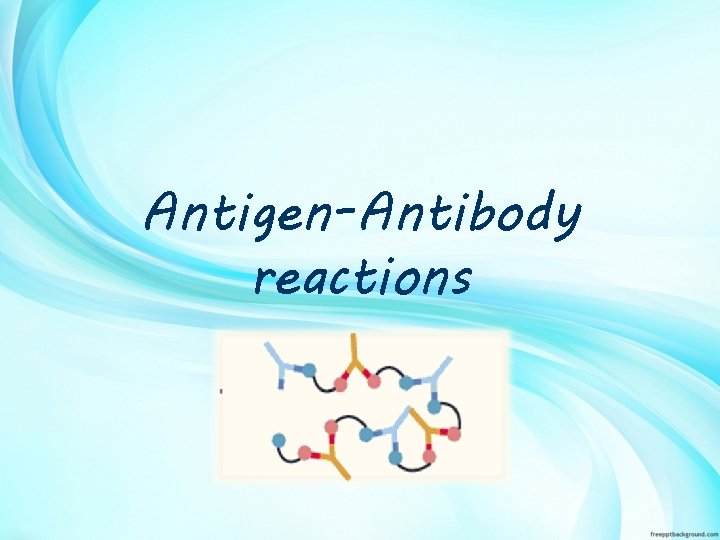
Antigen-Antibody reactions

Let’s start The immune system • The immune system is a system of biological structures and processes within an organism that protects against disease. • To function properly, an immune system must detect a wide variety of agents, from viruses to parasitic worms, and distinguish them from the organism’s own healthy tissue.
Antigens o Antigens are any substances that are capable, under appropriate conditions, of inducing the formation of antibodies and reacting specifically with the antibodies so produced. o These antigenic molecules may have several antigenic determinants, called epitopes, and each epitope can bind with a specific antibody. Thus, a single antigen can bind to many different antibodies with different binding sites
o Types of antigens: RBCs WBCs Bacteria Latex particles And any other foreign bodies.
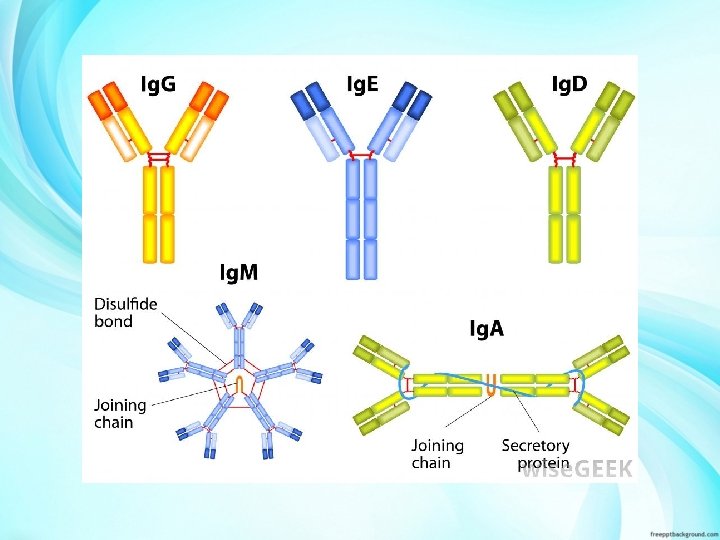
Antibodies • An antibody is a protein produced by the body’s immune cells “ activated B-lymphocytes” when it detects a foreign antigen. • Classes of antibodies: Ig. G : The main antibody in blood(70%), made in 2 ry immune response and has a long half life”up to 20 years”. Ig. M : accounts for(10%) of Igs, has a key role in 1 ry immune response. Ig. A : (20%) of Igs present in serum and secretions. Ig. E : (0. 001%), involved in allergy and parasitic infections. Ig. D : (1%) present on the surface of B cells, so that it plays a role in induction of Ab production
Nature of antigen antibody reactions Lock and Key Concept - The combining site of an antibody is located in the Fab portion binds with antigen’s epitope by Non-covalent and Reversible Bonds. Types Ag/Ab reactions: 1. Agglutination Ø Direct agglutination Ø Indirect agglutination 2. Precipitation
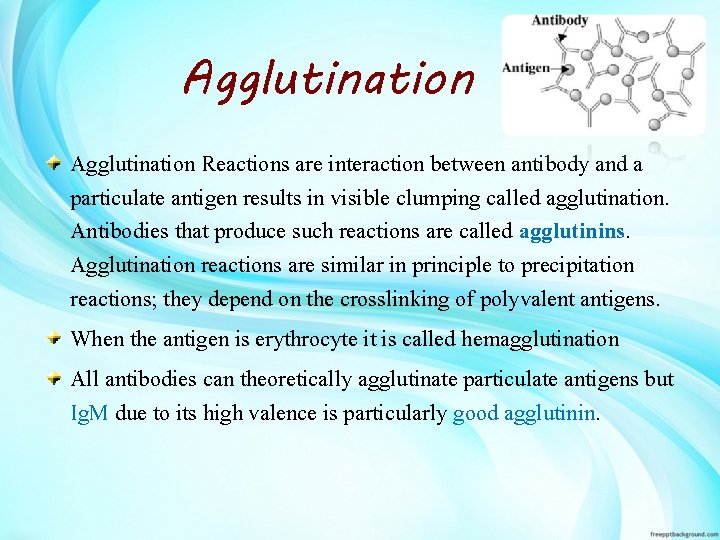
Agglutination Reactions are interaction between antibody and a particulate antigen results in visible clumping called agglutination. Antibodies that produce such reactions are called agglutinins. Agglutination reactions are similar in principle to precipitation reactions; they depend on the crosslinking of polyvalent antigens. When the antigen is erythrocyte it is called hemagglutination All antibodies can theoretically agglutinate particulate antigens but Ig. M due to its high valence is particularly good agglutinin.
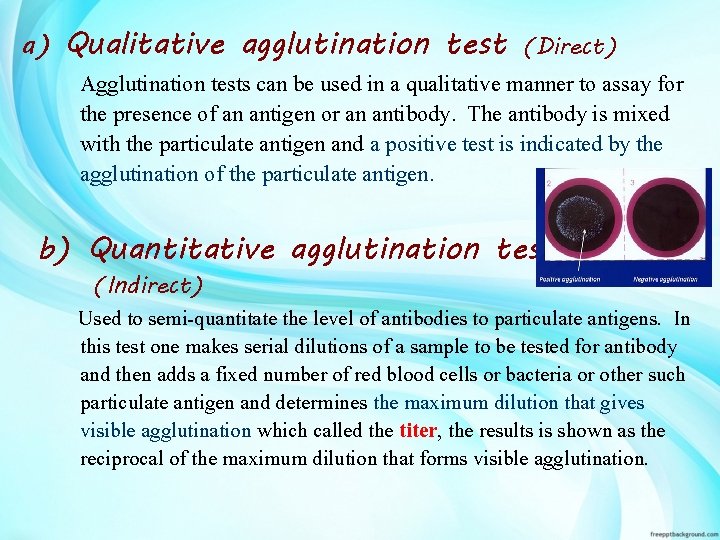
a) Qualitative agglutination test (Direct) Agglutination tests can be used in a qualitative manner to assay for the presence of an antigen or an antibody. The antibody is mixed with the particulate antigen and a positive test is indicated by the agglutination of the particulate antigen. b) Quantitative agglutination test : (Indirect) Used to semi-quantitate the level of antibodies to particulate antigens. In this test one makes serial dilutions of a sample to be tested for antibody and then adds a fixed number of red blood cells or bacteria or other such particulate antigen and determines the maximum dilution that gives visible agglutination which called the titer, the results is shown as the reciprocal of the maximum dilution that forms visible agglutination.
Advantages of agglutination tests: 1. 2. 3. 4. Low indvidual test cost. Ability to obtain semi-quantitative results. Short time to obtain result. Don’t need expensive instrument. Disadvantages of agglutination tests: May give false positive or negative results 1. False +ve due to: Technical errors as using plasma instead of serum, hemolysed or lipemic sample or dirty working slide. Cross reaction 1. False –ve due to: - not giving enough time for agglutination, antibodies not yet formed in the body or - prozone phenomena.
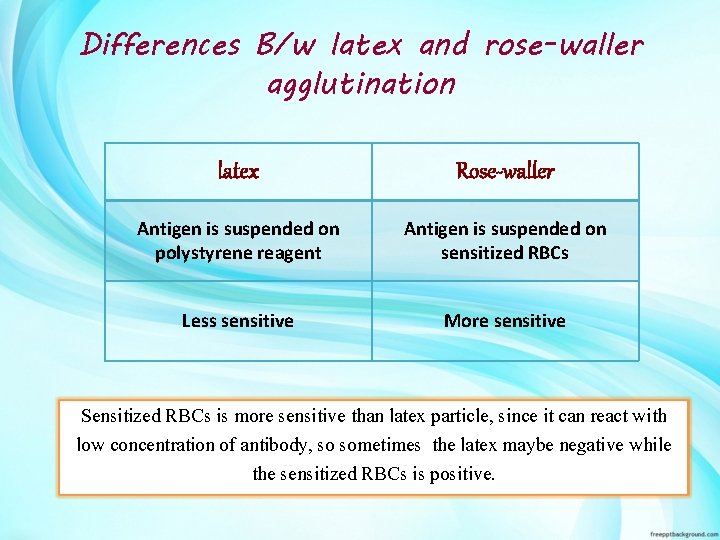
Differences B/w latex and rose-waller agglutination latex Rose-waller Antigen is suspended on polystyrene reagent Antigen is suspended on sensitized RBCs Less sensitive More sensitive Sensitized RBCs is more sensitive than latex particle, since it can react with low concentration of antibody, so sometimes the latex maybe negative while the sensitized RBCs is positive.
Applications of agglutination tests 1. Determination of blood types or antibodies to blood group antigens. 2. To assess bacterial infections e. g: OX-19, widal test and brucella. . , etc 3. For some autoimmune diseases e. g: RF.
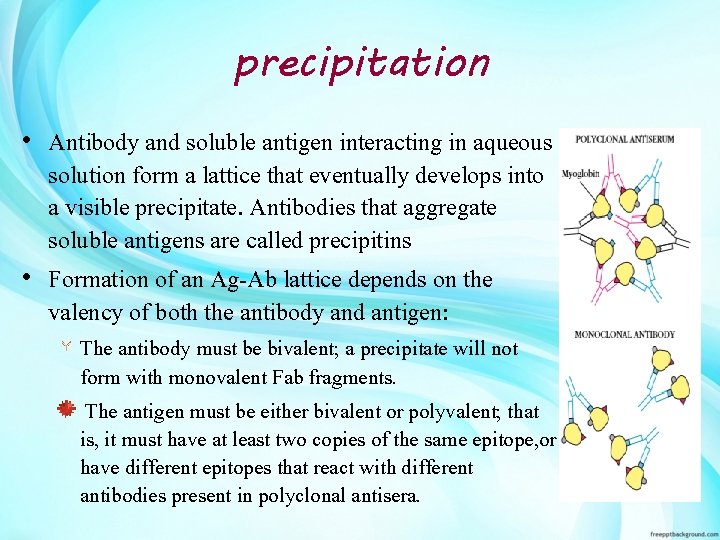
precipitation • Antibody and soluble antigen interacting in aqueous solution form a lattice that eventually develops into a visible precipitate. Antibodies that aggregate soluble antigens are called precipitins • Formation of an Ag-Ab lattice depends on the valency of both the antibody and antigen: The antibody must be bivalent; a precipitate will not form with monovalent Fab fragments. The antigen must be either bivalent or polyvalent; that is, it must have at least two copies of the same epitope, or have different epitopes that react with different antibodies present in polyclonal antisera.
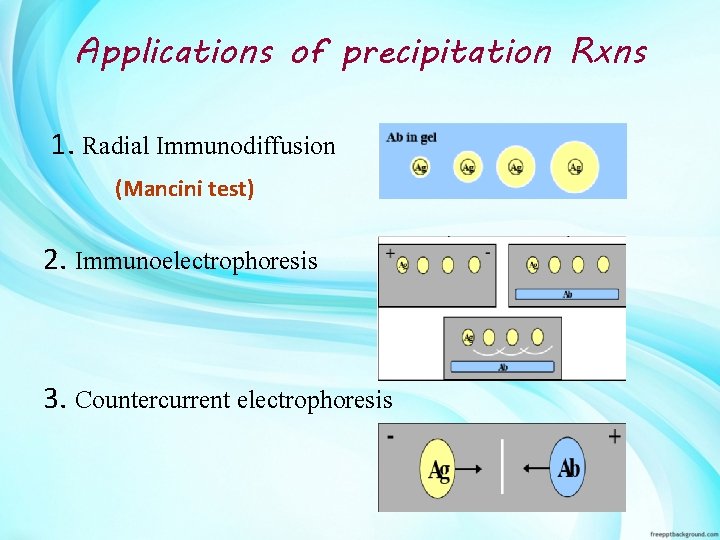
Applications of precipitation Rxns 1. Radial Immunodiffusion (Mancini test) 2. Immunoelectrophoresis 3. Countercurrent electrophoresis
Factors affecting Ag/Ab rxns 1. 2. 3. 4. 5. Buffer Concentration of antigen Concentration of antibody Temperature Electolytes
Prozone phenomena • Prozone effect - On occasion one observes that when the concentration of antibody is high (i. e. lower dilutions) there is no agglutination and then as the sample is diluted agglutination occur. • The lack of agglutination at high concentrations of antibodies is called the prozone effect. That occur due to antibody excess resulting in very small complexes which do not clump to form visible agglutination. • An excess of antibody inhibits precipitation and agglutination reactions.

“Prozone effect”
Dilutions ◌ Dilution is decreasing the concentration of a solution by a calculated factor using an approved diluent. As well, dilution is used to prepare samples, buffers, and controls. ◌ In serology tests it is Used to detect the titer of a specific Ab. ◌ When a strong positive reaction is encountered, dilution should be made to detect the titer. Volumes used in dilutions mustn't be below 10 ul or more than 1000 ul.
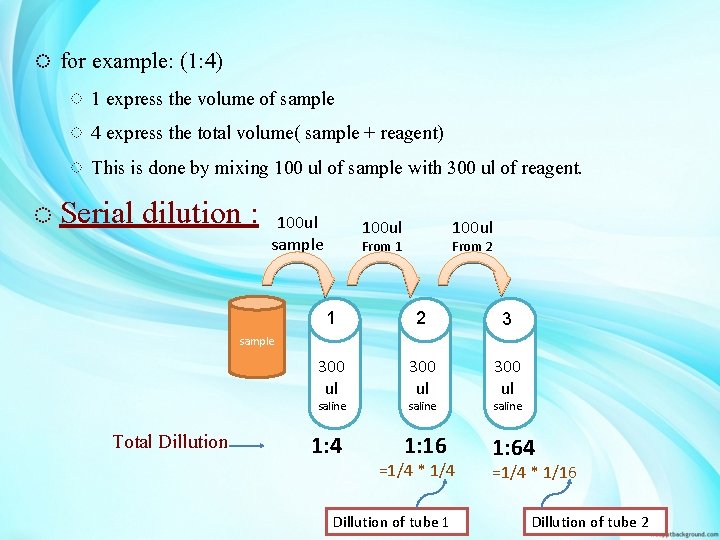
◌ for example: (1: 4) ◌ 1 express the volume of sample ◌ 4 express the total volume( sample + reagent) ◌ This is done by mixing 100 ul of sample with 300 ul of reagent. ◌ Serial dilution : 100 ul sample 100 ul From 1 From 2 1 2 3 300 ul sample saline Total Dillution 1: 4 saline 1: 16 =1/4 * 1/4 Dillution of tube 1 saline 1: 64 =1/4 * 1/16 Dillution of tube 2
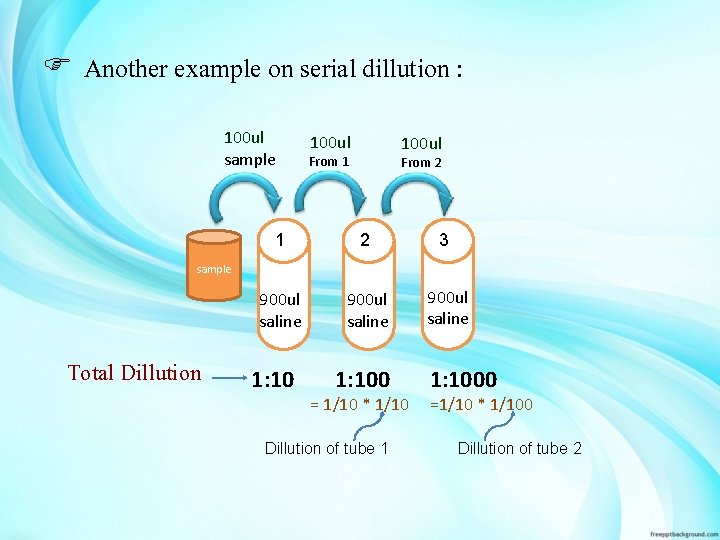
F Another example on serial dillution : 100 ul sample 100 ul From 1 From 2 1 2 3 900 ul saline sample Total Dillution 1: 100 = 1/10 * 1/10 Dillution of tube 1 1: 1000 =1/10 * 1/100 Dillution of tube 2
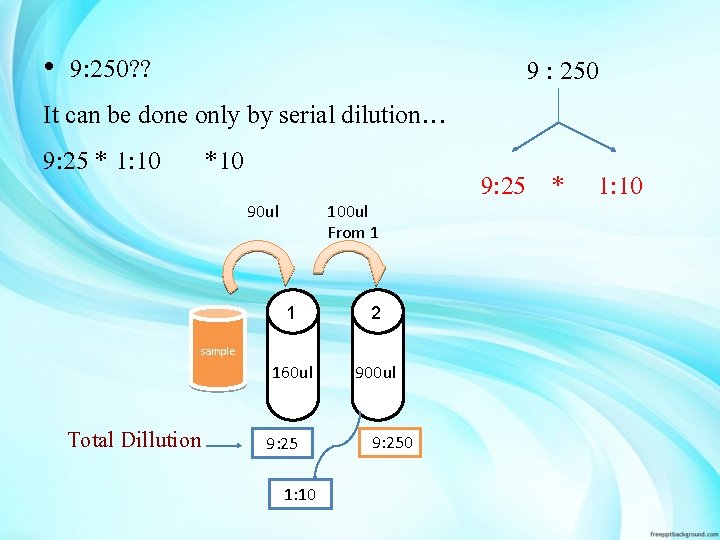
• 9: 250? ? It can be done only by serial dilution… 9: 25 * 1: 10 *10 90 ul 100 ul From 1 1 2 160 ul 900 ul sample Total Dillution 9: 25 1: 10 9: 250 9: 25 * 1: 10
- Slides: 21