
Antifungal Agents PartIII Lecture3 Dated 21 05 2021




- Slides: 14
Antifungal Agents (Part-III) (Lecture-3 : Dated 21. 05. 2021) Dr. Nirbhay Kumar Asstt. Professor & Head Deptt. of Veterinary Pharmacology & Toxicology Bihar Veterinary College, Bihar Animal Sciences University, Patna
AZOLE ANTIFUNGAL AGENTS • Fungistatic agents. • Broad spectrum of activity. • IMIDAZOLES: Clotrimazole Ketoconazole Sulconazole • TRIAZOLES: Itraconazole Econazole Miconazole Isavuconazole Voriconazole Fenticonazole Tioconazole Posaconazole Fluconazole
Azole Antifungal Agents contd… • Clotrimazole: The first imidazole compound discovered with antifungal activity was clotrimazole. • Miconazole: Effective amphotericin B. against some fungi refractive to Uses of both clotrimazole and miconazole: Topical treatment of localized superficial infections. • Ketoconazole: The first orally active imidazole. • Triazoles (Fluconazole & Itraconazole) : More safe & effective.
Azole Antifungal Agents contd… Mechanism of action: • The azoles inhibit the fungal cytochrome P-450 3 A enzyme, lanosine 14α-demethylase, which converts lanosterol to ergosterol, the main sterol in the fungal cell membrane. • The resulting depletion of ergosterol alters the fluidity of the membrane, and this interferes with the action of membraneassociated enzymes. The net effect is an inhibition of replication. • Azoles also inhibit the transformation of candidal yeast cells into hyphae-the invasive and pathogenic form of the parasite.
Clotrimazole • Interferes with amino acid transport into the fungus by an action on the cell membrane. • Effective in topical treatment: - Tinea infections - Athlete’s foot - Otomycosis and - Oral, cutaneous & vaginal candidiasis. • It is well tolerated by most patients. • No systemic toxicity is seen after topical use.
Econazole & Miconazole Econazole: • It is similar to clotrimazole. • Effectively penetrates superficial layers of the skin. • Is highly effective in dermatophytosis, otomycosis and oral thrush. Miconazole: • It is highly efficacious drug for tinea, pityriasis versicolor, otomycosis, cutaneous and vulvovaginal candidiasis. • Single application on skin acts for few days.
Ketoconazole • It was the first azole that can be given orally to treat systemic fungal infections. • It is well absorbed from GI tract. • Antifungal spectrum: Most effective against yeast and dimorphic fungi such as Candida, H. capsulatum as well as most dermatophytes. It is less effective against C. neoformans, S. schenckii and Aspergillus. • Toxicity: The main hazard of ketoconazole is liver toxicity. Inhibition of adrenocortical steroid and testosterone synthesis has been recorded with high doses, the latter resulting in gynaecomastia in some male patients.
Fluconazole • It is well absorbed and can be given orally or intravenously. • t 1/2 = 25 hours. • It may become the first drug of choice for most types of fungal meningitis (as it reaches high concentrations in CSF). Toxicity : • Unwanted side effects are generally mild. • Hepatitis is rare. • Does not produce the inhibition of hepatic drug metabolism and of steroidogenesis that occurs with ketoconazole.
Itraconazole • Itraconazole is active against a range of dermatophytes. • Broad spectrum of activity than ketoconazole and fluconazole. • Half-life (t 1/2) is about 36 hours. • Steroid hormone synthesis inhibition and serious hepatotoxicity are absent in itraconazole.
TERBINAFINE • Highly lipophilic, keratinophilic fungicidal compound active against wide range of skin pathogens. • It is particularly useful against nail infections (ringworm). • Mechanism of action – It acts by selectively inhibiting the enzyme squalene epoxidase, which is involved in the synthesis of ergosterol from squalene in the fungal cell wall. The accumulation of squalene within the cell is toxic to the organism. • Toxicity - Unwanted effects occur in about 10% of individuals and are usually mild and self-limiting.
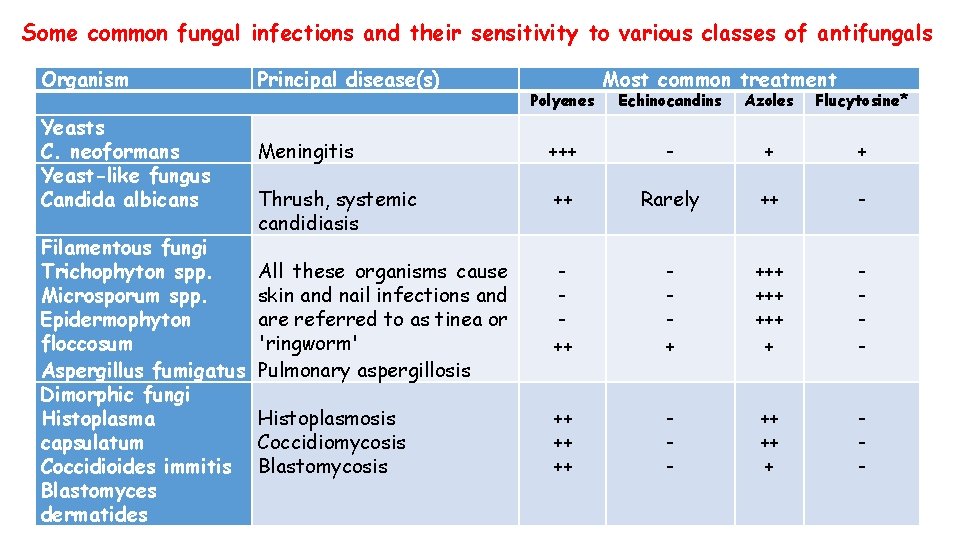
Some common fungal infections and their sensitivity to various classes of antifungals Organism Yeasts C. neoformans Yeast-like fungus Candida albicans Filamentous fungi Trichophyton spp. Microsporum spp. Epidermophyton floccosum Aspergillus fumigatus Dimorphic fungi Histoplasma capsulatum Coccidioides immitis Blastomyces dermatides Principal disease(s) Polyenes Most common treatment Echinocandins Azoles Flucytosine* Meningitis +++ - + + Thrush, systemic candidiasis ++ Rarely ++ - All these organisms cause skin and nail infections and are referred to as tinea or 'ringworm' Pulmonary aspergillosis ++ + +++ +++ + - Histoplasmosis Coccidiomycosis Blastomycosis ++ ++ ++ - ++ ++ + -
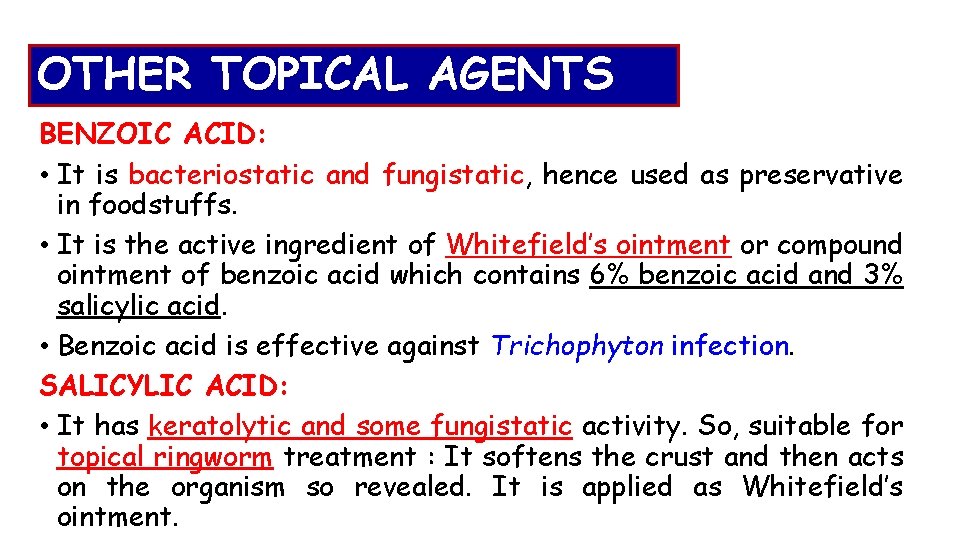
OTHER TOPICAL AGENTS BENZOIC ACID: • It is bacteriostatic and fungistatic, hence used as preservative in foodstuffs. • It is the active ingredient of Whitefield’s ointment or compound ointment of benzoic acid which contains 6% benzoic acid and 3% salicylic acid. • Benzoic acid is effective against Trichophyton infection. SALICYLIC ACID: • It has keratolytic and some fungistatic activity. So, suitable for topical ringworm treatment : It softens the crust and then acts on the organism so revealed. It is applied as Whitefield’s ointment.
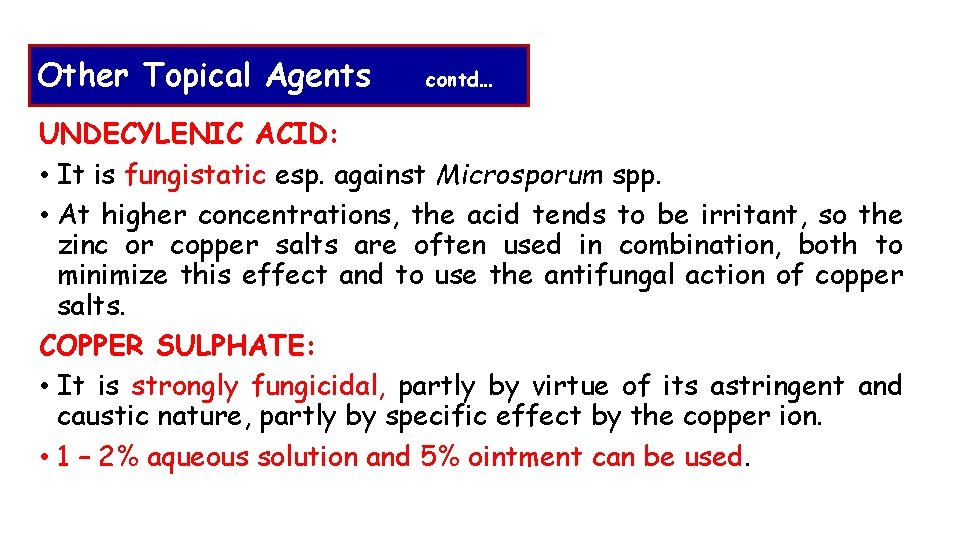
Other Topical Agents contd… UNDECYLENIC ACID: • It is fungistatic esp. against Microsporum spp. • At higher concentrations, the acid tends to be irritant, so the zinc or copper salts are often used in combination, both to minimize this effect and to use the antifungal action of copper salts. COPPER SULPHATE: • It is strongly fungicidal, partly by virtue of its astringent and caustic nature, partly by specific effect by the copper ion. • 1 – 2% aqueous solution and 5% ointment can be used.
Thank You