
Antiferomagnetism and triplet superconductivity in Bechgaard salts Daniel
Antiferomagnetism and triplet superconductivity in Bechgaard salts Daniel Podolsky (Harvard and UC Berkeley) Timofey Rostunov (Harvard) Ehud Altman (Harvard) Antoine Georges (Ecole Polytechnique) Eugene Demler (Harvard) References: Phys. Rev. Lett. 93: 246402 (2004) Phys. Rev. B 70: 224503 (2004) cond-mat/0506548
Outline • Introduction. Phase diagram of Bechgaard salts • New experimental tests of triplet superconductivity • Antiferomagnet to triplet superconductor transition in quasi 1 d systems. SO(4) symmetry • Implications of SO(4) symmetry for the phase diagram. Comparison to (TMTSF)2 PF 6 • Experimental test of SO(4) symmetry
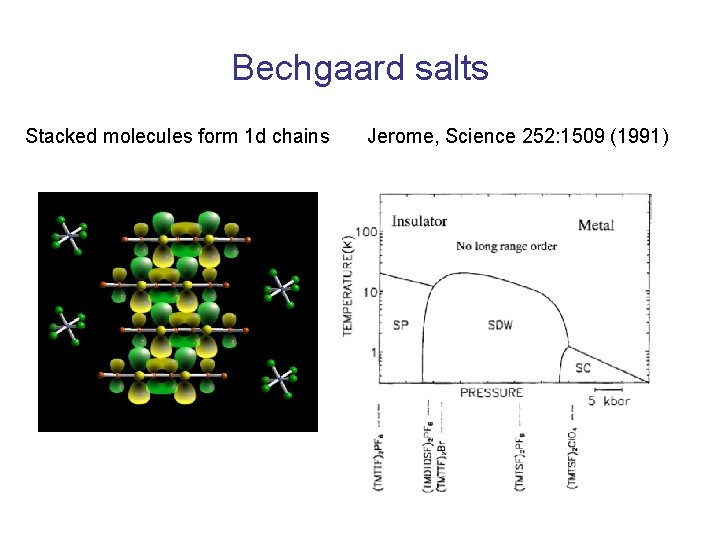
Bechgaard salts Stacked molecules form 1 d chains Jerome, Science 252: 1509 (1991)
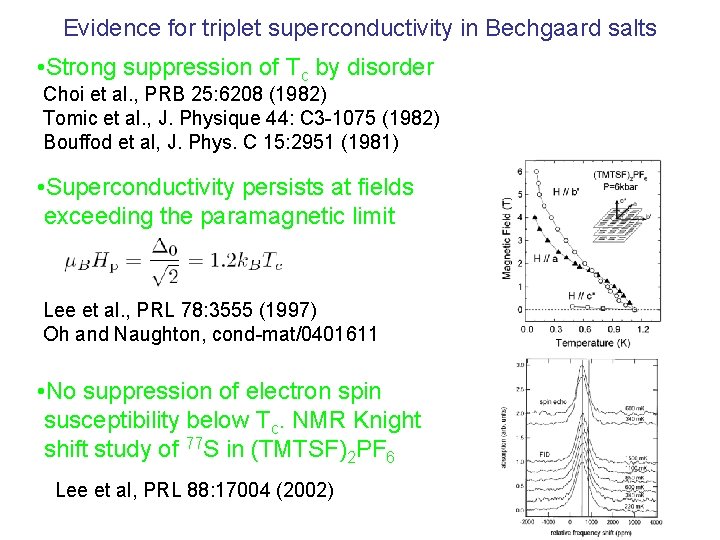
Evidence for triplet superconductivity in Bechgaard salts • Strong suppression of Tc by disorder Choi et al. , PRB 25: 6208 (1982) Tomic et al. , J. Physique 44: C 3 -1075 (1982) Bouffod et al, J. Phys. C 15: 2951 (1981) • Superconductivity persists at fields exceeding the paramagnetic limit Lee et al. , PRL 78: 3555 (1997) Oh and Naughton, cond-mat/0401611 • No suppression of electron spin susceptibility below Tc. NMR Knight shift study of 77 S in (TMTSF)2 PF 6 Lee et al, PRL 88: 17004 (2002)
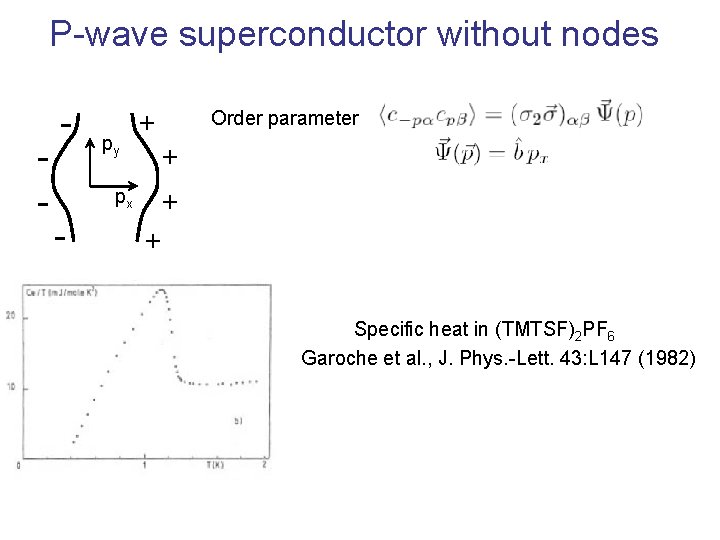
P-wave superconductor without nodes - - py + + px - Order parameter + + Specific heat in (TMTSF)2 PF 6 Garoche et al. , J. Phys. -Lett. 43: L 147 (1982)
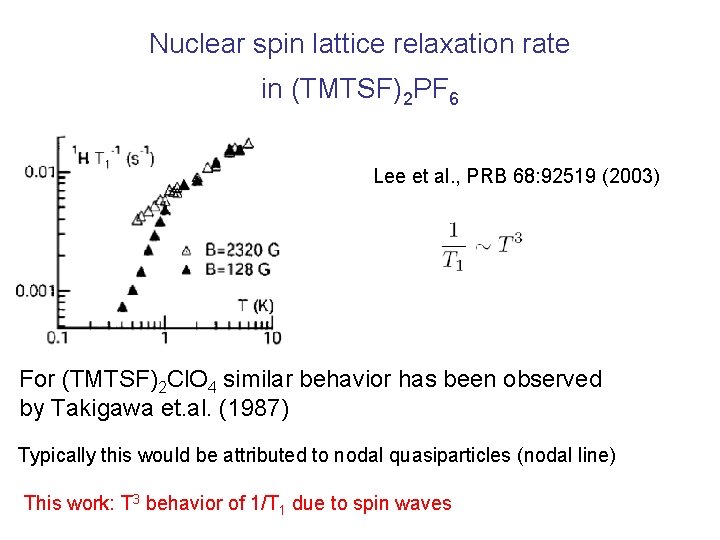
Nuclear spin lattice relaxation rate in (TMTSF)2 PF 6 Lee et al. , PRB 68: 92519 (2003) For (TMTSF)2 Cl. O 4 similar behavior has been observed by Takigawa et. al. (1987) Typically this would be attributed to nodal quasiparticles (nodal line) This work: T 3 behavior of 1/T 1 due to spin waves
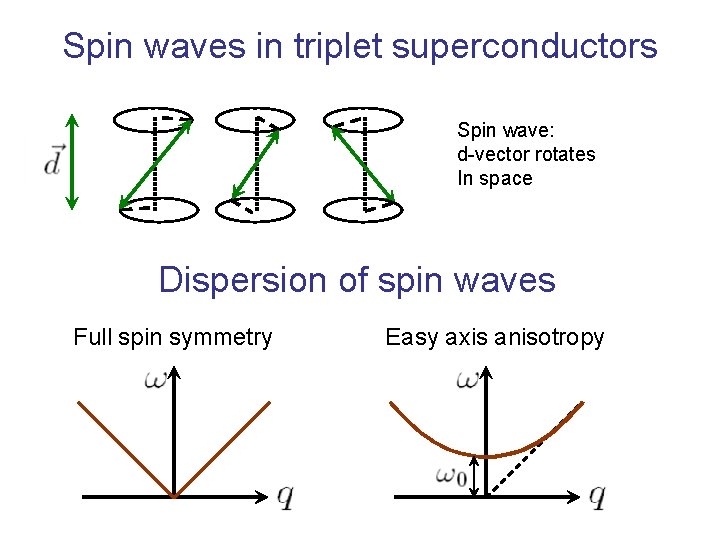
Spin waves in triplet superconductors Spin wave: d-vector rotates In space Dispersion of spin waves Full spin symmetry Easy axis anisotropy
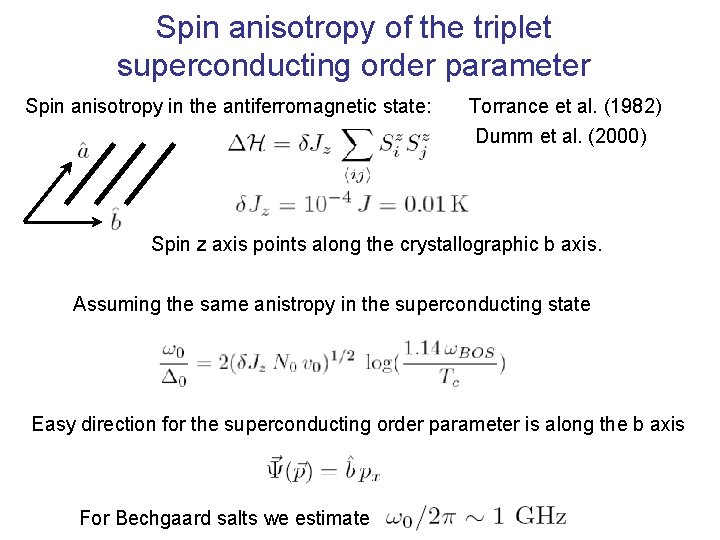
Spin anisotropy of the triplet superconducting order parameter Spin anisotropy in the antiferromagnetic state: Torrance et al. (1982) Dumm et al. (2000) Spin z axis points along the crystallographic b axis. Assuming the same anistropy in the superconducting state Easy direction for the superconducting order parameter is along the b axis For Bechgaard salts we estimate
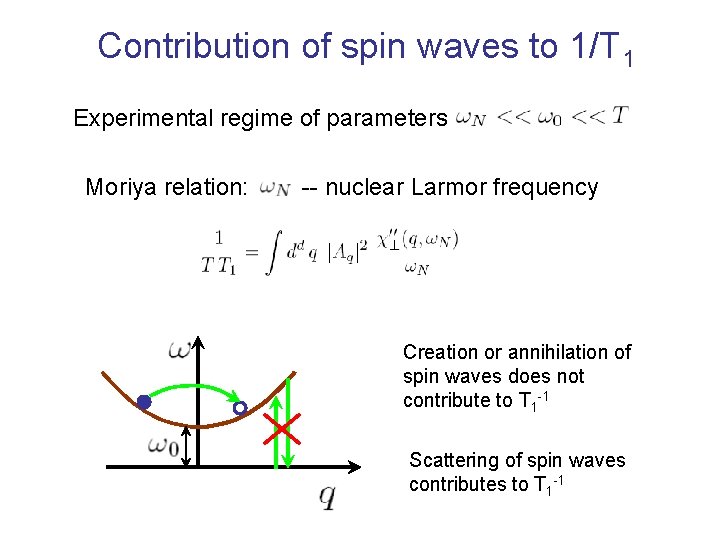
Contribution of spin waves to 1/T 1 Experimental regime of parameters Moriya relation: -- nuclear Larmor frequency Creation or annihilation of spin waves does not contribute to T 1 -1 Scattering of spin waves contributes to T 1 -1
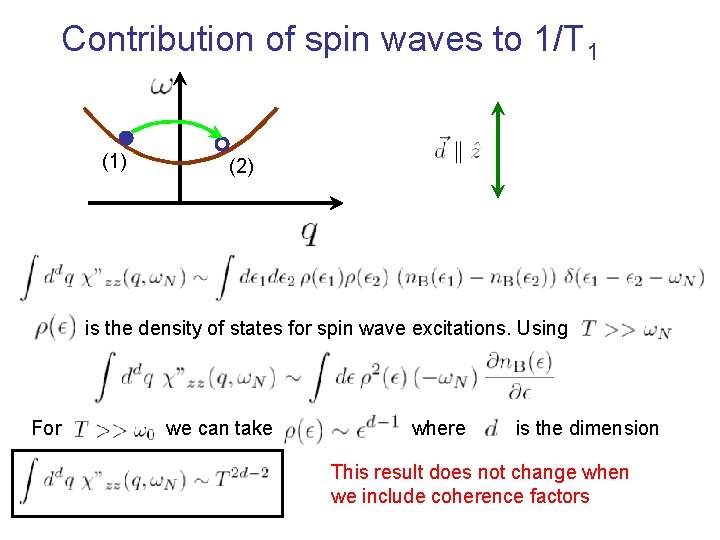
Contribution of spin waves to 1/T 1 (1) (2) is the density of states for spin wave excitations. Using For we can take where is the dimension This result does not change when we include coherence factors
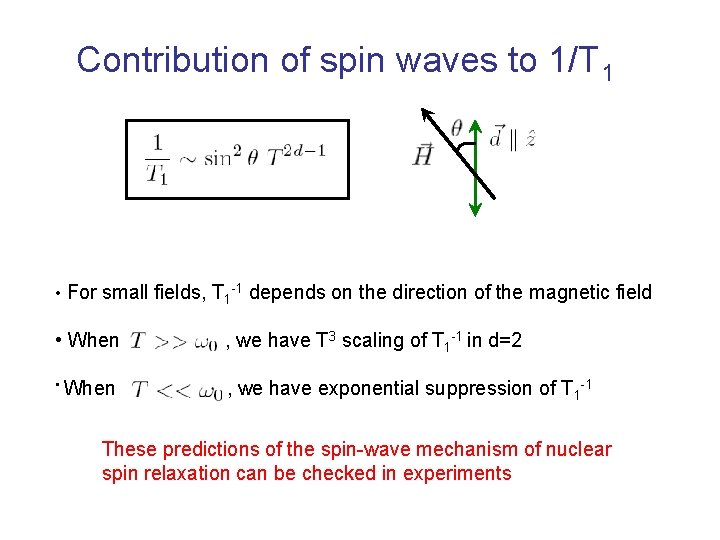
Contribution of spin waves to 1/T 1 • For small fields, T 1 -1 depends on the direction of the magnetic field • When , we have T 3 scaling of T 1 -1 in d=2 • When , we have exponential suppression of T 1 -1 These predictions of the spin-wave mechanism of nuclear spin relaxation can be checked in experiments
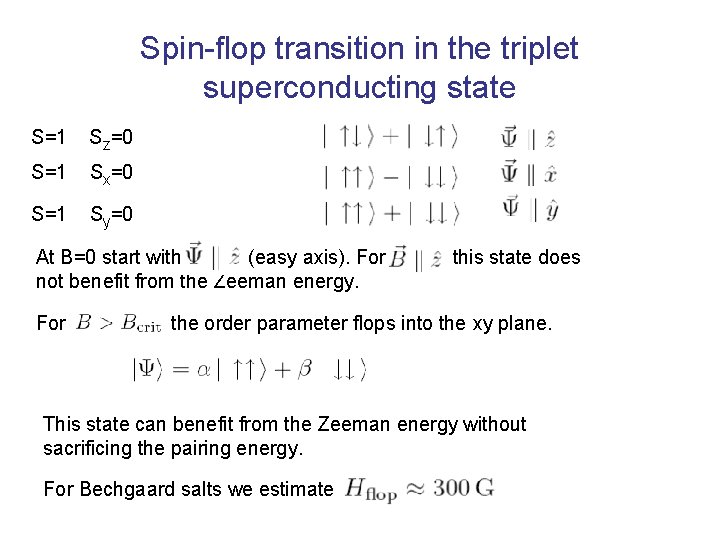
Spin-flop transition in the triplet superconducting state S=1 Sz=0 S=1 Sx=0 S=1 Sy=0 At B=0 start with (easy axis). For not benefit from the Zeeman energy. For this state does the order parameter flops into the xy plane. This state can benefit from the Zeeman energy without sacrificing the pairing energy. For Bechgaard salts we estimate
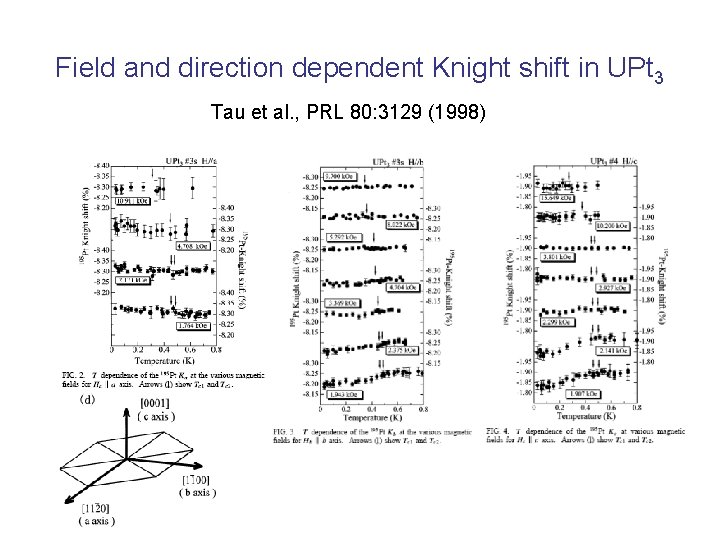
Field and direction dependent Knight shift in UPt 3 Tau et al. , PRL 80: 3129 (1998)
Competition of antiferomagnetism and triplet superconductivity in Bechgaard salts
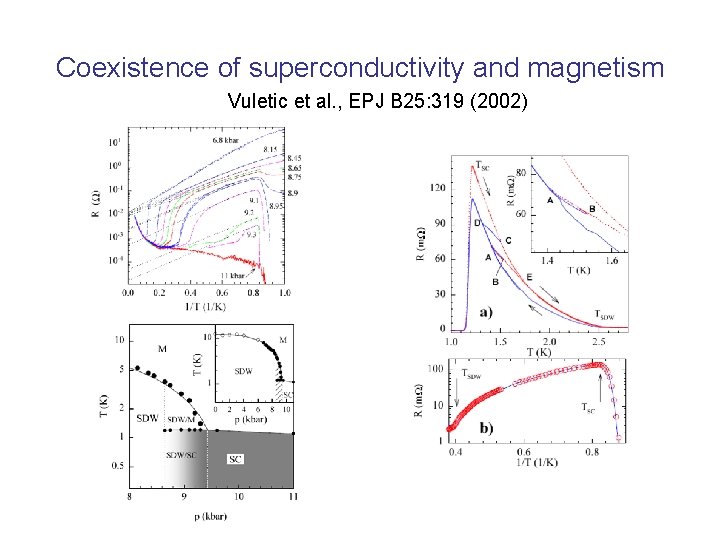
Coexistence of superconductivity and magnetism Vuletic et al. , EPJ B 25: 319 (2002)
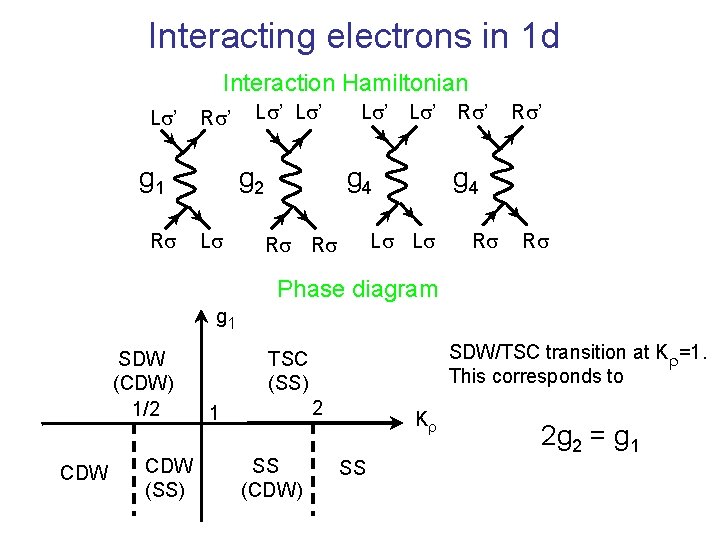
Interacting electrons in 1 d Interaction Hamiltonian Ls’ Rs’ g 1 Rs Ls’ g 2 Ls Ls’ g 4 Rs’ g 4 Ls Ls Rs Rs Rs’ Rs Rs Phase diagram g 1 SDW (CDW) 1/2 CDW (SS) SDW/TSC transition at Kr=1. This corresponds to TSC (SS) 2 1 SS (CDW) Kr SS 2 g 2 = g 1
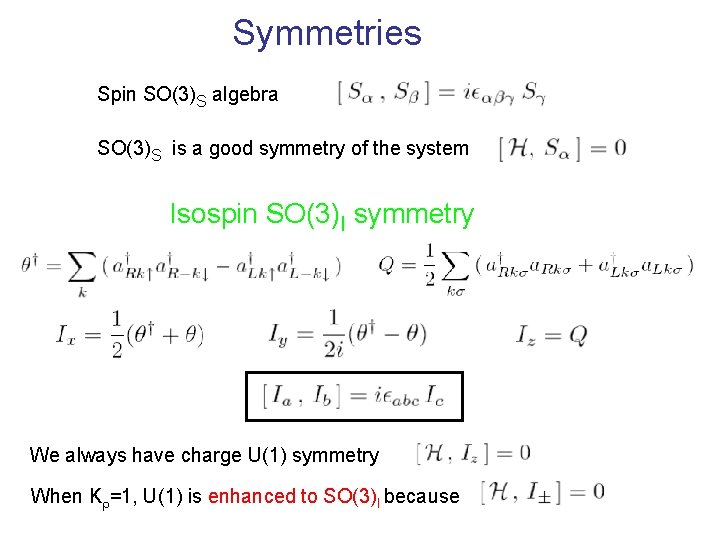
Symmetries Spin SO(3)S algebra SO(3)S is a good symmetry of the system Isospin SO(3)I symmetry We always have charge U(1) symmetry When Kr=1, U(1) is enhanced to SO(3)I because
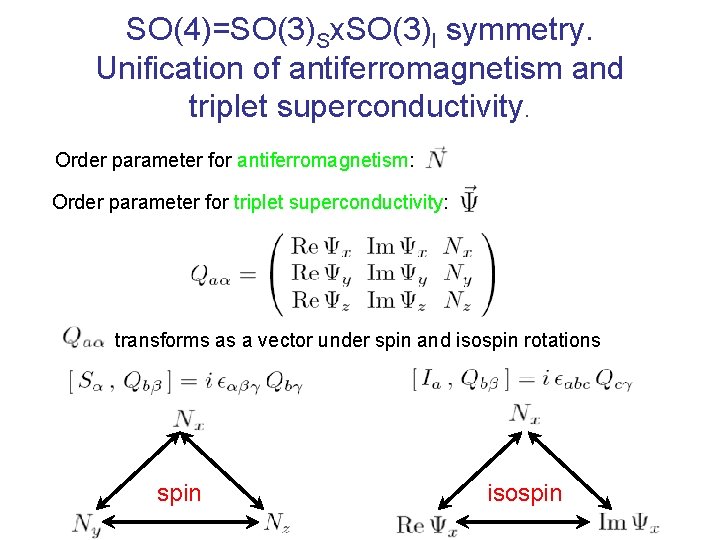
SO(4)=SO(3)Sx. SO(3)I symmetry. Unification of antiferromagnetism and triplet superconductivity. Order parameter for antiferromagnetism: Order parameter for triplet superconductivity: transforms as a vector under spin and isospin rotations spin isospin
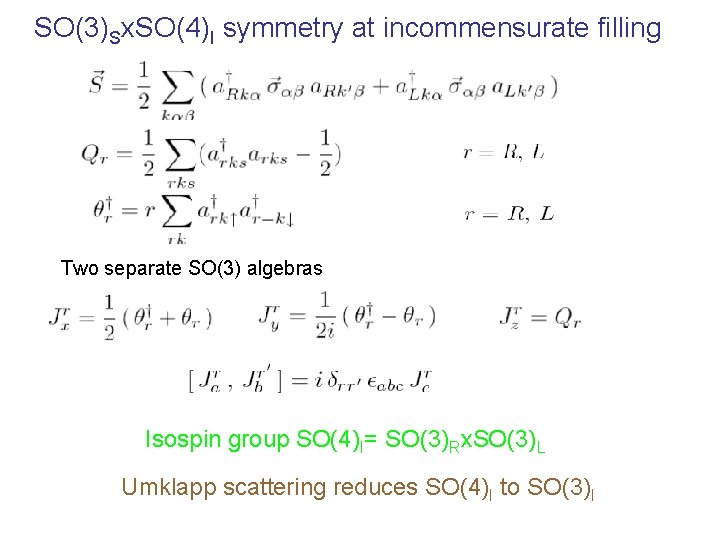
SO(3)Sx. SO(4)I symmetry at incommensurate filling Two separate SO(3) algebras Isospin group SO(4)I= SO(3)Rx. SO(3)L Umklapp scattering reduces SO(4)I to SO(3)I
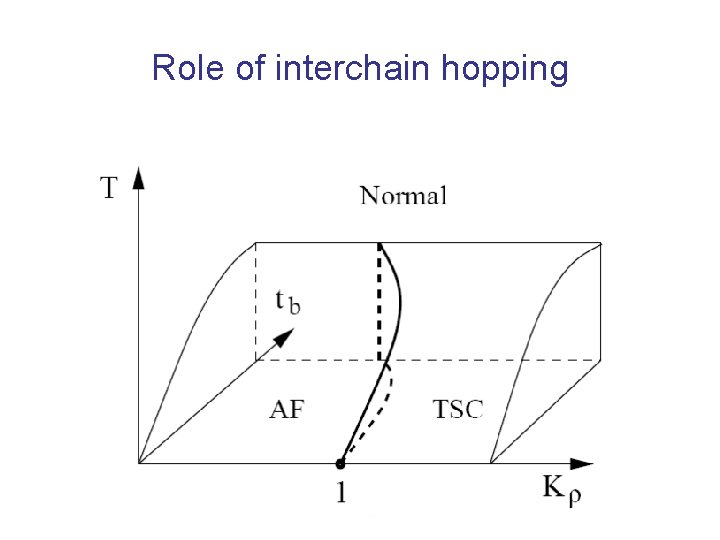
Role of interchain hopping
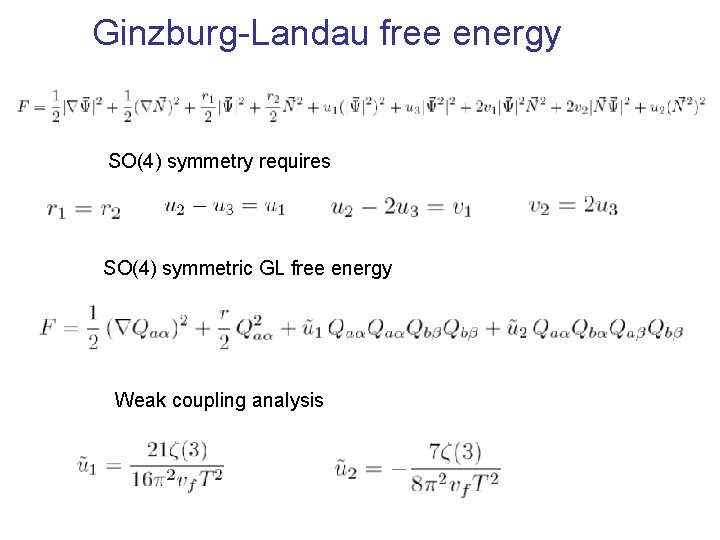
Ginzburg-Landau free energy SO(4) symmetry requires SO(4) symmetric GL free energy Weak coupling analysis
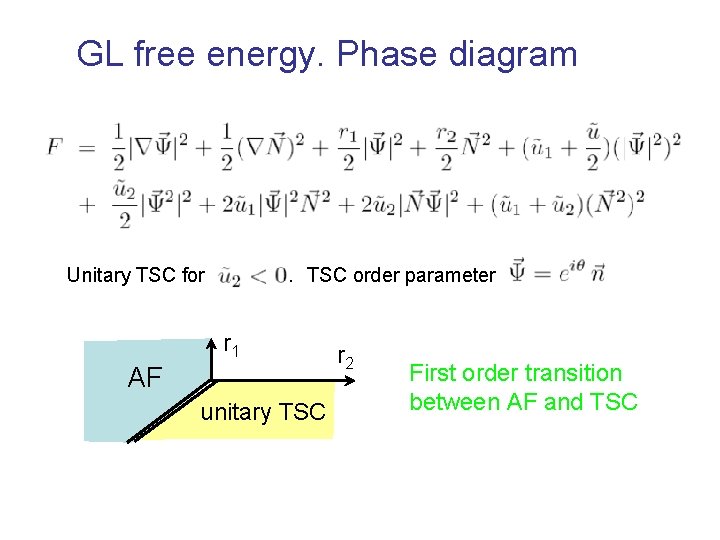
GL free energy. Phase diagram Unitary TSC for . TSC order parameter r 1 AF unitary TSC r 2 First order transition between AF and TSC
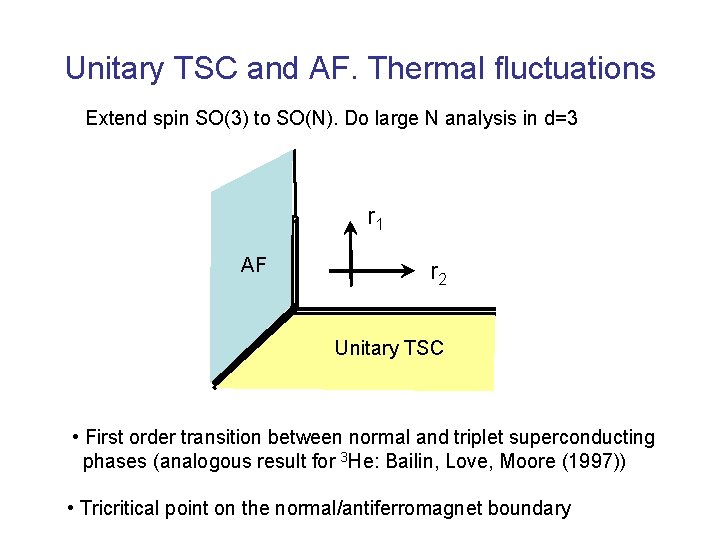
Unitary TSC and AF. Thermal fluctuations Extend spin SO(3) to SO(N). Do large N analysis in d=3 r 1 AF r 2 Unitary TSC • First order transition between normal and triplet superconducting phases (analogous result for 3 He: Bailin, Love, Moore (1997)) • Tricritical point on the normal/antiferromagnet boundary
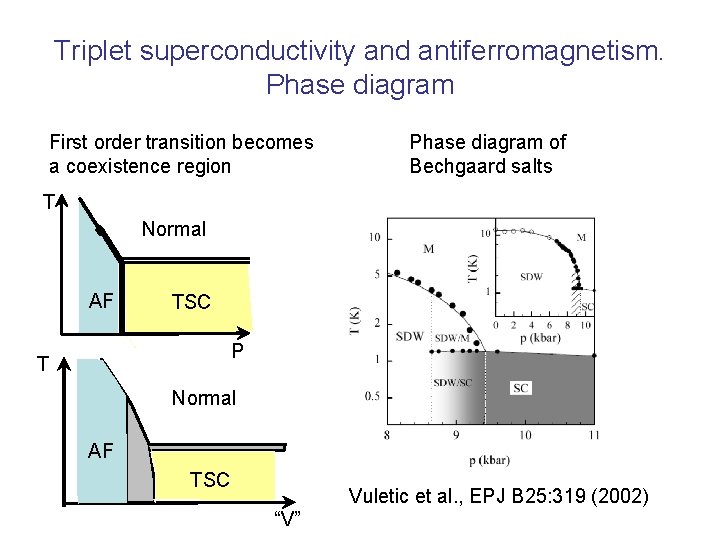
Triplet superconductivity and antiferromagnetism. Phase diagram First order transition becomes a coexistence region Phase diagram of Bechgaard salts T Normal AF TSC P T Normal AF TSC Vuletic et al. , EPJ B 25: 319 (2002) “V”
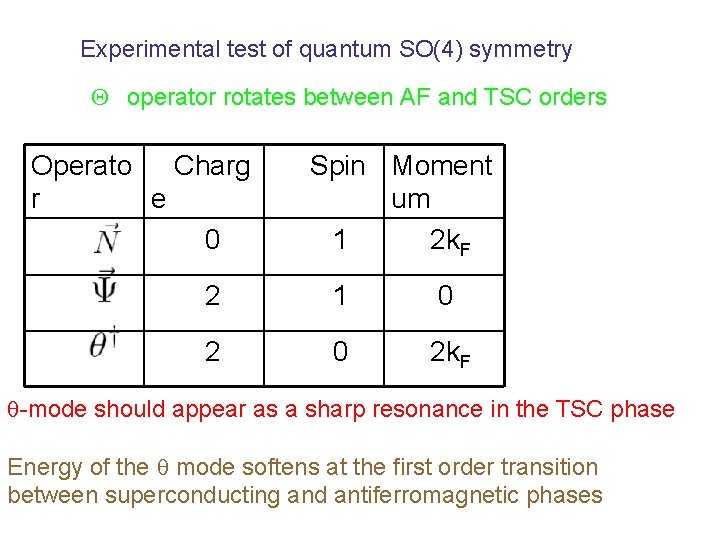
Experimental test of quantum SO(4) symmetry Q operator rotates between AF and TSC orders Operato Charg r e 0 Spin Moment um 1 2 k. F 2 1 0 2 k. F q-mode should appear as a sharp resonance in the TSC phase Energy of the q mode softens at the first order transition between superconducting and antiferromagnetic phases
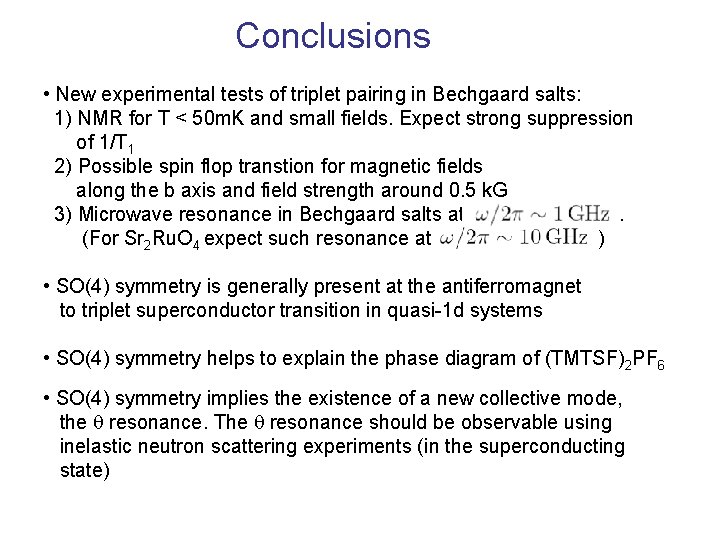
Conclusions • New experimental tests of triplet pairing in Bechgaard salts: 1) NMR for T < 50 m. K and small fields. Expect strong suppression of 1/T 1 2) Possible spin flop transtion for magnetic fields along the b axis and field strength around 0. 5 k. G 3) Microwave resonance in Bechgaard salts at. (For Sr 2 Ru. O 4 expect such resonance at ) • SO(4) symmetry is generally present at the antiferromagnet to triplet superconductor transition in quasi-1 d systems • SO(4) symmetry helps to explain the phase diagram of (TMTSF)2 PF 6 • SO(4) symmetry implies the existence of a new collective mode, the q resonance. The q resonance should be observable using inelastic neutron scattering experiments (in the superconducting state)
- Slides: 26