
Anticonvulsant Prophylaxis and Steroid Use in Adults with
- Slides: 14
Anticonvulsant Prophylaxis and Steroid Use in Adults with Metastatic Brain Tumors: ASCO and SNO Joint Endorsement of the CNS Guidelines Chang, et al. www. asco. org/neurooncology-guidelines ©American Society of Clinical Oncology 2019. All rights reserved.
Introduction § The College of Neurological Surgeons (CNS) has recently published a series of guidelines on the treatment and care of adults with metastatic brain tumors. § Prior to publication, the CNS requested that ASCO provide feedback on and consider endorsing the guideline series. § As the care of the target population of these guidelines is an important issue for the members of both ASCO and the Society for Neuro-Oncology (SNO), ASCO and SNO conducted a joint guideline endorsement process on these guidelines. www. asco. org/neurooncology-guidelines ©American Society of Clinical Oncology 2019. All rights reserved.
ASCO Endorsement Methodology The ASCO Clinical Practice Guidelines Committee endorsement process includes: • a methodological review by ASCO guidelines staff • a content review by an Expert Panel • final endorsement approval by ASCO CPGC. The full ASCO methodology manual can be found at: www. asco. org/guideline-methodology CNS Guideline Methodology can be found at: https: //www. cns. org/guidelines/guideline-procedures-policies/guideline-developmentmethodology www. asco. org/neurooncology-guidelines ©American Society of Clinical Oncology 2019. All rights reserved.
Clinical Questions CNS Anticonvulsant Guideline: § Do prophylactic anti-epileptic drugs (AEDs) decrease the risk of seizures in nonsurgical patients with brain metastases who are otherwise seizure free? Do prophylactic AEDs decrease the risk of seizures in patients with brain metastases and no prior history of seizures in the postoperative setting? CNS Steroids Guideline: § Do steroids improve neurologic symptoms and/or quality of life in patients with metastatic brain tumors compared to supportive care only or other treatment options? If steroids are given, what dose should be used? www. asco. org/neurooncology-guidelines ©American Society of Clinical Oncology 2019. All rights reserved.
Target Population and Audience Target Population Adults with metastatic brain tumors. Target Audience Medical oncologists, neurologists and others providing care for adults with metastatic brain tumors www. asco. org/neurooncology-guidelines ©American Society of Clinical Oncology 2019. All rights reserved.
Summary of Recommendations Additions by the ASCO/SNO Expert Panel are in bold italics. See note below regarding CNS recommendation levels. CNS Anticonvulsants Guideline § Level 3: Prophylactic anti-epileptic drugs are not recommended for routine use in patients with brain metastases who did not undergo surgical resection and are otherwise seizure free. § Level 3: Routine post-craniotomy anti-epileptic drug use for seizure-free patients with brain metastases is not recommended. www. asco. org/neurooncology-guidelines ©American Society of Clinical Oncology 2019. All rights reserved.
Summary of Recommendations CNS Steroids Guideline Steroid therapy versus no steroid therapy Asymptomatic brain metastases patients without mass effect § Insufficient evidence exists to make a treatment recommendation for this clinical scenario. Brain metastases patients with mild symptoms related to mass effect § Level 3: Corticosteroids are recommended to provide temporary symptomatic relief of symptoms related to increased intracranial pressure and edema secondary to brain metastases. It is recommended for patients who are symptomatic from metastatic disease to the brain that a starting dose of 4– 8 mg/day of dexamethasone be considered. www. asco. org/neurooncology-guidelines ©American Society of Clinical Oncology 2019. All rights reserved.
Summary of Recommendations Brain metastases patients with moderate to severe symptoms related to mass effect § Level 3: Corticosteroids are recommended to provide temporary symptomatic relief of symptoms related to increased intracranial pressure and edema secondary to brain metastases. If patients exhibit severe symptoms consistent with increased intracranial pressure, it is recommended that higher doses such as 16 mg/day or more be considered. Choice of Steroid § Level 3: If corticosteroids are given, dexamethasone is the best drug choice given the available evidence. www. asco. org/neurooncology-guidelines ©American Society of Clinical Oncology 2019. All rights reserved.
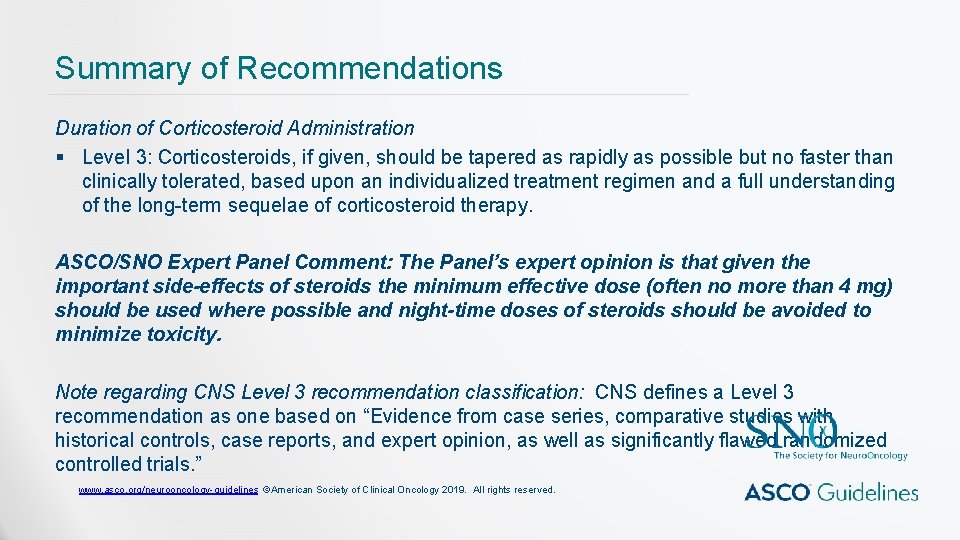
Summary of Recommendations Duration of Corticosteroid Administration § Level 3: Corticosteroids, if given, should be tapered as rapidly as possible but no faster than clinically tolerated, based upon an individualized treatment regimen and a full understanding of the long-term sequelae of corticosteroid therapy. ASCO/SNO Expert Panel Comment: The Panel’s expert opinion is that given the important side-effects of steroids the minimum effective dose (often no more than 4 mg) should be used where possible and night-time doses of steroids should be avoided to minimize toxicity. Note regarding CNS Level 3 recommendation classification: CNS defines a Level 3 recommendation as one based on “Evidence from case series, comparative studies with historical controls, case reports, and expert opinion, as well as significantly flawed randomized controlled trials. ” www. asco. org/neurooncology-guidelines ©American Society of Clinical Oncology 2019. All rights reserved.
Reprint Permission Reproduced from: Chen CC, Rennert RC, Olson JJ: Congress of Neurological Surgeons Systematic Review and Evidence-Based Guidelines on the Role of Prophylactic Anticonvulsants in the Treatment of Adults with Metastatic Brain Tumors. Neurosurgery published online ahead of print: January 9, 2019. (doi: 10. 1093/neuros/nyy 545), 2019 and Ryken TC, Kuo JS, Prabhu RS, et al: Congress of Neurological Surgeons Systematic Review and Evidence-Based Guidelines on the Role of Steroids in the Treatment of Adults with Metastatic Brain Tumors. Neurosurgery published online ahead of print: January 9, 2019. (doi: 10. 1093/neuros/nyy 546), 2019 by permission Oxford university Press on behalf of the Congress of Neurological Surgeons. Please visit: https: //academic. oup. com/neurosurgery/articleabstract/84/3/E 195/5281386 and https: //academic. oup. com/neurosurgery/articleabstract/84/3/E 189/5281370 www. asco. org/neurooncology-guidelines ©American Society of Clinical Oncology 2019. All rights reserved.
Endorsement Statement ASCO and SNO endorse the CNS guidelines on anticonvulsants and steroids in the treatment of adults with brain metastases, with a minor alteration. www. asco. org/neurooncology-guidelines ©American Society of Clinical Oncology 2019. All rights reserved.
Additional Resources More information, including a Supplement, slide sets, and clinical tools and resources, is available at www. asco. org/gag-guidelines Link to original guidelines: https: //academic. oup. com/neurosurgery/article-abstract/84/3/E 195/5281386 and https: //academic. oup. com/neurosurgery/article-abstract/84/3/E 189/5281370 Patient information is available at www. cancer. net www. asco. org/neurooncology-guidelines ©American Society of Clinical Oncology 2019. All rights reserved.
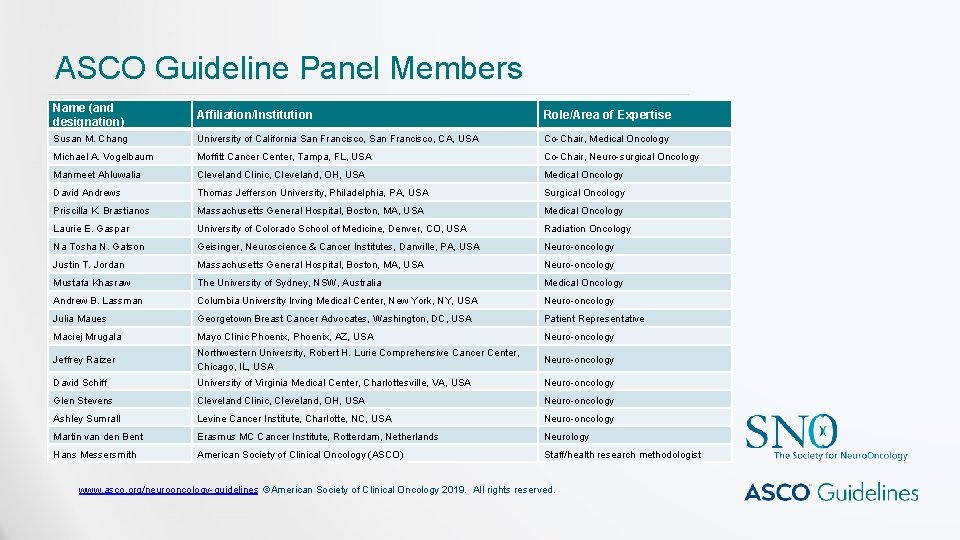
ASCO Guideline Panel Members Name (and designation) Affiliation/Institution Role/Area of Expertise Susan M. Chang University of California San Francisco, CA, USA Co-Chair, Medical Oncology Michael A. Vogelbaum Moffitt Cancer Center, Tampa, FL, USA Co-Chair, Neuro-surgical Oncology Manmeet Ahluwalia Cleveland Clinic, Cleveland, OH, USA Medical Oncology David Andrews Thomas Jefferson University, Philadelphia, PA, USA Surgical Oncology Priscilla K. Brastianos Massachusetts General Hospital, Boston, MA, USA Medical Oncology Laurie E. Gaspar University of Colorado School of Medicine, Denver, CO, USA Radiation Oncology Na Tosha N. Gatson Geisinger, Neuroscience & Cancer Institutes, Danville, PA, USA Neuro-oncology Justin T. Jordan Massachusetts General Hospital, Boston, MA, USA Neuro-oncology Mustafa Khasraw The University of Sydney, NSW, Australia Medical Oncology Andrew B. Lassman Columbia University Irving Medical Center, New York, NY, USA Neuro-oncology Julia Maues Georgetown Breast Cancer Advocates, Washington, DC, USA Patient Representative Maciej Mrugala Mayo Clinic Phoenix, AZ, USA Neuro-oncology Jeffrey Raizer Northwestern University, Robert H. Lurie Comprehensive Cancer Center, Chicago, IL, USA Neuro-oncology David Schiff University of Virginia Medical Center, Charlottesville, VA, USA Neuro-oncology Glen Stevens Cleveland Clinic, Cleveland, OH, USA Neuro-oncology Ashley Sumrall Levine Cancer Institute, Charlotte, NC, USA Neuro-oncology Martin van den Bent Erasmus MC Cancer Institute, Rotterdam, Netherlands Neurology Hans Messersmith American Society of Clinical Oncology (ASCO) Staff/health research methodologist www. asco. org/neurooncology-guidelines ©American Society of Clinical Oncology 2019. All rights reserved.
Disclaimer The Clinical Practice Guidelines and other guidance published herein are provided by the American Society of Clinical Oncology, Inc. (ASCO) to assist providers in clinical decision making. The information herein should not be relied upon as being complete or accurate, nor should it be considered as inclusive of all proper treatments or methods of care or as a statement of the standard of care. With the rapid development of scientific knowledge, new evidence may emerge between the time information is developed and when it is published or read. The information is not continually updated and may not reflect the most recent evidence. The information addresses only the topics specifically identified therein and is not applicable to other interventions, diseases, or stages of diseases. This information does not mandate any particular course of medical care. Further, the information is not intended to substitute for the independent professional judgment of the treating provider, as the information does not account for individual variation among patients. Recommendations reflect high, moderate, or low confidence that the recommendation reflects the net effect of a given course of action. The use of words like “must, ” “must not, ” “should, ” and “should not” indicates that a course of action is recommended or not recommended for either most or many patients, but there is latitude for the treating physician to select other courses of action in individual cases. In all cases, the selected course of action should be considered by the treating provider in the context of treating the individual patient. Use of the information is voluntary. ASCO provides this information on an “as is” basis and makes no warranty, express or implied, regarding the information. ASCO specifically disclaims any warranties of merchantability or fitness for a particular use or purpose. ASCO assumes no responsibility for any injury or damage to persons or property arising out of or related to any use of this information, or for any errors or omissions. www. asco. org/neurooncology-guidelines ©American Society of Clinical Oncology 2019. All rights reserved.