
Anticoagulants Antiplatelet and Fibrinolytic Drugs Introduction A thrombus
Anticoagulants , Antiplatelet and Fibrinolytic Drugs
Introduction A thrombus is a clot that forms within the heart or a blood vessel. There are 2 major pathways of coagulation : 1 - The Extrinsic system : Initiated by vascular damage , the release of tissue thromboplastin, and the activation of clotting factor VII 2 - The Intrinsic system : Initiated by activation of clotting factor XII
A - Anticoagulants Two Drugs commonly used to anticoagulated patients 1 - Heparin 2 - Warfarin 1 - HEPARIN Has a rapid onset of action Used to treat pulmonary embolism , deep venous thrombosis, acute myocardial infarction. Can be used prophylactically to prevent post operative embolism Limitations: Heparin stops the expansion of thrombi and prevents the formation of new thrombi. It does not dissolve the existing thrombi.
Cont. Heparin Rout of administration: SC and IV, IM must be avoided because of hematoma formation Metabolism: by the liver Adverse effect : 1 - Hemorrhage. 2 - Hypersensitivity reaction 3 - Thrombocytopenia. ( after approximately a week on Heparin administration , patient may develop Heparin induced antiplatelet antibodies) How to counter act the effect of Heparin ? Use Protamine Sulfate
Contraindications: - Hypersensitivity reaction - Bleeding disorder - Surgery of the brain, eye, or spinal cord - Intracranial hemorrhage - Infective Endocarditis Low Molecular Wight Heparin LMW It is a Smaller molecule heparin and weighs less than regular Heparin Example: Enoxaparin Advantage over Heparin: 1 - Greater bioavailability and longer half life 2 - Unlikely induce thrombocytopenia 3 - No need for constant lab. Monitoring
2 - Warfarin is given orally. It has a delayed onset of action (8 -12 hours) , and crosses the placenta. Mechanism of action Warfarin acts by inhibiting the synthesis of vitamin Kdependent clotting factors, which include Factors II, VII, IX, and X, and the anticoagulant proteins C and S. Warfarin is used when a long-term anticoagulant is needed. Prophylaxis and treatment of venous thrombosis and its extension, pulmonary embolism (PE). Prophylaxis and treatment of thromboembolic complications associated with atrial fibrillation (AF) and/or cardiac valve replacement.
Reduction in the risk of death, recurrent myocardial infarction (MI), and thromboembolic events such as stroke or systemic embolization after myocardial infarction. SIDE EFFECT Hemorrhage and Necrosis of skin and other tissues MONITORING: INR/ The INR is a test of blood clotting, which is primarily used to monitor warfarin therapy, where the aim is to maintain an elevated INR in a certain range eg, 2. 0 to 3. 0. How to counteract the effect of warfarin ? Administer vitamin K OR fresh frozen plasma and allow 24 hours for full reversal.
B - Antiplatelet The Role of antiplatelet in clot formation They delay clot formation by inhibiting platelet aggregation. 1 - Aspirin: Aspirin irreversibly inhibit Thromboxane A 2 ( causes platelets aggregation) synthesis by blocking the enzyme cyclooxygenase. (up to the life-time of the platelets 8 -10 days). To separate this action aspirin in small dose 75 -100 mg/day inhibits TXA 2 synthesis without significant effect on the endothelial PGI 2. This low dose of aspirin may also causes peptic ulcer bleeding in patients > 60 years. Side effects: nausea. GI bleeding and Rash
2 - Clopidogrel: (PLAVIX) It is used to prevent stroke in patient who are intolerant to aspirin. 3 - Dipyridamole: (Persantin) It inhibits phosphodiesterase enzyme, so increasing intraplatelet cyclic adenosine monophpsphate, This leads to decreased thromboxane A 2 synthesis. It has coronary VD activity. Side Effects: 1 - Dizziness 2 - abdominal pain 3 - Headache It is more effective and more expensive than aspirin
4 - Glycoprotein (GP) IIb-IIIa antagonist: Example: Abciximab: Administered IV They are monoclonal antibodies that reversibly inhibit the binding of fibrin to the platelet glycoprotein IIb/ IIIa Receptor cell surface protein , which is involved in platelet cross-linking. It produces immediate and profound inhibition of platelet adhesion and the action last for 12 -36 h after termination of I. V infusion. The benefit may maintain up to three years. Adverse effects Thrombocytopenia & hemorrhage, but lesser than with small dose of heparin (it is treated by platelet transfusion)
Uses of antiplatelet drugs: They are used to protect against stroke Myocardial infarction MI death in patient at high risk e. g. after angina pectoris, MI, atheroma or prothetic valves.

C- Fibrinolytic Drugs (Thrombolytic) Mechanism: they activate the conversion of plasminogen to plasmin, which in turn converts fibrin into soluble products. Plasminogen plasmin Fibrin soluble product (dissolved thrombi)
C- Fibrinolytic Drugs (Thrombolytic) Mechanism: they activate the conversion of plasminogen to plasmin, which in turn converts fibrin into soluble products. Plasminogen plasmin Fibrin soluble product (dissolved thrombi) Drug Streptokinase Adverse Effect Allergy, anaphylactic reaction in patient has antistreptococcal antibodies. Also not reused within 6 months. Rapid injection causes abrupt hypotension.
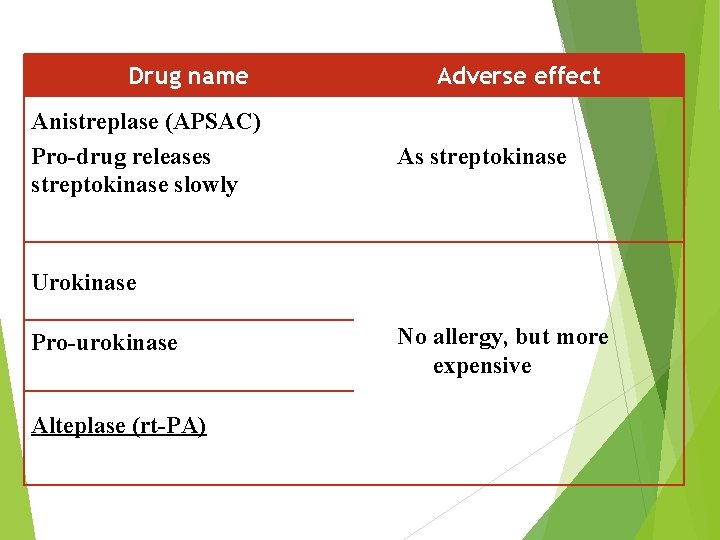
Drug name Anistreplase (APSAC) Pro-drug releases streptokinase slowly Adverse effect As streptokinase Urokinase Pro-urokinase Alteplase (rt-PA) No allergy, but more expensive
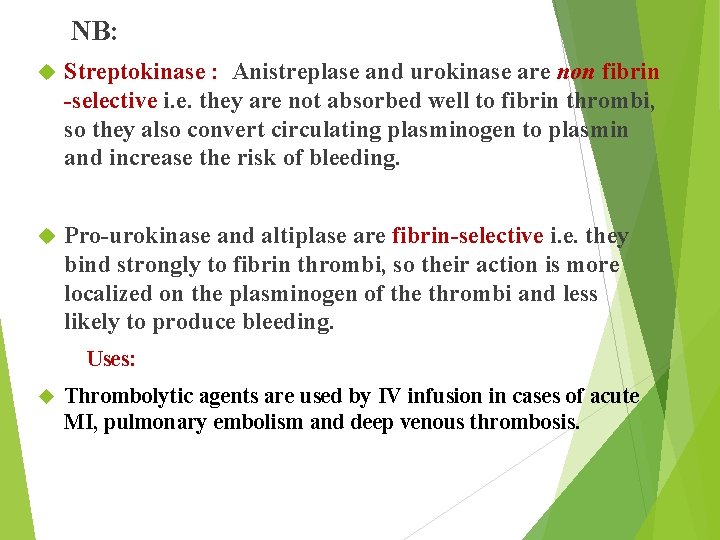
NB: Streptokinase : Anistreplase and urokinase are non fibrin -selective i. e. they are not absorbed well to fibrin thrombi, so they also convert circulating plasminogen to plasmin and increase the risk of bleeding. Pro-urokinase and altiplase are fibrin-selective i. e. they bind strongly to fibrin thrombi, so their action is more localized on the plasminogen of the thrombi and less likely to produce bleeding. Uses: Thrombolytic agents are used by IV infusion in cases of acute MI, pulmonary embolism and deep venous thrombosis.
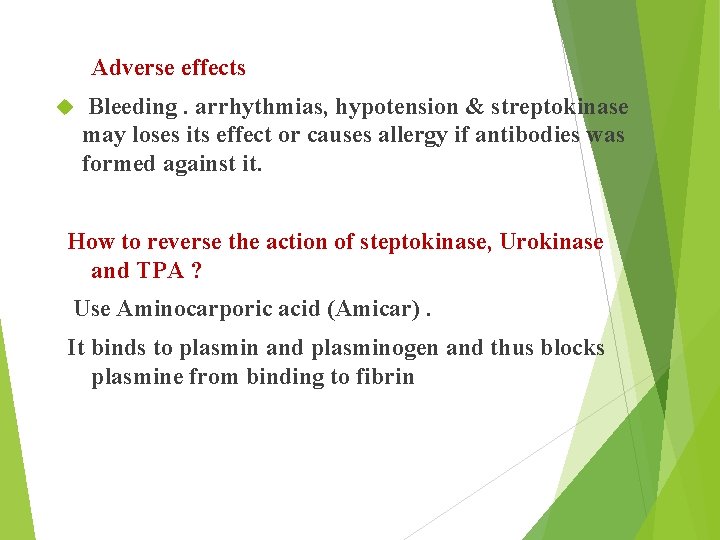
Adverse effects Bleeding. arrhythmias, hypotension & streptokinase may loses its effect or causes allergy if antibodies was formed against it. How to reverse the action of steptokinase, Urokinase and TPA ? Use Aminocarporic acid (Amicar). It binds to plasmin and plasminogen and thus blocks plasmine from binding to fibrin
- Slides: 16