
Antibodies How does your body fight infections Introduction

Antibodies How does your body fight infections?

Introduction • The body has to be ready to fight off anything which could do damage to it • One of the ways that it can do this is by releasing lots of chemicals that will destroy anything in their path • However, there’s an even more specific system that has been designed to target particular bugs that might get in – and this is where antibodies come in
Outline • What is an antibody? • What does an antibody do? • Types of antibodies
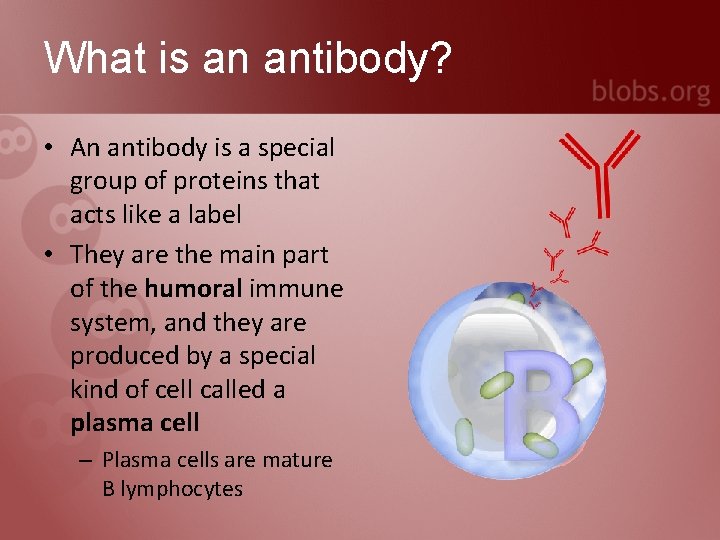
What is an antibody? • An antibody is a special group of proteins that acts like a label • They are the main part of the humoral immune system, and they are produced by a special kind of cell called a plasma cell – Plasma cells are mature B lymphocytes
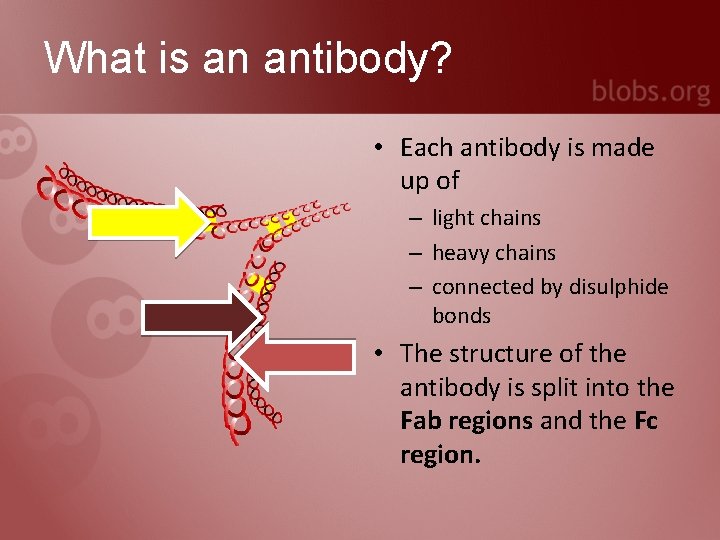
What is an antibody? • Each antibody is made up of – light chains – heavy chains – connected by disulphide bonds • The structure of the antibody is split into the Fab regions and the Fc region.
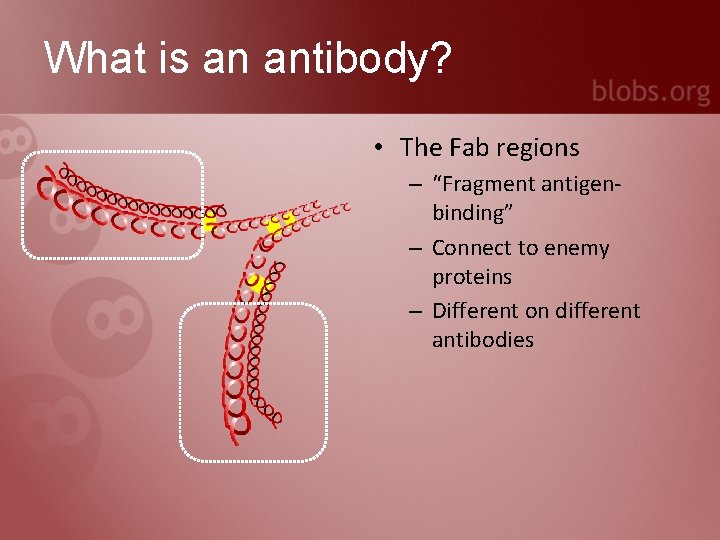
What is an antibody? • The Fab regions – “Fragment antigenbinding” – Connect to enemy proteins – Different on different antibodies
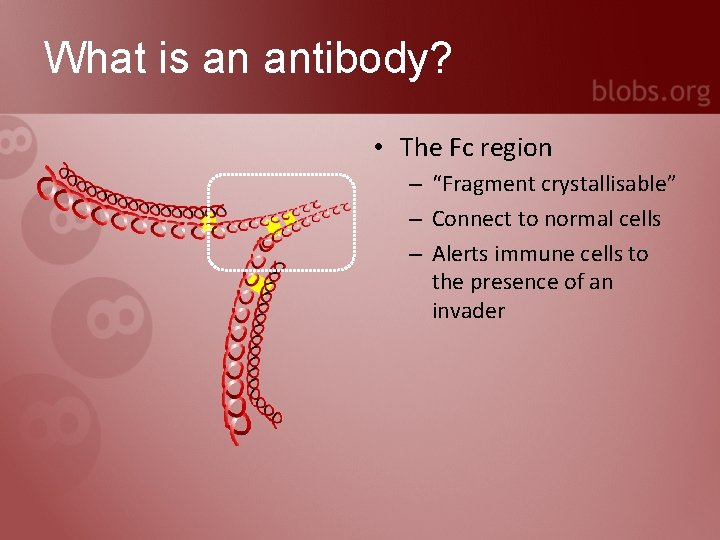
What is an antibody? • The Fc region – “Fragment crystallisable” – Connect to normal cells – Alerts immune cells to the presence of an invader
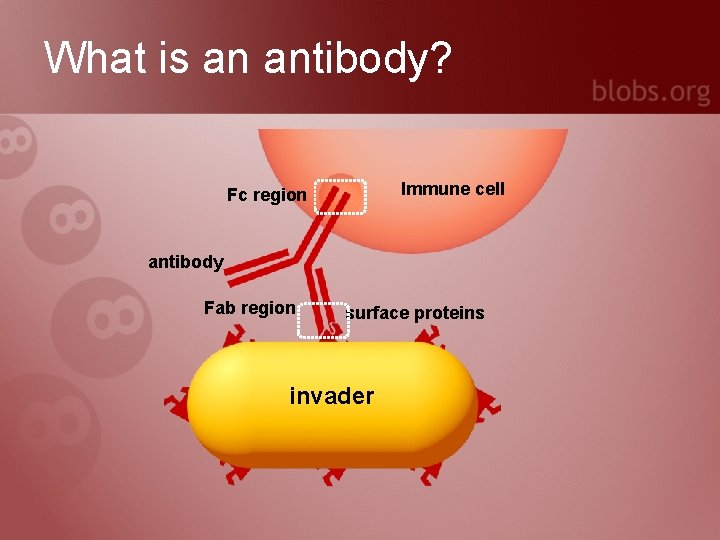
What is an antibody? Immune cell Fc region antibody Fab region surface proteins invader
What do antibodies do? • Antibodies are able to help prevent invasion from bacteria, viruses and other enemies in several ways – Neutralisation – Flagging – Opsonisation
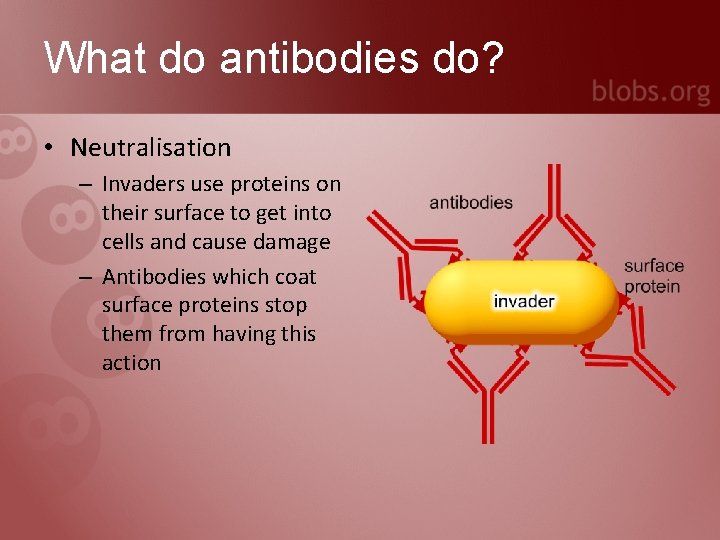
What do antibodies do? • Neutralisation – Invaders use proteins on their surface to get into cells and cause damage – Antibodies which coat surface proteins stop them from having this action
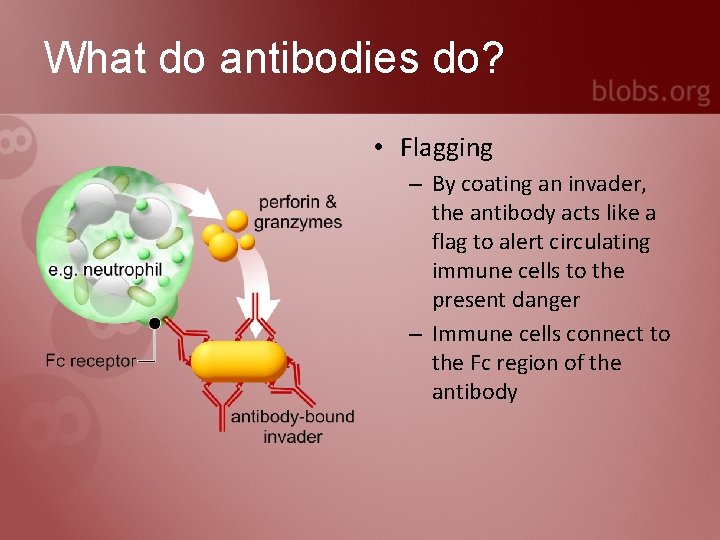
What do antibodies do? • Flagging – By coating an invader, the antibody acts like a flag to alert circulating immune cells to the present danger – Immune cells connect to the Fc region of the antibody
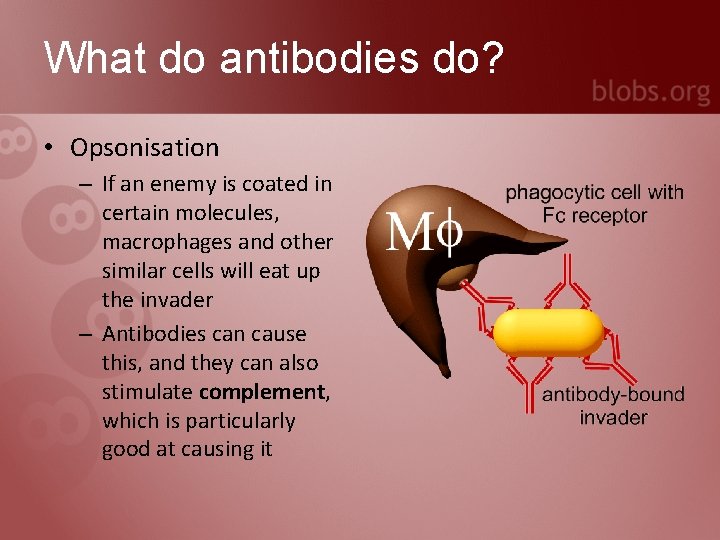
What do antibodies do? • Opsonisation – If an enemy is coated in certain molecules, macrophages and other similar cells will eat up the invader – Antibodies can cause this, and they can also stimulate complement, which is particularly good at causing it
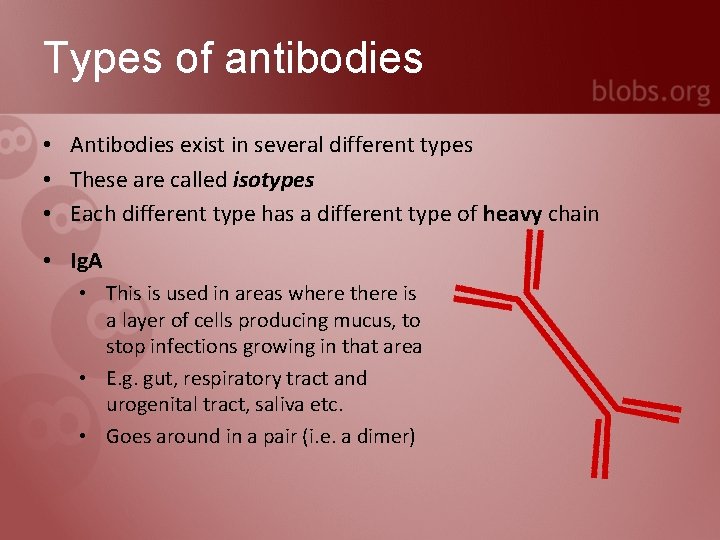
Types of antibodies • Antibodies exist in several different types • These are called isotypes • Each different type has a different type of heavy chain • Ig. A • This is used in areas where there is a layer of cells producing mucus, to stop infections growing in that area • E. g. gut, respiratory tract and urogenital tract, saliva etc. • Goes around in a pair (i. e. a dimer)
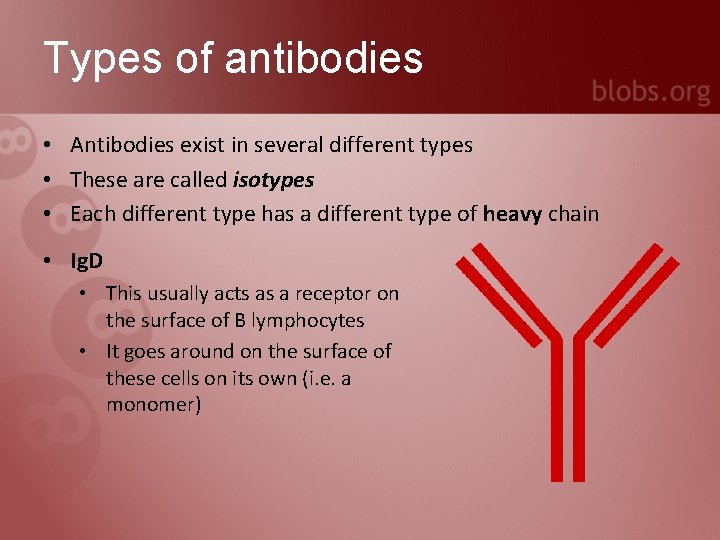
Types of antibodies • Antibodies exist in several different types • These are called isotypes • Each different type has a different type of heavy chain • Ig. D • This usually acts as a receptor on the surface of B lymphocytes • It goes around on the surface of these cells on its own (i. e. a monomer)
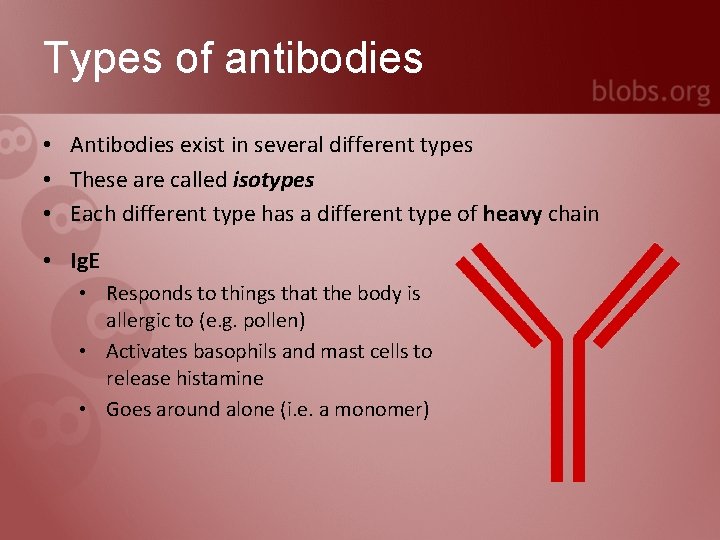
Types of antibodies • Antibodies exist in several different types • These are called isotypes • Each different type has a different type of heavy chain • Ig. E • Responds to things that the body is allergic to (e. g. pollen) • Activates basophils and mast cells to release histamine • Goes around alone (i. e. a monomer)
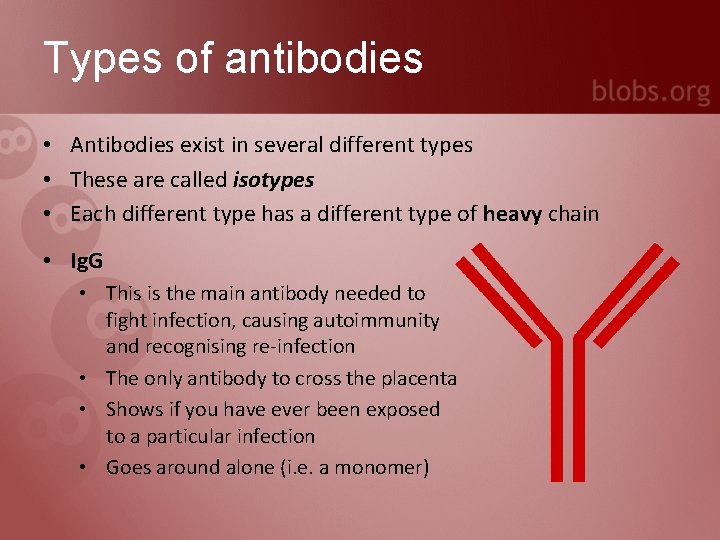
Types of antibodies • Antibodies exist in several different types • These are called isotypes • Each different type has a different type of heavy chain • Ig. G • This is the main antibody needed to fight infection, causing autoimmunity and recognising re-infection • The only antibody to cross the placenta • Shows if you have ever been exposed to a particular infection • Goes around alone (i. e. a monomer)
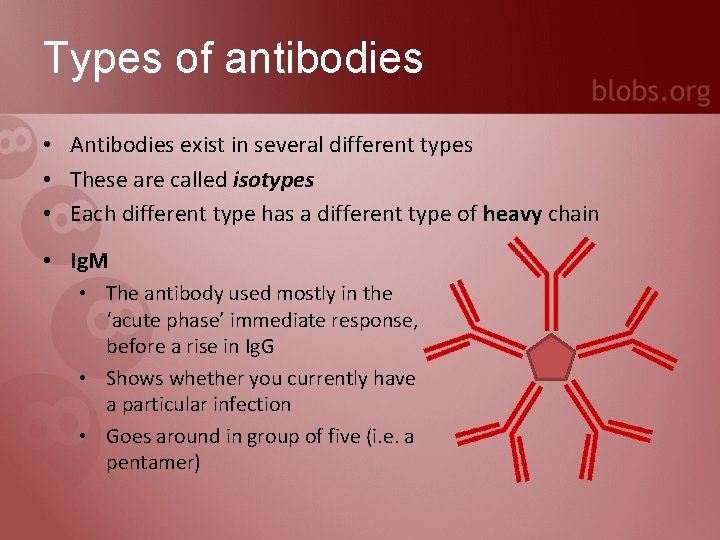
Types of antibodies • Antibodies exist in several different types • These are called isotypes • Each different type has a different type of heavy chain • Ig. M • The antibody used mostly in the ‘acute phase’ immediate response, before a rise in Ig. G • Shows whether you currently have a particular infection • Goes around in group of five (i. e. a pentamer)
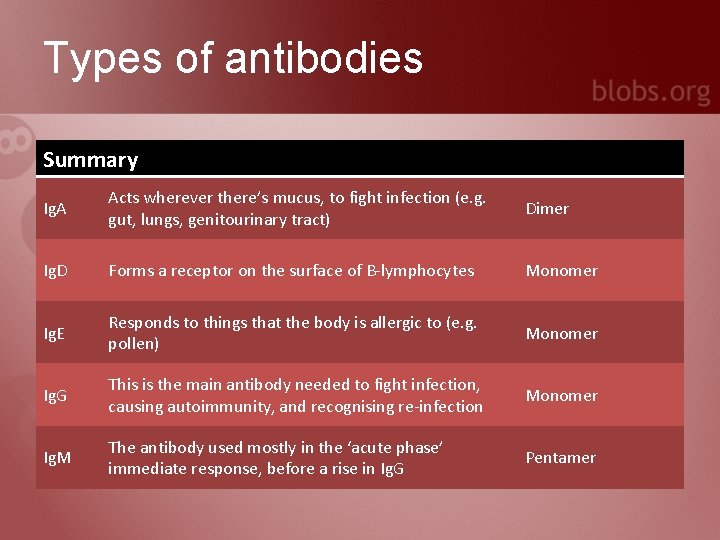
Types of antibodies Summary Ig. A Acts wherever there’s mucus, to fight infection (e. g. gut, lungs, genitourinary tract) Dimer Ig. D Forms a receptor on the surface of B-lymphocytes Monomer Ig. E Responds to things that the body is allergic to (e. g. pollen) Monomer Ig. G This is the main antibody needed to fight infection, causing autoimmunity, and recognising re-infection Monomer Ig. M The antibody used mostly in the ‘acute phase’ immediate response, before a rise in Ig. G Pentamer
Conclusion • Humoral immunity is an important way in which the body fights off infection • It is based around antibodies, which are groups of proteins that act like labels on invaders • Antibodies fight infection in three major ways: neutralising enemies, flagging them up to immune cells, and coating them to help them get eaten • Different isotypes of antibodies work in different ways and in different locations in the body

Any questions? Further reading: • De. Franco AL, Locksley RM, Roberston M (2007) Immunity: The Immune Response in Infectious and Inflammatory Disease. 5 th Ed. Oxford University Press • Frank SA. (2002) Immunology and Evolution of Infectious Disease. Princeton University Press • Janeway CA Jr. (1993) How the immune system recognizes invaders. Scientific American. 269(3): 72 -79 For more information, don’t forget to visit www. blobs. org
- Slides: 20