
Antibacterial Sulfonamides Sulfa drugs Chemistry and nomenclature Sulfamethazine
Antibacterial Sulfonamides (Sulfa drugs)

Chemistry and nomenclature Sulfamethazine
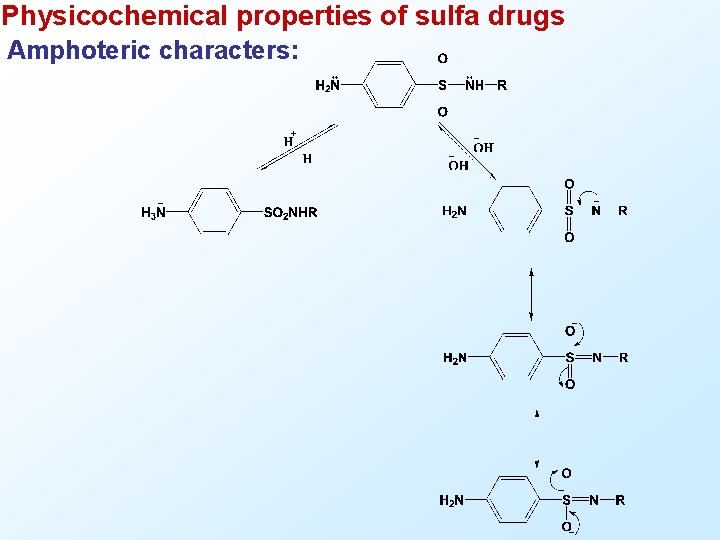
Physicochemical properties of sulfa drugs Amphoteric characters:
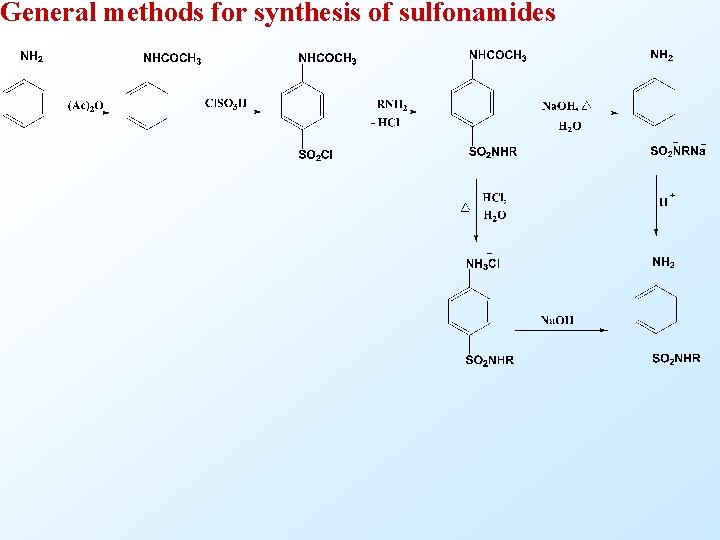
General methods for synthesis of sulfonamides

Structure activity relationship Change in A 1 Free NH 2 is essential for activity, substitution by another group such (NO 2, NHOH or acetylation (prodrugs) which will give free NH 2 in vivo upon reduction or hydrolysis or with acylated compounds which will give in vivo upon hydrolysis the free NH 2 (e. g. sulfasalazine, succinyl sulfathiazole and phthalyl sulfathiazole) still retain its activity. 2 Alkylation of NH 2 gives inactive compounds. 3 Removal of amino group or its substitution with another group gives inactive compounds. 4 Shifting of the NH 2 group to m position or to o position gives inactive compounds.
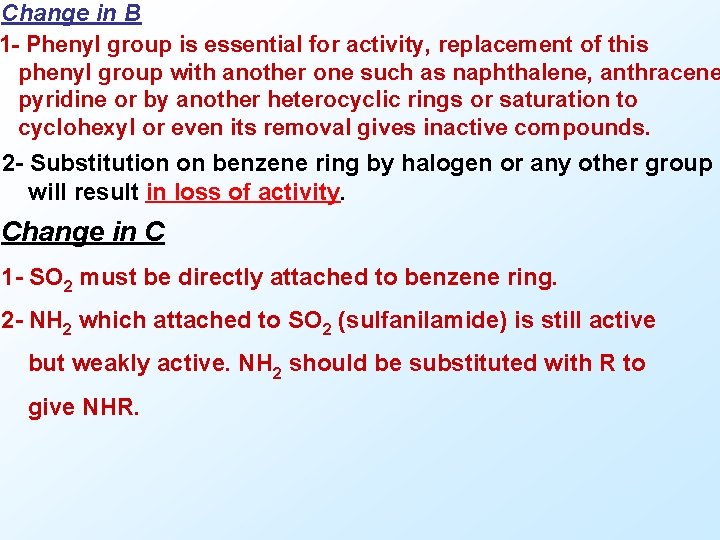
Change in B 1 Phenyl group is essential for activity, replacement of this phenyl group with another one such as naphthalene, anthracene pyridine or by another heterocyclic rings or saturation to cyclohexyl or even its removal gives inactive compounds. 2 Substitution on benzene ring by halogen or any other group will result in loss of activity. Change in C 1 SO 2 must be directly attached to benzene ring. 2 NH 2 which attached to SO 2 (sulfanilamide) is still active but weakly active. NH 2 should be substituted with R to give NHR.
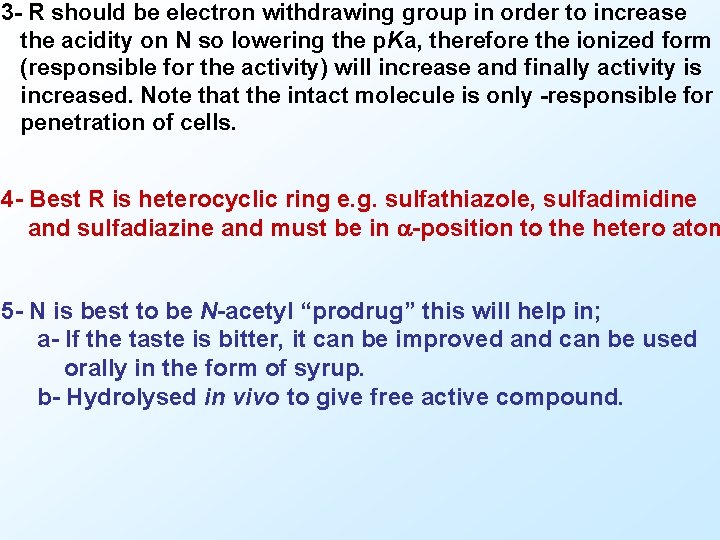
3 R should be electron withdrawing group in order to increase the acidity on N so lowering the p. Ka, therefore the ionized form (responsible for the activity) will increase and finally activity is increased. Note that the intact molecule is only responsible for penetration of cells. 4 Best R is heterocyclic ring e. g. sulfathiazole, sulfadimidine and sulfadiazine and must be in a position to the hetero atom 5 N is best to be N acetyl “prodrug” this will help in; a If the taste is bitter, it can be improved and can be used orally in the form of syrup. b Hydrolysed in vivo to give free active compound.
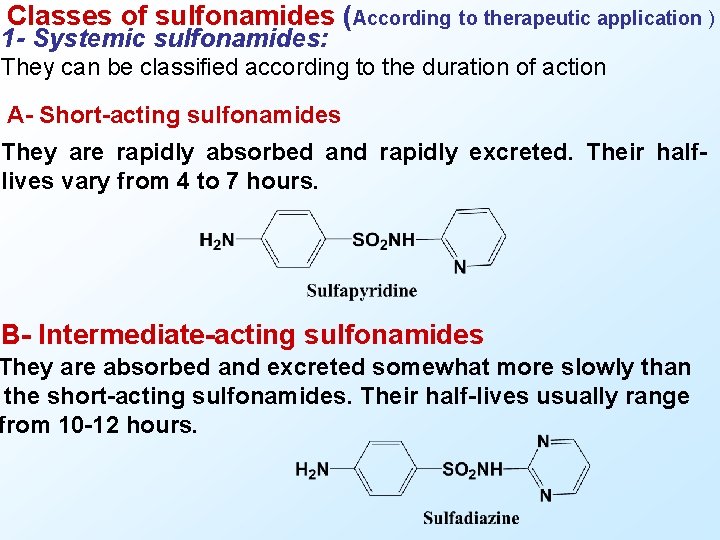
Classes of sulfonamides (According to therapeutic application ) 1 - Systemic sulfonamides: They can be classified according to the duration of action A Short acting sulfonamides They are rapidly absorbed and rapidly excreted. Their half lives vary from 4 to 7 hours. B Intermediate acting sulfonamides They are absorbed and excreted somewhat more slowly than the short acting sulfonamides. Their half lives usually range from 10 12 hours.
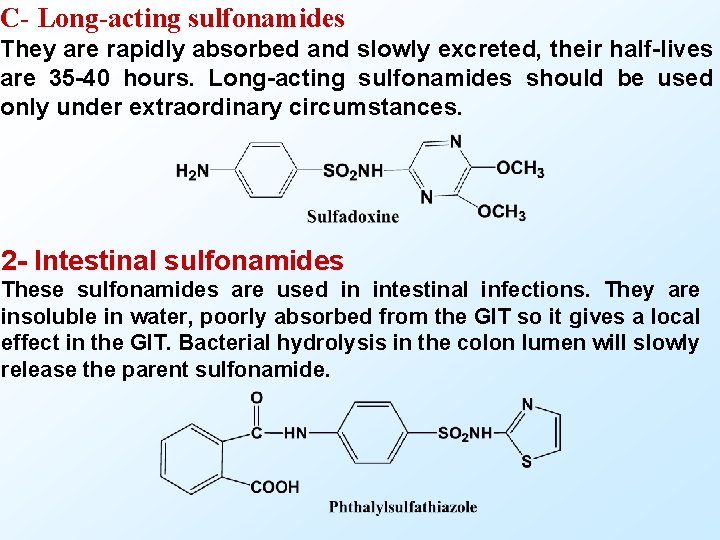
C- Long-acting sulfonamides They are rapidly absorbed and slowly excreted, their half lives are 35 40 hours. Long acting sulfonamides should be used only under extraordinary circumstances. 2 Intestinal sulfonamides These sulfonamides are used in intestinal infections. They are insoluble in water, poorly absorbed from the GIT so it gives a local effect in the GIT. Bacterial hydrolysis in the colon lumen will slowly release the parent sulfonamide.
![Sulfasalazine (USP) 5 -[p-(2 -pyridylsulfamoyl)phenylazo]salicylic acid.](http://slidetodoc.com/presentation_image_h2/63025150142587f85fc83ee00823a7d8/image-10.jpg "Sulfasalazine (USP) 5 -[p-(2 -pyridylsulfamoyl)phenylazo]salicylic acid.")
Sulfasalazine (USP) 5 -[p-(2 -pyridylsulfamoyl)phenylazo]salicylic acid.
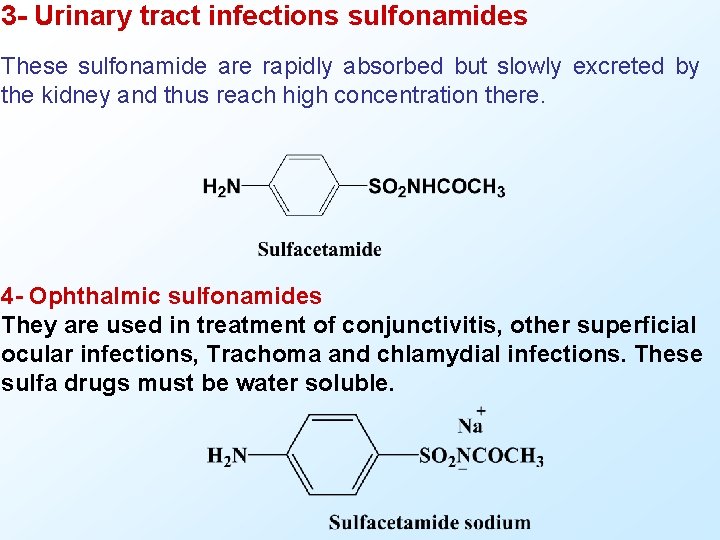
3 Urinary tract infections sulfonamides These sulfonamide are rapidly absorbed but slowly excreted by the kidney and thus reach high concentration there. 4 Ophthalmic sulfonamides They are used in treatment of conjunctivitis, other superficial ocular infections, Trachoma and chlamydial infections. These sulfa drugs must be water soluble.
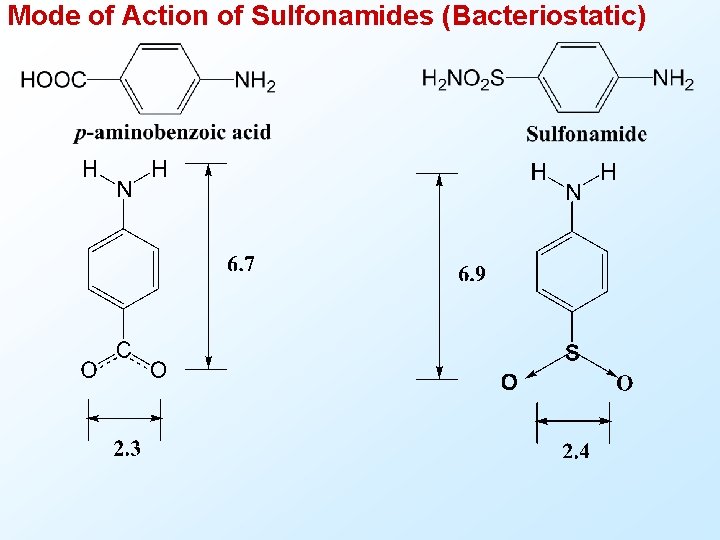
Mode of Action of Sulfonamides (Bacteriostatic)
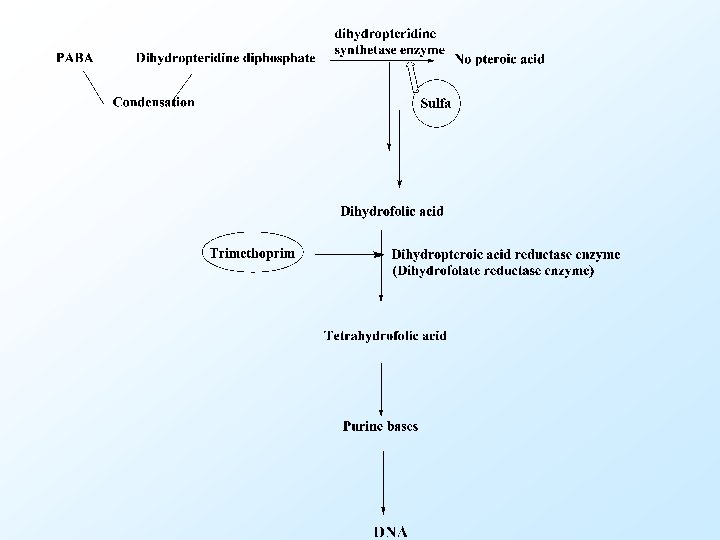
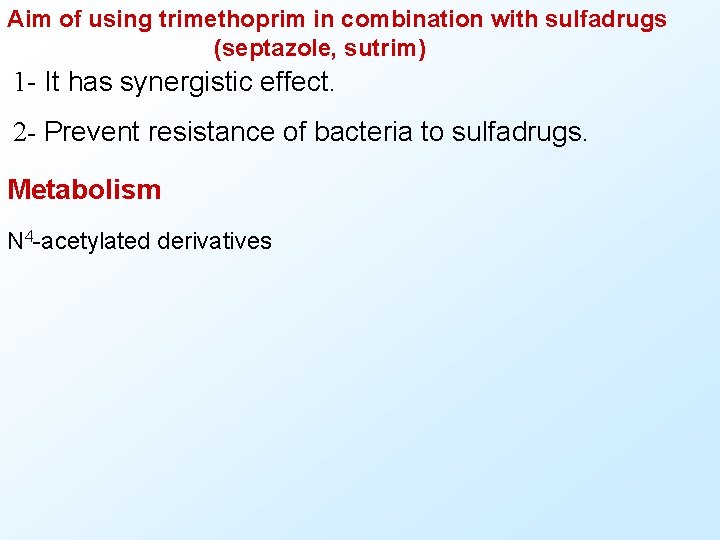
Aim of using trimethoprim in combination with sulfadrugs (septazole, sutrim) 1 - It has synergistic effect. 2 - Prevent resistance of bacteria to sulfadrugs. Metabolism N 4 -acetylated derivatives
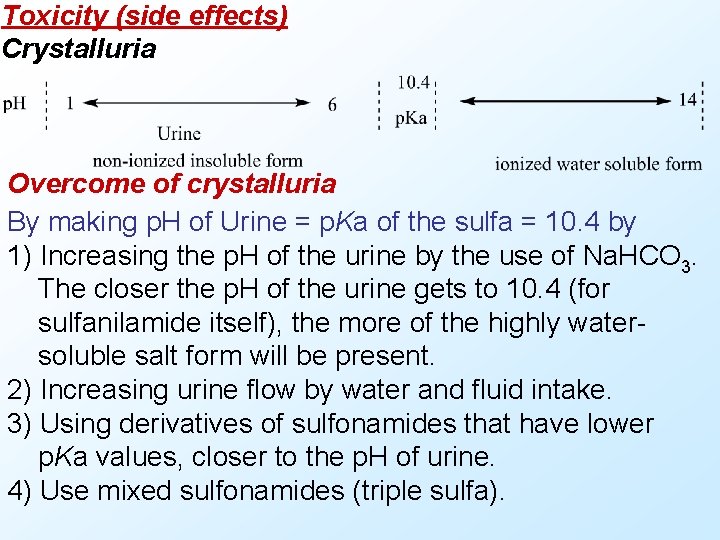
Toxicity (side effects) Crystalluria Overcome of crystalluria By making p. H of Urine = p. Ka of the sulfa = 10. 4 by 1) Increasing the p. H of the urine by the use of Na. HCO 3. The closer the p. H of the urine gets to 10. 4 (for sulfanilamide itself), the more of the highly watersoluble salt form will be present. 2) Increasing urine flow by water and fluid intake. 3) Using derivatives of sulfonamides that have lower p. Ka values, closer to the p. H of urine. 4) Use mixed sulfonamides (triple sulfa).
Mixed Sulfonamides 1) Sulfadiazine, sulfamerazine and sulfamethazine. (oral suspension or tablets). 2) Sulfacetamide, sulfadiazine and sulfamerazine (oral suspension). 3) Disulfa (sulfadiazine and sulfamerazine) (oral tablet) Other side effects including; Hypersensitivity, GIT irritation and diarrhea. Resistance Increasing the production of PABA
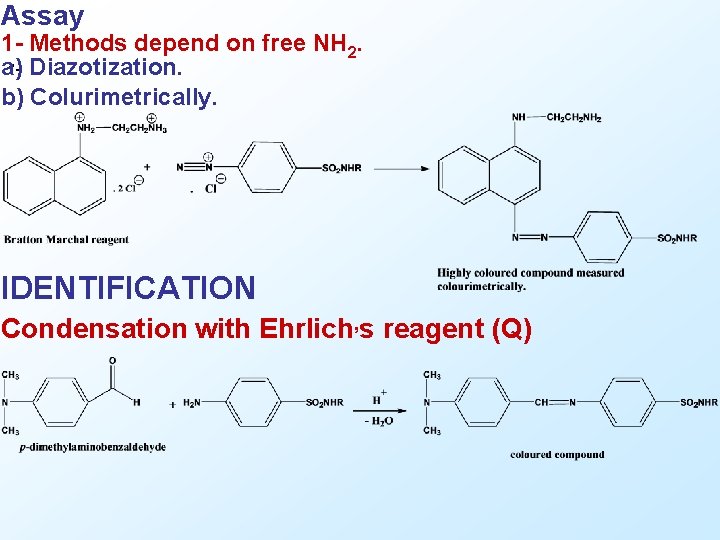
Assay 1 Methods depend on free NH 2. 1 - Diazotization. a) b) Colurimetrically. IDENTIFICATION Condensation with Ehrlich, s reagent (Q)
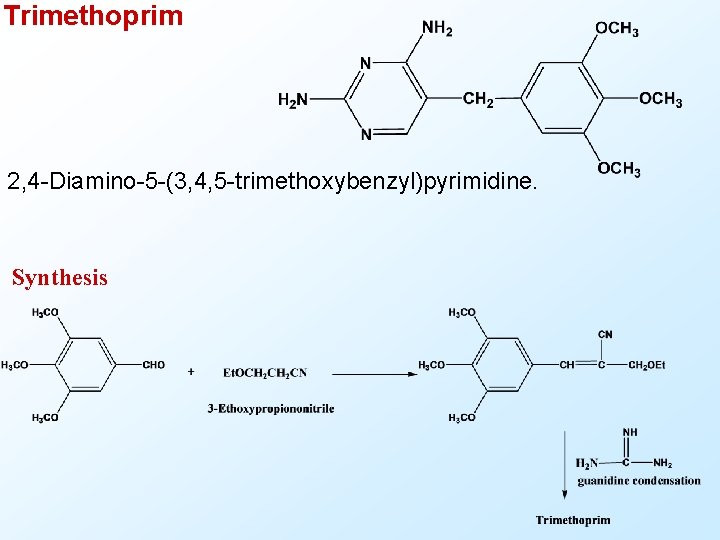
Trimethoprim 2, 4 -Diamino-5 -(3, 4, 5 -trimethoxybenzyl)pyrimidine. Synthesis
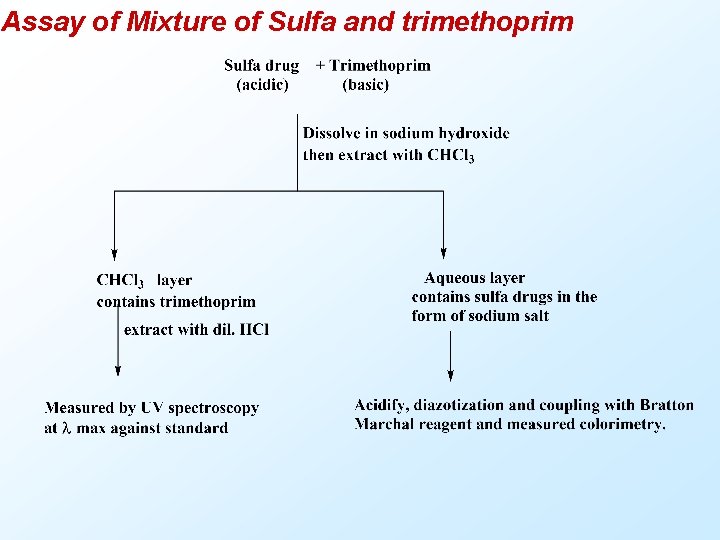
Assay of Mixture of Sulfa and trimethoprim
- Slides: 19