
Antiarrhythmics Antidysrhythmics Dysrhythmia Arrhythmia Defined as abnormality in
Antiarrhythmics
Antidysrhythmics �Dysrhythmia (Arrhythmia): �Defined as abnormality in the rhythm of the heartbeat. �Associated with high degree of morbidity/mortality �Types: �Tachydysrhythmias �Bradydysrhythmias

Antidysrhythmics �Vaughan Williams Classification: �Class I: Sodium Channel Blockers �Class II: Beta Blockers �Class III: Potassium Channel Blockers �Class IV: Calcium Channel Blockers �Class V: Other Antidysrhythmic Drugs

Classification of Antiarrhythmic Agents IA Quinidine Procainamide Disopyramide IB Lidocaine Mexiletine Tocainide IC Flecainide Propafenone Encainide

Class I: Sodium Channel Blockers �Sodium Channel Blockers: �Block cardiac sodium channels �Decrease conduction velocity in the atria, ventricles, and Purkinje system
�Class IA agents � Atrial fibrillation � Flutter; � Supraventricular & ventricular tachyarrhythmias Eg: Quinidine, procainamide
Class II: Beta Blockers Mechanism of action �Beta-blockers competetively bind to betaadrenoceptors located in cardiac nodal tissue, the conducting system, and contracting myocytes �Inhibit Renin release and reduce angiotensin II and aldosterone production �Reduce adrenegic outflow from CNS
�Therapeutic use �First line drug in treating HT �Especially useful with preexisting angina and MI
� Classes of beta-blockers 1 st generation - non selective BETA blockers eg : propanolol, sotalol, pindolol 2 nd generation - more cardio selective for B 1 eg : atenolol, bisoprolol, metoprolol, esmolol 3 rd generation - cardio selectivity + NO mediated vasodilator action eg : nebivolol, carvedilol Labetalol - combined alpha and beta blocker
� Side effects and contraindications � Bradycardia � Reduced exercise capacity � Heart failure � Hypotension � AV nodal conduction block � Bronchoconstriction – contraindicated in BA and COPD � Hypoglycaemia Contraindicated with sinus bradycardia and partial AV block. Be cautious when combining with cardio selective CCB`s eg : verapamil
Class III: Potassium Channel Blockers �Potassium Channel Blockers: �bind to and block the potassium channels that are responsible for repolarization
�Amiodarone �Effective against both atrial and ventricular dysrhythmias (only for life-threatening because of toxicity—lung damage/visual impairment)
Other Antidysrhythmic Drugs �Adenosine: �Slows conduction through the AV node �Treats SVT �Short plasma half life (less than 10 seconds) �Given IV—closest IV site to the heart, followed by push of saline
�Digoxin Treat only if there is a clear benefit and then only if the benefit outweighs the risks Treatment reduces: � Symptoms (palpitations, angina, dyspnea, and faintness) � Mortality
Antidysrhythmics: Bradydysrhythmias �Atropine: �Muscarinic Antagonist �Competitively block the actions of acetylcholine �Stimulation of muscarinic receptors decreases heart rate �Blocking these receptors will INCREASE heart rate
�Isoproterenol: �Acts on Beta-adrenergic receptors �Activates Beta 1 receptors on the heart-overcomes AV block, restarts the heart following cardiac arrest, increases cardiac output during shock
Quinidine • Type IA antiarrhythmic • Indicated for atrial fibrillation and ventricular tachycardias
Quinidine Adverse Effects • GI irritation • Bitter taste • Hepatitis & other hepatic conditions • Rash & drug fever • Thrombocytopenia • Cinchonism • • Tinnitus Blurred vision Headaches Dizziness
Quinidine • Hepatically eliminated (t 1/2 ~6 -8 hr) • Increases digoxin & warfarin levels
Procainamide �Type IA antiarrhythmic �Indicated for acute conversion of ventricular & atrial dysrhythmias
Procainamide • Short half-life (~3 hours) • Causes drug-induced SLE
Procainamide Adverse Effects • Gastrointestinal • CNS • Fever • Rash • Blood dyscrasias • Some negative inotropic properties • Hypotension w/ rapid IV infusions
Disopyramide • Type IA antiarrhythmic • Indicated in atrial and ventricular arrhythmias
Disopyramide Adverse Effects • Gastrointestinal • Negative inotrope • Anticholinergic adverse effects • Dry mouth • Blurred vision • Constipation • Urinary retention
Disopyramide • Elimination • ~50% hepatic • ~50% renal • Half-life • ~7 hours
Lidocaine • Type IB antiarrhythmic • Indicated in acute treatment and prevention of ventricular dysrhythmias
Lidocaine �Half Life �Initially, 1. 5 hours; but increases to 3. 0 hours 2 -3 days into therapy Ø Lidocaine reduces its own rate of metabolism
Lidocaine �Toxicity most often manifested by: Nausea Dizziness Drowsiness Confusion Tremors Facial numbness Paresthesias Peripheral numbness Altered speech Seizures
Flecainide • Type IC antiarrhythmic • Since it is very proarrhythmic: • Generally used only for atrial dysrhythmias
Flecainide Adverse Effects • Gastrointestinal • CNS • Negative inotrope Pharmacokinetics • Mostly hepatic clearance (60%); some renal (30%) • Half-life: ~20 hours
Propafenone • Type IC with some beta-blocking properties • Primarily used for atrial dysrhythmias • Rarely, ventricular
Propafenone Adverse Effects • Gastrointestinal • CNS • Negative inotrope • Metallic taste
Propafenone • Non-linear absorption & elimination • Hepatic elimination • Active metabolites • Extensive (90%) & Slow (10%) metabolizers • Increases digoxin levels
Sotalol • Non-selective beta-blocker with type III antiarrhythmic activity • Used to acutely treat and prevent atrial & ventricular dysrhythmias
Sotalol • Renally eliminated • Negative inotrope • Beta-blocker concerns • Torsade de pointes
Sotalol • Renally eliminated • Negative inotrope • Beta-blocker concerns • Torsade de pointes
Sotalol Now available parenterally • Indications • Ventricular tachyarrhythmias • Atrial fibrillation/flutter
Amiodarone �Type III antiarrhythmic agent �Contains alpha- & beta-receptor blocking properties as well as sodium-, potassium-, & calcium- channel blocking properties �Indicated for ventricular & atrial dysrhythmias
Amiodarone �Toxicities CNS Liver GI Thyroid Skin Bradycardia �Baseline labs �Thyroid �Liver �Pulmonary Cornea deposits Optic neuropathy Photosensitivity Pulmonary fibrosis (recheck every 6 mths) (annual CXR) Arch Intern Med 2000; 160: 1741 -8
Amiodarone �An allergy to iodine (but not contrast dye) is a contraindication to using amiodarone
Digoxin • Vagolytic effects slow heart rate and conduction through AV node • Used to slow the ventricular rate of atrial fibrillation
Digoxin • Loading dose • About 0. 0125 mg/kg of LBW • Give 50% now, then two doses of 25%; each separated by 4 -6 hours • Severe renal failure reduces the Vd; thus, a smaller loading dose is required • Therapeutic range: 1– 2 mcg/L
Digoxin – General Facts • • Half-life: 36 hours or longer Long distribution phase (6 -12 hours) Primarily renal elimination Important Drug interactions • Verapamil • Quinidine • Amiodarone • Propafenone • Effects reversed with Digibind & Digifab • Digibind/fab use impacts digoxin levels
Digoxin Adverse Effects Gastrointestinal Dysrhythmias Central nervous system Visual
DIGOXIN TOXICITY Precipitating Factors Hypokalemia Hypomagnesemia Hypercalcemia Hypothyroidism Amyloidosis
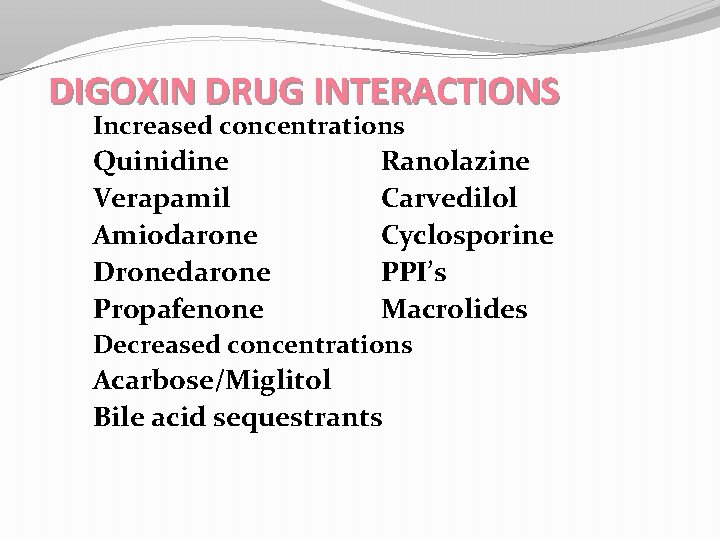
DIGOXIN DRUG INTERACTIONS Increased concentrations Quinidine Verapamil Amiodarone Dronedarone Propafenone Ranolazine Carvedilol Cyclosporine PPI’s Macrolides Decreased concentrations Acarbose/Miglitol Bile acid sequestrants
Adenosine �Rapid IV push (6 mg over 1 -2 sec) �When using IV line, flush with saline �If no effect after 1 -2 min, give 12 mg; may repeat 12 mg dose once �Short-term adverse effects: Flushing Shortness of breath Chest discomfort Asystole �Effects potentiated by dipyridamole �DO NOT use in heart transplant patients
Adenosine The effects of adenosine are antagonized by methylxanthines Ø Theophylline Ø Caffeine
TORSADE DE POINTES Cardiovascular Agents Type IA �Quinidine �Procainamide �Disopyramide Type III �Sotalol �Dronedarone �Ibutilide �Dofetilide Ranolazine
TORSADE DE POINTES Treatment �Discontinue causative medication �Correct hypokalemia & hypomagnesemia �Give magnesium 1 -2 grams IV �To prevent subsequent episodes, increase heart rate until cause of Td. P is corrected and/or cleared from the body �Temporary pacemaker �Isoproterenol Cardioversion is only indicated when patient becomes hemodynamically compromised
TORSADE DE POINTES Antimicrobials Pentamidine Macrolides �Erythromycin & Clarithromycin Ketolides �Telithromycin Fluoroquinolones �Moxifloxacin
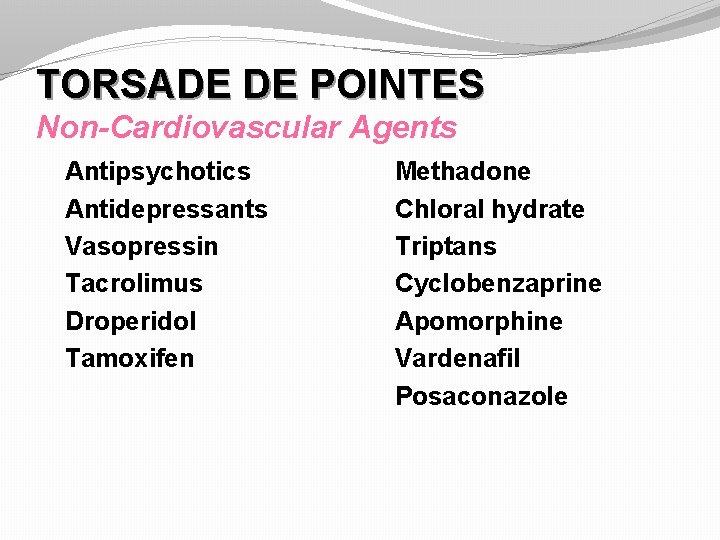
TORSADE DE POINTES Non-Cardiovascular Agents Antipsychotics Antidepressants Vasopressin Tacrolimus Droperidol Tamoxifen Methadone Chloral hydrate Triptans Cyclobenzaprine Apomorphine Vardenafil Posaconazole
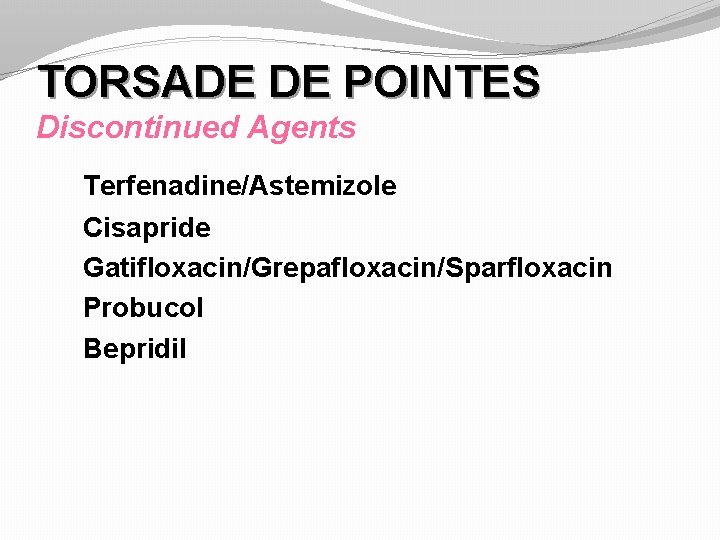
TORSADE DE POINTES Discontinued Agents Terfenadine/Astemizole Cisapride Gatifloxacin/Grepafloxacin/Sparfloxacin Probucol Bepridil

THANK YOU
- Slides: 54