
Antiarrhythmic Drugs Class I Antiarrhythmic Drugs n n
- Slides: 20
Antiarrhythmic Drugs
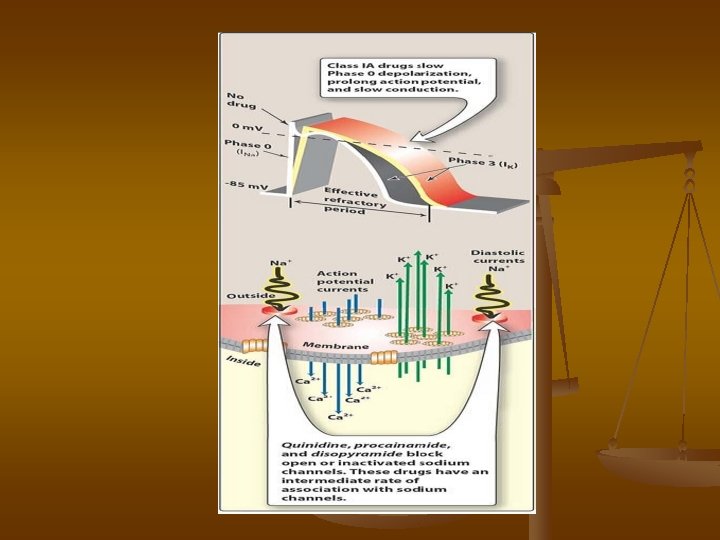
Class I Antiarrhythmic Drugs n n n Class I antiarrhythmic drugs act by blocking voltagesensitive sodium channels via the same mechanism as local anesthetics. The decreased rate of entry of sodium slows the rate of rise of Phase 0 of the action potential. Class I antiarrhythmic drugs, therefore, generally cause a decrease in excitability and conduction velocity. A. Use-dependence n Class I drugs bind more rapidly to open or inactivated sodium channels than to channels that are fully repolarized following recovery from the previous depolarization cycle.
Class I drugs # Class IA agents - slow the rate of rise of the action potential (thus slowing conduction) prolong the action potential, and increase the ventricular effective refractory period. - They have an intermediate speed of association with activated/inactivated sodium-channels and an intermediate rate of dissociation from resting channels. # Class IB drugs - They rapidly interact with sodium channels. # Class IC agents - markedly depress the rate of rise of the membrane action potential. They bind slowly to sodium channels.
Quinidine n It is IA drug with Class III activity n n n n Mechanism of action: Quinidine binds to open and inactivated sodium channels and prevents sodium influx, thus slowing the rapid upstroke during Phase 0. It also decreases the slope of Phase 4 spontaneous depolarization and inhibits potassium channels. Therapeutic uses: used in AV-junctional, and ventricular tachyarrhythmias. Quinidine is used to maintain sinus rhythm after direct-current cardioversion of atrial flutter or fibrillation and to prevent frequent ventricular tachycardia. Adverse effects: Torsde de point, Asystole, Anticholinergic, cinchonism
Procainamide n n n Actions: This Class IA drug, a derivative of the local anesthetic procaine, shows actions similar to those of quinidine. Pharmacokinetics: It is acetylated in the liver to N-acetylprocainamide (NAPA). NAPA has properties of a Class III drug. NAPA is eliminated via the kidney, and dosages of procainamide may need to be adjusted in patients with renal failure. Adverse effects: reversible lupus erythematosus“like syndrome asystole or induction of ventricular arrhythmias. depression, hallucination, and psychosis.
Disopyramide n n Actions: This Class IA drug shows actions similar to those of quinidine. Disopyramide causes peripheral vasoconstriction. Used in the treatment of ventricular arrhythmias as an alternative to procainamide or quinidine. Adverse effects: Disopyramide shows effects of anticholinergic activity (for example, dry mouth, urinary retention, blurred vision, and constipation).
Lidocaine n It is a Class IB drug. Therapeutic uses: n Lidocaine is useful in treating ventricular arrhythmias arising during myocardial ischemia, such as that experienced during a myocardial infarction. n Pharmacokinetics: Lidocaine is given intravenously because of extensive first-pass transformation by the liver, n Adverse effects: Lidocaine has a fairly wide toxic -to-therapeutic ratio. It shows little impairment of left ventricular function and has no negative inotropic effect n CNS effects include drowsiness, slurred speech, paresthesia, agitation, confusion, and convulsions. n Cardiac arrhythmias may also occur. n
Mexiletine and tocainide These Class IB drugs have actions similar to those of lidocaine, and they can be administered orally. n Mexiletine is used for chronic treatment of ventricular arrhythmias associated with previous myocardial infarction. n Tocainide is used for treatment of ventricular tachyarrhythmias n Tocainide causes pulmonary fibrosis. Flecainide It is a Class IC drug. n Therapeutic uses: n in treating refractory ventricular arrhythmias. It is particularly useful in suppressing premature ventricular contraction. n Flecainide has a negative inotropic effect and can aggravate congestive heart failure. n Propafenone: Class IC similar flecainide. n
Class II Antiarrhythmic Drugs (Beta-blockers) ►These drugs diminish Phase 4 depolarization, thus depressing automaticity, prolonging AV conduction, and decreasing heart rate and contractility. ► uses ♥ tachyarrhythmias caused by increased sympathetic activity. ♥ atrial flutter and fibrillation ♥ AV-nodal reentrant tachycardia. ♥ Propranolol reduces the incidence of sudden arrhythmic death after myocardial infarction Metoprolol n it reduces the risk of bronchospasm. Esmolol n It is a very short-acting beta-blocker used for intravenous administration in acute arrhythmias that occur during surgery or emergency situations.
Class II Antiarrhythmic Drugs (Beta-blockers) n These drugs diminish Phase 4 depolarization, thus depressing automaticity, prolonging AV conduction, and decreasing heart rate and contractility. n Class II agents are useful in treating tachyarrhythmias caused by increased sympathetic activity. They are also used for atrial flutter and fibrillation and for AVnodal reentrant tachycardia. [ n Propranolol reduces the incidence of sudden arrhythmic death after myocardial infarction n n B. Metoprolol it reduces the risk of bronchospasm. C. Esmolol It is a very short-acting beta-blocker used for intravenous administration in acute arrhythmias that occur during surgery or emergency situations.
Class III Antiarrhythmic Drugs Amiodarone ☺ it contains iodine and is related structurally to thyroxine. ☺ Class I, III, and IV actions. Its dominant effect is prolongation of the action potential duration and the refractory period. ☺ Therapeutic uses: ♦ treatment of severe refractory supraventricular and ventricular tachyarrhythmias. ♦ Despite its side-effect profile, amiodarone is the most commonly employed antiarrhythmic. ☺ Pharmacokinetics: n It has a prolonged half-life of several weeks, and it distributes extensively in adipose tissue. Full clinical effects achieved until 6 weeks
☺ Adverse effects: ► interstitial pulmonary fibrosis ► gastrointestinal tract intolerance ► tremor, ataxia, dizziness ► hyper- or hypothyroidism ► Liver toxicity ► photosensitivity ► neuropathy ► muscle weakness ► blue skin discoloration caused by iodine accumulation in the skin.
Sotalol ► class III antiarrhythmic agent and has potent nonselective beta-blocker activity. ► It prolongs both repolarization and duration of the action potential, thus lengthening the effective refractory period. Therapeutic uses: ► antiarrhythmic ► Beta-Blockers are used for long-term therapy to decrease the rate of sudden death following an acute myocardial infarction.
Class IV Antiarrhythmic Drugs n Class IV drugs are calcium-channel blockers resulting in a decreased rate of Phase 4 spontaneous depolarization. They also slow conduction in tissues that are dependent on calcium currents, such as the AV node. Verapamil and diltiazem n Verapamil shows greater action on the heart n n than on vascular smooth muscle nifedipine, a calcium-channel blocker used to treat hypertension exerts a stronger effect on the vascular smooth muscle than on the heart. Diltiazem is intermediate in its actions.
Actions: ►Verapamil and diltiazem bind only to open, depolarized channels so they are therefore usedependent ► verapamil and diltiazem slow conduction and prolong the effective refractory period in tissues that are dependent on calcium currents, as the AV node. ► They treat arrhythmias that must traverse calcium-dependent cardiac tissues.
☺ Therapeutic uses: ► Verapamil and diltiazem are more effective against atrial than ventricular arrhythmias. ► They are useful in treating reentrant supraventricular tachycardia and in reducing the ventricular rate in atrial flutter and fibrillation. ► They used to treat hypertension and angina. ☺ Adverse effects: ► Verapamil and diltiazem have negative inotropic and contraindicated in patients with preexisting depressed cardiac function. Both ► drugs can also produce a decrease in blood pressure because of peripheral vasodilation an effect that is actually beneficial in treating hypertension.
► Digoxin n It decreases conduction velocity in the AV node. n Digoxin is used to control the ventricular response rate in atrial fibrillation and flutter. n At toxic concentrations, digoxin causes ventricular tachycardia and fibrillation which treated with lidocaine or phenytoin. ► Adenosine Mechanism of action inhibition of the slow inward calcium current and activates adenylate cyclase through A 2 receptors in smooth muscle at high doses, the drug decreases conduction velocity, prolongs the refractory period, and decreases automaticity in the AV node. n Intravenous adenosine is the drug of choice for abolishing acute supraventricular tachycardia. It has low toxicity but causes flushing, chest pain, and hypotension. n short duration of action (15 sec).
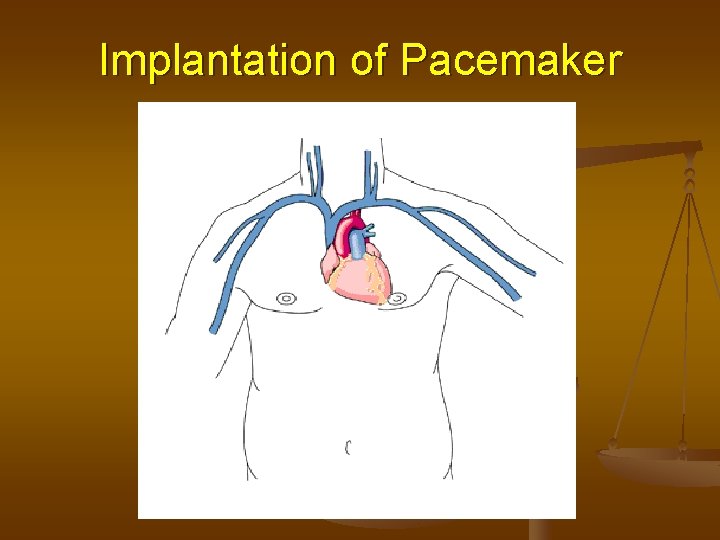
Pacemakers Surgical implantation of electrical leads attached to a pulse generator 1 - Leads are inserted via subclavicle vein and advanced to the chambers on the vena cava (right) side of the heart n Two leads used, one for right atrium, other for right ventricle 1) Pulse generator containing microcircuit and battery are attached to leads and placed into a “pocket” under the skin near the clavicle 2) Pulse generator sends signal down leads in programmed sequence to contract atria, then ventricles Pulse generator can sense electrical activity generated by the heart and only deliver electrical
Implantation of Pacemaker