Anti Counterfeiting Technologies EE 126 Computer Engineering Clifford

- Slides: 10
Anti Counterfeiting Technologies EE 126 Computer Engineering Clifford C Youn
What’s Counterfeiting? • Forged, copied or imitated without the perpetrator having the right to do with the purpose of deceiving or defrauding • Potential negative ramifications of counterfeit parts with altered serial numbers being sourced and distributed in the supplier networks • Damage from Counterfeiting – About 5 -7% of total world trade - $600 billion 1) – Poor product quality, deterioration of the brand, concern for consumer safety, decrease in company’s revenue 1) IAAC (International Anti Counterfeiting Coalition), 2012
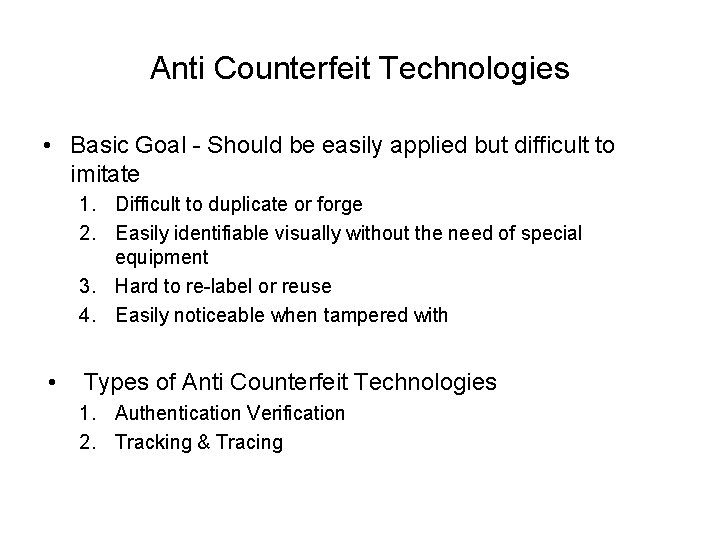
Anti Counterfeit Technologies • Basic Goal - Should be easily applied but difficult to imitate 1. Difficult to duplicate or forge 2. Easily identifiable visually without the need of special equipment 3. Hard to re-label or reuse 4. Easily noticeable when tampered with • Types of Anti Counterfeit Technologies 1. Authentication Verification 2. Tracking & Tracing
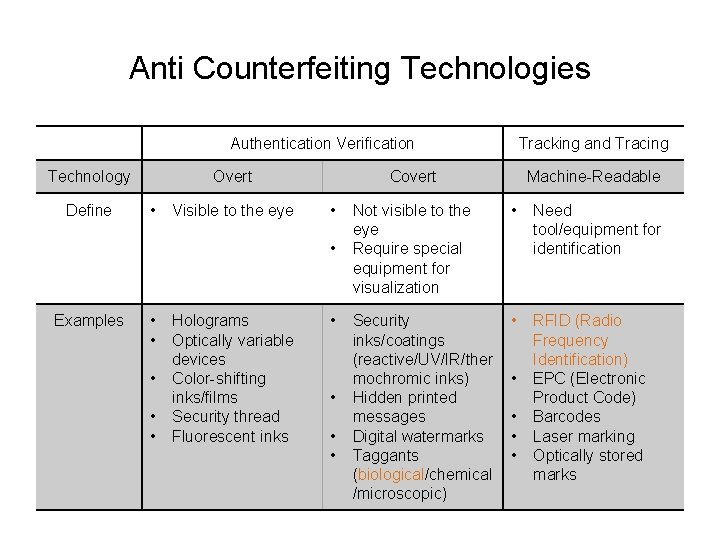
Anti Counterfeiting Technologies Authentication Verification Technology Define Overt • Visible to the eye Covert • • Examples • • • Holograms Optically variable devices Color-shifting inks/films Security thread Fluorescent inks Tracking and Tracing • • Machine-Readable Not visible to the eye Require special equipment for visualization • Need tool/equipment for identification Security inks/coatings (reactive/UV/IR/ther mochromic inks) Hidden printed messages Digital watermarks Taggants (biological/chemical /microscopic) • RFID (Radio Frequency Identification) EPC (Electronic Product Code) Barcodes Laser marking Optically stored marks • •
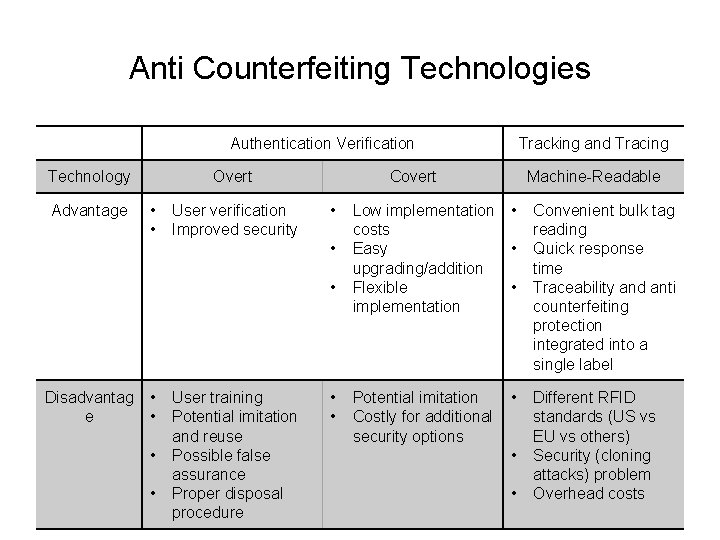
Anti Counterfeiting Technologies Authentication Verification Technology Advantage Overt • • User verification Improved security Covert • • • Disadvantag • e • • • User training Potential imitation and reuse Possible false assurance Proper disposal procedure Tracking and Tracing • • Machine-Readable Low implementation • costs Easy • upgrading/addition Flexible • implementation Potential imitation Costly for additional security options • • • Convenient bulk tag reading Quick response time Traceability and anti counterfeiting protection integrated into a single label Different RFID standards (US vs EU vs others) Security (cloning attacks) problem Overhead costs
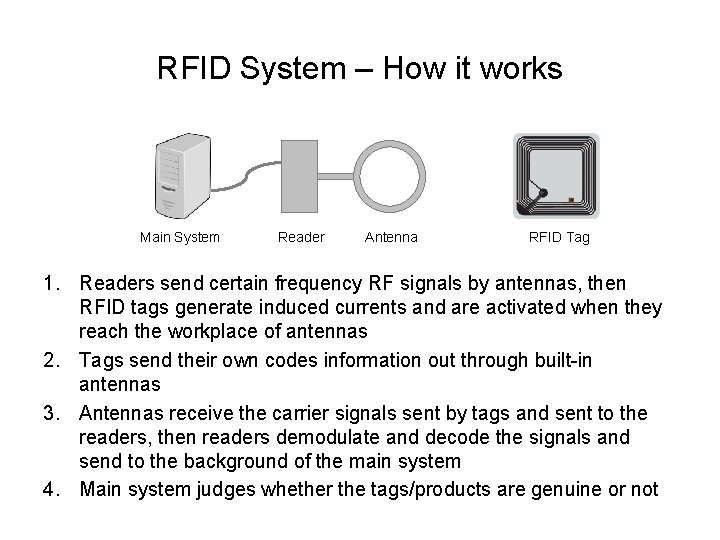
RFID System – How it works Main System Reader Antenna RFID Tag 1. Readers send certain frequency RF signals by antennas, then RFID tags generate induced currents and are activated when they reach the workplace of antennas 2. Tags send their own codes information out through built-in antennas 3. Antennas receive the carrier signals sent by tags and sent to the readers, then readers demodulate and decode the signals and send to the background of the main system 4. Main system judges whether the tags/products are genuine or not
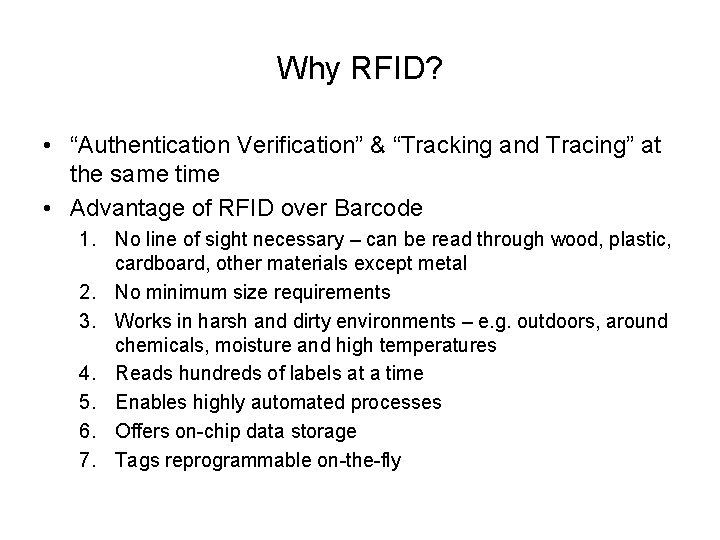
Why RFID? • “Authentication Verification” & “Tracking and Tracing” at the same time • Advantage of RFID over Barcode 1. No line of sight necessary – can be read through wood, plastic, cardboard, other materials except metal 2. No minimum size requirements 3. Works in harsh and dirty environments – e. g. outdoors, around chemicals, moisture and high temperatures 4. Reads hundreds of labels at a time 5. Enables highly automated processes 6. Offers on-chip data storage 7. Tags reprogrammable on-the-fly
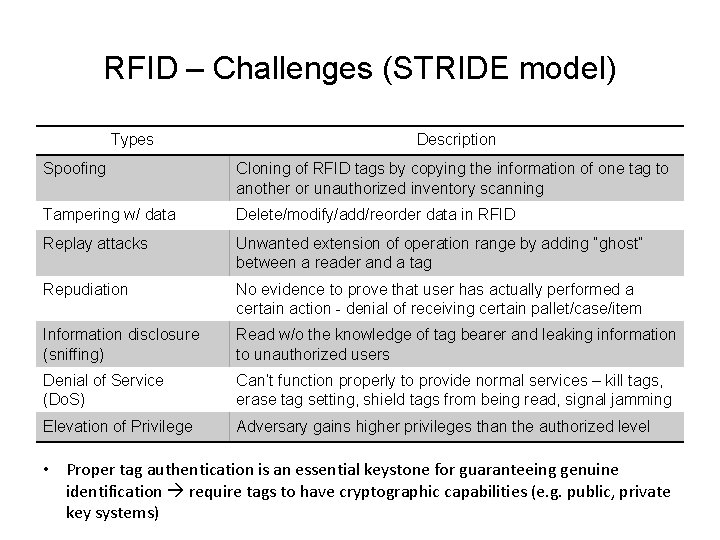
RFID – Challenges (STRIDE model) Types Description Spoofing Cloning of RFID tags by copying the information of one tag to another or unauthorized inventory scanning Tampering w/ data Delete/modify/add/reorder data in RFID Replay attacks Unwanted extension of operation range by adding “ghost” between a reader and a tag Repudiation No evidence to prove that user has actually performed a certain action - denial of receiving certain pallet/case/item Information disclosure (sniffing) Read w/o the knowledge of tag bearer and leaking information to unauthorized users Denial of Service (Do. S) Can’t function properly to provide normal services – kill tags, erase tag setting, shield tags from being read, signal jamming Elevation of Privilege Adversary gains higher privileges than the authorized level • Proper tag authentication is an essential keystone for guaranteeing genuine identification require tags to have cryptographic capabilities (e. g. public, private key systems)
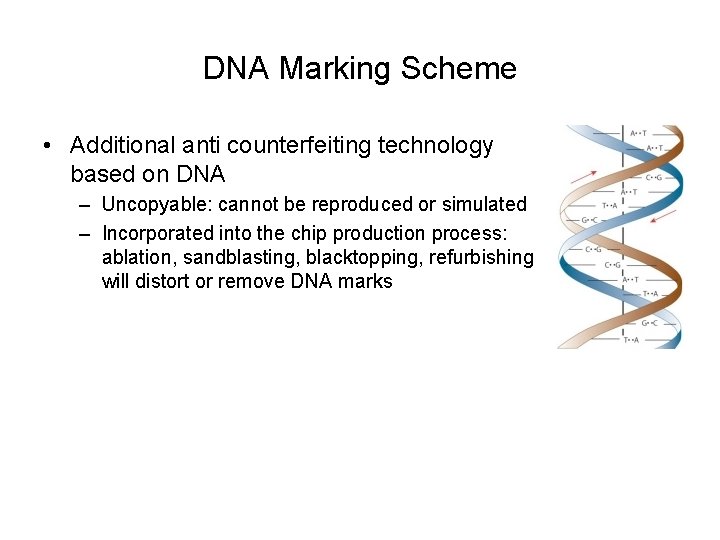
DNA Marking Scheme • Additional anti counterfeiting technology based on DNA – Uncopyable: cannot be reproduced or simulated – Incorporated into the chip production process: ablation, sandblasting, blacktopping, refurbishing will distort or remove DNA marks
Thank you!