
Anthropometry n Literally The measure of man quantifies


- Slides: 10
Anthropometry n Literally, ‘The measure of man’ ¨ quantifies n human variability What? ¨ physical measures ¨ height, weight, reach, length, width, depth, circumference, surface area, etc. ¨ strength, dexterity, range of motion ISE 311 - 5 1
Why? n We are not all the same size. ¨ Exclude n“Let as few as possible: the small person reach, let the large person fit. ” ¨ Poor design for mechanical abilities of the human body can lead to discomfort or injury, e. g. , the height of keyboard for a computer. n Sources of Anthropometry Data ¨ Text n. Ergo disk ¨ Tables in books in the HF/SQC lab (215) ¨ Online sources, e. g. http: //www. cdc. gov/nchs/about/major/nhanes/Anthropometric%20 Measures. htm ISE 311 - 5 2
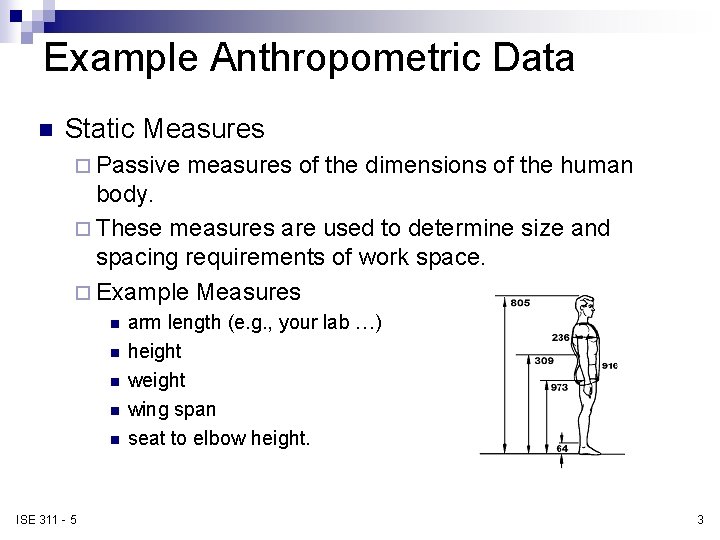
Example Anthropometric Data n Static Measures ¨ Passive measures of the dimensions of the human body. ¨ These measures are used to determine size and spacing requirements of work space. ¨ Example Measures n n n ISE 311 - 5 arm length (e. g. , your lab …) height wing span seat to elbow height. 3
More Anthropometric Data n Dynamic Measures ¨ Measures of the dynamic properties of the human body, such as strength and endurance. ¨ These measures are used to match the dynamic characteristics of controls to user. ¨ Measures n n n ISE 311 - 5 range of motion for various joints force of leg pushes strength of fingers 4
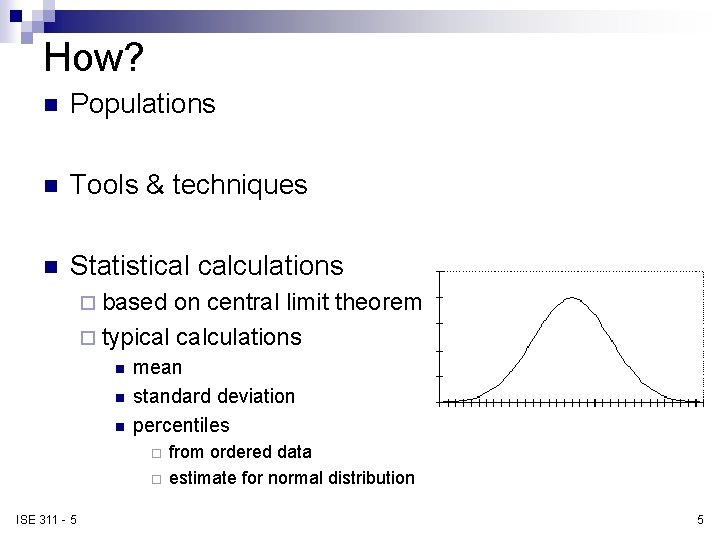
How? n Populations n Tools & techniques n Statistical calculations ¨ based on central limit theorem ¨ typical calculations n n n mean standard deviation percentiles ¨ ¨ ISE 311 - 5 from ordered data estimate for normal distribution 5
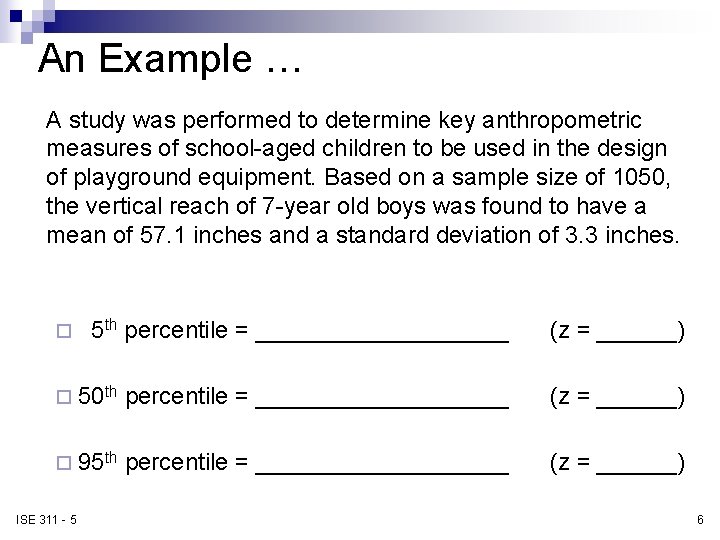
An Example … A study was performed to determine key anthropometric measures of school-aged children to be used in the design of playground equipment. Based on a sample size of 1050, the vertical reach of 7 -year old boys was found to have a mean of 57. 1 inches and a standard deviation of 3. 3 inches. ¨ 5 th percentile = __________ (z = ______) ¨ 50 th percentile = __________ (z = ______) ¨ 95 th percentile = __________ (z = ______) ISE 311 - 5 6
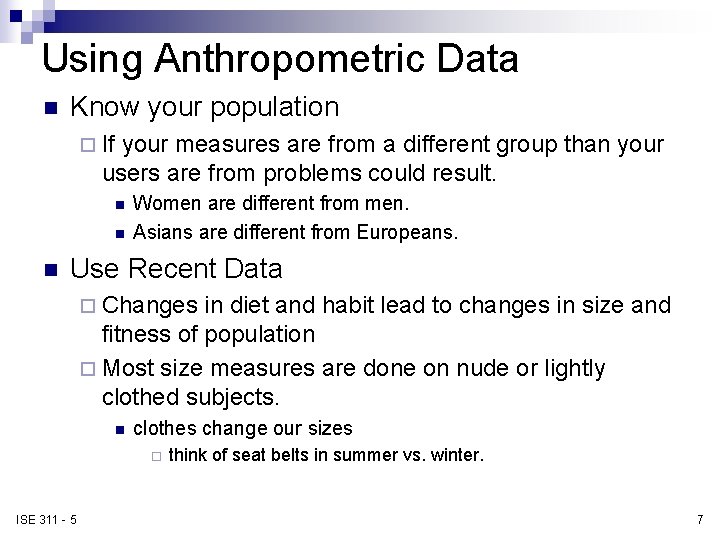
Using Anthropometric Data n Know your population ¨ If your measures are from a different group than your users are from problems could result. n n n Women are different from men. Asians are different from Europeans. Use Recent Data ¨ Changes in diet and habit lead to changes in size and fitness of population ¨ Most size measures are done on nude or lightly clothed subjects. n clothes change our sizes ¨ ISE 311 - 5 think of seat belts in summer vs. winter. 7
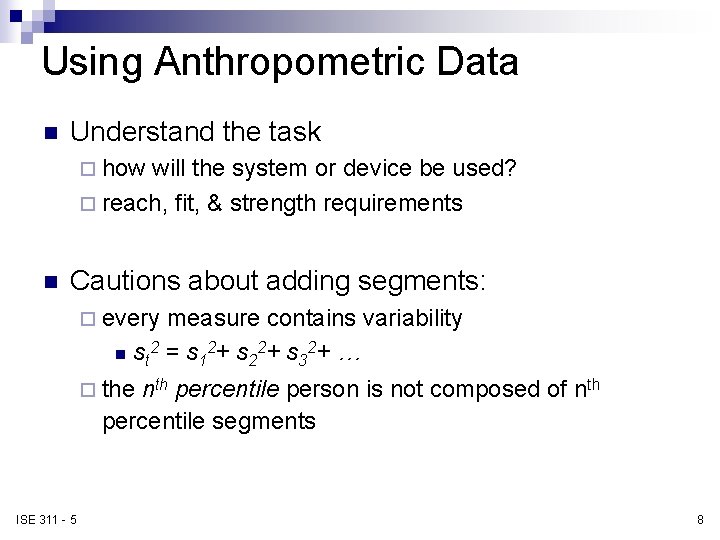
Using Anthropometric Data n Understand the task ¨ how will the system or device be used? ¨ reach, fit, & strength requirements n Cautions about adding segments: ¨ every measure contains variability n st 2 = s 12+ s 22+ s 32+ … ¨ the nth percentile person is not composed of nth percentile segments ISE 311 - 5 8
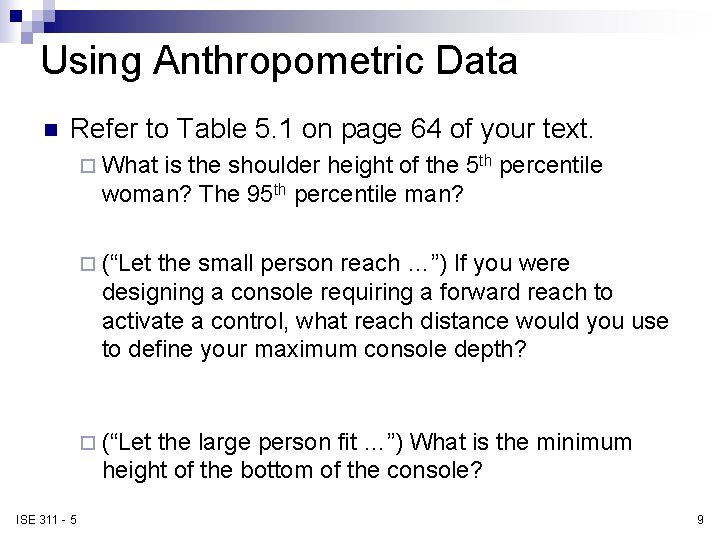
Using Anthropometric Data n Refer to Table 5. 1 on page 64 of your text. ¨ What is the shoulder height of the 5 th percentile woman? The 95 th percentile man? ¨ (“Let the small person reach …”) If you were designing a console requiring a forward reach to activate a control, what reach distance would you use to define your maximum console depth? ¨ (“Let the large person fit …”) What is the minimum height of the bottom of the console? ISE 311 - 5 9
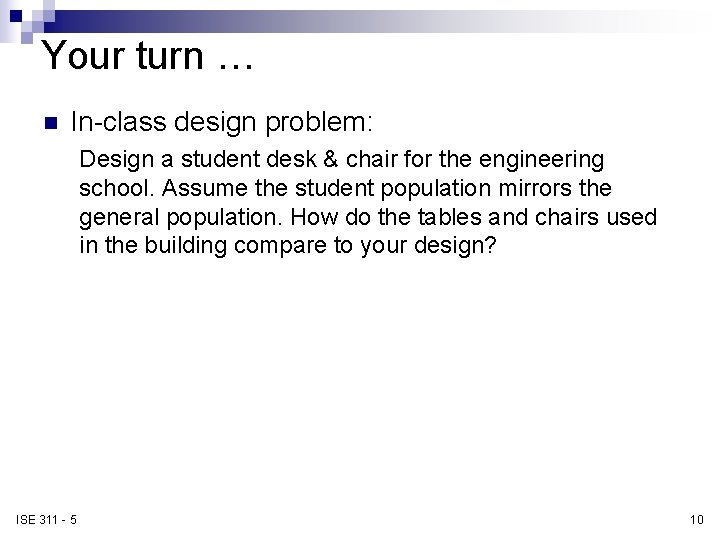
Your turn … n In-class design problem: Design a student desk & chair for the engineering school. Assume the student population mirrors the general population. How do the tables and chairs used in the building compare to your design? ISE 311 - 5 10