
ANTHROPOLOGY Mans Search for God They heard the
- Slides: 50
ANTHROPOLOGY Man’s Search for God They heard the sound of the LORD God walking in the garden in the cool of the day, and the man and his wife hid themselves from the presence of the LORD God among the trees of the garden. Then the LORD God called to the man, and said to him, “Where are you? ” Man’s search for God begins with God’s search for man. Those words are what echo in the heart of fallen man, whom even though separated from God by sin and devoid of his presence, sense deep inside that there is something missing, an innate presence of something outside of himself which explains his existence and ever draws him to seek and understand that which he does not know. And thus, Separated from God, Man endeavors to restore that which he lost.
Genesis 4: 1 -8 After the fall Adam teaches his children to worship the Lord and God continues to have a relationship with his creation. “Now the man had relations with his wife Eve, and she conceived and gave birth to Cain, and she said, “I have gotten a man child with the help of the LORD. ” Again, she gave birth to his brother Abel. And Abel was a keeper of flocks, but Cain was a tiller of the ground. So it came about in the course of time that Cain brought an offering to the LORD of the fruit of the ground. Abel, on his part also brought of the firstlings of his flock and of their fat portions. And the LORD had regard for Abel and for his offering; but for Cain and for his offering He had no regard. So Cain became very angry and his countenance fell. Then the LORD said to Cain, “Why are you angry? And why has your countenance fallen? “If you do well, will not your countenance be lifted up? And if you do not do well, sin is crouching at the door; and its desire is for you, but you must master it. ” Cain told Abel his brother. And it came about when they were in the field, that Cain rose up against Abel his brother and killed him. ” (Genesis 4: 1– 8 NAS 95) Sin and rebellion cause continued separation from the presence of God and leads to further sin and rebellion.
Genesis Before the Flood Son’s of God “Adam had relations with his wife again; and she gave birth to a son, and named him Seth, for, she said, “God has appointed me another offspring in place of Abel, for Cain killed him. ” To Seth, to him also a son was born; and he called his name Enosh. Then men began to call upon the name of the LORD. ” (Genesis 4: 25– 26 NAS 95) “This is the book of the generations of Adam. In the day when God created man, He made him in the likeness of God. He created them male and female, and He blessed them and named them Man in the day when they were created. When Adam had lived one hundred and thirty years, he became the father of a son in his own likeness, according to his image, and named him Seth. ” (Genesis 5: 1– 3 NAS 95) “Enoch lived sixty-five years, and became the father of Methuselah. Then Enoch walked with God three hundred years after he became the father of Methuselah, and he had other sons and daughters. So all the days of Enoch were three hundred and sixty-five years. Enoch walked with God; and he was not, for God took him. ” (Genesis 5: 21– 24 NAS 95)
Genesis Before the Flood Son’s of Man “Then Cain went out from the presence of the LORD, and settled in the land of Nod, east of Eden. Cain had several children whom he raised and also lived in the lands where Cain settled from the presence of the Lord. There is no mention of Cain or his descendants walking with or worshiping the Lord. They were a proud and rebellious people as indicated by the actions and words of Lamech who took for himself two wives and bragged of his killing a boy for just striking him. We have no indication from scripture of what kind of religious development might have occurred within the corrupt nature and ways of man at this time but we can speculate that due to their rebellion and the innate desire of man to seek answers to all that is happening around him and in him that they like others that will come later, began to worship gods of their own creation and inspired by the influence of the deceiver, Satan.
Genesis Before the Flood The actions of man bring divine judgment and deliverance “Now it came about, when men began to multiply on the face of the land, and daughters were born to them, that the sons of God saw that the daughters of men were beautiful; and they took wives for themselves, whomever they chose. Then the LORD saw that the wickedness of man was great on the earth, and that every intent of the thoughts of his heart was only evil continually. Noah was a righteous man, blameless in his time; Noah walked with God. We know the rest of the story of God’s judgment and his deliverance but man’s search does not end there for it is not long before man, recently experiencing the blessings and deliverance God, once again is driven from His presence because of sin and this time the world and mankind as a whole will live to experience the results of that sin throughout the ages going through endless cycles of judgment and deliverance as God deals with mankind's rebellion and at the same time continues to reveal himself to Them.
Genesis after the flood First act of Noah was to build an Alter to the Lord, God continued to maintain personal relationship with his creation through Noah and his sons and establishes a new covenant. The Flood changed everything except the propensity of man to sin and rebel against God. Noah’s foolishness leads to an act of sin by his son Ham which draws judgment and a curse. “The sons of Ham were Cush (Ethiopia) and Mizraim (Egypt) and Put and Canaan. ” (Genesis 10: 6 NAS 95) Canaan which will become a people and nation of great religious corruption throughout the entire region He is also the father of Cush who is the father Nimrod from whom the next part of our study begins.
The Birth of Religion Romans 1: 18 -25 “For the wrath of God is revealed from heaven against all ungodliness and unrighteousness of men who suppress the truth in unrighteousness, because that which is known about God is evident within them; for God made it evident to them. For since the creation of the world His invisible attributes, His eternal power and divine nature, have been clearly seen, being understood through what has been made, so that they are without excuse. For even though they knew God, they did not honor Him as God or give thanks, but they became futile in their speculations, and their foolish heart was darkened. Professing to be wise, they became fools, and exchanged the glory of the incorruptible God for an image in the form of corruptible man and of birds and four-footed animals and crawling creatures. Therefore God gave them over in the lusts of their hearts to impurity, so that their bodies would be dishonored among them. For they exchanged the truth of God for a lie, and worshiped and served the creature rather than the Creator, who is blessed forever. Amen. ” (Romans 1: 18– 25 NAS 95)
The Birth of Religion The origin of religion can generally be traced to the ancient Near East and classified in three basic categories: 1. polytheistic - the belief in the existence of numerous gods. 2. pantheistic - is that theory which holds that all finite things are merely aspects, modifications, or parts of one eternal and self-existent being. It regards God as one with the natural universe. God is all; all is God. 3. monotheistic - the belief that there is only one deity. Descendants of Noah “These are the families of the sons of Noah, according to their genealogies, by their nations; and out of these the nations were separated on the earth after the flood. Now the whole earth used the same language and the same words. It came about as they journeyed east, that they found a plain in the land of Shinar and settled there. ” (Genesis 10: 32– 11: 2 NAS 95)
Nimrod “Now Cush became the father of Nimrod; he became a mighty one on the earth. He was a mighty hunter before the LORD; therefore it is said, “Like Nimrod a mighty hunter before the LORD. ” The beginning of his kingdom was Babel and Erech and Accad and Calneh, in the land of Shinar. ” (Genesis 10: 8– 10 NAS 95) Judaic interpreters as early as Philo (1 st century AD) interpreted "a mighty hunter before the Lord" (lit. "in the face of the Lord") as signifying "in opposition to the Lord". Some rabbinic commentators have also connected the name Nimrod with a Hebrew word meaning 'rebel'. They said, “Come, let us build for ourselves a city, and a tower whose top will reach into heaven, and let us make for ourselves a name, otherwise we will be scattered abroad over the face of the whole earth. ” (Genesis 11: 3– 4 NAS 95) Nimrod has traditionally been considered the leader of those who built the Tower of Babel in the land of Shinar, though the Bible never actually states this. Nimrod’s kingdom included the cities of Babel, Erech, Accad, and Calneh, all in Shinar. Therefore it was likely under his direction that the building of Babel and its tower began.
Mesopotamia The birthplace of civilization The peoples of Mesopotamia originally consisted of two peoples. These peoples were not originally one united nation, but members of various different city-states. Sumer - located in southern Mesopotamia - inhabited by the non-Semitic Sumerians. The Sumerians were incredibly advanced, as well as inventing Writing, they also invented Mathematics, Wheeled Vehicles, Astronomy, Astrology, The Calendar and created the first City States/Nations such as Uruk, Ur, Lagash, Isin, Umma and Larsa. . Akkad - located in northern Mesopotamia - inhabited by the Semitic Akkadians (later to be known as Assyrians and Babylonians). The Sumerians had an awesome influence over the Semitic Akkadian peoples and their culture
Mesopotamian religion was polytheistic, thereby accepting the existence of many different deities, both male and female, with certain gods being viewed as superior to others by their specific devotees. These devotees were often from a particular city or city-state that held that deity as its patron deity, for instance the god Enki was often associated with the city of Eridu, and the god Marduk was associated with Babylon. Whilst the full number of gods and goddesses found in Mesopotamia is not known, one scholar counted around two thousand four hundred that we now know about, most of which had Sumerian names. The Mesopotamian gods bore many similarities with humans, and were anthropomorphic, thereby having humanoid form. Similarly, they often acted like humans, requiring food and drink, as well as drinking alcohol and subsequently suffering the effects of drunkenness. In many cases, the various deities were family relations of one another, a trait found in many other polytheistic religions.
Sumerian Deities There was no organized set of gods; each city-state had its own patrons, temples, and priest-kings. The Sumerians were probably the first to write down their beliefs, which were the inspiration for much of later Mesopotamian mythology, religion, and astrology. The Sumerians worshipped: Anu as the full time god, equivalent to "heaven" - indeed, the word "an" in Sumerian means "sky" and his consort Ki, means "Earth". Enki in the south at the temple in Eridu. Enki was the god of beneficence, ruler of the freshwater depths beneath the earth, a healer and friend to humanity who in Sumerian myth was thought to have given humans the arts and sciences, the industries and manners of civilization; the first law-book was considered his creation,
Sumerian Deities Enlil, lord of the ghost-land, in the north at the temple of Nippur. His gifts to mankind were said to be the spells and incantations that the spirits of good or evil were compelled to obey, Inanna, the deification of Venus, the morning (eastern) and evening (western) star, at the temple (shared with An) at Uruk. The sun-god Utu at Sippar, The moon god Nanna at Ur. The Sumerian afterlife involved a descent into a gloomy netherworld to spend eternity in a wretched existence as a Gidim (ghost)
Ancient Religions of the Bible Canaanite The religion of the Canaanite peoples was a crude and debased form of ritual polytheism. It was associated with sensuous fertility-cult worship of a particularly lewd and orgiastic kind, which proved to be more influential than any other nature religion. El is the name by which the supreme Canaanite deity is known. This is also a name by which God is called in the Old Testament. El was considered the exalted "father of men and gods. " Baal was the son of El, and the reigning king of the gods, dominating the Canaanite pantheon. As El's successor he was enthroned on a lofty mountain in the far northern heavens. Often he was considered to be "the Lord of Heaven" Baal was the god of the rain and storm, whose voice could be heard reverberating through the heavens in the thunder. Anath - A combination of the sister and spouse of Baal, was one of a galaxy of three Canaanite goddesses whose character gives a hint of the depths of the moral depravity to which the Canaanite cults sank. The other two are Astarte and Asherah. All three were patronesses of sex and war -- sex mainly in its sensuous aspect as lust, and war in its aspects of violence and murder.
Ancient Religions of the Bible Egyptian Ancient Egyptian religion was a complex system of polytheistic beliefs and rituals which were an integral part of ancient Egyptian society. It centered on the Egyptians' interaction with a multitude of deities who were believed to be present in, and in control of, the forces and elements of nature. The myths about these gods were meant to explain the origins and behavior of the forces they represented, and the practices of Egyptian religion were efforts to provide for the gods and gain their favor. The religion had its roots in Egypt's prehistory and lasted for more than 3, 000 years. The details of religious belief changed over time as the importance of particular gods rose and declined, and their intricate relationships shifted. At various times certain gods became preeminent over the others, including the sun god Ra, the creator god Amun, and the mother goddess Isis. The Egyptian conception of the universe centered on Ma'at, a word that encompasses several concepts in English, including "truth, " "justice, " and "order. " It was the fixed, eternal order of the universe, both in the cosmos and in human society.
Ancient Religions of the Bible Egyptian In Egyptian belief, this cosmos was inhabited by three types of sentient beings. One was the gods; another was the spirits of deceased humans, who existed in the divine realm and possessed many of the gods' abilities. Living humans were third category, and the most important among them was the pharaoh, who bridged the human and divine realms. The Egyptians had elaborate beliefs about death and the afterlife. They believed that humans possessed a ka, or life-force, which left the body at the point of death. In life, the ka received its sustenance from food and drink, so it was believed that, to endure after death, the ka must continue to receive offerings of food, whose spiritual essence it could still consume. Each person also had a ba, the set of spiritual characteristics unique to each individual. Unlike the ka, the ba remained attached to the body after death. Egyptian funeral rituals were intended to release the ba from the body so that it could move freely, and to rejoin it with the ka so that it could live on as an akh. However, it was also important that the body of the deceased be preserved, as the Egyptians believed that the ba returned to its body each night to receive new life, before emerging in the morning as an akh.
Ancient Religions of the Bible Egyptian religious texts consisted of: Mythology Creation Myths Osiris & Isis Rituals and magical texts Hymns and prayers Funerary texts Egyptian Deities: Amon - god of air and wind Anubis - god of the dead and the underworld Horus - a sky god, god of war and protection against evil. Isis - Queen of the gods, married to her brother Osiris - King of the gods, god of the afterlife and rebirth, as well as the god of growing things. Ra - god of the sun Seth - brother of Isis and Osiris, god of chaos.
Ancient Religions of the Bible Babylonian Babylon is Akkadian "babilani" which means "the Gate of God(s)" and it became the capital of the land of Babylonia. The etymology of the name Babel in the Bible means "confused" (Gen 11: 9) and throughout the Bible, Babylon was a symbol of the confusion caused by godlessness. The name Babylon is the Greek form of the Hebrew name Babel. The Babylonians had many gods. Some of these were Sumerian, some Akkadian and other later groups and some imported from the mountainous regions to the north and east of Mesopotamia. These gods reflected the various needs and fears of the different peoples. The Sumerians would have had city gods and gods of the harvest. The desert nomads who invaded Mesopotamia at various times would have had water gods and sand gods. The people of the high mountains may have had gods of thunder and lighting. These would have been amalgamated into the existing pantheon either as a completely new god or, much more often, be joined into an existing god. Often when this happened the combined god continued under the name of the new people arriving in Mesopotamia. Because of this the Babylonians had a great many gods.
Ancient Religions of the Bible Important Babylonian gods Anu: the god of the highest heaven Marduk: national god of the Babylonians Tiamat: dragon goddess Kingu: husband of Tiamat Enlil: god of weather and storms Nabu: god of the scribal arts Ishtar: goddess of love Ea: god of wisdom Enurta: god of war Anshar: father of heaven Shamash: god of the sun and of justice Ashur: national god of the Assyrians Kishar: father of earth
Ancient Religions of the Bible Babylonian The Amorites promoted the god Marduk at the city of Babylon, so that he became the chief god of the Babylonian religion, starting around 1100 BC. Babylonian religion was temple-centered, with elaborate festivals and many different types of priests, especially the exorcist and the diviner, who mainly were trained to drive away evil spirits. Babylonian literature was mainly dominated by mythology and legends. Among these was a creation myth written to glorify their god Marduk. According to this myth, Marduk created heaven and earth from the corpse of the goddess Tiamat. Another work was the Gilgamesh Epic, a flood story written about 2000 BC.
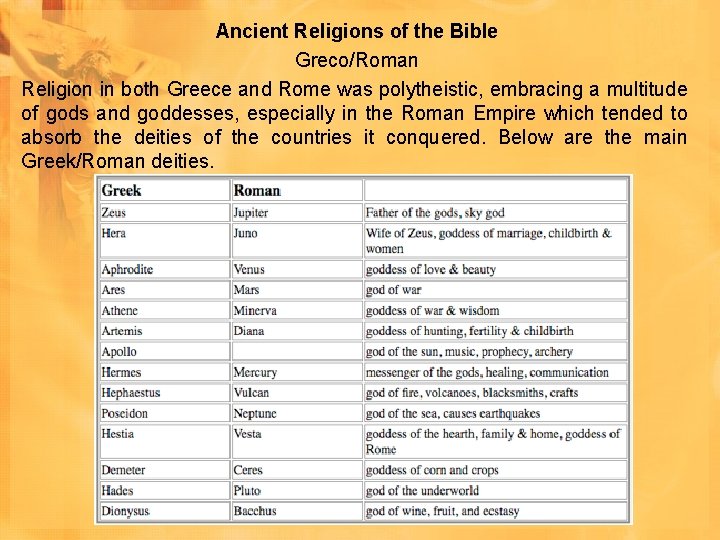
Ancient Religions of the Bible Greco/Roman Religion in both Greece and Rome was polytheistic, embracing a multitude of gods and goddesses, especially in the Roman Empire which tended to absorb the deities of the countries it conquered. Below are the main Greek/Roman deities.
Ancient Religions of the Bible The Ancient history of Greece covers around 6, 000 years, from the first permanent settlement until Greece was absorbed by Rome; the ancient history of Rome on the other hand, begins in the 8 th century BCE and extends into the 5 th century CE. The Minoans of Crete seem to have worshipped bulls and sacrificed them. Their chief religious symbol was the double-headed axe, probably used for animal sacrifice. The Mycenaean age ended in destruction in 1100 BCE, to be followed by the Classical Greek civilization that tended to look to Egypt for learning and culture rather than to their own forebears. At the end of the 6 th century there was a new arousal of interest in the old legends of Greece, which were retranslated in a new and more spiritual light. The growth of the Greek cities and Hyalinization of the Mediterranean led to the declaration of the divinity of rulers such as Alexander the Great (356323 CE). After the death of Alexander the Great, his successor, Ptolemy I revealed the importance of Egyptian religion to Greece by incorporating the Egyptian cults of Isis and Osiris (now called Serapis) into Greek religion in the 4 th century BC.
Ancient Religions of the Bible Religion in ancient Rome encompassed the religious beliefs and cult practices regarded by the Romans as indigenous and central to their identity as a people, as well as the various and many cults imported from other peoples brought under Roman rule. Romans thus offered cult to innumerable deities who influenced every aspect of both the natural world and human affairs as long as it did not offend the Roman tradition. Good relations between mortals and the divine were maintained by piety through the correct offering of ritual and divine honors, especially in the form of sacrifice. Participation in traditional religious rituals was considered a practical and moral necessity in personal, domestic and public life. Religion was not confined to particular occasions nor sacred places, but permeated daily life and every aspect of society. Roman religion was essentially state controlled religion, families maintaining household shrines dedicated to fertility and plenty. Imperial deification began after the assassination of Julius Caesar in 44 BCE when the Roman Senate proclaimed him as a god.
The 5 Major Religions of the World Hinduism According to historians, the origin of Hinduism dates back to 5, 000 or more years. The word "Hindu" is derived from the name of River Indus, which flows through northern India. In ancient times the river was called the 'Sindhu', but the Persians who migrated to India called the river 'Hindu', the land 'Hindustan' and its inhabitants 'Hindus'. Thus the religion followed by the Hindus came to be known as 'Hinduism'. It was earlier believed that the basic tenets of Hinduism were brought to India by the Aryans who invaded the Indus Valley Civilization and settled along the banks of the Indus river about 2000 BC. However, this theory has now been proved to be a flawed one and is considered nothing more than a myth. According to scholars, the evolution of Hinduism may be divided into three periods: the ancient (6500 BCE-1000 AD), the medieval (1000 -1800 AD), and the modern (1800 AD to present). Hinduism is commonly thought to be the oldest religion in the history of human civilization.
The 5 Major Religions of the World Basic tenets of Hinduism There is no “one Hinduism”, and so it lacks any unified system of beliefs and ideas. Hinduism is a conglomerate of diverse beliefs and traditions, in which the prominent themes include: Dharma (ethics and duties) Samsara (rebirth) Karma (right action) Moksha (liberation from the cycle of Samsara) It also believes in truth, honesty, non-violence, celibacy, cleanliness, contentment, prayers, austerity, perseverance, penance, and pious company.
The 5 Major Religions of the World The Sacred Texts of the Hindus The accumulated treasury of spiritual laws discovered by different persons in different times" constitutes the sacred Hindu texts. Collectively referred to as the Shastras, there are two types of sacred writings in the Hindu scriptures the Shruti (heard) and Smriti (memorized). Shruti literature refers to the habit of ancient Hindu saints who led a solitary life in the woods, where they developed a consciousness that enabled them to 'hear' or cognize the truths of the universe. Sruti literatures are of two parts: the Vedas and the Upanishads. There are four Vedas: The Rig Veda -"Royal Knowledge" The Sama Veda - "Knowledge of Chants" The Yajur Veda - "Knowledge of Sacrificial Rituals" The Atharva Veda - "Knowledge of Incarnations" There are 108 extant Upanishads.
The 5 Major Religions of the World The Sacred Texts of the Hindus Smriti Literature refers to 'memorized' or 'remembered' poetry and epics. They are more popular with Hindus, because they are easy to understand, explains universal truths through symbolism and mythology, and contain some of the most beautiful and exciting stories in the history of religion world literature. The three most important of Smriti literature are: The Bhagavad-Gita - The most well known of the Hindu scriptures, called the "Song of the Adorable One", written about the 2 nd century BC. The Mahabharata - The world's longest epic poem written about 9 th century BC. The Ramayana - The most popular of Hindu epics, composed by Valmiki around 4 th or 2 nd centuries BC with later additions up to about 300 CE.
The 5 Major Religions of the World The Major Hindu deities Hinduism believes that there is only one supreme Absolute called "Brahman". However, it does not advocate the worship of any one particular deity. The gods and goddesses of Hinduism amount to thousands or even millions, all representing the many aspects of Brahman. Therefore, this faith is characterized by the multiplicity of deities. The most fundamental of Hindu deities is the Trinity of Brahma, Vishnu and Shiva - creator, preserver and destroyer respectively. Other popular deities include Ganesha, Krishna, Hanuman and a number of Goddesses. Hindus also worship spirits, trees, animals and even planets.
The 5 Major Religions of the World Buddhism is a religion based on the teachings of Siddhartha Gautama, who lived about 25 centuries ago in what is now Nepal and northeastern India. He came to be called "the Buddha, " which means "awakened one, " after he experienced a profound realization of the nature of life, death and existence. In English, the Buddha was said to be enlightened, although in Sanskrit it is bodhi, "awakened. " In the remaining years of his life, the Buddha traveled and taught. However, he didn't teach people what he had realized when he became enlightened. Instead, he taught people how to realize enlightenment for themselves. He taught that awakening comes through one's own direct experience, not through beliefs and dogmas. Buddhism is so different from other religions that some people question whether it is a religion at all. For example, the central focus of most religions is God, or gods. But Buddhism is non-theistic. The Buddha taught that believing in gods was not useful for those seeking to realize enlightenment.
The 5 Major Religions of the World Buddhism Most religions are defined by their beliefs. But in Buddhism, merely believing in doctrines is beside the point. The Buddha said that we should not accept doctrines just because we read them in scripture or are taught them by priests. Instead of teaching doctrines to be memorized and believed, the Buddha taught how we can realize truth for ourselves. The focus of Buddhism is on practice rather than belief. Buddhist concepts include: Karma Rebirth Saṃsāra Enlightenment Nirvana Buddhists believe in the exercise of both spiritual and physical disciplines expressed in the practices of Meditation and yoga and in some monasteries the arts of self defense known to us today as kung fu or Chinese boxing.
Buddhism Four Noble Truths The foundation of Buddhism is the Four Noble Truths. The truth of suffering (dukkha) The truth of the cause of suffering (samudaya) The truth of the end of suffering (nirhodha) The truth of the path that frees us from suffering (magga) They are believed to be the first teaching of Gautama Buddha after attaining Nirvana. They are sometimes considered to contain the essence of the Buddha's teachings. The fourth of the Buddha's Noble Truths—is the way to the cessation of suffering. It has eight sections, each starting with the word "samyak" (meaning "correctly", "properly", or "well", frequently translated into English as "right"), and presented in three groups known as the three higher trainings. A major outline of Buddhist practice is this Eightfold Path.
The Noble Eightfold Path Prajñā is the wisdom that purifies the mind, allowing it to attain spiritual insight into the true nature of all things. It includes: dṛṣṭi: viewing reality as it is, not just as it appears to be. saṃkalpa: intention of renunciation, freedom and harmlessness. Śīla is the ethics or morality, or abstention from unwholesome deeds. It includes: vāc: speaking in a truthful and non-hurtful way karman: acting in a non-harmful way ājīvana: a non-harmful livelihood Samādhi is the mental discipline required to develop mastery over one's own mind. This is done through the practice of various contemplative and meditative practices, and includes: vyāyāma: making an effort to improve smṛti: awareness to see things for what they are with clear consciousness, being aware of the present reality within oneself, without any craving or aversion samādhi: correct meditation or concentration.
The 5 Major Religions of the World Judaism Originating in the Hebrew Bible (also known as the Tanakh) and explored in later texts such as the Talmud, it is considered by religious Jews to be the expression of the covenantal relationship God developed with the Children of Israel. According to traditional Rabbinic Judaism, God revealed his laws and commandments to Moses on Mount Sinai in the form of both the Written and Oral Torah. Judaism claims a historical continuity spanning more than 3, 000 years. It is one of the oldest monotheistic religions, and the oldest to survive into the present day. The largest Jewish religious movements are Orthodox Judaism Conservative Judaism Reform Judaism. A major source of difference between these groups is their approach to Jewish law.
The 5 Major Religions of the World Defining Character and Principles of faith Unlike other ancient Near Eastern gods, the Hebrew God is portrayed as unitary and solitary; consequently, the Hebrew God's principal relationships are not with other gods, but with the world, and more specifically, with the people He created. Judaism thus begins with an ethical monotheism: the belief that God is one, and concerned with the actions of humankind. According to the Hebrew Bible, God promised Abraham to make of his offspring a great nation. Many generations later, he commanded the nation of Israel to love and worship only one God; that is, the Jewish nation is to reciprocate God's concern for the world. He also commanded the Jewish people to love one another; that is, Jews are to imitate God's love for people. These commandments are but two of a large corpus of commandments and laws that constitute this covenant, which is the substance of Judaism. Core tenets 13 Principles of Faith
The 5 Major Religions of the World Jewish religious texts Tanakh (Hebrew Bible) and commentaries, include Mesorah, Targum and Jewish Biblical exegesis. Works of the Talmudic Era (classic rabbinic literature), include Mishnah and commentaries, , Tosefta and the minor tractates, Talmud: The Babylonian Talmud and commentaries and Jerusalem Talmud and commentaries Midrashic literature: Halakhic Midrash and Aggadic Midrash Halakhic literature: Major Codes of Jewish Law and Custom which include - Mishneh Torah and commentaries, Tur and commentaries, Shulchan Aruch and commentaries and Responsa literature Jewish Thought and Ethics: Jewish philosophy, Kabbalah, Hasidic works Musar literature and other works of Jewish ethics. Siddur and Jewish liturgy Piyyut (Classical Jewish poetry)
The 5 Major Religions of the World Jewish Afterlife Beliefs The core of Judaism is a covenant relationship - which is both a contractual agreement and a "marriage" of love - between Yahweh and his chosen people. Because Judaism is built around a relationship involving agreements and promises in this life, the afterlife is less essential for Judaism than for other world religions. The ancient Hebrews emphasized the importance of the present life over the afterlife. As with both the ancient Greeks and Mesopotamians, the afterlife, if it was considered at all, was conceived of as a pale shadow of earthly life, much like the Greek Hades. Also similar to the Greek Hades, in the Hebrew afterlife no distinction was made between the treatment of the just and the unjust after death. Instead, rewards and punishments were meted out in the present life, and in the covenant "contract" Yahweh promised to do just that. The thought of resurrection did not enter the minds of Jewish thinkers until they were influenced by the Persian religion of Zoroastrianism. The sect of the Pharisee’s adopted this belief but it was rejected by the Sadducees. The Essenes tended to lean toward the belief in re-incarnation as taught by the Greek philosopher Pythagoras.
The 5 Major Religions of the World Islam means to submit freely to The Commandments and Will of The One and Only God (Allah). This submission should come from within, from sound belief in and conviction to Allah, with no doubt. It should also come from love, trust, and affection. Islam is the monotheistic religion articulated by the Qur’an, a text considered by its adherents to be the verbatim word of God and by the teachings and normative example of Muhammad, considered by them to be the last prophet of God. An adherent of Islam is called a Muslims believe that God is one and incomparable and the purpose of existence is to worship God. Muslims also believe that Islam is the complete and universal version of a primordial faith that was revealed at many times and places before, including through Abraham, Moses and Jesus, whom they consider prophets. Muslims maintain that previous messages and revelations have been partially changed or corrupted over time, but consider the Qur'an to be both the unaltered and the final revelation of God.
The 5 Major Religions of the World Origin of Islam The origin of Islam can be traced back to 7 th century Saudi Arabia. Islam is thus the youngest of the great world religions. The prophet Muhammad (circa 570 -632 A. D. ) introduced Islam in 610 A. D. after experiencing what he claimed to be an angelic visitation. Muhammad dictated the Qur'an, the holy book of Islam, which Muslims believe to be the preexistent, perfect words of Allah. The Qur'an testifies of itself that it was given by God through the angel Gabriel to the prophet Muhammad. Basic Beliefs in Islam Muslims believe that there is ONLY One supreme God (Allah). In Islam to believe in Allah is not only to believe in Allah's existence but also to believe in all Allah's attributions, to worship Allah alone, and to obey all Allah's commands.
The Muslim belief of Oneness A) Oneness of Lordship: To believe that Allah is The ONLY Creator, Provider, and The Commander. B) Oneness of Worship: To believe that Allah is the ONLY God who should be worshipped, and obeyed as Allah prescribed. C) Oneness of Allah's Names and Attributes: To believe that Allah Is Perfect and His Names and Attributes are Perfect according to what Allah tells us about Himself in the Qur’an, believing that those Names and Attributes, in their perfection, belong only to Allah. ◊ Muslims believe that NO one shares Allah's divinity that is neither angel nor human. ◊ Muslims do not believe that Allah sleeps, gets tired, or dies. Allah has neither Weakness nor Weariness. ◊ Muslims do not believe that human beings are created in the image of Allah. ◊ Muslims believe that there is no intermediary who will take any one nearer to Allah or plead on anyone's behalf. They believe that any individual can directly supplicate to Allah and ask for anything he/she wants.
Oneness of The Message Muslims believe that Allah Sent Messengers to each nation throughout the history of humankind. Messengers came with the same message: to worship the One Supreme God and to obey His Commands. Innocence of mankind at Birth. Muslims believe that people are born free of any sin and bear no responsibility for other's faults and sins. It is only after they reach the age of puberty, and they knowingly commit sins that they will be held responsible for their actions in this life and the hereafter. There is no original sin in Islam. Muslims believe that both Adam and Eve were equally tempted, both sinned, and were both responsible for disobeying Allah. Both were remorseful and repented, and Allah forgave both of them. Muslims believe that no soul is responsible for the sins and faults of others, even if they are their parents, children, wives or husbands. Muslims believe that forgiveness is always available through repentance. Muslims pray for repentance directly to Allah, without any intermediary. Salvation in Islam is only through belief and practice. both go together, sideby-side, to be granted salvation.
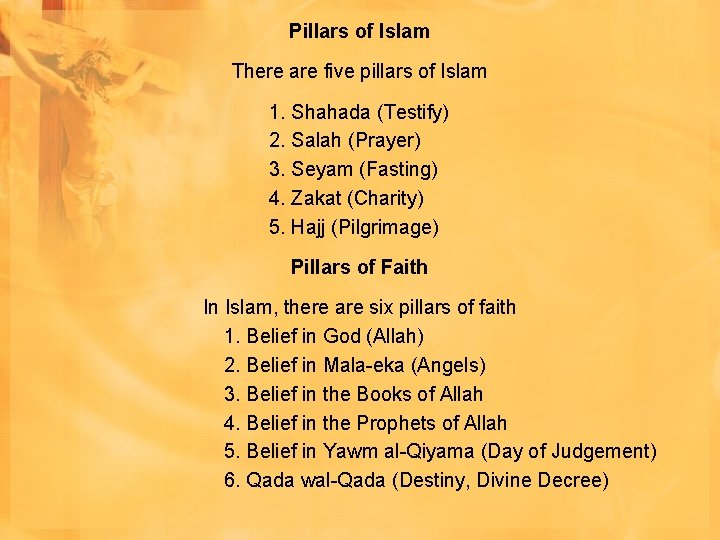
Pillars of Islam There are five pillars of Islam 1. Shahada (Testify) 2. Salah (Prayer) 3. Seyam (Fasting) 4. Zakat (Charity) 5. Hajj (Pilgrimage) Pillars of Faith In Islam, there are six pillars of faith 1. Belief in God (Allah) 2. Belief in Mala-eka (Angels) 3. Belief in the Books of Allah 4. Belief in the Prophets of Allah 5. Belief in Yawm al-Qiyama (Day of Judgement) 6. Qada wal-Qada (Destiny, Divine Decree)
The 5 Major Religions of the World Christianity The origin of Christianity begins with God himself coming in the likeness of man through his son Jesus Christ and establishing a new covenant with his creation. (Alpha & Omega) It is the fulfillment of many Old testament prophecies and the culmination of that which was foretold and pictured throughout OT history. Christians are monotheistic but differ with Judaism and Islam in that they believe in one God made up of three distinct persons, The Father, The Son and The Holy Spirit. Christians believe that Jesus Christ was the son of God, co-equal with the father. He lived among man for 33 years as a sinless example for all who would believe and to meet the requirements of God to become an unblemished sacrifice for the sins of mankind, once for all. He was crucified, buried and rose again from the dead on the 3 rd day in bodily form and ascended to the right hand of the father where He continually intercedes for the saints until the time of the end when He will return to establish His kingdom once and for all eternity.
The 5 Major Religions of the World Christianity Christians believe in Heaven, the place where God resides and where the saved will reside also, and Hell, the place of eternal damnation and separation from God. Salvation is gained by one way only and that is through the atoning blood of Jesus Christ, through repentance and faith in His finished work. Works do not play a part in Christian redemption but are and should be a integral part of a Christians life and faith. They have one recognized cannon of scripture made up of 66 books which included the Hebrew Old Testament and the New Testament teachings of Jesus and His apostles. They practice two sacraments, Baptism and Communion and follow two commandments, To love God with all their heart, soul and mind and to love their neighbor as themselves.
The Religion of Man Humanism originated in the West with the Greek philosopher Socrates, and in the East with the Chinese philosopher Kung Fu Tzu (Confucius) about 2, 500 years ago. Socrates felt that in order to develop sound values people should learn how to think for themselves. Kung Fu Tzu believed that "A society ought to work for the benefit of all its members rather than be used merely as a pretext for the excesses of its rulers, " and that "virtue means to love one another. " Humanists believe that the evidence that our values have a supernatural basis is weak; on the other hand, Humanists find compelling the evidence that our values are based in the human person. Therefore, in order to know whether a given course of conduct is meaningful or right, we can ask ourselves whether it promotes the maintenance or development of the normal capabilities of human beings, such as thinking, feeling, and physical health.
The Religion of Man Humanism Some of the important implications following from these core convictions are: People should try hard to get the facts before forming opinions or committing to values. People should base their values primarily upon the worth and inherent dignity of the human person. The refinement of any good value system is the project of a lifetime. There is no single, comprehensive, authoritative source of truth. The idea that all people are much the same everywhere, and are equally entitled to justice and opportunity regardless of race or gender, owes much to Humanism.
The Religion of Man Humanism and Religion Humanism is a down-to-earth philosophical movement that represents a turn toward the satisfaction of human needs, both material and spiritual, and the fulfillment of human potential, here and now. Humanism therefore lacks much interest in the supernatural and theological, or in an afterlife. Humanists are not necessarily atheists, there are many religious Humanists. Linking religious and secular humanists is the belief that nothing should ever be accepted on faith. There must always be good evidence for beliefs, religious or otherwise. This is the most fundamental tenet of rationalism. The three pillars of rationalism are science, mathematics, and philosophy. All three are important to the Humanist as sources of trustworthy understanding.
The Religion of Man Modern Humanism Although termed a religion by some, Modern Humanism, is better defined as a non-theistic worldview; a philosophy which influences the views and actions of its proponents. Humanism places the human experience as the central basis for reality, claiming that mankind’s distinct ability to reason and understand the world in which they live is fundamental to existence. It is in this light that Humanists believe that a naturalistic worldview, with humanity at its center, is the only way that mankind can give meaning and importance to life. Religious Humanism, also referred to as an Ethical Culture, is a form of Modern Humanism which takes Humanist views from the realm of philosophy to that of a complete non-theistic religion. Religious Humanists have a distinct set of beliefs, not unlike other religions, which form the basis of their human centered worldview.
Humanist Manifesto The three Humanist Manifestos, written between 1973 and 2003, outline the key views of religious Humanism. The one which best portrays Modern Humanist views is number three, written in 2003. The article's six tenants of Humanist thought embrace that; Knowledge of the world is derived by observation, experimentation, and rational analysis. Humans are an integral part of nature, the result of unguided evolutionary change. Ethical values are derived from human need and interest as tested by experience. Life's fulfillment emerges from individual participation in the service of humane ideals. Humans are social by nature and find meaning in relationships. Working to benefit society maximizes individual happiness.
The Religion of Man The New Age There is nothing NEW about the New Age. Today's New Age movement is the newest face of "metaphysical religion, " which has been part of the American religious spectrum since the 17 th century, focused on selfimprovement and global spiritual change. It has no Central Scriptures or Writings, it’s sacred narratives focus on forms of progressive millennialism, the hope to see a new and better future for the individual and society. New Agers generally believe in an impersonal deity that is present in all beings. Since each human being contains elements of god, New Age practitioners look to develop that divine spark and their awareness of it and look to development of this divine nature as a hallmark of religious practice. They believe that the human mind creates it own reality, and that suffering and evil exist as illusions created by the mind. They also believe in Karma. New Agers accept the concept of reincarnation and believe that future rebirths allow the individual human soul to slowly develop itself toward a higher spiritual state.
The Religion of Man The New Age is an umbrella term used to describe an organization of diverse groups that share an enthusiasm for the creation of a new era (or "New Age") exemplified by harmony and enlightenment. Themes of New Age belief include: • A heightened spiritual consciousness accompanied by social and personal transformation as demonstrated by the eradication of hunger, sickness, poverty, racism, sexism, and war. • Individuals can get a foretaste of this enlightenment through personal spiritual transformation, healing, and growth. New Age ideas have many different origins from a variety of places, but most of them can be traced to Eastern religious traditions such as Hinduism, Buddhism, and other ancient religious traditions. New Age groups are often distinguished by their occult practices of psychic readings, Tarot cards, yoga, meditation strategies, and astrology. Many New Age groups also believe in various natural healing practices and traditional medicines including acupuncture, herbal therapy, natural foods, and spiritual healing.