
Anthropology Appreciating Human Diversity Fifteenth Edition Conrad Phillip
- Slides: 29
Anthropology Appreciating Human Diversity Fifteenth Edition Conrad Phillip Kottak University of Michigan Mc. Graw-Hill © 2013 Mc. Graw-Hill Companies. All Rights Reserved. 22 -1
C H A P T E R ARTS, MEDIA, AND SPORTS 22 -2
ARTS, MEDIA, AND SPORTS • • What Is Art? Art, Society, and Culture Media and Culture Sports and Culture 22 -3
ARTS, MEDIA, AND SPORTS • What are the arts, and how have they varied historically and cross-culturally? • How does culture influence the media, and media affect culture? • How are culture and cultural contrasts expressed in sports? 22 -4
WHAT IS ART? • Arts: include music, theater arts, visual arts, storytelling, and literature • Expressive culture: manifestations of human creativity • Many cultures lack terms that can be translated easily as “art” or “the arts” 22 -5
WHAT IS ART? • Art: an object, event, or other expressive form that evokes an aesthetic reaction • Aesthetics: an appreciation of the qualities perceived in art • Mills: in many cultures, role of art lover lacks definition, because art not viewed as separate activity 22 -6
ART AND RELIGION • Maquet: Artwork is something that stimulates and sustains contemplation • Much art is done in association with religion • Art may be created, performed, or displayed outdoors in public or in special indoor settings • Art is produced for its aesthetic value as well as religious purposes 22 -7
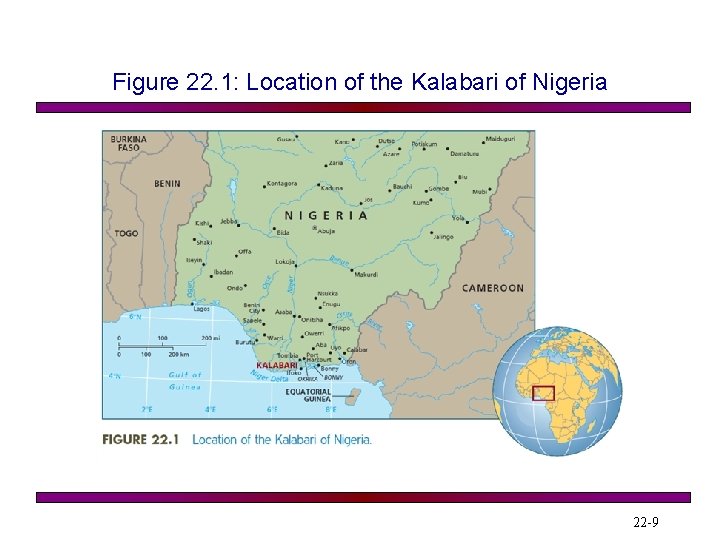
LOCATING ART • Tribal societies typically lack museums, but some maintain special areas where artistic expression takes place • State societies rely on critics, judges, and experts to define what’s art and what isn’t • We need to avoid applying our own standards about what is art to the products of other cultures • Kalabari 22 -8
Figure 22. 1: Location of the Kalabari of Nigeria 22 -9
ART AND INDIVIDUALITY • Some anthropologists argue study of non-Western art ignores individual and focuses on the group • To some extent, more collective effort • Bohannan: pay less attention to artists and more attention to art critics and products • Haapala: artists and works are inseparable • A thing of beauty may be a joy forever even if we don’t credit its creator 22 -10
THE WORK OF ART • For the artist, art is work • In nonstate societies, artists cannot work on art all the time • In states, artists are full-time specialists whose career is their work • For such familiar genres as painting or music, societies tend to have standards by which they judge whether an artwork is complete or fully realized 22 -11
ART, SOCIETY, AND CULTURE • Around 100, 000 years ago, some of world’s first artists occupied Blombos Cave • Henshilwood: sharp instruments show symbolic thinking • In Europe, art goes back more than 30, 000 years to the Upper Paleolithic • Art usually more public than cave paintings ART SOCIETY AND CULTURE 22 -12
ETHNOMUSICOLOGY • Ethnomusicology: comparative study of music of the world and as an aspect of culture and society • Music: a cultural universal, and musical abilities seem to run in families • • Music arose early in human history All cultures have lullabies Music is inherently cultural and social Folk art, music, and lore refer to expressive culture of ordinary people 22 -13
ETHNOMUSICOLOGY • Basongye: three features to distinguish between music and other sounds • Music always involves humans • Musical sounds must be organized • Music must continue • Folk: of the people; e. g. , art, music, and lore of ordinary people • Planinica 22 -14
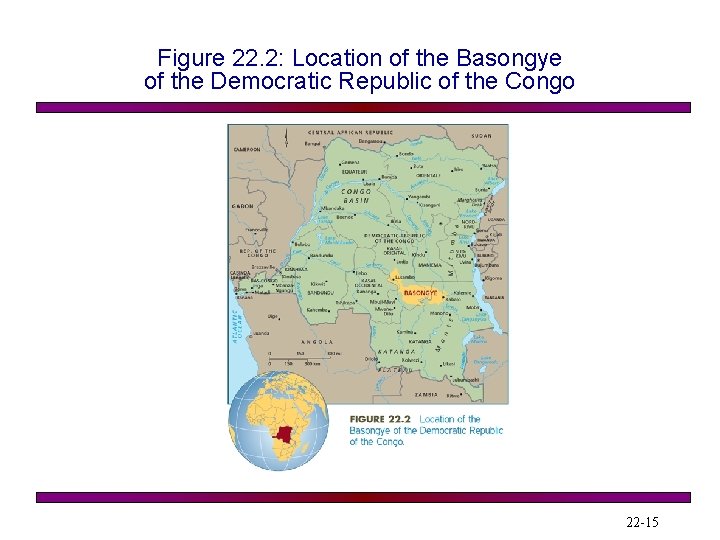
Figure 22. 2: Location of the Basongye of the Democratic Republic of the Congo 22 -15
REPRESENTATIONS OF ART AND CULTURE • Art can stand for tradition, even when traditional art is removed from its original (rural) context • Grimshaw: many ethnographic films start off with music, often drumbeats • Assumption that arts of nonindustrial societies usually have a link with religion 22 -16
ART AND COMMUNICATION • Art functions in society as form of communication between artist and community or audience • Certain segments of population are more likely to appreciate certain forms of art • Tension and resolution of drama can lead to catharsis; intense emotional release • Often, art is meant to commemorate and to carry an enduring message 22 -17
ART AND POLITICS • Art can express or challenge community sentiment and standards • Much art that is valued today was received with revulsion in its own time • In U. S. , no museum director can mount exhibit without considering politically organized segments of society 22 -18
THE CULTURAL TRANSMISSION OF THE ARTS • As part of culture, appreciation for arts depends on cultural background • Appreciation for the arts is learned • Navajo music: individualism; conservatism; proper form • In many societies, myths, legends, tales, and art of storytelling play important roles in transmission of culture and preservation of tradition 22 -19
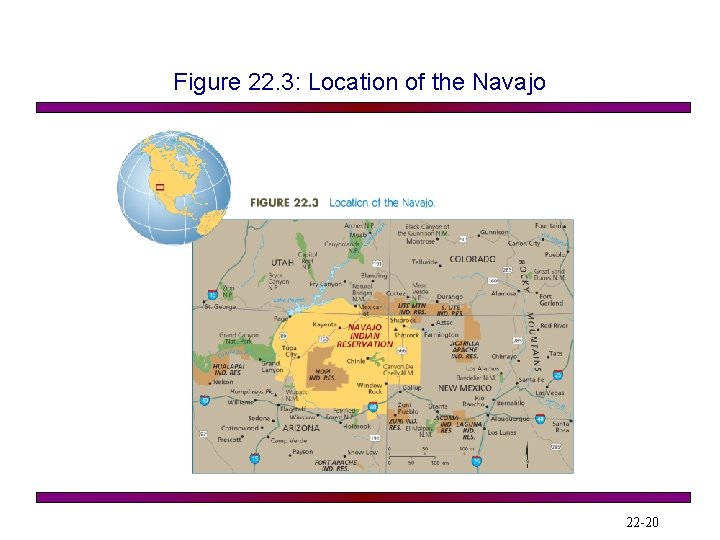
Figure 22. 3: Location of the Navajo 22 -20
THE ARTISTIC CAREER • In nonindustrial societies, artists tend to be part-time specialists • Many non-Western societies offer career tracks into the arts • Children born into certain lineages are destined for particular artistic careers • Artists need support • Arts are by definition neither practical nor ordinary 22 -21
CONTINUITY AND CHANGE • The arts go on changing, although certain art forms have survived for thousands of years • Countries and cultures are known for particular contributions, including art: • • Balinese: dance Navajo: sand paintings, jewelry, weaving French: cuisine Greeks: drama 22 -22
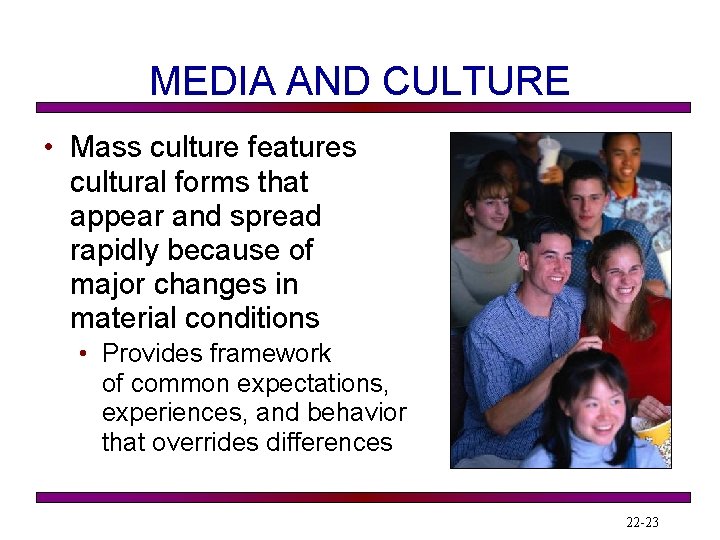
MEDIA AND CULTURE • Mass culture features cultural forms that appear and spread rapidly because of major changes in material conditions • Provides framework of common expectations, experiences, and behavior that overrides differences 22 -23
USING THE MEDIA • Text: anything that can be processed, interpreted, and assigned meaning by anyone exposed to it • Fiske: individual’s use of popular culture is a creative act • Media consumers actively select, evaluate, and interpret media in ways that make sense to them • Media offer rich web of external connections • Media provide social cement 22 -24
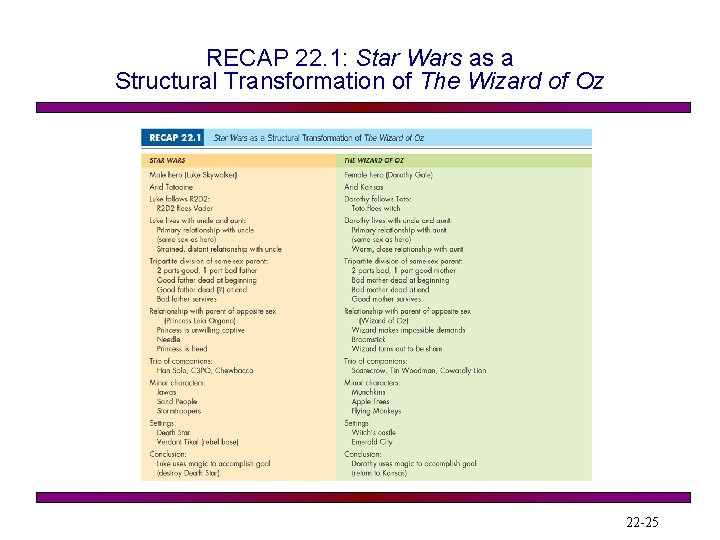
RECAP 22. 1: Star Wars as a Structural Transformation of The Wizard of Oz 22 -25
ASSESSING THE EFFECTS OF TELEVISION • Kottak: family planning is one area TV has influenced behavior • Current viewing level, and number of years of TV presence in the home predictors of (smaller) family size • Limited number of players in each telenovela 22 -26
SPORTS AND CULTURE • Football • Popularity depends directly on mass media • Arens: football is popular because it symbolizes certain key aspects of U. S. life • Illustrates values of hard work and teamwork • Montague and Morais: presents miniaturized and simplified version of modern organizations 22 -27
WHAT DETERMINES INTERNATIONAL SPORTS SUCCESS? • Cultural values, social forces, and media • Media can heighten interest • Brazilian media strikingly intolerant of losers • The U. S. culture: hard work and personal improvement as important as winning 22 -28
BEING VERSUS DOING • An American’s identity emerges as a result of what he or she does • In Brazil, identity rests on being • The U. S. media almost always focus on some aspect of doing • U. S. sports coverage feasts on unexpected results • Despite focus on doing, American culture does not insist that individuals can fully control outcomes 22 -29