
ANTHRAX MICROBIOLOGY 1420 BY NAGHMEH SHAHAMI PATHOGENESIS Anthrax

ANTHRAX MICROBIOLOGY 1420 BY NAGHMEH SHAHAMI

PATHOGENESIS • Anthrax is an acute, infectious disease of human beings and animals caused by encapsulated, gram-positive, spore-forming, soil organism Bacillus anthracis. • Anthrax endospores do not divide, have no measurable metabolism, and are resistant to drying, heat, UV light, gamma radiation, and many disinfectants. • B. anthracis spores can be found on all continents, even Antarctica and remain dormant for decades.
ANTHRAX IN HISTORY • The name of the disease comes from anthrax, the Greek word used for Coal, because of the black skin lesions. • Description of the disease began in antiquity seen in works of the Roman poet Virgil. • Robert Koch first identified the B. anthracis in 1875. He uncovered the lifecycle and means of transmission of anthrax and through his researches could explaine the role of microbes in causing illness for the first time. • Louis Pasteur in 1881, made the first vaccine for domestic animals containing live B. anthracis. • The anthrax biological weapon developed during Second World War but never used. • An outbreak of inhalation anthrax occurred near a Soviet military microbiology facility in 1979. Represented the largest documented outbreak in anthrax history. All related records were cleared by KBG.
COURSE OF ACTION • Anthrax is a zoonosis that commonly infect mammals, especially grazing herbivores that ingest or inhale the spores while grazing. • Carnivores living in the same environment may become infected by consuming infected animals. • Diseased animals can spread anthrax to humans, through direct contact such as inoculation of infected blood to the broken skin, or indirectly by consumption of diseased meat. • Many studies confirming the role of insects, especially Musca domestica in the spread of B. anthracis.
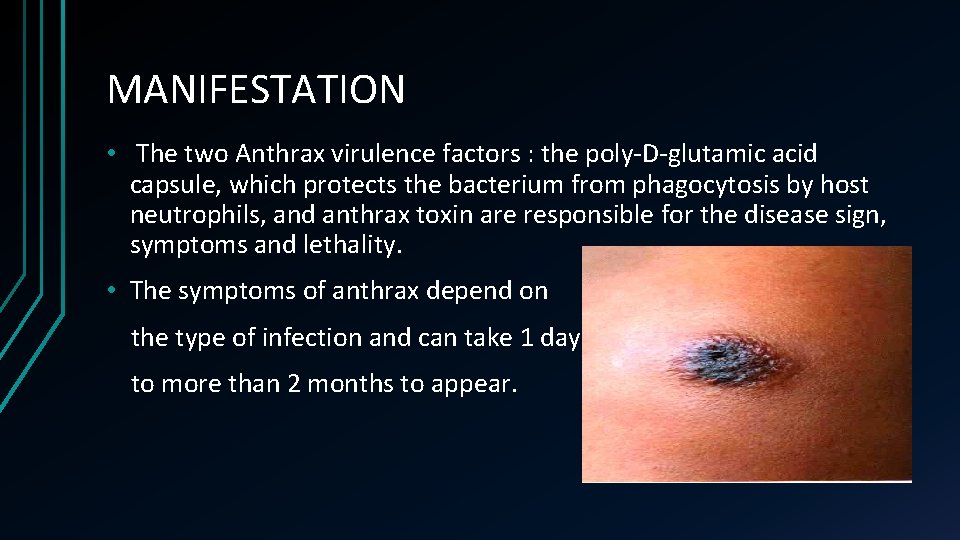
MANIFESTATION • The two Anthrax virulence factors : the poly-D-glutamic acid capsule, which protects the bacterium from phagocytosis by host neutrophils, and anthrax toxin are responsible for the disease sign, symptoms and lethality. • The symptoms of anthrax depend on the type of infection and can take 1 day to more than 2 months to appear.
ROUTE OF INFECTION • People get infected with anthrax when spores get into the body. • B. anthracis spores infected the host in four ways: o Cutaneous o Inhalation o Ingestion o Injection

CUTANEOUS ANTHRAX • Cutaneous anthrax develops when spores get into the body of the host through a cut or scrape. • 95% of all anthrax infections in the United States are cutaneous anthrax. • It is the least dangerous form of anthrax. Without treatment, up to 20% of patients may die. With treatment, almost all patients will survive. • Cutaneous anthrax is common on the head, neck, forearms, and hands. • People who handle infected animals or contaminated animal products such as hair, wool, and skin are at greater risk. • Symptoms include a group of small blisters that may itch, a painless skin ulcer with black center, swelling around the soars and edema of head and neck.
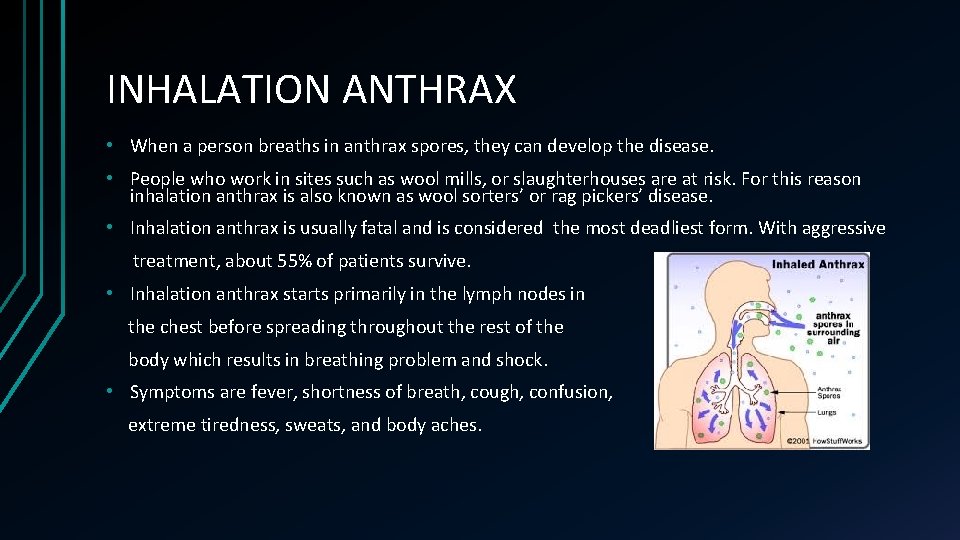
INHALATION ANTHRAX • When a person breaths in anthrax spores, they can develop the disease. • People who work in sites such as wool mills, or slaughterhouses are at risk. For this reason inhalation anthrax is also known as wool sorters’ or rag pickers’ disease. • Inhalation anthrax is usually fatal and is considered the most deadliest form. With aggressive treatment, about 55% of patients survive. • Inhalation anthrax starts primarily in the lymph nodes in the chest before spreading throughout the rest of the body which results in breathing problem and shock. • Symptoms are fever, shortness of breath, cough, confusion, extreme tiredness, sweats, and body aches.

GASTROINTESTINAL ANTHRAX • Develops by ingesting raw or uncooked meat from an animal infected with anthrax. • This form of anthrax is rare in the United State, with only two cases reported. • With treatment, 60% of patients survive. • An outbreak of GI anthrax was reported in 2010 in Philippines among people who had eaten meat from a dead carabao(water buffalo), with over 400 cases of illness and two deaths. • Symptoms are flu like plus nausea, vomiting, diarrhea, stomach pain and swelling.
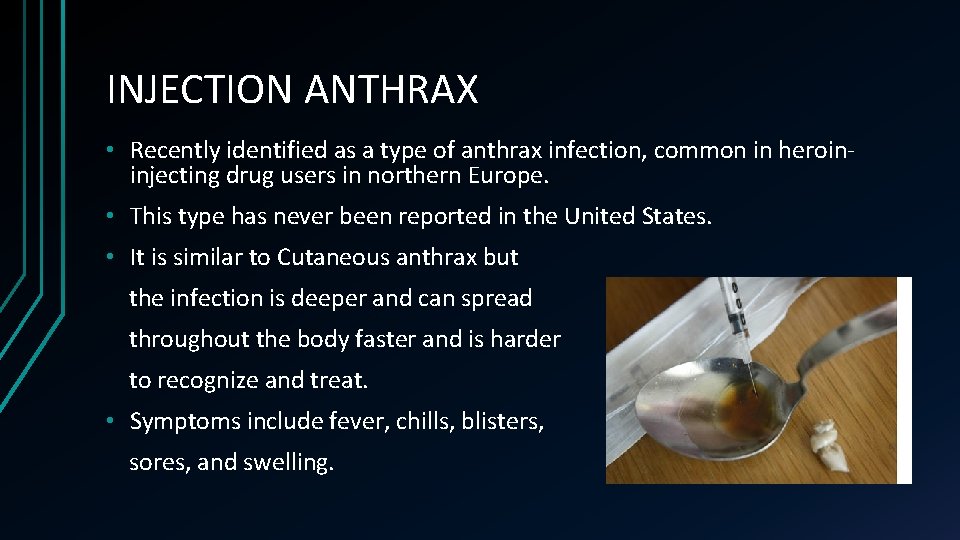
INJECTION ANTHRAX • Recently identified as a type of anthrax infection, common in heroininjecting drug users in northern Europe. • This type has never been reported in the United States. • It is similar to Cutaneous anthrax but the infection is deeper and can spread throughout the body faster and is harder to recognize and treat. • Symptoms include fever, chills, blisters, sores, and swelling.
DIAGNOSIS & TREATMENT • In the United States doctors rarely have seen patients with anthrax. To confirm a diagnosis of anthrax they should do bacteriologic tests, immunologic test, and chest CT scan. • All culture must be taken before the patient taking antibiotics. • Penicillin and doxycycline are used for the treatment. • Antitoxin therapy is a potential new treatment that inhibit the toxicity of anthrax toxin; but currently it is not available in the United States.
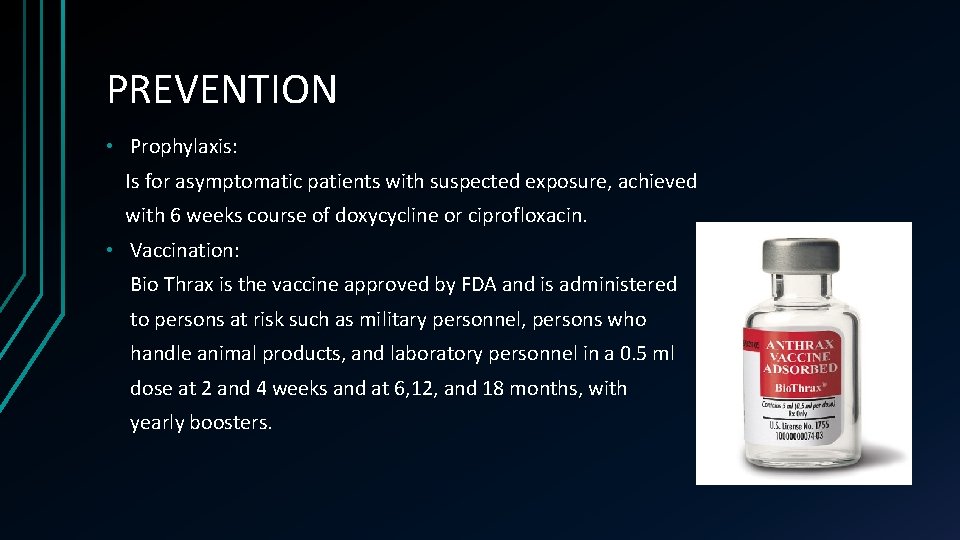
PREVENTION • Prophylaxis: Is for asymptomatic patients with suspected exposure, achieved with 6 weeks course of doxycycline or ciprofloxacin. • Vaccination: Bio Thrax is the vaccine approved by FDA and is administered to persons at risk such as military personnel, persons who handle animal products, and laboratory personnel in a 0. 5 ml dose at 2 and 4 weeks and at 6, 12, and 18 months, with yearly boosters.
FUTURE CHALENGES • At the birth of cellular immunology Elie Metchnikoff used the anthrax Bacillus to examine the ability of his newly discovered macrophages to kill microbes. • Today, scientists are using B. anthracis and its toxins to understanding early events in the infectious process and the molecular basis of inflammation.
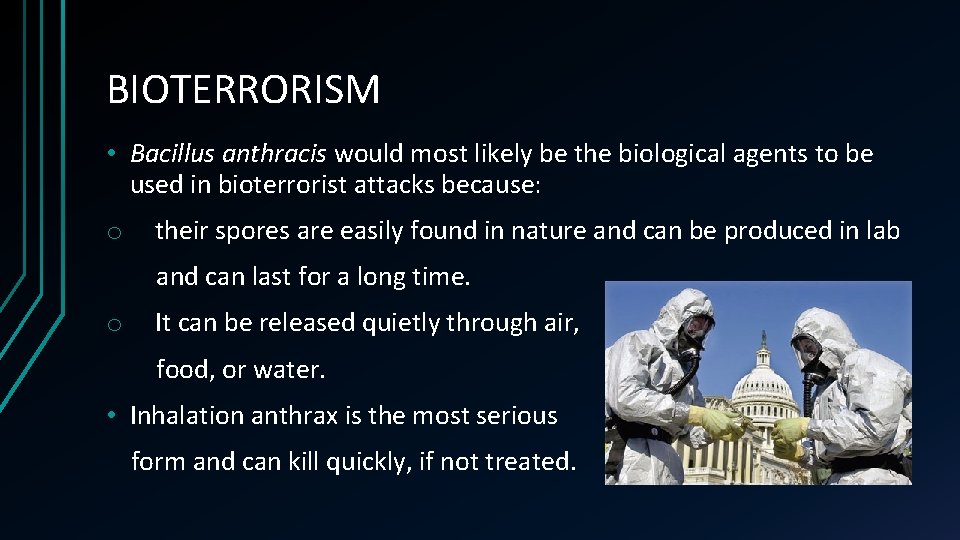
BIOTERRORISM • Bacillus anthracis would most likely be the biological agents to be used in bioterrorist attacks because: o their spores are easily found in nature and can be produced in lab and can last for a long time. o It can be released quietly through air, food, or water. • Inhalation anthrax is the most serious form and can kill quickly, if not treated.
AMERITHRAX • The 2001 anthrax attacks in the United States known as Amerithrax by FBI began on September 18, 2001, one week after September 11 attacks. • Letters containing anthrax spores were mailed to several news agencies, and two Democratic Senators. This attacks killed 5 people and infected 17 others. • On February 19, 2010, FBI closed the investigation and announced Bruce Edwards Ivins as a extremely sensitive suspect. • Ivins was a biodefense scientist working for government at Maryland. He committed suicide on August 2008. • Johns Hopkins Center for Civilian Biodefense Strategies investigation indicates that there was a link between 9/11 hijackers and the anthrax attacks.
REFERENCES • Dixon, C. T. , Meselson, M. , Guillemin, J. , Hanna, P. C. (1999). Anthrax. New England Journal of Medicine, 341, 815 -826. DOI: 10. 1056/NEJM 199909093411107 • Fasanella, A. , Scascaiamacchia, S. , Garofolo, G. (2010). Evaluation of the house Fly Musca Domestica as a Mechanical Vector for an Anthrax. Public Library of Science, 5(8): e 12219. DOI: 10. 1371/journal. pone. 0012219 • Stenbach, G. (2003). History of Anthrax. The Journal of Emergency Medicin, 24, 463 -467. • Schneemann, A. , Manchester, M. Anti-toxin antibodies in prophylaxis. Future Microbiology 4(1). 35 -43. DOI: 10. 2217/17460913. 4. 1. 35 • Clinical Policy Bulletin: Anthrax Vaccine/Treatment (0483). retrieved from http: //www. aetna. com/cpb/medical/data/400_499/0483 • http: //www. cdc. gov/anthrax/basics/diagnosis. html • http: //www. ncbi. nlm. nih. gov/pubmed/12745053




Title and Content Layout with Chart Series 1 Series 2 Series 3 6 5 4 3 2 1 0 Category 1 Category 2 Category 3 Category 4

Two Content Layout with Table • First bullet point here Group 1 Group 2 • Second bullet point here Class 1 82 95 • Third bullet point here Class 2 76 88 Class 3 84 90

Two Content Layout with Smart. Art • First bullet point here • Second bullet point here Task 1 • Third bullet point here Task 2 Task 3



- Slides: 26