
Anterior or posterior release for severe rigid neuromuscular
- Slides: 12
Anterior or posterior release for severe rigid neuromuscular scoliosis: which is safer and more effective? Zhen Liu, Yong Qiu, Ze-zhang Zhu, Bang-ping Qian Drum Tower Hospital, Nanjing University Medical School Spine Surgery, Drum Tower Hospital, Nanjing University, CHINA
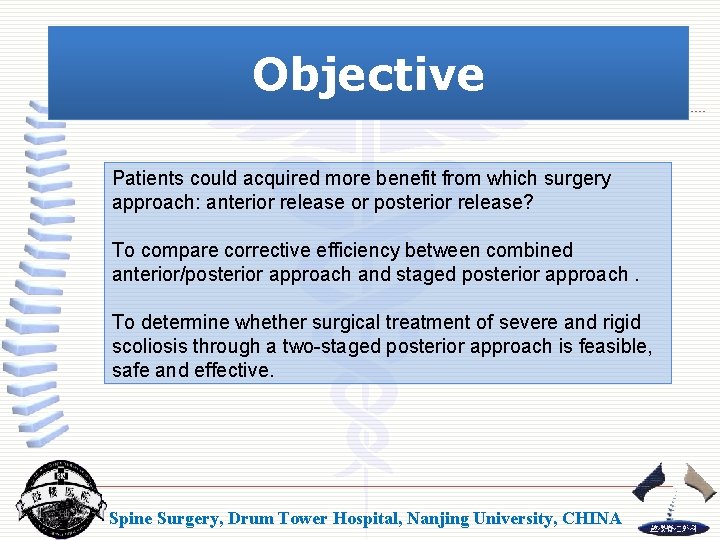
Objective Patients could acquired more benefit from which surgery approach: anterior release or posterior release? To compare corrective efficiency between combined anterior/posterior approach and staged posterior approach. To determine whether surgical treatment of severe and rigid scoliosis through a two-staged posterior approach is feasible, safe and effective. Spine Surgery, Drum Tower Hospital, Nanjing University, CHINA
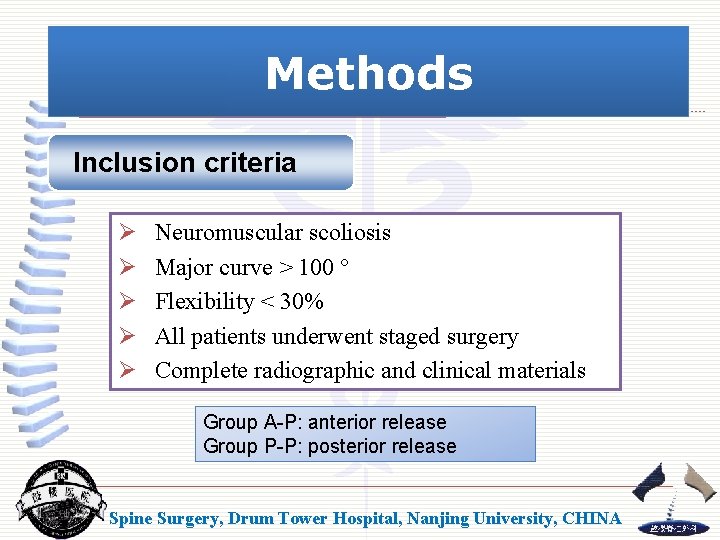
Methods Inclusion criteria Ø Ø Ø Neuromuscular scoliosis Major curve > 100 ° Flexibility < 30% All patients underwent staged surgery Complete radiographic and clinical materials Group A-P: anterior release Group P-P: posterior release Spine Surgery, Drum Tower Hospital, Nanjing University, CHINA
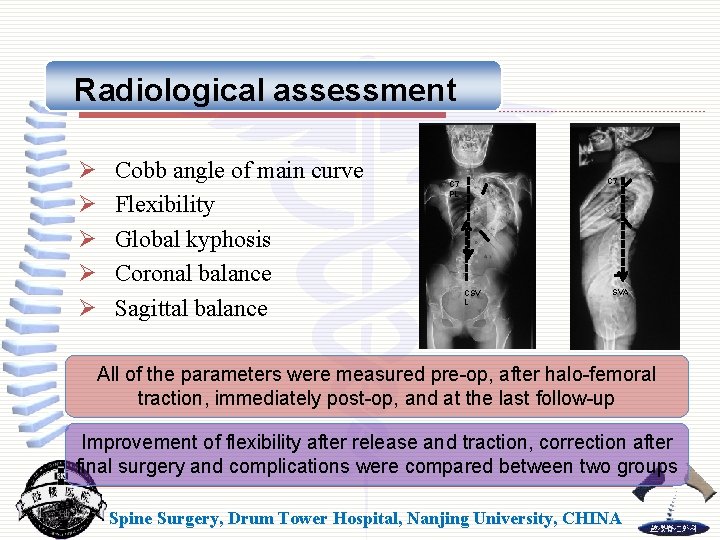
Radiological assessment Ø Ø Ø Cobb angle of main curve Flexibility Global kyphosis Coronal balance Sagittal balance C 7 PL CSV L SVA All of the parameters were measured pre-op, after halo-femoral traction, immediately post-op, and at the last follow-up Improvement of flexibility after release and traction, correction after final surgery and complications were compared between two groups Spine Surgery, Drum Tower Hospital, Nanjing University, CHINA
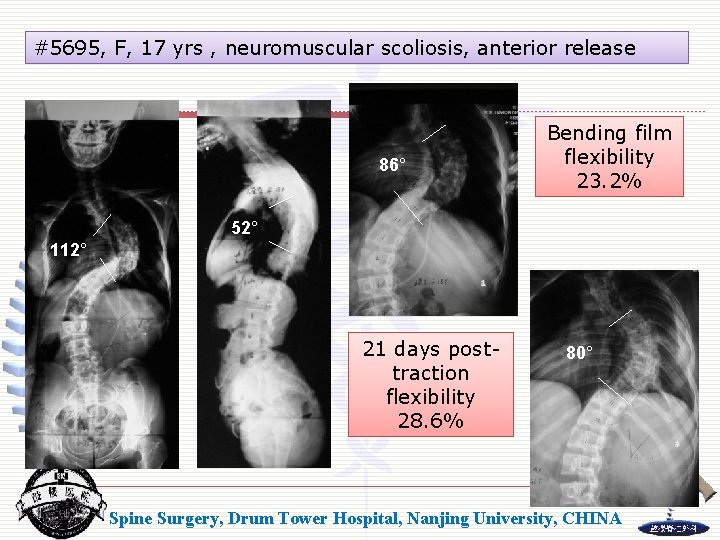
#5695, F, 17 yrs , neuromuscular scoliosis, anterior release 86° Bending film flexibility 23. 2% 52° 112° 21 days posttraction flexibility 28. 6% 80° Spine Surgery, Drum Tower Hospital, Nanjing University, CHINA
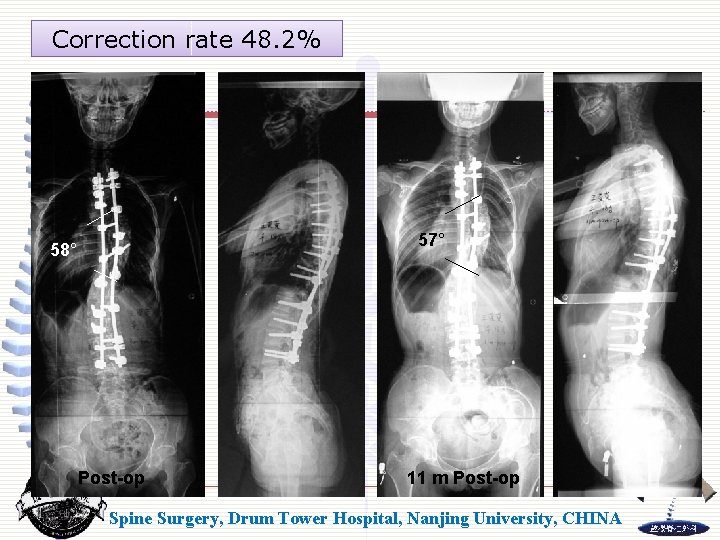
Correction rate 48. 2% 57° 58° Post-op 11 m Post-op Spine Surgery, Drum Tower Hospital, Nanjing University, CHINA
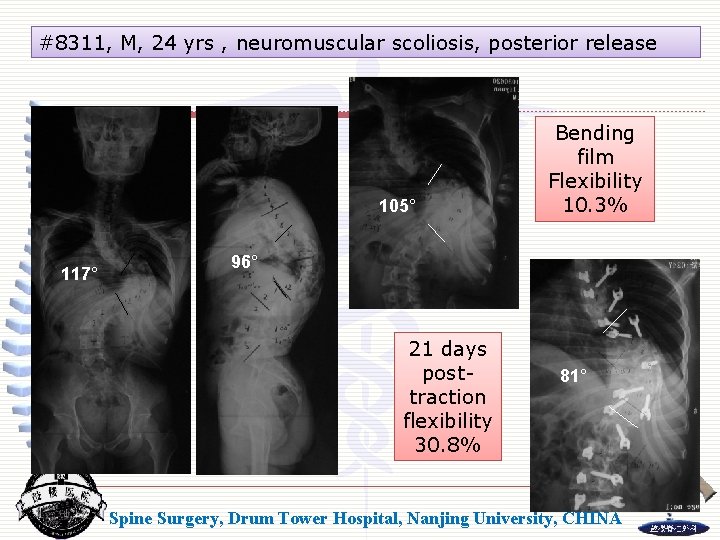
#8311, M, 24 yrs , neuromuscular scoliosis, posterior release 105° 117° Bending film Flexibility 10. 3% 96° 21 days posttraction flexibility 30. 8% 81° Spine Surgery, Drum Tower Hospital, Nanjing University, CHINA
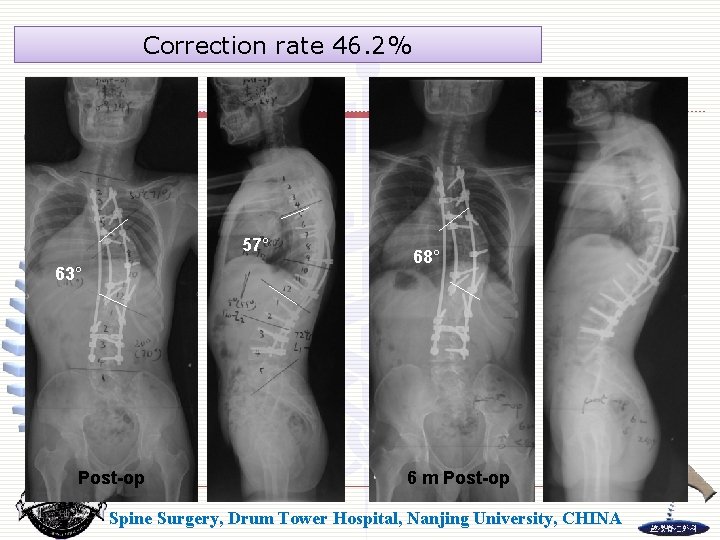
Correction rate 46. 2% 57° 63° Post-op 68° 6 m Post-op Spine Surgery, Drum Tower Hospital, Nanjing University, CHINA
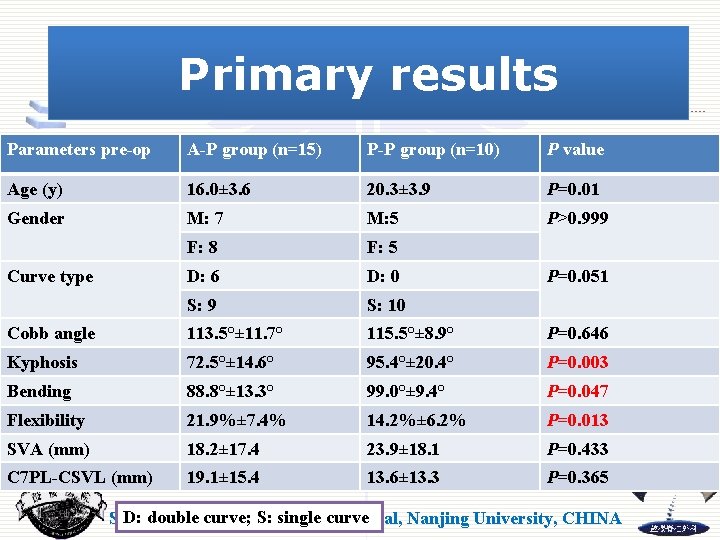
Primary results Parameters pre-op A-P group (n=15) P-P group (n=10) P value Age (y) 16. 0± 3. 6 20. 3± 3. 9 P=0. 01 Gender M: 7 M: 5 P>0. 999 F: 8 F: 5 D: 6 D: 0 S: 9 S: 10 Cobb angle 113. 5°± 11. 7° 115. 5°± 8. 9° P=0. 646 Kyphosis 72. 5°± 14. 6° 95. 4°± 20. 4° P=0. 003 Bending 88. 8°± 13. 3° 99. 0°± 9. 4° P=0. 047 Flexibility 21. 9%± 7. 4% 14. 2%± 6. 2% P=0. 013 SVA (mm) 18. 2± 17. 4 23. 9± 18. 1 P=0. 433 C 7 PL-CSVL (mm) 19. 1± 15. 4 13. 6± 13. 3 P=0. 365 Curve type P=0. 051 D: double curve; S: single Spine Surgery, Drum Towercurve Hospital, Nanjing University, CHINA
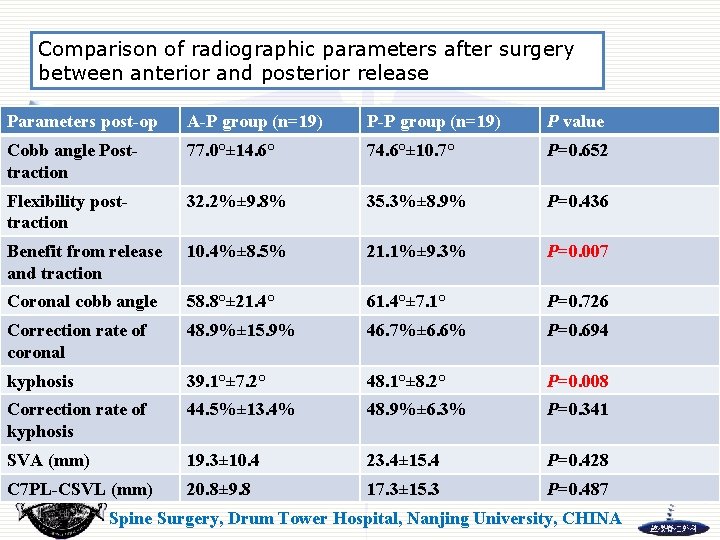
Comparison of radiographic parameters after surgery between anterior and posterior release Parameters post-op A-P group (n=19) P value Cobb angle Posttraction 77. 0°± 14. 6° 74. 6°± 10. 7° P=0. 652 Flexibility posttraction 32. 2%± 9. 8% 35. 3%± 8. 9% P=0. 436 Benefit from release and traction 10. 4%± 8. 5% 21. 1%± 9. 3% P=0. 007 Coronal cobb angle 58. 8°± 21. 4° 61. 4°± 7. 1° P=0. 726 Correction rate of coronal 48. 9%± 15. 9% 46. 7%± 6. 6% P=0. 694 kyphosis 39. 1°± 7. 2° 48. 1°± 8. 2° P=0. 008 Correction rate of kyphosis 44. 5%± 13. 4% 48. 9%± 6. 3% P=0. 341 SVA (mm) 19. 3± 10. 4 23. 4± 15. 4 P=0. 428 C 7 PL-CSVL (mm) 20. 8± 9. 8 17. 3± 15. 3 P=0. 487 Spine Surgery, Drum Tower Hospital, Nanjing University, CHINA
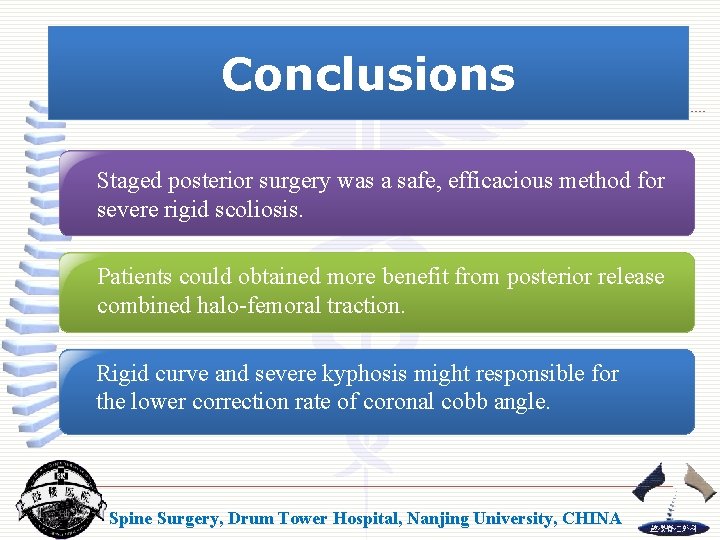
Conclusions Staged posterior surgery was a safe, efficacious method for severe rigid scoliosis. Patients could obtained more benefit from posterior release combined halo-femoral traction. Rigid curve and severe kyphosis might responsible for the lower correction rate of coronal cobb angle. Spine Surgery, Drum Tower Hospital, Nanjing University, CHINA
Thank you! Spine Surgery, Drum Tower Hospital, Nanjing University, CHINA