
ANTERIOR CIRCULATION ANEURYSMS AND SURGICAL CONSIDERATIONS INTRODUCTION Incidence











- Slides: 28
ANTERIOR CIRCULATION ANEURYSMS AND SURGICAL CONSIDERATIONS
INTRODUCTION Incidence of aneurysm difficult to estimate Prevalence 0. 2 -7. 9 % Half of the aneurysms ruptures Incidence of aneurysmal rupture is 6 -12 / 100, 000 Brain 2001; 124(Pt 2): 249– 78. Anterior circulation aneurysm van Gijn J, Rinkel GJ. Subarachnoid hemorrhage: diagnosis, causes and management.
INTRODUCTION Overall mortality at 6 months: 40% - 50% 15% of patients expire before reaching the hospital 25% die within 24 hours Only one third of those who survive have functional independent lives. Stroke 1997; 28: 660– 4. Rebleed has a catastrophic morbidity : 48% to 78% Treatment of a ruptured aneurysm: imperative. Jane JA, Winn HR, Richardson AE. The natural history of intracranial aneurysms: rebleeding rates during the acute and long term period and implication for surgical management. Clin Neurosurg 1977; 24: 176– 84. Anterior circulation aneurysm Hop JW, Rinkel GJ, Algra A, et al. Case-fatality rates and functional outcome after subarachnoid hemorrhage: a systematic review.
ANTERIOR CIRCULATION ANEURYSMS 86. 5% � Acom Anterior circulation aneurysm (30%) � Pcom(25%) � MCA bifurcation (20%). � ICA bifurcation (7. 5%) � Pericallosal /callosomarginal artery bifurcation (4%)
CLINICAL PRESENTATION Major rupture � SAH � IVH � Subdural blood Mass effect- cranial nerve palsy: � 3 rd nerve in PCOM � Chiasmal syndrome - ophthalmic, Acom Cranial neuropathy- giant aneurysm compressing brainstem Endocrine disturbance: sellar and suprasellar Anterior circulation aneurysm � ICH
CLINICAL PRESENTATION Worst headache of life Meningeal irritation LOC at the ictus Seizures in acute phase Focal neurologic abnormalities (25%) : hemiparesis, aphasia, hemineglect, cranial nerve palsies, memory loss Anterior circulation aneurysm
CLINICAL PRESENTATION Ocular haemorrhages (20 -40%) Hypertension Temperature elevation Tachycardia Anterior circulation aneurysm
SAH WORK-UP : CT SCAN Sensitivity decreases with respect to increased time from ictus: 95% within the first 48 hours 80% at 72 hours 50% at 1 week Intraparenchymal hemorrhage may occur with MCA and PCOM aneurysms Interhemispheric and intraventricular hemorrhages may occur with ACOM aneurysms Outcome is worse for patients with extensive clots in basal cisterns than for those with a thin diffuse hemorrhage Helps rule out HCP Falsely negative � � Small hemorrhages Severe anemia Anterior circulation aneurysm � � �
SAH WORK-UP : DSA Gold standard : 80 -85% sensitivity Surgical information: If negative (10 -20%): repeat test 3 -4 weeks later May be useful to evaluate for possible cerebral vasospasm 3 -D reconstruction: invaluabledome-to-neck ratio � parent artery or branch orientation to neck � enhances surgical view for clip placement and vessel reconstruction � Anterior circulation aneurysm Cerebrovascular anatomy, aneurysm location & source of bleeding � Aneurysm size/shape/orientation of dome and neck � Relation to the parent/perforating arteries �
SAH WORK-UP : CTA Anterior circulation aneurysm Reported to detect aneurysms larger than 3 mm Sensitivity of 95% and 83% specificity. Provide sufficient anatomic detail especially relation to nearby bony structure.
SAH WORK-UP: MRA Can detect aneurysms >3 mm with 86% sensitivity Useful the status of small, un ruptured aneurysms � Evaluate the degree of intramural thrombus in giant aneurysms � Screening high risk patients: including 1 st degree relative of patients with IC aneurysm False +ve 16% Anterior circulation aneurysm � Monitoring
UN-RUPTURED ANEURYSMS: WHY TREATMENT ISUIA trial. N Engl J Med 1998; 339: 1725 -33 Anterior circulation aneurysm Risk of SAH is 0. 05 -6 % each year 50 % rupture : fatal Increase in size >1 cm increases the risk 11 fold
TIMING OF SURGERY Anterior circulation: early surgery has good results. Stroke 23: 205 -214; 1992 Anterior circulation aneurysm Haley EC jr et al the international cooperative study on the timing of aneurysm surgery; the north American experience.
ISAT TRIAL (LANCET 2005; 360: 1267 -75) � Relative and absolute risk reduction in dependency or death is 22. 6 vs 6. 9 % in surgical and endovascular group � survival free of disability at 1 year is significantly better with coiling is more likely to result in independent survival at 1 year than clipping; the benefit continues for at least 7 years Risk of rebleed was higher in endovascular group at one year Anterior circulation aneurysm Prospective, randomized, controlled trial N = 2143 (ruptured intracranial aneurysms) The safety of endovascular coiling compared with clipping Mortality or disability was 30. 6 Vs 23. 7 in surgical and endovascular group at one year (p=0. 0019)
SURGICAL APPROACHES (ACA AND ACOM) Pterional craniotomy � usual Subfrontal approach � useful for superiorly pointing aneurysm when there is a large amount of frontal blood clot Anterior interhemispheric approach � contraindicated for anteriorly pointing aneurysms as the dome is approached first Trancallosal approach Anterior circulation aneurysm approach
PTERIONAL CRANIOTOMY (GOLD STANDARD) Disadvantages: Temporalis muscle wasting Significant retraction on frontal lobe Need to open the sylvian fissure, which may be difficult in some case (Fischer grade III & IV) Anterior circulation aneurysm
CHOICE OF SIDE OF THE CRANIOTOMY A right Pterional craniotomy is used with the following exceptions: ACom aneurysm pointing to the right � Dominant left A 1 feeder to aneurysm (with no filling from the right A 1) � Additional left sided aneurysm Anterior circulation aneurysm � Large
OPERATIVE APPROACH (DACA) Right anterior frontal Parasaggital craniotomy for the interhemispheric approach Anterior circulation aneurysm
OPERATIVE APPROACH (MCA) Medial trans-sylvian approach For patients with short M 1 segment, aneurysm arises from the proximal M 1 trunk or have a complicated configuration with increased risk of rupture Superior temporal Gyrus approach Advocated by Heros; For aneurysms A/W ICH The aneurysm is exposed through the hematoma cavity in the sup temporal gyrus Anterior circulation aneurysm Lateral trans‐sylvian approach For the unruptured and uncomplicated MCA bifurcation aneurysm Exposes the dome first
INTRACAVERNOUS AND PARACLINOID ANEURYSM • Female : male = 9: 1 • 5 -6 th decade • incidental lesions/ mass effect • multiplicity Anterior circulation aneurysm 3 types: • Cavernous segment • Clinoidal segment • Opthalmic segment
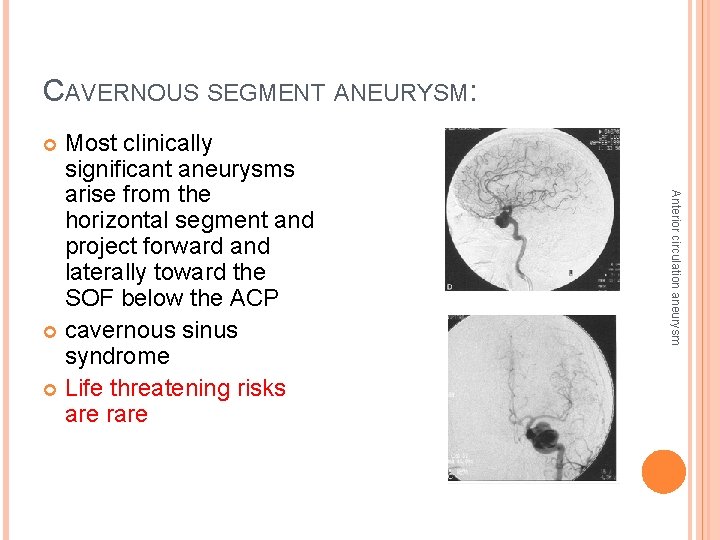
CAVERNOUS SEGMENT ANEURYSM: Most clinically significant aneurysms arise from the horizontal segment and project forward and laterally toward the SOF below the ACP cavernous sinus syndrome Life threatening risks are rare Anterior circulation aneurysm
CLINOIDAL SEGMENT ANEURYSM: Medial variant (can resemble superior Hypophyseal artery aneurysm ): Enlargement into the pituitary fossa Hypopituitarism, may simulate Pituitary apoplexy, epistaxis. Anterior circulation aneurysm Anterolateral variant (can resemble ophthalmic artery aneurysm): erode ACP Monocular visual loss Large ones can compress optic chiasm
OPHTHALMIC SEGMENT ANEURYSM: Superior Hypophyseal artery aneurysm Arise from the inferomedial surface, burrow inferiorly below the diaphragm sella, expanding the carotid cave k/a parasellar variant Suprasellar variant has secondary suprasellar extension Dorsal variant Ophthalmic segment aneurysm Anterior circulation aneurysm Ophthalmic artery aneurysm Project dorsally compressing the Optic nerve Monocular nasal field defect is produced due to superolateral compression of ON against falciform ligament
OPERATIVE TECHNIQUES Anterior circulation aneurysm Proximal control is obtained at the cervical ICA before craniotomy for the giant or complicated aneurysms or for ruptured clinoid segment lesions.
COMPLICATIONS OF PARACLINOID ANEURYSM SURGERY Delayed ICA stenosis or thrombosis Visual deterioration III, IV, VI and miosis CSF rhinorrhea Anterior circulation aneurysm
PCOM ANEURYSM 50% of the ICA aneurysm Females SAH with a lateral suprasellar and ambient cistern pattern Intraparenchymal haemorrhage into the uncus of the temporal lobe, intraventricular haemorrhage into the temporal horn or haemorrhage into the subdural space can also occur Non pupil sparing occulomotor palsy Anterior circulation aneurysm
ICA BIFURCATION ANEURYSM SAH May present with intraparenchymal haemorrhage into the basal ganglia simulating the hypertensive bleed May enlarge to giant size and compress the optic apparatus Anterior circulation aneurysm
THANK YOU