
Antenna Structure Registration and the Environmental Notification Process
- Slides: 25
Antenna Structure Registration and the Environmental Notification Process Jennifer Flynn FCC/WTB/CIPD October 12, 2018
What is Antenna Structure Registration? • In order to promote air safety and the efficient use of navigable air space, the FAA requires notice of any proposed construction or alteration that may affect navigable air space. • The Antenna Structure Registration (ASR) program requires owners of antenna structures to register with the FCC any antenna structure that requires notice to the FAA due to physical obstruction. • The ASR system is an online system that stores the location, height, marking and lighting, and other information on all antenna structures that are registered with the FCC. • In general, this includes structures that are taller than 200 feet above ground level or that may interfere with the flight path of a nearby airport. • The FCC’s antenna structure registration, marking and lighting rules are located in Part 17 of the FCC's rules.
What is Environmental Notification? • In a 2011 Order, the Commission adopted procedural measures to ensure, consistent with the Commission’s obligations under federal environmental statutes, that environmental effects of proposed communications towers are fully considered prior to construction. • The environmental notification process is codified at 47 CFR Sec. 17. 4(c). • The environmental notification process applies to new tower applications in the ASR system and to certain applications for modification of registered towers that may have a significant environmental effect.
Overview: ASR and Environmental Notification • Part 1: • • Submit a partially completed ASR application (FCC Form 854) and obtain ASR application number Use ASR application number to provide local public notice Set national public notice date in ASR to begin on or after the local public notice date The national notice date commences the 30 -day comment period to give the public opportunity to file a request for further environmental review. • Pleadings • If a Request for Further Environmental Review is received, complete pleading cycle • The Bureau determines whether an environmental assessment (EA) is required • The submission of an EA restarts the 30 -day comment period • Part 2 • May be completed only after any and all requests and Bureau concerns are resolved • Amend ASR application to include FAA Study number and issue date • Certify that the tower will have no significant environmental impact
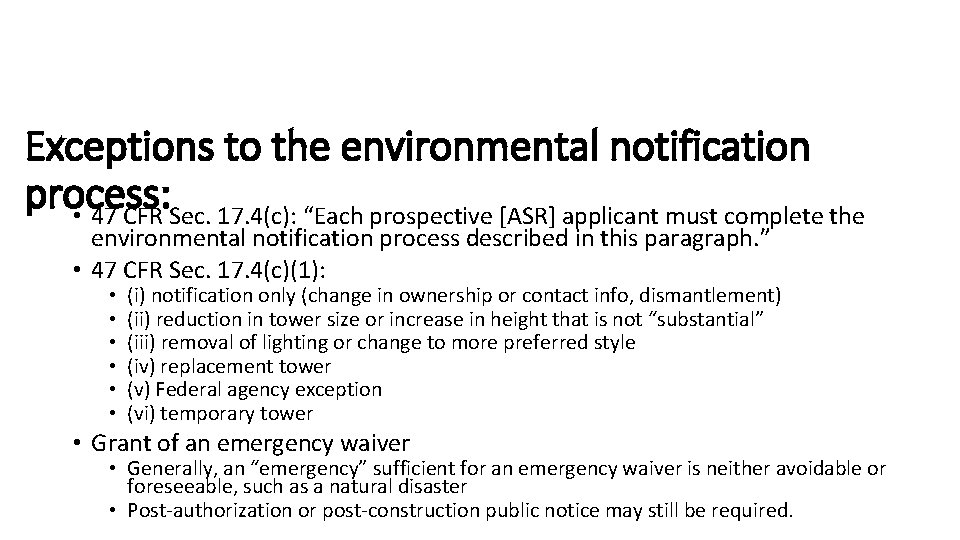
Exceptions to the environmental notification process: • 47 CFR Sec. 17. 4(c): “Each prospective [ASR] applicant must complete the environmental notification process described in this paragraph. ” • 47 CFR Sec. 17. 4(c)(1): • • • (i) notification only (change in ownership or contact info, dismantlement) (ii) reduction in tower size or increase in height that is not “substantial” (iii) removal of lighting or change to more preferred style (iv) replacement tower (v) Federal agency exception (vi) temporary tower • Grant of an emergency waiver • Generally, an “emergency” sufficient for an emergency waiver is neither avoidable or foreseeable, such as a natural disaster • Post-authorization or post-construction public notice may still be required.
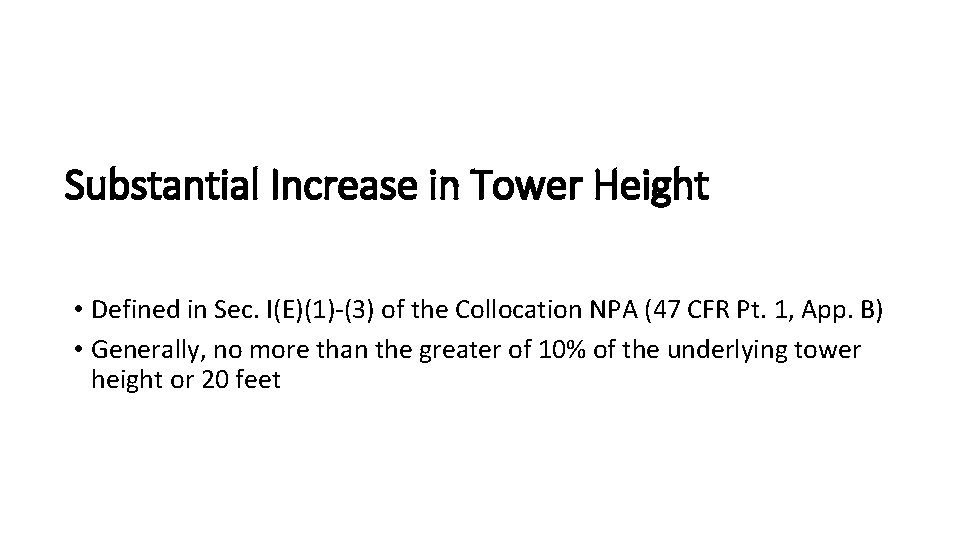
Substantial Increase in Tower Height • Defined in Sec. I(E)(1)-(3) of the Collocation NPA (47 CFR Pt. 1, App. B) • Generally, no more than the greater of 10% of the underlying tower height or 20 feet
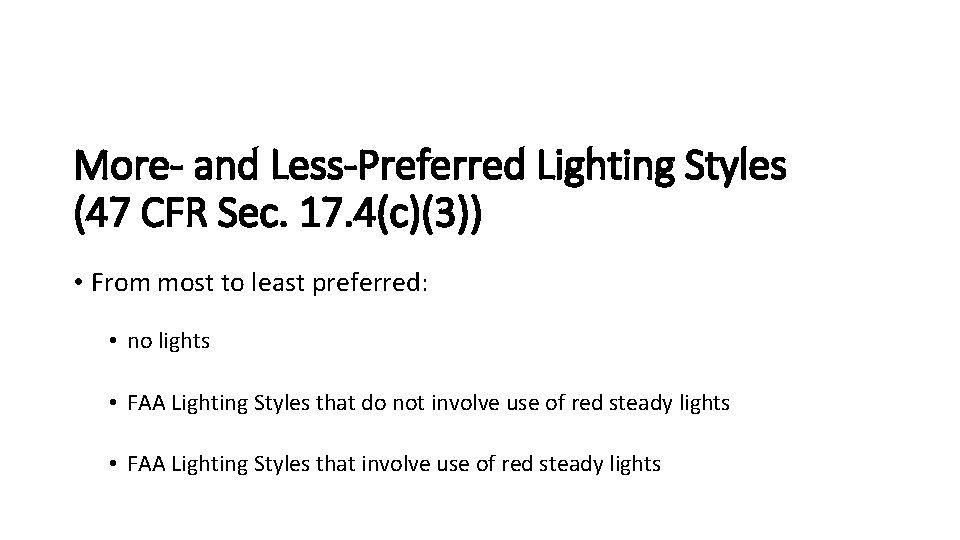
More- and Less-Preferred Lighting Styles (47 CFR Sec. 17. 4(c)(3)) • From most to least preferred: • no lights • FAA Lighting Styles that do not involve use of red steady lights • FAA Lighting Styles that involve use of red steady lights
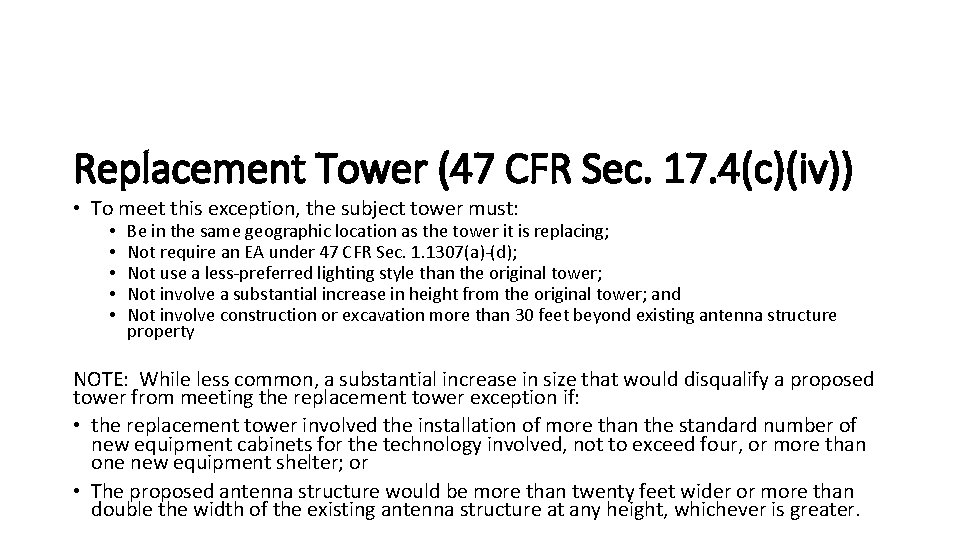
Replacement Tower (47 CFR Sec. 17. 4(c)(iv)) • To meet this exception, the subject tower must: • • • Be in the same geographic location as the tower it is replacing; Not require an EA under 47 CFR Sec. 1. 1307(a)-(d); Not use a less-preferred lighting style than the original tower; Not involve a substantial increase in height from the original tower; and Not involve construction or excavation more than 30 feet beyond existing antenna structure property NOTE: While less common, a substantial increase in size that would disqualify a proposed tower from meeting the replacement tower exception if: • the replacement tower involved the installation of more than the standard number of new equipment cabinets for the technology involved, not to exceed four, or more than one new equipment shelter; or • The proposed antenna structure would be more than twenty feet wider or more than double the width of the existing antenna structure at any height, whichever is greater.
Other Federal Agency Exception (47 CFR Sec. 17. 4(c)(1)(vi)) • Construction, modification, or replacement of an antenna structure • On Federal land, where another Federal agency has assumed responsibility for determining whether the facilities in question will have a significant effect on the quality of the human environment and, if it will, for invoking the environmental impact statement process, or • Where another Federal agency has assumed the same responsibility pursuant to a written agreement with the Commission (see 47 CFR Sec. 1. 1311(e))
Temporary Tower Exception (47 CFR Sec. 17. 4(c)(1)(vii)) • To meet this exception, the proposed tower must: • • • Be in place for no more than 60 days, Require notice of construction to the FAA, Not require marking or lighting under FAA regulations, Be less than 200 feet in height above ground level, and Involve no excavation or excavation only where the depth of previous disturbance exceeds the proposed construction depth (excluding footings and other anchoring mechanisms) by at least two feet. • Additionally, an applicant must wait 30 days after removal of a temporary antenna structure deployed pursuant to this exception before relying on this exception again to deploy another antenna structure covering substantially the same service area.
ASR Application Requiring Environmental Notification • Information required upfront: • • Ownership information such as name, address, and phone number; Contact information such as name, address, and phone number; Antenna structure information such as the location, height, and type of structure; Proposed marking and/or lighting; Whether another federal agency is taking responsibility for the environmental review; The national notice date; and Whether an Environmental Assessment (EA) is included.
FAA No Hazard Determination / Study # • Not required to file an ASR application • Not required to commence the environmental notification process • However, the lighting and marking description contained in both the local and national public notices must be accurate. • If the FAA requires different lighting and/or marking than that described in public notice, public notice must be redone. • Because national notice cannot precede local public notice, if only the local public notice contained incorrect information, both would have to be redone. • An ASR application will not be granted without a valid FAA Study #.
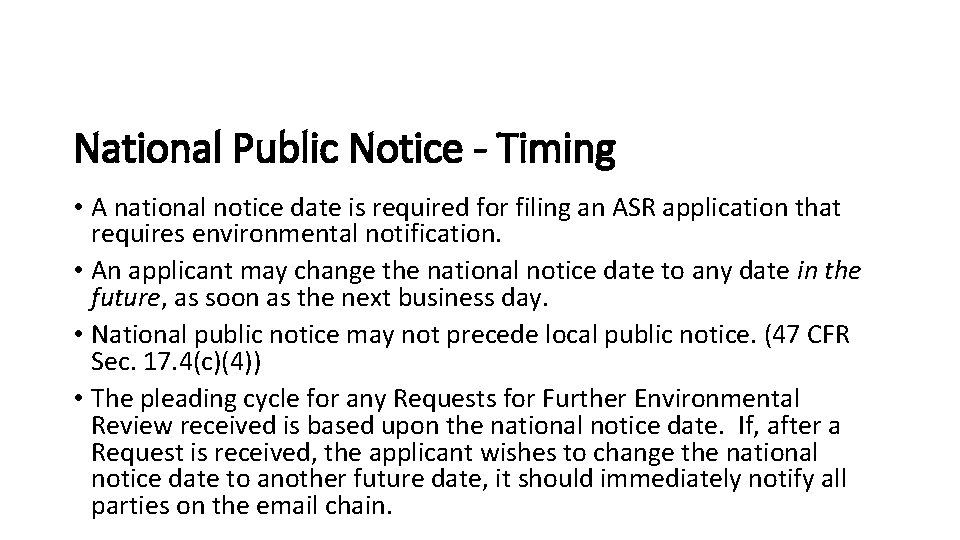
National Public Notice - Timing • A national notice date is required for filing an ASR application that requires environmental notification. • An applicant may change the national notice date to any date in the future, as soon as the next business day. • National public notice may not precede local public notice. (47 CFR Sec. 17. 4(c)(4)) • The pleading cycle for any Requests for Further Environmental Review received is based upon the national notice date. If, after a Request is received, the applicant wishes to change the national notice date to another future date, it should immediately notify all parties on the email chain.
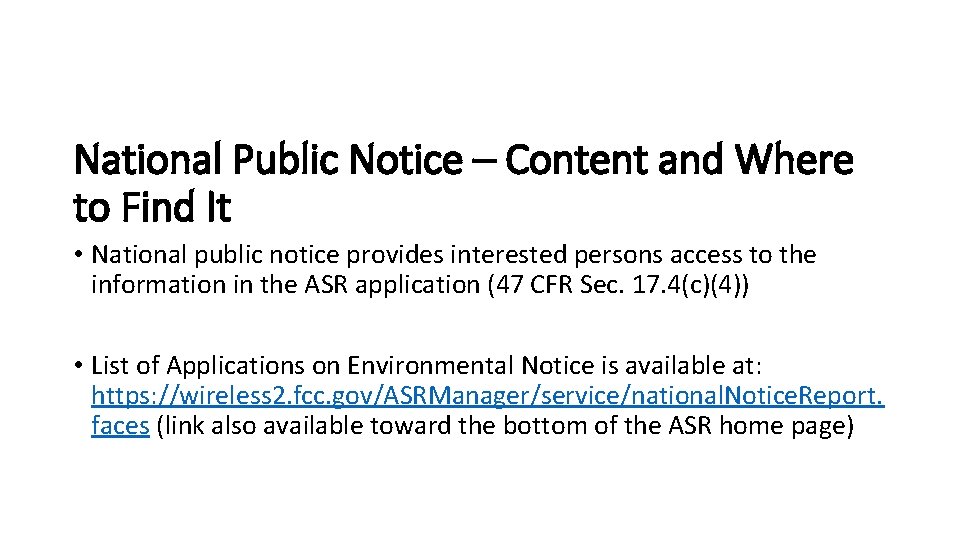
National Public Notice – Content and Where to Find It • National public notice provides interested persons access to the information in the ASR application (47 CFR Sec. 17. 4(c)(4)) • List of Applications on Environmental Notice is available at: https: //wireless 2. fcc. gov/ASRManager/service/national. Notice. Report. faces (link also available toward the bottom of the ASR home page)
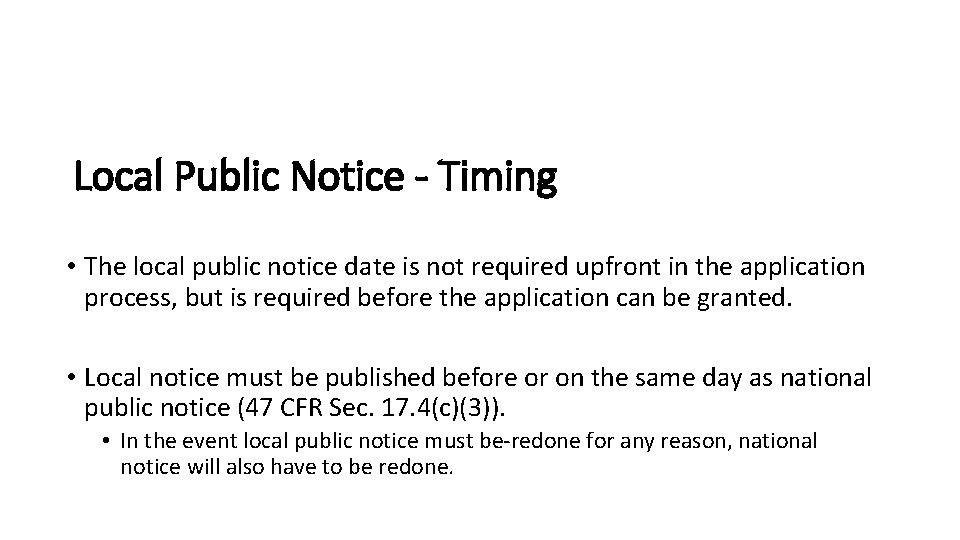
Local Public Notice - Timing • The local public notice date is not required upfront in the application process, but is required before the application can be granted. • Local notice must be published before or on the same day as national public notice (47 CFR Sec. 17. 4(c)(3)). • In the event local public notice must be-redone for any reason, national notice will also have to be redone.
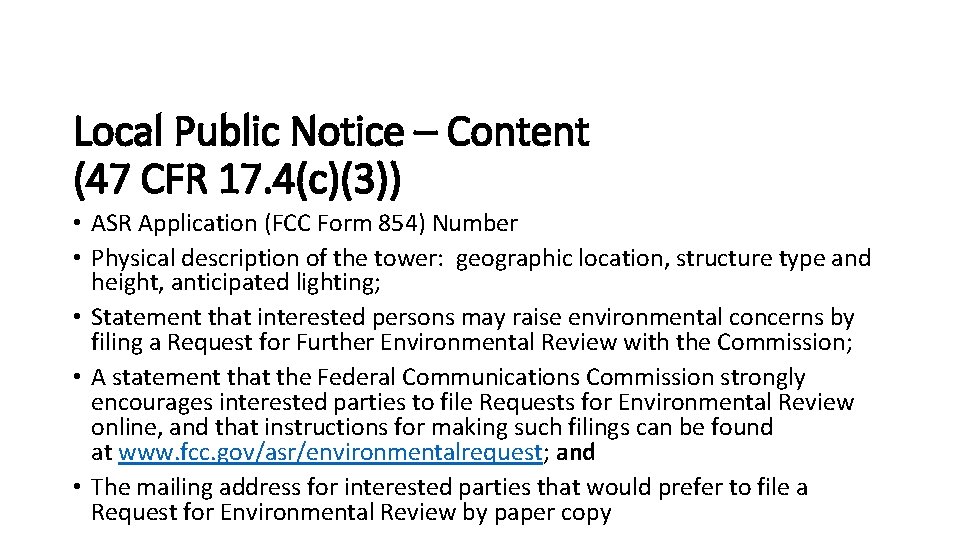
Local Public Notice – Content (47 CFR 17. 4(c)(3)) • ASR Application (FCC Form 854) Number • Physical description of the tower: geographic location, structure type and height, anticipated lighting; • Statement that interested persons may raise environmental concerns by filing a Request for Further Environmental Review with the Commission; • A statement that the Federal Communications Commission strongly encourages interested parties to file Requests for Environmental Review online, and that instructions for making such filings can be found at www. fcc. gov/asr/environmentalrequest; and • The mailing address for interested parties that would prefer to file a Request for Environmental Review by paper copy
Combining Local Public Notices • Local public notice is required as part of both the Commission’s environmental notification process and its Section 106 (National Historic Preservation Act) review • Applicants may publish one local public notice for both, as long as the notice contains all the required elements of both review processes. • Sec. (V)(C) of the NPA for Historic Preservation Review (47 CFR Pt. 1, App. C) requires the following elements in local public notice: • 1. location of the proposed facility including street address; • 2. a description of the proposed facility, including type and height; • 3. instructions on how to submit comments regarding potential effects on Historic Properties; and • 4. the name, address, and phone number of a contact person.
Beware of alleged (and usually fee-based) local public notice websites! • As we have noted on our website: • Providing notice on a website that is not both specifically local and wellknown to members of the public as being the equivalent of “a newspaper of general circulation or other appropriate means, such as through the public notification provisions of the relevant local zoning process” does NOT satisfy the local public notice requirement contained in the Commission’s environmental notification rule. See 47 CFR § 17. 4(c)(3).
Requests for Further Environmental Review – Pleading Cycle (47 CFR Sec. 17. 4(c)(5), (c)(5)(i)) • The pleading cycle is based on the national notice date. • Once a Request for Further Environmental Review is received, applicants should inform the Bureau and any and all requesters immediately if it wishes to change the national notice date on its application. • Requests for Further Environmental Review are due 30 days after the national notice date (if day 30 is a weekend or holiday, deadline is bumped to the next business day) • Oppositions to Requests due 10 days later (if day 10 is a weekend or holiday, deadline is bumped to the next business day) • Replies to Oppositions are due 5 business days later – weekends and holidays are not counted
Requests for Further Environmental Review – Content (47 CFR Sec. 17. 4(c)(5)(ii)) • Must state why either • the interested person or entity believes that the proposed antenna structure or physical modification of an existing antenna structure may have a significant impact on the quality of the human environment for which an Environmental Assessment must be considered by the Commission as required by § 1. 1307 of this chapter; or • an EA submitted by the prospective ASR applicant does not adequately evaluate the potentially significant environmental effects of the proposal. • Must be submitted as a written petition (either electronically or by hard copy) • Must set forth in detail reasons supporting the requester’s contentions
The Last Step – Part 2 Certification • May not be submitted until: • All environmental review is completed, including Section 106 and TCNS processes; and • All Requests for Further Environmental Review have been resolved by the Bureau • How can I tell if my application is ready for Part 2 Certification? • To check if the application is ready for the Part Two Certification, Log in to ASR Online Filing (https: //wireless 2. fcc. gov/ASRManager/login. faces) with your FCC Registration Number (FRN) and password. From the Antenna Structure Registration Dashboard, click the My Applications tab. On the Application Manager page click on the Env. Certification tab. The application file number will appear here if it is ready for certification. • Do not attempt to complete Part 2 Certification prematurely.
Could I have to do an environmental notification again for the same facility? • In some cases, the answer is yes: • Defects in prior public notice, such as missing or inaccurate content or publishing national public notice before local public notice • Some amendments to pending ASR applications • Some modifications to registered towers
Amendments to Pending ASR Applications (47 CFR 17. 4(c)(6)) • New environmental notification must be done for all other changes to the physical structure, lighting, or geographic location data, including: • • Addition of an environmental assessment Any change in structure type or coordinates Any increase in tower height Any change to a less-preferred lighting style, including the addition of lights when there previously was none. • No new environmental notification required for: • Reduction in height for a proposed new or modified antenna structure • Proposed lighting is removed or changed to an equally preferred or more preferred lighting style • Purely administrative changes
Modifications to Existing Registrations • Major modifications to registered towers require environmental notification: • Substantial increase in height • Submitting an environmental assessment • Changing the registered lighting to a less-preferred lighting style • Minor modifications do not require environmental notification: • • • Administrative Changes Updating the FAA Study Number Correcting Coordinates (The tower is not physically moving) Lowering the Overall AGL Height Changing registered lighting to a more preferred lighting style
Service-specific Applications and the Environmental Notification Process • To accommodate the environmental notification process, you now have two options when filing a service-specific license application on the FCC Form 601 (Form 601) in the Universal Licensing System (ULS) for an antenna structure that also requires registration in the ASR system: • You can provide the ASR Registration Number on the Form 601, if the Form 854 application has already been granted; or • If the Form 854 application has not yet been granted, you can provide the ASR File Number on the Form 601 if the following conditions are met: • You obtained an FAA No Hazard Determination and included the FAA Study Number on the Form 854; • You provided local notice of the proposed antenna structure; and • The proposed tower has been posted on the FCC's website pursuant to the environmental notification process.